


RBH Sound MC-6C Bookshelf Speaker Review
- Product Name: RBH Sound MC-6C Bookshelf Speaker
- Manufacturer: RBH
- Performance Rating:


- Value Rating:
- Review Date: May 29, 2007 20:00
- MSRP: $ 849/pr
| Frequency range +/- 3 dB Sensitivity (2.83V/1m) Nominal impedance Recommended amp power Crossover frequency Tweeter driver Low frequency driver(s) Enclosure type Connection input(s) Recommended placement Dimensions (H x W x D) Weight Finish |
60Hz - 20kHz±3dB 86.0 dB 8 ohms 50– 120 watts 3 kHz 1” Aluminum Dome 6 ½” Aluminum Sealed Single Wire Stand, shelf, on wall (via wall mount kit) 12 ½” H x 7 ¾” W x 8 ¾” D 17 lbs/ea Black |
Pros
- Excellent sound quality
- Superb midrange performance
- Won’t bottom out
Cons
- Molded baffle design making speakers not field serviceable
MC-6C Speaker Introduction and Design Overview
 One of my
first introductions to RBH Sound was when I took a leap of faith and ordered
their TS-10A subwoofer. This was before
Audioholics existed and I was just breaking into the audio scene. Prior to getting the TS-10A, I never experienced
a really good sounding sub and the others I demoed in my home simply didn’t do
it for me. I recall the thrill the
TS-10A gave me NOT solely because of its ability to belt out LOUD SPL, but
because of its musicality in doing it.
Shortly after, I had RBH send me a pair of their original MC-6C
bookshelf speakers to evaluate. I hooked
them into my system and gave them a listen.
While I enjoyed their forward presentation while listening to percussion
instruments, I felt they were lacking in upper extension and overall transparency. My reference speakers at the time walked all
over them, so I sent them packing. It
wasn’t until RBH Sound sent me a pair of their Status Acoustics Decimo’s that I
truly became a believer in their speakers.
To this day (nearly 7 years later), I still use them to judge all other
bookshelf speakers against and so far, not one pair has been able to dethrone
them.
One of my
first introductions to RBH Sound was when I took a leap of faith and ordered
their TS-10A subwoofer. This was before
Audioholics existed and I was just breaking into the audio scene. Prior to getting the TS-10A, I never experienced
a really good sounding sub and the others I demoed in my home simply didn’t do
it for me. I recall the thrill the
TS-10A gave me NOT solely because of its ability to belt out LOUD SPL, but
because of its musicality in doing it.
Shortly after, I had RBH send me a pair of their original MC-6C
bookshelf speakers to evaluate. I hooked
them into my system and gave them a listen.
While I enjoyed their forward presentation while listening to percussion
instruments, I felt they were lacking in upper extension and overall transparency. My reference speakers at the time walked all
over them, so I sent them packing. It
wasn’t until RBH Sound sent me a pair of their Status Acoustics Decimo’s that I
truly became a believer in their speakers.
To this day (nearly 7 years later), I still use them to judge all other
bookshelf speakers against and so far, not one pair has been able to dethrone
them.
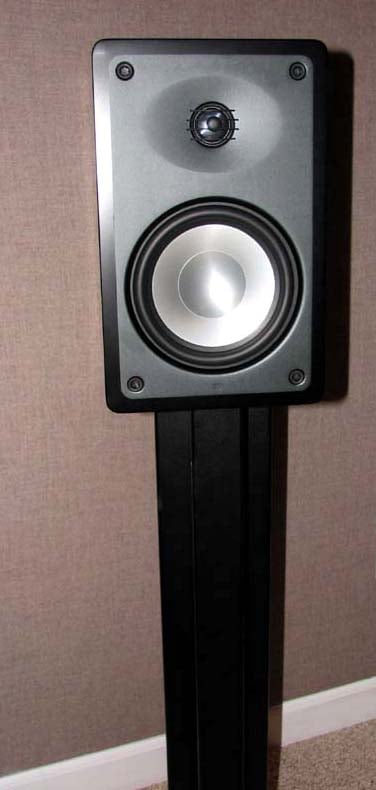
RBH Sound’s chief engineer Shane Rich was unwilling to accept defeat. Never staying complacent, he was looking to improve the sound quality of these speakers and hence the Mark II version of these speakers was born. The MC-6C remains a two way sealed bookshelf design, just like its predecessor. Gone however are the cheesy swivel dome tweeters of yesteryear, now replaced with a new 1” fixed aluminum dome waveguide tweeter on their new RDAB (Resonance Damping Alloy Baffle) baffle system. Sounds fancy huh? According to RBH, RDAB reduces cabinet resonance to improve sound quality, most notably in the critical midrange frequencies. Doing a knuckle test on the cabinet and baffle, it made a deadening thud demonstrating the cabinet was indeed very inert. Ok so at first glance, the new MC-6C appears to be quite an improvement over the original design. But, will the sound quality live up to my expectations of what an RBH speaker should sound like, or will I send this speaker packing like I did the last time I heard them? Read on to find out….
Build Quality
RBH Sound products have always received high marks from us in the build quality department. There is good reason for this. They don’t skimp on driver components or parts. The cabinets are constructed from ¾” MDF and are overstuffed with high quality Dacron insulation. The drivers are recessed into the MDF baffle as any good speaker should be. Then the RDAB baffle completely covers the driver baskets and screws adding a nice finishing touch to the aesthetics of the product. The grilles are framed with MDF instead of cheap plastic and utilize very attractive aluminum pegs that make for excellent contact with the cabinet. There are no discernable seams or edges in the cabinet's and they came finished in a beautiful black oak veneer are high quality textured veneers.
Unfortunately because of the molded baffle design, I was unable to pull the drivers out for some real photo ops. I did manage to take the back speaker terminal plate off to examine the crossover and heavy cabinet insulation and requested a picture of the woofer driver from RBH Sound to use in this review. Should this speaker ever require servicing, RBH would likely have to simply replace it as it cannot easily be taken apart. With a 5 year warranty from a highly reputable company, I don’t foresee this as being a major issue.
The Woofer
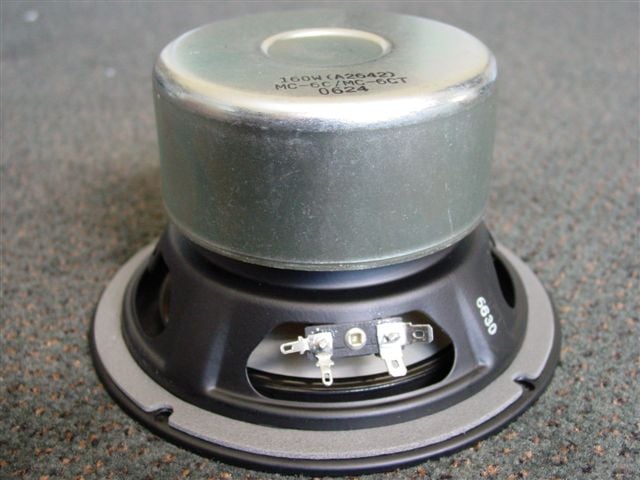
The 6 ½” aluminium cone woofer is very similar to the driver used in their Signature Series except the basket is stamped rather than cast aluminum. While this is certainly a design compromise over a good ole cast basket, it’s an understandable one. Let’s not also forget so many speakers from other brands exclusively use stamped baskets on even their most elaborate designs. RBH Sound still employed many of their tricks from their Signature line woofers including bumped backplate on the magnets, polyimide film voice coil formers for higher power handling, silicone coated aluminum cones and butyl rubber surrounds to minimize resonance and ringing. Also note this driver is fully shielded and the magnet structure is encased in a metal can to reduce any stray fields. Many manufacturers tend to skimp here and only provide the opposing magnet without the metal can.
Tweeter
The 1” aluminum dome tweeter employed in the MC line
is a completely new tweeter for RBH Sound.
The driver utilizes a waveguide to control dispersion for optimal off
axis response, and has a rubber surround to allow for longer excursions so it
can play lower in frequency for better integration with the woofer driver.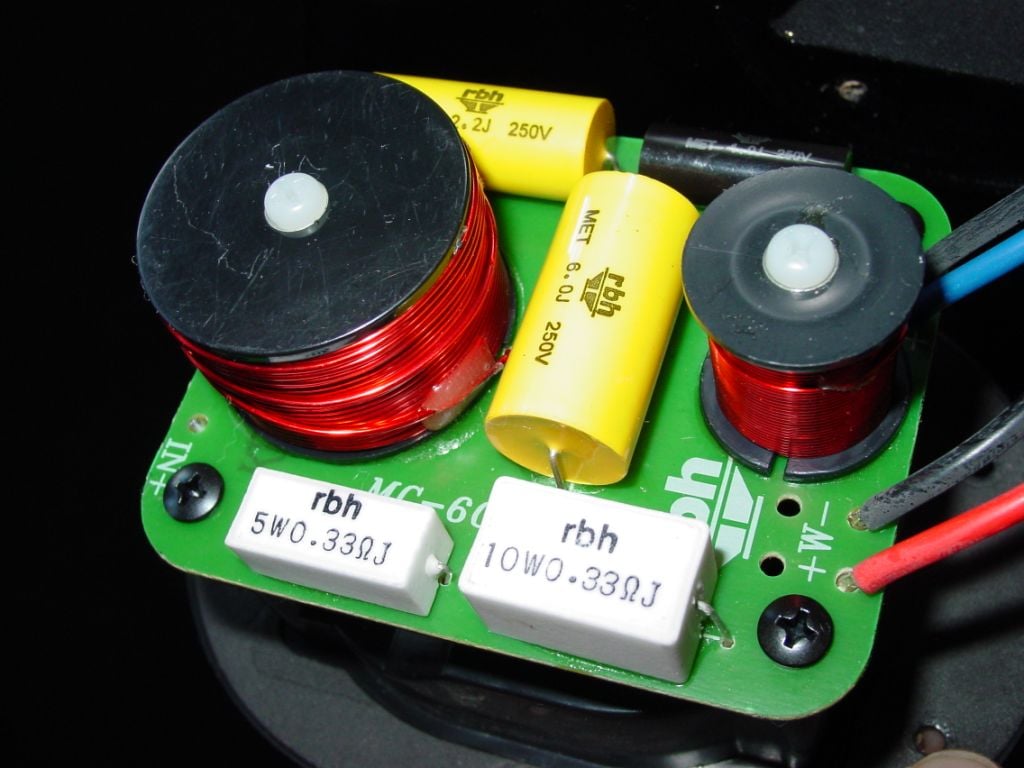
Crossover
As usual, RBH doesn’t skimp here like so many other manufacturers do. You won’t find any cheap electrolytic caps in series with the tweeter. Instead you will find audiophile polypropylene capacitors, ceramic resistors and air core inductors.
The speaker design relies on the electrical crossover network and natural acoustical roll off of the drivers which the overall response can be best described as a 2nd order Linkwitz-Riley design which produces a -6 dB crossover point to achieve a maximally flat amplitude response.
The Backside
The MC-6C has a very clean back end. RBH employs a 5-way gold plated binding post utilizing indented terminal lugs. I am not the biggest fan of these binding posts since they can be quite challenging to turn on thick gauge wire as they are closely located. Personally, I use compression banana plug terminations so it becomes a moot point. The completely rounded cabinets look great at any angle but, of course, look sexiest from the front because of the shiny aluminum drivers and molded baffle.

RBH MC-6C Back View
MC-6C Speaker Setup and Listening Tests
I placed the MC-6C’s on my 30” sand-filled Plateau speaker stands which puts the tweeter right at about ear level on my Continental theater seats. The speakers were positioned about 5ft from side and back walls and spread apart about 10ft from each other which was roughly the distance from my primary listening position. After experimenting, I found they sounded their best with a slight toe-in, adding more focus and tightening up the soundstage without sounding bright. I used the Emotiva Reference Theater Series preamp and processor, the Denon DVD-5910CI as the source with my trusty Status Acoustics Decimo’s reference bookshelf speakers and Dali Mentor 1’s on hand for comparison. All cables were furnished by Impact Acoustics (Sonicwave toslink) and Bluejeans Cable (10AWG speaker cable and analog interconnects).
Listening Tests
CD: Pat Metheny – We Live Here
 If you
haven’t figured it out by now, I am a huge Pat Metheny fan and strongly feel that
long after his time, he will be remembered as one of the greatest jazz
guitarists ever. I selected We Live Here not only because of its
significant musical content, but because it’s a well recorded CD that really
can give a speaker system quite a workout.
If you
haven’t figured it out by now, I am a huge Pat Metheny fan and strongly feel that
long after his time, he will be remembered as one of the greatest jazz
guitarists ever. I selected We Live Here not only because of its
significant musical content, but because it’s a well recorded CD that really
can give a speaker system quite a workout.
In track #3 “The Girls Next Door,” the cymbals had a lot of air to them, while the persistent cha-ching sound of Paul Wertico’s stick work was highly detailed and focused though not quite as much as I’ve heard on my Decimos and especially the Dali Mentor 1’s. While the Dali’s were clearly the most revealing speakers of the group for high frequencies, they lacked in the critical midrange area. In comparison, Pat’s guitar carried much more presence and realism on the significantly less expensive RBH MC-6C’s. The MC-6C’s set up a nice 3 dimensional soundstage placing the guitars left of dead center and back. I heard a very prominent stereo effect in the guitars that I didn’t hear on the Dali’s. In track #8 “Red Sky”, the sound was very open and expansive. Piano had a genuine tonal signature, similar to that I experienced on my Decimos. You could delineate the type of pickups in Pat’s guitars. Bass was well controlled and tight and regardless of how loudly I played these speakers, they didn’t bottom out or falter on dynamic passages.
CD: Steely Dan – Two Against Nature
 I was quite pleased when Steely Dan beat out all of
the gangster rap so called “artists” and won a Grammy at the music awards for
this CD. Finally a band won because of
its musical talent and not because they were hip on MTV. Two Against Nature not only contains musical content worthy of the
name Steely Dan, but also exists as a reference quality recording that any
audiophile should have in their collection. Track #1 “Gaslighting
Abbie” demonstrated the MC-6C’s excellent imaging abilities with clear
separation of instrumentals and with the vocals of Donald Fagen pinned dead
center as they should be. I found a
slight toe-in improved the focus of these speakers without shifting the tonal
balance or making them sound bright as so many other speakers tend to.
I was quite pleased when Steely Dan beat out all of
the gangster rap so called “artists” and won a Grammy at the music awards for
this CD. Finally a band won because of
its musical talent and not because they were hip on MTV. Two Against Nature not only contains musical content worthy of the
name Steely Dan, but also exists as a reference quality recording that any
audiophile should have in their collection. Track #1 “Gaslighting
Abbie” demonstrated the MC-6C’s excellent imaging abilities with clear
separation of instrumentals and with the vocals of Donald Fagen pinned dead
center as they should be. I found a
slight toe-in improved the focus of these speakers without shifting the tonal
balance or making them sound bright as so many other speakers tend to.
The MC-6C’s portrayed nice air in the triangle instrument in Track #3 “Two Against Nature”. The bass was tight and the reverb in the clap percussion was right on. The Dali’s were more revealing in the upper treble, but the clap percussion on them seemed almost dead when directly compared to the RBH’s. The RBH tweeters maintained their composure even at high listening levels. It didn’t take me long to realize that the MC-6C’s had some of the best sounding metal dome tweeters I have heard in speakers, regardless of price. Not since our review of the Canton Karat reference speakers which sold for considerably more, have we heard metal dome tweeters sound this clean and free of distortion or stress.
I cranked up Track #4 “Janie Runaway” to see what these speakers were made of. I recorded SPL levels of 96dB at the listening position 12ft from the speakers in my 6,000ft^3 room. Trumpets were slightly forward sounding and came off crystal clean. Not once did the woofers bottom, nor did the speakers sound like they were running out of gas. This is a tribute to their sealed design and excellent woofer driver. In comparison, I quickly switched over to the Dali Mentor 1’s that have the same sensitivity but are a ported design and utilize a slightly smaller woofer. They immediately bottomed out and I swiftly reduced the volume as I felt the woofers were literally going to pop out of the cabinet. This taught me something important about speaker design. With speakers, and especially subs, there are two critical parameters a designer must consider, extension and SPL. In a bookshelf type product, if you go after more extension like Dali did, then you ultimately sacrifice SPL. RBH decisively chose SPL, purposely rolling off the bass response in consideration that the user would pair these speakers with a subwoofer. In my opinion this was the better choice. The MC-6C’s had plenty of extension to play down in the 60Hz range making it easy to blend with a subwoofer. Best of all, you can still run them full range without fear of bottoming or distressing the woofers since the design of the speaker naturally rolls off the bottom end much like a THX certified speaker system does.
CD: Dianne Reeves – Never Too Far
 I almost always throw this CD into my reviews because
it tests so many capabilities of a hi-fi system and the musical content is
quite enjoyable. In track #4 “How Long”,
Dianne’s voice didn’t have a lispy sound to it like I’ve heard on many speaker
systems. Instead her vocals remained
clear, and percussions sounded great, though the bottom octave of bass in the
track was extremely anemic. If you are
running these speakers for mostly two channel duties, I strongly suggest stereo
subs placed in close proximity to the speakers equidistant from the listening
position.
I almost always throw this CD into my reviews because
it tests so many capabilities of a hi-fi system and the musical content is
quite enjoyable. In track #4 “How Long”,
Dianne’s voice didn’t have a lispy sound to it like I’ve heard on many speaker
systems. Instead her vocals remained
clear, and percussions sounded great, though the bottom octave of bass in the
track was extremely anemic. If you are
running these speakers for mostly two channel duties, I strongly suggest stereo
subs placed in close proximity to the speakers equidistant from the listening
position.
I again pushed the MC-6’s hard with Track #2 “Never Too Far” and they never faltered. These speakers had something to prove to me. It seems they wanted to decompose all of my preconceptions that they would be no better than their predecessors. I had to acquiesce as I was clearly proven wrong.
CD: Dire Straits – Brothers in Arms
 This is an
old recording, but a classic musically and a marvel sonically. Nearly 22 years old, this recording has stood
the test of time and is a must have for any music lover that also values high
quality fidelity to show off their speaker system.
This is an
old recording, but a classic musically and a marvel sonically. Nearly 22 years old, this recording has stood
the test of time and is a must have for any music lover that also values high
quality fidelity to show off their speaker system.
Track #4 “Your Latest Trick”, the saxophone was right in your face, as it should be, when listening to it on the RBH MC-6C’s. Vocals were clear and avoided that “cupped” sound I so often hear on lesser quality speaker systems. Guitars really stood out in the recording making me appreciate the awesome musicianship not typically found in today’s mainstream pop/rock music genre.
Track #6 “Ride Across the River” made me feel like I was on an African safari. The MC-6C’s did a great job rendering the bass parts but simply couldn’t reproduce the deep kick drums. Again, stereo subs would certainly fill out the sound spectrum nicely. The guitar soloing in the left speaker captured my full attention while the background insect sounds had me reaching for a can of Off. I spent more time than I wanted too listening to this album.
MC-6C Speaker Measurements and Analysis
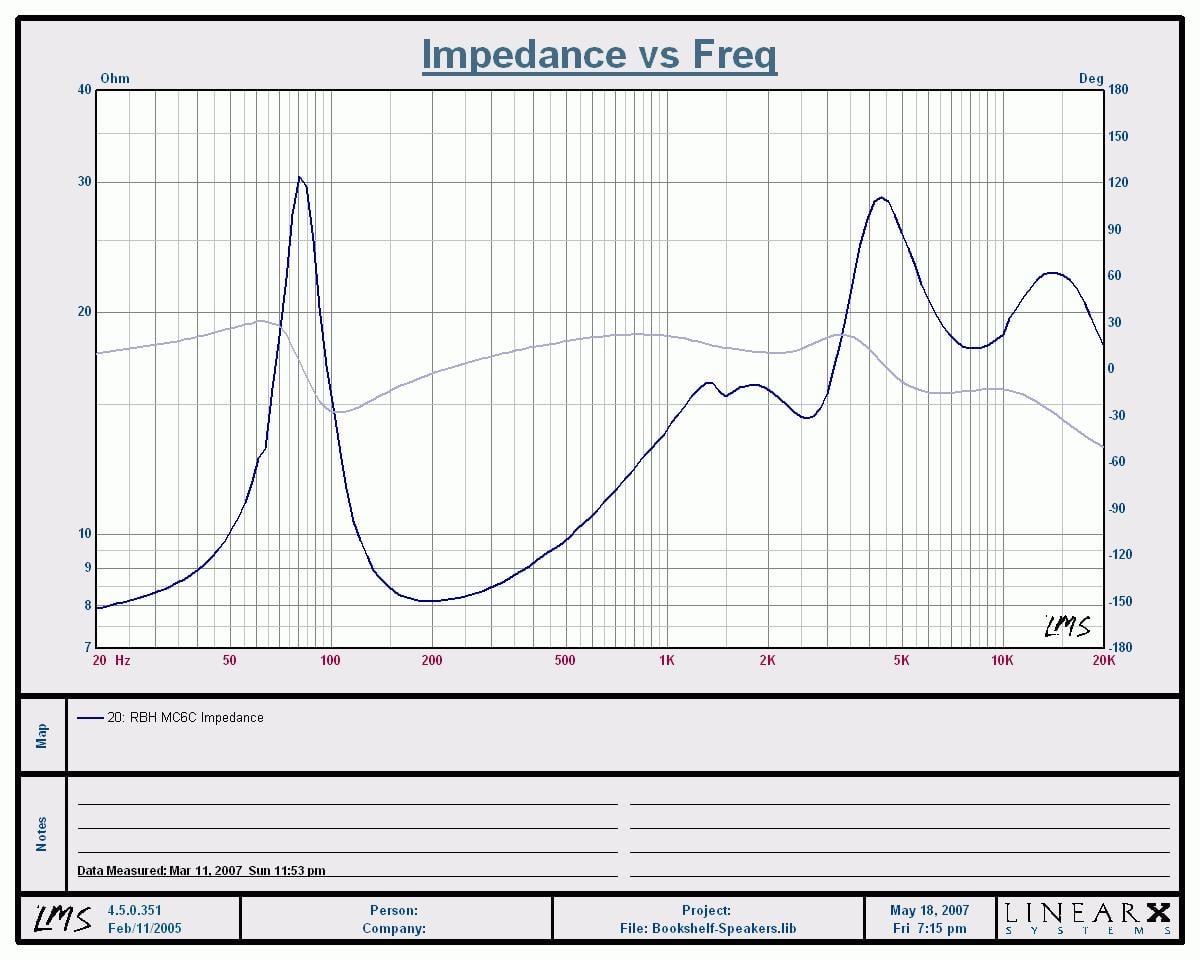
Impedance / Phase Measurements of the MC-6C
System impedance doesn’t dip below 8 ohms and maintains a very uniform phase response of – 30 to + 20 degrees throughout most of the audio range. Any decent receiver with a good amplifier section should drive these speakers with ease, but don’t feel shy feeding them some high quality power as they can take it and will also reward you with excellent sound quality.
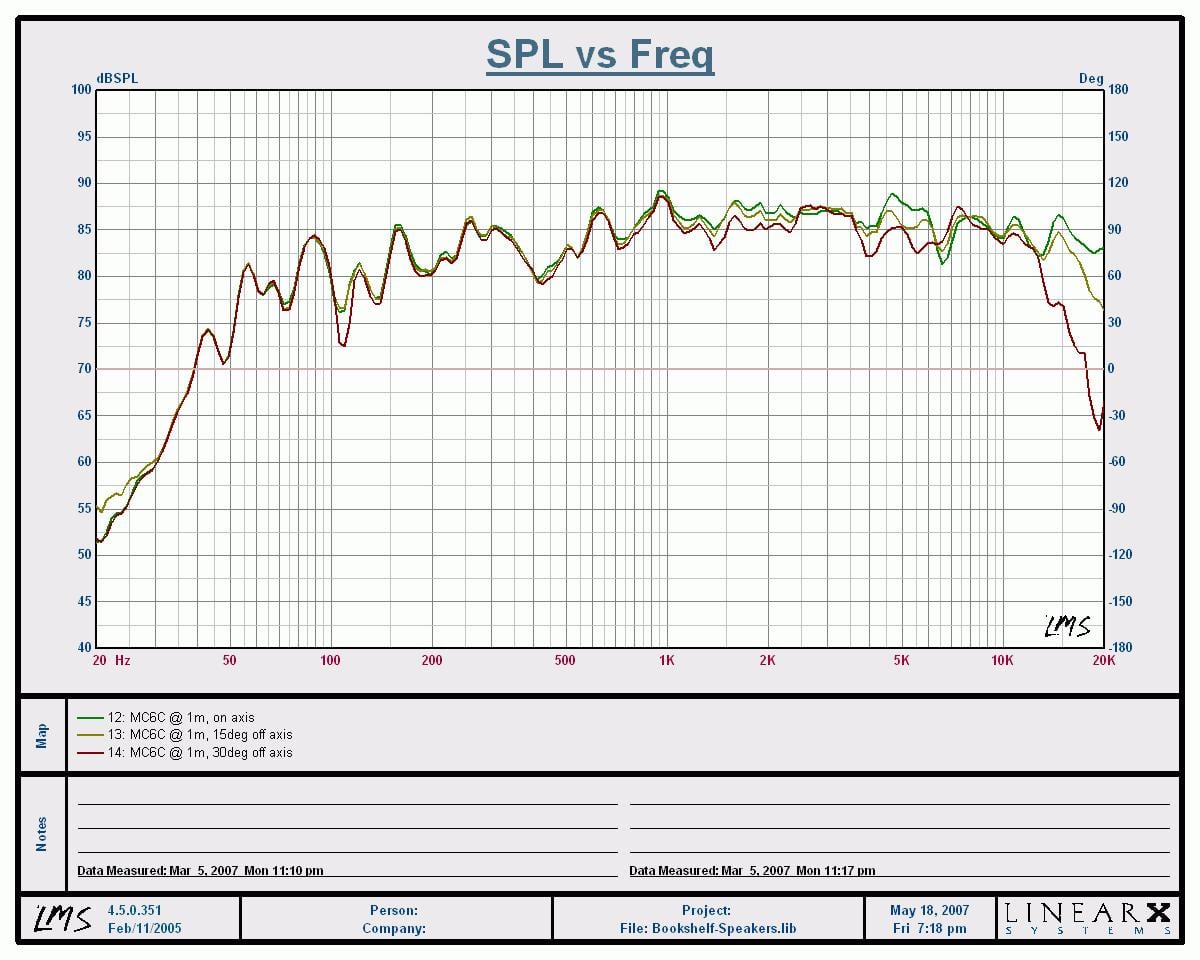
In Room 1 Meter
Frequency Response (1/12th octave smoothed)
Green – on axis,
Yellow – 15 deg off, Red – 30deg off
the MC-6C’s exhibited an extremely linear response with text book off axis response that would be an NRC members wet dream.
It’s not often I second guess my measurements as being too good for a speaker system, but the MC-6C’s forced me to measure them twice because I was almost dumbfounded by how exemplary they measured. Above 300Hz (below which all the room modal issues were mucking up the measurements), the MC-6C’s exhibited an extremely linear response with text book off axis response that would be an NRC members wet dream. Between the 1-5kHz range, the MC-6C’s were smooth as butter and avoided the typical saddle effect I see on many speaker systems whose design goals are for boom and sizzle effect. You can tell you’ve got a good speaker system on your hands when the manufacturer doesn’t try to cover up its poor midrange performance by boosting the top or bottom end.
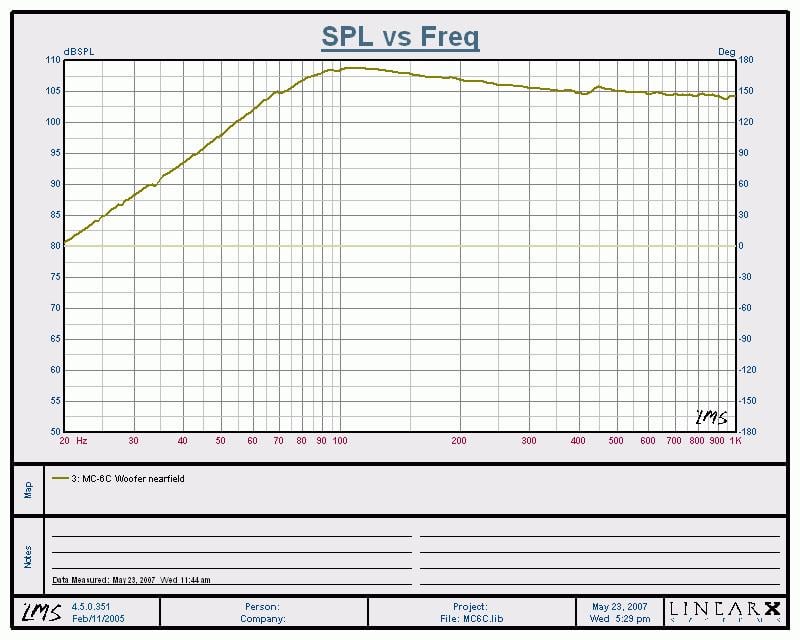
Nearfield Frequency Response of MC-6C Woofer
The typical rule of thumb for the acousti-mechanical roll-off rate of a sealed system is 12dB/octave. The roll-off rate for the MC-6C measured a tad steeper (14.25dB/octave attenuation at 30 Hz which is 1 octave below the rated 60 Hz cutoff frequency). This is a function of the slightly elevated Q of the woofer system which has a Q value of approximately 1.
The driver is the MC-6C is virtually the same driver RBH Sound uses in their in-wall/ in-ceiling speakers which operate in a free air/ infinite baffle type environment, so they pretty much have to be bullet proof. The bumped back plate on the motor structure along with the enhanced driver suspension pretty much eliminates any chance of the driver bottoming out. If the driver is severely overdriven with bass frequencies it will eventually burn up, but it should not bottom out. The fact that the speaker is an acoustic suspension design further protects the driver from bottoming out. It’s important to note that even with a roll-off rate of 14.25 dB the roll-off is not as steep as a typical vented speaker which rolls of at 18dB/ octave. Most vented speaker will bottom out without too much effort because the port unloads the driver below the tuning frequency. As you can see from the graph, these speakers don’t produce much tactile bass below 50Hz or so which is why I highly recommend pairing them with a quality subwoofer or two.
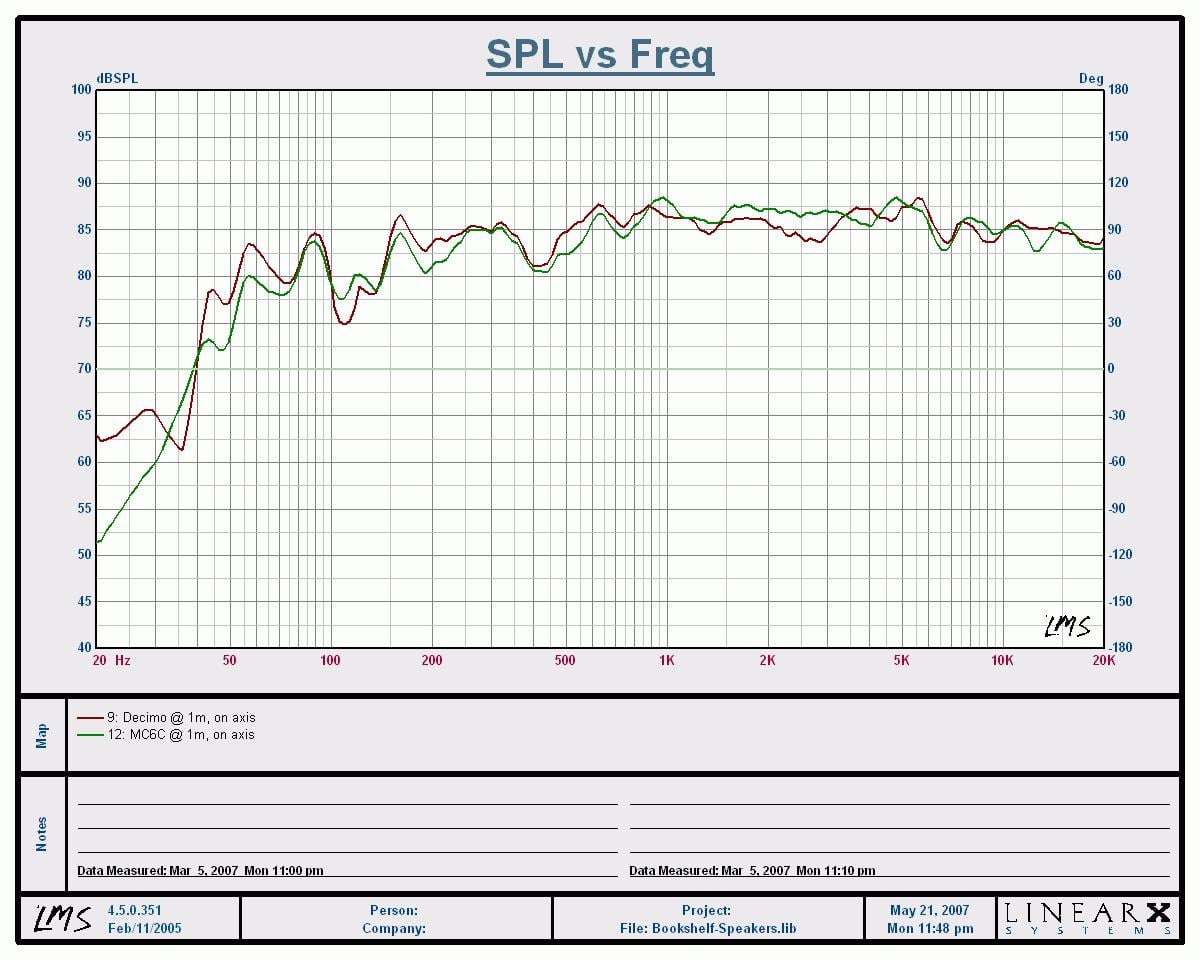
Frequency Response Comparison of the RBH MC-6C vs the Status Acoustics Decimo’s
I was curious to see how the MC-6C’s measured up to my reference bookshelf speakers – the Status Acoustics Decimo’s since tonally I found them to be very similar. Sure enough they also measured very similarly, both with very linear frequency response, and superb off axis response. The Decimo’s had more bottom end but also were more susceptible to bottoming out which is why I run them through my processors bass management and couple them with a powered subwoofer.
As an interesting aside, I asked Shane Rich what his design target was when he designed the MC-6C’s and he told me he was shooting NOT against one of their competitors products, but instead for similar performance of the, you guessed it, Decimo’s. Looks like they hit the target quite nicely.
MC-6C Speaker Conclusion
The RBH
Sound MC-6C speaker system has certainly exceeded my expectations and proved
that, like a fine wine, a product line can get better overtime (if careful
engineering is utilized). The fact that
the MC-6C’s could outgun other pricier speakers I currently have in for review
is a testament to a speaker company not so concerned with profit margins as
much as they are with bringing a high performance product to market that
targets music lovers and movie aficionados alike. They can play plenty loud,
never sounding strained or stressed when asked to be pushed harder than they
should be. Although they lack some of
the transparency and fluidity of my Decimo’s and very few other high rollers,
their pristine midrange, dynamic nature and rock bottom pricing more than makes
up for it. These speakers have no right
sounding as good as they do in a sub $1k price range.
I have no reservations recommending the RBH Sound MC-6C’s for critical two channel applications, or high performance home theater installs paired with their matching MC-616C and MC-44C surround speakers. If you want the ultimate performance from these speakers, remember that I strongly encourage you to carefully select two very musical and potent subwoofers to pair with these babies. I found mating them with my Velodyne DD-15’s worked quite nicely in adding the much needed bottom end and further smoothing out the overall tonality of the system. Whatever configuration permutation you can think up, I am certain the new MC line of RBH Sound can meet your needs and can practically guarantee you aren’t likely to send them packing once you get them integrated into your listening room.
RBH Sound
382 Marshall Way
Layton, Utah 84041
General phone & FAX
Toll-free: (800) 543-2205
Local: (801) 543-2200
FAX: (801) 543-3300
About RBH Sound
RBH Sound is one of the oldest speaker companies in the USA still run and operated by the original founder - Roger Hassing. In 1976 RBH Sound produced its first loudspeaker. RBH soon began to OEM for McIntosh, (back in the days of Gordon Gow), providing cabinets for their speakers. This set the stage for doing a superb job since McIntosh didn’t worry about how to cheapen the product, but to make it better and, at least at the time, lead the class in performance. Later on RBH Sound began producing loudspeakers for a retailer in Los Angeles called Northridge Audio. They didn’t advertise or market these products to avoid a conflict of interest with their other OEM customers (i.e. McIntosh, Parasound, Fosgate, etc). People nonetheless sought them out because of their high performance, which lead to a good success story and response for their products. Over the years RBH Sound was successful at helping other companies in achieving their goals. Based on their strong engineering background and sourcing ability, they took it upon themselves to enter the market under their own banner.
The Score Card
The scoring below is based on each piece of equipment doing the duty it is designed for. The numbers are weighed heavily with respect to the individual cost of each unit, thus giving a rating roughly equal to:
Performance × Price Factor/Value = Rating
Audioholics.com note: The ratings indicated below are based on subjective listening and objective testing of the product in question. The rating scale is based on performance/value ratio. If you notice better performing products in future reviews that have lower numbers in certain areas, be aware that the value factor is most likely the culprit. Other Audioholics reviewers may rate products solely based on performance, and each reviewer has his/her own system for ratings.
Audioholics Rating Scale
 — Excellent
- — Very Good
- — Good
- — Fair
- — Poor
| Metric | Rating |
|---|---|
| Build Quality | |
| Appearance | |
| Treble Extension | |
| Treble Smoothness | |
| Midrange Accuracy | |
| Bass Extension | |
| Bass Accuracy | |
| Dynamic Range | |
| Performance |  |
| Value | |
Gene manages this organization, establishes relations with manufacturers and keeps Audioholics a well oiled machine. His goal is to educate about home theater and develop more standards in the industry to eliminate consumer confusion clouded by industry snake oil.
View full profile Subscribe to our newsletter