


Mi-Horn VHT Series Loudspeaker System Review
Mi-Horn VHT Series
- Product Name: VHT Series
- Manufacturer: Mi-Horn
- Performance Rating:

- Value Rating:
- Review Date: September 05, 2005 20:00
- MSRP: $ 440 (includes 2 pairs of DAC1.5 and 1 DAC1.5C)
DAC1.5 Bookshelf Speaker - $80/ea
- Driver: 1” dome tweeter
- 5” Polypropylene cone midrange
- Sensitivity: 90 dB
- Impedance: 4 ohms
- Freq. Response: 60 - 20k Hz (+/-3dB)
- Power Handling: 60 W Max.cont.
- Size: 7.25” x 9” x 12”
- Weight: 8 lbs./each
- Rear vented cabinet
- Black wood grain vinyl veneer finish
DAC1.5C Center Channel Speaker - $120/ea
- Driver: 1” dome tweeter
- 5” Polypropylene cone mid. x 2
- magnetically shielded drivers
- Sensitivity: 91 dB
- Impedance: 8 ohms
- Freq. Response: 55 - 20k Hz (+/-3dB)
- Power Handling: 70 W Max. cont.
- Size: 19” x 9” x 7”
- Weight: 13 lbs./each
- Rear vented cabinet
- Black wood grain vinyl veneer finish
Pros
- Excellent Value
- Surprisingly Good Performance
- Mihorn kit improves speaker efficiency
Cons
- Ho Hum Looks
- Average bass performance
- Compressed sounding at high levels
- Mihorn kit causes further compression and shrilling highs
Mi-Horn VHT Technology Overview

Musical Industry (MI) was founded November, 2002. Their objective is the pursuit of lower cost sound improvements in hi-end audio. Upon a quick glance at their site, I must admit to a high level of skepticism. Being the objectivist I am, I simply find little value in ancillary devices or tweaks that have little basis in provable sciences. But, there are those audiophiles that would care less one way or the other so long as higher fidelity is promised, even if its not delivered, they will think they can hear it and be happy nonetheless.
When reviewing inexpensive home theater equipment, it is often a difficult challenge for a reviewer to put the product into perspective and judge it based on what it is intended to do, while keeping in mind all of the designer trade offs the manufacturer had to make to hit a particular price point. When Mi-Horn introduced us to their Mi-Horn device, I almost wrote it off as snake oil until I pondered its application. It is an accessory device to be placed onto a speaker system to increase efficiency and control dispersion. In most cases, it's usually inadvisable for a consumer to modify their speaker design with some aftermarket part, but Mi-Horn makes this process relatively painless. Depending on your application, it may or may not be a worthwhile endeavor to consider. In the case of their DAC1.5 bookshelf speaker and DAC1.5C center channel speaker, it's an easy decision since the speakers come with the Mi-Horn devices as an optional installable accessory. These speakers are produced by a company called Unisound which are relatively unknown among audio enthusiasts. However, they are known by savvy retailers as producing high value products and OEM solutions.


Installing the Mi-Horn devices requires a Phillips head screw driver and a few minutes of twisting action to get all of the horns installed via fastening them to the drivers with screws. Mi-Horn offers Velcro adhesive alternatives for speaker systems incompatible with this installation option. In fact, these speakers came with the Velcro hook-ups for the tweeter sections. After getting the Mi-Horns installed, I couldn't help but reminisce of the days where scratch collars were a must for my pet poodle who always suffered from ear infections. The Mi-Horns aren't quite big enough for a dog or cat, but hamsters and gerbils rejoice, for there is salvation to your itchy ears at last ;-)
They even have a pictorial
"how to"
informational on their site
at:
http://mihorn.com/velcroinstall.htm
 The theory behind Mi-Horn technology is to minimize reflected sound caused by the room so
that the first arrival sound is more clearly identified by the listener.
This is nothing
new.
Companies have been using horn loaded driver technology since the dawn of
loudspeakers.
The big names such as JBL and Klipsch have popularized these designs, especially
in concert and movie venues.
The advantages of horns are two fold, increased efficiency,
controlled dispersion.
These are all attributes that in my opinion best suite outdoor concert
venues or large arenas, though some audiophiles prefer horns in their hifi systems.
I for one
am not a horn lover.
I prefer the less compressed, more open and spacious sound of conventional
cone and dome driver designs, at least for home audio and theater.
But that's neither
here or there since the focus of this review is on a horn technology meant to enhance budget speaker
systems.
The theory behind Mi-Horn technology is to minimize reflected sound caused by the room so
that the first arrival sound is more clearly identified by the listener.
This is nothing
new.
Companies have been using horn loaded driver technology since the dawn of
loudspeakers.
The big names such as JBL and Klipsch have popularized these designs, especially
in concert and movie venues.
The advantages of horns are two fold, increased efficiency,
controlled dispersion.
These are all attributes that in my opinion best suite outdoor concert
venues or large arenas, though some audiophiles prefer horns in their hifi systems.
I for one
am not a horn lover.
I prefer the less compressed, more open and spacious sound of conventional
cone and dome driver designs, at least for home audio and theater.
But that's neither
here or there since the focus of this review is on a horn technology meant to enhance budget speaker
systems.
Mi-Horn VHT First Impressions
I wasn't sure what to expect in such a budget speaker system, especially since I am accustomed to reviewing speaker pairs that cost significantly more than this entire five speaker package. I was happy to see such a good packing job for these speakers. They were double boxed and wrapped in plastic, while the grills we also wrapped in their own packaging. The cabinetry seemed to be well put together and I was most surprised to see all of the drivers were recessed in the baffle, an oversight by some higher end speaker manufacturers like Paradigm. Recessing the drivers helps minimize driver diffraction off the front baffle and it is simply mind boggling to see loudspeakers being produced today that don't incorporate this obvious positive design attribute.


The grill cloth fit snugly on the plastic grill and the cabinetry appeared to be at least 1/2" thick MDF, probably more like 5/8" . When I popped the drivers out, I was surprised to not see a cheap neodymium magnet tweeter typically found in many of the upscale European speaker brands. Instead I found a scaled down copy of what appeared to be a Dynaudio tweeter, (DAC tweeter pictured left, Dynaudio pictured right ) but without the backing heat sink. Perhaps this tweeter is produced in the same factory as the Dyne. The eyeball like center and motor structure seem to share too many similarities to be a coincidence. Regardless, it's a rarity to find a 1" silk dome tweeter with a conventional motor structure in an $80 speaker. The 5 ¼" woofer is a polycone with a stamped basket and respectable sized motor structure. The crossover is where most of the cost compromises were made.
The DAC1.5 has a simple polypropylene capacitor in series with the tweeter and no crossover element for the woofer. Thus power handling is severely compromised given the limits of the bass driver. The DAC1.5C crossover is a bit more elaborate containing one coil inductor and polypropylene capacitor. I didn't buzz out the crossover but I am guessing it's a second order design implementation on the tweeter to provide a more uniform response given the D'Appolito driver arrangement. I was pleased to see the cabinet internals were lined with polyfoam to help minimize cabinet resonance. There was no cabinet bracing to speak of other than the four walls, but that is to be expected in a speaker of this price class. As a side note, I have seen more poorly designed cabinets in speakers costing far more than these. I commend Unisound for not using cheap electrolytic capacitors in series with the tweeter, a trick some manufacturers tend to do as a cost savings at the expense of high frequency linearity and reliability. Overall I cannot fault the construction or design of these speakers given the price. It's obvious these speakers aren't glorified profit machines so many audiophiles and press often love to wallow over.
The Setup
I began my evaluation with one pair of stock DAC1.5's and another pair with the Mi-Horns attached. I measured both speaker sets with an SPL meter and pink noise and found the horn loaded versions about 2-3 dB more efficient. No surprise there. When comparing the two sets of speakers, I used the receiver A/B speaker outputs for each set and level trims to compensate for the sensitivity differences between them. Since the grills could not be installed in conjunction with the Mi-Horns, I left them off for all listening tests - with and without the Mi-Horns. Speakers were sharply toed in to the listening position with the Mi-Horns installed while they were toed in to a lesser degree without Mi-Horns. The speakers were placed on 30 舡 Plateau sand-loaded stands for all of the listening tests unless otherwise noted.
Listening Tests: Two-Channel
 I began my listening session with
the song
"The Chant"
from Fourplay.
This song has an exorbitant amount of
bass and dynamics that certainly test the limits of a speaker system, particularly the bass
drivers.
I was expecting the DAC1.5's to bottom out, especially since they ran the bass
driver full range.
To my surprise I didn't hear woofer bottoming at relatively loud
listening levels.
In contrast, I found the much more expensive
Dynaudio 52-SE's
hiccupped severely when playing this track at similar
levels.
Granted the Dyne's had superior bass extension (perhaps the best I have heard in
a relatively small bookshelf speaker) but didn't provision any excursion limits to prevent
bottoming.
It was nice to see the little DACs didn't suffer from this almost extinct
issue in a majority of driver designs on the market today.
I began my listening session with
the song
"The Chant"
from Fourplay.
This song has an exorbitant amount of
bass and dynamics that certainly test the limits of a speaker system, particularly the bass
drivers.
I was expecting the DAC1.5's to bottom out, especially since they ran the bass
driver full range.
To my surprise I didn't hear woofer bottoming at relatively loud
listening levels.
In contrast, I found the much more expensive
Dynaudio 52-SE's
hiccupped severely when playing this track at similar
levels.
Granted the Dyne's had superior bass extension (perhaps the best I have heard in
a relatively small bookshelf speaker) but didn't provision any excursion limits to prevent
bottoming.
It was nice to see the little DACs didn't suffer from this almost extinct
issue in a majority of driver designs on the market today.
While the DAC1.5's didn't bottom per se, they did loose composure and clarity when driven to loud levels, which is why I recommend using these speakers in small to moderate room sizes, and crossing them over between 60-90Hz to a subwoofer. I don't care how elaborate you make a speaker design. It's simply not going to deliver deep, authorative bass extension based on the laws of physics. What the Unisound DACs did produce was reasonably extended and controlled bass response at moderate volume. I found crossing them over at 80Hz to one of my RBH 1010-SEP subwoofers from my T2 system helped alleviate these speakers and opened up a degree of dynamic range and clarity that was lost on program material with a strong emphasis on bass.
Switching between Mi-Horn enabled and stock Unisound DAC1.5's, I took notes on my listening observations. With the stock speaker, I heard decent imaging and soundstage at the primary listening position as well as off axis. With the horns installed, I noted a much more compressed sound, stringent top end, and a very narrow sweet spot that, if you sat off center from, pretty much destroyed the polar response of the speakers. They no longer imaged or sounded 3 dimensional. Instead they sounded louder, clearer and brighter, almost like after using a bad receiver auto EQ calibration system. The problem here is I felt the stock versions of these speakers were already a bit bright for my tastes. Adding Mi-Horns only exacerbated this problem.
Listening to female vocals from Sade and Diana Krall revealed a more nasal sound characteristic with the Mi-Horns installed. I even tried permutations of Mi-Horn on tweeter only, woofer only, etc, and in all cases I preferred no horns at all. With the Mi-Horns installed only on the bass drivers, the sound was too forward in the mid bass, making the speaker sound boomy or boxy. With them installed only on the tweeters, it made the speaker sound too sibilant.
 On the flip side, listening to the Mi-Horn versions on Techno/Party music
often created a louder, more powerful sound.
I placed all four DAC1.5 speakers loaded with
Mi-Horns in the corners of my room firing at the primary listening position and popped in some
Depeche Mode.
While the sound was again bright and forward, turning up the bass on my sub
helped to balance it.
I was now hearing Depeche Mode loud and clear just the way this type of
music was meant to be played.
Sure, accuracy was out the window, but this setup would likely
make a lasting impression on your friends or family that think small cube speakers are the epiphany
of audio.
For parties, this is a great setup, especially considering that if you trash the
speakers, replacements are cheap.
Best of all, with the added efficiency of the horns, you
don't need oodles of amplifier power to drive your party-goers to
insanity.
On the flip side, listening to the Mi-Horn versions on Techno/Party music
often created a louder, more powerful sound.
I placed all four DAC1.5 speakers loaded with
Mi-Horns in the corners of my room firing at the primary listening position and popped in some
Depeche Mode.
While the sound was again bright and forward, turning up the bass on my sub
helped to balance it.
I was now hearing Depeche Mode loud and clear just the way this type of
music was meant to be played.
Sure, accuracy was out the window, but this setup would likely
make a lasting impression on your friends or family that think small cube speakers are the epiphany
of audio.
For parties, this is a great setup, especially considering that if you trash the
speakers, replacements are cheap.
Best of all, with the added efficiency of the horns, you
don't need oodles of amplifier power to drive your party-goers to
insanity.
Mi-Horn VHT Measurements and Analysis
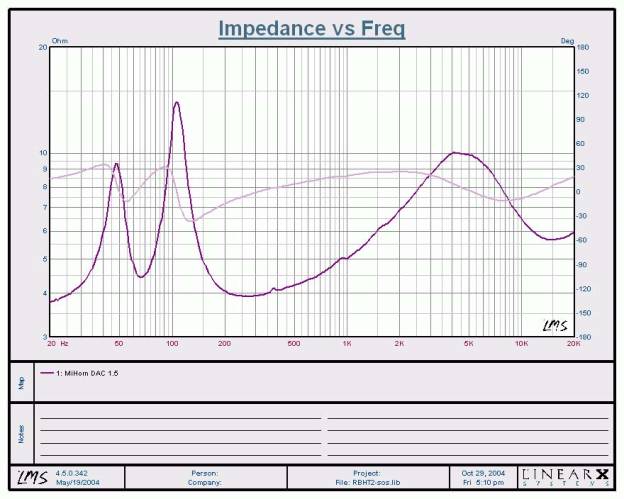
The impedance profile is a bit erratic but doesn't dip below 4 ohms within its usable bandwidth. Given its high efficiency, and benign electrical phase, I don't see being a problem for any moderately price receiver to drive without incident. The systems low end response appears to be tuned at around 65Hz.
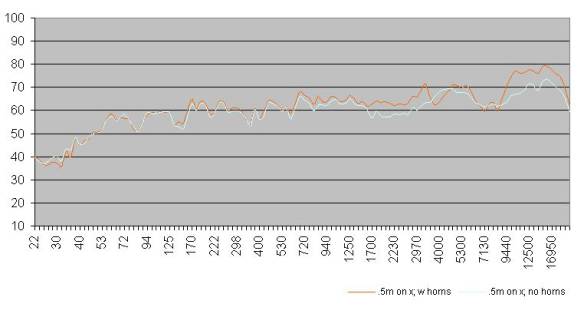
On Axis Nearfield Frequency Response (1/2 meter) of the DAC1.5
The light blue trace represents the DAC1.5 without Mi-Horn while the orange trace includes Mi-Horn installed. Usable bass extension appears to be around 55Hz. The tweeter is set about 6-10dB too hot above 9kHz which likely explains why I felt these speakers were bright. With the Mi-Horn installed it boosted the top end almost an additional 8dB! For the hearing impaired this may be a Godsend. But for those with good hearing, you will likely prefer the more balanced sound without Mi-Horn.
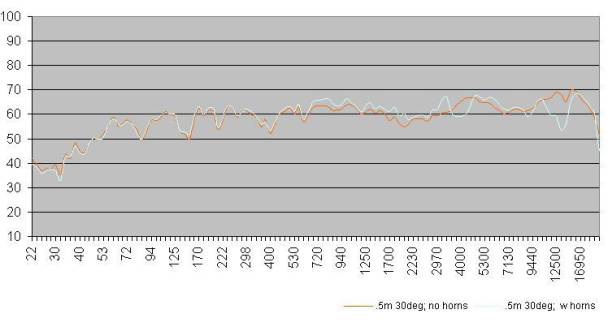
Off Axis Nearfield Frequency Response (1/2 meter) of the DAC1.5
The light blue trace represents the DAC1.5 with Mi-Horn while the orange trace is without Mi-Horn installed. As you can see with Mi-Horn added, the off axis performance is compromised diminished. This becomes even more problematic as you increase the distance between the speakers and listener.
Mi-Horn VHT Listening Tests and Conclusion
 Setting all of the Unisound
DAC1.5 speakers to small and crossing them over at 80Hz, I began my movie watching sessions with the
DAC1.5C center channel speaker located below the display but angled up at the listener.
Star Wars Episode I Attack of the Clones
was used for most of the movie listening
evaluation.
Setting all of the Unisound
DAC1.5 speakers to small and crossing them over at 80Hz, I began my movie watching sessions with the
DAC1.5C center channel speaker located below the display but angled up at the listener.
Star Wars Episode I Attack of the Clones
was used for most of the movie listening
evaluation.
I found the Unisound speaker system blended well together. Though it was a bit sibilant and compressed, it did convey good vocal clarity and enveloping effects, especially when sitting in the hot seat. Sitting to the extreme off axis areas, I found moderate lobing from the center channel. These issues were greatly exacerbated with the Mi-Horns installed - which is why I don't recommend them in multi-listener environments at all. Obi Won Kenobi's voice was clear, but a bit tinny sounding at times. Of course I am used to listening to center channel speakers costing 3-5 times more than this entire speaker package, so I am likely being a little overly critical here. In any event, these speakers did a commendable job with home theater.
Conclusions


The Mi-Horn accessory product was a bit of a mixed bag from my experience. While they did increase speaker efficiency, and helped focus the sound, they did so at an extreme penalty to speaker off axis response, imaging and soundstage. Increasing loudness at the expense of adding compression is usually not a desirable design goal for critical music listening or home theater. On the other hand, it's a very reasonable trade off for sound reinforcement applications where achieving maximum SPL is a primary goal. Given the fact that these speakers are relatively dynamically limited to begin with, this may be a practical solution for situations where higher SPL is needed for party type environments.
The Unisound DAC speakers maintained good composure if not driven beyond their means and utilized in moderately sized rooms. Don't expect them to take the place of a full fledged multi thousand dollar speaker package. However, they do offer a great alternative to a cubed system or typical department store junker, and at only a fraction of the cost. Considering their value and flexibility, whether you subscribe to the Mi-Horn technology or not isn't the point. These speakers are a bargain at their asking price. Consider the Mi-Horn accessory a novelty item to be used within the confines I defined in this review.
The Score Card
The scoring below is based on each piece of equipment doing the duty it is designed for. The numbers are weighed heavily with respect to the individual cost of each unit, thus giving a rating roughly equal to:
Performance × Price Factor/Value = Rating
Audioholics.com note: The ratings indicated below are based on subjective listening and objective testing of the product in question. The rating scale is based on performance/value ratio. If you notice better performing products in future reviews that have lower numbers in certain areas, be aware that the value factor is most likely the culprit. Other Audioholics reviewers may rate products solely based on performance, and each reviewer has his/her own system for ratings.
Audioholics Rating Scale
 — Excellent
- — Very Good
- — Good
- — Fair
- — Poor
| Metric | Rating |
|---|---|
| Build Quality | |
| Appearance | |
| Treble Extension | |
| Treble Smoothness | |
| Midrange Accuracy | |
| Bass Extension | |
| Imaging | |
| Soundstage | |
| Dynamic Range | |
| Performance | |
| Value | |
Gene manages this organization, establishes relations with manufacturers and keeps Audioholics a well oiled machine. His goal is to educate about home theater and develop more standards in the industry to eliminate consumer confusion clouded by industry snake oil.
View full profile Subscribe to our newsletter
