


Infinity Primus P162 Bookshelf Speaker Review
Infinity Primus P162 Bookshelf Speaker
- Product Name: Primus P162 Bookshelf Speaker
- Manufacturer: Infinity
- Performance Rating:


- Value Rating:
- Review Date: April 09, 2009 12:00
- MSRP: $ 159 (each)
Frequency Response (±3dB): 49Hz - 20kHz
Recommended Power Amplifier Range: 10 - 150 watts
Sensitivity (2.83V @ 1m): 90dB
Nominal Impedance: 8 ohms
Crossover Frequency(ies): 3,000Hz; 24dB/octave
Low-Frequency Driver: 6-1/2" (165mm) MMD®
High-Frequency Driver: 3/4" (19mm) MMD®
Dimensions (H x W x D): 14-3/4" x 8-1/4" x 11" (375mm x 208mm x
280mm)
Weight: 16.1 lb (7.3kg)
Finish: Black Wood-Grain Enclosure
Pros
- Wide soundstage
- Rock solid center image
- Decent bass
- Perfect for entry-level/budget-minded 1st purchase
Cons
- Ho-hum aesthetics
- Fatiguing highs
- Need to be placed fairly high relative to seated position
Infinity P162 Build Quality
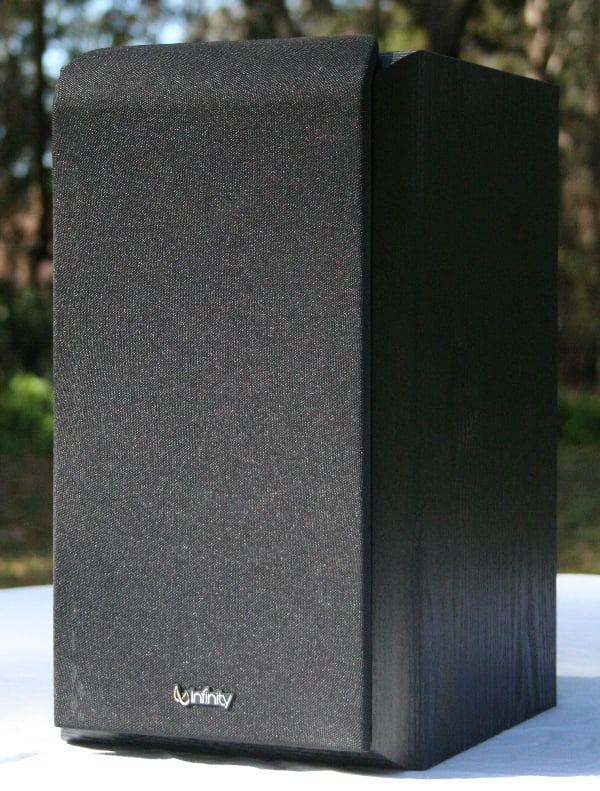 The Infinity Primus P162
Bookshelf speakers have been selling like hotcakes at the Audioholics store -
that's just a fact. They've got a lot of buzz right now and people on audio
forums all over the net are excited about them. It doesn't hurt that they've
also been on a bit of sale at just under $200 a pair. That's got a lot of
people excited about value as well. The store guys (the editorial staff of
Audioholics doesn't actually run the store contrary to popular belief)
approached me about a review of these speakers. I'm thinking they don't
actually read my reviews or they'd know that I'm a no-holds-barred kind of guy
who is not easily swayed by public opinion or mass hysteria. I'm going to
review these speakers as I would any other. That's what my readers expect and
that's what I'm going to give them.
The Infinity Primus P162
Bookshelf speakers have been selling like hotcakes at the Audioholics store -
that's just a fact. They've got a lot of buzz right now and people on audio
forums all over the net are excited about them. It doesn't hurt that they've
also been on a bit of sale at just under $200 a pair. That's got a lot of
people excited about value as well. The store guys (the editorial staff of
Audioholics doesn't actually run the store contrary to popular belief)
approached me about a review of these speakers. I'm thinking they don't
actually read my reviews or they'd know that I'm a no-holds-barred kind of guy
who is not easily swayed by public opinion or mass hysteria. I'm going to
review these speakers as I would any other. That's what my readers expect and
that's what I'm going to give them.
Build Quality
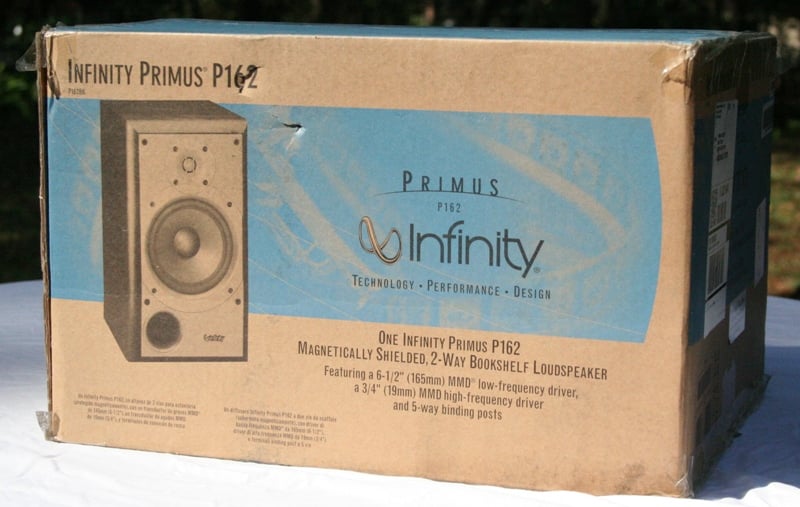 As
you'd expect from a company like Infinity, the Primus P162s came well packed in
custom boxes with cardboard tops and bottoms with foam edges glued to them.
This is a very efficient method of packaging which provides the maximum
protection with the least amount of foam. It also ensures that the foam doesn't
move or slip during handling keeping the speaker very well isolated from
outside damage.
As
you'd expect from a company like Infinity, the Primus P162s came well packed in
custom boxes with cardboard tops and bottoms with foam edges glued to them.
This is a very efficient method of packaging which provides the maximum
protection with the least amount of foam. It also ensures that the foam doesn't
move or slip during handling keeping the speaker very well isolated from
outside damage.
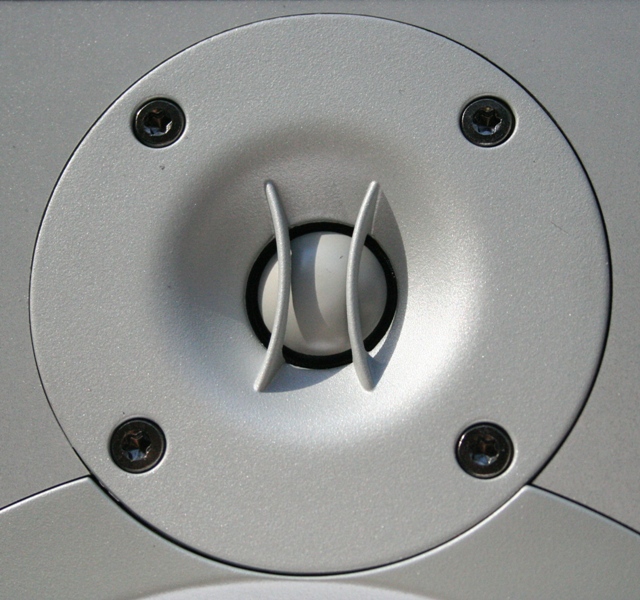
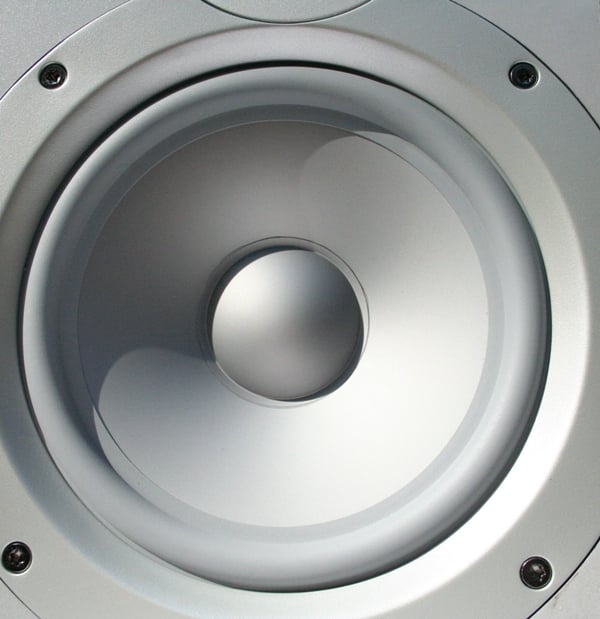
The speakers themselves are rather large for this price point (around $320 a pair) at over a foot tall and nearly a foot deep. The black wood-grain vinyl wrap is on par with the quality of other offerings at this price point - which to say is that it is barely passable. The edges had a tendency to peel up at the slightest provocation. The front of the speaker sports a rounded baffle and a grey plastic faceplate. The drivers (one .75" tweeter and a 6.5" woofer) are also grey. The speaker is front ported just below and to the left of the woofer. The logo is on the lower right of the faceplate and at the bottom center of the grill.
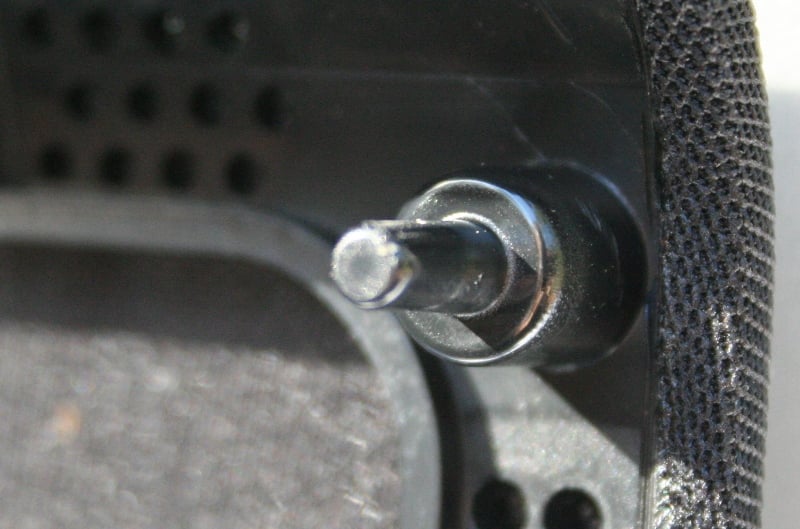 The grill is interesting in that
it wraps up around the rounded enclosure at the top. This gives the speaker a
sort of "swept back" look though it is really just a rectangular box.
With the grill off, the grey faceplate seems to float in the center of the
enclosure. The grill attached VERY firmly on plastic posts. Unlike other grills
I've experienced, this one feels sturdy and stable with plenty of molded
plastic reinforcement. The posts, while plastic, are thick and strong so that
even though you have to fight a bit to get the grill off (a good thing for all
of us with kids), you don't feel like you are likely to break anything.
The grill is interesting in that
it wraps up around the rounded enclosure at the top. This gives the speaker a
sort of "swept back" look though it is really just a rectangular box.
With the grill off, the grey faceplate seems to float in the center of the
enclosure. The grill attached VERY firmly on plastic posts. Unlike other grills
I've experienced, this one feels sturdy and stable with plenty of molded
plastic reinforcement. The posts, while plastic, are thick and strong so that
even though you have to fight a bit to get the grill off (a good thing for all
of us with kids), you don't feel like you are likely to break anything.
 The
back of the speaker shows a bit of overlap of the walls, top, and bottom of the
speakers with the back panel. This is actually quite common and something I've
seen in higher dollar speakers like the DALI LECTOR 8s and Krix Phoenix. It isn't
my favorite design choice but it is on the back so it really doesn't matter.
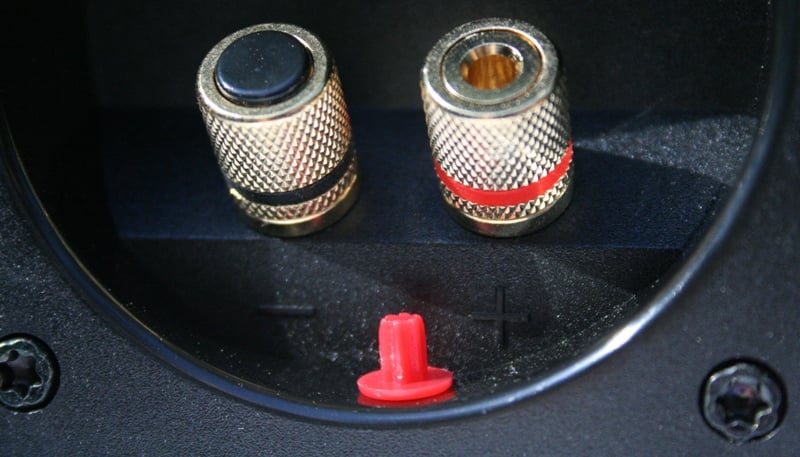
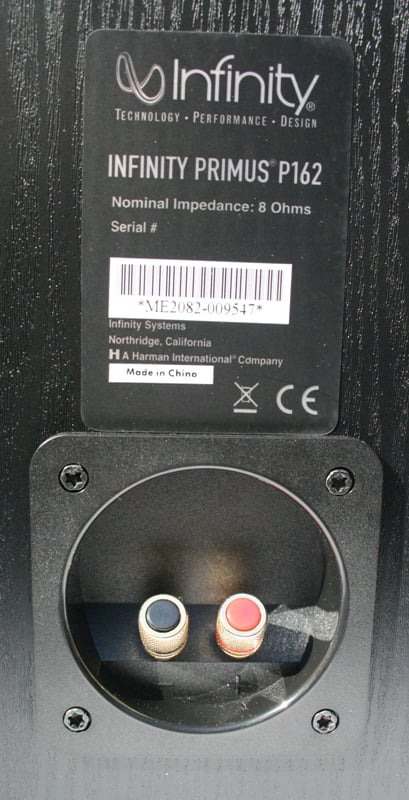
There is a single pair of 5-way binding posts with plastic caps in a black
plastic housing on the back of the speaker as well.
The
back of the speaker shows a bit of overlap of the walls, top, and bottom of the
speakers with the back panel. This is actually quite common and something I've
seen in higher dollar speakers like the DALI LECTOR 8s and Krix Phoenix. It isn't
my favorite design choice but it is on the back so it really doesn't matter.
There is a single pair of 5-way binding posts with plastic caps in a black
plastic housing on the back of the speaker as well.
The speakers arrived with a generalized manual for the entire Primus line, a paper specifying a limited 3/5 year warranty, and rubber feet to stick to the bottom for shelf mounting. If you have stands, I HIGHLY recommend you NOT place the rubber feet on the speaker and instead on the top of the stand (many stands come with rubber pads for the tops these days). This eliminates any problems you may have with placement on top of the stand in trying to make contact with the pads on the bottom of the speaker. Word of note, the warranty is transferable between owners which is nice for those that want to try the P162s out but think they may sell them later down the road.
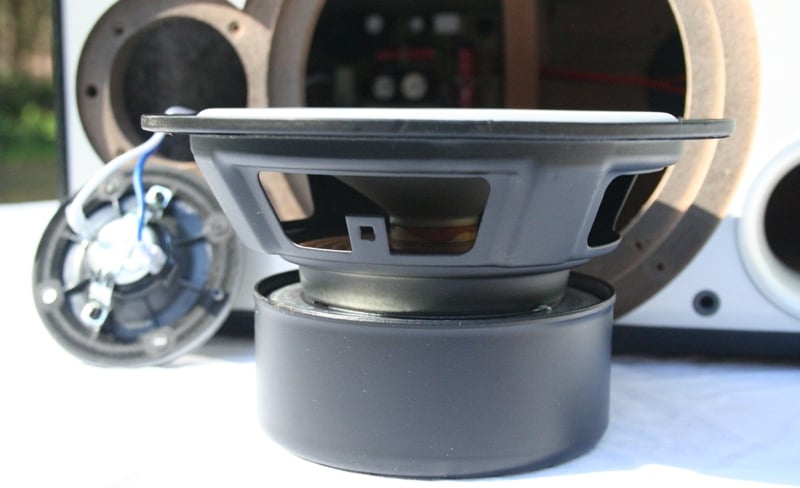 Taking the speakers apart, I
quickly noted that the woofers were shielded. A quick test of placing the
speaker up to my ancient CRT monitor confirmed that the shielding was working
effectively. The cabinet is about 5/8" thick MDF (it's a bit hard to tell
with the plastic face plate - may be as thin as 1/2"). The port is very
short but flared slightly on both ends. The cabinet has a bit of acoustical material around the top portion of the
box (around the tweeter) but only on the side wall opposite the port on the
bottom portion. There is one brace across the middle of the cabinet. The knock
test doesn't sound so hot with these speakers with a bit of a ring everywhere
including where the brace is located.
Taking the speakers apart, I
quickly noted that the woofers were shielded. A quick test of placing the
speaker up to my ancient CRT monitor confirmed that the shielding was working
effectively. The cabinet is about 5/8" thick MDF (it's a bit hard to tell
with the plastic face plate - may be as thin as 1/2"). The port is very
short but flared slightly on both ends. The cabinet has a bit of acoustical material around the top portion of the
box (around the tweeter) but only on the side wall opposite the port on the
bottom portion. There is one brace across the middle of the cabinet. The knock
test doesn't sound so hot with these speakers with a bit of a ring everywhere
including where the brace is located.
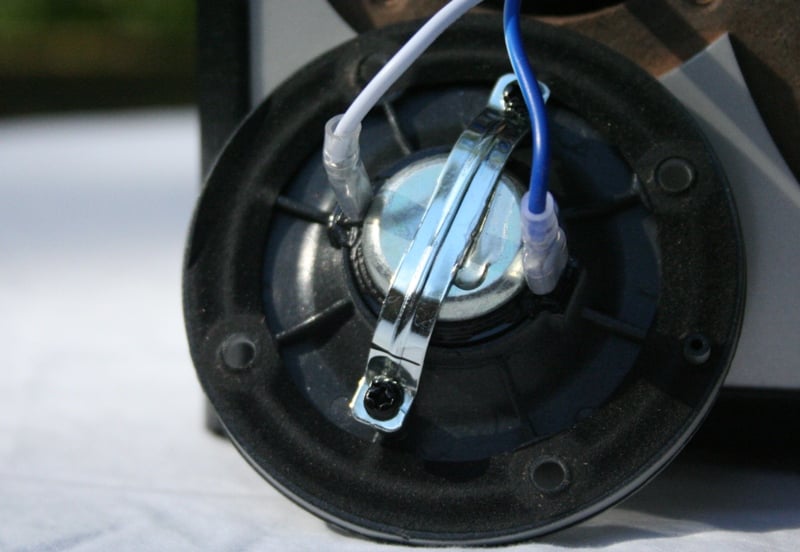
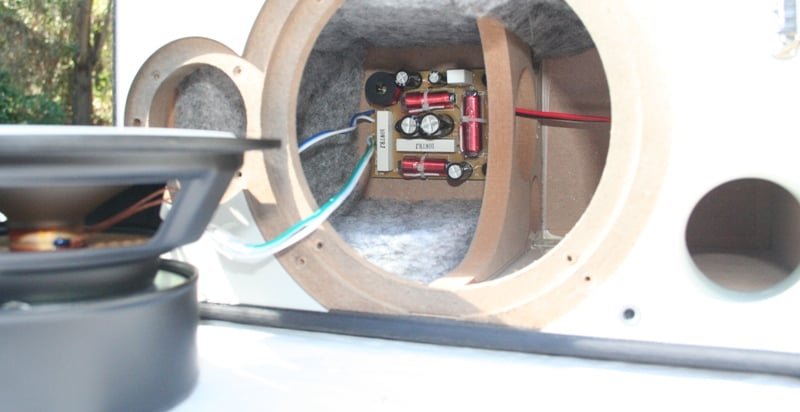 The woofers have stamped
baskets and the tweeter is mounted to a plastic housing. Usually, tweeters and
woofers are made out of different materials but with the P162s, they are both
constructed out of Metal Matrix Diaphragm (MMD)
material. This is essentially aluminum that has been anodized on both sides. Usually,
we'd expect tweeters (at least) to be made out of something harder like
titanium or aluminum but Infinity claims that MMD
"…is 3 times as rigid as titanium, and 85 times more rigid than felted
paper. This unique design is capable of eliminating unwanted tonal resonances
in the signal path. The end result is a full, clear, tight reproduction of low
and high frequencies." At the very least, if your feng shui is all about
matching, you've found a speaker with drivers that finally do. For me, the sort
of dull grey looks more like plastic than metal which inspires a feeling of
cost cutting rather than cutting edge technology. If I were Infinity, I'd
research some ways to make MMD
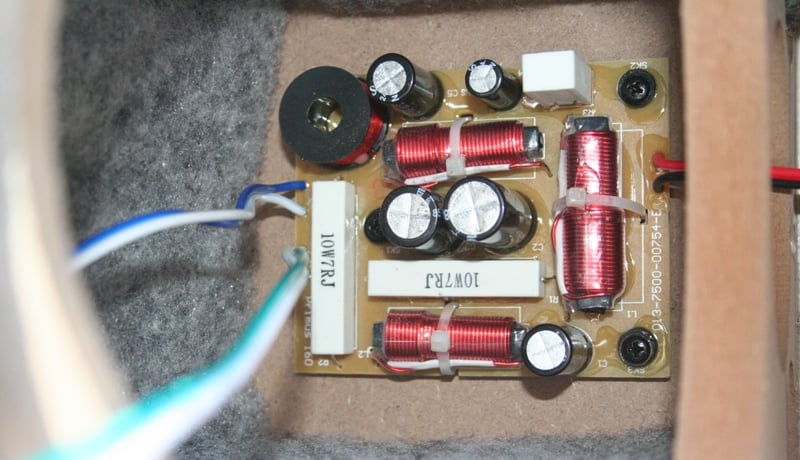
look more like metal and less like an old iPod case. The crossover is a rather
elaborate network consisting of one air core inductor, a few iron core ones and
electrolytic caps as cost saving measures. Without seeing a schematic, I’d
guesstimate Infinity employed 2nd order crossovers on the woofer and tweeter
and based on the smooth impedance plot below, also incorporated a zobel network
or two. It is obvious some good thought went into this crossover unlike most
speakers in this price range that simply slap on a series cap on the tweeter
and run the woofer full range.
The woofers have stamped
baskets and the tweeter is mounted to a plastic housing. Usually, tweeters and
woofers are made out of different materials but with the P162s, they are both
constructed out of Metal Matrix Diaphragm (MMD)
material. This is essentially aluminum that has been anodized on both sides. Usually,
we'd expect tweeters (at least) to be made out of something harder like
titanium or aluminum but Infinity claims that MMD
"…is 3 times as rigid as titanium, and 85 times more rigid than felted
paper. This unique design is capable of eliminating unwanted tonal resonances
in the signal path. The end result is a full, clear, tight reproduction of low
and high frequencies." At the very least, if your feng shui is all about
matching, you've found a speaker with drivers that finally do. For me, the sort
of dull grey looks more like plastic than metal which inspires a feeling of
cost cutting rather than cutting edge technology. If I were Infinity, I'd
research some ways to make MMD
look more like metal and less like an old iPod case. The crossover is a rather
elaborate network consisting of one air core inductor, a few iron core ones and
electrolytic caps as cost saving measures. Without seeing a schematic, I’d
guesstimate Infinity employed 2nd order crossovers on the woofer and tweeter
and based on the smooth impedance plot below, also incorporated a zobel network
or two. It is obvious some good thought went into this crossover unlike most
speakers in this price range that simply slap on a series cap on the tweeter
and run the woofer full range.

Primus P162 Set-up and Measurements
 The Infinity P162s were
fairly easy to place. Even with no toe-in (pointed straight ahead) I got a very
clear center image. Turning the speakers toward me, I found that the imaging
tightened slightly but at the expense of soundstage width. On my 30"
Studio Tech stands, my ears were just about between the port and the woofer (a
little higher or lower depending on my level of slouch) - lower than the generally
recommended tweeter height. As you'll see later in the measurements section,
this is actually the sweetspot for the speaker response so it worked out well.
I wired the speakers up with Blue Jeans Canare 4S11 Cable. Source was a Denon
DVD-3910 universal player through a Denon AVR-2307CI
pushing two Seymour
AV Ice Block 5001 monoblock amplifiers. I was sitting about 8 feet from the
speakers with the pair about 6 feet apart. The speakers were no closer (and in
most cases quite a bit farther away) than 2 feet from any boundary.
The Infinity P162s were
fairly easy to place. Even with no toe-in (pointed straight ahead) I got a very
clear center image. Turning the speakers toward me, I found that the imaging
tightened slightly but at the expense of soundstage width. On my 30"
Studio Tech stands, my ears were just about between the port and the woofer (a
little higher or lower depending on my level of slouch) - lower than the generally
recommended tweeter height. As you'll see later in the measurements section,
this is actually the sweetspot for the speaker response so it worked out well.
I wired the speakers up with Blue Jeans Canare 4S11 Cable. Source was a Denon
DVD-3910 universal player through a Denon AVR-2307CI
pushing two Seymour
AV Ice Block 5001 monoblock amplifiers. I was sitting about 8 feet from the
speakers with the pair about 6 feet apart. The speakers were no closer (and in
most cases quite a bit farther away) than 2 feet from any boundary.
Measurements & Testing
For laboratory measurements I used the Sencore SP395A FFT Audio Analyzer and a Sherbourn 2/75B amp. I measured the Infinity P162's in room on and off-axis frequency response with 1/12th octave resolution. The first thing I discovered is that the sweetspot for this speaker is quite a bit lower than the generally recommended tweeter level. Many speakers measure best between the tweeter and woofer but the P162s measured best at woofer level or a bit lower. From about 4" away, dead center on the woofer was the flattest response with tweeter level showing a huge bump in the high frequency range. From a farther out, the flattest response was lower - about the level of the port or a touch higher. It seemed apparent to me that Infinity was putting a lot of sizzle into this speaker based on market demands at this price point and the typical sales channels they are offered to. Aside from the hot top end response above 10kHz, the speaker measured fairly linear and displayed good bass extension given the enclosure and woofer size.
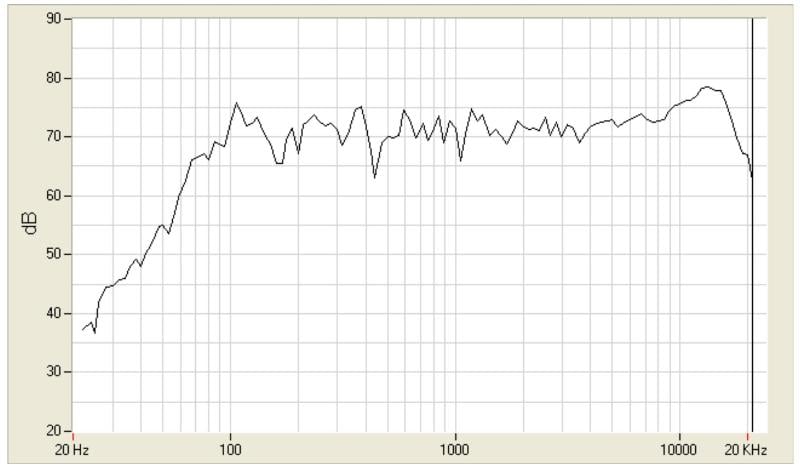
P162 1 Meter Frequency Response (1/12th
Octave) On Axis
Note:
this is NOT a 1 watt measurement
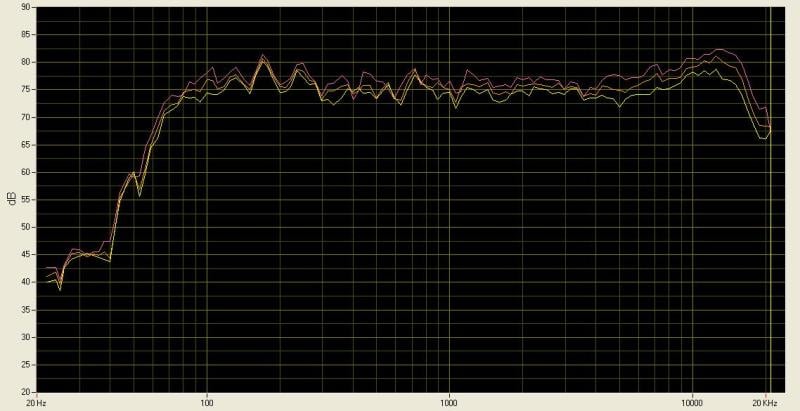
P162
1/2 Meter Frequency Response (1/12th Octave)
Pink - On axis, Orange - 15 degrees off axis, Yellow - 30
degrees off axis
As you can see, the response of the speaker is fairly uniform with a bit of a bump in the higher register - especially on axis. This is a speaker that should be positioned with a minimum of toe-in with the ear height no higher than the middle of the woofer.
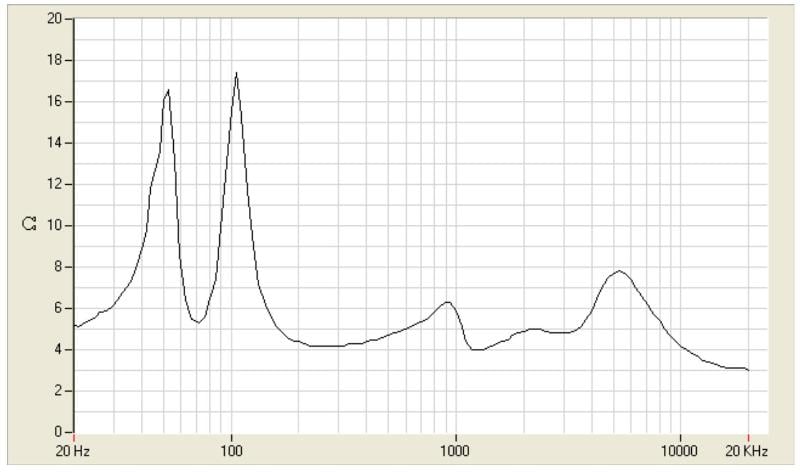
P162 Impedance
The Sencore consistently measures impedance one ohm low. I measured 5.5ohms at the terminals which lines up pretty well with the Sencore. Infinity claims 8 ohms and while not technically true, the benign impedance profile should match up well with most any receiver on the market. In conversations that Gene DellaSala (Audioholics President) has had with Dr. Floyd Toole of Harman, he stated that it’s a Harman requirement to have no speakers dip much below 4 ohms which is clearly evident in the design of this system.
Infinity P162 Listening and Conclusion
As always, the first thing I do with a new set of speakers is it test out their low end response. Infinity claims the P162s reach down to a fairly impressive 49Hz. Grabbing my trusty Rives Audio Test CD II, I tested out their claims. At my listening position, using the Radio Shack SPL corrected tones, I found that the response didn't really kick in until closer to 80Hz. At 40Hz and 50Hz I was getting output, but it was 10dB or more lower than the 80Hz response in my room. At 100Hz, the response jumped even a little more though much of that could be due to room effects. I don't know where Infinity got that 49Hz number from, but it seems a bit generous to me (in a corner-loaded way). In my room I crossed these speakers over no lower than 80Hz. Based on the measurements above, a more lively room might be able to stretch that to 60Hz.
I always like to use yello's the eye when setting up a pair of speakers. While it isn't the greatest album for "natural" sound, it does have a lot of phase shifting, low bass sweeps, and pans. This album gives even the best stereo speakers a run for their money. In this instance, I wasn't so worried about sound quality evaluation as I was about placement. Once I determined the toe-in (just a hair toward me), I was impressed with the P162's ability to provide a convincing side-to-side pan and a wide soundstage. With a pair of bookshelfs as large as the P162s (they aren't huge by any stretch but they are big), you'd expect a big sound. The P162s don't disappoint.
Bang & Olufsen Vol. XIII - The
Sound of Perfection
The first thing I
noticed with the B&O demo CD was the rock solid center image. The Infinity
P162s easily and effortlessly anchored the vocals directly between them and
never wavered. This is the sort of thing I love to hear in budget bookshelf
speakers. While the P162s are not exactly at a true "entry level"
price, they are well within reach of even the most budget minded enthusiasts.
Nothing is more impressive to a significant other that had doubts about a
speaker purchase than asking which speakers are playing, having them point at
the mains and the center, and then watching the look on their face as you tell
them only the mains are playing. It's the first thing I did when I bought my
Axioms way back when and I expect a lot of first time buyers investing in the
P162s will do the same.
Morecheeba
- Big Calm One of the things
about the my Denon AVR-2307CI is
that when you switch speaker sizes (large/small) for the mains, it resets the
two channel mode to "no sub" mode. This is fine most of the time as I
run full range mains but I occasionally forget to check that setting when I
install a review pair of speakers. I spent the first track or two of this listening
session without the sub (something I would have done on purpose eventually).
The P162s had a very respectable bass response, even sans the support of the Axiom EP500 sub. While my
direct (i.e. Rives Test CD) experience with the P162s showed a lack of bass in
my room, the bass it did have was very linear and pleasant even run full range.
While a sub is warranted for movies and some music, you're probably going to be
very pleased with your purchase without one. Just don't go borrowing a friend's
sub for a night - not knowing what you're missing is probably best.
One of the things
about the my Denon AVR-2307CI is
that when you switch speaker sizes (large/small) for the mains, it resets the
two channel mode to "no sub" mode. This is fine most of the time as I
run full range mains but I occasionally forget to check that setting when I
install a review pair of speakers. I spent the first track or two of this listening
session without the sub (something I would have done on purpose eventually).
The P162s had a very respectable bass response, even sans the support of the Axiom EP500 sub. While my
direct (i.e. Rives Test CD) experience with the P162s showed a lack of bass in
my room, the bass it did have was very linear and pleasant even run full range.
While a sub is warranted for movies and some music, you're probably going to be
very pleased with your purchase without one. Just don't go borrowing a friend's
sub for a night - not knowing what you're missing is probably best.
The biggest problem I experienced with these speakers was the high end. Fatigue quickly set in with extended listening sessions. While I didn't find myself wincing or in any sort of physical discomfort, I did find that I didn't really enjoy spending much time with the P162s at higher volumes for any prolonged length of time. This effect was only exacerbated by running the P162s without a sub. As I've found with other speakers, a full bottom end will sometimes mask high end problems. It doesn't solve them, but it will distract you long enough so that you don't notice them at first. Of course, if you're not planning on spending a lot of time with them at high volumes, this issue might be moot for you. This is really a limitation of a smaller tweeter like the one used in the Primus P162 which is likely going into extreme thermal compression and distortion at higher volume levels.
Rusted
Root - When I Woke With the amount and
variety of musical instruments that are used in When I Woke, I often feel like a Rusted Root concert would have to
have a huge stage for all the instruments - or risk looking like a Saturday
Night Live "cram them all in there" set. The Infinity P162s provided
a very nice and wide soundstage. While I wouldn't call it deep, the width was
definitely there. Again, when looking at a budget pair of speakers, width is
surely preferable to depth in that it is quickly identifiable. Center image was
again solid. For the most part, the left/right was very good - something I'd
noticed with the B&O demo disc. However, with Rusted Root, it seemed that
the farther to the side it was supposed to be anchored, the better
differentiated it sounded. As the sound moved toward the center, it tended to
blend in with the center image. This is in no way a slight - just an
observation. At just over $300 a pair (much less on sale), this is to be
expected.
With the amount and
variety of musical instruments that are used in When I Woke, I often feel like a Rusted Root concert would have to
have a huge stage for all the instruments - or risk looking like a Saturday
Night Live "cram them all in there" set. The Infinity P162s provided
a very nice and wide soundstage. While I wouldn't call it deep, the width was
definitely there. Again, when looking at a budget pair of speakers, width is
surely preferable to depth in that it is quickly identifiable. Center image was
again solid. For the most part, the left/right was very good - something I'd
noticed with the B&O demo disc. However, with Rusted Root, it seemed that
the farther to the side it was supposed to be anchored, the better
differentiated it sounded. As the sound moved toward the center, it tended to
blend in with the center image. This is in no way a slight - just an
observation. At just over $300 a pair (much less on sale), this is to be
expected.
Conclusion
 If I was designing a set of
budget bookshelf speakers and I wanted them to sell themselves, I'd focus on a
few things: Great center image, wide soundstage, and the lowest response I
could muster. Well, Infinity hit the nail on the head with this one. It is easy
to see how people are excited about these speakers - they do the stuff that is
most noticeable well. The aesthetics are a bit ho-hum for my tastes and I found
the highs to be more fatiguing than I'd like. The fact that the sweetspot for
listening is low on the speaker (below the woofer) means you'll probably need
some fairly high stands (minimum 30 inches). But it also indicates something
else - these are the perfect entry level speakers.
If I was designing a set of
budget bookshelf speakers and I wanted them to sell themselves, I'd focus on a
few things: Great center image, wide soundstage, and the lowest response I
could muster. Well, Infinity hit the nail on the head with this one. It is easy
to see how people are excited about these speakers - they do the stuff that is
most noticeable well. The aesthetics are a bit ho-hum for my tastes and I found
the highs to be more fatiguing than I'd like. The fact that the sweetspot for
listening is low on the speaker (below the woofer) means you'll probably need
some fairly high stands (minimum 30 inches). But it also indicates something
else - these are the perfect entry level speakers.
Infinity Primus P162
$159 (each)
Infinity Systems
250
Crossways Park Drive
Woodbury, NY
11797
516.674.4INF
About Infinity Systems
Infinity Systems is a unit
of Harman International Industries, Incorporated (www.harman.com). Harman
International designs, manufactures and markets a wide range of audio and
infotainment products for the automotive, consumer and professional markets,
and maintains a strong presence in the Americas, Europe and Asia, employing
more than 11,000 people worldwide.
The Score Card
The scoring below is based on each piece of equipment doing the duty it is designed for. The numbers are weighed heavily with respect to the individual cost of each unit, thus giving a rating roughly equal to:
Performance × Price Factor/Value = Rating
Audioholics.com note: The ratings indicated below are based on subjective listening and objective testing of the product in question. The rating scale is based on performance/value ratio. If you notice better performing products in future reviews that have lower numbers in certain areas, be aware that the value factor is most likely the culprit. Other Audioholics reviewers may rate products solely based on performance, and each reviewer has his/her own system for ratings.
Audioholics Rating Scale
 — Excellent
- — Very Good
- — Good
- — Fair
- — Poor
| Metric | Rating |
|---|---|
| Build Quality | |
| Appearance | |
| Treble Extension | |
| Treble Smoothness | |
| Midrange Accuracy | |
| Bass Extension | |
| Bass Accuracy | |
| Imaging | |
| Soundstage | |
| Dynamic Range | |
| Fit and Finish | |
| Performance |  |
| Value | |
As Associate Editor at Audioholics, Tom promises to the best of his ability to give each review the same amount of attention, consideration, and thoughtfulness as possible and keep his writings free from undue bias and preconceptions. Any indication, either internally or from another, that bias has entered into his review will be immediately investigated. Substantiation of mistakes or bias will be immediately corrected regardless of personal stake, feelings, or ego.
View full profile Subscribe to our newsletter