


HSU Research HB-1 Bookshelf Speaker Review
HSU Research HB-1 Bookshelf Speaker
- Product Name: HB-1
- Manufacturer: HSU Research
- Performance Rating:


- Value Rating:
- Review Date: April 12, 2007 20:00
- MSRP: $ 179 (Each - black or maple) right now on sale for $125
Woofer: 61/2½ treated paper cone woofer with treated cloth surround, flat polycotton spider and high temperature aluminum voice coil
Tweeter: Very high efficiency controlled directivity horn with neodymium magnet and ferro-fluid cooled voice coil.
Crossover: Computer aided, final voicing by Dr. Hsu (i.e., fine tuning by Dr. Hsu to sound good to his ears)
Frequency Range: 60 - 20 kHz
Recommended crossover to subwoofer/mid bass module: 80 Hz
Sensitivity: 92 dB/1m/2.83V rms, half space
Nominal impedance: 6 ohms
Minimum impedance: 4 ohms
Enclosure type: Vented
Enclosure material: 3/4½ MDF
Dimensions: 15½ H x 8½ W x 8½ D
Net Weight: 12.2 pounds, Shipping Weight: 14.5 pounds
Recommended Amplifier Power: 10 - 250 W rms
Pros
- Great for large rooms
- Good for movies
- Excellent price
Cons
- Small “sweet” spot
- Finicky placement for optimal imaging
- Poor aesthetics
HSU HB-1 Build Quality and Setup
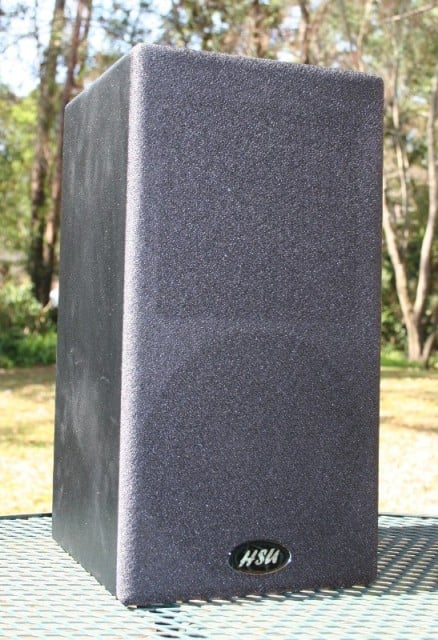 When a company like HSU Research with a reputation for making quality products (in this case subs) at extremely affordable prices announces a new product, we all sit up at attention. When they announce something other than a new model of a tried and true product in their current line, we raise an eyebrow. When the product is something new and different from anything they’ve ever offered before, well, we couldn’t help but get excited. The HB-1 is a horn loaded bookshelf specifically made to fill large rooms (large enough to contain one or more of HSU Research’s top end subs I’d imagine). It is designed to be crossed over at 80 Hz (the THX recommended crossover point) which mean that it has the ability to seamlessly blend with a quality subwoofer or two (perhaps even an HSU model). So far, it sounds like HSU Research is trying to make themselves a “one stop shop” for high-end audio.
Build Quality
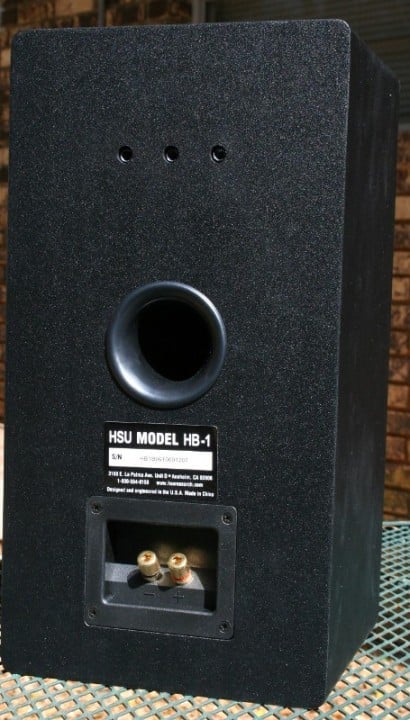
 Each HB-1 arrived in its own box, perfect if you are putting together a 6.1 system (no silly “they only come in pairs” rules). The speakers are quite a bit larger than I expected, almost as tall as my old Axiom m22’s but a bit wider. The horn loaded tweeter takes up nearly half the real estate on the front baffle and looks even bigger than the 6.5” woofer. The corners are rounded and the entire speaker is wrapped in black vinyl. There are no feet or provisions for feet on the bottom of the speaker. HSU Research didn’t even provide any sticky rubber or felt pads assuming that you’d already have them on your stands. The back of each speaker has a pair of binding posts and three threaded inserts for wall mounts. In the middle of the back of the speaker there is a flared port.
 The HSU logo is prominently displayed on the grill. The grill also matches the color of the vinyl wrapping that, in the right light, is hard to distinguish between the two. Honestly, there were times that I had to look for the logo to know where the front of the speaker was. However, when there was a lot of direct front light, the shiny finish on the horn would reflect and show through. The grills are very sturdy and well connected. The posts on the grill are plastic and have enough resistance so that you have to work a bit to get them off. The plastic posts make me a little nervous that they will someday bend or break with frequent removal of the grill. I’d feel better if the post was metal but that worry is probably unfounded.
Aesthetically, with the grills on, the HB-1 resembles the SVS SBS-01 offerings except for the size. Because the speakers are so much larger, I find them to be a bit less attractive (note – I didn’t find the SBS’s all that attractive to begin with). On top of that, their appearance earns less points in the WAF department with the grill off (something I rarely say) so there is little you can do to improve the aesthetics less building them into an entertainment center which may compromise performance. With the grills on, as flat black speakers are wont to do, they blend into a darkened room very well.
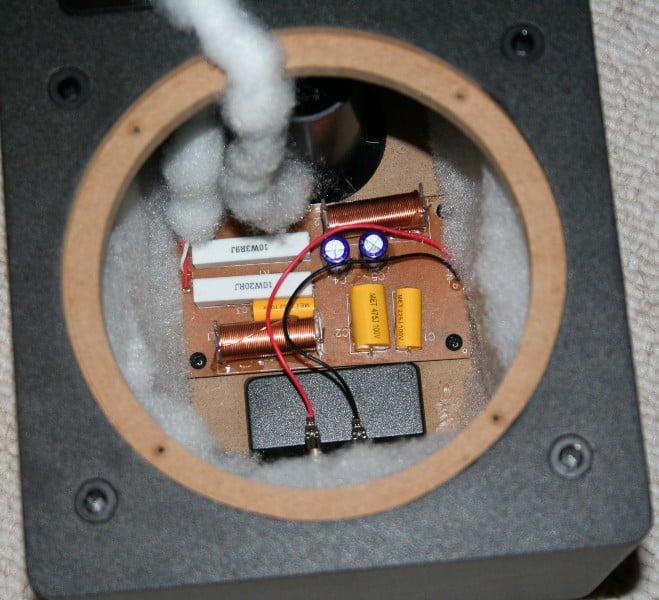
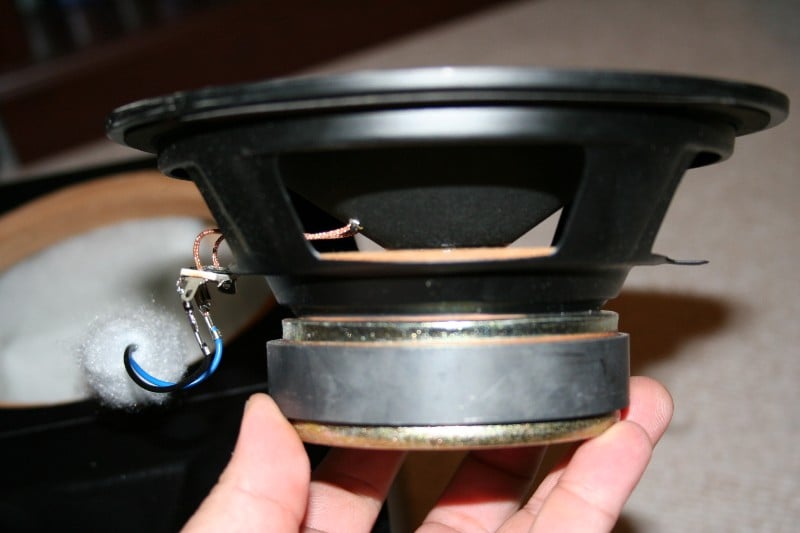
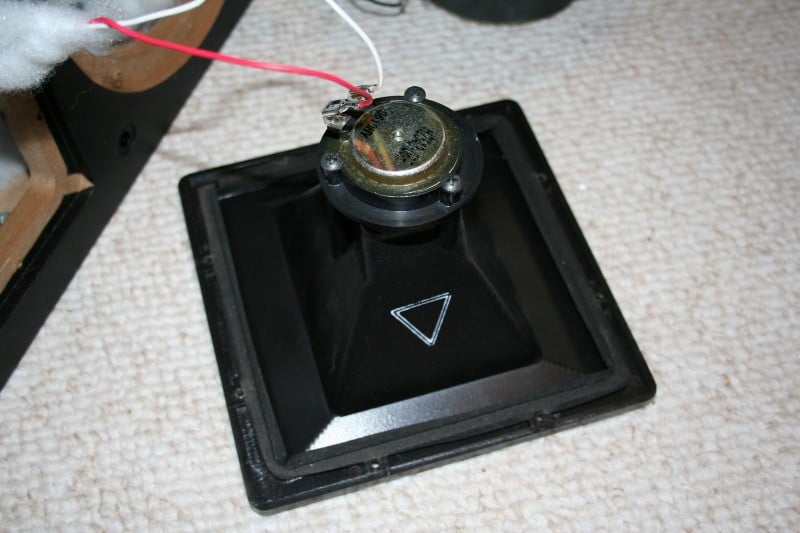
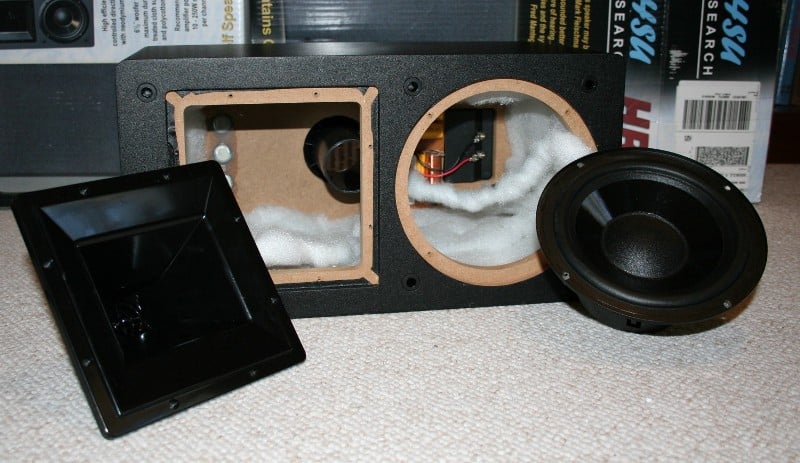
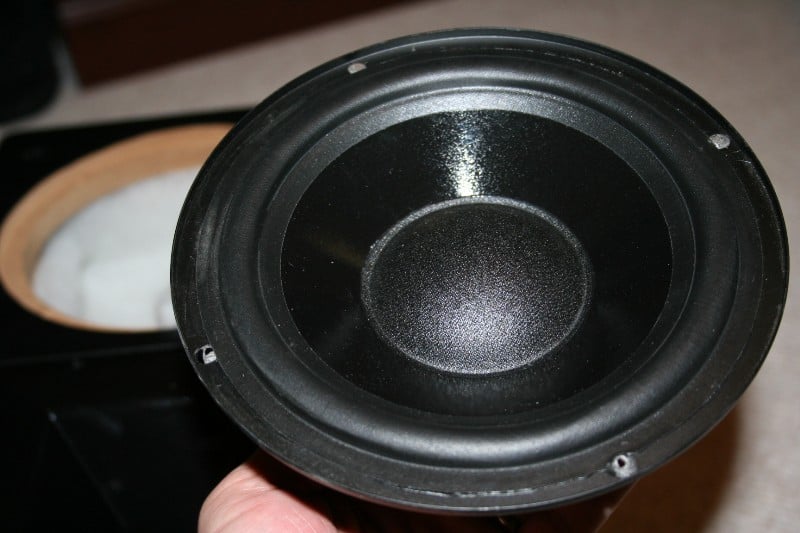
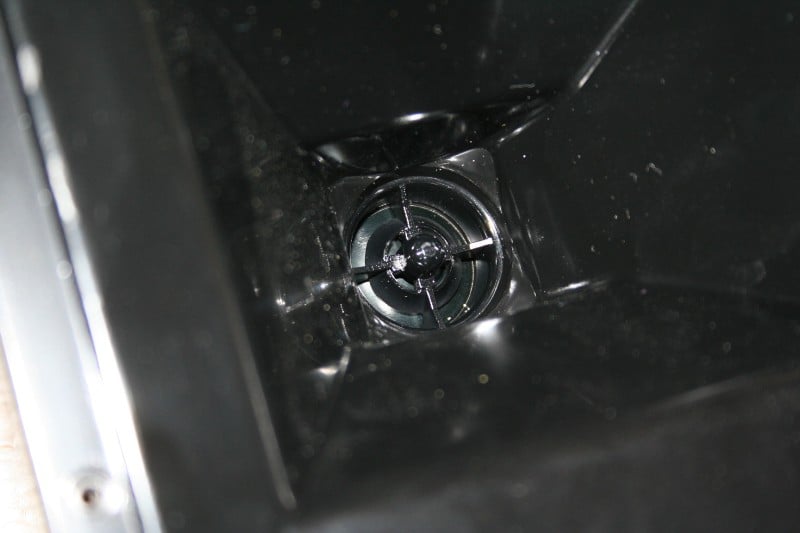
Cracking open the speakers, it was (for once) easy to see all the component parts. The crossover was mounted on the back wall just below the port and above the binding posts. The 6.5” woofer was secured by a plastic vanity ring over the metal surround which helps reduce the transfer of driver to cabinet resonance. The woofer basket is stamped which is to be expected at this price point. I was particularly impressed with the rigidity of the woofer material – it was much harder than other treated paper woofers I’ve experienced in the past. I confirmed that the unit was constructed out of ¾” MDF and it was lined with a thin layer of polyfill. There was no additional internal cross bracing. The port was flared on the outside but not inside which helps to reduce port turbulence noise. The drivers are NOT shielded so you best keep these speakers away from a CRT display or magnetic media storage device.
Setup
 Because of the size of the speaker, you need to be careful what size stands you buy. For my seated position, a 30” stand was about 10” too high. I wouldn’t go with anything taller than a 24” stand (and perhaps something shorter in my case). Remember, the tweeters should be about ear height. The center of the tweeter is about 11” from the bottom of the speaker which should help you when stand shopping. Positioning these speakers was either extremely easy or extremely hard depending on the level of precision you were looking for. A directivity horn is like a laser. If it is pointed right at you, it sounds one way, if it isn’t… well, it sounds different. In this case, different isn’t necessarily bad. For precise imaging, you’re going to want to follow the “golden triangle” (same distance between you and each of the speakers as the distance between the speakers) with the speakers pointed directly at you. This will give you the best possible imaging. If you can’t (or don’t want to) do that, then go ahead and point them straight forward. They still imagine OK but the soundstage is much more diffuse. There are a single set of 5-way binding posts on the back ensuring that the bi-wire debate is moot. I can imagine no sane reason to need a separate amp for a horn loaded tweeter anyhow.
Author’s Note: I actually ended up testing two sets of these speakers. The first set I never could get to image correctly. HSU Research believed that there was a problem with the first set and sent me another. Unfortunately (for the purposes of this review) the new set also had upgraded tweeters. The new speakers imaged much better but now I can’t be sure that this is because the first pair were defective or because of the upgraded tweeters. As HSU Research has indicated that the new tweeters simply extend the frequency response above 20 kHz and eliminate a small peak at 12 kHz, I’m inclined to believe that the first pair was defective.
HSU Research has a lot of suggestions for placement of these speakers in their owner’s manual:
The distances to the three nearest solid surface should be in the ratio 1:1.26:1.60. When you have the distance to the floor the greatest, for a typical ear height of 40" (i.e., woofer 34" off the floor), this translates into 21 and 27" from the two nearest walls. If the HB-1 is used as a center channel, it’s best to use it in the normal upright position just like the left and right speakers. You can also lay it on its side at the expense of horizontal polar response.
 After busting out my slide rule… I went ahead and just placed them where I normally place speakers. In my world, speaker placement doesn’t take a degree in mathematics. The manual goes on to dissuade someone from wall mounting these speakers because of the port - basically, it suggests that you should use a “swivel” type mount to increase the distance between the rear of the speaker and the wall. This is generally a good idea in that it gives the port some room to “breathe” and it reduces boundary reinforcement which could bloat the bass response. These creates some confusion for me in that they have obviously included threaded inserts on the back of the speaker for wall mounting but then designed the unit with a rear port and imply that wall mounting isn’t the best idea. Better, I think, that they relocate/remove the port or remove the mounting hardware. This won’t stop people from wall mounting them but it will show the user that wall mounting isn’t the optimal placement. Sure, removing the port may decrease the bass output but then you wouldn’t have as many placement concerns.
HSU HB-1 Listening Tests and Conclusions
These speakers are obviously meant to be used with a sub (obvious because HSU said so) so that is how I conducted the listening tests. Crossing the unit over at 80 Hz (also recommended by HSU), it mated well with my Axiom EP500. I was surprised at how well these speakers mated with my other Axiom speakers as well. Often when I integrate new speakers into my room for reviews, I’m forced to try and pair them with my current rig. This can cause… problems. Especially when you are trying to match the fronts. Add to the fact that these are horn loaded and the Axioms have a titanium domed tweeter and the HSU’s are quite a bit more sensitive and … well, you can see why I was worried. Overall, I have to say, that these speakers mated better with the Axiom VP100 center channel than I ever thought possible. The timbre matching was fairly close. I didn’t experience nearly the problems I have in the past with other speakers. Do I suggest you assume that the HB-1’s will match any speakers? No. If you are looking at purchasing a system you should probably just get the entire HSU system rather than hope they’ll match well with your current gear.
CD: Rives Test CD 2 As has become the norm for me lately, I started off taking a listen to the Rives Test CD 2 to get an idea of the frequency response of these speakers. Understand, these are just impressions of “useable” bass in my room. Your results may vary considerably. At first, I was surprised at how low a tone I was hearing from these speakers. As low as 31.5 Hz was audible… until I realized it was 99% port noise (surprisingly it wasn’t the annoying chuffing I’ve come to associate with port noise). At 50 Hz I was hearing about 50% port and 50% tone. 63 Hz was mostly tone (chuffing was barely audible at my seated position), and 80 Hz was all tone. For an experiment I stuffed the ports to see how this would affect the bass. Sure enough it tightened it up… all the way to non-existence in some cases. I wouldn’t suggest this unless placing the speakers directly against a wall surface is unavoidable.
CD: Soundtrack to Miss Saigon [Original London Cast] OK, time to come clean. Back in the day I was a drama major. One of the side effects is having a small collection of Musical Theater CDs and a lot of “you’re a waste of a perfectly good gay man” comments. I wanted to hear how well these speakers reproduced female voices. Miss Saigon is a good choice in that it has two main female characters – one is an extremely rare contralto part while the other is the more common mezzo-soprano. This gives me a good sampling of a large range of female vocals. Songs like “I Still Believe,” “The Movie in my Mind,” and “Now that I’ve Seen Her” offer some of the most compelling and engaging female songs in any musical I’ve seen in years.
I’ve seen this musical in person a number of times so I know how it should sound. The HB-1’s really did a great job at presenting not only the force behind some of these incredible performances, but the nuances. Horns are known for being dynamic and for being able to be driven to insane levels with the most modest of sources. And the HB-1’s are no different. I drove these speakers louder than every other speaker that has been in my system without any audible distortion. And I never felt like I was pushing the limits. All I got from these speakers was the feeling Ivan Drago must have gotten when he said, “He's not human. He's like a piece of iron.” These speakers just didn’t want to give up. For the most part, at moderate to high volumes, I found them to be much more forgiving than I was expecting. These are highly efficient, 6 ohm rated speakers which means any decent amp section can drive them without incident. My Denon AVR-3805 had no problems driving these speakers but it did get quite hot after an hour of so of loud listening.
CD: Rusted Root – When I Woke To give the men equal time (well, not really, I’m not that magnanimous) I stuck in Rusted Root, an album that I am intimately familiar with. While I was focusing mostly on the male vocals, I couldn’t help but notice again the contralto and soprano backup singers. In particular Beautiful People stuck out as a test not only of the HB-1’s ability to handle male and female vocals but their ability to contend with quickly changing volumes and tones. Dynamics were very good and the male vocals were handled well. There is a plethora of information in this album; of course the vocals and main instruments but also a number of reeds, brass, cowbells, and just about everything else you can think of. At no time did I think the HSU Research HB-1’s were tainting any of these instruments. Each rang true to my ear.
CD: Yello – the eye When testing imaging, I had to go back to my old standard. The eye has some of the most annoying songs that are some of the best tests for imaging, soundstage, and bass response. So, fun listening – no, good testing – yes. I played a lot with the toe-in and positioning of these speakers and confirmed that proper positioning really made a big difference in the imaging. I was first introduced to this album on a set of electrostats (which are known for tiny sweet spots and crazy imaging). The HSU Research HB-1’s gave me a feeling similar to that first experience… when properly placed and toed in. Otherwise the imaging was just OK. For those of you that have never really experienced great imaging, you’re going to be in for a treat. At times, the music almost seems like it is coming from your head. The HB-1’s do a good job of doing that with the proper placement. The problem – it is a hard thing to share. The sweet spot isn’t tiny, but you’re probably going to have to be pretty close friends to share it if you know what I mean.
DTS CD: Diana Krall – Love Scenes (read the review) It isn’t really fair to test these speakers on a surround CD but I made an exception because most of the information on this DTS CD is conveyed from the left and right channels. Plus this is just a darn good album to listen too. It really helped the soundstage to have a little of the vocals coming from the center channel – which served to anchor them regardless of placement. The upper bass notes and piano all sounded very lifelike and clean. This album is known for having some of the best sound quality on any format, except for the occasions where they drove the mic preamps into clipping which is only revealed by the very best systems and astute pair of ears. I felt like the HB-1’s did a good job of conveying this without coloring the music in any way.
Recommendations
 It is so hard to say anything critical about a speaker at this price point. Still, they aren’t the only game on the block in the ~$250 range. My only real complaint was the small sweet spot. Also, and less importantly, I wouldn’t mind seeing some threaded inserts included on the bottom of the speaker incase someone wanted to install feet for placement on a shelf or display stand. At the very least, HSU Research should consider throwing in a few sticky rubber or felt tabs to attach to the bottom of the speaker. I know that there is a maple version of this speaker but I’ve seen no pictures of it. I suspect they would be more aesthetically pleasing than the black versions I tested. Regardless, after the HB-1’s were set up in the room for a while they didn’t draw attention to themselves, but they were definitely not a conversation piece.
Conclusion
 While I didn’t write up any of my experiences with these speakers and movies (movies are too reliant on the other speakers to fairly test a pair of bookshelves), I believe that this set (along with the HSU Research matching center channel the HC-1) would be a fine choice for movies. The price is very competitive especially considering that they are going for $125 a pop right now. You can get a 5.1 setup with one of HSU Research’s award winning subs for under a grand. That is something movie buffs should think hard about. I would highly recommend people looking for rear surround speakers on a budget to consider the HB-1’s. I suspect that they would perform surround (and especially surround back) duties very well. For serious critical music listening, you’ll need to pay particular attention to placement. But I would think that surround music (something recorded in DTS or a multichannel SACD or DVD-A) would sound great. What we have here is a very good speaker for an entry level system. And by entry level I mean would trounce nearly any other system that people would consider to be “entry”. Easy to setup, easy to power, and easy on the wallet. Paired with one of HSU Research’s subs and you’ve got a winning combination. This should make the short list of all fledgling Audioholics looking for an affordable but impressive solution.
Hsu Research Inc.
3160 E. La Palma Ave, Unit D
Anaheim, CA 92806
www.hsuresearch.com
About HSU Research
HSU Research, Inc. began as a specialized deep bass research company in 1991. Dr. Hsu started the business shortly after receiving a PhD in engineering from MIT. He moved to Orange County, California with the dream of making the world’s best subwoofers.
Dr. Hsu started with a subwoofer made of recycled cardboard tube called a sono-tube. It was seven feet tall. The experiment was powerful, and played pristine bass notes deeper than humans can hear, down to 16 Hz. Dr. Hsu called the design a "true subwoofer."
In 2003, Dr. Hsu aimed for the mass market with the STF subwoofer series and Ventriloquist surround system. Dr. Hsu felt that high performance audio was gaining recognition and popular acceptance. Instead of throwing money into flashy parts, as is typical in the mass market, money went into high performance components. The new products reflected Dr. Hsu's beliefs that superior audio performance and reliability should be available to many people, not just a privileged few.
In 2006, Dr Hsu applied for patents on several new technologies, including the turbocharger, mid-bass module (positional optimization of low frequency reproduction), and a way of bending a port tube so it will perform as well as a straight port. The year 2006 also marked the acceptance of the Ventriloquist patent. These advances further widen the gap between the performance of a HSU product and the competition.
Today, Dr. Hsu spends his time behind the scenes, developing products for Fortune 500 companies and consulting privately with his customers. His goal is to design best-of-breed audio technology for the smart masses. Honesty, a mastery of engineering, and sound innovations define HSU Research.
The Score Card
The scoring below is based on each piece of equipment doing the duty it is designed for. The numbers are weighed heavily with respect to the individual cost of each unit, thus giving a rating roughly equal to:
Performance × Price Factor/Value = Rating
Audioholics.com note: The ratings indicated below are based on subjective listening and objective testing of the product in question. The rating scale is based on performance/value ratio. If you notice better performing products in future reviews that have lower numbers in certain areas, be aware that the value factor is most likely the culprit. Other Audioholics reviewers may rate products solely based on performance, and each reviewer has his/her own system for ratings.
Audioholics Rating Scale
 — Excellent
- — Very Good
- — Good
- — Fair
- — Poor
| Metric | Rating |
|---|---|
| Build Quality | |
| Appearance | |
| Treble Extension | |
| Treble Smoothness | |
| Midrange Accuracy | |
| Bass Extension | |
| Bass Accuracy | |
| Imaging | |
| Soundstage | |
| Dynamic Range | |
| Fit and Finish | |
| Performance |  |
| Value | |
As Associate Editor at Audioholics, Tom promises to the best of his ability to give each review the same amount of attention, consideration, and thoughtfulness as possible and keep his writings free from undue bias and preconceptions. Any indication, either internally or from another, that bias has entered into his review will be immediately investigated. Substantiation of mistakes or bias will be immediately corrected regardless of personal stake, feelings, or ego.
View full profile Subscribe to our newsletter