


Dynaudio Audience 52-SE Loudspeaker Review
Dynaudio Audience 52 Special Edition
- Product Name: 52-SE
- Manufacturer: Dynaudio
- Performance Rating:

- Value Rating:

- Review Date: November 29, 2004 18:00
- MSRP: $ 1400
|
Sensitivity (2.83 V/1 m): |
86 dB |
|
Recommended Amp. Power: |
Small size rooms: >25 watts |
|
IEC Long Term Power Handling: |
150 watts |
|
Impedance, Nominal: |
4 ohms |
|
Impedance, (20-200 Hz): |
3.4 - 19.3 ohms |
|
Impedance, (200-20 kHz): |
3.4 - 6.7 ohms |
|
Impedance, Phase Shift (20-200 Hz): |
-49° - +45° |
|
Impedance, Phase Shift (200-20 kHz): |
-4° - +18° |
|
Impedance, HF (200 kHz): |
6.2 ohms |
|
Frequency Response (+/- 3 dB): |
45 Hz - 26 kHz |
|
Resonance Frequency: |
47 Hz |
|
Internal Cabinet Volume: |
10 litres |
|
Enclosure type: |
Bass reflex |
|
Weight: |
7.2 kg |
|
Dimensions (W x H x L): |
204 x 330 x 256 mm |
|
Crossover: |
2 way, impedance corrected |
|
Crossover Frequencies: |
2700 Hz |
|
Crossover Slope: |
Woofer 6 dB/oct; Tweeter 6 dB/oct |
|
Connection: |
CE compliant insulated gold binding posts |
|
Recommended Placing: |
Stand |
Pros
- Excellent bass extension and overall fidelity
- Open and airy highs without overabundant sibilance
- Impressive soundstage
- Easy amplifier load
Cons
- Boxy appearance
- Par midrange performance
- Woofer bottoming during heavy bass output
- Pricey
Dynaudio Audience 52 SE Company History
Founded in Denmark in 1977, Dynaudio initially manufactured speakers using its own crossovers while relying on OEM drivers. Within three years, all of Dynaudio loudspeaker systems were equipped with their own drivers which were developed by their in-house R&D team. At this point in time, Dynaudio began selling its drivers to other speaker manufacturers. According to Wilfried Ehrenholz, Dynaudio's co-founder and sole owner " This proved to be a very successful move because, while there are many different speaker manufacturers, there are only a few driver manufacturers - and even fewer at the quality end of the market. Within a very short period of time Dynaudio drivers became popular all over the world and were widely recognized for their quality by audiophile consumers ".
Although Dynaudio's fame centers around its drivers, the company's biggest business has been and continues to be its finished home audio loudspeaker systems. At the present, over 55% of Dynaudio's worldwide annual sales are attributed to its Authentic Fidelity home audio loudspeaker line.
While the company is best known as a producer of drive units, the smallest part of Dynaudio's overall business (about 3%), ironically, is in fact the sales to OEM users (which include some of the world's highest regarded loudspeaker manufacturers) and the DIY hobbyist market. As of January 1, 2000 , Dynaudio officially stopped all production and support of the hobbyist drivers and kits. The market was so small in the grand scope of the company's production, that the decision was mostly based on this fact.
Dynaudio's manufacturing facilities are based in Skanderborg , Denmark , where both production and R&D is conducted. The company's worldwide sales, marketing, and distribution offices are headquartered in Hamburg , Germany . Drivers are manufactured under laboratory conditions in a recently expanded facility dedicated to driver production, while all high quality cabinets are produced in a separate specialized carpentry facility isolated from the driver production.
According to Ehrenholz, " an increasing worldwide demand on high quality loudspeakers fueled in part by new digital recording technologies and better educated consumers provides Dynaudio a perfect platform to increase its market share. Over the past decade, the company has experienced consistent growth and has added additional personnel, while also expanding its research and development. At present, Dynaudio invests more than 10% of its annual turnover on R&D."
52-SE First Impressions, Setup, and Tests
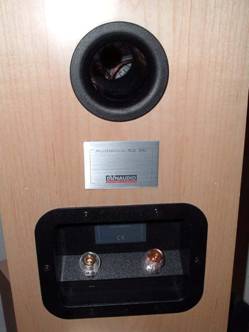
Over the years I have heard many great things about Dynaudio speakers, particularly the quality of their drivers which up till this point I only knew that they looked really good and were very expensive. You could imagine my level of enthusiasm when Dynaudio decided to send me a pair of their speakers for review. Enter the Audience 52-SE. These speakers were based on the original 52 design, but with upgrades in crossover components and drive units.
The Dynaudio 52 SE's are a two-way bookshelf, rear ported design. The binding posts were WBT with a little notch at the bottom to accommodate European style connectors. I found the spacing between the (+) and (-) terminals a bit perplexing and frankly inconvenient when trying to connect most manufactured speaker cables that keep the (+) and (-) conductors as closely spaced as possible to minimize inductance. I found that I had to physically separate the conductors at the end of the cable near the connectors in order to connect to these speakers.
Note: Standard spacing for years has been ¾" to accept dual banana plugs. However we learned in the past when reviewing the Canton DC 2 Loudspeakers that European products generally conform to this wider spacing arrangement to prevent consumers from accidentally plugging their appliances into them.
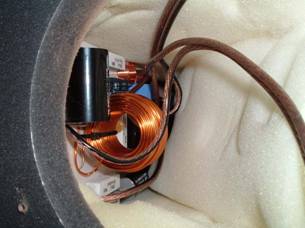
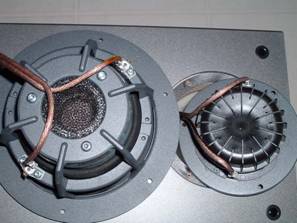
Dynaudio 52 SE Xovers (left pic) and Drivers (right pic)
 Inside the 52 SE resides a crossover network endowed with costly air core inductors, polypropylene capacitors and ceramic resistors. The cabinet was well insulated as a whole, lined with bitumen to minimize cabinet resonance, and the front baffle was almost 1" thick, but I was mildly surprised to find the cabinet was absent of baffling or vertical bracing.
The mid/woofer driver was a rather unusual design with such a large vented pole piece and voice coil and cast frame. It was obvious that this driver was a serious contender for producing bass, but it remained to be seen if it would serve midrange duties with equal favor. The tweeter also contained a large motor structure and sealed rear chamber indicating it could handle large amounts of power and play lower in frequency compared to most conventional designs.
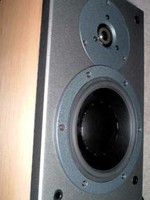
I was startled to see the woofer was not recessed into the baffle. I find it bad practice not to do so and remain puzzled why a few loudspeaker companies fail to realize the merits of the diffraction reducing benefits. The same could be said about the cabinet shape itself. In high performance loudspeaker design, every little bit helps, including rounding off the corners, again a good diffraction reducing technique that doesn't cost a whole lot in production, but can go a long way in fidelity enhancement.
Set-Up
I mounted the 52 SE's on my 30" sand filled metal stands where my reference bookshelf speakers normally reside. The 52 SE's are physically similar in size, thus made these stands very suitable for these speakers since they allowed for the speaker's tweeters to be at ear level in the seated position. I found placing these speakers a few feet from side and back walls with slight toe-in yielded the most optimal sound in my listening environment. The speaker separation was about 8 feet and my seated position was about 10 feet away. The associated audio gear used for this review was the Onix A120 Mk.II integrated amplifier, Audience modded Sony SCD-CE775 SACD changer, RBH 1010-SEP subwoofer, RE Designs Interconnects and Cardas Crosslink 1S speaker cables with banana plugs. Dynaudio was adamant about breaking these speakers in prior to critical listening tests so I kindly asked them to do it to save me some time.
Listening Tests
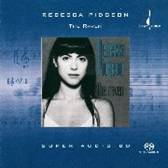 I began with Rebecca
Pidgeon's -
The Raven
SACD. Both the normal CD and SACD layers are excellent recordings that
will reward you with sonic bliss if your system and room are capable of unlocking its
potential.
I chose this recording because it really demonstrates how well a speaker can convey
vocals.
Rebecca's voice came through on the Dynaudio 52-SE's with full body and presence, but
seemed to lack the articulation and intimacy I was so familiar with on similarly priced
systems.
While these speakers were no slouch in this category, they just simply were not
exemplary either.
I would say thus far my impression of female vocals on these speakers was
par.
However, what made me stand at attention was the excellent bass extension and response I
was hearing from these speakers.
When listening to "Spanish Harlem", I was most
impressed.
I swore there was a subwoofer playing during this song, and felt the 52-SE's
delivered beyond their call of duty in this instance.
I began with Rebecca
Pidgeon's -
The Raven
SACD. Both the normal CD and SACD layers are excellent recordings that
will reward you with sonic bliss if your system and room are capable of unlocking its
potential.
I chose this recording because it really demonstrates how well a speaker can convey
vocals.
Rebecca's voice came through on the Dynaudio 52-SE's with full body and presence, but
seemed to lack the articulation and intimacy I was so familiar with on similarly priced
systems.
While these speakers were no slouch in this category, they just simply were not
exemplary either.
I would say thus far my impression of female vocals on these speakers was
par.
However, what made me stand at attention was the excellent bass extension and response I
was hearing from these speakers.
When listening to "Spanish Harlem", I was most
impressed.
I swore there was a subwoofer playing during this song, and felt the 52-SE's
delivered beyond their call of duty in this instance.
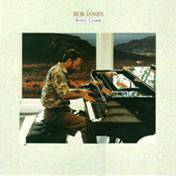 Bob James -
Ivory
Coast
is one of my all time Jazz CD favorites simply because they
just don't make music like this anymore.
It's melodic, its fluid, it's relaxing, and surreal;
atypical in today's smooth jazz genre.
Right off the bat, I liked what I was hearing on the
Dynaudio's.
The imaging was good, soundstage deep, the high end - extended and smooth as it
should be, and again the bass - well extended.
I wasn't sure if the
first order crossover
topology
or combination of robust driver design was responsible for the very realistic, almost
lifelike sound I was hearing, but on this CD, the Dynaudio's all but disappeared and what I was left
with was Bob's excellent piano ballads and accompanying instruments.
I found myself listening
to this CD in its entirety with the lights dimmed and a nice glass of red wine.
At this point
in my listening tests, I would categorize the Dynaudio's as recessed and slightly closed-in midrange,
deep blossoming bass, and sibilance free, clairvoyantly transparent highs.
I was
beginning to realize these speakers leaned more towards the jazz and percussion listener than they
did towards one who preferred the more vocal side of music.
Bob James -
Ivory
Coast
is one of my all time Jazz CD favorites simply because they
just don't make music like this anymore.
It's melodic, its fluid, it's relaxing, and surreal;
atypical in today's smooth jazz genre.
Right off the bat, I liked what I was hearing on the
Dynaudio's.
The imaging was good, soundstage deep, the high end - extended and smooth as it
should be, and again the bass - well extended.
I wasn't sure if the
first order crossover
topology
or combination of robust driver design was responsible for the very realistic, almost
lifelike sound I was hearing, but on this CD, the Dynaudio's all but disappeared and what I was left
with was Bob's excellent piano ballads and accompanying instruments.
I found myself listening
to this CD in its entirety with the lights dimmed and a nice glass of red wine.
At this point
in my listening tests, I would categorize the Dynaudio's as recessed and slightly closed-in midrange,
deep blossoming bass, and sibilance free, clairvoyantly transparent highs.
I was
beginning to realize these speakers leaned more towards the jazz and percussion listener than they
did towards one who preferred the more vocal side of music.
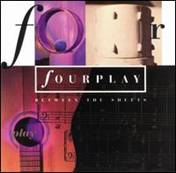 Just when I was about to declare the
Dynaudio Audience 52-SE's the definitive bass master of bookshelf speakers, I was thrown a curve
ball.
Fourplay's -
Between the Sheets
title track "Chant" is not for the wimpy speakers
at heart.
In fact, Fourplay should add a disclaimer to this CD - "
We don't warranty against
blown woofers, listen with care
".
I was eager to hear the bass response of this song on
the Dyne's and fired it up.
Instead I heard a shockingly loud popping sound predominantly out
of the right speaker each time the bass drum hit at the song's intro.
Thinking there must be a
defect in the woofers voice coil assembly, I immediately turned the music down, disconnected the
right speaker and re-listened with just the left one.
The popping sound surfaced again, but I
had to inch the volume up just a tad for it to be as loud as it was heard on the right speaker.
What I was hearing was the woofer bottoming out.
I was astonished to hear this in a modern day
speaker, especially since most drivers now employee a shorting ring on the bottom of the pole piece
to prevent the voice coil from going out of the gap.
Just when I was about to declare the
Dynaudio Audience 52-SE's the definitive bass master of bookshelf speakers, I was thrown a curve
ball.
Fourplay's -
Between the Sheets
title track "Chant" is not for the wimpy speakers
at heart.
In fact, Fourplay should add a disclaimer to this CD - "
We don't warranty against
blown woofers, listen with care
".
I was eager to hear the bass response of this song on
the Dyne's and fired it up.
Instead I heard a shockingly loud popping sound predominantly out
of the right speaker each time the bass drum hit at the song's intro.
Thinking there must be a
defect in the woofers voice coil assembly, I immediately turned the music down, disconnected the
right speaker and re-listened with just the left one.
The popping sound surfaced again, but I
had to inch the volume up just a tad for it to be as loud as it was heard on the right speaker.
What I was hearing was the woofer bottoming out.
I was astonished to hear this in a modern day
speaker, especially since most drivers now employee a shorting ring on the bottom of the pole piece
to prevent the voice coil from going out of the gap.
My recommendation here is either to use the volume control sparingly during bass-intense music listening sessions, or cross them over between 60 - 80 Hz or so, and supplement them with a subwoofer. The latter is the preferred choice, especially in a home theater environment. I found this worked very well and allowed me to turn the volume up to maximum levels I could comfortably listen too.
I continued listening to familiar source material that I run most loudspeakers through to get a good understanding of the performance capabilities of these speakers. At the end of my evaluation I was left with the conclusion that these speakers truly shined with percussion / jazz type music, but lacked the ultimate elements of intimacy in the midrange arena to convince me I was listening to a singer and not a speaker. Their Achilles heal perhaps was the bass / midrange driver with its long throw, large 3" diameter voice coil and oversized dust cap which seemed more suited for midbass duties than it did for a dedicated midrange. Perhaps a 3-way variant of this speaker would have been more appropriate and something we should check out in the future. Don't take this as a major blow against this speaker however. The Audience 52 SE's did a great job on instrumental music and classical. I think this is partly attributed to the excellent tweeter design and quality of crossover components employed. There were moments when I listened to this speaker that I thoroughly enjoyed them and you may wallow in them as well if they suit your musical tastes.
52-SE Recommendations and Measurements
The Dynaudio Audience 52 SE's proved to be an
enjoyable speaker to both listen to and review.
Though I was a bit perplexed by a few inherent
design anomalies such as the lack of recessing the woofer into the baffle and lack of countermeasures
to ensure no woofer bottoming.
Perhaps a different bass alignment would be more appropriate in
this design.
I couldn't help to wonder just how much further Dynaudio could have pushed the
envelope of performance by employing a few design techniques to overcome the deficiencies
noted.
In any case, overall, these were fine sounding, well crafted
loudspeakers and if
used within the defined limits stipulated in this review, they should serve well for critical two
channel listening and a full blown home theater system.
Measurements and Analysis
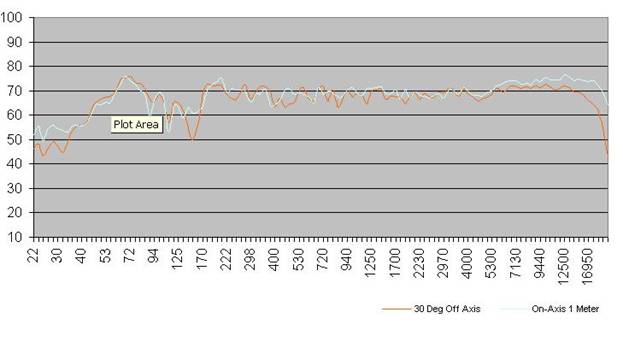
The 52-SE's exhibited excellent frequency extension, but with a slight de-emphasis of about 6-7 dB in the midrange between 500Hz and 4kHz. This explains why I felt the midrange performance was a bit lacking in this speaker or another way to put it was the high frequency extension was a bit more upfront. The dip between 90Hz to 170Hz was likely attributed to a measurement anomaly as it did not surface when retaken at the listening position. Usable bass extension was about 45Hz as promised in the design, but because of the potential of bottoming the woofers, I would recommend crossing them over at about 60-80Hz and mate them with a subwoofer. Off axis response of the speaker was uniformly good and I recommend a slight toe-in to achieve the smoothest response at the listening position.
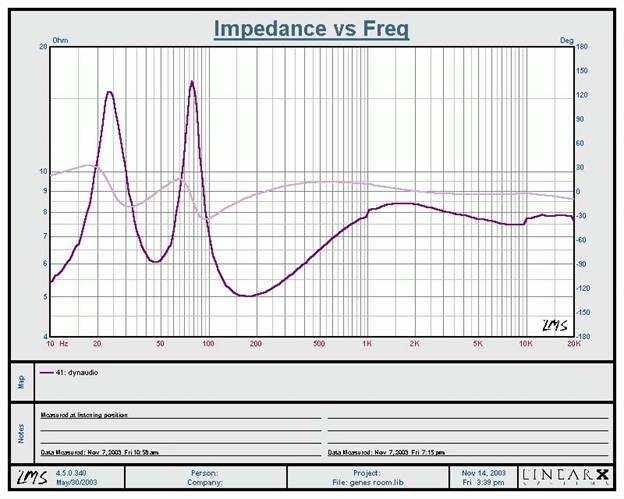
The impedance plot (dark purple) of the 52-SE's was generally excellent and should prove a moderately easy load for any decent amplifier in a receiver to drive. The impedance dips to 5 ohms from 100Hz to 400Hz but overall maintains around 8 ohms impedance. I am puzzled why Dynaudio conservatively rated them as a 4 ohm load impedance. Perhaps they did so to be on the safe side, especially given their moderately low sensitivity. The port tuning of 45Hz as specified by the manufacturer, appears as measured in the frequency response as well as the saddle point between the two peaks in the impedance plot.
The phase plot (light purple) is also excellent, maintaining a +- 30 degree window within the low to mid bass region and almost a resistive load impedance above 500Hz. This is better than specified by the manufacturer and again indicating a rather benign load impedance and relative easy load for an amplifier.
The Score Card
The scoring below is based on each piece of equipment doing the duty it is designed for. The numbers are weighed heavily with respect to the individual cost of each unit, thus giving a rating roughly equal to:
Performance × Price Factor/Value = Rating
Audioholics.com note: The ratings indicated below are based on subjective listening and objective testing of the product in question. The rating scale is based on performance/value ratio. If you notice better performing products in future reviews that have lower numbers in certain areas, be aware that the value factor is most likely the culprit. Other Audioholics reviewers may rate products solely based on performance, and each reviewer has his/her own system for ratings.
Audioholics Rating Scale
 — Excellent
- — Very Good
- — Good
- — Fair
- — Poor
| Metric | Rating |
|---|---|
| Build Quality | |
| Appearance | |
| Treble Extension | |
| Treble Smoothness | |
| Midrange Accuracy | |
| Bass Extension | |
| Bass Accuracy | |
| Imaging | |
| Soundstage | |
| Dynamic Range | |
| Performance | |
| Value |  |
Gene manages this organization, establishes relations with manufacturers and keeps Audioholics a well oiled machine. His goal is to educate about home theater and develop more standards in the industry to eliminate consumer confusion clouded by industry snake oil.
View full profile Subscribe to our newsletter