


DALI Mentor 1 Bookshelf Loudspeaker Review
- Product Name: Mentor 1 Bookshelf Speaker System
- Manufacturer: DALI
- Performance Rating:

- Value Rating:

- Review Date: April 16, 2007 18:04
- MSRP: $ 1,800/pr
| Frequency range +/- 3 dB Sensitivity (2.83V/1m) Nominal impedance Maximum SPL Recommended amp. power Crossover frequencies Hybrid tweeter module Low frequency driver(s) Enclosure type Bass reflex tuning frequency Connection input(s) Recommended placement Dimensions (H x W x D) Dimensions (H x W x D) Weight Finish |
45Hz – 34 kHz 86.0 dB 6 ohms 106 dB 40 – 120 watts 3.4 kHz /12 kHz 1 x 28 mm soft dome 1 x 17 x 45 mm ribbon 1 x 5" Bass reflex 47 Hz Single Wire Stand, shelf, on wall (via wall mount kit) 31.8 x 16.2 x 24.1 [cm] 12.5 x 6.4 x 9.5 [inches] 5.2 / 11.5 [kg/lb] Cherry |
Pros
- Exceptional clarity and detail
- Small form factor
- Nice aesthetics
Cons
- Elevated tweeter response tends to sound bright
- Expensive
Introduction
DALI is a loudspeaker company whose name seems to come up from time to time both online and in casual conversations with my Audioholics peers. Everyone kind of equates them with high end, but typically haven’t heard a pair- at least not here in the USA. My first exposure to their product line was back at CES 2007. I was most impressed with the Mentor product line build quality, aesthetics and most importantly – the sound. They put on quite a nice demo at the show and the group of DALI reps was very courteous and knowledgeable about their product line. I was eager to get a pair in for review and was happy to see DALI make good on their promise to give us the exclusive on their brand new bookshelf speaker the Mentor 1.
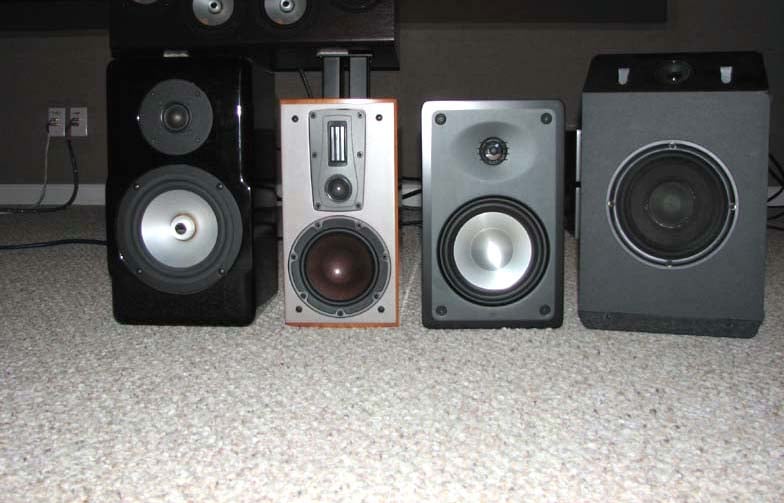 When the Mentor
1’s arrived, they did so in two boxes. I
thought, "Boy those speakers must be bigger than I was told and certainly
much heavier." To my surprise DALI
accidentally sent two pairs of Mentor
1’s by accident (hey, I am not complaining).
It was a refreshing surprise to get a hold of a bookshelf speaker that
occupies a small footprint. As you can
see in the image, these speakers are the smallest of the pairs I had at my
disposal – about 2/3rds the size of the Bose 201’s. Now all I had to do was determine if they
delivered the sonic goods to satisfy the Audiophile at heart whose constrained
by the WAF factor.
When the Mentor
1’s arrived, they did so in two boxes. I
thought, "Boy those speakers must be bigger than I was told and certainly
much heavier." To my surprise DALI
accidentally sent two pairs of Mentor
1’s by accident (hey, I am not complaining).
It was a refreshing surprise to get a hold of a bookshelf speaker that
occupies a small footprint. As you can
see in the image, these speakers are the smallest of the pairs I had at my
disposal – about 2/3rds the size of the Bose 201’s. Now all I had to do was determine if they
delivered the sonic goods to satisfy the Audiophile at heart whose constrained
by the WAF factor.
Build Quality
Design Overview
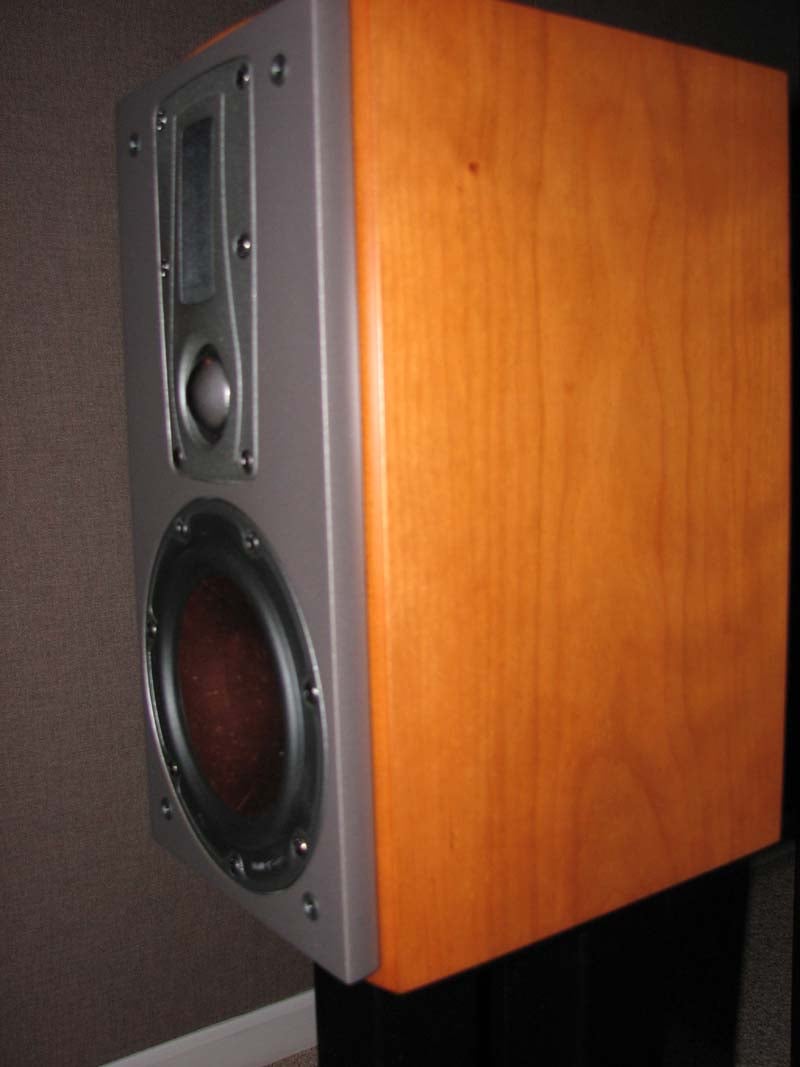 The DALI Mentor 1’s are a bit out of the norm from
the typical bookshelf speaker system we’ve encountered. They are a ported two-way design, but employ a
separate dome and ribbon tweeter system.
The advantage here is extended frequency response, higher power
handling, and greater transparency. The Mentor 1’s employ a 5”
wood fiber pulp cone woofer, 1.1” soft dome tweeter and a 2” ribbon
tweeter. DALI claims these speakers are
time coherent and employ a linear impedance profile – two of many design
attributes in their products which constitute their design philosophy. It sounds good to me.
The DALI Mentor 1’s are a bit out of the norm from
the typical bookshelf speaker system we’ve encountered. They are a ported two-way design, but employ a
separate dome and ribbon tweeter system.
The advantage here is extended frequency response, higher power
handling, and greater transparency. The Mentor 1’s employ a 5”
wood fiber pulp cone woofer, 1.1” soft dome tweeter and a 2” ribbon
tweeter. DALI claims these speakers are
time coherent and employ a linear impedance profile – two of many design
attributes in their products which constitute their design philosophy. It sounds good to me.
The Mentor 1’s drivers are mounted on a 1/2” MDF baffle which is isolated from the actual enclosure to reduce mechanical vibration transfer from the drivers to the enclosure. All of the drivers are countersunk into the baffle as any good loudspeaker should to minimize diffraction. The cabinet appears to also be constructed of 1/2” MDF, making the front baffle total thickness a whopping 1”. A quick knock test on the cabinet and front baffle revealed they had uniquely different sonic resonances.
The Woofer
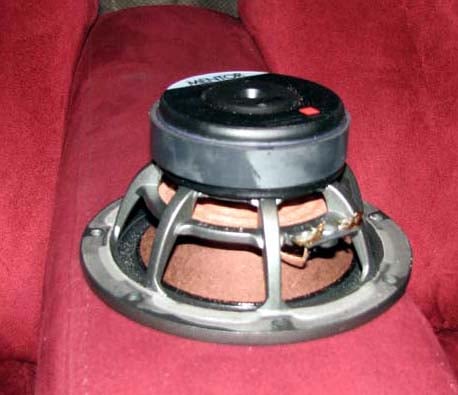
According to DALI, the ultra lightweight, stiff wood fiber paper cone is responsible for its very fast & agile response. The motor structure utilizes a die-cast rigid aluminium chassis (no wimpy stamped baskets) to minimize resonance. The rear side of the spider assembly is open (6mm air gap) to reduce air compression around the (17mm) voice coil. Upon inspection it was clear to me this was a quality driver. The cone was stiff as it should be and had a very linear response when moving within the limits of its excursion capability. The driver is not magnetically shielded so keep this speaker clear of computer hard drives or CRT displays. The woofer was well secured to the cabinet with seven (7) screws making it clear to me that DALI understands the importance of reducing mechanical vibrations by ensuring the drivers are firmly planted into the front baffle.
Tweeter(s)
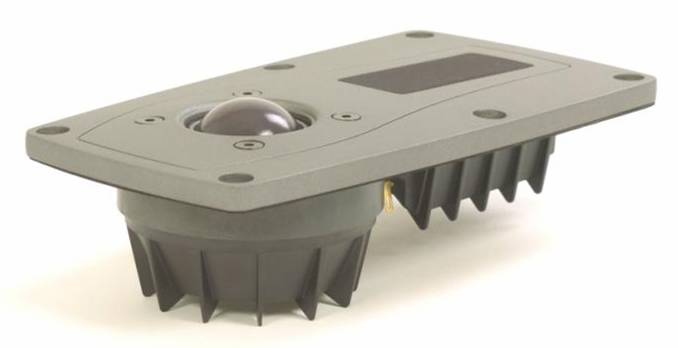
The Mentor 1’s employ a hybrid tweeter module consisting of a dome and ribbon driver topology. DALI claims the dome tweeter is specifically designed to have a natural acoustical roll off response to blend seamlessly with the ribbon tweeter without the need of a passive low pass filter network. According to DALI, the tweeter array sports a floating waveguide behind the dome for optimum support of the dome shape and resonance damping without blocking the free airflow. I was particularly impressed with the large acoustical rear chambers on the dome and ribbon drivers. Their primary functions are to lower compression and the resonance frequency, taking some of the pressure off the woofer to produce the upper midrange.
Crossover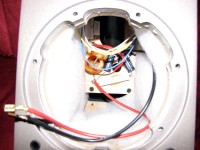
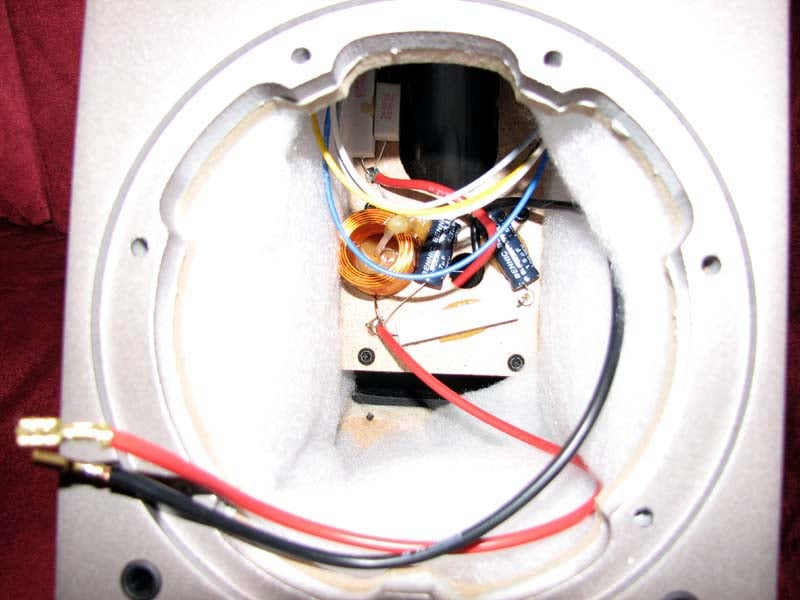
The brains of the speaker – DALI employed all air core inductors for greater precision and lower losses due to core saturation. Tight tolerance ceramic resistors were utilized in the crossover design but to my surprise DALI used what appeared to be electrolytic capacitors instead of polypropylene. Poly caps tend to be more linear at high frequencies at the expense of increased cost factor and footprint. I’d be curious if DALI offers an upgrade path to these crossover parts for future designs.
The network was carefully designed to help make the speaker system behave more like a resistive load allowing for a more consistent sound when playing on a variety of amplifiers. You’d be surprised how many manufacturers overlook this important engineering design principal in their designs.
The crossover was firmly secured down to the back of the cabinet via screws and the internal cabinet was generously damped with Dacron insulation on the side walls and bottom though curiously missing insulation at the top of the cabinet.
The Backside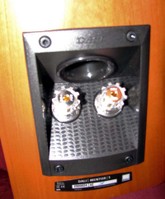
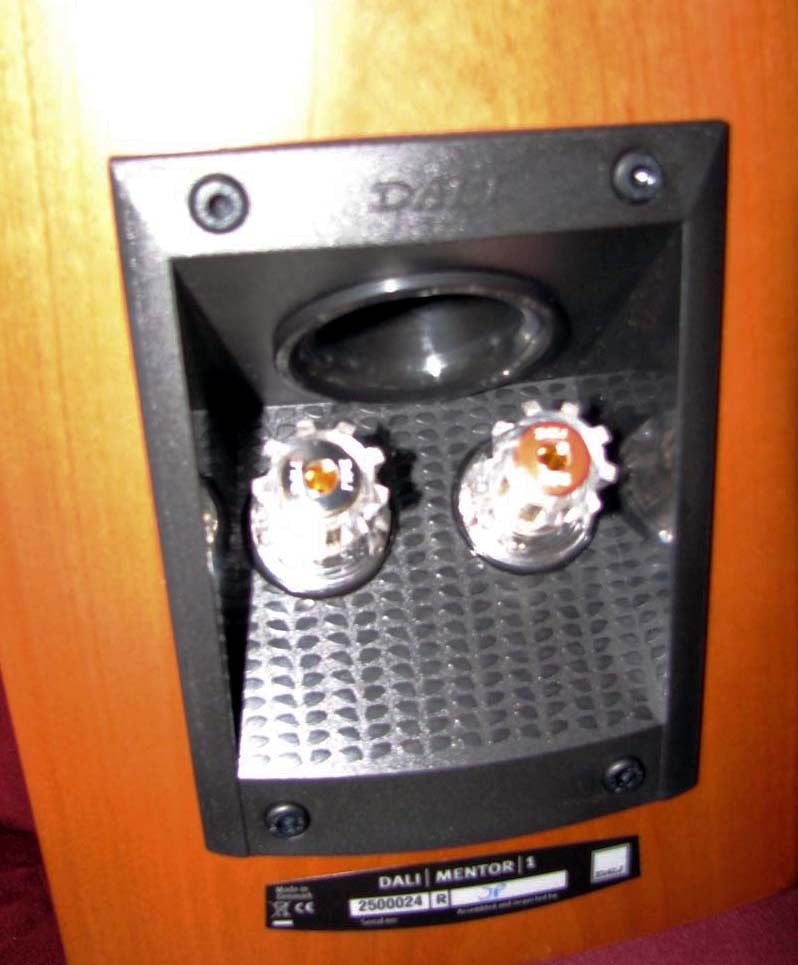
The DALI Mentor 1’s have a really nice rear end. From the contoured shaped back panel (which serves for aesthetics reasons and reduction of standing waves in the cabinet), the heavy duty WBT binding posts, to the neatly tucked away inclined port, these speakers demonstrate efficiency in design and function. In fact, the clever inclined port was likely implemented as a space saving method of extending port length in a small cabinet to lower the tuning frequency and increase bass extension. My only minor concern is for people using garden hose thick speaker cables which could potentially block the port. I suggest using some common sense here. If you think you need to use wire gauge any heavier than 10AWG on these speakers, perhaps some therapy is in order.
To wrap up
our tour of the speaker, I felt it prudent to mention that DALI has taken the
right steps to design quality into their product, including paying special
attention to the little things. For
example, the grill cover is top notch.
It’s tightly woven fabric, and from my performance measurements very
transparent.
I felt it prudent to mention that DALI has taken the right steps to design quality into their product....
The grill itself is constructed of wood instead of cheap plastic so commonly found in loudspeakers these days. The overall fit and finish of these speakers is excellent from the woodwork right down to the drivers which all utilize real ferrite magnet motor structures. The collection of parts truly scores high points in the 'pride of ownership' department.
Set-Up
I placed the Mentor 1’s on my 30” sand-filled Plateau speaker stands which puts the tweeter right at about ear level on my Continental theater seats. The speakers were positioned about 5ft from side and back walls and spread apart about 10ft from each other which was roughly the distance from my primary listening position. After experimenting, I found they sounded their best with minimal to NO toe-in for reasons I will get to later in the review. I used the Emotiva Reference Theater Series preamp and processor, the Denon DVD-5910CI as the source with my trusty Status Acoustics Decimo’s reference bookshelf speakers on hand for comparison. All cables were furnished by Impact Acoustics (Sonicwave toslink) and Bluejeans Cable (10AWG speaker cable and analog interconnects).
Listening Tests
CD: Harry
Connick – When Harry Met Sally
The Mentor 1’s surpassed my expectations on bass extension and uniformity on Track #9 “Let’s Call the Whole Thing Off”. I felt as if the speaker sounded much larger than it actually was, yet at the same time it carried the very intimate feeling I love about bookshelf type speakers. The twang in the bass was clearly present and I was floored by the detail in Harry’s finger snapping that seemed more prevalent in these speakers than even my own beloved reference bookshelf speakers the Status Acoustics Decimo’s. I did detect a slight coloration in the upper midrange that I decided to further explore. But first, I had to get passed my enjoyment of how well these speakers imaged. Vocals came from dead center as they should, and the soundstage seemed to be about 3-4ft behind the plane of the speakers giving a very 3D soundfield absent in lesser designed speakers. I really enjoyed the experience of the high hat cymbals which seemed to be peering into my head just like I experienced with conventional ESL type speaker systems but without the loss of imaging when shifting my head left to right so typical of those types of designs.
After listening to this track a couple of times, I realized there was a slight sibilance in Harry Connick Jr's voice which seemed even more pronounced as the volume level increased. I also noted that his voice seemed a bit more recessed than in my reference speakers.
Moving on to track# 2 “Love is Here to Stay” the drums came alive in the room as you could hear the sticks hitting the rim of the drumheads while capturing the air flowing through the trumpets. Again I noticed the vocals were a bit recessed. It was clear to me that the sonic signature of these speakers were uniquely different than my reference speakers. The Mentor 1’s portrayed more detail, accentuating every subtle nuance, while my Decimo’s were more forward in the vocals, having more warmth and naturalness in their overall presentation.
SACD: Patricia Barber – Modern Cool
Track #1 “Touch of Trash” again demonstrated the Mentor 1’s excellent ability to convey all of the sonic subtleties of the recording. The cow bell sounded so real it was freaky. The speakers imaged very well and literally disappeared in the room. The Mentor 1’s made a good attempt in bass extension on this song but tended to lose composure, as expected, when driven at higher SPL levels in my large theater room. Crossing these speakers over at 80Hz to a sub will alleviate this concern considerably and it’s a measure I recommend for anyone installing these speakers in a home theater environment. As good as the instrumentals sounded on the DALI’s, Patricia’s voice was a bit too hot in the top end for me to declare sonic perfection. Though the speakers weren’t overly fatiguing, I felt that they carried too much top end which shifted their sonic balance to the bright end of the musical spectrum. The degree of brightness is of course highly dependent on source material and the listening space. I found the Mentor 1’s to accentuate this tonal attribute mostly in female voices and/or in close mic’ed recordings. Toeing the speakers in made it more prevalent, so I’d advise you to use no toe in, or perhaps a small degree of toe out to soften the sound. The Mentor 1’s have unusually good horizontal dispersion so it’s not a bad thing to use no toe-in or even slight toe out.

This is a must-have CD when doing ABX testing for revealing sonic differences of electronics or speakers. It’s also a must have because in my opinion. It’s excellent accessible jazz and Chieli Minucci is simply a fabulous and inspirational guitarist.
Track
#2 “Jamaica, Jamaica” showed off the Mentor 1’s excellent ability to extract all
of the details within the recording.
Bass was tight and well controlled, again most impressive for a speaker
of its size. Overall the sound was more
focused but not as broad as I heard on my Decimo’s. The Mentor
1’s accentuated the cymbals a little too much for my liking making them sound
crisp rather than lush.
CD: Pat Metheny – We Live Here
 If you haven’t
figured it out by now, I am a huge Pat Metheny fan and strongly feel that long
after his time, he will be remembered as one of the greatest jazz guitarists of
all time. I selected We Live Here not only because of its
significant musical content, but because it’s a well recording CD that really
can give a speaker system quite a workout.
If you haven’t
figured it out by now, I am a huge Pat Metheny fan and strongly feel that long
after his time, he will be remembered as one of the greatest jazz guitarists of
all time. I selected We Live Here not only because of its
significant musical content, but because it’s a well recording CD that really
can give a speaker system quite a workout.
In track #3 “The Girls Next Door,” the cymbals had a lot of air to them, while the persistent cha-ching sound of Paul Wertico’s stick work was highly detailed and focused. Pat’s guitar sounded a couple of feet back from the speakers and slightly off to the left of dead center, setting up a nice 3 dimensional soundstage I’ve come to expect of excellent speakers. I didn’t feel the guitar sound was a prominent or realistic as I preferred when listening on my reference speakers.
The Mentor 1's setup a nice 3 dimensional soundstage I’ve come to expect of excellent speakers....
Track #5
“We Live Here” proved to be too much for the little 5” drivers of the Mentor 1’s when pushed to
appreciable levels in my listening room.
This was to be expected of a speaker of this size and is not a knock on
its abilities as much as a reality check when deciding on using small speakers
as your mains and contemplating on adding a dedicated subwoofer or two to
compliment the bass. The Mentor 1’s made a valiant
effort at conveying the bass content of this track, but the tactile response
and depth was simply not there. When
pushed hard the woofers showed signs of distress, but didn’t make a LOUD
popping sound like I heard when I reviewed the Dynaudio
52-SE. In comparison, the RBH
MC-6C’s I currently have in for review handled the bass portion of this song
with much more composure, but they are a sealed design and don’t play quite as
low. Personally, I prefer limiting the
extension of all bookshelf type speakers and allowing a subwoofer to handle the
bass duties. This will preserve dynamic
range of the speaker system and amplifier, and ensure the bass content will be
properly rendered on drivers better suited for the task.
Measurements & Analysis
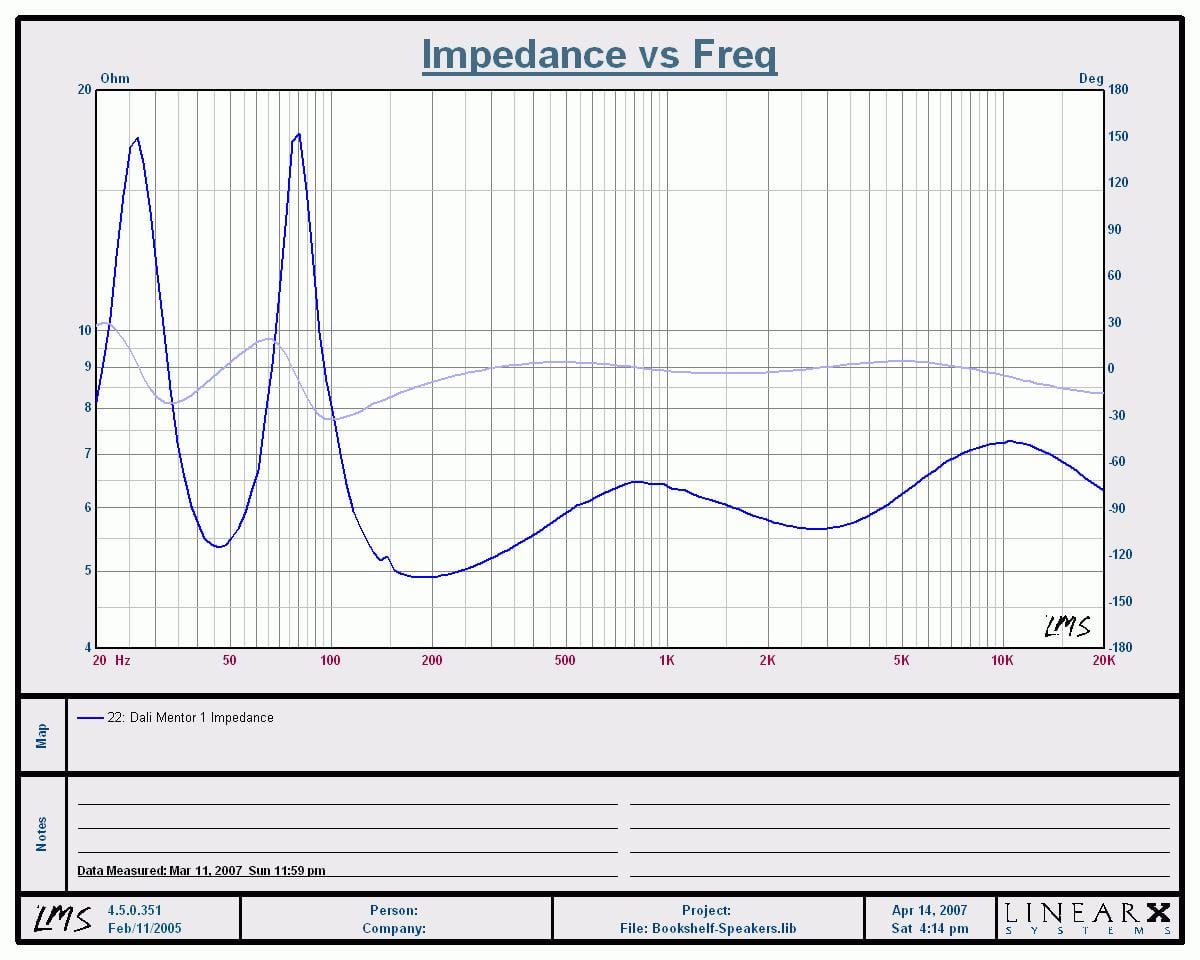
Impedance / Phase Measurements of the Mentor 1
DALI lived true to their claim that their loudspeakers are a “Amplifier Friendly” loudspeaker system – in my book this earns them big brownie points. System tuning appears to be around 45Hz as indicated by the impedance minima between the two saddle points. The impedance never dips below 5 ohms and most importantly, their phase response is very uniform maintaining –30 to 0 deg from 100Hz up to 20kHz. Any decent home theater receiver should be able to drive these speakers without incident and from my testing they do sound very uniform whether I tested them on an inexpensive receiver or the very impressive and inexpensive Reference Series separates system from Emotiva.
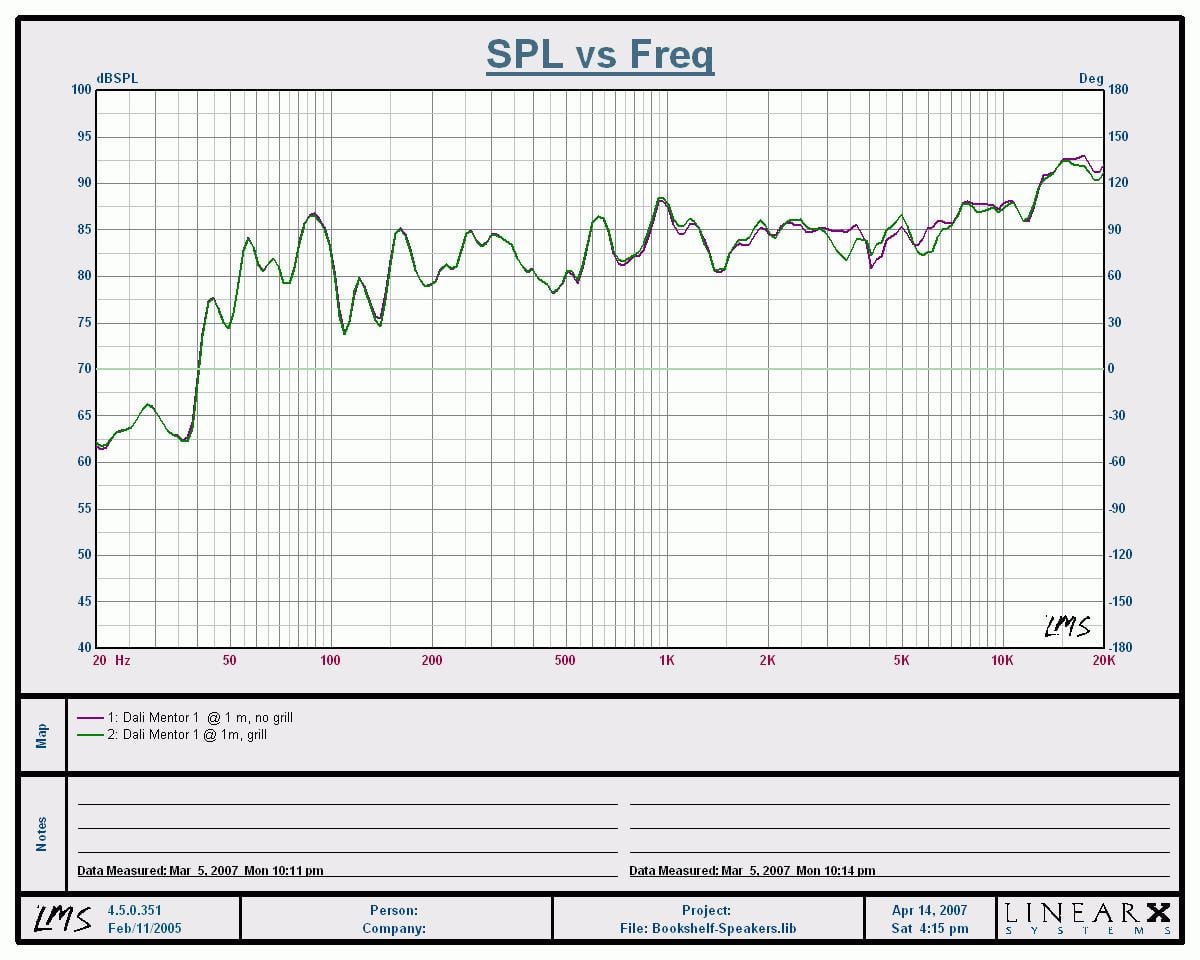
In Room 1 Meter Frequency Response Grills On/Off of the Mentor 1
I couldn’t measure any appreciable frequency response variation with the grill on versus being off other than the -2dB notch between 3-4kHz with the grill on which may partly explain why I subjectively felt that the Mentor 1’s sounded best with their grills off just as all very revealing speakers tend to.
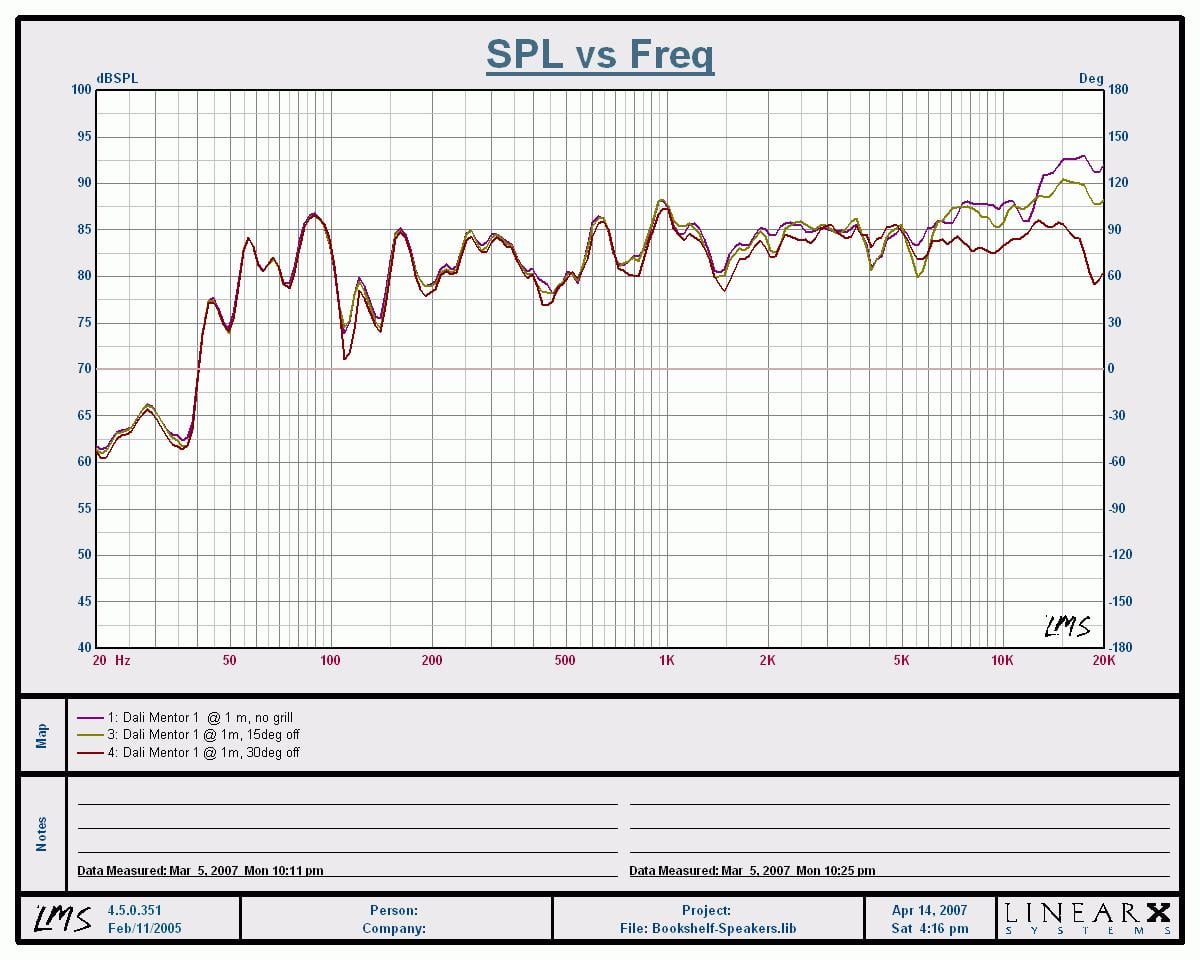
In Room 1 Meter Frequency Response On / Off Axis of Mentor 1
This graph perhaps reveals why I found the Mentor 1’s to be a bit hot in the top end. Overall the graph looks quite linear up until around 12kHz where we see a bump of 5dB out to 20kHz. Incidentally this is where the tweeter rolls off and the ribbon cuts in. It would have been nice if DALI offered a POT adjustment to tone the ribbon tweeter down for those whom prefer a warmer, less aggressive sound. The response of these speakers look best 30 degrees off axis, hence why I recommend little to no toe-in.
Mentor 1 Conclusion
The DALI Mentor 1 is a fine sounding speaker system in a neat little package. They are best suited for small to medium sized rooms and highly recommended to be utilized with a dedicated subwoofer. The tweeter array in the Mentor 1’s is exceptionally good, never sounding compressed or strained. But as you can see in my measurements, they have quite a great deal of high frequency energy. As a result, I suggest little to no toe-in, and to install them in a well acoustically controlled room, preferably with a dedicated subwoofer. Don’t even try to use these speakers in a room surrounded by vaulted ceilings, sliding glass doors and tile floors. In fact, if this describes your room, and you aren't planning on doing any treatment, then either select a different room for your home theater, or use headphones (particularly the Sennheiser HD 600s I recently reviewed). Take special care when choosing electronics as well that tend to favor the warmer side of the audio spectrum to help tame the brightness of these speakers.
...with the Mentor 1's, be prepared to be rewarded with a level of detail and transparency not typically found in many competitor speaker systems.
If what you are after is a compact, attractive, well-built speaker system that will reveal all of the subtleties of your recordings, then the DALI Mentor 1’s should be added to your auditioning shortlist. They score big in the WAF department, play nicely with virtually any decent amplifier or receiver on the market, and will likely impress any audiophile with their excellent imaging and 3D spatiality. In my opinion, these speakers favor jazz instrumental type recordings over compressed mainstream pop and rock music. The famous “garbage in = garbage out” saying about the sonic attributes of a speaker system being dependent on the recording quality definitely applies to these speakers. So do your best to pair them with good electronics, an acoustically neutral listening room, and quality source material and be prepared to be rewarded with a level of detail and transparency not typically found in many competitor speaker systems.
Editorial Note from DALI on High Frequency Response of the Mentor 1’s
The excessive high frequency energy that Gene observed in the Mentor 1’s is an intentional design attribute and part of DALI's "flat off-axis" design. DALI speakers are designed to be linear 20 to 30 degrees off-axis. If they are toed-in (should never be done), they will sound "Hot".
The curvature of the DALI wood-pulp cone, combined with a specific crossover design, results in off-axis linearity. For these reasons, DALI speakers must always be set-up "flat" with respect to the listener, so that the signal received is off-axis.
The reason for an off-axis design is to:
- Provide a wide and deeper "sweet spot" (larger listening area).
- Provide better room integration. 60% of all sound heard is reflected. Therefore, if off-axis sound is linear, reflected sound will also be more linear, resulting in better room integration.
- Avoid "beaming" distortion due to "break-up" of the cone (always 1 to 2 degrees "on-axis" in any cone design), directly onto the listener. In an off-axis design, this break-up distortion is harmlessly beamed down the left and right sides of the room, rather than being converged upon the listener.
DALI Loudspeakers
Suite # 201
3957 Irongate Road
Bellingham, WA
98226
tel: 360-733-4446
fax: 360-733-0080
website: www.dali-usa.com
email: beg@dali.dk
The Score Card
The scoring below is based on each piece of equipment doing the duty it is designed for. The numbers are weighed heavily with respect to the individual cost of each unit, thus giving a rating roughly equal to:
Performance × Price Factor/Value = Rating
Audioholics.com note: The ratings indicated below are based on subjective listening and objective testing of the product in question. The rating scale is based on performance/value ratio. If you notice better performing products in future reviews that have lower numbers in certain areas, be aware that the value factor is most likely the culprit. Other Audioholics reviewers may rate products solely based on performance, and each reviewer has his/her own system for ratings.
Audioholics Rating Scale
 — Excellent
- — Very Good
- — Good
- — Fair
- — Poor
| Metric | Rating |
|---|---|
| Build Quality | |
| Appearance | |
| Treble Extension | |
| Treble Smoothness | |
| Midrange Accuracy | |
| Bass Extension | |
| Bass Accuracy | |
| Dynamic Range | |
| Performance | |
| Value |  |
Gene manages this organization, establishes relations with manufacturers and keeps Audioholics a well oiled machine. His goal is to educate about home theater and develop more standards in the industry to eliminate consumer confusion clouded by industry snake oil.
View full profile Subscribe to our newsletter