


BG Z-1 Ribbon Monitor Loudspeaker System
BG Z-1 Bookshelf Speaker
- Product Name: Z-1 Ribbon Monitor Loudspeaker
- Manufacturer: BG Corp
- Performance Rating:

- Value Rating:
- Review Date: October 05, 2005 20:00
- MSRP: $ 499/pair
|
Physical Characteristics
|
Manufacturer's
Specs Frequency response: 55hz - 30kHz, tolerance unspecified Woofer: 5.25" aluminum cone, shielded. Tweeter: Neo3PDR, planar magnetic Sensitivity: 88db/w/m Impedance: 8 ohms Power handling: 100W Weight: 13lbs HxWxD: 13" x 7.1" x 9.5" |
Pros
- Outstanding tweeter.
- Small footprint.
- High standard of fit-n-finish.
Cons
- Midrange performance a bit reticent.
Z-1 Technology Overview
BG Corporation was founded in 1994 and is based in Carson City, Nevada. Up until late last year, they went by the brand name Bohlender-Graebener but today prefer to be simply known as BG. Their focus has been on permanent-planar magnetic loudspeaker systems.
About half of their planar drivers are manufactured at their Carson City facility. The rest are proprietary designs to their specification. The process begins with steel frames built in-house, planar drivers are assembled using their proprietary process for tensioning and securing of the planar film in the speaker. All drivers are quality tested for impedance, 'buzz' tests and frequency response.
There are two sets of five-way binding posts, allowing for bi-amp or bi-wire setups (if that sort of thing really floats your boat). A grill is also provided and fits flush into the front baffle via four pegs that attach to receptacles in the baffle. Four rubber feet are permanently attached to the bottom of each cabinet, this would help reduce energy transmission to/from the stands and save the finish from scratches.
What is this Planar stuff?
Planar-magnetic drivers are based around a thin film (planar meaning flat or lying in a single geometric plane) either made of a conductive material, or with a conductive filament embedded across its surface. This film or ribbon is suspended between two magnets. The signal is passed through the conductive material in the film/ribbon and causes it to oscillate between the magnets. This movement of the film/ribbon displaces air and thus creates sound. This approach is not a panacea, and as with everything else has its pros and cons.
On the plus side; the films are extremely light (compared to conventional drivers) and theoretically have better transient response due to lower inertia, as claimed by proponents of that school of thought. Also, the flat structure of the film/ribbon avoids the standing wave and phase issues typically faced by cone designs.
According to BG, its not the speed in general understanding that provides high resolution, but how fast and clean the decay is. Well designed planar ribbons can have advantages over conventional driver counterparts in this respect. This is because mass of a conventional driver is much higher than a ribbon, and subsequently the inertia is also higher and resonances in general are more pronounced and delayed.
On the negative side; these drivers have a limited excursion and are not efficient at moving large volumes of air. They are thus often relegated to high-frequency duty only, though in some larger designs even the mid-range and bass. They would produce a compressed sound in the lower frequencies, unless the drivers were of massive proportion. Also, if the backwave of the drivers were not somehow eliminated, placement would need a lot of attention. Dispersion suffers with these drivers as the surface area increases.
Editorial Note about Driver Speed by Mark Sanfilipo
From an analytical point of view, how "fast" a driver is, or its "speed" is canonically defined as its "rise time". Rise time (in this case) is the time it takes for the driver's acoustic output to increase from 10% to 90% of its final amplitude, in response to an electrical step-function input. Rise time is a function of the driver's bandwidth. In actual practice, a driver's bandwidth is usually constrained or limited at the high frequency end of its acoustic response by the low pass crossover circuit feeding it signal. Although various mechanisms, such as the driver's voice coil inductance, do indeed affect a driver's bandwidth, once its part of a complete system, it's the crossover that typically has the largest bandwidth-constraining effect on the driver. Thus, for example, a big woofer and a small woofer, having identical band-limited, acoustic low pass characteristics will have the same transient response.Large drivers have large Mmd (total moving mass, including air load) values. They also have large magnet structures, which mean they can apply large amounts of force moving the mass. Since acceleration is the applied force divided by the mass, for a given mass, by varying the force, acceleration can be varied. Thus a small, lightweight driver could actually prove slower than a heavyweight counterpart IF the available accelerating force is too low. Mass or inertia are therefore, by themselves, no indication of a driver's speed or lack thereof.
Having said the above, it is only fair to mention that planar products have diehard followings who often hold on to their speakers for decades. In 2004 BG was awarded a patent for innovation in this technology, the inventor was Igor Levitsky, VP of Engineering for BG Corp. I spoke with Igor about his invention and here is a summary of the improvements the patent was awarded for.

A common issue with planar drivers is the tradeoff between frequency bandwidth and dispersion. Generally, to extend the bandwidth into lower frequencies the driver has to be made larger, but the wider the driver is the greater the beaming at high frequencies. The foil in the BG PDR tweeter is considerably wide and allows a specified frequency extension down to 1.8kHz (from 25kHz, +/- 2.5db), the foil width extends to the four columns of slots seen on the faceplate. Normally, a driver this wide will have very limited horizontal dispersion in the higher frequencies; BG came up with an ingenious twofold solution to combat this. The process of etching removes the metal and creates gaps between aluminum conductors. First, the magnetic field is induced on the planar is designed to be stronger in the center and weaker to the sides. Second, a special felt covering the outside two columns progressively filter frequencies as they increase. The combined effect of these two design features results in the radiating width decreasing as the frequencies increase, to the point that the two side columns have no output above 10kHz. So above 10kHz the radiating width is only 15mm (0.6"), which would result in excellent horizontal dispersion.
The patent and design of the tweeter is impressive indeed, but in the end the only thing that matters is how the thing sounds. Well, let's find out.
BG Z-1 Listening Evaluation & Conclusion
Based on several weeks of informal listening, there were some distinct impressions I came away with. High-frequency reproduction was remarkable, I felt like I was not listening to a tweeter at all and instead the music materialized from nowhere. There seemed to be more detail than I have ever heard with a dome tweeter, and somehow it simply existed in the room without being thrown at me from a source. This phenomenon is consistent with my previous experiences with ribbons and electrostats.
The midrange seemed a tad reserved, as if the speakers were hesitant to let go of the music. Instruments and vocals seemed a bit robbed of richness and warmth, compared to the speakers in my reference system . Bass response was quite tight, but not very extended.
Of course, these initial impressions only serve to establish the equivalent of a "hypothesis". Now for the nuts, bolts and actual testing of these.
The first set of tests was done by a direct comparison to one of my reference speakers, the Triangle Titus 202.
'Dusk' (V.M. Bhatt, Simon Shaheen; Saltanah; WaterLilyAcoustics;
WLA-ES-51-SACD)
The higher frequencies on the Triangle were a bit harsh and lacking
in detail. But this is no surprise, the metal dome tweeter on the
Triangle is its weak point and can sound particularly harsh with
upstream components that have an extended high-frequency response (such
as the Cayin 265Ai integrated used here). In contrast the upper
registers on the BG Z-1 are as detailed and smooth as perhaps I have
ever heard. The layers of resonances of the strings on V.M. Bhatt"s
Mohan
Vina
were separate and distinctly audible, compared to a harsh morass of sound from the
Triangle.
Now the midrange on the Triangle was much richer, detailed and natural. Whereas, the BG sounded like it was holding back on communicating the richness and warmth of the instrument"s midrange. The Triangle is a particular champ at this, and is the sole reason it exists in my reference system inspite of its poor high-frequency performance.
'Bass resonance test' (Chesky Records; Chesky Jazz and Audiophile tests
Vol2; Chesky; JD68)
There was a considerable difference between the two speakers on this track. For one,
peaks registered about 7 to 8db higher, as measured at my listening position using a RadioShack SPL
meter. Subjectively, the Triangle not only sounded deeper but also more detailed and faster on
transients. In favor of the BG I would have to say that the bass response was very tight.
These comparisons to the Triangle reveal no surprises. The ribbon tweeter of the BG was much more detailed and not as noisy, than the metal dome unit of the Triangle. On the other hand the ultra-light and crossoverless paper woofer of the Triangle proved to be richer, deeper and faster than the aluminum one of the BG. Now what I really want I for someone to combine the BD tweeter with the Triangle woofer (without crossover), in a time/phase aligned cabinet. Properly executed, that would have the potential to be a giant slayer.
The second set of tests was done in comparison to the venerable Dynaudio 1.3 MKII, which retailed for $2400 and was discontinued about two years ago.
'Rag Gavati' ( V.M. Bhatt; Gathering Rain Clouds; Waterlily Acoustics;
WLA-ES-22-CD)
It took considerable effort to discern a difference between the two tweeters, but in
the end I can confidently report that the Dynaudio tweeter rendered more detail on the resonances of
the sympathetic strings of the
Mohan Vina
. Imaging and microdynamics were about dead nuts when
comparing the two speakers. What is important to take away here, is that the BG was so close in
performance to the highly respected and considerably more expensive Dynaudio.
'Cheek to cheek' (Ella Fitzgerald and Louis Armstrong; Ella and Louis;
Verve; 314 589 598-2)
Moving on to the midrange frequencies, on this track the Dynaudios
had more impact and much better transient response on Louis" raspy
vocals. This does not speak well for the BG, since the Dynaudio"s
themselves are fairly sluggish (especially when compared to the likes
of a Triangle Titus). My personal suspicion is that the woofer on the
BG maybe overdamped.
'Nearness of you' (Ella Fitzgerald and Louis Armstrong; Ella and Louis;
Verve; 314 589 598-2)
Again, there was a clear distinction between the two speakers, with
the Dynaudio sounding significantly richer and warmer on Ella"s vocals.
It made the difference between listening to a reproduction and being
emotionally involved with the presentation.
The Dynaudio had an obvious edge over the BG in depth and extension on the double bass, but that could have been predicted simply by reading the specs of the two speakers. Admirably, the BG did not attempt to make up for a lack of extension with sloppiness, underdamped this woofer is not.
Overall, I would have to say that this is a considerable achievement for a $500/pair loudspeaker. Especially the tweeter, with its performance so close to a $2400/pair model. The bass frequencies deliver the extension one would expect from a cabinet and woofer this size, but without a hint of loose or underdamped response (maybe to a fault). As with all products of this genre, use a subwoofer if you need ultimate bass extension. The only weakness of any significance to me lies in the midrange, as detailed in my notes above.
Conclusion
I honestly do not think that you can make a speaker without compromises, at any pricepoint. The lower the price point the greater the compromises. While paying a few hundred dollars for a pair of speakers is not a minor outlay for most people, it is important to realize that this still is a budget product.
The Z-1 has a tremendous tweeter, which could easily be used in a unit at a much higher price point. Treble performance is certainly above-class in terms of low distortion, tonality, dynamics (macro and micro) and imaging.
The mid/bass driver is about what you would expect in this price bracket, with few exceptions such as the tremendous Triangle (which, in turn, has serious compromises in its tweeter). Bass extension is about what one would expect for monitor of this size. Through the bass and midrange distortion seemed fairly low and tonality seemed fair, dynamics (macro and micro) suffered a bit.
Fit and finish are about as good as I have seen. In summation, I would have to say this is definitely an above average product relative to its price point.
BG Z-1 Ribbon Monitor Review
MSRP: $499pair
Manufacturer: BG Corp.
1780 Forrest Way
Carson City, NV 89706
USA
Phone: (775) 884-1900
BG Z-1 Measurements & Analysis
Impedance & Electrical Phase Response of the BG Z-1
The Z-1's appear to be tuned around 60Hz which makes this speaker ideal to be mated with a quality subwoofer for enhanced bass extension. Phase response was very linear and kept within 0-30 degrees from 100Hz to 20kHz. Impedance is around 7-8 ohms overall with the lowest dips between 5kHz to 20kHz of around 6 ohms. The moderately high efficiency of this design, minimum phase response and almost resistive load profile, (a tribute to the innovative tweeter and good crossover design), makes this a relatively easy load for any decent receiver or moderate power amplifier to drive. More importantly, this speaker should sound more consistent when driven by a variety of amplifiers because of these qualities.
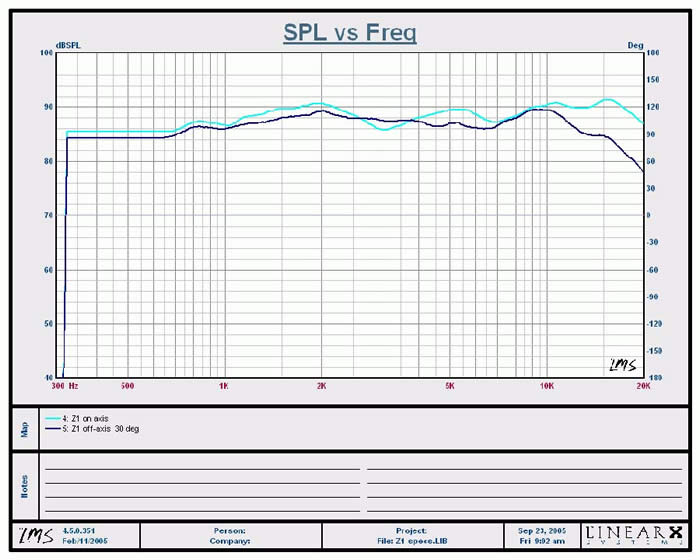
On Axis & 30 Deg Off Axis Frequency Response (300Hz to 20kHz; smoothed) @ 1 watt / meter
Light blue trace is on axis response, dark blue trace is 30 degrees off axis response. The -4dB dip from 2-3kHz as well as the overall dip in response from 2kHz to 7kHz may explain why Arvind found the midrange performance to be somewhat recessed. Based on these measurements, it is advisable to toe these speakers in 15-30 degrees to achieve the most uniform performance.
Spliced woofer/port Nearfield Response with On/Off Axis 1 Meter Response
Useable low end bass extension as confirmed with the impedance measurements and the woofer response above is around 60Hz. It is recommended to apply bass management to these speakers in conjunction with a subwoofer set around 70-80Hz for increased dynamic range and extended bass response.
According to BG, the Z-1 has been designed as a speaker for listening WITH a SUBWOOFER. It was purposefully designed so that when with subwoofer, it delivers full range sound at very low distortion while achieving high SPL levels. They feel the days of small two way monitors that are designed for a small full range stereo system are gone and I personally agree with their sentiments. Mating a sub with a pair of bookshelf monitors such as these, usually provides a better degree of dynamic range, bass extension and overall more articulate mids and top end since the woofer is no longer tasked at producing midrange and low end response.
The Score Card
The scoring below is based on each piece of equipment doing the duty it is designed for. The numbers are weighed heavily with respect to the individual cost of each unit, thus giving a rating roughly equal to:
Performance × Price Factor/Value = Rating
Audioholics.com note: The ratings indicated below are based on subjective listening and objective testing of the product in question. The rating scale is based on performance/value ratio. If you notice better performing products in future reviews that have lower numbers in certain areas, be aware that the value factor is most likely the culprit. Other Audioholics reviewers may rate products solely based on performance, and each reviewer has his/her own system for ratings.
Audioholics Rating Scale
 — Excellent
- — Very Good
- — Good
- — Fair
- — Poor
| Metric | Rating |
|---|---|
| Build Quality | |
| Appearance | |
| Treble Extension | |
| Treble Smoothness | |
| Midrange Accuracy | |
| Bass Extension | |
| Bass Accuracy | |
| Imaging | |
| Soundstage | |
| Dynamic Range | |
| Performance | |
| Value | |
 Subscribe to our newsletter