


Axiom Audio Epic Midi 400 Speakers Review
Axiom Audio Epic Midi 400 System
- Product Name: Epic Midi 400 System
- Manufacturer: Axiom Audio
- Performance Rating:

- Value Rating:

- Review Date: August 25, 2008 08:55
- MSRP: $ 1975
|
M2 v2
QS4
|
VP100
EP400
|
Pros
- Unlimited finish options
- Superb bass
- Realistic surround array simulation
Cons
- Midrange detail of center channel could improve
- Subwoofer is ridiculously expensive
- Limited mounting options
- Standby mode not obvious on subwoofer (user manual claims it has "instantaneous" 10W mode)
Epic Midi - Build Quality and System Setup
I have to be careful with this review not to completely blow off the M2 speakers. They did great, with accurate sound and good detail and soundstaging. They were, however, so overshadowed by the incredible performance of the EP400 subwoofer that came with the Epic Midi 400 system that it was hard not to keep turning back again and again to the cubic monster sitting on the floor. In fact, all of our listening tests went really well, but the 500W mini monster sub was the defining factor in almost every test.
Build Quality & Setup
 There is no question that the build
quality of Axiom Audio products is well executed. In fact, the M2's, weighing
11 pounds each are tight little products that leave little in the way of room
for improvement given their price ($280/pair) and finish. The M2s have a single
1-inch dome tweeter and a single shielded 5 1/4-inch woofer in a trapezoidal
cabinet that easily passes our patented (not) knuckle knock test. The M2s are
unique in that they share a lot of engineering with the well-regarded M22ti
speakers. They had a very similar sound but with less output capability and
midrange detail. The high quality binding posts used on the rear of the
speakers is above-par and we like Axiom's "puckered" style of rear
port which serves to diffract and disperse the air coming out so as to reduce
noise.
There is no question that the build
quality of Axiom Audio products is well executed. In fact, the M2's, weighing
11 pounds each are tight little products that leave little in the way of room
for improvement given their price ($280/pair) and finish. The M2s have a single
1-inch dome tweeter and a single shielded 5 1/4-inch woofer in a trapezoidal
cabinet that easily passes our patented (not) knuckle knock test. The M2s are
unique in that they share a lot of engineering with the well-regarded M22ti
speakers. They had a very similar sound but with less output capability and
midrange detail. The high quality binding posts used on the rear of the
speakers is above-par and we like Axiom's "puckered" style of rear
port which serves to diffract and disperse the air coming out so as to reduce
noise.
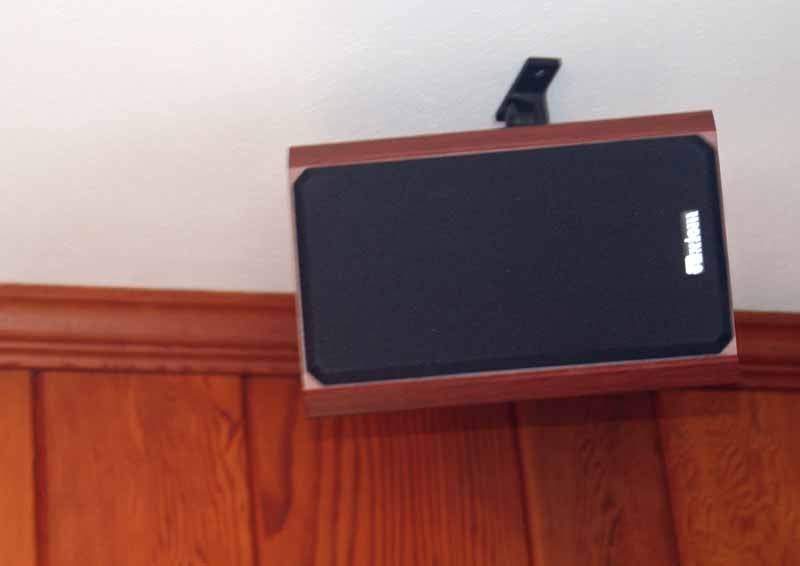
Because the speakers are rear-ported, you won't want to install them (at least not too tightly) into an enclosed space. These speakers are meant to breathe - preferably via speaker stands. As you'll see below, we used a non-traditional mounting method for these speakers. It worked, but Axiom would do well to bring to market a mounting system or adapter worthy of its little M2 speakers.
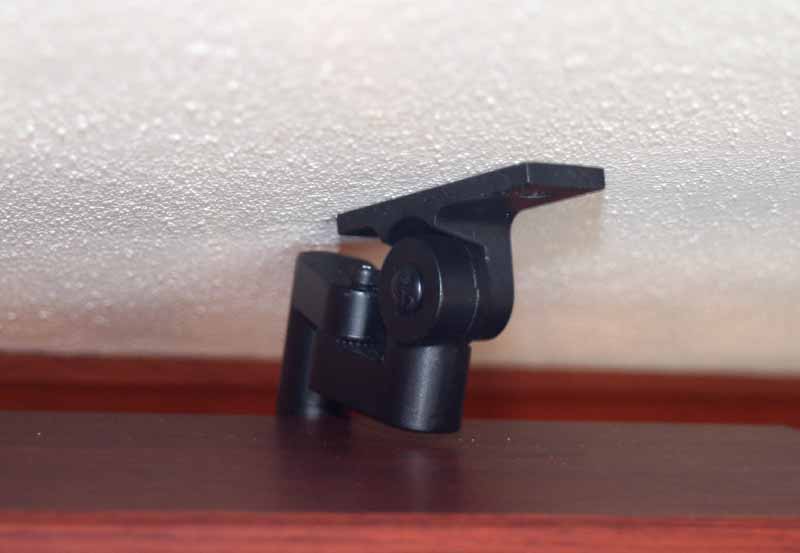 While Axiom Audio provides compatible
brackets with which to mount the M2s, their Full Metal Ceiling Brackets are
truly made to fit best with their QS4/8 speakers. For the M2s, they ended up
being a very tight fit and with the net effect of only being able to mount the
speakers in a horizontal orientation (which makes the non-rotatable Axiom logo
appear sideways as well). To mount the speakers with this bracket we first
secured the top part to the ceiling by anchoring it to a joist with two
lag-style bolts. Next, the vertical speaker mount was attached to the speaker
and secured with the included mounting bolt. Once this was completed we could
attach the pivoting piece to the ceiling mount and then lift and set the
speaker into the ceiling mounting assembly and tighten the bolts. It's several
steps, but they all make sense and offer you the flexibility to place the
speakers in the best possible orientation to the listening position. Keep in
mind that if you require too steep of an angle you'll be hampered by the
maximum allowed range of the tilting mechanism before it contacts the ceiling
(see inset photo).
While Axiom Audio provides compatible
brackets with which to mount the M2s, their Full Metal Ceiling Brackets are
truly made to fit best with their QS4/8 speakers. For the M2s, they ended up
being a very tight fit and with the net effect of only being able to mount the
speakers in a horizontal orientation (which makes the non-rotatable Axiom logo
appear sideways as well). To mount the speakers with this bracket we first
secured the top part to the ceiling by anchoring it to a joist with two
lag-style bolts. Next, the vertical speaker mount was attached to the speaker
and secured with the included mounting bolt. Once this was completed we could
attach the pivoting piece to the ceiling mount and then lift and set the
speaker into the ceiling mounting assembly and tighten the bolts. It's several
steps, but they all make sense and offer you the flexibility to place the
speakers in the best possible orientation to the listening position. Keep in
mind that if you require too steep of an angle you'll be hampered by the
maximum allowed range of the tilting mechanism before it contacts the ceiling
(see inset photo).
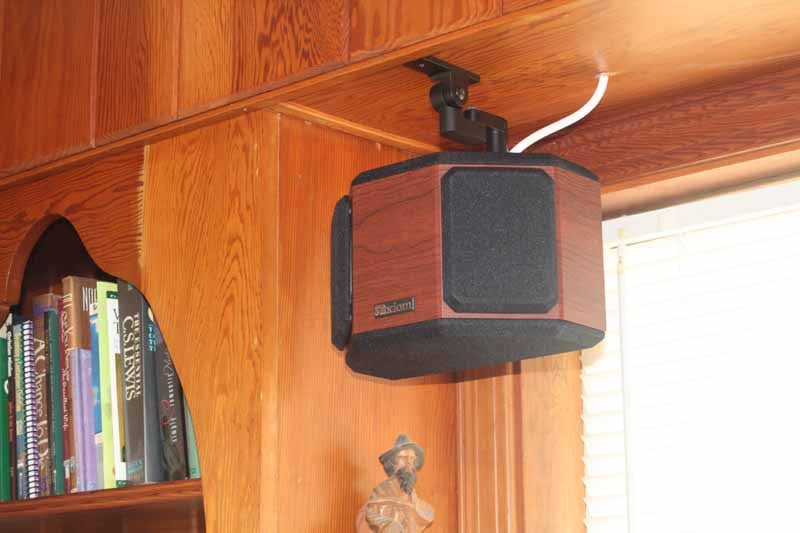 The QS4s are great surround speakers,
though pricey, and we were excited to see how they would sound mounted behind
the listening position as part of our 5.1 system. We mounted the QS4s in the
same way as the M2s, but these were oriented vertically, as expected, and were
much easier to manage overall. The wiring came directly from above through the
ceiling and we were able to make a very nice termination at the speaker binding
posts with bare wire. Perhaps because of the reduced weight and/or lower angle
we found that it was far easier to mount the QS4 speakers using the metal
ceiling brackets than the M2s. Both the satellites and the surrounds felt very
rigid and solid once mounted and we felt confident enough to sit underneath
them and not worry about getting our heads dented in by falling cabinets.
The QS4s are great surround speakers,
though pricey, and we were excited to see how they would sound mounted behind
the listening position as part of our 5.1 system. We mounted the QS4s in the
same way as the M2s, but these were oriented vertically, as expected, and were
much easier to manage overall. The wiring came directly from above through the
ceiling and we were able to make a very nice termination at the speaker binding
posts with bare wire. Perhaps because of the reduced weight and/or lower angle
we found that it was far easier to mount the QS4 speakers using the metal
ceiling brackets than the M2s. Both the satellites and the surrounds felt very
rigid and solid once mounted and we felt confident enough to sit underneath
them and not worry about getting our heads dented in by falling cabinets.
The QS4s are a "quad-pole" surround speaker which really just means that they fire in four directions at once. Two 1-inch dome tweeters face outward at ~30 degree angles while the twin 4-inch woofers fire upwards and downwards. The result is a very diffuse sound that is excellent for home theater and perfect for both rear wall or side wall placement. The QS4s can handle up to 175 Watts according to Axiom (man, I'd love to test that, lol) and with a sensitivity rating of 90dB SPL at 1W/1m we found it was nice and easy to drive to high levels of output.
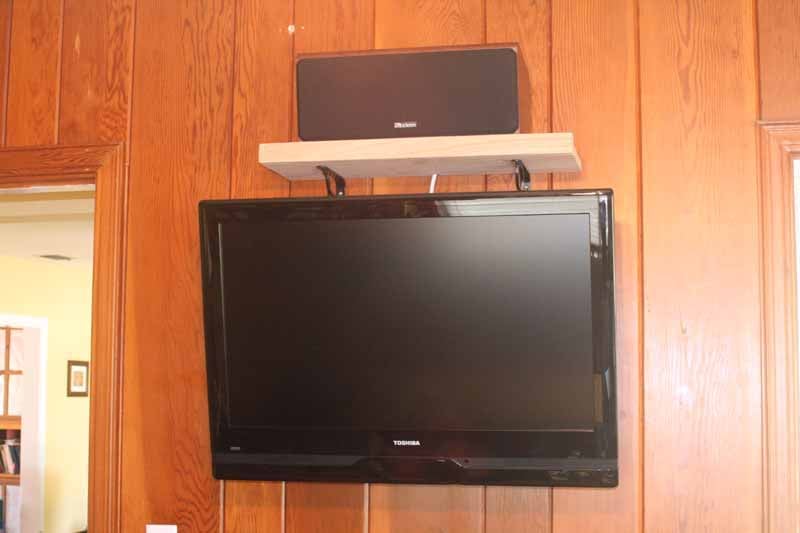 The VP100 Center channel is Axiom's
smallest offering and was mounted onto a shelf just above the 32-inch Toshiba
LCD TV we utilized in the room. This worked out very well since the system
co-existed with a music/Mac rig that lived just below on a desk. The room was
very multi-purpose, but it also had great dimensions for ensuring several
people could sit and watch or listen without feeling like they were on top of
each other. The tallish ceilings meant that we weren't "pushing it"
to elevate the television a bit and place the M2s in their ceiling-mount
positions. After all, it had to be cleared by a door opening underneath the front
left channel. The center channel is the heaviest of the satellite/surround
speakers, coming in at around 14 lbs and featuring dual 5 1/4-inch woofers
which flanked the 1-inch dome tweeter in an MTM arrangement.
The VP100 Center channel is Axiom's
smallest offering and was mounted onto a shelf just above the 32-inch Toshiba
LCD TV we utilized in the room. This worked out very well since the system
co-existed with a music/Mac rig that lived just below on a desk. The room was
very multi-purpose, but it also had great dimensions for ensuring several
people could sit and watch or listen without feeling like they were on top of
each other. The tallish ceilings meant that we weren't "pushing it"
to elevate the television a bit and place the M2s in their ceiling-mount
positions. After all, it had to be cleared by a door opening underneath the front
left channel. The center channel is the heaviest of the satellite/surround
speakers, coming in at around 14 lbs and featuring dual 5 1/4-inch woofers
which flanked the 1-inch dome tweeter in an MTM arrangement.
The EP400 subwoofer is a freak of nature. With its single 8-inch driver we didn't expect the unit to go as low as it did (usable bass down to ~25Hz), nor did we count on it being quite so musical or capable of handling very dynamic content without losing its lunch. The EP400 is made almost bullet-proof by Axiom's onboard DSP technology and 500-watt amplifier. The driver is an 8-inch long-throw woofer with cast aluminum basket. There is no port on the sub (despite the typo on their website indicating there is) and for good reason. Subs this size tend to make port noise when trying to play down low. Instead, Axiom opted for a sealed enclosure with a powerful long throw woofer and proprietary DSP system to take care of any distortion issues while also linearizing the low end response. This allows the system to function without the aid of a port for easing volume output (despite the fact that its older siblings, the EP500 and EP600 have them).
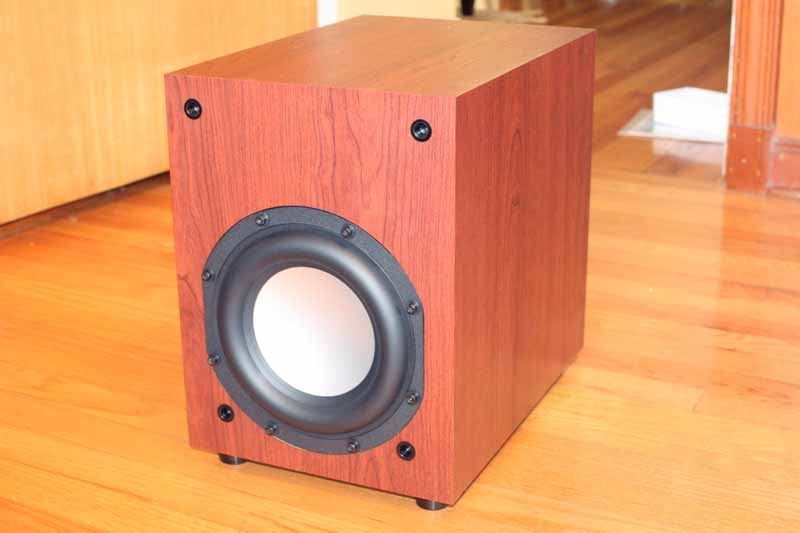
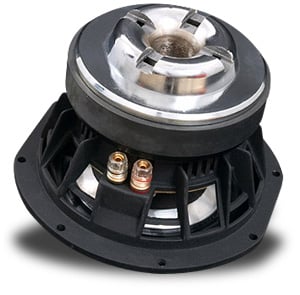
Look at the massive motor structure and superb build quality of the EP400 driver.
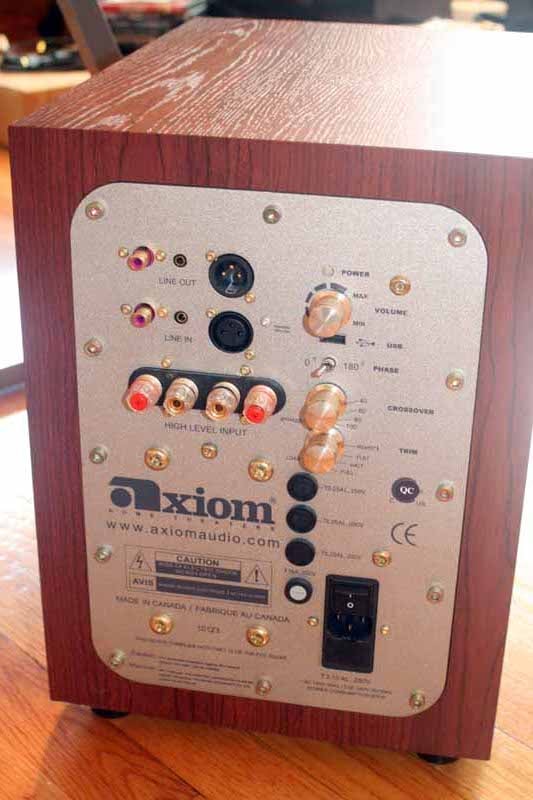 For controls, the sub features both
balanced and unbalanced line inputs and outputs, speaker level (high level)
inputs, but no speaker level outputs. Before you ask, there ARE processors,
like the Denon
AVP-A1HDCI which allow for balanced subwoofer outputs. In addition, we've
had two different Axiom EP-series subs whose unbalanced connectors broke after
just over a year of use, so those XLR inputs are looking pretty good, even if
it does require a special cable to utilize them. There is a trim control that
can be set to Flat, Half or Full depending upon how much boost you
want in the room above 33Hz. We left the setting at Flat since this seemed to do just fine in our 12x13 room. The trim
control also has future-only functions like Remote and Load which aren’t
something you'd use at present (and since they are also present on the EP500
and have never been used, don't expect to any time soon).
For controls, the sub features both
balanced and unbalanced line inputs and outputs, speaker level (high level)
inputs, but no speaker level outputs. Before you ask, there ARE processors,
like the Denon
AVP-A1HDCI which allow for balanced subwoofer outputs. In addition, we've
had two different Axiom EP-series subs whose unbalanced connectors broke after
just over a year of use, so those XLR inputs are looking pretty good, even if
it does require a special cable to utilize them. There is a trim control that
can be set to Flat, Half or Full depending upon how much boost you
want in the room above 33Hz. We left the setting at Flat since this seemed to do just fine in our 12x13 room. The trim
control also has future-only functions like Remote and Load which aren’t
something you'd use at present (and since they are also present on the EP500
and have never been used, don't expect to any time soon).
The crossover is only adjustable from 40-100Hz in 20 Hz steps and can also be set to Bypass (150Hz). Axiom recommends setting the sub's crossover to the setting just above the setting you use on your AV receiver. It's a little confusing if you follow Axiom Audio's instructions, and since the sub should only be getting low frequencies as determined by the AV receiver, we recommend using Bypass for all settings. Phase can be adjusted via a toggle switch (0 or 180 degrees.) The sub has a 10W Standby mode according to the User Manual, however it isn't obvious and the rear LED doesn't change colors to reflect this. Additionally, it is supposedly "instant" though we don't know exactly what that means. Don't take all this nitpicking too much to heart - for all its (mostly insignificant) quirks, the EP400 sounds great and performs extremely well.
Epic Midi - Listening Tests and Conclusion
My immediate impressions of the system included amazement at how tactile the subwoofer was in the listening room. It was so smooth that at first we wondered if it was working properly. I'm so used to small subs flexing their muscles in a way that has them standing out and making a show of themselves. The Axiom EP400 simply did its job thoroughly and accurately. When it was called for, tactile energy poured forth. When it was simply rolling out lower octaves, the room filled with pleasing bass that wasn't at all one-notey. The QS4 surrounds really captured the essence of what I feel surrounds are meant to. There was a complete diffusion of sound behind us yet we were able to get a good stereo separation despite the fact that the rear speakers were only 4-5 feet away from the listening position. The VP100 Center channel also did an excellent job at anchoring the dialogue and vocals to the 32-inch Toshiba we were using while evaluating the system.
DVD: Saving
Private Ryan During
the opening scene at Omaha
Beach the panning and
directionality of the Axiom Epic Midi system was apparent. Bullets whizzed
overhead and the entire sound field was caught up in the harrowing rush to
cover. "Radar Station" was an equally intense scene and Axiom's EP400
really came through as the ultra-low "thumpy" bullet shots filled the
room as the soldiers dashed for the enemy gunning positions. The sub would need
to be accompanied by another (or upgraded to a larger sub from Axiom) in a
bigger room, but for this small room it was more than adequate. It was
impressive to hear the dynamic range of the system, especially when the action
went from 0-60 in no time flat. Small background explosions could be heard in
the distance and then suddenly the sound field would be filled with the
cracking of gunfire and the massive impact sounds of an explosion. This is
great test material and Axiom's system did very well at proving that their
near-entry level system is up to the task of home theater.
During
the opening scene at Omaha
Beach the panning and
directionality of the Axiom Epic Midi system was apparent. Bullets whizzed
overhead and the entire sound field was caught up in the harrowing rush to
cover. "Radar Station" was an equally intense scene and Axiom's EP400
really came through as the ultra-low "thumpy" bullet shots filled the
room as the soldiers dashed for the enemy gunning positions. The sub would need
to be accompanied by another (or upgraded to a larger sub from Axiom) in a
bigger room, but for this small room it was more than adequate. It was
impressive to hear the dynamic range of the system, especially when the action
went from 0-60 in no time flat. Small background explosions could be heard in
the distance and then suddenly the sound field would be filled with the
cracking of gunfire and the massive impact sounds of an explosion. This is
great test material and Axiom's system did very well at proving that their
near-entry level system is up to the task of home theater.
DVD-Audio/DTS: Lowen & Navarro
- Carry On Together The
lead song, "Compass Point", had a Mandolin which put forth a clear
and crisp top end with detailed string strumming and a beautiful tone. We found
that with DTS music tracks we felt the need to ease back off the subwoofer
levels a bit. While excellent for movies, the EP400 needed to be tamed somewhat
to sound a perfect blend with music tracks. Some AV receivers will allow you to
vary the subwoofer output level in different modes, this may help automate that
process. Other receivers will allow on-the-fly level trims and you can use that
to temporarily adjust the subwoofer to taste without having to get up and
adjust the physical volume control.
The
lead song, "Compass Point", had a Mandolin which put forth a clear
and crisp top end with detailed string strumming and a beautiful tone. We found
that with DTS music tracks we felt the need to ease back off the subwoofer
levels a bit. While excellent for movies, the EP400 needed to be tamed somewhat
to sound a perfect blend with music tracks. Some AV receivers will allow you to
vary the subwoofer output level in different modes, this may help automate that
process. Other receivers will allow on-the-fly level trims and you can use that
to temporarily adjust the subwoofer to taste without having to get up and
adjust the physical volume control.
Bass guitar sounded rich and complete, with both the top end snap and bottom end roll we have come to associate with good bass playing. It was great not to hear any obvious gaps or holes between the lower midrange capabilities of the speakers and the upper limits of the subwoofer (which we had crossed over at 80Hz). On cymbals we felt there was a tad bit of "air" missing but it didn't seem to distort or compress the frequencies at even at moderate output levels. "Cold Outside" is one of my favorite tracks on this album and the piano had a smooth, extended ring out and decay that carried the natural reverb of the room to our ears.
DVD-Audio/DTS: The
Blue Man Group - The Complex Dave
Matthews' voice was well-anchored to the center in "Sing Along" and
the whips were sooth while bass had a pleasing and solid feel with just the
right amount of mid-bass present. The PVC hits were present but didn't carry
the same tonality and impact I've heard with more upper-mid-rich systems. This
is most likely due to the levels we were driving the system to and the amount
of information we were asking these small boxes to carry. Tracy Bonham's lead
in "Up to the Roof" was solid but left us wanting a bit more definition
in her delivery. The VP100 performed well in this system but would probably
have a hard time keeping up with some of the larger speaker offerings from
Axiom. The wispy break that pops up before one of the final choruses was crisp
and satisfying - we really like the tweeter in the M2s. Overall we felt that
the Epic Midi system did a really good job on multi-channel music. The upper
midrange was the only area lacking in definition - which is understandable for
this type of loudspeaker design.
Dave
Matthews' voice was well-anchored to the center in "Sing Along" and
the whips were sooth while bass had a pleasing and solid feel with just the
right amount of mid-bass present. The PVC hits were present but didn't carry
the same tonality and impact I've heard with more upper-mid-rich systems. This
is most likely due to the levels we were driving the system to and the amount
of information we were asking these small boxes to carry. Tracy Bonham's lead
in "Up to the Roof" was solid but left us wanting a bit more definition
in her delivery. The VP100 performed well in this system but would probably
have a hard time keeping up with some of the larger speaker offerings from
Axiom. The wispy break that pops up before one of the final choruses was crisp
and satisfying - we really like the tweeter in the M2s. Overall we felt that
the Epic Midi system did a really good job on multi-channel music. The upper
midrange was the only area lacking in definition - which is understandable for
this type of loudspeaker design.
DTS CD: Eagles
- Hell Freezes Over We
listened for the telltale bass line which opens up track 9 "New York
Minute" and the Axiom sub basically laughed at me as it played it with
ease - adding a wondrous bump to the kick as due course. Henley's
vocals poured through the Center channel like he was embedded in the room. We
were repeatedly brought back to the realization that this system is simply a
revealing, clear 5.1 audio setup that has an almost limitless amount of
enjoyability. During "Seven
Bridges Road" we really felt that the bass
vocal was uncanny. The combined vocal effect came across well and we were able
to easily pick apart each voice - though the system didn't have an
artificially-exaggerated channel separation. The sound was natural and very
full.
We
listened for the telltale bass line which opens up track 9 "New York
Minute" and the Axiom sub basically laughed at me as it played it with
ease - adding a wondrous bump to the kick as due course. Henley's
vocals poured through the Center channel like he was embedded in the room. We
were repeatedly brought back to the realization that this system is simply a
revealing, clear 5.1 audio setup that has an almost limitless amount of
enjoyability. During "Seven
Bridges Road" we really felt that the bass
vocal was uncanny. The combined vocal effect came across well and we were able
to easily pick apart each voice - though the system didn't have an
artificially-exaggerated channel separation. The sound was natural and very
full.
Conclusions
Axiom Audio has put together a very pleasing system in the Epic Midi 400. Because we enjoyed the system so much it is hard to recommend it without the subwoofer upgrade (and of course, we'd have to hear it with the lesser priced subs to see how performance was impacted.) The only difficulty is in the amount of competition available at this price point. For just under $2000 Axiom is in for a lot of comparison shopping. It's clear, however, that the star of the show was the EP400 subwoofer. While the M2s and VP100 Center channel performed admirably, the EP400 enabled a seamless blend that seemed to extend forever as it reproduced even the lowest frequencies we expected in the tracks we listened to (some of which we didn't have time to include in this review). We can heartily recommend the Epic Midi 400 system as an excellent-sounding system and one that would go well into almost any small to medium-sized room.
Epic Midi 400 Speaker
System
MSRP $1975
Axiom Audio
Highway 60
Dwight, Ontario
Canada
P0A 1H0
866-244-8796
About Axiom Audio
For more than two decades, Axiom Audio has made its
reputation by achieving unprecedented performance quality. At inception, Axiom
Audio's founder Ian Colquhoun sparked a new period of progress in the annals of
loudspeaker design with his work at the National Research Council lab in Ottawa, Canada,
under the direction of Dr. Floyd Toole. There he spent innumerable hours
perfecting innovation after innovation. The revolutionary theories and
methodology resulting from this work were recognized and published in industry
journals around the world. Canadian audio engineering gained particularly high
status, which Ian Colquhoun and his company have helped maintain ever since.
The Score Card
The scoring below is based on each piece of equipment doing the duty it is designed for. The numbers are weighed heavily with respect to the individual cost of each unit, thus giving a rating roughly equal to:
Performance × Price Factor/Value = Rating
Audioholics.com note: The ratings indicated below are based on subjective listening and objective testing of the product in question. The rating scale is based on performance/value ratio. If you notice better performing products in future reviews that have lower numbers in certain areas, be aware that the value factor is most likely the culprit. Other Audioholics reviewers may rate products solely based on performance, and each reviewer has his/her own system for ratings.
Audioholics Rating Scale
 — Excellent
- — Very Good
- — Good
- — Fair
- — Poor
| Metric | Rating |
|---|---|
| Build Quality | |
| Treble Extension | |
| Treble Smoothness | |
| Midrange Accuracy | |
| Bass Extension | |
| Bass Accuracy | |
| Imaging | |
| Soundstage | |
| Dynamic Range | |
| Fit and Finish | |
| Performance | |
| Value |  |
Clint Deboer was terminated from Audioholics for misconduct on April 4th, 2014. He no longer represents Audioholics in any fashion.
View full profile Subscribe to our newsletter