


ADAM A7 Monitor Speakers Review
ADAM A7 Monitor Speakers
- Product Name: A7 Monitor Speakers
- Manufacturer: ADAM Professional Audio
- Performance Rating:

- Value Rating:
- Review Date: March 02, 2010 17:45
- MSRP: $ 1149/pr
Woofer: 7" (175 mm) carbon sandwich
Tweeter: 4.5 sq. in. ART
Equiv. Diaphragm area: 2.5" (60 mm)
Velocity transform ratio: 4:1
Amplifiers: 2 x 50W/80W Class D (ICE)
Input Sensitivity -∞ to +10 dB
Low shelve > 6 kHz ±6 dB
High shelve < 150 Hz ±6 dB
Tweeter gain ±4 dB
Inputs: XLR / RCA
Frequency response: 46 Hz - 35 kHz
THD > 80 Hz: <1.5 %
Long term output: >105 dB
Max. peak: >115 dB
Crossover frequency: 2200 Hz
Input impedance: 10 Kohm
Weight: 17.6 lb (8 kg)
Magnetically shielded: Yes
Dimensions: 13" (330 mm) H x 7.5" (185 mm) W x 11" (280 mm) D
Warranty: 5 Years
Pros
- Sparkling treble
- Focused bass response
- Power switch and volume on front
- Small footprint/ big sound
- Great price for quality
Cons
- None worth mentioning
Overview and Build Quality
 ADAM (Advance Dynamic Audio Monitors) is a Berlin based manufacturer of a variety of loudspeakers for both pro audio and home applications. All of their speakers employ the ART (Accelerating Ribbon Technology) transducer, which is an unfolded tweeter design that doesn't have the piston like movement that the majority of speakers incorporate. Instead, when an audio signal is applied, a pleated membrane moves air 4 times faster and much more efficiently than traditional transducers. ADAM says that this results in "unprecedented clarity and pristine transient reproduction." ADAM isn't the only company taking this route, but in a mainstream studio monitor it's a pretty unique feature - one that we looked forward to checking out.
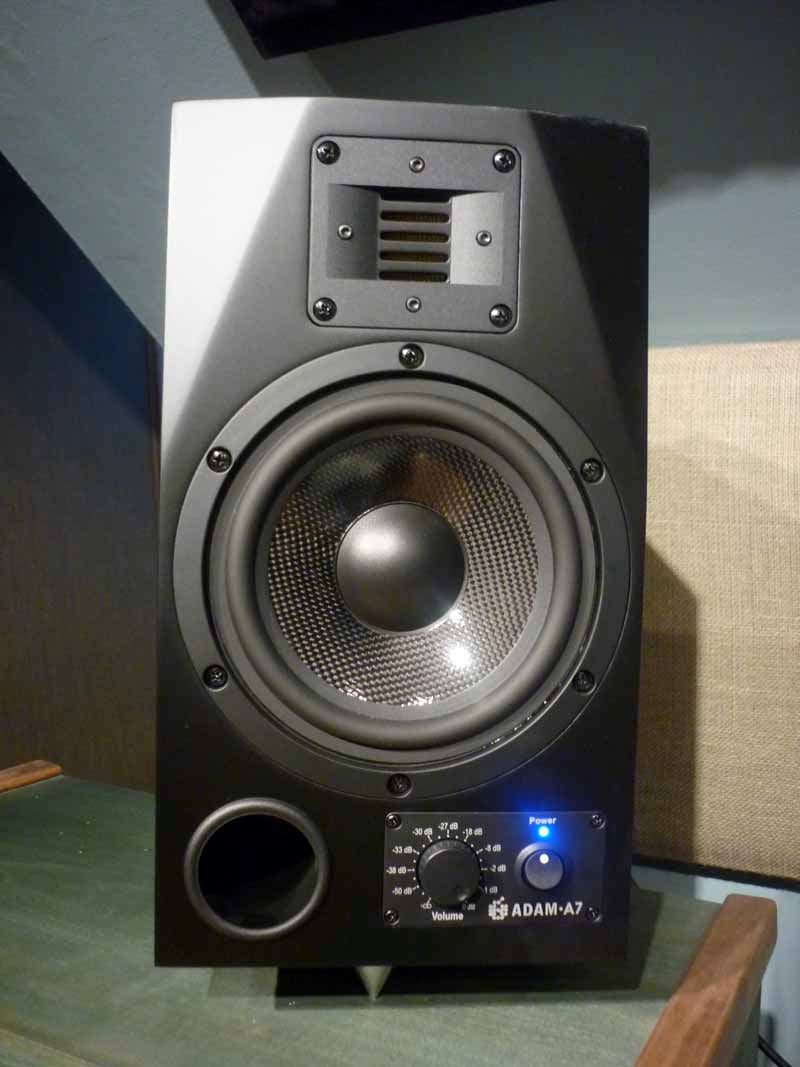
The ADAM A7 ( $1149/ pr ) is a two way near-field studio monitor with the aforementioned ART tweeter and a 6.5 in. carbon "sandwich" mid/bass driver. This is all powered by two 50-watt (80W peak) amplifiers, one per driver. Housed in an attractive black cabinet that weighs 18 lbs and measures 13in. high x 7.5in wide x 11in deep, the top front edges are beveled back (chamfered) to reduce surface reflections from the tweeter. This gives the monitor a very rugged, but classy look. The circular power rocker switch is located on the front panel along with an input gain control that logarithmically brings up the volume to maximum gain.

The rear panel sports balanced XLR and unbalanced RCA inputs, a standard removable power cable receptacle, and 3 recessed control pots for tuning the speakers to your room. One is a tweeter control that boosts or cuts the tweeter output up to 4db and the other 2 are shelving filters that offer +/- 6 db at >6K and <150Hz. These controls are important in a studio monitor as they can compensate for the acoustics of the room as well as proximity to a wall, which results in accentuated low frequency response (commonly referred to as "boundary gain").
Experiencing the A7
I first heard the A7's in Mark Hill's small project studio on the outskirts of Nashville. I was mixing a record that I was producing and found that I was really enjoying going to hear the mixes at night in that room, on those speakers. I mostly chalked up the experience to the exceptional mixing of engineer Richie Biggs, to general good vibes, and the really cool project that I was working on. After finishing the record, I decided I needed to bring some A7's into my day-to-day workspace and see what it was that made it such a great overall listening event.
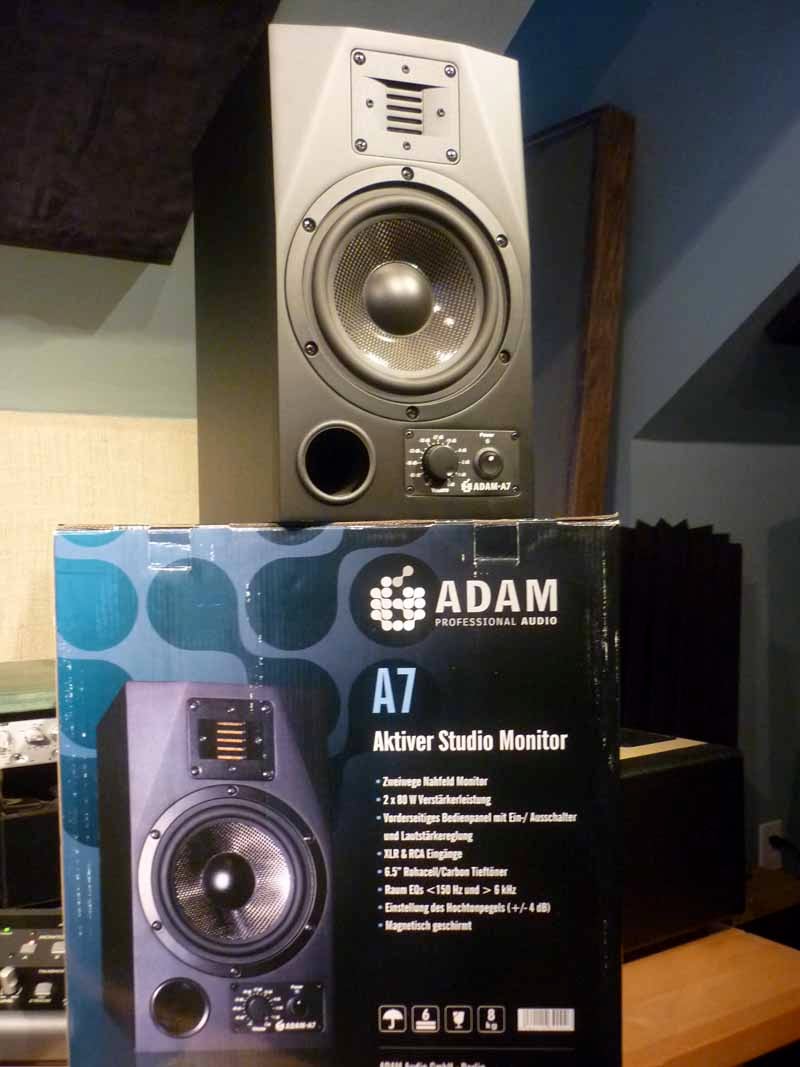 Having moved from Alesis M1 active monitors to Mackie HR 624's in the past few years, I've grown accustomed to not trusting my decisions regarding low end (how much is really there?) and dealing with grating high frequencies as well. I usually chalk it up to my room or my engineering, as I'm primarily an instrumentalist forced into audio engineering by this wild new world of the modern music business. But I've also been doing this for over 20 years, and I know what I want to hear. I unboxed the A7's and set them up vertically, found the sweet spot in the triangle and pulled up a guitar track that I was working on. Immediately I found myself forgetting about what I lack in the Mr. Wizard department and pretty much just enjoyed what I was playing. I record a lot of acoustic guitar in my room and I know my mics and mic preamps pretty well by now. I generally record guitars as flat as possible as to leave the most room for interpretation up to my mix engineers. Sometimes this doesn't lead to the most pleasant listening experience while recording. But right away I noticed that even in dropped tunings the guitar sound on the A7's was really beautiful, the low end focused and gorgeous, the mids speaking well throughout, and the high end, well...
Is this what the A.R.T. transducer is all about? Wow. The high frequencies on these speakers are just fantastic. There's none of the harshness that I've gotten used to when wrestling with my Gibson J-45 sound, just a really nice open and sparkly top end that I'm always hoping to stumble upon.
Listening Evaluation and Conclusion
Solo guitar is one thing for sure and I generally use my room as an overdub facility, but as the weeks went on I've worked on a number of projects on these speakers. I had some mixes done in my room as opposed to somewhere else to see how they'd compare to what I've become used to. Some of the work we do at my place is destined for TV and in the end that requires a certain amount of brightness. Adding that high end to the A7's made the tracks really enjoyable on a variety of playback options from laptops to car speakers. Also, after hours of listening to all that high end, I don't have that dreaded "I don't ever want to hear music again" feeling that I get at the end of a long day of recording. (ear fatigue is not a myth, dear readers)
I was also pleasantly surprised by the bass response as we worked on a throwback 70's funk song as well. Remember, the bass drivers are only 6.5". I could hear all of the notes very clearly from the Fender Jazz bass and the kick drum was set apart, well defined and punchy. I'm always amazed when I turn up the volume with these speakers and feel all of the low end. I found myself glancing under the console for the sub that wasn't there. And actually, for you sub bass freaks or recordists that want to know what's really going on "down there" ADAM offers the Sub7 sub-woofer ($549) which matches well with the A7's or even the smaller A5's. I fear it would be overkill for my small room and didn't miss having a sub for a second.
 As far as listening to a mastered recording goes, my other test is one that dates me, but it can't be helped, as it's the CD that I've listened to in countless environments. It's the Sting Soul Cages test. Line up on whatever side you will in regards to Sting and his music, but this record is wonderfully recorded and mixed. It also has a beautiful and varied array of instrumentation from Northumbrian pipes to oboe, gut string guitar and typical rock rhythm section as well."Island Of Souls" starts the record and is a slow build from Synclavier strings and classical guitar to full band. Once again the A7's brought out everything I've ever loved about listening to this record since I first heard it on Tannoy Gold reference monitors back in '91. The kick drum is focused and distinct from Sting's loping bass lines, the vocal and guitars aren't fighting in the midrange (like in my car) and the high end is super smooth and sparkly. "Mad About You" is another personal favorite as a recording and sounded perfect on the A7's. Nothing mushy from instrument to instrument as I really turned up the gas. Man, we used a lot of reverb in the 90's! The vocal sounds great on these speakers, the upper harmonic range really holding together at loud volumes with no distortion. Really nice.
As a favor to my daughter I also listened to some music that wasn't "old". She suggested Taylor Swift. I listened to "You Belong To Me" from the Fearless recording. Uhh, it sounded really great. And really modern from a loud and compressed standpoint too. The low end is really punchy and the acoustic instruments have tons of sparkle and air. This recording has a lot of dimension to it and the A7's soundstage really brings out that depth well. Even the vocal has a certain bright charm to it and isn't as annoying as when I hear it coming from my daughter's iPod boombox. Neat. Awesome. Cool.
Summary
Obviously I enjoyed the time I spent with the A7's. From the warm and focused low end to the smooth highs of the A.R.T tweeter, these speakers have great tone and balance throughout the whole spectrum. Small but powerful, they will be a welcome addition to any project studio or any mix engineer's arsenal of nearfield monitors. Taking mixes from the studio to the car to the computer showed these speakers to accurately represent the changes we made to mixes and they were easy to listen to for long days and nights of recording and mixing. Well done ADAM!
ADAM A7 Monitors
MSRP $1149/pr
ADAM Audio GmbH
Ederstr. 16
D-12059 Berlin
Germany
About ADAM Professional Audio
It was in Spring 11149 when the physicist Klaus Heinz and the electrical engineer Roland Stenz, loaded with vast experience on the field of speaker systems and a revolutionary tweeter design, founded ADAM Professional Audio. This highly sophisticated design was soon to become the pinnacle of authentic sound reproduction and the basis for achieving the very goal of the young but ambitious company: to challenge the few giants in the industry by offering a superior product. And as a matter of fact, in a short amount of time, Advanced Dynamic Audio Monitors managed to become one of the most preeminent tools in professional monitoring.
The Score Card
The scoring below is based on each piece of equipment doing the duty it is designed for. The numbers are weighed heavily with respect to the individual cost of each unit, thus giving a rating roughly equal to:
Performance × Price Factor/Value = Rating
Audioholics.com note: The ratings indicated below are based on subjective listening and objective testing of the product in question. The rating scale is based on performance/value ratio. If you notice better performing products in future reviews that have lower numbers in certain areas, be aware that the value factor is most likely the culprit. Other Audioholics reviewers may rate products solely based on performance, and each reviewer has his/her own system for ratings.
Audioholics Rating Scale
 — Excellent
- — Very Good
- — Good
- — Fair
- — Poor
| Metric | Rating |
|---|---|
| Build Quality | |
| Appearance | |
| Treble Extension | |
| Treble Smoothness | |
| Bass Extension | |
| Imaging | |
| Soundstage | |
| Fit and Finish | |
| Performance | |
| Value | |
 Subscribe to our newsletter