


EMP EW30 On-Walls Review
- Product Name: EMP EW30 On-Wall Speaker Review
- Manufacturer: EMP
- Performance Rating:

- Value Rating:
- Review Date: November 04, 2007 13:35
- MSRP: $ 375/ea
|
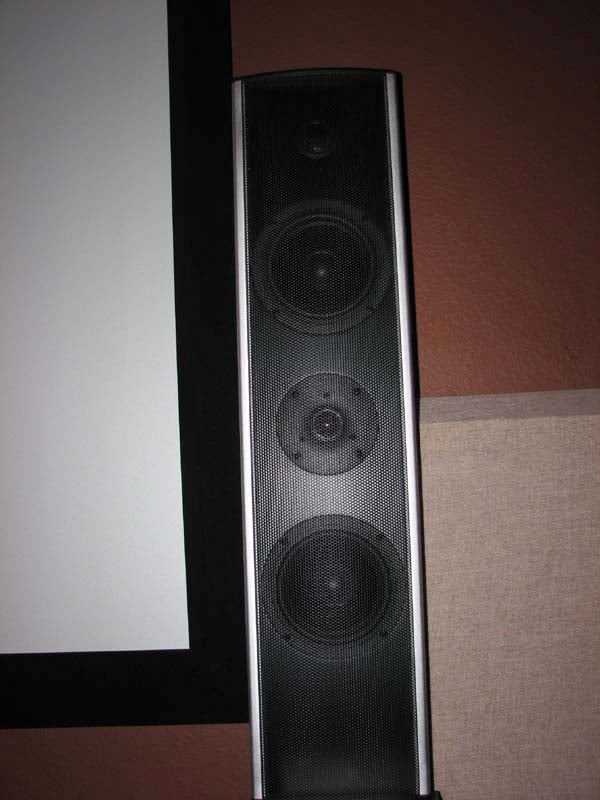
Frequency range +/- 3 dB 46Hz - 20kHz±3dB Sensitivity (2.83V/1m) 86.0 dB Nominal impedance 6 ohms Recommended amp power 50– 200watts Crossover frequency 220Hz, 2.2kHz Tweeter driver 1” Silk Dome Enclosure type Ported Connection input(s) Single Wire Recommended placement on wall (via wall mount kit) or stand mountable Dimensions (H x W x D) 25” H x 7 1/8” W x 5 5/8” D Weight 19.5 lbs/ea Grill: Black or Silver (both included) Finish Silver with black caps and accents
|
Pros
- Excellent build quality and appearance
- Overall solid performer
- Easy to install
Cons
- Slightly recessed midrange and upper midbass
Introduction
Streamlined. High Wife Acceptance Factor (WAF). These are buzz words often thrown around in our industry to determine whether or not a particular product, usually a speaker or subwoofer, will win big points in the aesthetics department for those looking to integrate a home theater system into their living or family rooms without hindering precious floor space or the room's décor. More often than not, people tend to compromise sound quality over looks making the #1 most common mistake of using all in-ceiling speakers or worse “cubed” speakers which are definite NONO’s for sacrificing quality audio reproduction simply because it looks better. But what if you could have your cake and eat it too? What IF you can have a speaker system that is BIG on performance but also scores high WAF? Enter EMP – a new speaker company whose products are crafted by our friends at RBH Sound and sold exclusively online. In this review, we put EMP’s EW30 on-wall speakes to the test to determine if they have the sonic chops to match their “streamlined” appearance.
Build Quality
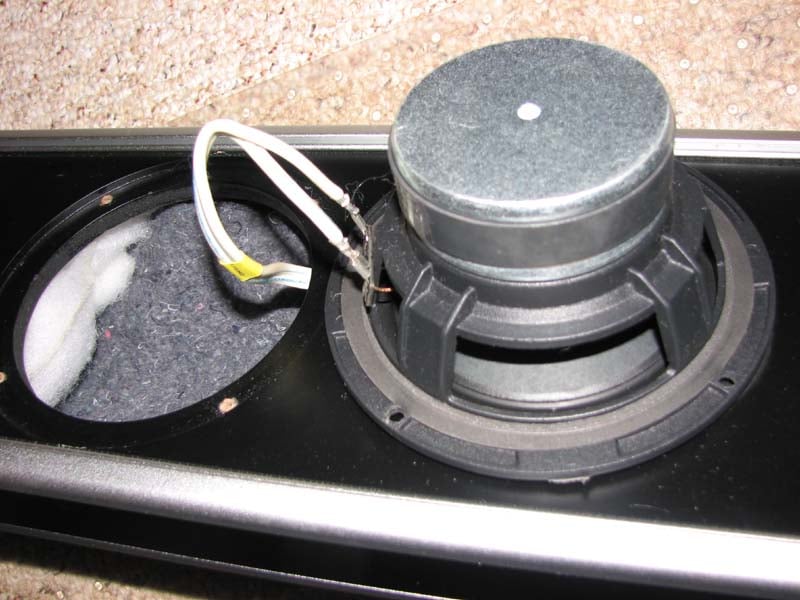 Constructed from extruded aluminum, these speakers
convey serious enclosure quality. I am a
big fan of these cabinet types as they not only look great, but often offer
superior control of cabinet resonance compared to conventional MDF
designs. Tapping on the cabinet revels a
consistently dead sound throughout. In
fact, I peered inside the cabinet by removing the grill and popping out one of
the drivers. I was pleased to find the
cabinet was well insulated and EMP spared no expense at using real cast drivers
instead of cheap stamped baskets like so many competitor products tend to do to
cut corners. The carbon fiber woofers
are basically treated paper similar to drivers I’ve seen from a reputable companies
such as Peerless. The tweeter is a 1”
silk dome with a conventional motor structure. Note that these speakers are not
Constructed from extruded aluminum, these speakers
convey serious enclosure quality. I am a
big fan of these cabinet types as they not only look great, but often offer
superior control of cabinet resonance compared to conventional MDF
designs. Tapping on the cabinet revels a
consistently dead sound throughout. In
fact, I peered inside the cabinet by removing the grill and popping out one of
the drivers. I was pleased to find the
cabinet was well insulated and EMP spared no expense at using real cast drivers
instead of cheap stamped baskets like so many competitor products tend to do to
cut corners. The carbon fiber woofers
are basically treated paper similar to drivers I’ve seen from a reputable companies
such as Peerless. The tweeter is a 1”
silk dome with a conventional motor structure. Note that these speakers are not
 magnetically shielded but it shouldn’t present a problem unless you are using
them in close proximity to a CRT based display or anything with a hard drive
(keep them away from your DVR). In that
case, I suggest some good old 1970’s big box Lafayette specials.
magnetically shielded but it shouldn’t present a problem unless you are using
them in close proximity to a CRT based display or anything with a hard drive
(keep them away from your DVR). In that
case, I suggest some good old 1970’s big box Lafayette specials.
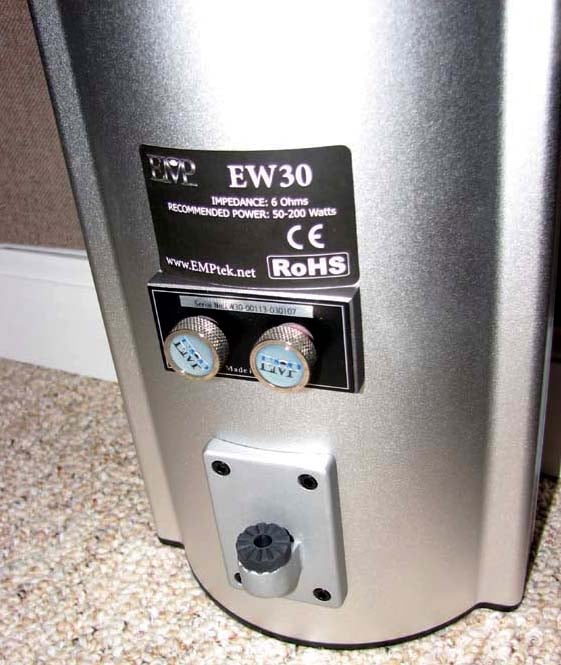
The backside of the EW30s sport hefty mounting plates top and bottom and silver terminal nuts which you must unscrew to push the speaker wire through. They dressed the speaker up nicely but extra care must be taken to observe polarity since it's marked behind the terminal cap and not clearly visible on the speaker cabinet itself. Upon first glance, I almost missed it. It would have been good measure for EMP to include color coded terminal caps to match the color polarity on the threaded connectors mounted on the back casing.
Set-Up
Changeable Grill Covers
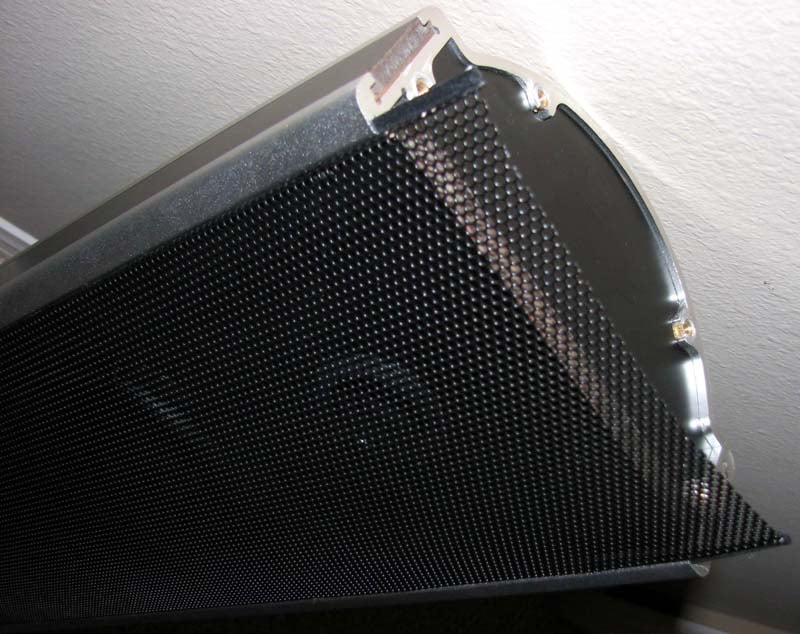
Before installing the EW30s you must first consider a couple of things such as your preference for grill cover color, the location you wish to mount them, and by what method. The EW30s come preinstalled with the black grills but they provide you the optional gray grill cover to better match your plasma display should the casing be non black such as the older Panasonics. Taking off the grill cover was much easier than replacing it. You start by removing the 4 hex screws on the top and bottom panels of the speaker. Then you gently flex the grill while lifting it out on one end and slowly following through to the other. Next replace the grill with the optional silver one, carefully ensuring it is centered before replacing the top and bottom panels of the speakers. The manual recommends you insert one side into the grill track and then gently bend the other one to fit it in place. Of course I couldn’t accomplish that in one or two tries so thinking I was clever, I slid the grill in from one side which was going fairly easy until I reached the halfway point and noticed rubber shavings on one side. At that point, not even my kung fu grip could pry it lose. I was committed to stay the course realizing once I did get the grill cover back on, it would never be a “removable” grill cover again. Luckily I stuck with the black cover which is what I wanted and began muscling the cover to get it in place. That lasted a good 3 or 4 seconds as I reached for the rubber mallet to get the job done. This was an experience I don’t want to repeat and I strongly encourage you to either follow the guidelines in the manual or leave well enough alone. Just because you can change out the grill cover doesn’t necessarily follow that you must change it out.
Mounting the Speakers
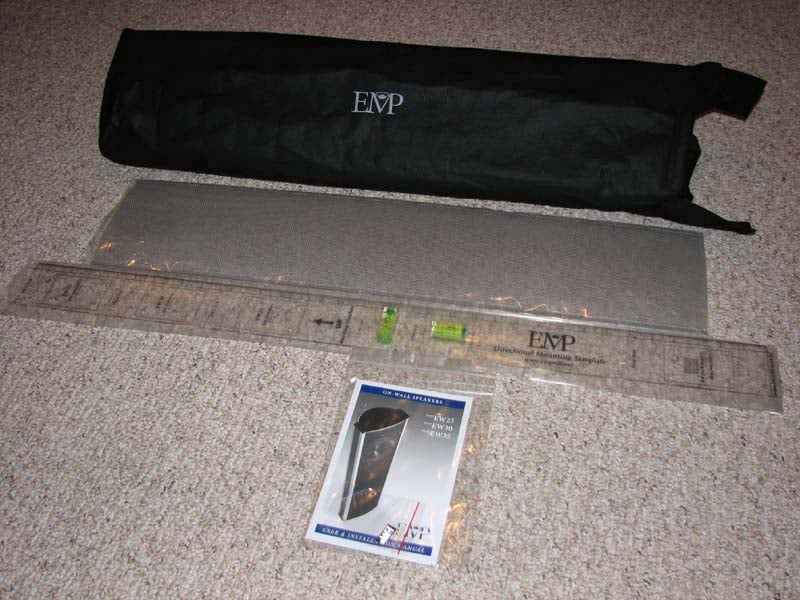 The EW30s come complete with a Directional Mounting
Template (DMT) to determine and mark your desired speaker location. It features a bubble type leveling system to
help out guys like me that can’t eyeball it or draw a straight line with a
ruler. The manual stresses that the
installer utilizes the centering cross hair marks on the template if you are
installing the EW30s and not the marks for the EW25’s or 35’s. Based on my recent debacle with the grills,
I’d suggest following the manual guidelines very closely. After you mark off the four mounting holes
with a pencil for the upper and lower brackets, you must decide on the method
of mounting them. If you are driving
into studs, then use the supplied screws.
If you are driving into drywall that you need to use the supplied drywall
anchors to support the heft of these speakers.
Pay careful attention to the bite direction when installing the wall
brackets. Next connect the speaker wire
to the speakers (note polarity).
Finally, follow the mounting directions in the manual and ensure you
properly tighten the hex nuts until the speaker can no longer pivot. Be very careful to ensure you have a solid
installation as you don’t want these metal monsters crashing down on an end
table, or worse a loved one or pet.
The EW30s come complete with a Directional Mounting
Template (DMT) to determine and mark your desired speaker location. It features a bubble type leveling system to
help out guys like me that can’t eyeball it or draw a straight line with a
ruler. The manual stresses that the
installer utilizes the centering cross hair marks on the template if you are
installing the EW30s and not the marks for the EW25’s or 35’s. Based on my recent debacle with the grills,
I’d suggest following the manual guidelines very closely. After you mark off the four mounting holes
with a pencil for the upper and lower brackets, you must decide on the method
of mounting them. If you are driving
into studs, then use the supplied screws.
If you are driving into drywall that you need to use the supplied drywall
anchors to support the heft of these speakers.
Pay careful attention to the bite direction when installing the wall
brackets. Next connect the speaker wire
to the speakers (note polarity).
Finally, follow the mounting directions in the manual and ensure you
properly tighten the hex nuts until the speaker can no longer pivot. Be very careful to ensure you have a solid
installation as you don’t want these metal monsters crashing down on an end
table, or worse a loved one or pet.
Editorial Note: Placement Guidelines
When installing on-wall speakers, I suggest you take mental note of coverage area and the best way to achieve a direct path of sound to that area. Placing speakers too high will reduce the fidelity and weaken the high frequency reproduction as you will be listening to the speaker too far off axis. This is one of many reasons I NEVER recommend in-ceiling speakers for the front three channels. Ideally the tweeter should be as close to seated ear level as possible in the listening area.
Try to place these speakers further apart than just the width of the display (if your significant other will allow it). In order to get the biggest possible soundstage and best imaging, they should be about 50-60% apart as the distance between their central plane and the listening area (IE. if you are sitting 10ft from the display, the speakers should be about 6-7 feet apart).
Speaker Break-In – may I have some cheese?
Like so many loudspeaker companies these days touting that their speakers need an ungodly amount of time for break in (usually longer than the retailers return policy) to sound their best., EMP jumped on that bandwagon, but a bit more conservatively by recommending a good 18-24 hours of play. This would still amount to over a month of time if the average listener uses their audio system 5 hours per week. Don’t get too caught up in number as we’ve found speakers require far less break in time than is generally reported by manufacturers and its most notable on subwoofers NOT tweeters or midbass units. Bottom line is if you don’t like the sound of your speakers out of the box, you may likely never like them and instead only get “used” to them to rationalize your purchasing decision. Never wait to play out the speakers for the manufacturer recommended break in times to determine if the speakers are keepers.
Equipment Used
Since I didn’t want to mark up my walls for this review, I instead chose to mount these speakers on my Plateau 30” stands directly up against my wall. I tested these speakers in my acoustically treated dedicated theater room and also my family room systems using a variety of equipment such as the Emotiva Reference Theater Series preamp and two channel power amp, Yamaha RX-V2700 A/V receiver and the Denon DVD-5910CI as the source. All cables were furnished by Impact Acoustics (Sonicwave TOSLink) and Bluejeans Cable (10AWG speaker cable and analog interconnects). Whenever relevant, I compared the sound of the EW30s directly with my Axiom Audio W3 on-wall speakers both setup in similar locations and up against the front wall.
EMP EW30 Listening Tests
CD: Larry
& Lee – Larry Carlton and Lee Ritenour
If you’re a jazz fan, than you are likely well aware of two of finest jazz guitarists today - Lee Ritenour and Larry Carlton. They teamed up back in 1995, when jazz was a little lumpier, to produce this fine guitar duet chock full of great instrumental solos and meaty jazz music. I use this CD as a reference often because it has excellent dynamic range and really gives a speaker system a good workout while also instantly clues me in on if the speaker is tonally accurate or not. The EMP EW30s conveyed the detail in this recording I was all too familiar with. Track #1 “Crosstown Kids” conveyed a large soundstage more so vertically than horizontally. When I directly compared these speakers to my Axiom W3 on-wall speakers, I felt that the EW30s sounded more expansive and natural in the highs, but didn’t have nearly the mid bass impact and slam of the W3s. Track #3 “L.A. Underground” showed off the EW30’s ability to project a 3 dimensional soundstage, revealing the airiness of the high hats with a touch of crispness but NOT overbearingly brightness you find with lesser designed speakers. I felt the bass reproduction was a bit lacking and I highly recommend using a subwoofer with this speaker system to get the fullest range of sound. Despite the modest bass output, I never found the EM30’s to sound strained or overworked when playing at high SPL’s despite the fact I was running them full range.
CD: Steely Dan – Two Against Nature
Instrumentally the EW30s were
fairing pretty well, but I  wanted to see how they handled vocals thus I popped
in a Steely Dan CD – Two Against Nature, which has quickly become a modern
classic. Track #7 “Cousin Dupree” again showed off the very wide soundstage of
the EW30s. Donald’s voice was a bit
recessed but it did sound quite natural.
In direct comparison to the Axiom W3s, I again felt the EW30s offered a
more natural and expansive sound, especially vertically, but the W3s had a more forward and in your
face presence in the vocals along with greater midbass impact on the
percussions. In my mind, neither speaker could replace a similarly
priced, well designed dedicated bookshelf speaker properly located in the room,
but both speakers did commendably well considering their application and space
savings they offered to those who cannot place a bookshelf speaker on a stand
or mount them off of a wall. They also
pretty much trounced any in-ceiling speakers I have heard. Needless to say, I enjoyed my Steely Dan
listening session on the EW30s as I went through about 4 to 5 tracks before I
moved on to my next demo disc.
wanted to see how they handled vocals thus I popped
in a Steely Dan CD – Two Against Nature, which has quickly become a modern
classic. Track #7 “Cousin Dupree” again showed off the very wide soundstage of
the EW30s. Donald’s voice was a bit
recessed but it did sound quite natural.
In direct comparison to the Axiom W3s, I again felt the EW30s offered a
more natural and expansive sound, especially vertically, but the W3s had a more forward and in your
face presence in the vocals along with greater midbass impact on the
percussions. In my mind, neither speaker could replace a similarly
priced, well designed dedicated bookshelf speaker properly located in the room,
but both speakers did commendably well considering their application and space
savings they offered to those who cannot place a bookshelf speaker on a stand
or mount them off of a wall. They also
pretty much trounced any in-ceiling speakers I have heard. Needless to say, I enjoyed my Steely Dan
listening session on the EW30s as I went through about 4 to 5 tracks before I
moved on to my next demo disc.
CD: Dianne Reeves – Never Too Far
 You’ve seen this CD pop up in many of my recent reviews. There is good reason for this as I can
instantly determine if a speaker is tonally colored in the highs once I start
hearing Dianne’s voice. I also dig her
music style so it’s a win-win situation and thus why it remains as one of the
discs in my reference collection. I
started with track #2 “Never too Far” paying close attention to the
vocals. I welcomed the broad soundstage but
found a lack of focus I am so accustomed to when listening on my much more
expensive reference bookshelf Status Acoustics Decimo speakers. Noting that limitation which I also find on
many other on-wall type speaker products, including the Axiom W3s, I payed
closer attention to the vocal tonality.
Again the EW30s were laid back in their presentation, never sounding
fatiguing or overbearing where as the W3s had a more forward sound to them,
fuller in the mid bass region, but also a bit too sibilant in the top end
making the vocals sound a bit spitty.
You’ve seen this CD pop up in many of my recent reviews. There is good reason for this as I can
instantly determine if a speaker is tonally colored in the highs once I start
hearing Dianne’s voice. I also dig her
music style so it’s a win-win situation and thus why it remains as one of the
discs in my reference collection. I
started with track #2 “Never too Far” paying close attention to the
vocals. I welcomed the broad soundstage but
found a lack of focus I am so accustomed to when listening on my much more
expensive reference bookshelf Status Acoustics Decimo speakers. Noting that limitation which I also find on
many other on-wall type speaker products, including the Axiom W3s, I payed
closer attention to the vocal tonality.
Again the EW30s were laid back in their presentation, never sounding
fatiguing or overbearing where as the W3s had a more forward sound to them,
fuller in the mid bass region, but also a bit too sibilant in the top end
making the vocals sound a bit spitty.
The low end extension of track #3 “Come In” was a bit lacking when listening on the EW30s running full range. This song has some serious bottom end extension warranting a true full range tower speaker or an addition of a good subwoofer or two. I engaged my Axiom EP500 subwoofer to supplement the bass and it helped to significantly round out the sound of the speakers. They blended quite well when crossed over at 80Hz which is what I recommend to those considering these speakers.
EMP EW30 Measurements and Analysis
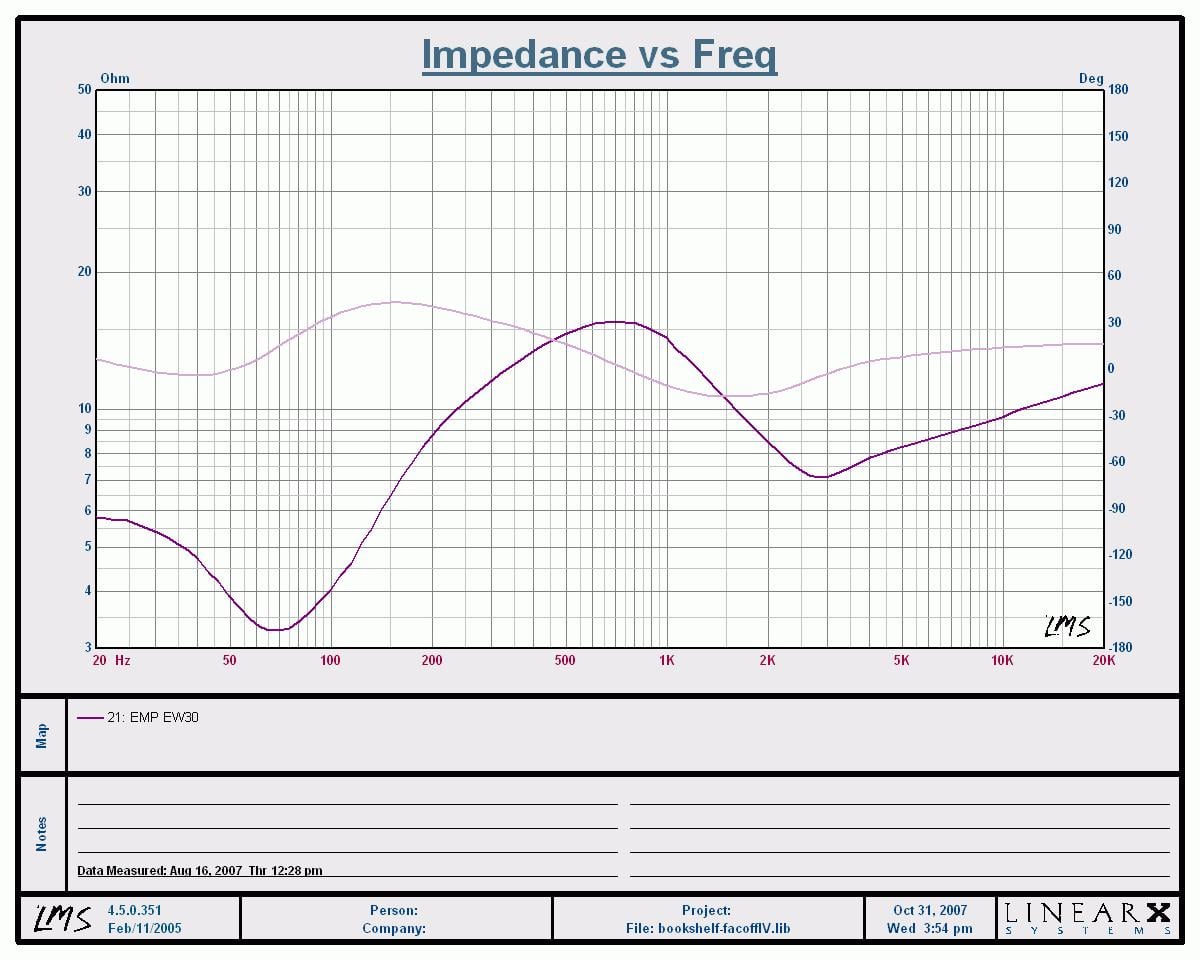
Impedance / Phase Measurements of the EW30
I was surprised to see the system impedance dip to 3.5 ohms from 50-100Hz which in my opinion is more reason to bass manage these speakers to remove the strain from the amplifier and let the more capable subwoofer produce the bass. The EW30s exhibit a relatively benign phase response of well under +- 30 degrees throughout the entire audio band indicating some good thought was applied to ensure these speakers would consistently sound good no matter what amplifier they were being played on.
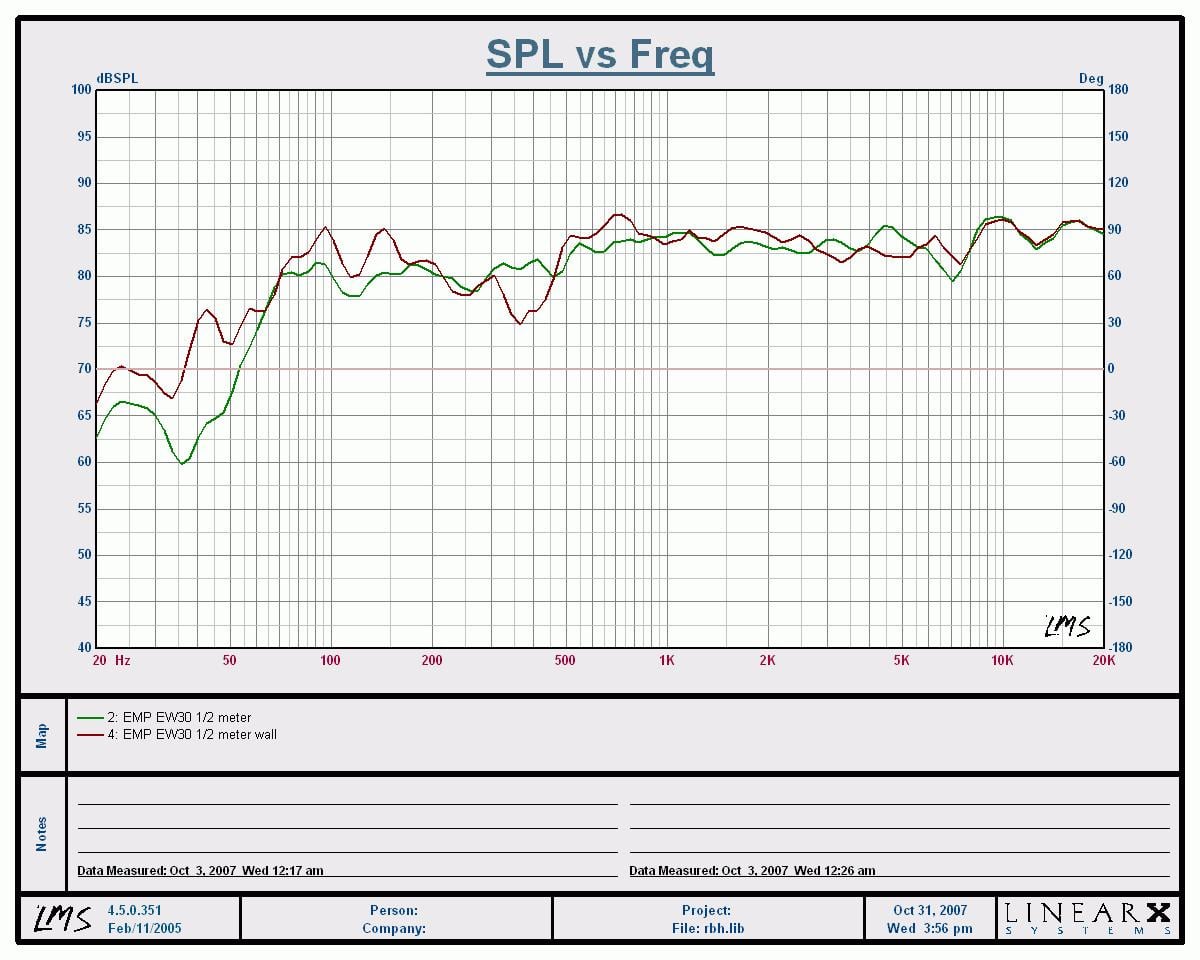
In Room ½ Meter
Frequency Response (1/12th octave smoothed)
Green – off wall, Brown
– on wall
Above
500Hz, these speakers are surprisingly very linear maintaining a +-3dB in room
frequency response. Below 500Hz there
seemed to be a slight tapering off of bass which may indicate why I felt they
lacked a bit of upper bass punch.
Placing them against the wall (their intended designed placement)
boosted the bass response significantly due to boundary gain as indicated in
the measurements below 150Hz. These speakers were designed to be placed against a wall and thus incidentally measure most linear and sound their best when placed as such.
EMP EW30 Conclusion
 The EW30s sound their best when mated with a good subwoofer and bass
managed to 80Hz. They simply cannot
deliver, nor should they be expected to, the bass impact of todays movies or
multi channel music mixes without the supplement of a subwoofer. Placing the tweeter as close to ear level as
possible will result in the most accurate tonal balance possible for the
speakers. They are moderately efficient
and a relatively easy load for even a modestly powered $400 A/V receiver to
drive, but don’t be afaid to pump some quality power into them as they can
certainly take it.
The EW30s sound their best when mated with a good subwoofer and bass
managed to 80Hz. They simply cannot
deliver, nor should they be expected to, the bass impact of todays movies or
multi channel music mixes without the supplement of a subwoofer. Placing the tweeter as close to ear level as
possible will result in the most accurate tonal balance possible for the
speakers. They are moderately efficient
and a relatively easy load for even a modestly powered $400 A/V receiver to
drive, but don’t be afaid to pump some quality power into them as they can
certainly take it.
The EW30s sounded as good as they looked. I didn’t walk away disappointed or floored by their performance either. They simply did the job they were designed too, quite well I might add, and perhaps were among the best on-wall type speakers I have heard. Their ability to portray a wide soundstage with plenty of detail in the top end and never sounding bright was a definite plus as I have heard far too many speakers in this genre with unacceptable coloration in the mids and highs.
So before you shell out big money to an installer to setup an all inceiling speaker system (which I call a fancy intercom system) for your theater room, consider one of the new on-wall speaker systems from EMP. They look great, blend in well with today’s flat panel displays and deliver the sonic goods allowing a discerning listener with a mindful eye on aesthetics to have their proverbial cake and eat it too.
EMP Loudspeakers
http://www.emptek.com
382 Marshall Way
Layton, Utah 84041
801-991-1308
phone
801-543-3300 fax
The Score Card
The scoring below is based on each piece of equipment doing the duty it is designed for. The numbers are weighed heavily with respect to the individual cost of each unit, thus giving a rating roughly equal to:
Performance × Price Factor/Value = Rating
Audioholics.com note: The ratings indicated below are based on subjective listening and objective testing of the product in question. The rating scale is based on performance/value ratio. If you notice better performing products in future reviews that have lower numbers in certain areas, be aware that the value factor is most likely the culprit. Other Audioholics reviewers may rate products solely based on performance, and each reviewer has his/her own system for ratings.
Audioholics Rating Scale
 — Excellent
- — Very Good
- — Good
- — Fair
- — Poor
| Metric | Rating |
|---|---|
| Build Quality | |
| Appearance | |
| Treble Extension | |
| Treble Smoothness | |
| Midrange Accuracy | |
| Bass Extension | |
| Bass Accuracy | |
| Dynamic Range | |
| Performance | |
| Value | |
Gene manages this organization, establishes relations with manufacturers and keeps Audioholics a well oiled machine. His goal is to educate about home theater and develop more standards in the industry to eliminate consumer confusion clouded by industry snake oil.
View full profile Subscribe to our newsletter