


Axiom Audio Algonquin Outdoor Speaker System Review
- Product Name: Algonquin Outdoor Speaker
- Manufacturer: Axiom Audio
- Performance Rating:


- Value Rating:
- Review Date: February 25, 2008 15:05
- MSRP: $ 330/pr (shipping included)
- Enclosure: Vortex / Reflex
- Max Amp Power: 175 Watts
- Min Amp Power: 10 Watts
- Freq Resp +/-3dB: 60 - 22 kHz
- Freq Resp +3dB/-9dB: 50 - 22 kHz
- Impedance (Ohms): 8 Ohms
- SPL In-Room 1w/1m: 92 dB
- SPL Anechoic 1w/1m: 88 dB
- X-Over 2.2 kHz
- Tweeter: Single 1"titanium
- Woofer: Single 6.5"aluminum
- Dimens. H W D (inches / mm): 13.5" x 8.5" x 8.25" / 343 x 216 x 210mm
- Weight (lbs/kg) each 9.05 lbs / 4.1 kg
Pros
- Very good sound for an outdoor speaker
- Plenty of bass extension
- Custom color matching
Cons
- Not fully weatherproof design
- Woofer has no crossover to limit driver breakup mode
- Pricey mounting brackets
- Pricing has gone up substantially since publication of this review
Axiom Algonquin Outdoor Speaker Introduction
I finally got my play/workout room completed and was in the process of putting the finishing but very critical touches on it. It was time to get my sound and video system setup. It's vital that I have good sound to keep me pumping to my favorite tunes at my home gym which allows the time to fly by during my grueling workouts. Thus I was looking for a small but potent speaker system that was easy to mount and would blend seamlessly into the room. I picked two pairs of speakers for this task and decided to mount the winner at the end of the day. The first was the Klipsch AW-525 and the second was the new Axiom Audio Algonquin (which for me is as hard to say as it is to spell). The Axiom Algonquin Outdoor speakers are a two-way ported bookshelf speaker in a weather resistant plastic cabinet featuring the same 6.5" aluminum woofers and 1" titanium tweeters found in their indoor M3 version.
I put both speaker systems (Klipsch AW-525 and Axiom Algonquin) through my battery of subjective listening tests and audio measurements and was pleasantly surprised in the admirable performance of both. But, to determine which one got mounted in my room will require for you to read this review in its entirety.
Algonquin Build Quality and Setup
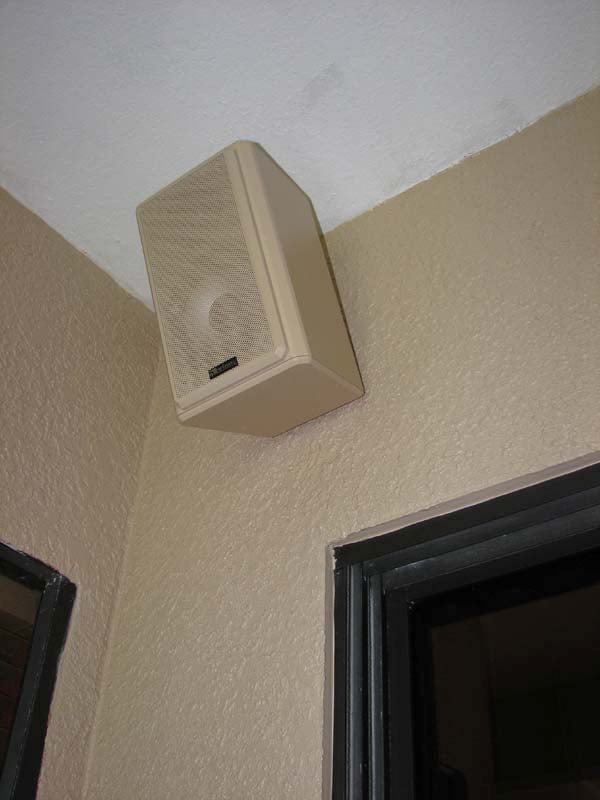
Axiom Audio has always been known for good build quality and above average fit and finish for a speaker in its price class. Their fit and finish has recently gone up quite a few notches with the introduction of their custom VaSSallo veneers where they offer real wood and even match the finish of your choice should you provide them with a sample swatch. In this case, the Algonquin's come in four standard finishes but I nudged Axiom to match the color I painted my room, and sure enough they did it. For a modest premium of 12%, not only did they match the color exactly but they did it for the grill covers and even the mounting brackets and associated hardware. Now that is custom!
The Drivers
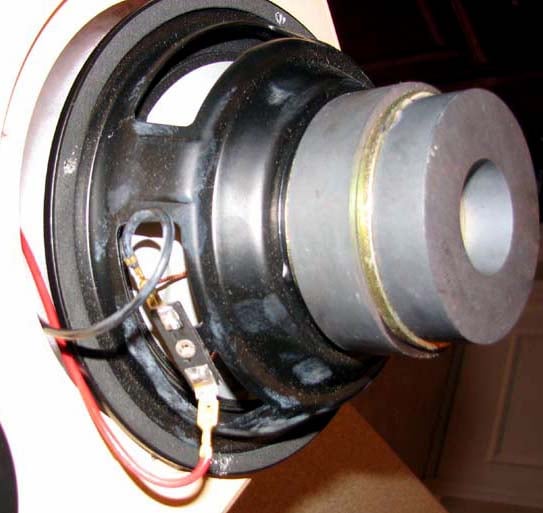
The 6 1/2 inch aluminium cone woofer is the same stamped basket design borrowed from their box speakers, namely the M3s. In fact, this speaker system is the equivalent model to that with the exception to the cabinet material which is a weather resistant plastic instead of MDF. The Axiom woofer is surprisingly semi shielded in that it has the bucking magnet added but its not encased in an steel can. This should be fine for anyone placing the speaker in close proximity to a CRT-type display.
Again Axiom uses the same 1 inch Titanium dome tweeter found on their boxed speakers. This is a good driver and Axiom's secret recipe for why their speakers sound so articulate and detailed. It’s definitely one of the better budgeted metal domes I've heard, sharing many of the sonic virtues of some of my favorite metal domes found from the likes of Canton and NHT. It doesn't suffer from what some loudspeaker engineers refer to as Asian Metal Dome Syndrome (AMDS) that so many metal domes do where you can hear harmonic break up in the mid frequencies especially when running test tones through them. Axiom does a great job ensuring tight tolerances on their drivers so they consistently perform as expected while minimizing these sonic nasties.
Crossover
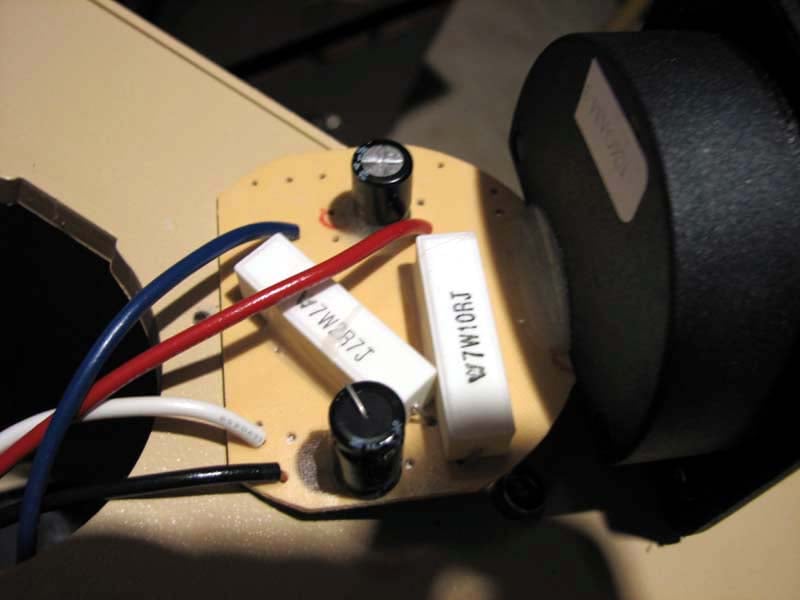
I was surprised to see such a basic crossover design void of any filter network on the bass driver and utilizing electrolytic capacitors in series with the tweeter. This is something I'd expect to see in a pair of $100 Walmart speakers, not a pair of high end speakers costing much more.
It's not necessarily always a bad thing to not have a filter element on the woofer, especially since it can increase efficiency. But, in a two-way system design utilizing stiff metal cone drivers, it's usually a good idea to have a series inductive element to minimize the audible effects of the woofer's breakup mode, especially when played at loud volumes. I initially thought the woofer had a series RC zobel network in parallel but Axiom later informed me there is no filter network at all on the woofer and all four crossover elements (2 resistors and 2 capacitors) are for the tweeter. The tweeter employs a first order network which doesn't do the greatest job at minimizing distortion at lower frequencies when played at loud levels. Although the system as a whole performed admirably, I couldn't help but wonder how much further they could have pushed the envelope of performance by employing higher quality parts and a more carefully executed crossover design. Personally I'd rather see Axiom dump the shielding magnet and upgrade the capacitors to 5% polypropylene if not for the sonic improvement as much as for longevity.
The Cabinet
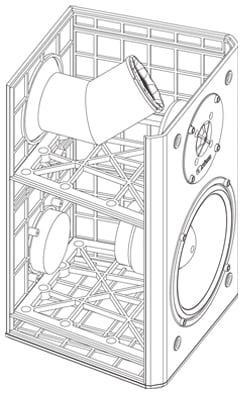
The Algonquin cabinet is constructed of a special UV coated plastic with an integrated angled screen port for maximum bass extension. It has cabinet brace around the middle of the cabinet and is insulated with cotton fill in the lower cavity where the woofer resides. The crossover is mounted to the terminal cup and has no protective casing over the electronics. Although Axiom claims these speakers are fully weatherproof and waterproof, I beg to differ on their definition of what that means. In Florida where it rains pretty much daily during the summertime, I'd hate to see what happens if someone mounts these speakers in an open area and gets hit with a fierce storm of blowing rain-filled wind. My definition of waterproof is a speaker that can be submerged in a pool for a week and still play after you take it out. There are very few speakers on the market that can do this, so I categorize all others such as these as weather "resistant". My advice here is to place them under a covered lanai.
The finish on the cabinet was very clean and I loved the metal grill. My only complaint here is I wished the cabinet had been constructed of slightly thicker or more inert plastic so as to not sound so hollow when knocking on the sidewall. I realize I am nitpicking here, especially since this product is so reasonably priced but I wouldn’t be an Audioholic if I didn’t criticize every product I bring under review, no matter how much I liked it.
Set-Up & Installation
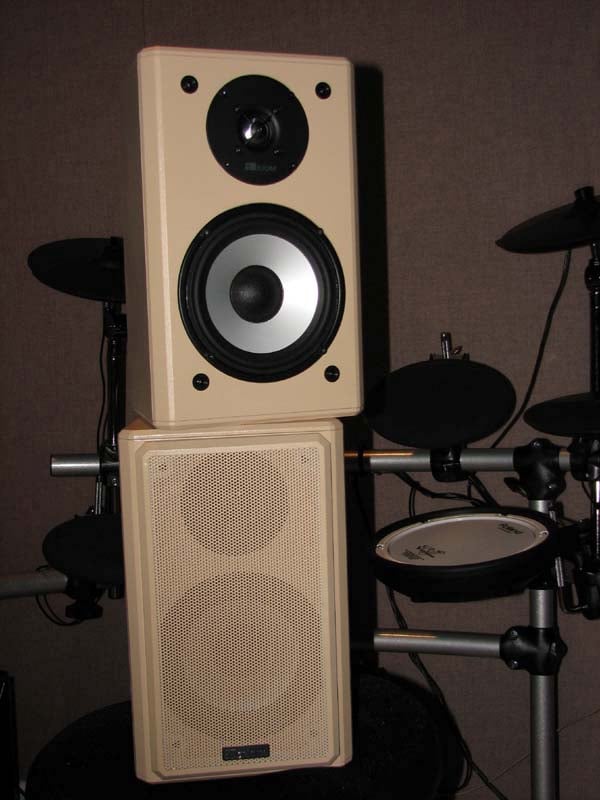
I placed the Algonquins on my 30" sand-filled Plateau speaker stands which put the tweeters right at about ear level on my Continental theater seats. The speakers were positioned about 5ft from side and back walls and spread apart about 10ft from each other which was roughly the distance from my primary listening position. After experimenting, I found they sounded their best with no toe-in. I used the Emotiva RPA-1 stereo power amp connected to my Denon AVR-5805 receiver, the Denon DVD-5910CI as the source and all Impact Acoustics Sonicwave series speaker cables and interconnects. I also had a pair of RBH Sound MC-6C bookshelf speakers on hand for reference as well as the Klipsch AW-525 outdoor speakers.
Full Metal Brackets
Mounting the Algonquins was a pretty easy chore. All of the hardware is supplied with the Full Metal Brackets except the hex bolts which are already inserted into the back of the speakers. Basically the first step is to dismantle the full metal bracket into three pieces by removing the hex bolts.
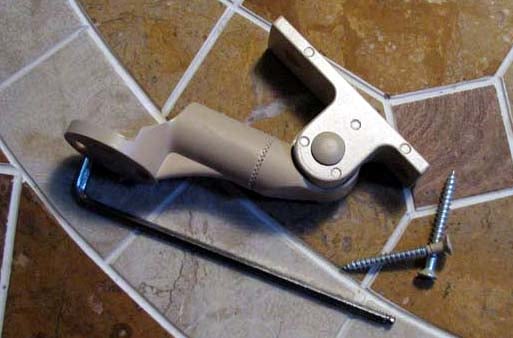
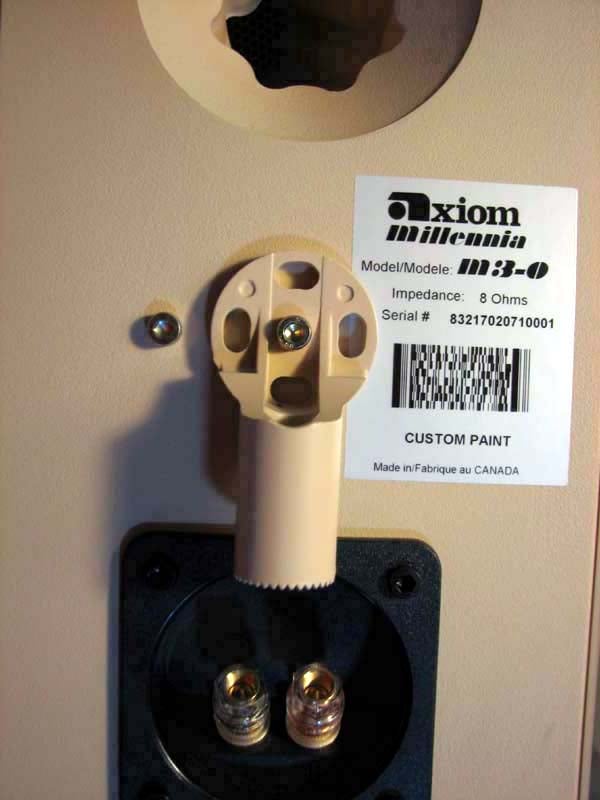
Next install the speaker mount into the speaker after you remove the supplied hex bolt from the actual speakers. But, don't get flapped up on the instructions as I did when the actual speakers have two hex bolts and the instructions only show one. Use the center bolt for the full metal bracket and the offset bolt for the ceiling bracket. I wish they would have spaced the two holes out just a tiny bit more so I could have mounted both hex bolts into the cabinet. I had to add a washer to the one hex bolt since none were supplied despite they were depicted in the installation manual. I found the speaker flexed too much under pressure, thus loosening the bolt without it. Next it was time to screw the bracket into the wall. In my case I opted to use tapcons instead of the supplied wood screws since I was mounting them onto a concrete wall. The final step is a bit tricky as you have to reassemble the bracket with the speaker attached. This is definitely a two-handed job, so use caution not to drop the speaker and double check that the hex bolts are fully secured before letting go of the speakers. Although the full metal bracket system is a bit costly ($80/pair), it's one of the only solutions on the market that I know of that gives you full horizontal and vertical pivot control. This is particularly useful in my situation where my speakers are mounted up towards the ceiling and I wish to angle them down towards the listening area. Axiom has also informed me they will be releasing a more cost effective dedicated outdoor bracket system this spring.
Algonquin Listening Tests
Unless otherwise noted, all of my critical listening tests were conducted in my Auralex acoustically treated theater room prior to installing them in my workout room.
CD: Pat Metheny / John Scofield - I
Can See Your House from Here
This has become an instant jazz classic of guitar legends Pat Metheny and John Scofield. It's a close miked recording and, on a good speaker system, can really be sonic delight. I started with track #3 "No Matter What". The Axioms revealed a respectable amount of airiness to the brushes with great sustain that seemed to extend a bit beyond the speakers. Guitars were clear and vibrant and although the tonal balance favored the upper treble frequencies a bit, was still overall smoother than when I directly compared them to the Klipsch AW-525s. The cymbals on the Klipsch speakers were more in your face and sounded more constricted. The bass wasn't as deep and there seemed to be too much emphasis on the mid frequencies. It was clear to me within minutes that the Axioms were more at home with playing complex jazz music than the Klipsch’s were. Although it wasn't a fair comparison, I wanted to hear how different the Axioms sounded compared to the much more expensive RBH Sound MC-6C's. The RBH's had a much more open and carefree sound than either of the two speaker systems and the guitars simply sounded more "real". While they didn’t quite have the bass extension of the Axioms, they were a bit tighter and more controlled. The Axioms were tonally closer to the RBH’s than the Klipsch's and I felt they shared many of the virtues that make the RBH MC-6C's such a fine bookshelf loudspeaker. This is saying a lot considering the Axioms come in at less than 2-1/2 times the price.
CD: Dave Matthews - Crash
The Axioms did a commendable job revealing the tingly sound of the cymbals in Track #3 "Crash Into Me". The bass drums had a nice punch to them with a good deal of extension for a speaker of its size. The vocals and snare drum hits came off a bit bright but remained clear and well focused. In comparison, Dave Matthews vocals came off a bit too lispy for my tastes when I listened to him on the Klipsch speakers. The tingle sound of the cymbals I was so fond of from the Axioms was faded into the background and the bass, although tight and well controlled, seemed almost anemic sounding in comparison. Granted, this isn't fair, since the Klipsch contain a smaller 5-1/4" woofer in a sealed cabinet design, but considering both speakers were roughly the same price and genre, I thought it was still valid to point out that the Axioms give you far greater bass extension and punch which is critical for those not planning on installing a subwoofer.
Track #6 "Say Goodbye" is quite a percussive treat to the ears. When listening on the Axioms, I really enjoyed the airiness in the flutes and the harmonics of the snare drum which commanded attention. The Klipsch speakers simply sounded more two dimensional and lacked the realism I was hearing in the Axioms. Had I not done a direct comparison, I wouldn't have realized just how much more detail in the instrumentals I was hearing on the Axioms.
It wasn't until I really pushed both systems that I started hearing distress. The Klipsch simply sounded more compressed and closed in, while the Axioms maintained better separation of instruments but took on an edgy tonal quality in the upper mids and high frequencies. It sounded to me like the driver breakup mode was becoming audible on the Axiom since the woofer was being run fullrange with no crossover element. To keep things in perspective however, most bookshelf speakers I play at high volumes in large listening spaces with no bass management tend to break up, especially in the bottom end because the manufacturer chose to tune the speakers lower for maximum bass extension with a severe trade off in SPL. The Onix x-ls, Dynaudio 52-SEs, Dali Mentor 1s and Usher S-520s are prime examples of speakers exhibiting this phenomenon. I didn't experience bottoming out issues for the Klipsch or Axiom speakers which particularly surprised me since the Axioms were a ported design and tuned fairly low (50Hz region). This is a tribute to a well-executed bass alignment that Axiom employed in this design. No matter how hard I pushed them on real world music materials such as the kick drums from the Fourplay Chant CD, the woofers didn't falter. Fear not, as you can run these speakers full range.
CD: Porcupine Tree - Signify
I moved both sets of speakers (Axiom's and Klipsch's) into my workout room to do some listening evaluations in their intended listening space. My preference for the Axioms became more evident. The Axioms simply had a much fuller and more articulate sound. I was particularly impressed with the punchy bass of the Axioms when I fired up a few songs from Porcupine Tree namely track #2 "Signify". The Axioms did a great job of revealing accurate tonality and detail of the acoustical guitars in Track #5 "Waiting Phase One". The percussions in track #6 "Waiting Phase Two" were bold and dynamic on both speaker systems but they simply sounded more detailed and better put together on the Axioms. Since my workout room has a lot of windows, glass doors and hardwood floors, the horn-loaded Klipsch speakers just didn't seem to be the right choice for this application. It's important to note that I did hear 4 Klipsch AW-525s in an outdoor environment that sounded quite good, but they seemed to be a bit more finicky than the Axioms as to what type of listening space they played into. At the end of the day, I'd probably be happy having either system in my room but the Axioms were the clear winner to me.
Algonquin Measurements & Analysis
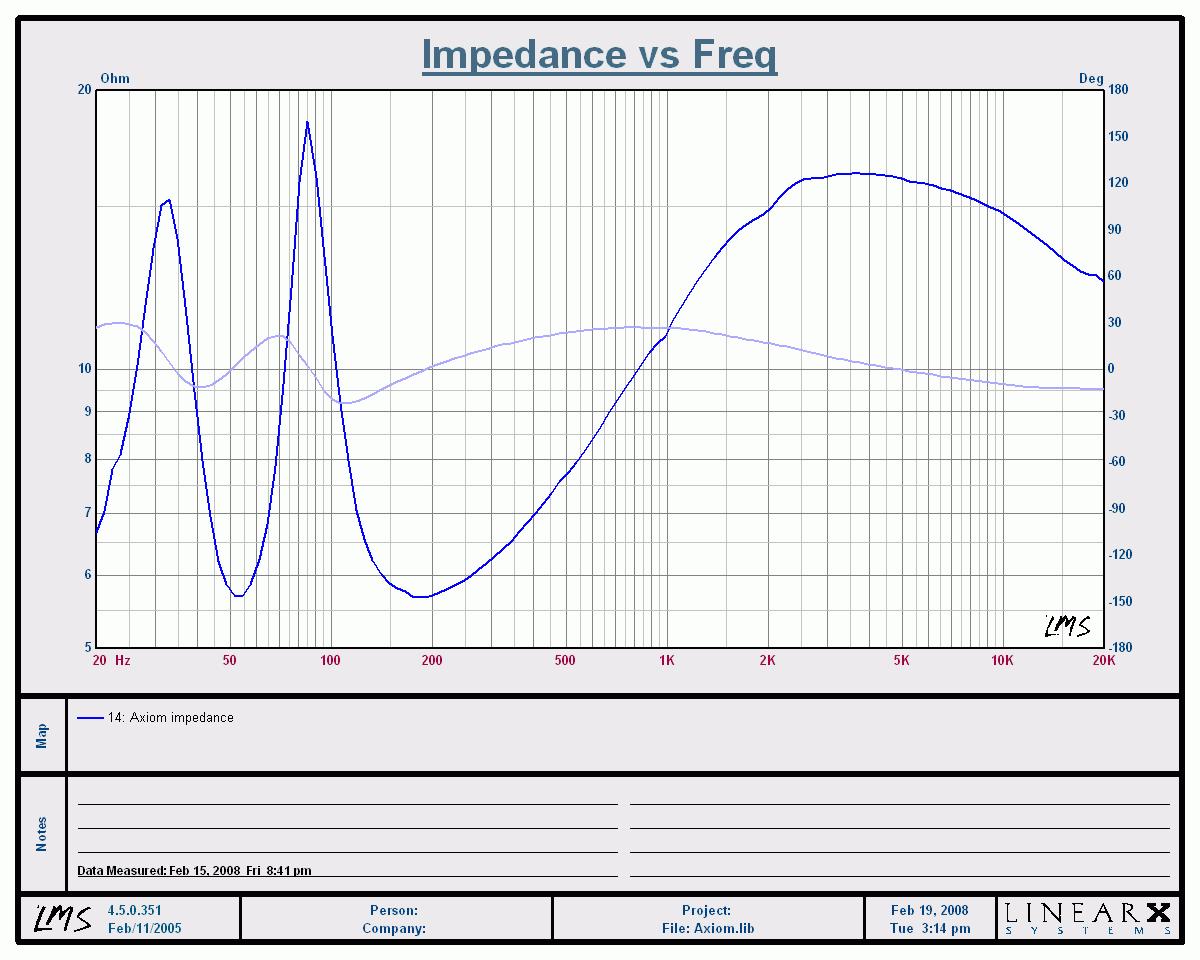
Algonquin Impedance / Phase Measurements
System impedance dipped a bit below 6-ohms in the lower frequencies but considering the relatively high efficiency of the design, it's safe to rate them as 8-ohm speakers. The impedance minimum was located near the tuning frequency at around 52Hz. The system phase response maintained well under +-30 degrees which was to be expected considering the low order filter networks employed. This makes for a very easy speaker load to drive my virtually any home theater receiver available these days.
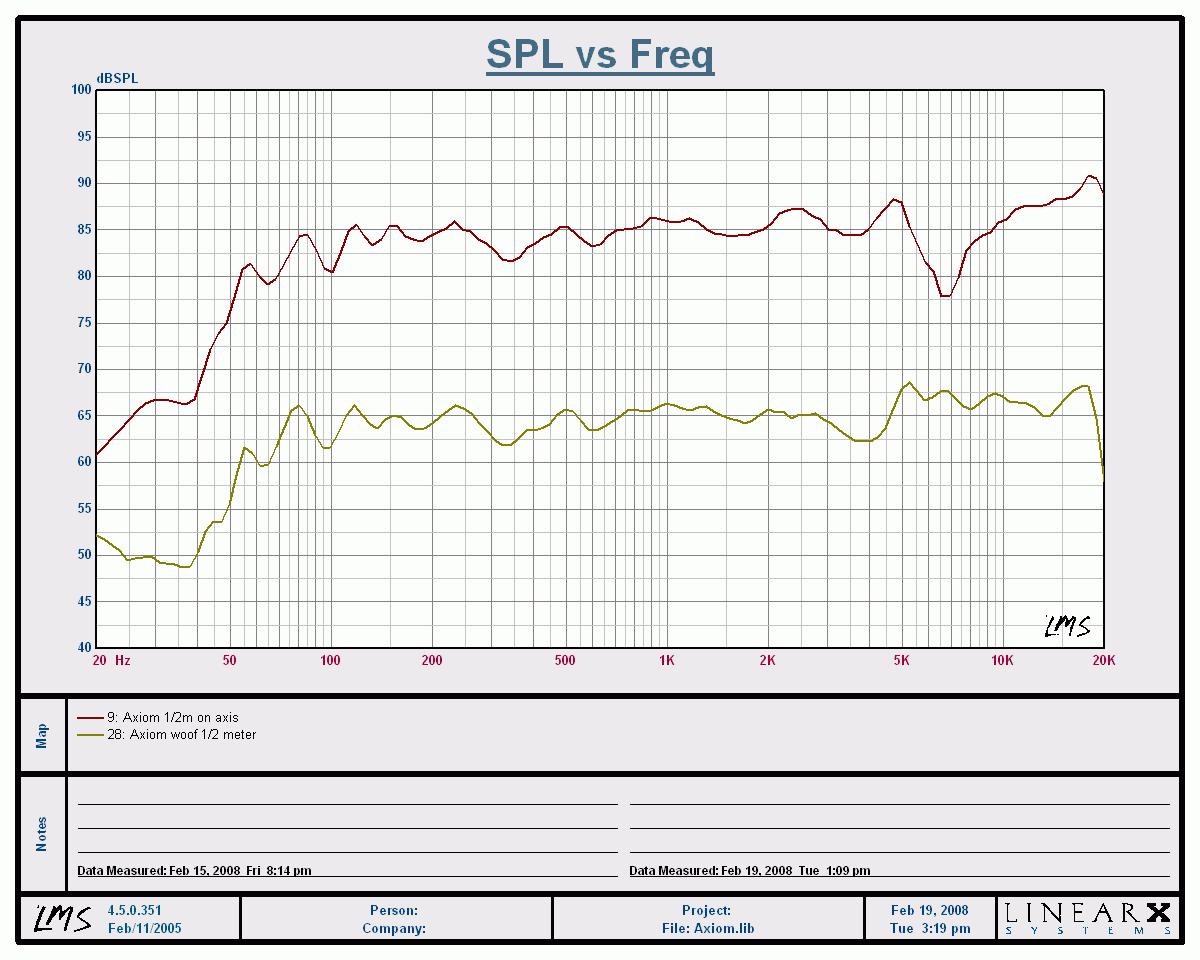
Algonquin In Room 1/2
Meter Frequency Response (1/6th octave smoothed)
Red – on axis centered,
Yellow – on-axis woofer
The Algonquins looked best when the measurement mic was at the height of the woofer's center. At this position, I measured a frequency response +-3dB from 70Hz to about 19kHz. There is a slight "oil can" resonant mode prevalent around 18kHz on the tweeter but this is pretty normal as far as metal domes go. When I placed the mic centered between the woofer and tweeter 1/2 meter away, the tweeter's output appeared to be a few dB hot above 10kHz. Thus I decided to take a more precise summed nearfield measurement to see what was going on.
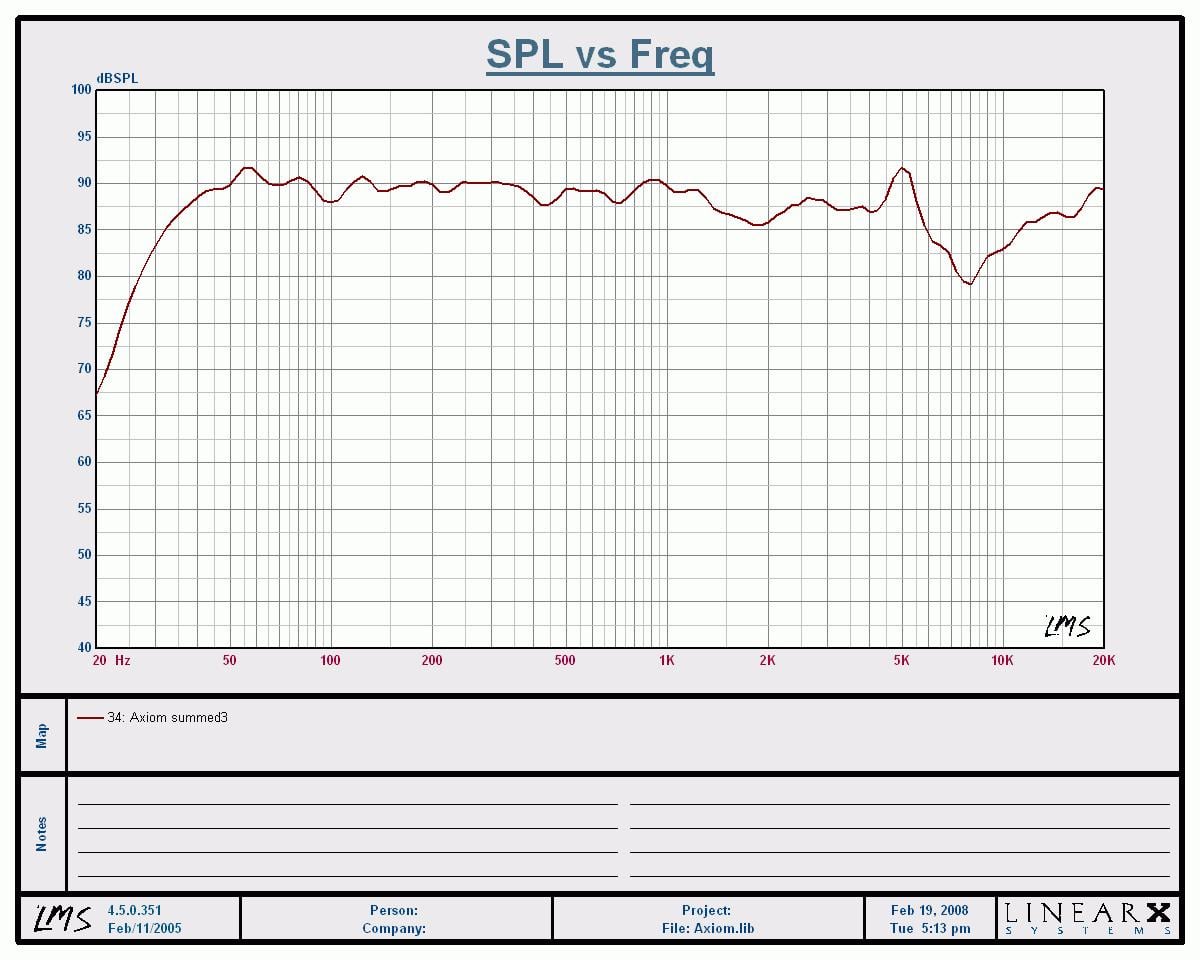
Algonquin Summed Nearfield Frequency Response
Measuring the tweeter at 1 meter, I scaled the response to match the woofer and port nearfield measurements and applied a minimum phase transform to properly integrate all 3 measurements. Aside from the same null I found around 8kHz, the overall combined measurement seemed to correlate more closely with Axioms results from their anechoic chamber. I believe the suckout is caused by phase cancellations between the woofer and tweeter since the woofer has no crossover.
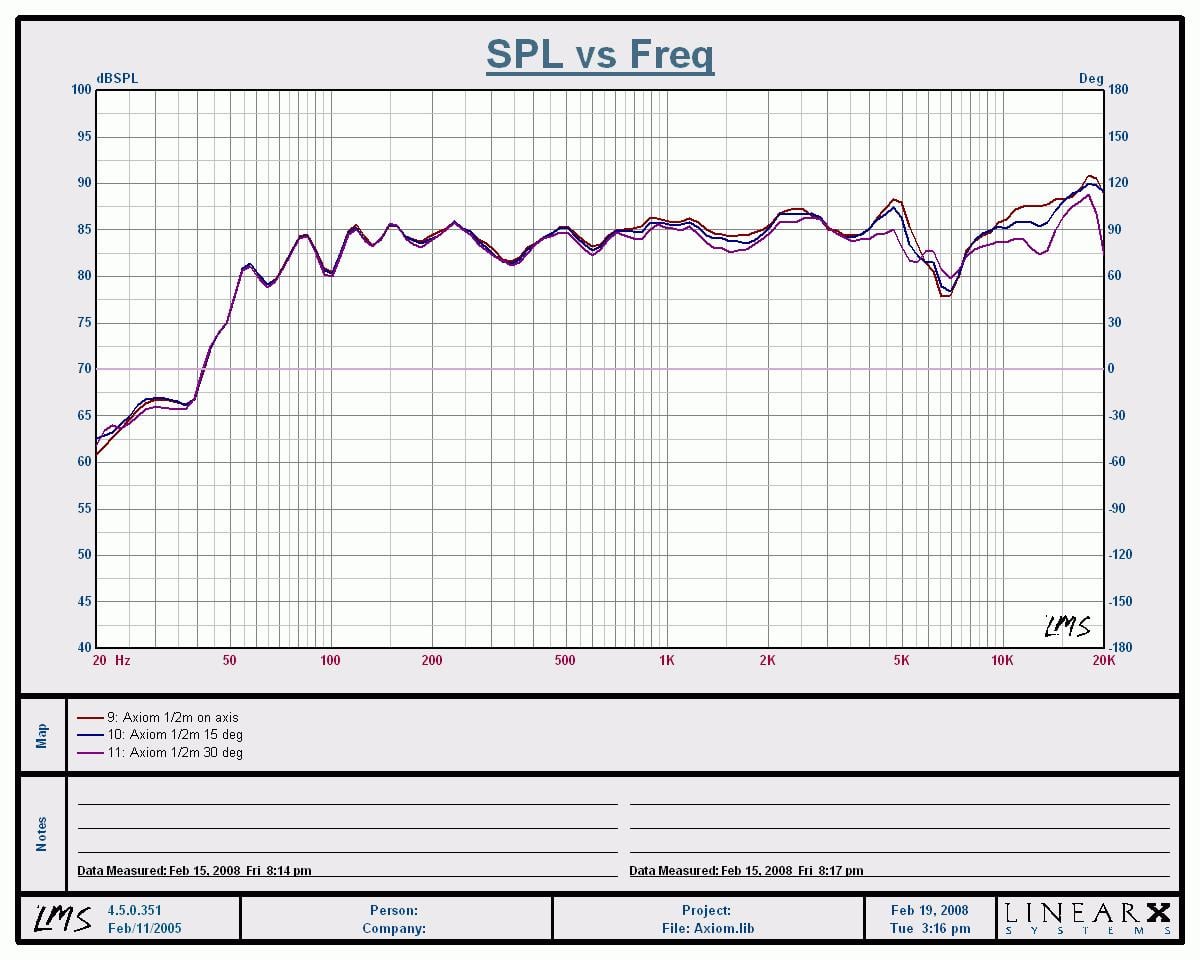
Algonquin 1/2 Meter
On/Off Axis Frequency Response
Red – on axis; Blue –
15 deg off axis; Purple – 30 deg off
axis
Given the rather ample tweeter output of the Algonquins, I recommend little to no toe-in. In fact, before I pulled any measurements and did some listening experiments of my own, I found they sounded best with no toe-in and with the tweeters slightly above ear level. This is pretty much how most people will use these speakers in an outdoor type of environment.
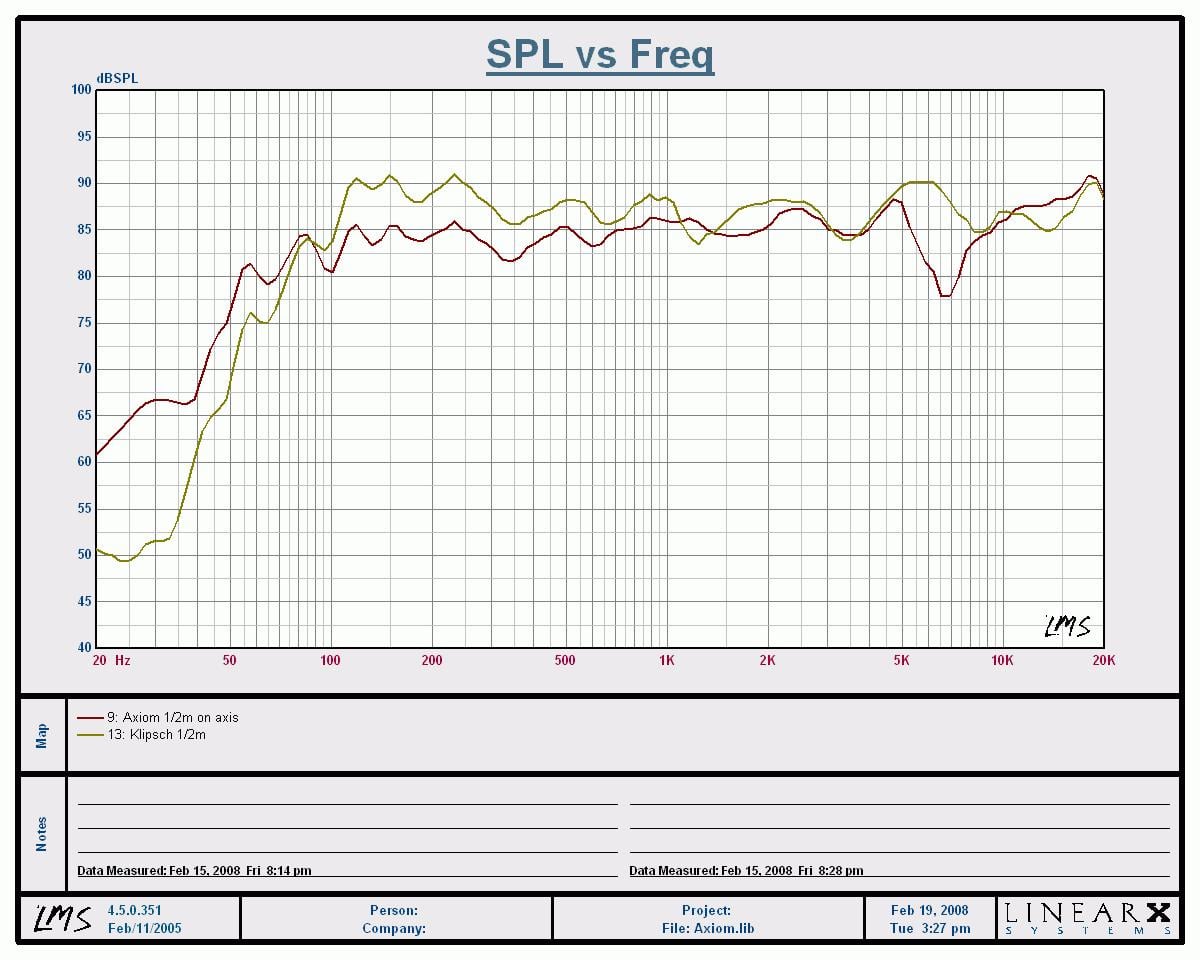
Frequency Response Comparison of the Algonquin vs the Klipsch AW-525
I was curious to see how these two speakers compared measurement wise so I pulled a quick 1/2 meter response for each. It's clear that the Axioms have superior bass extension, no surprises there thanks to the larger woofer in a ported cabinet. The Klipsch's measured about 5dB more efficient so although they don't have quite the same power handling (75 watts as opposed to 175 watts of the Axioms), they will still play about 1.3 dB louder at their rated power limits though that doesn’t imply they will sound as good doing it.
Noise Leakage Test
When I ran low frequency sweeps from 300Hz down to 20Hz, I found a minor cabinet resonance centered around 145Hz which actually became more evident when I placed pressure on the top side particularly on one of the cabinets. In comparison however, the Klipsch cabinet became quite noisy below 100Hz and even rattled in the 20-25Hz regions. However, this wasn't something that was discernable under normal listening conditions. Neither speakers are a direct substitute for a good old fashion MDF design, but both will surely stand up better against the harsh outdoor weather conditions. Thus the slight compromise in controlling cabinet resonance over durability is certainly a sensible tradeoff.
Algonquin Conclusion
 Despite the
few shortcomings I found with the Axiom Algonquins, they certainly proved to be
among the best sounding speakers I've heard in this price class, and especially
in their genre of outdoor speaker systems.
Their ability to give you a full spectrum of sound, solid bass
extension, and plenty of efficiency and power handling makes them ideal for
those looking for quality bookshelf type speaker systems for their gaming room
or covered barbeque area. Seeing how
most outdoor speakers underperform sonically, I'd venture to say the Algonquins
would really draw attention to themselves to visiting friends and family
members whom aren’t accustomed to having high fidelity sound outdoors.
Despite the
few shortcomings I found with the Axiom Algonquins, they certainly proved to be
among the best sounding speakers I've heard in this price class, and especially
in their genre of outdoor speaker systems.
Their ability to give you a full spectrum of sound, solid bass
extension, and plenty of efficiency and power handling makes them ideal for
those looking for quality bookshelf type speaker systems for their gaming room
or covered barbeque area. Seeing how
most outdoor speakers underperform sonically, I'd venture to say the Algonquins
would really draw attention to themselves to visiting friends and family
members whom aren’t accustomed to having high fidelity sound outdoors.
The fact that Axiom offers color matching to further blend into your room décor is an added bonus that virtually no other manufacturer offers. Their prompt and unparalleled customer service and very generous return policy makes them a safe buy for anyone not sure if these speakers are right for them. My only caution is to be mindful of placement as I don't recommend fully exposing these speakers to all of the weather elements outdoors since they are a ported design.
After spending a few weeks listening to these speakers in my workout room, they have earned a permanent position and have dethroned my Klipsch AW-525’s. I can't think of a higher recommendation than that and only hope one day Axiom decides to offer a no compromise line of speakers to go after the ultra high end of the market and show off what they could do when budgets are freed up. In the meantime, I will be making good use of my Algonquins.
Axiom Audio Algonquin
MSRP: 330/pair (including delivery
anywhere in North America)
Axiom
Audio
http://www.axiomaudio.com
Highway
60
Dwight, Ontario
Canada
P0A 1H0
About Axiom Audio
For more than two
decades, Axiom Audio has made its reputation by achieving unprecedented
performance quality. Founded in 1980,
Axiom is counted as one of the cornerstones of the Canadian loudspeaker
business. Using the world's most
advanced computerized woodworking equipment, the company has become one of the
world's premier manufacturers of quality loudspeakers. The company's home office and manufacturing
facilities are located in the Muskoka district of Ontario.
The Score Card
The scoring below is based on each piece of equipment doing the duty it is designed for. The numbers are weighed heavily with respect to the individual cost of each unit, thus giving a rating roughly equal to:
Performance × Price Factor/Value = Rating
Audioholics.com note: The ratings indicated below are based on subjective listening and objective testing of the product in question. The rating scale is based on performance/value ratio. If you notice better performing products in future reviews that have lower numbers in certain areas, be aware that the value factor is most likely the culprit. Other Audioholics reviewers may rate products solely based on performance, and each reviewer has his/her own system for ratings.
Audioholics Rating Scale
 — Excellent
- — Very Good
- — Good
- — Fair
- — Poor
| Metric | Rating |
|---|---|
| Build Quality | |
| Appearance | |
| Treble Extension | |
| Treble Smoothness | |
| Midrange Accuracy | |
| Bass Extension | |
| Bass Accuracy | |
| Dynamic Range | |
| Performance |  |
| Value | |
Gene manages this organization, establishes relations with manufacturers and keeps Audioholics a well oiled machine. His goal is to educate about home theater and develop more standards in the industry to eliminate consumer confusion clouded by industry snake oil.
View full profile Subscribe to our newsletter