


Lair PS3 Game Review
Lair for PS3
Platform:
Playstation3 (PS3)
Developer:
Factor 5
Publisher:
Sony Computer Entertainment
Game
Resolution: 1080p/30
Display:
Panasonic PT-AX200, Gateway 30” LCD
Reference
System: Reference System 2
MSRP:
$59.99
Style:
Action-Adventure
Rating:
Teen (Blood & Gore, Violence)
Pros
- Uncompressed full-surround audio
- Impressive orchestral scoring
- Exceptional detail
- Cinematic cut scenes
Cons
- Not much LFE for your subwoofer
- Sixaxis controls extremely tedious
- Inaccurate targeting
- Bizarre in-game mini cut scenes that detract from the action
- 1-on-1 dragon fights disappointing
- Gameplay is somewhat monotonous
Introduction
Lair is a game which received much fanfare. It is, in fact, a game which has already been reviewed by several primary gaming magazines. While those sources focused on gameplay, we felt that the elements of audio and video quality were sorely lacking – at least in any sort of objective sense. As we unwrapped the Blu-ray packaging and inserted the game into the PS3 we realized we were going to be in for one heck of a sensory experience.
Game Byline
In a world ravaged by endless conflict and natural disaster, a call for peace turns into a bloodbath of betrayal and deceit in Lair for the PLAYSTATION3 (PS3) computer entertainment system. Playing as a warrior named Rohn who rides a voracious dragon trained for deadly aerial and ground combat, gamers must defeat the war-hungry Mokai to save the Asylian civilization. Together, Rohn and his dragon will attempt to change the destiny of a world on the brink of extinction by scorching, clawing and smashing through thousands of enemies and their war-trained beasts.
Visuals
Within the gameplay of Lair, colors are muted into a very film-like tonality that is reminiscent of a very good cinematographer/telecine team. Though at times bland, the imagery is very cinematic and colors feel at least authentic given the medium – as if there was a colorist involved in the process of developing the cinematics and visual sequences. It leaves you thinking, during play and afterwards, that this was a carefully crafted work of art that attempts to render itself as close to a true cinema style as possible. I especially liked the close-up dragon shots and cityscape scenes which made good use of both texture and color.
Resolution, Detail and Anti-Aliasing
 There
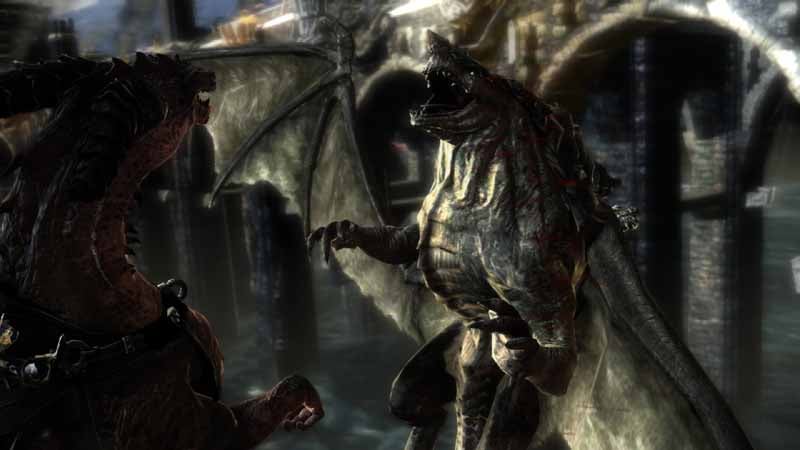
is a ton of detail in this game. Stone buildings, intricate roofs and
detailed architecture abound in almost every game chapter. During
slow pans (of which there are many) I noted a visible breakup of the
detail as judder-like effects blurred pans and resulted in slightly
flickering visuals. Edges were anti-asliased for the most part but I
could definitely see that jaggies were more noticeable on some of my
displays – and less noticeable on others. The output of the PS3 is
going to be somewhat dependent upon the display you are using,
particularly if you are outputting 1080i. As intricate as games are
these days, motion artifacts abound and there doesn't seem to be any
easy way to eliminate them completely at the current level of console
technology.
There
is a ton of detail in this game. Stone buildings, intricate roofs and
detailed architecture abound in almost every game chapter. During
slow pans (of which there are many) I noted a visible breakup of the
detail as judder-like effects blurred pans and resulted in slightly
flickering visuals. Edges were anti-asliased for the most part but I
could definitely see that jaggies were more noticeable on some of my
displays – and less noticeable on others. The output of the PS3 is
going to be somewhat dependent upon the display you are using,
particularly if you are outputting 1080i. As intricate as games are
these days, motion artifacts abound and there doesn't seem to be any
easy way to eliminate them completely at the current level of console
technology.
When actually playing the game you may note, at certain angles, a slight jaggy edge around your dragon's wings. This increases and decreases depending upon angle and what's occurring. Honestly this is a universal problem I've noted and only the highest-end PC video cards running their anti-aliasing settings maxed out (8x, etc) do much better.
The dragon textures are excellent, with skin that folds and ripples, and legs and tails that have rather satisfying plating marks. Even the wings have a texture that keeps them from looking like they are made of bed sheets. Batman should be so fortunate. One area detail seemed to be missed was in the hand-to-hand dragon combat, where the blood seemed to be a rather unconvincing overlay of parallel slashes that floated in space. Characters seemed well designed, especially in the cut scenes, but the armies were so uniform when on the ground that they seemed little more than clones of the same figure slightly repositioned in different directions. I like a stiff formation, but there was absolutely no variance whatsoever in most sequences I participated in.
Cut Scenes
 Two
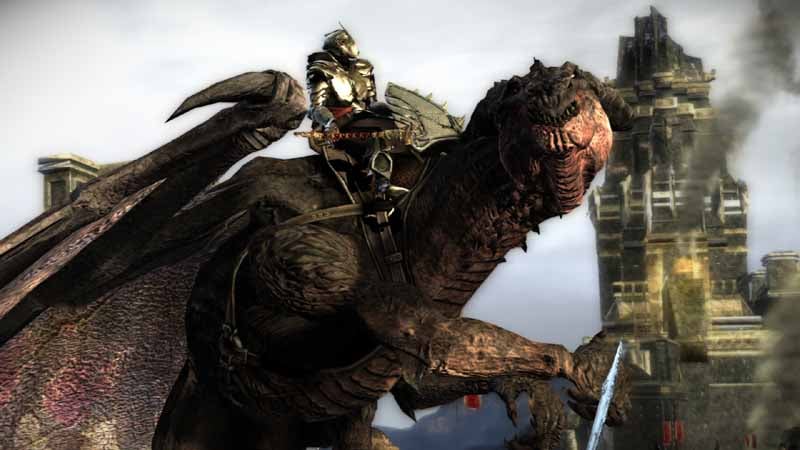
words: Freaking Awesome. But apparently full motion antialiased video
rather than real-time in-game engine cut-scenes. In my opinion I
could care less. Why not make the cut scenes look as good as
possible? Since you can't control your character regardless there
seems no reason why these shouldn't be blown out to the best
resolution available. A full music score adds to the effectiveness of
the cut scenes (discussed in more detail later) and you can instantly
tell that Lair
spent a lot of time with their voice acting and story editing.
Two
words: Freaking Awesome. But apparently full motion antialiased video
rather than real-time in-game engine cut-scenes. In my opinion I
could care less. Why not make the cut scenes look as good as
possible? Since you can't control your character regardless there
seems no reason why these shouldn't be blown out to the best
resolution available. A full music score adds to the effectiveness of
the cut scenes (discussed in more detail later) and you can instantly
tell that Lair
spent a lot of time with their voice acting and story editing.
One of the strange things about Lair arises whenever you go in to attack a dragon. During particular attacks you will end up in a face-to-face dragon combat situation where you breathe fire, claw and bite your way to victory. The trouble is that the action is so reactionary and delayed that it's more of a random button-push than anything particularly tactical or real-time. A faster response time and higher frame rate for these attack sequences would have been incredibly satisfying. What's there now seems a tad forced and at the conclusion the camera zips off in such a fashion that your dragon ends up in a direction that it wasn't originally, forcing you to reacquire your bearings each time. Vertigo abounds on a 100-inch screen, so be sure to take your Dramamine.
Lair PS3 Game Sound and Gameplay
A full orchestral score accompanies the entire game and boy does it make the experience all that much better. It is written by Academy Award-nominated composer John Debney (of Sin City and The Passion of the Christ fame). When playing you really feel like you're inside of a theatrical sequence. I've played a lot of games that have the expected crescendos and mood music, however this was clearly a step above – both in terms of its quality and the way it was utilized throughout each Chapter. There is apparently around 5-6 hours of scoring for this game and it shows, with thematic elements that share similar qualities but never sound repetitive.
Surround Audio Quality and Fidelity
Audio for this game is incredible. I played in full uncompressed 5.1 surround audio and the system supports up to 7.1. The sound was more immersive than anything I've yet experienced. While there were some point-source style effects, mostly the surrounds seemed to be filled with the scoring and subtleties. For example, in Scene 5 when there is a truce meeting in a large cathedral, the surrounds are providing the slap-back echo to give the feel of a larger, open room. Throughout my playing I was constantly amazed at the lack of “.1” material. While my bass management was certainly doing its work of crossing over low frequencies to the subwoofer, it didn't appear that Lair had much in the way of a dedicated LFE track. Dragon attacks and general gameplay were almost completely lacking in anything under 60-80Hz. When I finally completed the 5th Level (after literally HOURS of attempts) there was a final drawbridge closure that indicated the Mokai had been cut off. It's the pinnacle pre-render sequence for the entire level. As the gigantic iron gates connected with the stone bridge there was nary a sound. Not even much of a thump to indicate that the bridge had indeed closed off the troops from attacking. Oops.
Gameplay
Words cannot express the sheer dichotomy of the Sixaxis controller with respect to this game. In areas where you are free to roam and explore, the controller is a joy and a wonder to behold. It represented to me a completely different paradigm of gaming that had such incredible potential and charm. The swooping, the turning, the sheer beauty that it is to feel as if you are actually flying a dragon.
Alas, all that was destroyed upon extended gameplay that included navigating through tight areas and targeting specific objects, particularly rhinos or objects that were located near/behind/in-proximity-to dragons. After trying for the 16th time (yes, literally) to pass the fifth level “Crossing at Dawn” it took all the willpower I possessed not to throw the controller through the projector screen after I swooped directly over a targeted rhino three times in a row only to fail once again to complete the level. After additional hours of gameplay, I finally passed the level, but there was more a feeling of relief than satisfaction. In my opinion the game needs to remove the time limits or tighten the navigational controls and targeting options (you cannot currently select or cycle individual targets at all but are at the mercy of the computer.) The developers should also seriously reconsider betting any future games on mandatory Sixaxis control. After giving it hours upon hours of the benefit of the doubt, it's not a matter of getting used to it – it simply doesn't allow for enough finesse and movements are delayed. Targets get easily missed and turning around to reacquire is more like steering a Boeing 737 than a dragon. The gesturing 180-degree move, which is the only way to quickly get back to action that is behind you, worked about 1 in every 4 tries, even after more than 6 hours of practice.
Game Menu and Options
 Upon
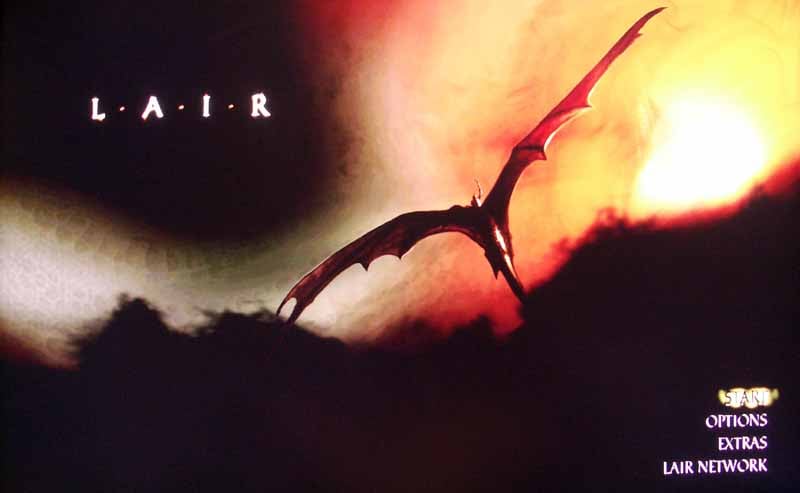
bootup, I found that you cannot bypass either the Intro screens or
the modified animated THX “cow” logo sequence, which progresses
smoothly into a Factor 5 screen. It's 1 minute and 25 seconds of your
life that will go by every time you boot up the game.
Upon
bootup, I found that you cannot bypass either the Intro screens or
the modified animated THX “cow” logo sequence, which progresses
smoothly into a Factor 5 screen. It's 1 minute and 25 seconds of your
life that will go by every time you boot up the game.
Under the Options menu you have a simple Gray Steps pattern to help you adjust brightness, but there is no actual in-game gamma control, meaning that you're unable to precisely configure the black levels you'll experience in the game. The good news is that I rarely ran into any game sequences that were “horror film” black (though chapter 6 was very close in the beginning).
Music, SFX and Voice levels can be adjusted as can the “Visible Frame” which is a way of guaranteeing your television's overscan or bezel doesn't crop off any of the picture. Subtitles can be enabled and the Camera Rotation can be inverted for those of us who learned our gaming chops playing flight simulators like FA-18 Hornet. Game Extras include Making of Lair, Concept Galleries, Production Gallery (a series of behind the scenes still photos) and Concert Hall – a way to listen to all of the pieces of score for each act. Videos, for some reason, seemed to play back at around 24 frames per second with an ever-present stutter – as if they were originally rendered for the Internet or a 24p 2:3 conversion wasn't being done with the proper pull-down. There is also a serious amount of macroblocking and banding present. You cannot fast forward or rewind through the videos as you can with standard Blu-ray video material.
Play Options
No multiplayer options exist for this game, however you can go online and compare your performance with other players using the built-in Online Leaderboards. It's a weak addition and honestly it seems that true multiplayer was yet another thing that fell by the wayside as the developers focused on the excellent story, cinematics and scoring. This game seems perfect for multiplayer, or at least some kind of online warfare mode that pits you against 15 other dragons. The one thing that does make Lair interesting in terms of playability is that strategically, you can seemingly solve the levels in a number of different ways. Ultimately all goals need to be met, and in somewhat of an order, but there is enough leeway to provide for some flexibility – at least on some levels.
Lair PS3 Screenshots, Conclusion and Ratings
Lair has some exceptional visuals as we've mentioned. Here is the best way to convey the imagery that will fill the screen as you embark on this adventure:

Character
detail was impeccable. Look at the chains around the leader's neck.
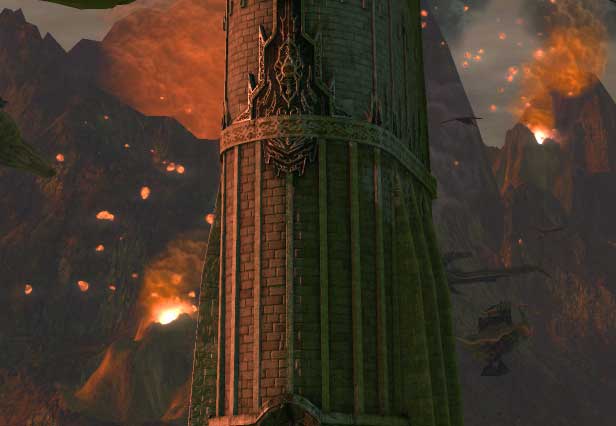
The
mountains in the background have incredible texture, as do the bricks
utilized in this castle. Note the ornate details on the front spire
as well.
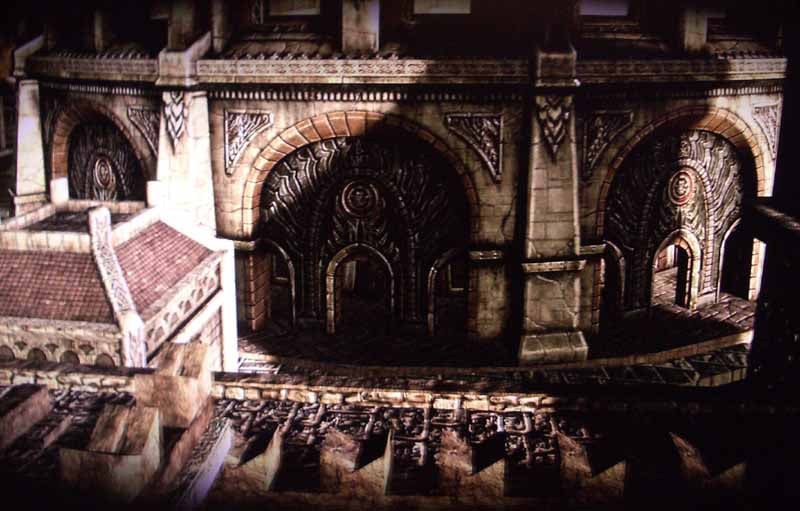
Shadows
are not frightening in Lair
as the PS3 is fully capable of rendering the details in the dark
areas of the picture.
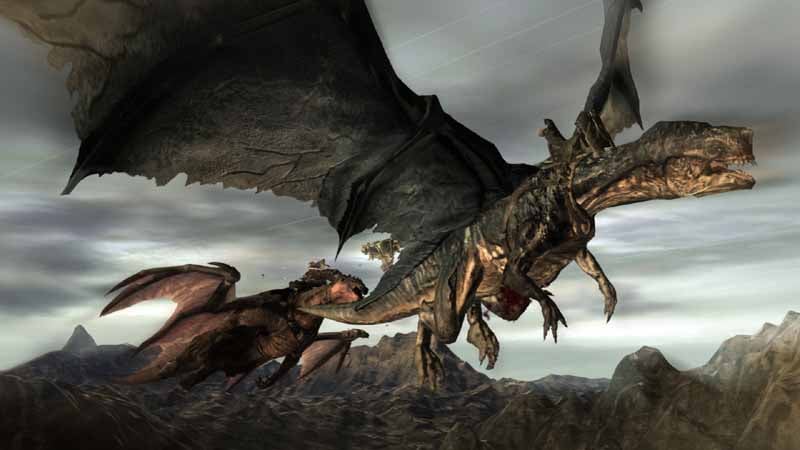
I
couldn't get over the textures utilized in the dragons. This screen
in particular shows the veins present on the wings as well as the
many folds of skin and incredible amounts of polygons and smoothing
that go into these models.
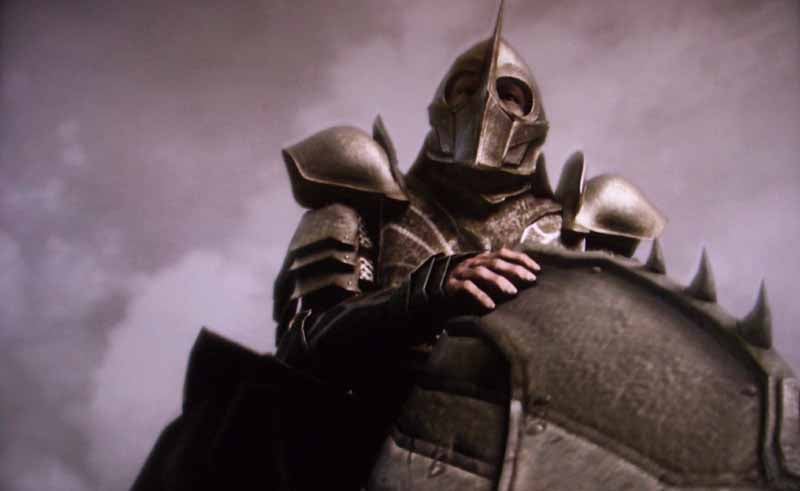
This
screenshot shows the cinematic nature and feel of the game. Watching
Lair reproduced some of the wonder felt watching Final
Fantasy: The Spirits Within
on the big screen.
Conclusion
I wish I wish I wish I could tell everyone to run out and buy Lair. Part of me says that the cinematic quality of the game is such that it will be satisfying enough, even with some of its quirks and control issues. I do, however acknowledge that even with our focus on the audio and video technical qualities of games, the bottom line is still playability. I think that because of Lair's lack of multiplayer, difficult control system and difficult targeting that this would not be a game I'd recommend without some reservations. Playing Lair is a lot like watching a movie, with some difficult gameplay in between sections. If you are a determined person I think you could figure out the controls enough to make this a very enjoyable experience. In my experience, 6-8 hours wasn't enough to overcome the difficulties and that produces a healthy amount of frustration. Lair is a cinematic masterpiece, however and on that basis alone it can be lauded and recognized for its contribution to the PS3 community.
Ratings
Visuals
- 5/5
The
visuals of Lair are incredible and represent a clear leap forward in
game technology. The sheer amount of models and textures show off the
power of the PS3's cell processor.
Sound
- 4/5
The
beautiful orchestral score was what enabled this rating to get to a
4. The lack of significant subwoofer effects is unforgivable given
the subject matter and obvious areas where a solid LFE track would
have increased the intensity of the storyline and gameplay. MORE SUB!
Gameplay
- 2/5
If
you manage to play long enough without throwing the controller
through a wall (try not to aim for the screen) you've accomplished
something. If I had a dragon, and that dragon steered and maneuvered
the way my dragon in Lair
did, the enemies wouldn't need to attack me - I'd kill it myself. The
Suxaxis controls needs some serious work and too many automated
camera moves detract from the game and create frequent
disorientation.
Value - 3/5
With no multiplayer and the lack of any cooperative elements, Lair is a game that will be a great demo for your friends to experience but probably won't have you reaching for that replay very often once you've conquered its secrets. You'll likely pull out Lair as often as you do a decent DVD you happen to have in your collection.
Clint Deboer was terminated from Audioholics for misconduct on April 4th, 2014. He no longer represents Audioholics in any fashion.
View full profile Subscribe to our newsletter