


Yamaha RX-Z7 A/V Receiver Preview
Yamaha RX-Z7 A/V Receiver
Summary
- Product Name: RX-Z7 AV Receiver
- Manufacturer: Yamaha
- Review Date: August 25, 2008 12:05
- MSRP: $2699.95
- First Impression: Pretty Cool
|
Channels: 7.1 RMS Output Power (20Hz - 20kHz): 140W x 7 RMS Output Power (1kHz): Total Power (20Hz - 20kHz): 980W Dolby TrueHD, Dolby Digital EX/ Dolby Pro Logic IIx, DTS-HD Master Audio, DTS-ES Discrete 6.1, DTS 96/24 / DTS Neo:6 Pure Direct HD Radio Tuner iPod Compatibility: with optional YDS-11 Bluetooth Compatibility: with optional YBA-10 Compressed Music Enhancer Neural Surround Neural-THX XM HD Surround SRS (Circle Surround II) THX Processing Sirius Satellite Radio Ready XM Satellite Radio Ready HDMI (In/Out): (5 / 2 ) Ver 1.3a i.Link (IEEE 1394) Component Video (In/Out): (4 / 2) A/V Inputs (S-Video): 6 (All S-Video) Digital Inputs/Outputs [O: Optical, C: Coaxial] : (O:5, C:3 / O:2) Front A/V with Digital Input: With HDMI / S-Video / Optical / USB Front Mini Input for Portables Front USB Input For Flash Memory Drives: Dual USB - Front and Rear LAN Terminal RJ-45 Network Connection D/A Conversion: 192 kHz / 24 bit Surround Programs: 38 Night Listening Enhancer DCDi Processing Time Base Corrector |
Component Video Up Conversion S-Video Up Conversion: Dialogue Lift YPAO (w/Optimizer Microphone): 8 Point w/Angle On-Screen Display: With GUI Assignable Power Amp Zone Speaker Terminals: Zone 2 / 3 Zone 2 Output: Component / Composite / Optical / Coaxial Zone 3 Output: Audio Only Zone 4 Output: Audio Only Zone Power Switching: Main/ Zone2 / Zone3 / Zone4 (Front panel) Zone Remote Control RS-232C Interface +12V Trigger Output : x 2 IR Ports: x 2 Receiver Manager Software Speaker A, B or A + B Selectable Subwoofer Crossover: 9-band Multi-Channel Decoder Inputs: 8-Channel Pre-Out All Channels Learning Remote Capability Macro Command Capability Product Dimensions (W x H x D): 17-1/8” x 7-11/16” x 17-3/8” Product Weight (lbs.): 40.6 Shipping Dimensions (W X H X D): 22-3/16" x 12-9/16" x 20-3/4" Shipping Weight (LBS): 48.5 |
Yamaha is looking to expand their top end of their receiver line with the addition of the RX-X7 - a $2700 behemoth that is touting, among many other features, near unlimited connectivity and five HDMI inputs. At 140 watts x 7, the RX-Z7 uses Vista compatible DNLA support to stream files off your computer (WAV, Mp3, WMA, AAC) and Internet radio streams (Mp3, WMA). It supports Sirius Internet Radio, Rhapsody, and, of course, Yamaha's own MusicCAST system. The receiver can even display the album artwork on the screen.
Video processing hasn't been overlooked with the inclusion of Anchor Bay's VRS video processing technologies. The RX-Z7 has 4 HDMI inputs and one on the face and 2 HDMI outputs. The HDMI outputs are for simultaneous viewing, however, so don't expect to be able to view two different sources at the same time. PReP Progressive Reprocessing with 2:2/2:3 pull-down detection and motion adaptive deinterlacing to eliminate artifacts has been included supposedly for flawless deinterlacing.
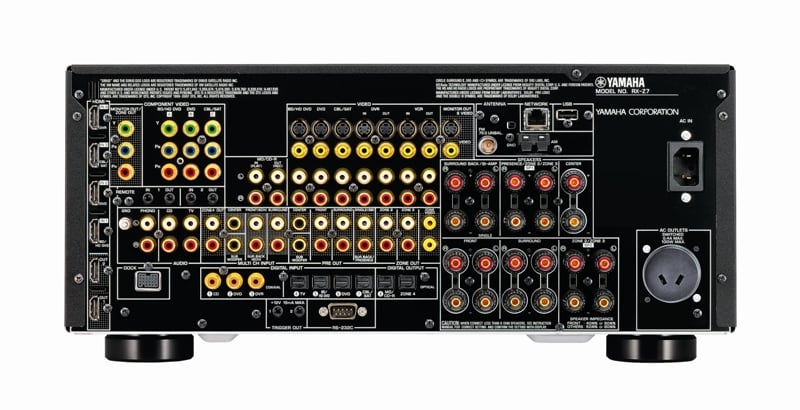
If you've got an iPod or a Bluetooth capable device, the RX-Z7 will play nice, but only with an additional purchase of a dock or receiver (respectively). iPod information will be available onscreen through the GUI. But if you don't have an iPod and don't want to mess with DNLA, you can still get to your content though one of the two USB ports that adhere to the Media Transfer Protocol (MTP) for playback of Mp3, WMA, WAV and AAC audio files from a portable player or USB drive. At this point, you've really run out of excuses for why you can't access your content. As are nearly all high-end receivers these days, all you'll need is an account and an antenna to connect up to XM and/or Sirius service (now Sirius XM since the merger). XM HD Surround powered by Neural Surround is available as well for those that like such things. For those that haven't bought into satellite radio, extra stations may be available to you via the HD Radio tuner. Band information will be available again onscreen. A nice feature is that the RX-Z7 supports iTunes tagging which allows you to "tag" the song you are listening to on HD radio for later download from iTunes.
Yamaha has long been known for their DSP modes and the RX-Z7 has the full compliment with 22 cinema modes including the ability to decode all the latests HD formats such as Dolby TrueHD and DTS-HD Master Audio. For the audiophiles, Pure Direct is of course available to defeat all processing and give you the audio signal as cleanly as possible. For those that don't care about fidelity, Yamaha’s Compressed Music Enhancer technology will clean up that uber-compressed junk you filled your iPod with.
The RX-Z7 supports up to four zones with audio to all and up to component video assignable to zone 2-4 with OSD available for zone 2. There are 6 user preset for the main zone and 4 for each of the others which controls any number of variables including speaker configuration, YPAO settings, and more. From an installer standpoint, this should be very useful. Of course, installers will like the RS-232 control and two 12 volt triggers. While most users will be using one of the two remote controls, installers will appreciate that the receiver can be controlled from a Web Browser on a PC or smart phone, as well as on a touch-pad controller for local area or home networks.
The Yamaha RX-Z7 looks to be a formidable addition to the Yamaha lineup. We look forward to getting a review sample on Gene's test bench as soon as possible.
Unless otherwise indicated, this is a preview article for the featured product. A formal review may or may not follow in the future.
As Associate Editor at Audioholics, Tom promises to the best of his ability to give each review the same amount of attention, consideration, and thoughtfulness as possible and keep his writings free from undue bias and preconceptions. Any indication, either internally or from another, that bias has entered into his review will be immediately investigated. Substantiation of mistakes or bias will be immediately corrected regardless of personal stake, feelings, or ego.
View full profile Subscribe to our newsletter