


Yamaha RX-V867 Receiver Preview
Yamaha RX-V867 AV Receiver
Summary
- Product Name: RX-V867
- Manufacturer: Yamaha
- Review Date: September 28, 2010 07:00
- MSRP: $899.95
- First Impression: Pretty Cool
High Sound Quality
- 7-channel 665W powerful surround sound (95W x 7)
- HD Audio format decoding: Dolby TrueHD and DTS-HD Master Audio; Dolby Digital Plus and DTS-HD High Resolution Audio
- Discrete amp configuration
- Pure Direct for HD audio and video enjoyment
- Low jitter PLL circuitry
- Assignable amplifiers for bi-amp connection
- Intelligent assignable amplifiers for Surround Back <-> Front Presence or Zone 2
High Picture Quality
- Analog and HDMI video upscaling to full HD 1080p
- 1080p-compatible HDMI: 6 inputs (1 on front) and 2 outputs (simultaneous)
- Supports Deep Color (30/36 bit), x.v.Color, 24Hz Refresh Rate and Auto Lip-Sync compensation
- High quality video processing with precise deinterlacing: -Motion adaptive and edge adaptive de-interlacing -Multi-cadence (incl. 3-2 pull-down) detection
Advanced Features
- SCENE buttons (BD/DVD, TV, CD and Radio) - quick and simple to use
- Network functions -Access to Internet Radio (MP3/WMA), Streaming Services (Rhapsody®, SIRIUS Internet Radio) and music files on PC (WAV, MP3, WMA, AAC, FLAC) -DLNA V.1.5 certified
- HDMI (V.1.4a with 3D and Audio Return Channel) • HDMI CEC functionality
- YPAO sound optimization for automatic speaker setup
- SIRIUS Satellite Radio ready
- New on-screen display GUI with album art
- Ability to change HDMI input while in Standby Through mode
- iPod/iPhone compatibility with optional YDS-12 Universal Dock
- iPod song titles displayed in English and Western European languages on the front panel and on-screen display
- Wireless connection for iPod/iPhone with optional YID-W10
- Bluetooth (A2DP) compatibility with optional Yamaha Bluetooth® Wireless Audio Receiver YBA-10
- Dialogue Lift • Auto power down function with variable time setting • Preset remote unit
Surround Realism
- HD Audio decoding with CINEMA DSP 3D (17 DSP programs)
- Compressed Music Enhancer with CINEMA DSP
- Virtual Presence Speaker function for CINEMA DSP 3D surround without Front Presence Speakers
- Adaptive DRC (Dynamic Range Control) and Adaptive DSP Level
- Versatile Zone Control
- Zone 2 on/off and control on front panel • Zone sleep and system sleep • Party mode • Remote input/output
- Programmable +12V trigger output
In a competitive market, one of two things has to happen - either prices have to go down or features have to go up. You can't stagnate. Yamaha Electronics seems to acknowledge this with their RX-V867 AV Receiver. There are few consumer dollars on the market and you want to make sure that your product will get them. In a flourishing economy, people spend more freely. They don't do as much research, don't think out purchases as much. If your product is on the right shelf at the right time, it has a good chance of a purchase. With so many consumer dollars around, in some cases all you need to do is show up.
But in a recession or even during more turbulent economic times, you can't sit on your laurels. You have to entice the consumer to buy and you do that by the appearance of value. That "appearance" may come in the form of more features at a price point or it may come from a big red "sale" sticker on the front. In the case of receivers, both work but the former tends to garner all those consumers that are doing their research.
Yamaha has been pumping out new receivers with state of the art features at price points we wouldn't have thought possible only a year or two ago. The new Yamaha RX-V867 receiver shows up with not only 3D capability built in (which equates to HDMI version 1.4a) an Audio Return Channel but also networking features, multiple HDMI inputs and dual outputs, and analogue and HDMI upscaling to 1080p. All this for less than $900? We just had to take a closer look.
There are a few things that Yamaha has been known for and they are unlikely to put out a receiver without these features represented. First, there are a slew of DSP modes - 17 to be exact. They've tacked on the "3D" moniker to their CINEMA DSP label which includes such oldies but goldies as Rock Arena, Jazz Club, and Mom's Basement (not sure about the exact names but you get the gist) but also a few new ones. The compressed music enhancer has been around for a bit as a way of trying to repair the damage done by zealous over-compression looking to shove all 10,000 songs they were promised on their iPods. With the advent of Dolby PLIIz and Audyssey DSX and their front height and front wide channels, Yamaha has been thinking, "Hey, we've been doing that for years!" Now they've one-upped the competition with a "virtual" presence (equates to a height) channel without the need of a speaker.
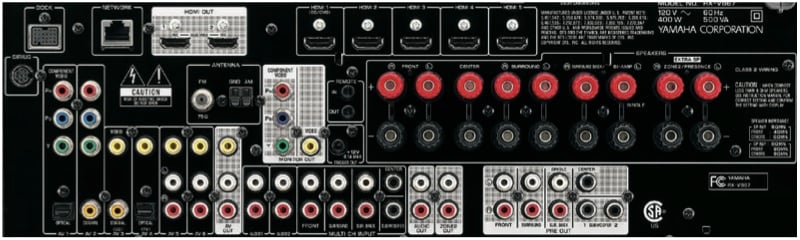
There are full 7.1 channel analogue inputs and 7.2 channel outputs for integration with legacy gear or external amps. We've been particularly fond of the dual subwoofer outputs and advocate people take advantage of them as often as possible. The Yamaha RX-V867 has six HDMI inputs (one on the front) and dual simultaneous outputs which supports Deep Color (30/36 bit), x.v.Color, 24Hz Refresh Rate and Auto Lip-Sync compensation. Analogue and HDMI upconversion to 1080p is onboard (though the manufacturer is not specified indicating that it is a proprietary solution) with motion adaptive and edge adaptive de-interlacing including multi-cadence (incl. 3-2 pull-down) detection. Provided it works as advertised it should pass most of the HQV tests with flying colors. We won't know until we get a unit in our hands. There is also the ability to change HDMI input while in Standby Through mode with the RX-V867 - something that is only now starting to show up on receivers.
There are dedicated five-way binding posts for each of the seven channels of amplification (95watts per channel) plus an extra set for presence and/or Zone 2 or bi-amping. We love this solution as it allows you to wire all the speakers and change configurations without having to run behind your receiver to switch out speaker wires. The RX-V867 weighs in at a respectable 25lbs and has outputs for component and composite video. We like how the outputs are surrounded by white on the back of the receiver making them easier to identify in the dark of a cabinet. There are a limited number of analogue video inputs including only two component and four composite. There are two each of optical and coaxial digital audio inputs. Zone 2 is supported though the internal amps (if assigned) or stereo analogue outputs. There is a Dock input for connecting one of Yamaha's add-on docks plus a dedicated Sirius Radio input for adding an antenna.
Yamaha's proprietary YPAO automatic room correction system is on board for setting up your speakers as is an all new GUI (Graphical User Interface) which will now show album art (presumably in conjunction with one of Yamaha's iPod docks). We're getting a little tired of companies like Yamaha (and many others) claiming functionality that requires an addition purchase to actually use. For a $900 receiver not to have a USB port is a bit of a mystery to us. When other manufacturers are including full iPod/iPhone functionality out of the box at much lower price points, not to have at least a USB port for basic compatibility seems a tremendous oversight.
The last big feature on the RX-V867 is networking. With a connection to your router to the Ethernet port on the back of the receiver you'll gain access to Internet Radio (MP3/WMA), Streaming Services (Rhapsody, SIRIUS Internet Radio) and music files on on your PC (WAV, MP3, WMA, AAC, FLAC). The RX-V867 is DLNA v1.5 certified which means you'll probably have little problems integrating the receiver into your system. Perhaps this is why Yamaha neglected the USB port but it seems a poor substitute for those that want to quickly integrate a visitor's iPod/iPhone into their system.
Conclusion
With the exception of one missing feature, the new Yamaha RX-V867 is quite an interesting product. For under $900, you get full analogue and HDMI upconversion to 1080p, HDMI 1.4a with 3D, Audio Return Channel, and input switching while in Standby Through mode, 95 watts per channel, dual subwoofer and HDMI outputs, extra binding posts for Zone 2, and a full suite of networking and streaming features. While you won't be able to integrate your iPod or iPhone without an additional purchase, you sure can do just about everything else. With 7.1 channel inputs for integration of legacy gear and 7.2 outputs for adding an amp later, this is a receiver you can grow old with. Well, at least a little older.
For more information please visit www.yamaha.com.
Unless otherwise indicated, this is a preview article for the featured product. A formal review may or may not follow in the future.
As Associate Editor at Audioholics, Tom promises to the best of his ability to give each review the same amount of attention, consideration, and thoughtfulness as possible and keep his writings free from undue bias and preconceptions. Any indication, either internally or from another, that bias has entered into his review will be immediately investigated. Substantiation of mistakes or bias will be immediately corrected regardless of personal stake, feelings, or ego.
View full profile Subscribe to our newsletter