
Skip to content. Skip to navigation
You are here: Home Pro Reviews A/V Receivers Yamaha RX-V1800 7.1 Channel Home Theater Receiver
#########
 

Yamaha RX-V1800 7.1 Channel Home Theater Receiver

by Jeff Lawson last modified May 23, 2008
Yamaha does it again

Yamaha does it again

Summary

  • Product Name: RX-V1800 AV Receiver
  • Manufacturer: Yamaha Electronics
  • Review Date: March 18, 2008 12:59
  • MSRP: $1299.95
  • First Impression: Gotta Have It!
Specifications

  • RMS Output Power (20Hz - 20kHz): 130W x 7
  • Dolby TrueHD, DTS-HD Master Audio
  • Dolby Digital EX/Dolby Pro Logic IIx, DTS-ES Discrete 6.1, DTS 96/24 / DTS Neo:6
  • iPod Compatibility (with optional YDS-10)
  • Compressed Music Enhancer
  • Neural Surround THX, XM HD Surround   
  • HDMI (In/Out) (4/1) v1.3a
  • Component Video (In/Out) (3/1)
  • Digital Inputs/Outputs: 5 TOSlink, 3 coaxial / 2 coaxial
  • DSP: 22 Surround Programs, Night Listening Enhancer
  • Time Base Corrector
  • HDMI Up Conversion (Scale to 480p / 720p / 1080i / 1080p)
  • Dialogue Lift
  • YPAO (w/Optimizer Microphone)
  • On-Screen Display
  • Assignable Power Amps
  • Zone 2/3 audio outputs with speaker terminals and dedicated remote
  • Zone Power Switching Main/ Zone2 / Zone3 (Front Panel)
  • Control: RS-232C Interface, 2 x 12V triggers, IR ports
  • Receiver Manager Software
  • Multi-channel Decoder Inputs 8-Channel
  • Learning Remote with macros
  • Product Dimensions (W x H x D): 17-1/8 x 6-3/4 x 17-1/4 inches
  • Product Weight: 37.3 lbs


Executive Overview

Once again Yamaha raises the bar and offers a feature rich home theater receiver at a price point that will still leave you some money left over for purchasing some movies. The RX-V1800 includes all of the very latest in HD audio decoding including Dolby Digital Plus, Dolby TrueHD, and dts-HD Master Audio, this receiver is going to get the attention of all those people who have just upgraded everything to HD with the exception of their receiver or outboard processor. The RX-V1800 is HDMI 1.3a compliant and comes with the Anchor Bay Technologies ABT1010 scaler engine with S-video and component video up conversion up to 1080p over HDMI. All that audio and video processing in addition to preamp outputs makes this unit a good choice for those who only need a processor. rxv1800back
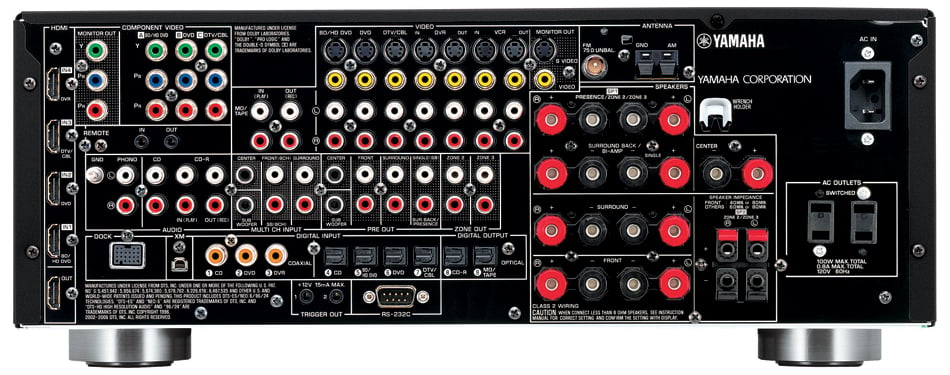
Like the RX-V2600 and the RX-V2700 before it (which this unit essentially replaces), this receiver is loaded to the max with audio processing power. In addition to all the Dolby Digital and DTS processing capabilities, the RX-V1800 also has Yamaha’s YPAO sound optimization, Yamaha’s Cinema DSP processing, Neural THX, XM HD Surround, and the Compressed Music Enhancer for restoring some fidelity to your MP3 collection. The RX-V1800 is also equipped to handle the optional YDS-10 universal dock for iPod connection.

If you require flexibility, this receiver has it in spades. Featuring assignable amps, the RX-V1800 can reroute power to either Zone 2 or Zone 3 and allow you to permanently wire speakers to those terminals. Alternatively, you can bi-amplify your main speakers with no need to level match the outputs - the receiver will do it all for you. Want to switch back those Zone 2/3 amps to power the Surround Back speakers in your main zone? It's just a click away using the on-screen display. If control is what you require, then RS-232C, dual 12V DC triggers (only 15mA, however) and IR in and out ports are only a connection away.

The RX-V1800 is rated at an impressive 130 watts x 7, and uses Yamaha’s Digital ToP-ART design that includes top grade audio-grade parts and devices. The receiver also features Burr-Brown 192 kHz/24-bit DACs for front channels and 192 kHz/24-bit ADC for Main Zone. If this receiver bears any resemblance to its predecessors, measurements should show clean, linear sound with very little harmonic distortion. As always, build quality and aesthetics are top notch. Packed with powerful audio and video processing, plenty of HD inputs, a high quality amplifier section and sharp looks, the Yamaha RX-V1800 offers a fantastic value for those who have ventured into the HD world.

Recent Forum Posts:

Post Reply
crashkelly posts on May 12, 2008 12:15
mouettus;409786
I bought it when it just came out... a while ago. Thx for the info.


Not a problem.

Cheers
Michael
mouettus posts on May 06, 2008 18:36
crashkelly;409757
I just got mine yesterday at A&B Sound for $990CDN. Is not an online sale but an in-store. Not sure if there is one in your general area, but if there is get FutureShop to price match. Will save you a nice chunk of cash.

Worth a shot if you are within the 30days.


I bought it when it just came out... a while ago. Thx for the info.
crashkelly posts on May 06, 2008 15:57
mouettus;408594
Bummer. Paid 1250 with taxes for this one at FutureShop, considered a deal. Wish I lived in the states just (triple underlined if I could) to get your amazing deals. You often get free shipping too.

Never saw that in Canada.


I just got mine yesterday at A&B Sound for $990CDN. Is not an online sale but an in-store. Not sure if there is one in your general area, but if there is get FutureShop to price match. Will save you a nice chunk of cash.

Worth a shot if you are within the 30days.
robdam1001 posts on May 05, 2008 22:46
shokhead;405733
From an authorized dealer?


yes, 6ave.com
PENG posts on May 05, 2008 19:59
AcuDefTechGuy;408229
I thought Audioholics said that Power Current is a non-issue these days?

The BP7001SC has a minimum impedance of 3.3 ohms (Sound & Vision Mag).

But @ 90dB, I don't think I was able to tell any differences between the Acurus 200X3, Emotiva MPS2, or the Denon PMA2000IVR.


It depends on many factors. It may be the case for you but not necessarily for others. Consider the following example:

Speaker A
Sensitivity: 87 dB @2.83V 1 meter
Nominal impedance: 4 ohms

Speaker B
Sensitivity: 90 dB @2.83V 1 meter
Nominal impedance: 8 ohms

Speaker A is therefore 6 dB less sensitive than speaker B.
Now let's day Person A owns speaker A and Person B owns speaker B and that Person A typically likes his music twice as loud and Person B. Remember, to perceive twice as loud, SPL may have to be as much as 10 dB higher, let's say 9 dB just for ease of demonstration.

So now Person A will need an amp that could provide this extra 15 dB (3 for being 4ohm and 3 for the lower sensitivity, and 9 to make it sound twice as loud) of SPL.

Let's further assume in this same room, Person B typically needs 10W to get the SPL he likes.

Since for every 3 dB of SPL increase you need to double the power, so to get Person A that extra 15 dB, he needs to have 32 times the power that Person B needs, that's 320W. On top of this, even for non classical music you need to have 2 to 3 dB of headroom so suddenly Person A would need a 500 WPC amp.

I know I am being extreme, in order to show how quickly the power requirement goes up depending on the characteristics of a specific speaker and its owner's personal preference. In reality, even a 15 WPC tube amp can do well in a smaller room, powering not too hard to drive speakers, for individuals who know how to protect their hearing, and play their music at moderate SPL (say, around 70 dB instead of 80 or higher).
Post Reply
 
Join our Newsletter for News & Deals
#########