


Onkyo TX-NR1009 THX Select2 Plus Networking Home Theater Receiver Preview
Onkyo TX-NR1009
Summary
- Product Name: TH-NR1009
- Manufacturer: Onkyo
- Review Date: June 03, 2011 00:20
- MSRP: $1399
- First Impression: Pretty Cool
- HDMI Support for 3D Video and Audio Return Channel
- High-Quality HQV® Vida™ VHD1900 Video Processor
- Marvell Qdeo™ Video Chip for 4K Upscaling and Processing
- ISF (Imaging Science Foundation) Video Calibration for Optimal
Video Performance
- Network Capability Delivers Internet Radio and Network Streaming
- THX® Select2 Plus™ Certified
- Direct Digital Connection of iPod/iPhone via Front-Panel USB Port
- Audyssey MultEQ® XT Advanced Room-correction and Speaker Calibration
- DTS Neo:X™Adds Extra Dimensions to Surround Sound
| Front L/R |
135 W + 135 W (8 ohms, 20 Hz-20 kHz, 0.08%, 2 channels driven, FTC) 160 W + 160 W (6 ohms, 1 kHz, 0.1%, 2 channels driven, FTC) |
| Center |
135 W (8 ohms, 20 Hz-20 kHz, 0.08%, 2 channels driven, FTC) 160 W (6 ohms, 1 kHz, 0.1%, 2 channels driven, FTC) |
| Surround L/R |
135 W + 135 W (8 ohms, 20 Hz-20 kHz, 0.08%, 2 channels driven, FTC) 160 W + 160 W (6 ohms, 1 kHz, 0.1%, 2 channels driven, FTC) |
| Surround Back L/R |
135 W + 135 W (8 ohms, 20 Hz-20 kHz, 0.08%, 2 channels driven, FTC) 160 W + 160 W (6 ohms, 1 kHz, 0.1%, 2 channels driven, FTC) |
| Dynamic Power |
300 W (3 ohms, 1 ch) 250 W (4 ohms, 1 ch) 150 W (8 ohms, 1 ch) |
| THD (Total Harmonic Distortion) | 0.08% (20 Hz-20 kHz, Half power) |
| Dimensions (W x H x D) | 17 1/8" x 7 13/16" x 17 1/8" (435 x 198.5 x 435.5 mm) |
| Weight | 40.8 lbs (18.5 kg) |
As manufacturers add more and more features to their receiver offering, it gets harder to impress the public. Onkyo has long been known to bring new features to market first. They do this again with the TX-NR1009, the first receiver with DTS Neo:X technology.
First, let's talk a bit more about some of the mundane features of the TX-NR1009. The receiver sports nine channels of amplification at 135 watts per channel (8 ohms, 20 Hz-20 kHz, 0.08%, 2 channels driven, FTC). It weighs in at a hefty 40.8 lbs and has obtained THX's Select2 certification. This means that it has been tested in a medium sized room. It has Audyssey's MultEQ XT room correction and speaker calibration system (not the newer XT32 version that can EQ dual subs and has increased FIR resolution) on board as well as all the usual decoding (Dolby PLIIz, Audyssey DSX/Dynamic EQ/Dynamic Volume, DTS HD, Dolby TrueHD, etc.).
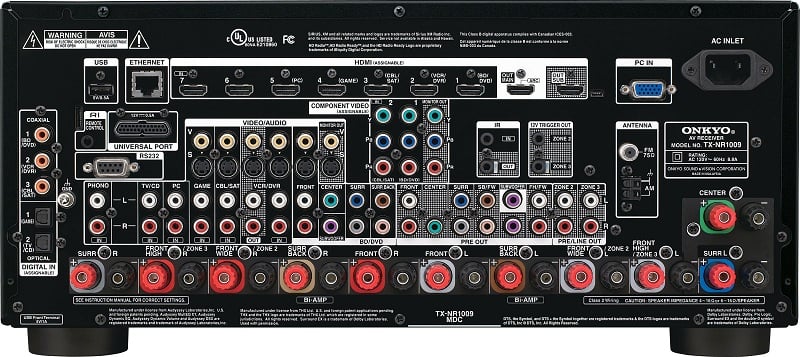
There are seven HDMI version 1.4a inputs (3D and ARC support) on the back and one on the front. The Onkyo TX-NR1009 has dual HDMI outputs. While there are nine internal amplifiers, there are eleven pairs of speaker terminals so that multiple configurations can be utilized without having to switch wires. There are a slew of composite/s-video inputs and two component video inputs. The TX-NR1009 has 7.1 channel analogue inputs for legacy gear and 9.2 analogue outputs for integrating external amplifiers and dual subwoofers. It also supports up to three zones of audio (all three can be powered by the receiver).
All video can be upconverted to HDMI by the TX-NR1009. Those signals are upscaled via HQV's Vida VHD1900 from 480i/p, 576p, and 720p video sources to high-resolution 1080p. Marvell's Qdeo, meanwhile, performs full 4K (3840 x 2160) upscaling of 1080p sources (a resolution your display can't handle yet). The Vida processor incorporates Auto HQV and HQV StreamClean to enhance video images in real time and eliminate noise in compressed video. With multi-cadence tracking, expanded 12-bit color processing, and four-field motion-adaptive de-interlacing, Vida optimizes the quality of both standard- and high-definition video images. Most importantly for videophiles, the TX-NR1009 also supports independent ISF calibration for optimum video performance.
All receivers these days either are, or aspire to be, networked. Via an Ethernet connection, the TX-NR1009 can stream Internet radio and streaming music services, with preformatted service packages for Mediafly, Pandora, Slacker, Napster, Rhapsody, vTuner, SIRIUS XM Internet Radio, and Last.fm. The receiver is both DLNA and Windows 7 certified and has front and back USB inputs that support MP3, WMA, WMA Lossless, FLAC, WAV, OggVorbis, AAC, and LPCM files. The "Universal" port on the back can accommodate all of the Onkyo external docks and adapters. If you have an iDevice, the TX-NR1009 can use the USB inputs to make a direct digital connection.
Of course, the big announcement is the inclusion of DTS Neo:X processing. DTS Neo:X is the industry’s first 2.0/5.1/6.1/7.1-to- 9.1/11.1 conversion technology within a single algorithm (in this case, only up to 9.1 is supported). You can set up the DTS Neo:X system for a basic 5.1 channel home theater to be augmented by surround back and front height speakers, surround back and front wide speakers, or front height and front width speakers.
Conclusion
We've been mighty impressed with the recent offerings from Onkyo but we have to say that the TX-NR1009 has left is a little underwhelmed. When you compare it to the Onkyo TX-NR809, you have to look pretty hard to see where your extra $200 is going. While it looks to be a great receiver in its own right, we would much prefer to see some sort of stereo subwoofer system (or the newer Audyssey MultEQ XT32) rather than just DTS' answer to Audyssey DSX and Dolby PLIIz. We do like the ISF calibration and the HQV video scaling but you can get these in cheaper Onkyo offerings. We're curious to see how this receiver wills stack up against others at a similar price point.
For more information, please contact www.us.onkyo.com.
Unless otherwise indicated, this is a preview article for the featured product. A formal review may or may not follow in the future.
As Associate Editor at Audioholics, Tom promises to the best of his ability to give each review the same amount of attention, consideration, and thoughtfulness as possible and keep his writings free from undue bias and preconceptions. Any indication, either internally or from another, that bias has entered into his review will be immediately investigated. Substantiation of mistakes or bias will be immediately corrected regardless of personal stake, feelings, or ego.
View full profile Subscribe to our newsletter