


Marantz NR1501 Slimline AV Receiver Review
Marantz NR1501 AAV Receiver
- Product Name: NR1501 Slimline AV Receiver
- Manufacturer: Marantz America
- Performance Rating:

- Value Rating:
- Review Date: February 15, 2010 09:20
- MSRP: $ 599.99
|
7 ch Discrete Analog Amplifier (50 watts x 7) in Slim Design Chassis HDMI 1.3 x4 Inputs / x1 Output Decoding of Dolby TrueHD, dts-HD Master Audio Video Converter for All Analog Sources to HDMI Independent Audio Board for Improved Sound Simple Set-up with MRAC Auto Calibration Component Video x3 Inputs / x1 Output |
Analog Audio Inputs x5, Digital Audio Inputs x3 Marantz Remote D-Bus In/Out Jacks Detachable Power Cord On Screen Display for Setup through HDMI out Glow Key, Precode Remote Control Available Option Rack Mount Kit RMK1501NR |
Pros
- Slim
- 4 x HDMI 1.3 inputs
- 3 x component video inputs
- Analogue to HDMI upconversion
- Full HD audio support via HDMI
- 5-way binding posts on primary speaker connections
Cons
- No input level control
- No analogue 5.1/7.1 outputs
- No Zone 2 functionality
Marantz NR1501 Introduction
The Marantz NR1501 Surround receiver has it where it counts. For example, the system will handle three composite and three component video inputs and upconvert those to its single HDMI output. This means that users with legacy equipment, such as older DVD players and set top boxes, can simply connect these up to the NR1501 and still get that output to their televisions with just a single HDMI cable. For those looking to wall mount a new flat panel display, or with remotely-located equipment, this is a wonderful feature. It also means that you won't have to switch inputs on your television when going from component video to HDMI. These days, convenience gets a lot of weight in home theater product decisions. The NR1501 doesn't scale incoming video, it merely transcodes it. What this means is that if you send a 480i signal in via component video, it will go out the HDMI output at 480i. This is actually a good thing, since we've seen lots of AV receivers do worse jobs at processing video than displays. If you have a great TV, let's let it do something!
In terms of audio the NR1501 has 5-way binding posts for all channels except the Surround Back channels which feature spring clips. With these clips you'll want to stick to using 18 gauge wire or higher (smaller) but we don't see this as particularly troublesome, especially given the space and cost savings. There are three S/PDIF inputs, a sufficient number given that there are four HDMI inputs which also support multi-channel audio (including the uncompressed Dolby TrueHD and dts-HD formats). If you still use analogue sources there are CD and Aux 2 stereo inputs in addition to the audio inputs available for all analogue inputs. The way Marantz handles its inputs is that they are all pretty much assignable, but by design there are fully analogue options for DVD, DSS and DVR and HDMI (without analogue audio options) is fully dedicated to Blu-ray and Game.
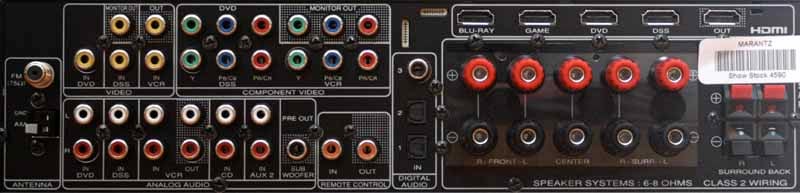
S-video has finally bitten the dust – R.I.P.
Marantz NR1501 Build Quality
The receiver is quite attractive. It's not as tiny and "toy-like" as some of those infamous Class-D receivers that were (are?) popular for those looking to save space and heat. In the case of the Marantz NR1501 it really does seem like they truly are saving space without sacrificing too much. The receiver is a full 2-inches shorter than its elder brother, the SR5004, and an inch less in depth to boot. It maintains that nice rounded front edge that puts a lot of other mainstream AV receivers to shame – the products just looks a high end piece worthy of recognition. We popped open the hood of the NR1501 and found a full-size EI power transformer and a large heat sink that really defied our imaginations of what could fit into such a small container. In addition, all of the channels use dual push pull transistors instead of a chip amp (in fact, no current Marantz receivers use chip amps). Many manufacturers (like Yamaha, for example) are now saving costs by using chip-based amplifiers in their $600 and under receivers. Kudos.
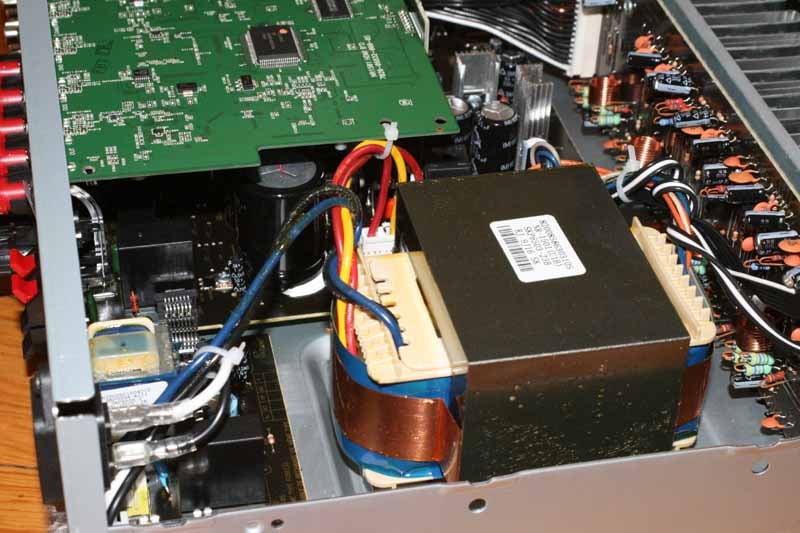
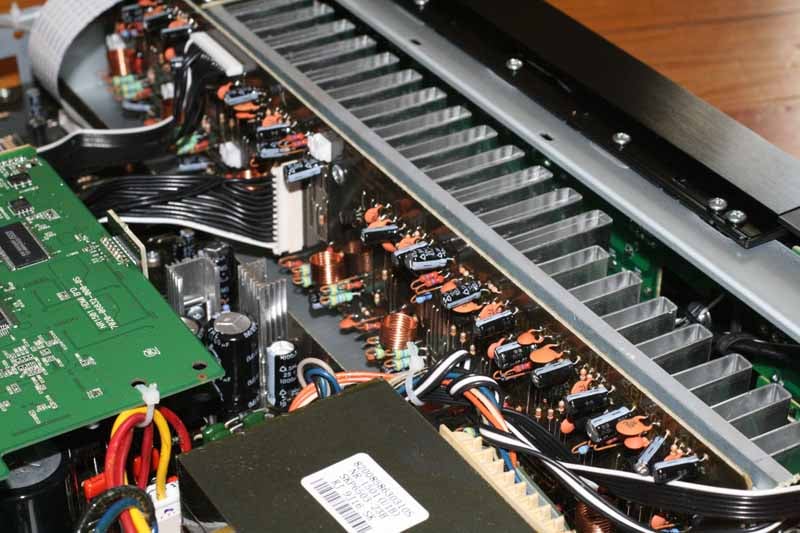

Marantz NR1501 Inside Views
Marantz NR1501 System Setup, Remote Control and HD Audio
 The Main Menu contains five basic areas, including System Setup, Input Setup, Speaker Setup, Ch(annel) Level Setup and Sound Parameter. Before we did anything, though I suppose it was out of order, we ventured into the Speaker Setup menu and began to configure our surround system. Aside from the Auto Setup which uses the included calibration microphone and Marantz Room Acoustic Calibration (M.R.A.C.) system, there are 4 options: Speaker Config, Speaker Distance, Speaker Crossover, and Room EQ Setup.
System Setup
This catch-all menu is dedicated to global settings like Sub W(oofer) Mode, where you can allow the sub output to be combined with the low frequency put out by your full range speakers, or strictly adhere to LFE plus bass management input. The single HDMI output can be configured to carry audio to the television or retain it for processing and decoding by the receiver. You can defeat the tone control and engage HT-EQ (which is basically a circuit that mimics THX' Re-EQ system to compensate for theatrical soundtracks being played in the home theater environment). Video Convert tells the Marantz NR1501 whether or not to pipe the analogue inputs into the HDMI path, upconverting them to digital.
Input Setup
The Input Setup menu gives you access to each of the 8 possible inputs: Blu-ray, Game, DVD, DSS, VCR, CD, Aux1, and Aux2. When you select an input to configure it presents you with the ability to rename it, select the digital (optical or coax) input, Audio mode (HDMI, digital or analogue), Auto Surround mode and Lip Sync.
Speaker Setup
Speaker Config allows you to select the size and presence of a speaker in your system. In this way you can ghost a nonexistent Center channel or run a system with or without a subwoofer. You can also tell the Marantz NR1501 whether your speakers are Large (Full range 20Hz – 20kHz) or small (anything else). Speaker Distance allowed us to set the group delay for each speaker by setting the distance to the listening position. We like to see 0.5 foot increments here, but the Marantz only allowed 1 foot steps. You can make adjustments in Feet or Meters (or should I say Metres?) The Crossover system works independently on Front, Center, Surround and Surround B(ack) speakers. You can set the crossover to 40-80 in 5Hz increments, then 90-150 in 10 Hz increments and also 175 and 200 Hz. "Full Range" means that the channel(s) will get full range with nothing being sent to the subwoofer.
Ch(annel) Level Setup
In this simple menu you can adjust levels in 1dB increments (we like to see 0.5dB steps) in order to better balance out the system. It will emit a test tone when you turn this function on using the remote or the menu system and a simple Radio Shack meter will allow you to verify that all speakers are reaching the "money seat" at proper levels.
The unremarkable Sound Parameter menu is where you set Night Mode, Dolby PLII and Neo:6 preferences. Overall, the menu system for the NR1501 was very plain. It gave you access to the basics, but there were no real surprises or complicated configurations to navigate. While many audioholics like complexity and options, I think Marantz nailed this one by keeping it very simple and straightforward. Running the Auto Setup was even easier since it took care of everything without having to tweak the Speaker Setup menu.
RC006SR Remote Control
 The remote that comes with the Marantz NR1501 has what's known as glow keys, or as we call them lovingly around here – "I'm-too-cheap-to-have-backlit-keys" keys. It's a basic remote and if you can see what you're doing it will serve you well. In the dark, however, it's difficult to navigate since 70% of the keys are identical in size and shape. The topmost section is dedicated to power and global functions like LCD dimmer and Night mode. The next section controls the sources. In the middle lies the menu controls, with the navigational section just underneath. Finally the keypad and EQ controls make up the bottom as do the oddly-placed TV Power and Input buttons. The Setup menu is activated by selecting the Amp source and hitting the Menu button – this felt rather odd to us, since the button marked "Setup" doesn't seem to do anything (and was the natural place we tried first). You won't exactly break this remote over your knee in frustration, but replacing it with a good universal remote control will make the entire system run that much more smoothly.
HD Audio Support
The NR1501 supports Dolby TrueHD, Dolby Digital Plus and dts-HD formats via HDMI. There are no dedicated 7.1 analogue inputs for legacy DVD-Audio and SACD players, so you won't want to necessarily use this receiver with legacy products that require those high resolution formats be transferred over anything other than HDMI. These days, however, if you're even moderately updated you should be able to grab most of what you need over HDMI audio. The space savings employed by Marantz to bring this receiver down to size make a lot of sense and if it meant giving up analogue audio inputs then I think it was the way to go.
Marantz NR1501 Listening Tests and Conclusion
We placed this receiver into Reference System 2 which uses the RBH Sound Signature SI-760/R speakers placed within a CinemaSITE system. These Signature Series speakers are extremely detailed and transparent and my listening has never been more enjoyable. As it is configured now, the system contains three SI-760/R speakers across the front, a pair of 66-SE dipole surround speakers and a pair of SI-1010P powered subwoofers. With the exception of the dipole surrounds, the Signature in-wall speakers reside within the CinemaSITE structure, which also supports the 92-inch Masquerade projector screen masking system from Carada. Video is shown through an Epson Pro Cinema 1080UB LCD projector and the source is a Lexicon BD-30 Blu-ray player without the external case and aluminum faceplate... oh, and with firmware loaded from the Oppo BDP-83. I am able, when not reviewing receivers, to utilize Audyssey's MultEQ Pro system to aid in smoothing out the bass response from the subwoofers in this room and have treated the room with absorption panels provided by RPG Diffusors. All audio electronics are conditioned and protected by an APC S15 system with additional SBATT. When the power goes out in Central Florida, this home theater can continue to play a movie all the way through the credits.
Listening Tests
Two-Channel Performance
I wanted to know how well the system drove my speakers without wondering how much could be attributed to DSP, so I disengaged M.R.A.C. and focused on listening to the soundstage, dynamics and frequency response of the selected two-channel tracks. While I listened to dozens of tracks over the review period, I spent considerable time documenting a couple of two-channel discs in particular.
CD: The Music of Apollo/Saturn V Center
Many many moons ago I worked on the primary Visitors' Center video wall program for the Kennedy Space Center. During that time, one of my bosses spent his time in a neighboring room composing what would become the theme music for the Apollo/Saturn V Center. Recorded at L.A. East Studios in Salt Lake City, Utah and mixed at Signet Sound, this CD is mastered with a ton of dynamic range. "The Firing Room" sets the theme for the entire soundtrack, introducing the theme with a solo trumpet and bringing in strings and brass that ebbed and swelled. The Marantz seemed to push the RBH Sound speakers well, driving them to release the dynamics of the piece with lots of gusto. "Eagle Lands on the Moon" is a piece that builds up into mini crescendos with lots of percussion and plenty of ballsy brass. It's a moving piece that tells the story of the adventure of that first moon landing and I felt that the NR1501 did at least an admiral job of pushing out the material. My reference AVR-5308CI seemed to deliver a lot more in terms of dynamics and bass control on this disc overall, but at 9x the price I think that's acceptable. I was pleased at the ability of the Marantz NR1501 to go back and forth between thick swells of instrumentation and quiet solo passages with a low noise floor. This is, however, the definition of dynamics and owners of this receiver should be very pleased.
CD: Alanis Morissette – Jagged Little Pill
 "All I Really Want" is a great tune with a really driving beat that pushed out distorted (on purpose) stereo guitars from each channel while Alanis' vocals poured forth like the angry white chick she is (vocally, anyway). I loved the clarity of her voice as it contrasted the overall "thickness" of this tune. I noted the lack of any compression on the top end of her sibilance notes and the wah-wah guitars delivered a lot of gritty texture that poured out with all the authenticity of a live performance. "You Oughta Know", one of her more popular songs, was a pleasure to listen to on my Reference system and the Marantz NR1501 drove the speakers without missing a beat. The stereo vocals were awesome and the punctuated bass really pushed the system's mid-bass response hard, coming through clear an without taking on that boxy tone that often accompanies an amp that can't deliver enough power to push speakers to higher SPL levels on-demand. By the time we got to "Wake Up" I was really appreciative of the refreshingly clean vocal line and underlying bass line that exercised the midrange drivers of my system. Alanis' voice sounded true-to-life and the speakers seemed to really disappear into the room, leaving me to enjoy the music unencumbered by artifacts or compression.
Multi-Channel Performance
I love multi-channel audio and movies with excellent surround, and the Marantz NR1501 excelled at producing beautiful 5.1-channel music. I grabbed a few of my favorite high resolution discs and played them back through the system in standard surround modes. For most, that meant multi-channel DVD-Audio (MLP) or Dolby TrueHD soundtracks.
DVD-Audio: The Beatles' Love (from the Vegas Cirque de Soleil show)
I've actually heard this show live in Vegas, so it's always interesting to compare my recollection of the show to the multi-channel soundtrack. "Eleanor Rigby" is my favorite track on this disc, though it's only a transitional piece. The pinpoint accurate placement of the strings (violins, violas and cellos – each distinctly separated) made me close my eyes and just enjoy the accurate representation offered by the NR1501. The instruments are placed both vertically and horizontally across the soundstage and are segregated sonically from the left to right - an impressive effect. George Harrison's backing vocals truly popped and the song is simply powerful. "Here Comes the Sun / The Inner Light" is another transitional piece (I seemed to really like this vignettes more than the extended main tracks themselves) that really stood out to me. The percussion and stand-out vocals really displayed a transparency that surprised me. I had initially thought the demand of a multi-channel performance like this would put undue strain on the mere 50W/channel offered by the Marantz receiver, but it really seemed to thrive and allocate the required power to produce accurate audio with gusto.
Blu-ray: Batman: The Dark Night
 This movie was absolutely over the top. From the very opening scenes, the crispness of the weapons and rigging sounds used to get the bank robbers into the bank. Simple things, like the impact of the drill against the bank vault door simply shook the room. The shotgun used by William Fichtner's character as he assaults the bad guys in the bank was absolutely explosive and the dialogue had the top end effect of being inside a large bank. Batman's motorcycle, when it emerges from the revised Tumbler, is an incredibly powerful symphony of detailed and layered sounds that were crisp and punchy. Glass breaking, cars denting, buildings going up in flames with subsonic sweeteners playing out underneath... there was so much to love about the Dolby TrueHD soundtrack on this movie I was at a loss for words (much like a kid in a candy store.) What I can say is that I was not disappointed. Not in the least. At my normal listening levels, the NR1501 played through the powerful soundtrack like it was singing a lullaby to a preschooler. Only when I really cranked it up to ear-bleeding levels did I see the difference as the top end seemed to get a tad compressed. For those in larger rooms or with tons of treatment, you may want to opt for a more powerful solution from Marantz, but 50W goes a long way in many homes and I don't foresee this being an issue for the intended target demographic looking at this product.
Conclusions and Overall Perceptions
I really like the design and layout of this receiver. The NR1501 doesn't have a lot of frills, but it's got 90% of the features anyone will likely need in a typical one-room setting. If you have the requirement of a second Zone or analogue preamp inputs or outputs, you'll want to go elsewhere. If your room is more than 2500 cubic feet, you may also want to consider stepping up to one of Marantz' more powerful offerings. But for those looking for a smaller form factor that will fit into your apartment, dorm, or home – the Marantz NR1501 is quite possibly the best-sounding product you're going to find for your hard-earned money.
Marantz NR1501
MSRP $599
Marantz America
100 Corporate Drive
Mahwah, N.J. 07430-2041
http://us.marantz.com
The Score Card
The scoring below is based on each piece of equipment doing the duty it is designed for. The numbers are weighed heavily with respect to the individual cost of each unit, thus giving a rating roughly equal to:
Performance × Price Factor/Value = Rating
Audioholics.com note: The ratings indicated below are based on subjective listening and objective testing of the product in question. The rating scale is based on performance/value ratio. If you notice better performing products in future reviews that have lower numbers in certain areas, be aware that the value factor is most likely the culprit. Other Audioholics reviewers may rate products solely based on performance, and each reviewer has his/her own system for ratings.
Audioholics Rating Scale
 — Excellent
- — Very Good
- — Good
- — Fair
- — Poor
| Metric | Rating |
|---|---|
| Multi-channel Audio Performance | |
| Two-channel Audio Performance | |
| Bass Management | |
| Build Quality | |
| Fit and Finish | |
| Ergonomics & Usability | |
| Ease of Setup | |
| Features | |
| Remote Control | |
| Performance | |
| Value | |
Clint Deboer was terminated from Audioholics for misconduct on April 4th, 2014. He no longer represents Audioholics in any fashion.
View full profile Subscribe to our newsletter