


harman/kardon HK 3490 Stereo Receiver Review
- Product Name: harman/kardon HK 3490 A/V Stereo Receiver
- Manufacturer: harman/kardon Electronics
- Performance Rating:


- Value Rating:
- Review Date: July 12, 2010 21:00
- MSRP: $ 499
- 120 watts x 2 (stereo) into 8-ohms (20-20,000 Hz) at 0.07% THD
- 150 watts x 2 (stereo) into 4-ohms (20-20,000 Hz) at 0.2% THD
- Dolby® Virtual Speaker mode for enhanced surround sound listening with two speakers
- Dolby® Headphone provides surround sound effects with any set of headphones using a stereo source
- XM Satellite Radio Ready (requires XM subscription and optional XM Mini-Tuner package)
- rotary bass, treble, and balance controls
- 3 audio (including phono) and 4 A/V (composite video) inputs
- digital audio inputs (2-channel PCM): 1 coaxial, 1 optical
- 2 preamp-level subwoofer outputs for connecting up to 2 powered subs
- preamp-out/main-in loop connections for system expansion
- full-size headphone jack
- 2 pairs of binding post speaker connectors
- 2 switched AC outlets
- AM/FM tuner with 30 presets
- front-panel switching for two pairs of main speakers
- remote control
- sleep timer
- dimensions: 17-3/8"W x 6-1/2"H x 15-1/4"D
- weight: 23 lbs
- warranty: 2 years
Pros
- Benchmark audio performance
- Digital audio inputs
- Oodles of power reserves
Cons
- Cheesy tone and balance control knobs
- Difficult to read frontpanel function buttons
- Remote not backlit
harman kardon HK 3490 Introduction
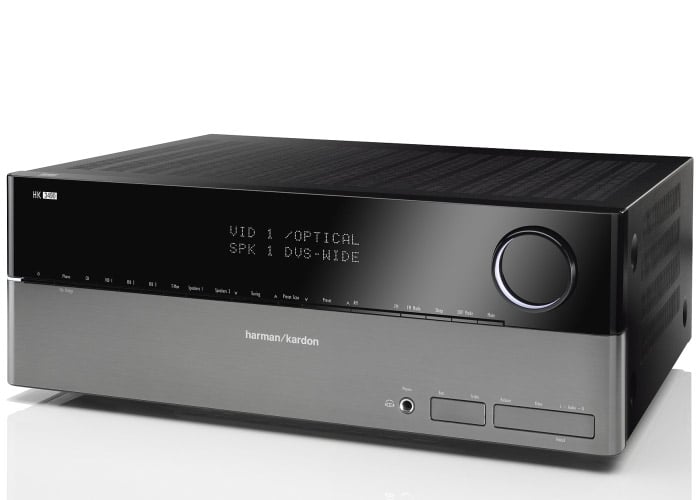 There comes
a time in everyone's lives where one needs to reboot and get back to the
basics. We see this all the time in the
movie industry with successful remakes such as Batman Begins, as well as the
car industry by revitalizing the classic spirit of models that seemed to lose
their way over the new generation of successors (ie. Mustang, Camaro). Getting back to the basics is usually a good
thing and something I often yearn for in the overly complex home theater world
laced in HDMI mishaps, and MP3 compression.
Harman/kardon understands this well as their products have traditionally
been more audiophile focused than many of their competitors. Enter the HK 3490 Stereo A/V Receiver. On paper, the HK 3490 seems to have great
performance and features that would please the audiophile and techno-geek
alike. With a nice meaty amplifier section rated at 120 watts per channel and 4 ohm rated to 150 wpc, we are talking some serious speaker drive capability.
There comes
a time in everyone's lives where one needs to reboot and get back to the
basics. We see this all the time in the
movie industry with successful remakes such as Batman Begins, as well as the
car industry by revitalizing the classic spirit of models that seemed to lose
their way over the new generation of successors (ie. Mustang, Camaro). Getting back to the basics is usually a good
thing and something I often yearn for in the overly complex home theater world
laced in HDMI mishaps, and MP3 compression.
Harman/kardon understands this well as their products have traditionally
been more audiophile focused than many of their competitors. Enter the HK 3490 Stereo A/V Receiver. On paper, the HK 3490 seems to have great
performance and features that would please the audiophile and techno-geek
alike. With a nice meaty amplifier section rated at 120 watts per channel and 4 ohm rated to 150 wpc, we are talking some serious speaker drive capability.
When one of my close friends was looking for a two-channel receiver for his bedroom system, I selfishly suggested this model simply because I wanted the chance to test it first hand. Little did I know, the HK 3490 would dazzle me with a performance and feature set not found on any of its peers.
harman/kardon HK 3490 Design Overview
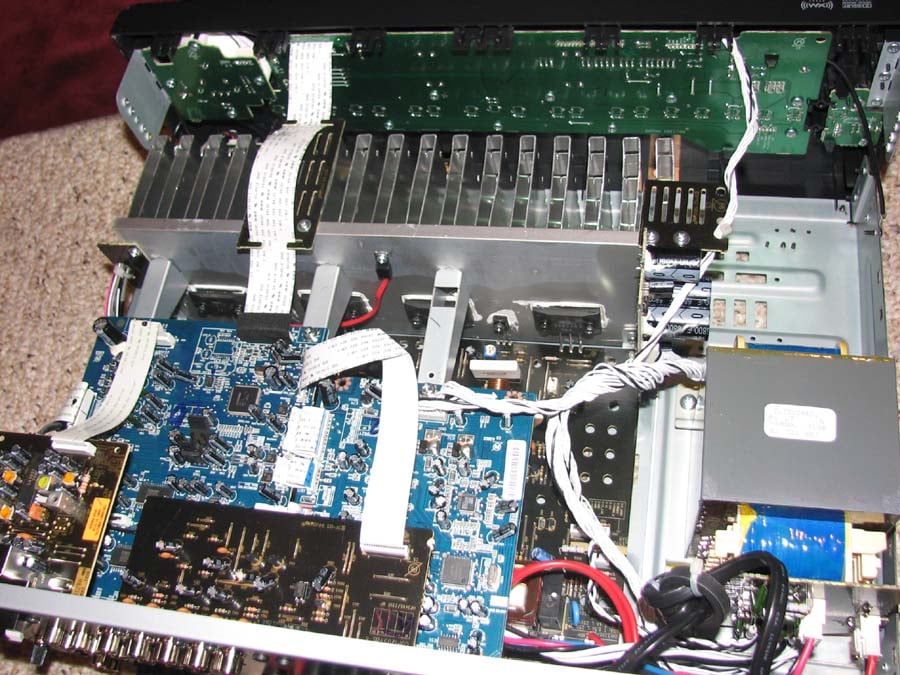
harman/kardon HK 3490 Top View
The HK 3490 power supply is sized like a typical mid to high priced 7.1 receiver yet it's only sporting two channels of amplification! I couldn't read the ratings of the power supply capacitors but they were quite thick and hefty. The power transistors were not the typical run of the mill ones found on most A/V receivers. These babies had some real size to them reminding me of how high end two-channel receivers used to be made when companies cared more about audio quality over cutting corners for profit margins. What was surprising to find in this two-channel receiver was a pair of AKM PCM DAC's. That's right, the HK 3490 has digital inputs and internal D/A converters on-board, a critically useful feature I've not been able to find on any other two-channel receivers.
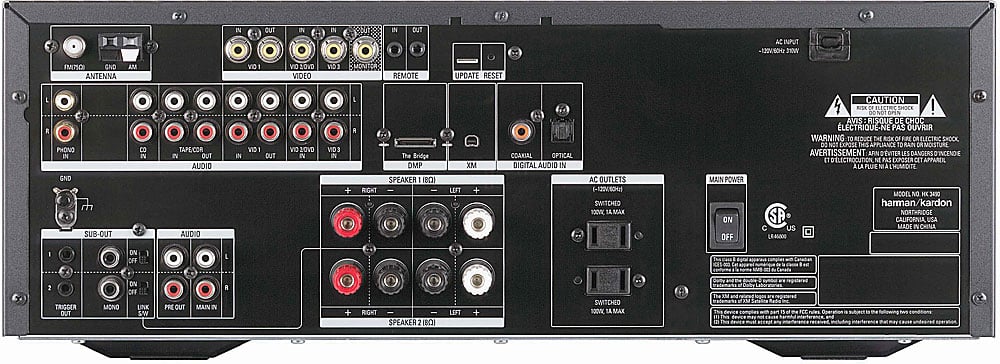
harman/kardon HK 3490 Back View
The HK 3490 back panel is cleanly laid out. There are two pairs of speaker outputs utilizing 5-way binding post connections. They are wired in parallel so no sound degradation will result by running two-pairs of speakers simultaneously. We do however caution users to stick with 8-ohm speakers if running two sets simultaneously. Otherwise, feel safe running a pair of 4-ohm speakers for stereo. As you will see in my measurements, the amp section of the HK 3490 is very stable at 4-ohms. The HK 3490 provides composite video switching, analog RCA audio connections and two digital inputs (1 coax, 1 toslink). It also provisions for dual subwoofer output connections but with no bass management provisions, which is typical of two-channel receivers. There is a Bridge II connector for iPod users and a master on/off power switch on the back, two switched outlets, and a non-detachable power cord
harman/kardon HK 3490 Front panel View
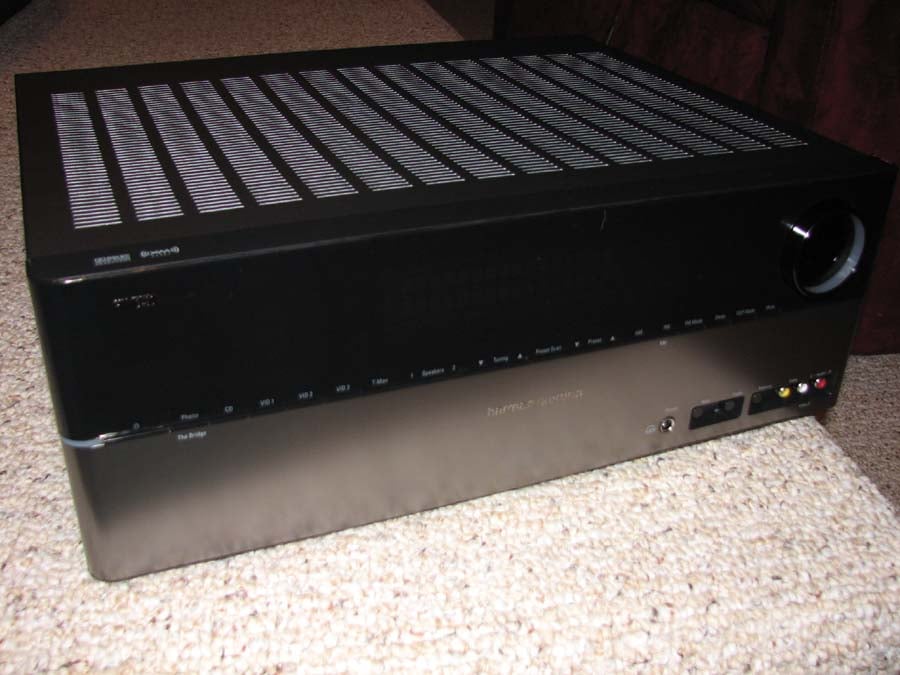
You can tell at first glance of the HK 3490 front panel, that this product means business. The chassis has a solid feel and heft to it and the layout of the front panel is quite elegant and simple. I have only a few cosmetic gripes which include the flimsy O-ring volume control, lack of backlighting on the input buttons and the tiny pop out balance and tone controls underneath the removable front panel flaps. I found it quite difficult to adjust the bass/treble controls but they luckily had a center click detent to make it easier to set to the zero or neutral position. Honestly if you've got really linear speakers and high quality amplification, you should have very little need to use tone controls which typically only color the sound and make it less accurate.
Product Features
The harman/kardon HK 3490 has some very unique features not typically found on any of its competitors such as:
- Digital audio inputs - this allows the user to take an inexpensive DVD player and turn it into a high end CD player by utilizing the internal AKM DAC's to handle the D/A conversion.
- Dual subwoofer outputs - this provides the end user the ability to line level connect up to two powered subwoofers in stereo, or one in mono using the right output, to extend bass frequencies of the system.
- Bridge II iPod interface - allows you to interface and operate your iPod device via the HK 3490 remote control while it also charging it during operation.
- Dolby Virtual Speaker - DSP mode for enhanced surround sound listening with two speakers.
- Dolby Headphone - provides surround sound effects with standard headphones using a stereo source.
- XM Radio ready - interfaces with optional XM tuner to receive highly compressed and nasty sounding XM radio broadcasts for those who care more about convenience than sound quality.
- Phone input support MM-type cartridges.
- Preamp Outputs and Main Power Amp Input couplers - allows you to connect external amplification, or an external processor or equalizer.
About the
only features I found missing on the HK 3490 which are available on some
competitor models were:
- Loudness control - bass & treble boost used at low volume to compensate for human hearing losses
- Multi zone - ability to connect external amplification to provide sound in other areas of the home using the receiver as the preamp and switcher.
I rarely
find the need to use loudness controls, especially when utilizing a powered
subwoofer in the system. I also don't
see much value of the multi-zone feature for most people purchasing two-channel
receivers but if that is an important feature for you, you may have to look
elsewhere. It is important to mention
however, that although the HK 3490 doesn't have a dedicated Zone2 output, you can
in fact use the dual subwoofer outputs (which are full-range signals) in
conjunction with an external preamp and power amp to route audio to another
room.
harman/kardon HK 3490 System Setup & Configuration
After bench testing the HK 3490, I hauled it over to my friend's house to set it up in his system. His system consists of a pair of EMP E55ti towers, a cheap $30 Sony DVD player, Motorola Brighthouse cable box, Planet Waves analog interconnects, Cardas 11AWG speaker cable and Sonicwave toslink and coax cables.
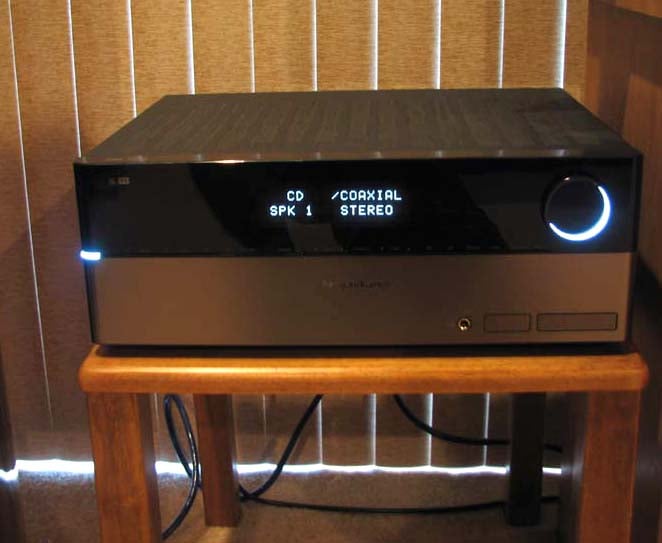
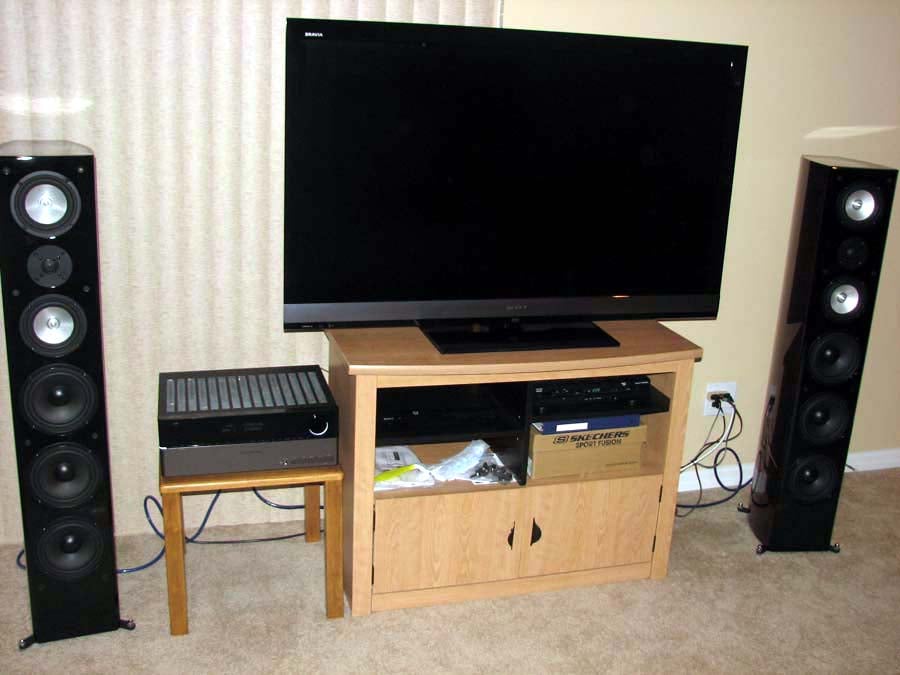
I
configured two of the inputs of the HK 3490 to receive digital audio signals
from the Sony DVD player and the Motorola cable box. Setting the inputs up to accommodate digital
sources was a bit tricky as it wasn’t intuitive, and I eventually found it buried
in the manual. To select the digital audio input,
press and hold the front-panel Source Selector and simultaneously press the
T-Mon Selector to change the audio input as follows: Analog, Optical,
Coaxial. Do this for each of the two
inputs which in our case was for the "CD" input for the DVD player
and "Vid 1" for the cable box.
It's important to note that the AKM DAC's of the HK 3490 only support
two-channel PCM. So, you need to
configure your DVD player for two-channel PCM else you will get no audio via
the digital connection if the player attempts to output a DD/DTS
bitstream.
Remote Control
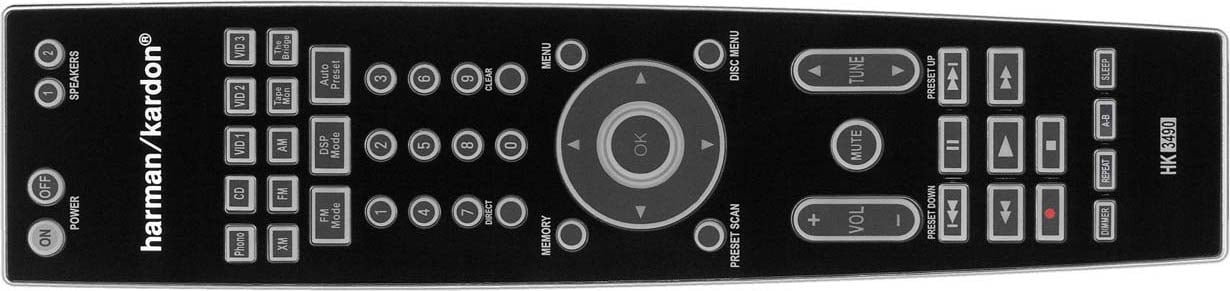
There is
nothing fancy or unusual about the remote control of the HK 3490 other than
perhaps its ginormic size. It’s a
completely push button remote that has no backlighting or learning
functionality, but it can however operate other harman/kardon equipment. I liked the fact that it has a speaker 1/2
selector to chose which speaker pairs are playing without having to make this
choice on the front panel display like you often have to do with other
products. In systems utilizing multiple
sources, we suggest investing in a budget universal remote from the likes of
Philips, URC or Harmony and stow this one away for future reference.
Listening Tests
I’ve always liked the sound
of harman/kardon stereo receivers so I was excited to get the chance again to
hear one of their latest creations first hand. Unless
otherwise stated, all listening tests were conducted full range with no powered
subwoofer and with the tone controls set in their Zero default position.
I fired up the Audioholics
demo CD I prepared for my blind listening test during my recent trip to Axiom
Audio. I broke out my assessment of the
HK 3490 using key tracks from this disc as noted below.
 Dianne Reeves - Never to Far
Bass was
incredibly punchy and tight. At high
listening levels, the HK 3490 was able to provide all of the power I demanded
without ever sounding strained. The
soundstage remained focused and I felt like I was listening to a high end
separates rig. I switched between the
analog and digital inputs and noted the superiority of the latter in terms of
bass definition and detail in the top end.
The AKM DAC's transformed my friend's bargain basement Sony DVD player
into a respectable CD transport.
Fourplay
- Chant
The
resonance in the kick drums rang clear when played through the EMP E55ti tower
speakers. There was oodles of punch
thanks to the luscious amp section of the HK 3490. Stereo separation was excellent and listening
at low volume displayed HK 3490s superb noise floor. To make a video analogy, it reminded me of
the black levels you get out of a really high quality, calibrated plasma
display.
Pat
Metheny / John Scofield - Say the
Brother's Name
The clarity
of Pat Metheny's guitar was to die for.
With eyes closed, I felt like I was listening to a live performance in a
small jazz club in NY. The HK 3490's
ability to handle subtle musical cues while also portraying confidence and
cohesiveness during dynamic passages really provided that "better than
being there experience" I often cite when coming across audio equipment
that exceeds my expectations in droves.
Sade -
Hang on to Your Love
If your
foot doesn't get tapping to Sade, then I suggest getting having your reflexes
checked. This song has a lot going on at
once between the bass drum, and assortment of percussive instruments layered in
Sade's hypnotic voice. The HK 3490 did a
great job of keeping all of the instruments distinct, allowing you to really
hear everything happening in the song.
It seemed to me that the HK 3490 begged to be driven harder and the EMP
speakers were happy to receive its pure unadulterated power.
I spent an
additional hour or so queueing up some of my favorite progressive rock and jazz
CD's and my initial impressions didn't waiver one bit. The HK 3490 provided a completely
satisfactory listening session that I didn't grow tired of. I was Gollum and the HK 3490 was the
ring. My precious!
I also
experimented a bit with the Dolby Virtual Speaker mode while watching some HD
broadcasts and found the results to be a mixed bag, highly source dependent
whether I preferred it on or off. The
inclusion of Dolby Virtual Speaker and Headphone modes to me were icing on this
already tasty cake. Thus, I can't negate their value add especially since they
didn't take away any performance from their inclusion into the product.
Suggestions for Improvement
It's
difficult to have any real criticisms of the HK 3490 because it does so many
things so well, but no product is perfect of course. Most of my issues with the HK 3490 are
cosmetic.
Here is a
tabulated a list of improvements I'd like to see on future models:
-
Backlit front panel input buttons for better visibility
-
Larger tone controls for easier adjustability and visibility
-
More compact and backlit remote control
-
Level trim adjustability for subwoofer output (though no two-channel receiver offers this)
-
Eliminate the O-ring volume control for all harman/kardon receivers (including this one) in favor of a sturdier, more conventional one
harman/kardon HK 3490 Measurements and Analysis
Using our Audio Precision APx585 8-channel HDMI analyzer, we conducted a full barrage of multi-channel amplifier tests on the harman/kardon HK 3490. We tested power using three methods all of which were taken at < 0.1% THD + N:
- Continuous Full Power Bandwidth (CFP-BW) from 20Hz to 20Khz into 8 and 4-ohm loads (up to two-channels)
- 1kHz Power Sweep vs Distortion (1kHz PSweep) - popularized by the print magazines, this is an instantaneous power vs distortion test at 1kHz. The problem with this test is it often masks slew related and or frequency response problems some amplifiers exhibit at the frequency extremes, and thus inflates the measured power results. It does provide an instant gratification # for consumers to argue over on the forums so we are now incorporating this test to please the masses.
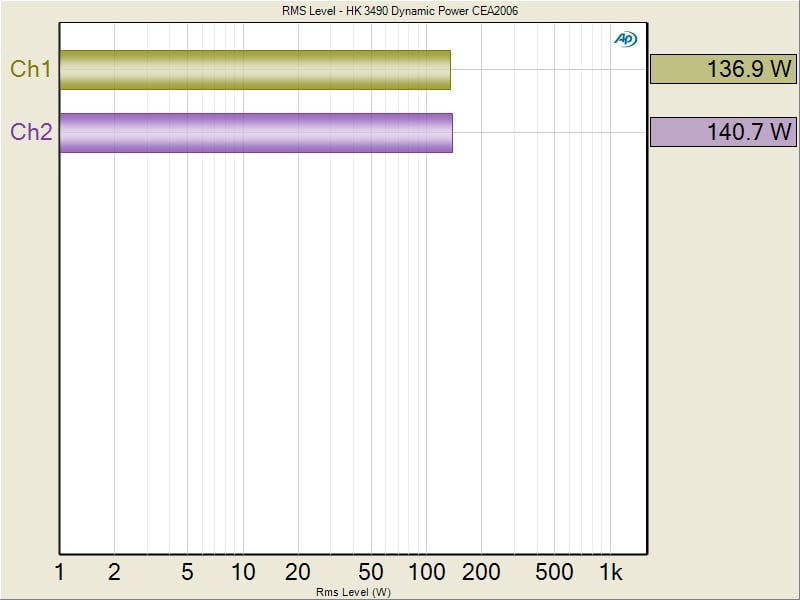
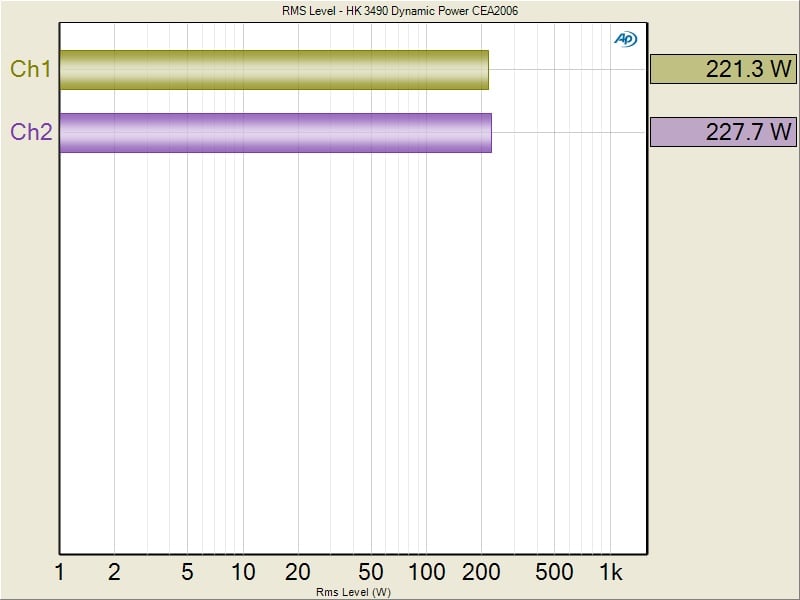
- Dynamic PWR - 1kHz CEA-2006 Burst Method testing. This is a dynamic power measurement adopted from the car industry similar to IHF method only a bit more difficult for an amplifier and more representative of real musical content.
Keep in mind most review publications don't do continuous power measurements and they usually publish power measurements into clipping at 1% THD + N. Our measurements are very conservative and it is clear that the 110wpc power rating is conservatively stated as you will see in the measured output below.
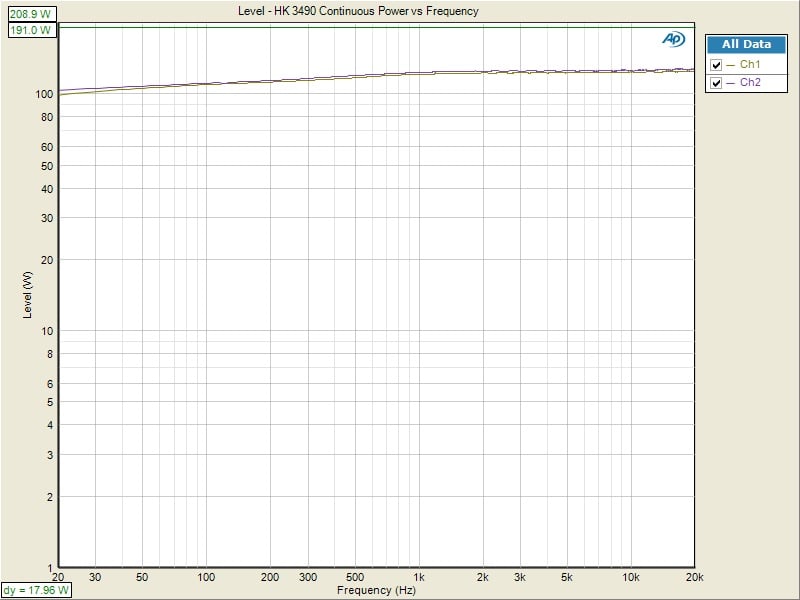
harman/kardon HK 3490 Continuous Power vs Frequency ( 2CH driven, 8-ohms)
harman/kardon HK 3490 Power vs Distortion (1kHz, 2CH driven)
@ 8-ohms (left graph); @ 4-ohms (right graph)
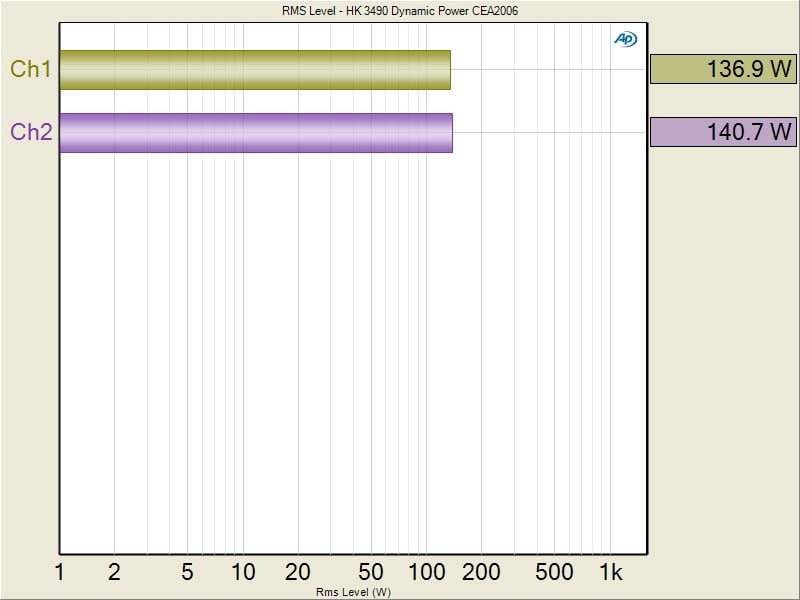
harman/kardon HK 3490 Dynamic Power (1kHz, 8-ohms, 2CH driven)
| # of CH | Test Type | Power | Load | THD + N |
| 2 | CFP-BW | > 100 watts | 8-ohms | 0.1% |
| 2 | 1kHz Psweep | 110 watts | 8-ohms | 0.1% |
| 2 | 1kHz Psweep | 116 watts | 8-ohms | 1% |
| 2 | 1kHz Psweep | 167 watts | 4-ohms | 0.1% |
| 2 | 1kHz Psweep | 178 watts | 4-ohms | 1% |
| 2 | Dynamic PWR | 140 watts | 8-ohms | 1% |
| 2 | Dynamic PWR | 227 watts | 4-ohms | 1% |
Tabulated Power Test results for the HK 3490 Receiver
The
harman/kardon HK 3490 power reserves were quite impressive for a receiver of
its price and size. It came very close
to running both channels at continuous full rated power (120watts) and held up
well for the 1kHz 8-ohm and 4-ohm power vs. distortion tests. In fact, the amp section in this receiver was
so stable that I ran all of the power tests with both channels driven and the
HK 3490 never complained or broke a sweat during my torture tests. Into 4-ohm loads, the HK 3490 exceeded its
150wpc power rating by putting out 167wpc x 2 @ 0.1% THD + N and a whopping
227wpc of dynamic power with both channels driven.
Crosstalk
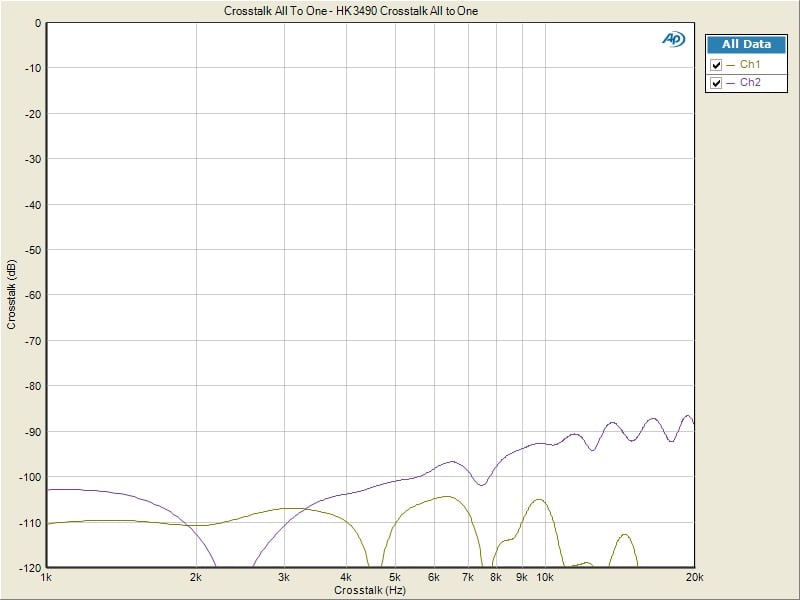
harman/kardon HK 3490 Crosstalk Measurement at Full Rated Power vs. Frequency
Running a full range frequency sweep from the preamp all the way through the power amp at full rated power (120wpc @ 8-ohms), I measured channel to channel crosstalk where the channel under test was at idle while the adjacent channel was running and vice versa. The Audio Precision plotted crosstalk for each channel under these circumstances and showed that the worst channel exhibited around 90dB at 20 kHz which is a phenomenal result. Anything greater than 60dB at 20kHz is considered inaudible by even the most critical ears. There is no doubt that the stereo separation in this receiver is superb.
Signal to Noise Ratio (SNR)

harman/kardon HK 3490 SNR per AES17
We measured the SNR at 1 watt power using no weighting for the worst possible measurement. It's important to know how quite a product is at low power levels to ensure the noise floor of the product isn't masking sonic detail. A number greater than 60dB at 1 watt is acceptable, while a measured response above 80dB is considered excellent or very quiet. The HK 3490 yielded around 80dB which is an excellent measurement. It's no wonder why the HK 3490 sounds so clean and detailed at low power levels.
harman/kardon HK 3490 Conclusion
 Harman/kardon
demonstrated a masterful blend of features and performance with the HK
3490. Their "back to the
basics" mentality of the HK 3490 redefined the modern two-channel stereo
receiver and set the benchmark for others to follow. Instead of loading this receiver with useless
features, harman/kardon decisively incorporated the ones that matter most:
quality amplification, digital audio inputs, and pristine fidelity. The HK 3490 had ample power to drive even
modestly efficient speakers to reference levels in small to medium sized rooms
without ever sounding strained or compressed.
Stereo lovers rejoice as I don't believe you can find a better sounding
stereo receiver, especially at this bargain basement price.
Harman/kardon
demonstrated a masterful blend of features and performance with the HK
3490. Their "back to the
basics" mentality of the HK 3490 redefined the modern two-channel stereo
receiver and set the benchmark for others to follow. Instead of loading this receiver with useless
features, harman/kardon decisively incorporated the ones that matter most:
quality amplification, digital audio inputs, and pristine fidelity. The HK 3490 had ample power to drive even
modestly efficient speakers to reference levels in small to medium sized rooms
without ever sounding strained or compressed.
Stereo lovers rejoice as I don't believe you can find a better sounding
stereo receiver, especially at this bargain basement price.
About harman/kardon
The thrust and goal of the Harman Kardon brand is to give music fans the finest sound with the greatest of ease. In the 1950s, company founders Sidney Harman and Bernard Kardon invented the receiver by combining a tuner and amplifier into a single unit that anyone (not just tech-genius audiophiles) could use.
In the 2000s, Harman Kardon was the first to simplify audio/video setup by fully color-coding an A/V receiver's rear-panel connections. In between, the company has pioneered everything from stereo sound to cassette decks to a remote control that automatically calibrates a home theater's sound system. Whatever you want your sound system to do, Harman Kardon wants to make it easy - and to make it sound great.
Harman/kardon
HK 3490
MSRP: $499
Harman Kardon
8500 Balboa Blvd.
Northridge, CA. 91329
The Score Card
The scoring below is based on each piece of equipment doing the duty it is designed for. The numbers are weighed heavily with respect to the individual cost of each unit, thus giving a rating roughly equal to:
Performance × Price Factor/Value = Rating
Audioholics.com note: The ratings indicated below are based on subjective listening and objective testing of the product in question. The rating scale is based on performance/value ratio. If you notice better performing products in future reviews that have lower numbers in certain areas, be aware that the value factor is most likely the culprit. Other Audioholics reviewers may rate products solely based on performance, and each reviewer has his/her own system for ratings.
Audioholics Rating Scale
 — Excellent
- — Very Good
- — Good
- — Fair
- — Poor
| Metric | Rating |
|---|---|
| Frequency Response Linearity | |
| SNR | |
| Measured Power (8-ohms) | |
| Measured Power (4-ohms) | |
| Two-channel Audio Performance | |
| Build Quality | |
| Fit and Finish | |
| Ergonomics & Usability | |
| Features | |
| Remote Control | |
| Performance |  |
| Value | |
Gene manages this organization, establishes relations with manufacturers and keeps Audioholics a well oiled machine. His goal is to educate about home theater and develop more standards in the industry to eliminate consumer confusion clouded by industry snake oil.
View full profile Subscribe to our newsletter