


Panasonic PT-DW7000U Cinema DLP
Panasonic PT-DW7000U 3-Chip DLP Projector
- Product Name: PT-DW7000U Cinema DLP Projector
- Manufacturer: Panasonic
- Performance Rating:

- Value Rating:
- Review Date: December 02, 2008 17:06
- MSRP: $ 25,000
|
|
Pros
- Extremely flexible lens options
- Ultra bright output for larger screens
- Dual lamp system allows for excellent black levels
- Expandable inputs via optional board
Cons
- Expensive for home cinema use
- No standard HDMI inputs
PT-DW7000 Build Quality and Features
 Prepare
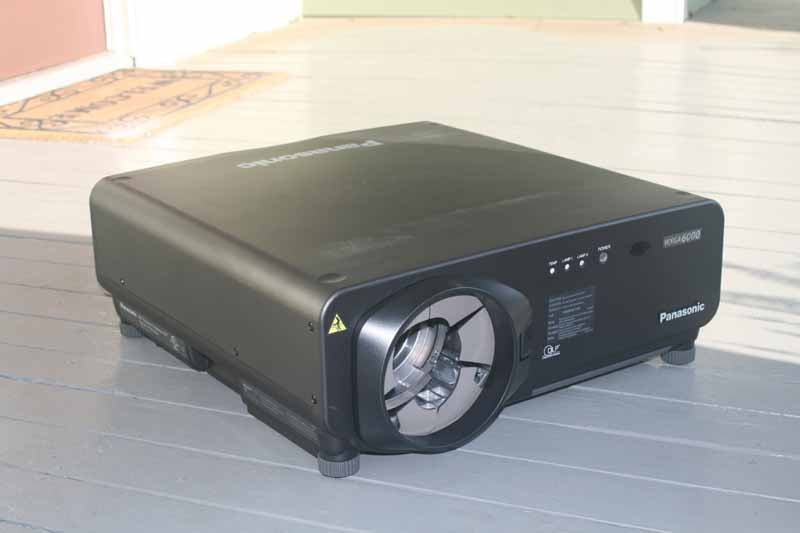
to be amazed. It's certainly perplexing to some (OK, to me) why 3-chip DLP systems (like the Panasonic PT-DW7000U) haven't
made more in-roads into the realm of consumer-attainable home theater. Perhaps
it's artificial inflation of the technology in order to separate the true
high-end from the home. Perhaps it's something far less sinister. In either
case there is no denying that when you finally witness it, the effects are
nothing short of mind-blowing. The Panasonic PT-DW7000U takes all of the
rainbow-free advantages of a traditional 3-chip LCD system and combines it with
the excellent black levels the DLP chip is known for. It does this, and fits it
into the lightest 3-chip large venue package currently on the market. The
results, to be brief, are quite stunning.
Prepare
to be amazed. It's certainly perplexing to some (OK, to me) why 3-chip DLP systems (like the Panasonic PT-DW7000U) haven't
made more in-roads into the realm of consumer-attainable home theater. Perhaps
it's artificial inflation of the technology in order to separate the true
high-end from the home. Perhaps it's something far less sinister. In either
case there is no denying that when you finally witness it, the effects are
nothing short of mind-blowing. The Panasonic PT-DW7000U takes all of the
rainbow-free advantages of a traditional 3-chip LCD system and combines it with
the excellent black levels the DLP chip is known for. It does this, and fits it
into the lightest 3-chip large venue package currently on the market. The
results, to be brief, are quite stunning.
We were fortunate enough to be able to really handle one of these three chip DLP monsters during the Platform Florida art event here in Central Florida. The event, which included local artwork, dance, music and film, had a room dedicated to showing independent films from around the state, and particularly from Central Florida filmmakers. It was a great opportunity to show off the power of a high lumen output 3-chip DLP projection system for several reasons. First, the films would be held in a room with a wall of windows. Secondly, the event would begin in the daytime with full sun. Because of the nature of the room, ceiling height and budget allowances, there was simply no way to block the light that would be entering the room for the first two hours of the event. What we needed was a high lumen output system that could be placed in "torch" mode during the sunlight hours, and then be gradually optimized once the sun went down.
 When
the projector arrived it came in a large, sturdy road case. The shipping weight
was around 100 pounds and I was never more thankful for wheels on a case
before. This is not a toy and I don't foresee too many people picking up a
product like this on a whim. Remember, we were using it for an event and it
gave us a great opportunity to see "how the other half lives" in
terms of high end home theater projectors. Reviewers, let alone consumers,
simply don't get to handle a machine of this build quality too often. The
projector comes without a lens, and for good reason. It's meant to use the
correct lens which will fit your installation requirements. This is something
you'll need to consider and Panasonic gives you plenty of choices. How many?
Let's just say that there are six lenses and you can place this projector
anywhere from 2 meters to 34 meters away and hit a 100-inch screen. Or you can
position the projector to hit something as large as 600-inches. That's right,
with the correct lend you can be 6.6 feet away, throw it over 111 feet and hit
the same sized screen, or use all that lumen power to fill a humongously large
image. Most will likely fall somewhere in between, but those are some excellent
numbers to give you an idea of what is possible.
When
the projector arrived it came in a large, sturdy road case. The shipping weight
was around 100 pounds and I was never more thankful for wheels on a case
before. This is not a toy and I don't foresee too many people picking up a
product like this on a whim. Remember, we were using it for an event and it
gave us a great opportunity to see "how the other half lives" in
terms of high end home theater projectors. Reviewers, let alone consumers,
simply don't get to handle a machine of this build quality too often. The
projector comes without a lens, and for good reason. It's meant to use the
correct lens which will fit your installation requirements. This is something
you'll need to consider and Panasonic gives you plenty of choices. How many?
Let's just say that there are six lenses and you can place this projector
anywhere from 2 meters to 34 meters away and hit a 100-inch screen. Or you can
position the projector to hit something as large as 600-inches. That's right,
with the correct lend you can be 6.6 feet away, throw it over 111 feet and hit
the same sized screen, or use all that lumen power to fill a humongously large
image. Most will likely fall somewhere in between, but those are some excellent
numbers to give you an idea of what is possible.
Installing the projector lens was simply a matter of removing the protective lens cover from the main unit, correctly aligning the lens with the projector body, inserting the lens, twisting it in place, and replacing the lens cover. It was frightening to think of how expensive the lens assembly was (about $3000 from most retailers), but everything went smoothly and the simple act of inserting the lens and twisting it until it locked took care of the mechanical and electrical connections that needed to be made.
Features & Overview
The Panasonic PT-DW7000U has a dual lamp system, capable of operating at 3000 (1 lamp) or 6000 lumens (2 lamps). This was perfect for our needs. We could begin the evening with 6000 lumens and both lamps cranking out in the Dynamic mode, then back down when the ambient light level dropped and we could eek out some serious contrast. Aside from the dual lamp system, the PT-DW7000U also offers a dynamic iris and dynamic gamma system. This gave us even more control and resulted in a nice gradual shift from daylight to nighttime. The attendees were treated to excellent quality video and were hardly aware that we were tuning the system behind the scenes as the night wore on. Of course, this simply speaks to the inherent flexibility and capabilities of the system - as most owners of this projector will have a more consistent location and environment with which to utilize its potential.
Inputs
On the side of the PT-DW7000U you'll find some serious pro connections. The main inputs are going to be RGBHV - which will also accept simple component video as well (YPbPr). We used a robust component cable from Cobalt Cables to which we then added RCA-to-BNC adapters. In my opinion, consumers and the industry should have stuck with BNC - it's a fantastically bullet-proof design, can be easily crimped onto RG6 and connects and disconnects easily (but only when you want it to!). There is no HDMI input on this projector by default. If you want digital video support, you'll need to spring for the optional DVI board (ET-MD75DV) which will run you around $1000. Either that or you'll need to bump up to a PT-DW10000U for $59,000 - but it comes with an auto-cleaning "robot" so that's cool...
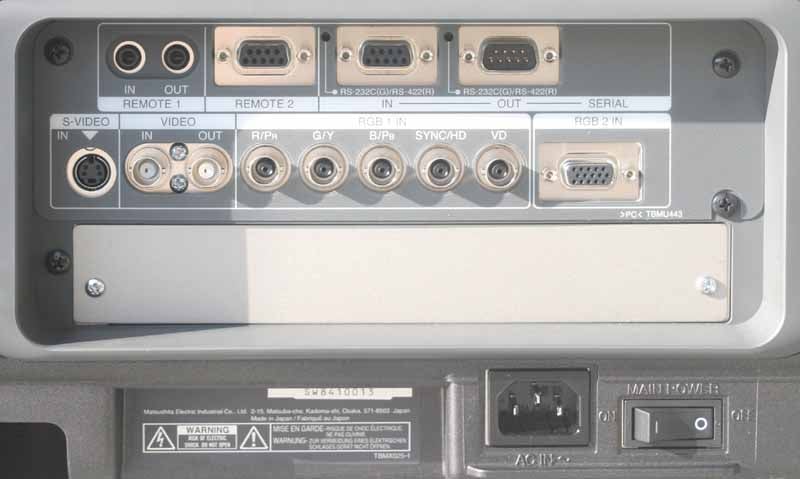
The
RGBHV inputs here support YCbCr (component video) signals up to 1080p/24/30
 On
the rear of the projector there is a control panel that duplicates most of the
remote control functions. It provides direct access to the inputs, power
controls (which are discrete), and has menu functions including directional
arrow keys and an enter button. A LENS button activates the mode by which you
can engage an electronic zoom, focus and lens shift. It is a nicely positioned
panel and will allow you to control all of the projector functions in the event
the remote control is misplaced.
On
the rear of the projector there is a control panel that duplicates most of the
remote control functions. It provides direct access to the inputs, power
controls (which are discrete), and has menu functions including directional
arrow keys and an enter button. A LENS button activates the mode by which you
can engage an electronic zoom, focus and lens shift. It is a nicely positioned
panel and will allow you to control all of the projector functions in the event
the remote control is misplaced.
We mentioned that the Panasonic had multiple lens options. We went with the 2.0-3.0 zoom ET-D75LE2 lens. What we didn't mention (until now) was that the PT-DW7000U also supports vertical and horizontal lens shift. Yes, it's hard to find more than vertical lens shift in high end single-ship DLP systems for home theater. Now I find that a 3DLP design from Panasonic has full vertical and horizontal shift - and it's motorized. The projector offers +/-30 horizontal shift and a +/-65% vertical shift. Unless you plan on really putting your projector somewhere strange, that's plenty to get your image right where it needs to be. While we don't recommend using it, the system also has a +/-40% digital keystone correction with the lens we were using.
It was fascinating to me to think that this system had a pair of 300W UHM lamps and didn't melt through the table onto the floor during the evening. In fact, the PT-DW7000U literally has a liquid cooling system to keep the heat directed away from the DMD mirrors from melting the inside of the projector. The theory is that you basically place the liquid so that it absorbs the reflected light energy that is directed away from the lens. This cooling liquid is then circulated and the system is able to consistently pull away the heat from the system.
The optical block is completely sealed off, keeping the potential for dust blobs to a minimum. When you build a projector intended for theatrical use (and those few high-end consumers who want the very best) you have to take all things into account. One of those things is bulb life. The last thing anyone needs in a commercial environment is for a projector to lose a bulb and bring down the movie. Panasonic addressed this in a couple ways. First, they have an optional long-life lamp that will run for 4000 hours. In single lamp operation mode, the PT-DW7000U can actually relay from one bulb to the next. That means that, practically, not theoretically, the projector can run non-stop 24 hours a day for 47 weeks without replacing the lamps. I don't know too many 24 hour movie houses, but this is an impressive feature nonetheless.
Let's stay on lamps for a bit here. Since the lamps are UHM, costs are kept to a minimum (though they aren't as cheap as the 150W lamps you find in consumer models). Average consumable cost for the 4000 hour extended life lamps is $700-800. There is a 2000 hour model, but the subtle price difference doesn't justify anyone purchasing it over the 4000 hour model. The thing I most liked however was that the bulb can be replaced without removing the projector from its mount. You simply remove the 7 screws holding on the rear panel, loosen the two fixing screws on each lamp unit and pull them out by their handles. Drop in the new lamps, replace the cover and you're good to go without ever having to remove it from its mount.
Remote Control
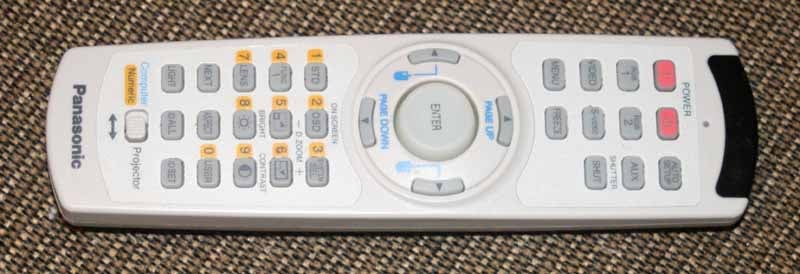
The remote for the PT-DW7000U isn't much to look at, but with a projector like this you are more apt to "set and forget" it than run around using the included remote. It certainly worked well enough from both behind and in front of the unit and we were able to quickly access the menu system and configure the system for our needs. The remote is backlit and has direct access controls for each of the inputs.
PT-DW7000U Viewing Tests and Conclusion
For our video source we utilized an Oppo DV-983H which has Anchor Bay's (ABT) VRS scaler/processor. It was a great fit and gave us an excellent source to mate with this powerhouse projector. The PT-DW7000U provided 2/3 pull-down conversion for a 1080i source, which we sent from the Oppo's component video outputs. Lens shift worked flawlessly and the electronic Zoom and Focus really made this projector stand out as a professional cinema product. Panasonic's Digital Cinema Reality engine was left at Auto (the 30p mode is for video that was never stored at 24p film speed) and did an excellent job at deinterlacing film content for video presentation. We noticed reduced judder effects and a lack of any jaggie artifacts in the picture.
The Florida event featured independent film videos from all over, and a couple of them were beautiful animated films that just amazed us - especially given the fully-lit room:
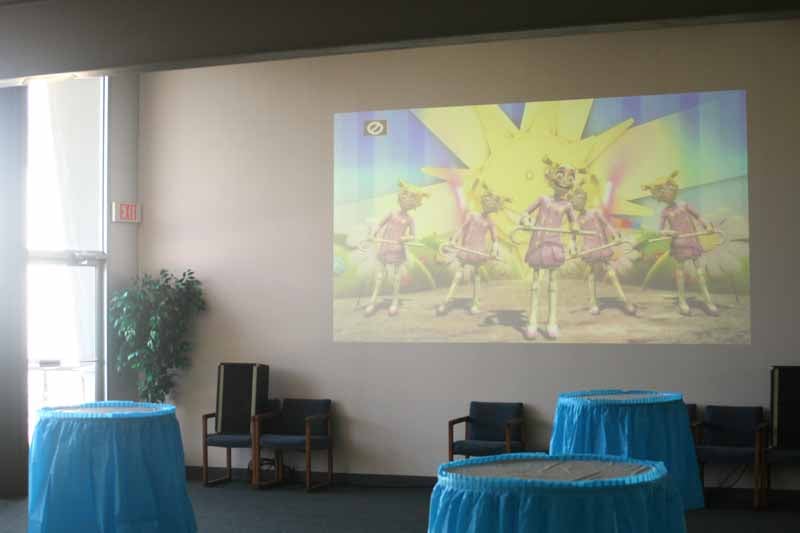
Don't try this at home with your puny 1600 lumen projector!
As mentioned, we started off with the projector in Dynamic Mode which activated both lamps and set a high color temperature for maximum light output. In the photo above you can see that we got an insane amount of light output even in the midst of a fully lit room. This isn't how we'd recommend you use a projector like this, but it was great to see that it would work for us even before the sun went down.
As the night went on we saw better and better picture and were eventually able to put the projector into its optimal single-lamp Cinema Mode:
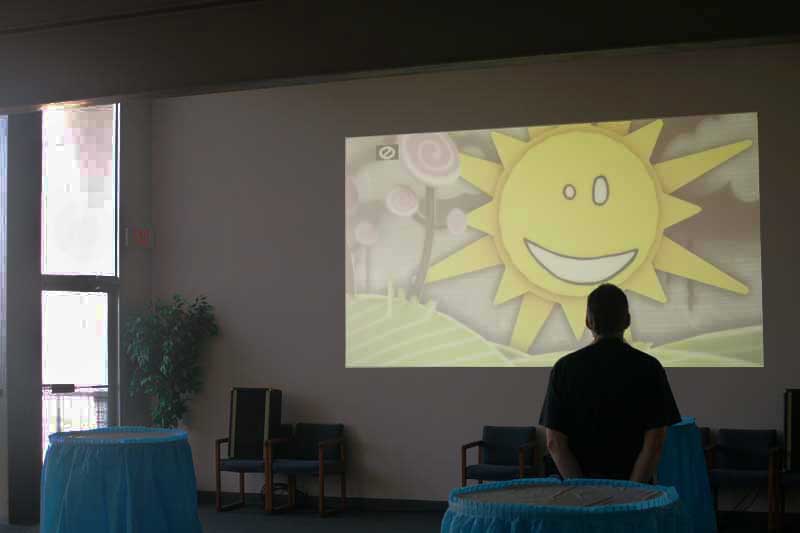
Dialing in the projector was certainly no problem. Brightness and Contrast were easily accessible from the Picture Menu and it was quick work to set the correct levels for our room. We especially liked how easy it was to access the menu from the rear panel of the projector. While the remote served us well with quicker access to some functions, the close proximity we had with the unit made it easy to experiment with picture modes and make adjustments to the picture during the setup process.
There is a lot more to this professional projector - exceptional access to RGB gain and cut values, clamp controls for correctly tweaking and adjusting the black levels, custom edge blending controls, and even raster controls for moving the digital image around inside the frame. We didn't have this projector long enough to go into too many of these features, but we were dazzled by what was available to installers for getting just the right image in nearly any scenario.
Conclusion
We abused the light output capabilities of the PT-DW7000U as much as we dared. Never before had I been so bold as to run a projector in near-full daylight - even with 6000 lumens of output. But here we were, with the Panasonic 3DLP projector egging us on to do more. This is an exceptional projector with an above-average picture. The availability of custom lenses for this machine gives it limitless placement potential in any commercial, residential, or house of worship application. While we would recommend it primarily as a medium-to-large venue cinema projector, the PT-DW7000U is nearly infinitely adaptable for any situation. This product is top-notch and would be a good purchase for anyone working under this level of budget. Highly recommended.
Panasonic PT-DW7000U 3DLP Projector
MSRP: $25,000
Panasonic Corporation of North
America
One Panasonic Way
Secaucus, NJ 07094
http://www.panasonic.com/
About
Panasonic
Panasonic is a
worldwide leader in the development and manufacture of electronic products for
a wide range of consumer, business, and industrial needs. Based in Osaka, Japan,
the company recorded consolidated net sales of US$81.44 billion for the year
ended March 31, 2005. The company's shares are listed on the Tokyo,
Osaka, Nagoya, New York (NYSE:MC), Euronext Amsterdam and Frankfurt stock exchanges. For more information on the
company and the Panasonic brand, visit the company's website at http://panasonic.co.jp/global/index.html.
The Score Card
The scoring below is based on each piece of equipment doing the duty it is designed for. The numbers are weighed heavily with respect to the individual cost of each unit, thus giving a rating roughly equal to:
Performance × Price Factor/Value = Rating
Audioholics.com note: The ratings indicated below are based on subjective listening and objective testing of the product in question. The rating scale is based on performance/value ratio. If you notice better performing products in future reviews that have lower numbers in certain areas, be aware that the value factor is most likely the culprit. Other Audioholics reviewers may rate products solely based on performance, and each reviewer has his/her own system for ratings.
Audioholics Rating Scale
 — Excellent
- — Very Good
- — Good
- — Fair
- — Poor
| Metric | Rating |
|---|---|
| Detail and Resolution | |
| Deinterlacing & Scaling | |
| Contrast and Black Levels | |
| Color Reproduction | |
| Noise Reduction | |
| Calibration Options | |
| Build Quality | |
| Ergonomics & Usability | |
| Ease of Setup | |
| Features | |
| Remote Control | |
| Fit and Finish | |
| Performance | |
| Value | |
Clint Deboer was terminated from Audioholics for misconduct on April 4th, 2014. He no longer represents Audioholics in any fashion.
View full profile Subscribe to our newsletter