


RE Designs Audio SCPA 1 Preamp Review
RE Designs Audio SCPA 1
- Product Name: SCPA 1
- Manufacturer: RE Designs Audio
- Performance Rating:


- Value Rating:
- Review Date: July 23, 2004 19:00
- MSRP: $ 2700
Input
Impedance: 20K Ohms nominal
Output Impedance: 100 Ohms nominal
Distortion: <.002% referred to 1 volt
Signal to Noise Ratio: -100dbv; power supply harmonics typically
less than-92dbv
Channel Trim Range : 6db to 18db gain
Tracking Error: 0.1db max
Stereo Separation: 104 db at 1khz
Output Drive: 12 volts peak
Frequency Response
R = 10k ohms; less than 0.1db deviation from 20hz to 20khz. For 10k ohms in
parallel with 10,000 picofarads of capacitance, 0.1db down at 20khz. The above
measurement represents the unit driving 50' to 100' of cable.
Dimensions: 16.75" wide x 12" deep x 3.5"
high (Rack mount handles available upon request)
Power Consumption: Approx. 8 watts
Warranty
The SCPA 1 is warranted to be free of defects for a period of 5 years from the
date of purchase. Repairs will be performed without charge for parts and labor
provided the unit is returned freight prepaid to R.E.Designs. Units that are in
warranty that have manufacturer's defects will have the shipping cost
reimbursed. Units which have been modified or subjected to gross abuse are
excluded from warranty protection.
Pros
- Phenomenal audio reproduction
- Ultra accurate channel trim balance (.025dB) and tracking (.1dB max, 0.05db typical)
- Simple operation
Cons
- No remote control capability
- Low product appeal
- Requires separate switcher to connect multiple audio sources
- No bass management
- No balanced connections
RE Designs Audio SCPA 1 Introduction
A couple of years ago I received a phone call from Dan Banquer (Chief Designer for RE Designs Audio) about the series of articles I have written on the format implementation issues with DVD-A and SACD for consumer audio. I was expecting to hear complaints about my articles like I have heard from a few manufacturers, but instead Dan complimented me and agreed with my recognitions regarding the shortcomings such as:
-
Lack of independent channel trims for Preamp EXT inputs.
-
No bass management or time delay compensation.
-
Format incompatibilities with standard 5.1 systems (IE. DVD-A/SACD is a 6 channel format, not 5.1, thus many recordings use that extra channel as an overhead, NOT subwoofer channel).
-
Lack of a standardized digital interface.
-
Lack of software and at the time mostly remasters 1980s 44kHz/16bit two channel one hit wonders was all that was available.
Luckily many of these items have since then been resolved by manufacturers and we are now starting to enjoy these formats in all their glory. In fact some of the recent hardware reviewed by Audioholics incorporated an i.Link connection for digital transmission of all of these formats over a signal cable allowing the preamp/receiver to handle all of the decoding, bass management and digital delay compensation.
RE Designs Audio SCPA 1 Technology Overview
So at this point you may be wondering what purpose a multi channel analog preamp would serve in a technological era of DSP dream machines capable of decoding and processing all know audio and video formats to man at the touch of a button, with amplification, all self contained in one box? My answer to this convoluted question is simple. For the diehard audiophile and purist at heart whose sole objective is to build a dedicated multi channel audio system without all the bells and whistles, with the utmost accuracy in calibration and noise suppression, the SCPA 1 may be the product of choice. Before considering the SCPA 1 for the job, one must first chose a digital playback device (IE. SACD player, Universal DVD Audio player, etc) that offers bass management and digital delay compensation via its multi channel analog outputs. I of course chose the venerable Denon DVD-5900 – the current Universal DVD player dream machine.
RE Designs Audio SCPA 1 Design and Setup
Unlike some esoteric preamps, the RE Designs SCPA 1 is a non discrete design using all high quality opamps (Burr Brown OPA671) in the gain circuits. Some audiophiles may frown on this, but these are usually the ones that believe in cable break in and other snake oil cable magic , with little to no understanding of electronics and how far opamps have evolved over the years, particularly for the duty of line level audio amplification purposes.
The OPA671 is a hard biased line drive op amp with very low noise & distortion. If you take a look at the spec sheet attached; on page 3 you will see a really low THD + N at gains of 1 and 10 into 200 ohms. The OPA 671 is also able to drive a lot of cable capacitance with minimal distortion, making it an optimal line driver for audio applications (driving long cables to powered speakers) Also due to it’s line drive capability output impedance can remain low for less noise pick up without the penalty of higher distortion. Feedback resistance can also be lowered for less thermal noise due to the op amps drive capability. The S/N at 12db gain of –100 dbv is very respectable for an unbalanced two stage amplifier.
According to Dan Banquer, Chief Engineer for RE Designs Audio, typical stereo separation at the listening position is usually somewhere around 8db to 10db. This alone would appear to nullify further investigation of electronics and stereo separation, but over the years Dan has made some interesting observations that he would like to share.
In designing and building a few line level units Dan has observed that the coupled signal when doing stereo separation testing has been 90 degrees out of phase from the input signal. It also appears that it is capacitively coupled and decreases as the frequency drops, and typically 6 db per octave. In reducing this coupling Dan has observed better noise immunity.
For Example: using “unshielded” wire to go from the back panel input to the board will degrade stereo separation. At the same time, due to the high input impedance of the input being connected too, would have higher susceptibility to noise due to pick up. If a piece of coax is used for the same connection an increase in stereo separation and lower noise pick up is realized. It would appear that a higher level of stereo separation could well be more indicative of better noise immunity in this application. Dan’s own personal observation is that reducing the 90 degree out of phase coupling gives a better “image” along with reduced noise. The RE Design goal is generally to achieve close to 70 db of separation at 20 kHz, Dan has found that audibility is very difficult above this. The above makes me ask the question; Is it stereo separation, or noise immunity, or both?
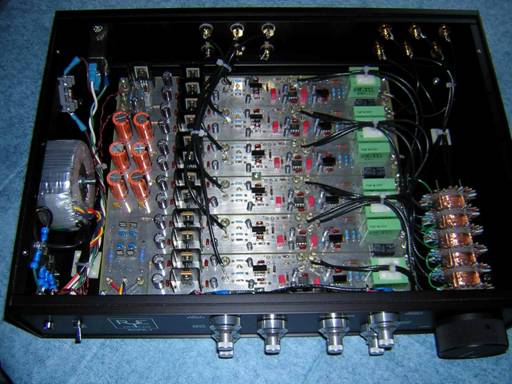
Inside the SCPA 1 notice the clean layout, copper clad
steel coax, 6 Gang Analog Volume Control, tightly regulated power supply with
toroidal transformer.
The use of the RG174 and RD174 in the SCPA 1 (a double shielded version of RG174) is for lower pick up noise in the unit. Consumer audio requires high impedance inputs, which are very easy to drive but also act as receiving antennas for unwanted noise. Using a coax with good shield coverage for point to point wiring reduces unwanted pick up noise. If you think about it for a minute; what has more shield coverage, a PCB etch or a coax with better than 90% shield coverage? The steel core of the center conductor of the wire helps ensure that the wire will not break under stress. The other reasons for the use of RG 174 is that it is a mini coax with a small O.D. and very flexible. In the world outside of audio it is commonly used as an inside the box wire, and scope probes.
There seems to be a bit of controversy on some of the cable cult forums regarding the merits of using copper clad steel. They claim copper clad steel exhibits distortion or diode rectification. Of course we know better based on our peer reviewed and repeatable measurements of cable distortion (or lack thereof) refuting such nonsense. It’s sad to see intelligent folks expend so much time on disseminating audio fallacies especially while overlooking the obvious and real impacts on fidelity of audio systems – the room. We shall not expand upon room acoustics here but make note that proper room acoustics and system setup will either make or break even the best of systems and associated gear.
The Set-Up
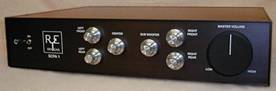 Connecting and
configuring the SCPA 1 couldn’t be easier. Simply connect 6 quality RCA’s from
your player to the SCPA 1 and another 6 RCA’s to your power amps, plug in the
power, and your done!
Connecting and
configuring the SCPA 1 couldn’t be easier. Simply connect 6 quality RCA’s from
your player to the SCPA 1 and another 6 RCA’s to your power amps, plug in the
power, and your done!
The volume pots are all analog, rotating the outer controls adjust with +/- 0.1dB max, 0.05 db typical, precision, while the inner controls allow for adjustability of .025dB along with a locking mechanism once you dialed in the optimal level. This type of precision is unheard of as even the best processors out there give you no better than .5dB precision. The SCPA 1 is 20 times more accurate in this respect. Dan and I have had disagreements about how much precision one really needs for channel trim adjustments. I feel .5dB is more than adequate; he thinks otherwise and can site studies of audibility of level changes as low as .20dB. I certainly won’t hold anything against a manufacturer offering higher precision than may be necessary and perhaps this type of precision is better suited for a professional audio environment such as mixing or mastering in a studio.
Calibrating the SCPA 1 was a bit of a chore since there was no remote control provisioning. Luckily I had a mic stand with a long extension cable to connect to my audio analyzer so I could sit near the SCPA 1 while reading the SPL meter and adjusting the channel trim levels. I was quite impressed with the level of channel trim matching I was able to achieve and noted the channel trim level balance maintained precision regardless of master level volume position confirming excellent tracking capabilities of the master volume control.
RE Designs Audio SCPA 1 Listening Tests and Conclusion
Before powering the SCPA 1 up I remember thinking to myself a preamp is a preamp, what am I really gonna hear differently with this box than any other? Playing a few DVD-A discs made me realize that all things are not created equal. The SCPA 1 had an uncanny ability to convey all of the detail of the music with utmost precision, freedom of noise, and unsurpassed channel separation.
DVD-Audio: Graham Nash Songs For SurvivorsGraham Nash DVD-A disc sounded stellar. The low noise floor of the SCPA 1 was evident. While I cannot vouch for the audible improvements of having such precision in level trim calibration, I can comfortably state that my multi channel experience using the SCPA 1 was nothing short of immersing and non fatiguing. Audiophiles and skeptics rejoice, opamps properly implemented in analog circuit design can and do deliver benchmark performance when used for preamp duties.
Conclusions
The SCPA 1 is not an attractive preamp. Its appearance is reminiscent of the old metal project boxes from Radio Shack so many of us inspiring engineering students labored on when doing senior design projects. It is void of features found in many less costly multi channel preamps such as digital processing, decoding, bass management, switching, etc. Make no mistake however, that the SCPA 1 delivers unparalleled audio performance and adjustable channel trim precision that has no equal in this capacity. It has little to no place in consumer audio, but will likely serve a professional audio installation at a recording studio or equivalent environment requiring these attributes.
With that, I propose two scenarios for Dan to increase product appeal for the consumer audio marketplace:
-
Repackage the SCPA 1 in a more appealing box with thick aluminum brushed front panel, shiny lights and fancy backpanel connectors. Jack up the price and market it to the esoteric crowd.
-
Sacrifice some precision, replace the volume trims with digitally controlled analog volume pots, add a remote control, switchable inputs and reduce the price to reach a bigger consumer base.
Dan’s response was:
I like it the way it is and reserve it for the serious multi-channel enthusiast who is looking for a precision, easy to use, multi-channel preamplifier with uncompromised performance.
So be it Dan.
Manufacturer Response
I would like to thank Gene and the staff of Audioholics for taking the time to review the SCPA 1. When I did the R & D a few years ago, I went to mix down engineers and asked them what was going to be needed in a pre amp for multi channel audio, The result is the SCPA 1. I think your comments about pro audio users favoring this unit for their consumer demonstrations are well founded. Both Dave Moulton of Moulton labs, and Jon Gatski, Editor of Pro Audio Review have, or are now using them for that exact purpose. In addition I am hoping this will appeal to multichannel music lovers who would like to mate this with a unit such as the Denon DVD 5900.I should also note that R.E. Designs does offer a two channel switchbox, the SB2, which has four stereo inputs and one stereo output to mate with SCPA 1.
Thanks again;
Dan Banquer
The Score Card
The scoring below is based on each piece of equipment doing the duty it is designed for. The numbers are weighed heavily with respect to the individual cost of each unit, thus giving a rating roughly equal to:
Performance × Price Factor/Value = Rating
Audioholics.com note: The ratings indicated below are based on subjective listening and objective testing of the product in question. The rating scale is based on performance/value ratio. If you notice better performing products in future reviews that have lower numbers in certain areas, be aware that the value factor is most likely the culprit. Other Audioholics reviewers may rate products solely based on performance, and each reviewer has his/her own system for ratings.
Audioholics Rating Scale
 — Excellent
- — Very Good
- — Good
- — Fair
- — Poor
| Metric | Rating |
|---|---|
| Multi-channel Audio Performance | |
| Two-channel Audio Performance | |
| Build Quality | |
| Ergonomics & Usability | |
| Features | |
| Performance |  |
| Value | |
Gene manages this organization, establishes relations with manufacturers and keeps Audioholics a well oiled machine. His goal is to educate about home theater and develop more standards in the industry to eliminate consumer confusion clouded by industry snake oil.
View full profile Subscribe to our newsletter