


Emotiva Audio RSP-1 Stereo Pre-Amplfier Review
Emotiva RSP-1 Pre-Amplfier
- Product Name: RSP-1 Stereo Pre-Amplfier
- Manufacturer: Emotiva Audio
- Performance Rating:

- Value Rating:
- Review Date: August 31, 2007 07:55
- MSRP: $ 699
- Precision low noise phono input with moving magnet or moving coil capability
- Five stereo inputs with precision instrumentation grade relay switching
- Microprocessor controlled pure analog signal path
- VFD display for all inputs and functions
- Full remote control operation
- Completely integrated bass manager for 2.1 operation with selectable frequency stereo high pass and mono low pass outputs
- Independent full range outputs (available simultaneously with 2.1 output)
- Tiffany style machined and gold plated discrete RCA connectors for all inputs and outputs
- All outputs, stereo and 2.1, are also available on balanced XLR connectors (standard)
- Tape monitor loop
- External processor loop
- Source Direct bypass
- Stereo / Mono switching
- Treble and bass trim controls
- Large format Alps precision film volume potentiometer with motorized control
- Headphone output
- Illuminated input indicators
- Panel dimmer
- Milled multi-element floating wing faceplate with indirect cobalt blue illumination.
- Infrared input and output connectors
- 12V trigger output
- High quality machined aluminum remote control with discrete tact switches
- IEC power inlet
Pros
- Price
- Performance
- Looks
Cons
- Nothing significant
Emotiva RSP-1 Introduction
Emotiva's RSP-1 is a 2-channel pre-amplifier that operates almost solely in the analogue domain. You won't find any digital audio inputs, video inputs or outputs, and you won't have to worry about what version HDMI you have. For all of you true audiophiles that are only interested in 2-channel, this is the unit for you. Especially for you vinyl freaks as the RSP-1 has a precision low noise phono input with moving magnet or moving coil capability, a functionality that, in recent years, has been harder and harder to find.
Build Quality
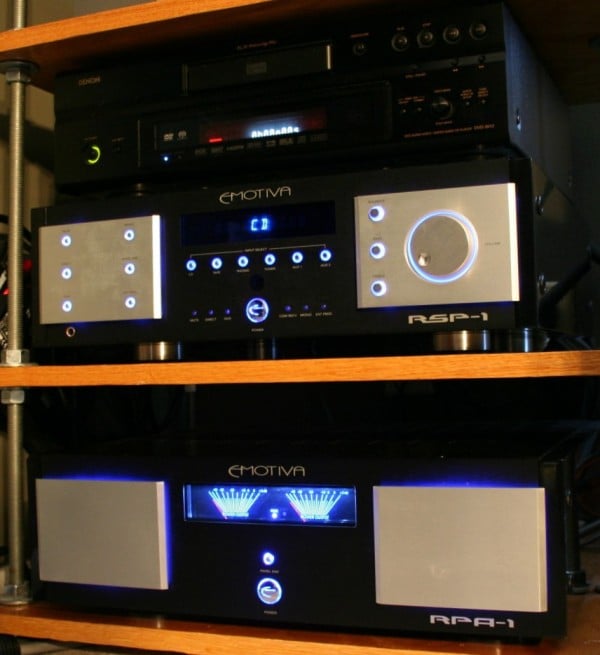 As you
delve more and more into the world of the audiophile, you'll find that items
tend to be uni-taskers - components that do one and only one thing. The thought
being that a component that is dedicated to one purpose in life is much more
likely to be successful that that purpose than one that tries to be all things
to all people. There seems to be a bit of face
validity to that argument even if I don't completely buy into it. Still
there are plenty of people that need AV equipment that only performs one or two
tasks and feel that the other functionality included may degrade the
performance on those tasks.
As you
delve more and more into the world of the audiophile, you'll find that items
tend to be uni-taskers - components that do one and only one thing. The thought
being that a component that is dedicated to one purpose in life is much more
likely to be successful that that purpose than one that tries to be all things
to all people. There seems to be a bit of face
validity to that argument even if I don't completely buy into it. Still
there are plenty of people that need AV equipment that only performs one or two
tasks and feel that the other functionality included may degrade the
performance on those tasks.
Just looking at the pictures of Emotiva gear gives you a good idea of how well built it is. Prominent metal faceplates, brushed aluminum chassis, high gloss black side panels, pretty blue lights… they all work together to give the impression of quality and endurance. The RSP-1 just looks like a piece of gear that will outlive you. Something that you'll pass down to your son or daughter (let's just hope they appreciate it).
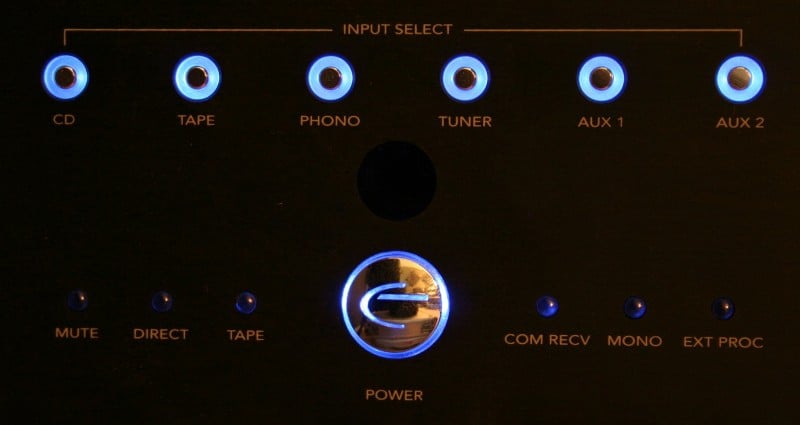
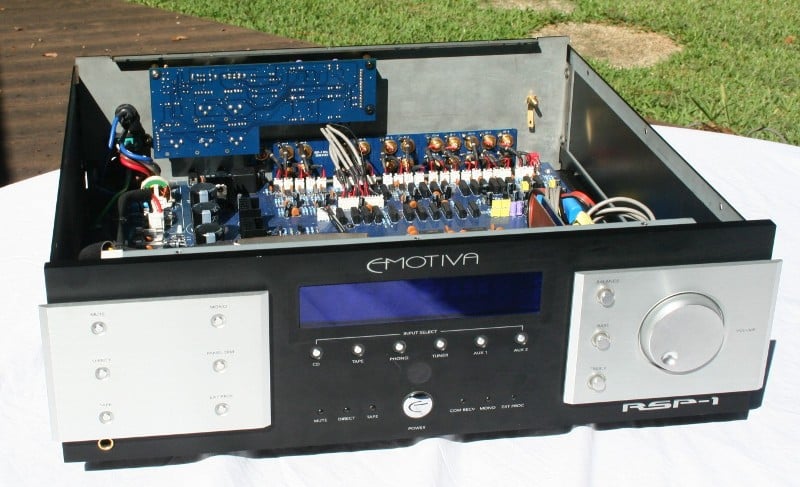 The front of the unit is adorned with various buttons
and knobs, all highlighted in blue. The three knobs on the right for Balance,
Bass, an Treble all extend with a press and retract with a second which helps
maintain the clean lines of the face plate. There are buttons to select the
various functions on the left including Mute, Mono, Direct (bypasses the tone
controls), Panel Dim, Tape, and Ext Proc (exterior processor) with the input
selection buttons in the middle below the LCD readout and above the power
button. The headphone jack is nearly hidden below the left metal faceplate. The
Panel Dim button has four settings - High, Medium, Low, and Very Low. There
isn't an "off" setting for those that want to eliminate that source
of light completely from their listening environment.
The front of the unit is adorned with various buttons
and knobs, all highlighted in blue. The three knobs on the right for Balance,
Bass, an Treble all extend with a press and retract with a second which helps
maintain the clean lines of the face plate. There are buttons to select the
various functions on the left including Mute, Mono, Direct (bypasses the tone
controls), Panel Dim, Tape, and Ext Proc (exterior processor) with the input
selection buttons in the middle below the LCD readout and above the power
button. The headphone jack is nearly hidden below the left metal faceplate. The
Panel Dim button has four settings - High, Medium, Low, and Very Low. There
isn't an "off" setting for those that want to eliminate that source
of light completely from their listening environment.
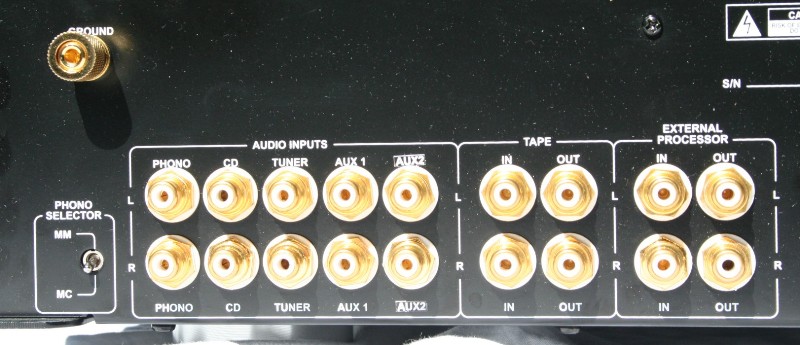
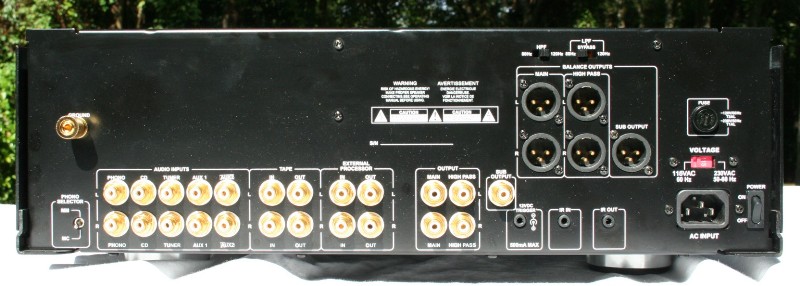 The back of
the unit is full of gold plated Tiffany style RCA jacks for each of the inputs
(phono, CD, aux 1 aux 2, tape (in and out), and external processor (in and
out)) and speaker and subwoofer outputs. The all-important ground connection
for your record player is also gold plated. There is an input and output for IR
(which may be important as we'll learn in a moment), a 12 volt trigger, and
balanced outputs for those interested in making such a connection. Next to the
phono input is a switch to select moving magnet or
moving coil depending on your player. At the top, there are two small switches
to select High Pass Filter (80Hz or 120Hz) and Low Pass Filter (80Hz, 120Hz, or
bypass).
The back of
the unit is full of gold plated Tiffany style RCA jacks for each of the inputs
(phono, CD, aux 1 aux 2, tape (in and out), and external processor (in and
out)) and speaker and subwoofer outputs. The all-important ground connection
for your record player is also gold plated. There is an input and output for IR
(which may be important as we'll learn in a moment), a 12 volt trigger, and
balanced outputs for those interested in making such a connection. Next to the
phono input is a switch to select moving magnet or
moving coil depending on your player. At the top, there are two small switches
to select High Pass Filter (80Hz or 120Hz) and Low Pass Filter (80Hz, 120Hz, or
bypass).
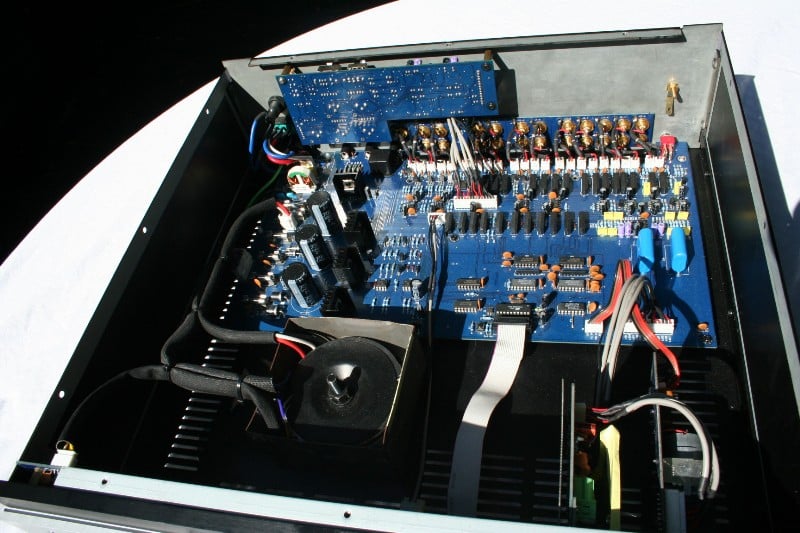 Opening
up the RSP-1, we find a really well laid out interior with a separated power
supply (utilizing torroid power transformer) from critical audio circuits,
glass epoxy PCB boards, and low noise op-amps. But the quality doesn't stop
there. We also find a toroud power supply, instrumentation grade inert gas
filled relay switching with silver contacts, and 1% tolerance resistors. Film
caps show up in all critical signal paths and the list goes on. This is truly a
no expense spared unit. How Emotiva can put this quality of components in a
$699 unit begs the question of what the other manufactures are doing with all
that money they are making.
Opening
up the RSP-1, we find a really well laid out interior with a separated power
supply (utilizing torroid power transformer) from critical audio circuits,
glass epoxy PCB boards, and low noise op-amps. But the quality doesn't stop
there. We also find a toroud power supply, instrumentation grade inert gas
filled relay switching with silver contacts, and 1% tolerance resistors. Film
caps show up in all critical signal paths and the list goes on. This is truly a
no expense spared unit. How Emotiva can put this quality of components in a
$699 unit begs the question of what the other manufactures are doing with all
that money they are making.
Setup
 The "setup" for
the RSP-1 is remarkably simple (as one would expect from an analogue only
unit). All you need to do is to connect your transport or transports to the
RSP-1 to the provided inputs, an amp to the outputs, and a 12 volt trigger (if
you use it) to the amp. Remember, with a unit like the RSP-1, you'll need a
good transport with exceptional DACs. The RSP-1 isn't meant to do much other
than pass the signal along unaltered. The bass management ability is pretty
rare in a unit such as this.
The "setup" for
the RSP-1 is remarkably simple (as one would expect from an analogue only
unit). All you need to do is to connect your transport or transports to the
RSP-1 to the provided inputs, an amp to the outputs, and a 12 volt trigger (if
you use it) to the amp. Remember, with a unit like the RSP-1, you'll need a
good transport with exceptional DACs. The RSP-1 isn't meant to do much other
than pass the signal along unaltered. The bass management ability is pretty
rare in a unit such as this.
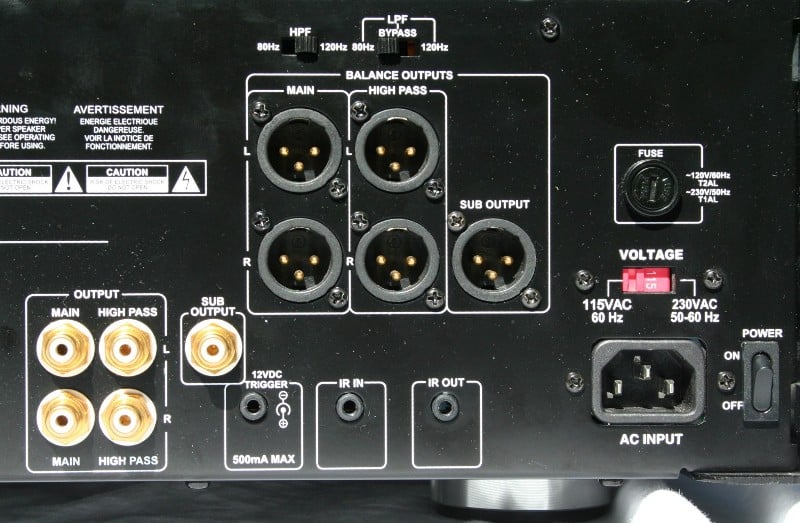 One
of the interesting choices that Emotiva made with the RSP-1 is that the
crossovers are selected via a switch rather than an onscreen menu and by which
output you use to connect the amplifier. This is done because the bass
management is done entirely in the analogue domain via active filter networks
eliminating the need for DACs. For each channel there is a set of outputs
labeled "Main" and a set labeled "High Pass".
Both of these outputs receive a signal simultaneously so you can the
theoretically connect two amplifiers and sets of speakers to the unit and have
them play at the same time. Of course, they'll be playing the same source material
(you can't send one signal to one set of outputs and a different signal to the
other). There is also an output for a subwoofer if you choose to use one.
One
of the interesting choices that Emotiva made with the RSP-1 is that the
crossovers are selected via a switch rather than an onscreen menu and by which
output you use to connect the amplifier. This is done because the bass
management is done entirely in the analogue domain via active filter networks
eliminating the need for DACs. For each channel there is a set of outputs
labeled "Main" and a set labeled "High Pass".
Both of these outputs receive a signal simultaneously so you can the
theoretically connect two amplifiers and sets of speakers to the unit and have
them play at the same time. Of course, they'll be playing the same source material
(you can't send one signal to one set of outputs and a different signal to the
other). There is also an output for a subwoofer if you choose to use one.
 When
setting up the RSP-1, you'll want to take into account a couple of things:
first the size of your speakers. If you have true full range speakers, you'll
want to hook them up to the "Main" output. This setup will send a
full range signal to the speakers and is completely unaffected by the High Pass
and Low Pass filter switches. If you have nearly full range speakers or if you
just want to use a sub, connect your speakers up to "Main" and set
the Low Pass filter to 80Hz with the sub
connected to the subwoofer output. Your main speakers will still get a
20kHz-20Hz signal but it will allow your sub to reinforce notes 80Hz and below.
If you have bookshelf speakers or speakers incapable of handling low
frequencies, you can connect them to the High
Pass outputs and set the High Pass
and Low Pass filters accordingly. Lastly, if you
would like to use the crossover in your subwoofer in any of the above
configurations (which gives you more control than an 80Hz/120Hz switch), select
"Bypass" on the LPF switch. This sends a full signal to the sub with
allows you to use the subwoofer crossover. You wouldn't want to select 80Hz on
the RSP-1 and set the sub's crossover at the same time else
it can result in frequency response variation and too much attenuation. Either use the sub LPF or the RSP-1's, but
not both.
When
setting up the RSP-1, you'll want to take into account a couple of things:
first the size of your speakers. If you have true full range speakers, you'll
want to hook them up to the "Main" output. This setup will send a
full range signal to the speakers and is completely unaffected by the High Pass
and Low Pass filter switches. If you have nearly full range speakers or if you
just want to use a sub, connect your speakers up to "Main" and set
the Low Pass filter to 80Hz with the sub
connected to the subwoofer output. Your main speakers will still get a
20kHz-20Hz signal but it will allow your sub to reinforce notes 80Hz and below.
If you have bookshelf speakers or speakers incapable of handling low
frequencies, you can connect them to the High
Pass outputs and set the High Pass
and Low Pass filters accordingly. Lastly, if you
would like to use the crossover in your subwoofer in any of the above
configurations (which gives you more control than an 80Hz/120Hz switch), select
"Bypass" on the LPF switch. This sends a full signal to the sub with
allows you to use the subwoofer crossover. You wouldn't want to select 80Hz on
the RSP-1 and set the sub's crossover at the same time else
it can result in frequency response variation and too much attenuation. Either use the sub LPF or the RSP-1's, but
not both.
If you have an external EQ or similar that you'd like to use, you connect that up through the Ext Proc input and output. Your transports will still be connected to their appropriate inputs. When you want to engage the external processing, all you need to do is hit the button on the front of the unit or on the remote. This will completely bypass the "Bass" and "Treble" controls of the RSP-1. The Tape monitor works in exactly the same way.
Lastly, if you have the ability to use a 12 volt trigger or external IR control, you'll want to make sure you hook those up as well. In my setup, the RSP-1 was connected to the RPA-1. The 12 volt trigger was nearly instantaneous and significantly faster than the RPA-1's "auto on" feature. I highly recommend using this ability if your amp supports it. I connected the RSP-1 to the RPA-1 with the "Main" speaker outputs. This allows my TK-5CT's to run full range without a subwoofer. Since I mostly use the RSP-1/RPA-1 combo for music playback, the TK's play plenty low enough to justify the forgoing the use of a sub. The Denon DVD-3910 was on transport duty - something it is well equipped to do.
Remote Control
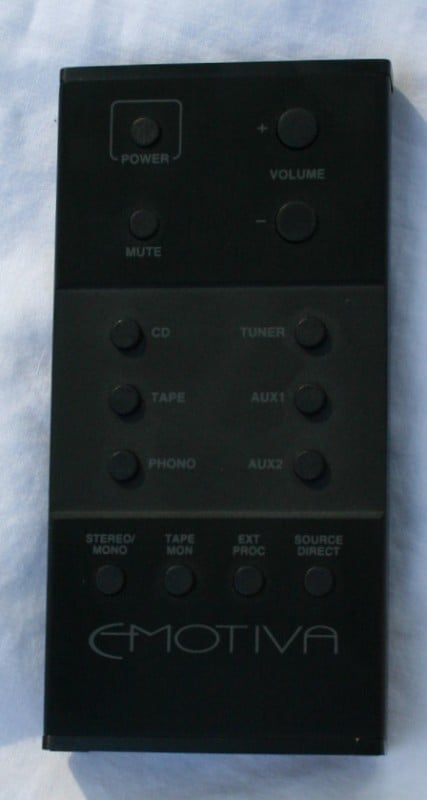 Plastic is
anathema to audiophiles so Emotiva obliged and provided a very sturdy, very
industrial looking remote. Brushed black aluminum with grey writing,
backlighting is nonexistent. The button layout would make any OCD person happy
with the straight lines and uniform shape. While it would be easy to hate this
remote, I don't. While it isn't that great of a remote (in the grand scheme of
remotes), I personally like the aesthetics of it (all those little screws are
kinda cool) and the metal keeps the remote cold in your hand (a huge bonus in
muggy Florida
in August). The 14 buttons would be easy enough to remember even though a unit
like the RSP-1 would probably be used mostly in a somewhat lighted room. The
downside? You need a screwdriver to change the batteries.
Plastic is
anathema to audiophiles so Emotiva obliged and provided a very sturdy, very
industrial looking remote. Brushed black aluminum with grey writing,
backlighting is nonexistent. The button layout would make any OCD person happy
with the straight lines and uniform shape. While it would be easy to hate this
remote, I don't. While it isn't that great of a remote (in the grand scheme of
remotes), I personally like the aesthetics of it (all those little screws are
kinda cool) and the metal keeps the remote cold in your hand (a huge bonus in
muggy Florida
in August). The 14 buttons would be easy enough to remember even though a unit
like the RSP-1 would probably be used mostly in a somewhat lighted room. The
downside? You need a screwdriver to change the batteries.
Since I have gear flowing in and out of my room all the time, I am in a unique position to discover (usually quite by accident) shared IR codes. If you've read anything about the RSP-1 online, you've surely heard that it has some IR crossover with other components. During my evaluation of the Pioneer PDP-5070HD, I found the unit turning on. If you have a universal remote, and rely on IR control, you may have a problem depending on what components you own. If you use an RF remote (and you should) with an IR blaster, then you'll find yourself avoiding any and all hassles. Since this is a unit designed for a dedicated two channel rig, I can't really imagine that this "issue" would affect too many people negatively.
Emotiva RSP-1 Listening Tests and Conclusion
Rarely do I get a chance to really let my speakers sing. Young kids who always seem to be napping at inconvenient times has made it so I make excuses to stay home from the store just so I can listen to a little music. With the Reference Audio Series RSP-1/RPA-1 combo pushing my speakers, I know I'm getting some of the best sonics I can ever expect from my speakers.
CD: Lorna Hunt - All
in One Day There
is going to be a theme of this listening test and that is
"revealing." This is Audioholics so don't expect me to wax poetic
about how much more chocolaty the midrange was or any of that nonsense. I've
listened to Lorna Hunt's album many, many times, often for reviews. While the
recording is a little noisy, the dynamic range is exceptional and the
instruments have a realism and presence that is often lacking on other albums.
When I pressed play on this disc my first reaction was, "Gee, I didn't
realize how noisy this album really was!" I was hearing a lot more
background noise than I was used to hearing. On the upside, the instruments,
already very lifelike, took on a three dimensional quality. Chimes in
particular sounded so good that I felt like I had hit them myself. The moments
of silence between tracks were exactly that - dead silent. I never heard a hiss
or anything else from the pre-amp during any of my listening tests.
There
is going to be a theme of this listening test and that is
"revealing." This is Audioholics so don't expect me to wax poetic
about how much more chocolaty the midrange was or any of that nonsense. I've
listened to Lorna Hunt's album many, many times, often for reviews. While the
recording is a little noisy, the dynamic range is exceptional and the
instruments have a realism and presence that is often lacking on other albums.
When I pressed play on this disc my first reaction was, "Gee, I didn't
realize how noisy this album really was!" I was hearing a lot more
background noise than I was used to hearing. On the upside, the instruments,
already very lifelike, took on a three dimensional quality. Chimes in
particular sounded so good that I felt like I had hit them myself. The moments
of silence between tracks were exactly that - dead silent. I never heard a hiss
or anything else from the pre-amp during any of my listening tests.
CD: Jamiroquai
- A Funk Odyssey Ever
have an album that you can't remember where you picked it up? For a long while
I thought this was one of my wife's CDs but she swears it isn't. Regardless,
Jamroquai's A Funk Odyssey has some
great beats and plenty of taxing passages. It probably comes as no surprise
that the RSP-1 tackled all this without so much as a hitch. One thing I noticed
here and during the other listening sessions was how much clearer and more
separated each of the notes was compared to listening on my A/V receiver. Many
times it seemed as if the RSP-1 was almost anticipating the next note and would
beat the music to it. This provided a much more differentiated presentation
where it seemed that each note was more distinct and clear. This gave the
soundstage a bit more depth. By "depth" I mean that I could
concentrate on a particular instrument or sound and follow it even though it
may be a secondary or tertiary riff.
Ever
have an album that you can't remember where you picked it up? For a long while
I thought this was one of my wife's CDs but she swears it isn't. Regardless,
Jamroquai's A Funk Odyssey has some
great beats and plenty of taxing passages. It probably comes as no surprise
that the RSP-1 tackled all this without so much as a hitch. One thing I noticed
here and during the other listening sessions was how much clearer and more
separated each of the notes was compared to listening on my A/V receiver. Many
times it seemed as if the RSP-1 was almost anticipating the next note and would
beat the music to it. This provided a much more differentiated presentation
where it seemed that each note was more distinct and clear. This gave the
soundstage a bit more depth. By "depth" I mean that I could
concentrate on a particular instrument or sound and follow it even though it
may be a secondary or tertiary riff.
CD: Rusted
Root - When I Woke When
you want a lot of drums, male and female vocals, and tempo changes in one album
you need look no further than When I Woke
by Rusted Root. A long time favorite of mine, to say that I am familiar
with this album is like saying I sort of know what my kids look like. In some
songs, there is such a cacophony of drums, shakers, guitars, and God knows what
else that it seems almost an assault on your ears. What really impressed me
about this listening test was how good the bass sounded. Sure, there was plenty
of treble and mids, but the bass just kicked. It wasn't quite tactile, but if I
put my hand on the couch, I could feel the vibrations in the leather. The
separation of the speakers was as phenomenal as I've ever heard with these
speakers. This is one of those listening sessions that ended up stretching into
hours as I lost myself in the music.
When
you want a lot of drums, male and female vocals, and tempo changes in one album
you need look no further than When I Woke
by Rusted Root. A long time favorite of mine, to say that I am familiar
with this album is like saying I sort of know what my kids look like. In some
songs, there is such a cacophony of drums, shakers, guitars, and God knows what
else that it seems almost an assault on your ears. What really impressed me
about this listening test was how good the bass sounded. Sure, there was plenty
of treble and mids, but the bass just kicked. It wasn't quite tactile, but if I
put my hand on the couch, I could feel the vibrations in the leather. The
separation of the speakers was as phenomenal as I've ever heard with these
speakers. This is one of those listening sessions that ended up stretching into
hours as I lost myself in the music.
Recommendations
Ready for me to nitpick, 'cause that's what I'm going to do. You can tell because 3 of my 4 recommendations are about the Dimmer function. Now I understand that a true "audiophile" would want less functions and not more, but I'm an Audioholic and I would like my life to be easier:
-
There is no OFF setting on the dimmer, not everyone wants/needs to see all those pretty blue lights.
-
The dimmer function is only controlled by the front of the unit. I'd like to have that control on the remote as well.
-
The dimmer brightness on the RSP-1 seems to be different than the RPA-1 - they should be the same. And if at all possible, I'd like some way to have the RSP-1 and RPA-1 dimmers change in tandem.
-
Calibrating the sub requires a test disc of some sort or test tones sent from the transport. I'd love to see some sort of integrated test tones in the RSP-1.
Conclusion
 The RSP-1
performs exactly as promised - a 2 channel processor that does little if anything
to the incoming signal. Considering the low price of the Reference Audio
Series, Emotiva has taken the dedicated high end 2-channel rig out of the hands
of the ultra-rich and placed it squarely within reach of most enthusiasts. If
you are looking for a 2 channel system and don't want to choose between a new
rig and a new car, this is the combo for you. It looks audiophile, it sounds
audiophile, it just doesn't cost audiophile.
The RSP-1
performs exactly as promised - a 2 channel processor that does little if anything
to the incoming signal. Considering the low price of the Reference Audio
Series, Emotiva has taken the dedicated high end 2-channel rig out of the hands
of the ultra-rich and placed it squarely within reach of most enthusiasts. If
you are looking for a 2 channel system and don't want to choose between a new
rig and a new car, this is the combo for you. It looks audiophile, it sounds
audiophile, it just doesn't cost audiophile.
Emotia RSP-1 2-Channel
Pre-Amplifier
$699
Emotiva Audio
Corporation
106 Mission Court
Suite
101
Franklin,
TN 37067
615-771-1224
877-EMO-TECH
About
Emotiva Audio
Emotiva
engineers believe that the experience of enjoying home audio and home theater
components begins with thoughtful design, robust engineering, superior quality
materials and a deep understanding of what the audio/video enthusiast wants and
needs. It occurs all too often; designers and manufacturers consider technology
and ease of use to be mutually exclusive qualities in a product. Emotiva
engineers think differently. Technologically superior and user friendly
products are paramount to the Emotiva design philosophy and are qualities that
allow Emotiva users to appreciate their purchase in the future as much as they
do today. We utilize only premium components with proven, critically evaluated
circuitry in the audio and video paths to preserve the original quality of the
sound and vision experience. Emotiva products compliment the entertainment
experience and bring it up to a level rarely experienced with other mass produced
products.
The Score Card
The scoring below is based on each piece of equipment doing the duty it is designed for. The numbers are weighed heavily with respect to the individual cost of each unit, thus giving a rating roughly equal to:
Performance × Price Factor/Value = Rating
Audioholics.com note: The ratings indicated below are based on subjective listening and objective testing of the product in question. The rating scale is based on performance/value ratio. If you notice better performing products in future reviews that have lower numbers in certain areas, be aware that the value factor is most likely the culprit. Other Audioholics reviewers may rate products solely based on performance, and each reviewer has his/her own system for ratings.
Audioholics Rating Scale
 — Excellent
- — Very Good
- — Good
- — Fair
- — Poor
| Metric | Rating |
|---|---|
| Two-channel Audio Performance | |
| Bass Management | |
| Build Quality | |
| Fit and Finish | |
| Ergonomics & Usability | |
| Features | |
| Remote Control | |
| Performance | |
| Value | |
As Associate Editor at Audioholics, Tom promises to the best of his ability to give each review the same amount of attention, consideration, and thoughtfulness as possible and keep his writings free from undue bias and preconceptions. Any indication, either internally or from another, that bias has entered into his review will be immediately investigated. Substantiation of mistakes or bias will be immediately corrected regardless of personal stake, feelings, or ego.
View full profile Subscribe to our newsletter