


Attack of the Clones (Processors)
Clone processors
It seems the 21st century has brought about the human obsession with cloning. You’ve heard about it in the news that scientist have cracked the human genome. Since then, there have been plenty of movies about cloning ranging from Scifi films such as Star Wars Episode II, and soon to be Star Trek Nemesis, to comedies such as Multiplicity, and action films starring our favorite bodybuilder Arnold Schwarzenegger in Seven Days.
It’s no wonder that cloning is making a popular presence even in the audio consumer marketplace. This began with LD and DVD players about a decade ago when McIntosh released a Laser Disc player with Pioneer guts in a fancier case for about twice the price of the latter. Many companies such as Yamaha, and Denon followed suit by offering Panasonic / Toshiba DVD platforms with their own case and markings. In some cases, however, a few of these companies cloned these DVD players, but made subtle upgrades to the DAC sections for improved audio fidelity.
We were surprised (OK, not really) to discover that cloning has made its presence in Digital Preamp Processors. These processors were originally co-developed by East Tech and Cirrus Logic for Outlaw Audio for OEM purposes to later sell to Audio Hardware Manufacturers with customized chassis, faceplates and logos to accompany them of course. Eastern Tech in an Asian OEM which manufacturers the design and specifications of these processors. The DSP is CD4932-63L which provides decoding for Dolby Prologic II, and all the varieties of Dolby Digital, and DTS including EX, and DTS Neo:6 and Cirrus Logic’s own Extra Surround as well as their Triple Crossover.
The following “Clone” Processors featured in this article are:
- Sherbourn PT-7000, $1500 Retail
- Atlantic Technology P-2000, $1699 Retail
- Outlaw Audio Model 950, $899 Retail
Common Features:
- Crystal 192/24 DAC’s and 96/24 ADC’s
- Cirrus Logic 4932-63L Chipset
- Same Backpanel layout
- Power Consumption 45watts
- Defeatable global analog 80Hz crossover for DVDA/SACD input
- Cirrus Logic Triple Crossover
- Cirrus Logic Extra Surround
- DD EX, DTS Neo:6, Prologic II
- Second Zone Operation
Clone Processors Photos and Comparisons
Back Panels
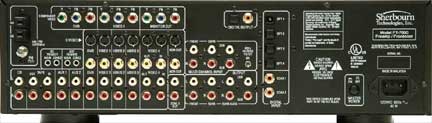
Notice how all three processors have identical backpanel layouts, with the exception to the markings. They all have a manual power switch, detachable 3 prong power cord, and identical chassis dimensions and power consumption of 45watts.


Internal Components
Also notice the common circuit cards and component layouts, as well as the power supply sections featuring a toroidal power transformer and a bank of electrolytic low ESR capacitors.


Front Panels
Notice the virtually identical front panel layouts and display screens. The only things that differentiate these processors from each other are the chassis color, construction, and brand markings.


Specifications
At the time of this article, detailed specifications for the Sherbourn Technologies PT-7000 were unavailable.
| Outlaw
Audio Model 950 |
Atlantic Technology P-2000 |
|
AUDIO SECTION Analogue Frequency response: 10 Hz - 90 kHz: +0, -3 dB (Bypass Mode)Signal to Noise Ratio: 102 dB (Bypass Mode) ∑ Distortion: 0.0038% (20 Hz ~ 20 kHz) (Bypass Mode) Input sensitivity / input impedance: 200 mV/ 47kohms Rated output: 1V(0dB gain in Bypass Mode) Digital Signal to Noise Ratio: 102 dBTotal Harmonic Distortion: <0.005% (1 kHz, at 0 dB) Dynamic Range: 100 dB D/A Output: Rated output 2 V (At 0 dB playback) Digital Input: S/P-DIF Format DSP Processor: Cirrus® CS 49326 ADC: Cirrus CS 5360 DAC: Cirrus CS 4396 VIDEO SECTION Composite Video Format: NTSCInput/Output Level: 1 volt P-P Input/Output Impedance: 75W Frequency Response: 5 Hz - 10 MHz -- +0, -3 dB S-Video Signal Format: NTSC Y/CLuminance (Y) Input/Output Level: 1 volt P-P Chrominance © Input/Output Level: 0.3 volt P-P Input/Output Impedance: 75W Frequency Response: 5 Hz - 10 MHz -- +0, -3 Component Video Signal Format: NTSC Y/Pr/PbAnalog Components Luminance (Y) Input/Output Level: 1 volt P-P Pr Input/Output Level: 0.7 volt P-P Pb Input/Output Level: 0.7 volt P-P Input/Output Impedance: 75W Frequency Response: DC - 45 MHz -- +0, -3 dB |
Preamplifier Analog Section Input Impedance:
26K. Bass Management High-Pass Slope
Crossover Frequency Tone Control Bass Center Frequency/Range
30Hz / ± 6dB Preamplifier Digital Section Frequency
Response Video Section Bandwidth All video inputs and outputs are 75 ohms, 1.5 Vp-p. Component inputs and outputs work with any Standard requiring ultra-wide bandwidth including Component-RGB, HDTV, line doublers, quadruplers, and scalers. Digital Audio All digital audio inputs and outputs
are to S/PDIF electrical (75 ohms, 0.5 Vp-p), Zone 2 Section Frequency Response and
Bandwidth |
Clone Processors Conclusion
So what have we learned from all of this? Perhaps that there are fewer hardware manufacturers these days committed to designing their own products in house. It’s cheaper today with respect to labor, component procurement, and regulatory approvals, to OEM products overseas and re-package them with your cosmetics and literature. This isn’t the first time we have seen this happen with consumer audio electronics, and this method is certainly not absent in other consumer electronic marketplaces.
We do not condemn these companies for marketing and selling an OEM product. In fact, there may be several benefits to this approach. For example, quality control is probably very good since there are multiple production lines producing this common product for several hardware manufacturers. The Bill of Materials (BOM) costs is kept low since it is being produced in mass quantities, yielding a cost competitive product to the hardware manufacturers and thus savings to you the consumer. Based on the feature set and specifications published on these processors, it would seem that this is a very good product offering at a cost that was unheard of only a few years ago. High end hardware manufacturers now have the ability to offer a separates package featuring a state of the art Digital Preamp Processor for $899, and a 7 Channel Power amplifier for around $2000 or less, with a total system cost less than that of some of those super expensive and flashy home theater flagship receivers with potentially higher performance and/or flexible integration.
There is one thing that puzzles us however. Why is the Outlaw Audio Model 950 Processor ($899) about $800 less than the Atlantic Technology offering and about $600 less than Sherbourns offering? The only differences we could see between the three processors, at least by inspection, was that the Atlantic Technology and Sherbourn processors compared to the Outlaw Audio one, and Atlantic Technology seemed to offer the most detailed documentation and product specifications of the three. I suppose the only way we will ever know if the added cost of the Atlantic Technology P-2000 and Sherbourn PT-7000 Processors is justified is to have all three hardware manufactures send us a sample for a “Clone Processor Face-Off” review. Perhaps we will contact them shortly with our proposal.
Until then, watch out for the next multiplicity of audio hardware cloning at the nearest audio store near you….
Feedback from Sherbourn Technologies
Ron Fone, President and Founder of Sherbourn Technologies, Inc, phoned us with the following comments on this article:
Although the 'platform' of the PT-7000 is the same as Outlaw's Model 950,
we
have made some significant changes to their product.
- We calibrate all of the boards.
- We use low leakage capacitors.
- We have improved the video bandwidth from 40 MHz to 55 MHz.
- We
have radically changed the cosmetics... including a
much thicker front panel that perfectly matches all of our amplifiers. - We have added the elegance of blue LEDs to cosmetically match our power amplifiers.
- We use a solid aluminum volume control knob.
- In addition, unlike Outlaw we include a set of basic cables.
- Plus of course the consumer gets the benefits of having a dealer's support and advice.
For more info about Sherbourn, visit http://www.sherbourn.com.
Feedback from Atlantic Technology / Outlaw Audio
Peter Tribeman, one of the Principals behind Atlantic Technology and Outlaw Audio phoned us and explained the following about Outlaw Audio:
The Outlaw business model is a direct to consumer model where it bypasses the usual distribution/retail chain and sells direct to the consumer, either from the company's own website or through several online partners. Thus the cost of their products are significantly lower than their competitors who follow the conventional model that supports and sells their products through dealerships via product demo’s and personalized customer support from the dealers sales staff.
Audioholics understands and recognizes the differences in Marketing Models these two companies follow and how the ‘Direct–to–Consumer' marketing model would result in a significant cost savings to the consumer on similar products. However, when I asked if there were any technical differences between the Atlantic Technology P-2000 and Outlaw Audio Model 950, Peter refused to answer specifically stating that the differences are proprietary and did not want to comment on them to create an avenue to compare the three units. Being a EE myself, with experience in working with reference designs for OEM purposes, I know that the changes one can make are minor at best, so I find that response a bit evasive (but certainly understandable). However, we feel that for those consumers desiring the support and personalized attention of a local dealer, then the added price may be well-justified regardless if there are performance differences or not between the units.
Gene manages this organization, establishes relations with manufacturers and keeps Audioholics a well oiled machine. His goal is to educate about home theater and develop more standards in the industry to eliminate consumer confusion clouded by industry snake oil.
View full profile Subscribe to our newsletter