


Weizhi Precision PRS-6 Power Distributor First Look
Weizhi Precision PRS-6 Power Distributor
Summary
- Product Name: PRS-6 Power Distributor
- Manufacturer: Weizhi Precision
- Distributor: Aaudio Imports
- Review Date: May 05, 2010 01:25
- MSRP: $3,200
- First Impression: Mildly Interesting
- Correct tone and pitch
- Perfect pace and timing
- Unlimited dynamics
- High
resolution, decay and micro detail
- Ultra low noise
floor
- No compression
- Extreme build
quality
- Compact, takes little floor space
Overall dimensions:
9.1 x 5.1 x 2.3" (LxWxH)
Weight:
7.7 lbs.
Occasionally we come across a product that reminds us why we got in this business in the first place. If you look back into the annuls of Audioholics' history, you'll find that the site was built on the broken backs of cable manufacturers. While others were running around espousing the virtues of esoteric cables, Audioholics was shining the harsh light of objective measurements and rigorous testing and revealing the overpriced cables for what they were: snake oil. While esoteric cables can (and often do because of their extreme designs) make a sonic difference, that difference is nearly always in the form of EQ. The signal is adjusted by the extreme properties of the cable from passing the signal unaltered (as a cheap, heavy gauge cable will do) into something else. If you want to pay hundreds or thousands of dollars for a cable that EQs your signal - more power to you. It's your money.
But snake oil doesn't just reside in cables. You can find it everywhere. What are receiver manufacturers doing adding tons of DSPs to their receivers? Do people really use them? We don't know anyone that does. Aside from the Pro Logic types that transform two channel material into multi-channel and the occasional 5/7 channel stereo for parties, DSPs are nothing more than a bullet point on a spec sheet. Snake oil? Not exactly, but they are adding technology that you don't really need in hopes that you'll ascribe the product value that it may not deserve. You find snake oil in amps that have an unnecessarily large and heavy chassis to convey quality to those that weigh their gear, in speakers with two and three sets of binding posts that don't need them, and in displays with modes that aren't ever needed in a real world environment. It's everywhere.
But if you really want to see it, take a look at power. You can't swing a dead cat at an esoteric audio show and not hit some sort of power conditioner or surge protector or EIC cable that seeks to right the wrongs the miles of power cabling from the electric company have not addressed. Case in point, the Weizhi Precision PRS-6 Power Distributor. We'll let you decide if it is snake oil or not, here are the facts:
Fact 1 - Constructed out of Duralumin
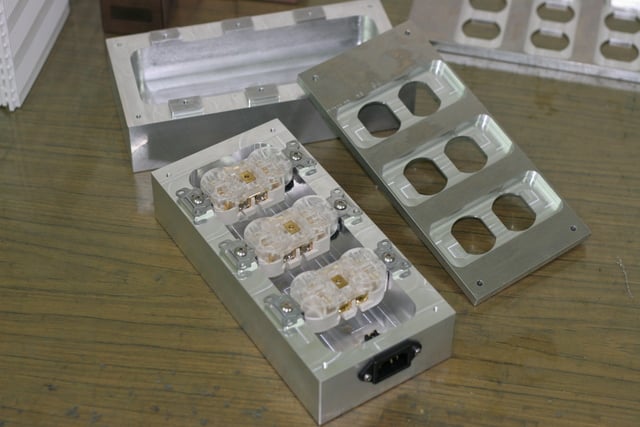
At first we thought they just made this word up but a little research found it is real. Invented in the early 1900's, Duralumin is basically an aluminum alloy. In fact, if you go to the Weizhe Precision website, you'll see they list the material as Aluminum 6061-T651. This is actually an aerospace grade aluminum alloy and was used on the Hindenburg. If you notice from the picture below, they are using a lot of it (note the side walls) which probably accounts for most of the 7.7lbs of weight.
Fact 2 - Performance Claims
Take a look at the specs above (click on the + sign) to see what Aaudio Imports is saying the PRS-6 can do. Now ask yourself not only if it could be true, but how would you know. To test, you'd have to unplug all your gear, power it all back up, and start the track over. In a best case scenario, you couldn't do that in the three to four seconds you'd need so that you could accurately remember what you'd just heard.
Fact 3 - Extreme Construction
There is no doubt of the construction of the PRS-6. It is obviously a beast. The amount of aluminum alone should tell you that. It's got a carbon fiber faceplate, Oyaide R1 recepticals, Furutech FI-09G inlet, and is wired with ACT EHPLC-OCC Uni-Crystal 6N Silver wire. We're sure none of this material comes cheap. The aluminum is all CNC machined for high tolerances and the overall look is... well boxy but boxy in a industrial way.
But what does it really do? It isn't a power conditioner (it doesn't claim to be) but is it even a surge protector? Not from what we can see. Nowhere on the page does it claim that it protects against surges. Not only that, but look at the picture of the opened box - there isn't much room for electronics in there. So what are you left with? Exactly what it claims - a Power Distributor. All it does is take one outlet, and make it six with no additional protection (other than the box itself).
Fact 4 - Audiophile Price
The last piece of "evidence" you need to consider is the price. At $3,200, the PRS-6 does a whole lot of nothing. While the marketing material says that, "A special nanotech coating of FAM material on the PRS-6’s interior and exterior surfaces shields it from 99.9 percent of RF and EMI interference," we're wondering if that is really enough to justify the price. To an esoteric audiophile - sure, it makes sense. But they worry about things like static electricity in the carpet and matching cables to amplifiers. While we don't begrudge them spending their money as they see fit, let's not confuse their ideas of quality with and objective view of performance to cost.
Conclusion
So, let's take a test here. If it smells like a snake and comes in a jar with one of those non-spill tops, is it Snake Oil or is it an esoteric product? You be the judge. While there is no denying that the PRS-6 is constructed out of top of the line materials, we'll let you decide if that justifies a $3,200, six-outlet extension cord. Ironically, the PRS-6 doesn't come with a power cord. But, hey, at least Aaudio Imports sells a 1.5 meter version for just a tad over $1,600. Now that's a bargain.
For more information, please visit www.aaudioimports.com.
Unless otherwise indicated, this is a preview article for the featured product. A formal review may or may not follow in the future.
As Associate Editor at Audioholics, Tom promises to the best of his ability to give each review the same amount of attention, consideration, and thoughtfulness as possible and keep his writings free from undue bias and preconceptions. Any indication, either internally or from another, that bias has entered into his review will be immediately investigated. Substantiation of mistakes or bias will be immediately corrected regardless of personal stake, feelings, or ego.
View full profile Subscribe to our newsletter