


River Cable Flexygy 8 Speaker Cable Review
River Cable Flexygy 8 Flat Speaker Cable
- Product Name: Flexygy 8
- Manufacturer: River Cable
- Performance Rating:

- Value Rating:
- Review Date: September 20, 2005 19:00
- MSRP: $ 373.69 (3 meter pair)
|
Electrical Characteristics
Note: Available as single cables or cable pairs in both straight and bi-wire configurations |
|
Pros
- Excellent fit and finish
- Snake Oil Free
- Customizable design
- Great for under-carpet installs
Cons
- Expensive
- Difficult to differentiate conductors in low lit room
River Cable Flexygy 8 Introduction
I know what you are thinking - not another speaker cable review?!? Don’t tell me some reviewer is about to take me on a tour of the wonders of exotic cables and how they magically can transform your hi-fi system into audio nirvana! Rest assured, we don’t suffer from audio nervosa (at least when it comes to cables) like many elitist audiophiles tend to. We are realists for the most part and do our best to keep things in perspective, especially on topics which are easily quantifiable through empirical data and analysis. Oddly it’s the topic of cables, one of the simplest components to analyze and quantify, that seems to be surrounded by the most propaganda and snake oil. We can only figure it must be because the differences between any reasonably competently designed speaker cables are so miniscule that some manufacturers must rely on these snake oils or newfound sciences to help bolster product appeal (directed towards unwary consumers who, through no fault of their own, simply don’t know any better.) Take a hobbyist for any particular passion (i.e. cars, fitness, etc) and plant the power of suggestion of them, sprinkle in some fancy techno babble while creating an urgency for the product, and they will likely buy it in droves. Add to the fact that audible preferences are very subjective in nature, and - wham - you got the winning receipt.
For a list of the common snake oils we have so far uncovered, I recommend reading the following article I authored titled "Top Ten Signs a Cable Vendor is Selling You Snake Oil"
River Cable Flexygy 8 Overview and Metrics
It is refreshing to discover esoteric cable companies such as River Cable that don’t promote snake oils or nonsense. Sure, their products are pricier than the cables you will typically find at your local home appliance store, but then again, the Home Depot 10AWG Zip cord doesn’t come dressed up in such nice clothing nor sport compression banana terminations.
In “straight” configuration, the Flexygy 8 is an 8 conductor (4 paralleled hot and return wires) with an aggregate gauge of 7AWG and effective gauge of 10AWG. You can also opt for bi-wire configurations where each pair has an effective gauge at each speaker terminal of 13AWG. I prefer to use a high quality single wired solution as opposed to a bi-wired one. Bi-wiring offers very few advantages over single wired solutions, but typically several disadvantages such as doubling of pair to pair capacitance seen by the amplifier, increasing cable costs, and furthering cable clutter by doubling up on your cables to each speaker. Personally I don’t subscribe to the bi-wire craze that some audiophiles tend to, but then again, I also don’t believe in magical CD mats or soaking your cables in kosher chicken fat blessed by a Rabbi before hooking them up to your stereo system. Thus I elected for my review samples to be “straight” single wired runs. River Cable offers the choice of banana or spade connectors. My preference is for banana assuming they are of good design.
Finding a banana plug to snugly mate with my beloved Status Acoustics Decimos has always been a challenge to say the least. The binding posts Status Acoustics choose on this product tends to cause lesser designed banana plugs to slide off or connect loosely to the speakers. River Cable has the perfect solution for all of their speaker cables. Their adaptable banana plug can accommodate pretty much any binding post out there. All you have to do is keep twisting the terminal until the banana plug firmly connects to your amp/speakers binding posts. Once tightened, I was unable to pull the cables off of my speakers or amp. Having a solid termination is critical to minimizing contact resistance. I have seen far too many poorly designed spade/banana plug terminations used by exotic cable vendors that simply added more series resistance to the product then they were allegedly trying to minimize in their cable design. I consider this counterproductive and it appears River Cable is in agreement as evidenced by their adaptable banana plug termination which is now popularized by many of the better cable manufacturers out there.
Birth Certificates Aren't Just for Babies!
 While some may think it’s a bit quaint to include a birth certificate along with
the cables, I felt it was a nice touch - especially considering so few esoteric
cable companies actually bother to measure, let alone test, their products. In
contrast River Cable does this with all of their cables. Many cable companies
simply don’t have the proper equipment or know-how to do so. Even more of them
place very little weight on measurements and perpetuate the philosophy that you can’t measure performance. We often
refer to these people as cable
soothsayers. Regarding cables, they couldn’t be more wrong.
While some may think it’s a bit quaint to include a birth certificate along with
the cables, I felt it was a nice touch - especially considering so few esoteric
cable companies actually bother to measure, let alone test, their products. In
contrast River Cable does this with all of their cables. Many cable companies
simply don’t have the proper equipment or know-how to do so. Even more of them
place very little weight on measurements and perpetuate the philosophy that you can’t measure performance. We often
refer to these people as cable
soothsayers. Regarding cables, they couldn’t be more wrong.
Most of the specs on the back of this birth certificate validate continuity and physical condition. It appears they were mostly taken for quality control to ensure continuity. Their website does list the following cable metrics which are essential in gauging cable performance.
River Cable Flexygy 8 Published Metrics:
- Capacitance: 10 pF/ft
- DC Resistance: 0.003 ohms/ft
- Velocity Factor: 0.87
- Inductance: 300 nHy/ft or .300 uH/ft
The capacitance specification is unusually low and the thought of high inductance immediately popped in my head before reading the rest of their specifications. As we learned in our article Calculating Cable Inductance in Speaker Cables and Dielectric Absorption in Cables Debunked, inductance and capacitance values are interrelated and based on the dielectric and conductor spacing between the (+) and (-) conductors.
Though the inductance is a bit higher than I’d like to see in cables, there is merit in producing ultra low capacitance and low resistance cables. These are the type of cables best suited for long runs to minimize resistive losses and amplifier stability issues of marginally stable amplifier designs. It’s particularly important to use low capacitance cables when powering ESL type speakers on tube amps. In this instance, the Flexygy seem to be the most appropriate cable design I have seen commercially produced.
River Cable Flexygy 8 Measurements and Conclusion

Inductance was well within their spec of .300uH/ft and reasonably low enough, though not stellar, for use in high fidelity audio systems. The Starflex cable is their best performing cable in this aspect. Though according to River Cable, users requiring lower inductance cable can order the Flexygy 8 in a different terminating scheme for lower inductance but higher capacitance.
The way they are achieving this is to alternate (+) / (-) wiring on adjacent pairs in an interleaving method as opposed to 4 adjacent (+) and 4 adjacent (-) terminations. The former takes advantage of two wires being in close proximity and thus the effects of their self-inductance is nearly canceled out by their mutual inductance terms. Listed below is a table based on their published specifications comparing the metrics of the two cable topologies.
|
Flexygy 8 Topology |
Low Capacitance (Standard) |
Low Inductance |
|
Ls |
.300 uH/ft |
.090 uH/ft |
|
Cp |
10 pf/ft |
200 pf/ft |
|
DCR |
3 mohms/ft |
3 mohms/ft |
For a more detailed discussion on cable inductance, the reader is encouraged to review our article on Calculating Cable Inductance

The resistance of the Flexygy 8 is about 10AWG equivalent at DC as specified by River Cable. To date, this is their lowest resistance speaker cable. We see a slight rising AC resistance with frequency (to the least degree on the Flexygy 8) attributed to skin effect, but practically speaking a non issue for the application of high fidelity audio.
For a more detailed discussion on Skin Effect, see our article on Skin Effect Relevance in Speaker Cables.

Capacitance was also on par (10pF/ft) with what River Cable specified. The reason for the slight increase in capacitance above 1kHz is attributed to measurement error of measuring a distributed device (speaker cable) with a measurement tool designed to measure lumped elements (magnetics, electrical circuits, etc). Again, if you have River Cable terminate this cable for low inductance, expect to see capacitance rise proportionally. Since capacitance is already super low, it will likely not make an significant difference. Personally, I would opt for the lower inductance termination option, especially since I don't buy into esoteric marginally stable amplifier designs.
River Cable actually touts flat cables as being the optimal geometry for minimizing capacitance. In actuality, conventional flat cables sandwich their conductors closely together which dramatically increases capacitance. I commend River Cable for producing a series of flat esoteric cables with well-controlled capacitance and reasonably low inductance. As previously mentioned, some esoteric vendors opt to sandwich the (+) and (-) conductors right on top of each other with minimal spacing. While this produces the lowest inductance possible, it comes at a penalty of ultra high capacitance, which can wreck havoc on marginally stable esoteric tube amplifiers when cables become excessively long without proper zobel compensation. High capacitance cables can also cause frequency peaking on systems resulting in a 舠 bright 舡 sonic signature. I consider speaker cables below 50pF/ft of capacitance low enough to NOT be an issue in real world applications.
Conclusion
If you are looking for me to describe the chocolaty midrange or airiness of these cables, you are reading the wrong publication. I only hear differences in cables that are poorly designed, and subsequently have poor corresponding measurements. And, at that, it takes very special circumstances for those differences to become clearly audible (i.e. a revealing system and good room acoustics & listening conditions).
The Flexygy 8 doesn't fall under the "poorly designed" category by any means. It's a superbly built product that provides higher installation flexibility because of its flat design and ultra low capacitance and resistance. It's well thought out in that you can order it from the manufacturer terminated either for low inductance or low capacitance to better suit your needs.
I love the flair pin they include with the cables that have an anti-voodoo message on them. From my experience with this company, this is certainly an appropriate message for them to instill on their consumers.
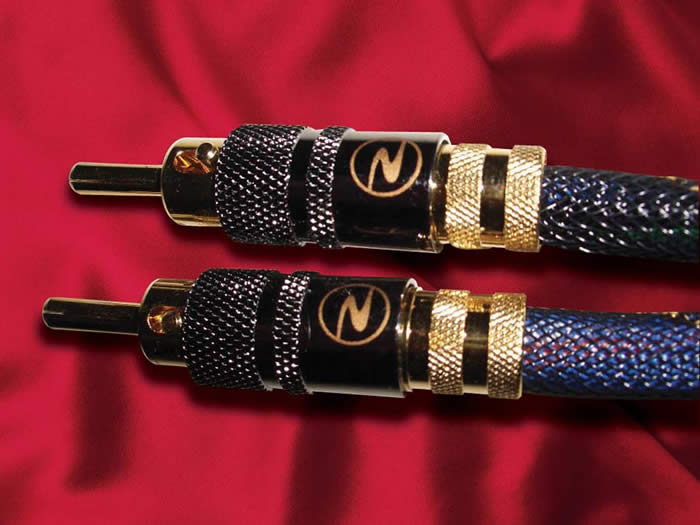 As with all River Cable products, I was
thoroughly impressed with the quality terminations employed for this design.
My only minor
complaint is it can be difficult to make out the (+) and (-) conductors in low light situations.
I prefer the conventional color scheme, Red (+) / Black (-), like they followed in the Starflex design,
but realize it wouldn't aesthetically match this cable.
Just use caution, or better yet,
use a flashlight to ensure proper hook up.
This goes double for color blind audiophiles!
As with all River Cable products, I was
thoroughly impressed with the quality terminations employed for this design.
My only minor
complaint is it can be difficult to make out the (+) and (-) conductors in low light situations.
I prefer the conventional color scheme, Red (+) / Black (-), like they followed in the Starflex design,
but realize it wouldn't aesthetically match this cable.
Just use caution, or better yet,
use a flashlight to ensure proper hook up.
This goes double for color blind audiophiles!
The flat cable has an appeal for those looking for an unobtrusive cable that can be tucked into a corner, or under a carpet fairly easily. The Flexygy 8 is a bit wider than the Flexygy 6 so make sure you have about 1.5" of space for this cable. The Flexygy 8 measures well, is aesthetically pleasing and will make those not comfortable with ordinary 10AWG zip cord happy to purchase an esoteric cable that will do no harm to the fidelity of their system. At $373.69 for a 3 meter pair, the Flexygy 8 came in at a 90% cost premium to my favorite cable in their product line 舑 the Starflex. It's a tough sale in my opinion, but for those who need a flat cable that is also customizable it may just be worth the extra price. Considering the esoteric cable market and what you don't always get (performance, build quality) with many higher priced cables, the River Cable Flexygy 8 seems to be a bargain. I recommend these cables to consumers wishing to purchase a top-notch, nicely crafted esoteric speaker cable that can fit under their carpet and also have a grade A appearance terminated to their speakers and amplifiers.
MSRP:
$373.69 for 3 meter pair, terminated
888-92 RIVER (888-927-4837)
Fax: 888-776-3713
customerservice@rivercable.com
The Score Card
The scoring below is based on each piece of equipment doing the duty it is designed for. The numbers are weighed heavily with respect to the individual cost of each unit, thus giving a rating roughly equal to:
Performance × Price Factor/Value = Rating
Audioholics.com note: The ratings indicated below are based on subjective listening and objective testing of the product in question. The rating scale is based on performance/value ratio. If you notice better performing products in future reviews that have lower numbers in certain areas, be aware that the value factor is most likely the culprit. Other Audioholics reviewers may rate products solely based on performance, and each reviewer has his/her own system for ratings.
Audioholics Rating Scale
 — Excellent
- — Very Good
- — Good
- — Fair
- — Poor
| Metric | Rating |
|---|---|
| Performance | |
| Value | |
Gene manages this organization, establishes relations with manufacturers and keeps Audioholics a well oiled machine. His goal is to educate about home theater and develop more standards in the industry to eliminate consumer confusion clouded by industry snake oil.
View full profile Subscribe to our newsletter