


Panamax-Furman MIW-XT Remote Power Review
Panamax-Furman MIW-XT
- Product Name: MIW-XT Remote Power System
- Manufacturer: Panamax-Furman
- Performance Rating:

- Value Rating:

- Review Date: September 23, 2009 05:00
- MSRP: $ 149.95
AC Circuit
- Total Current Capacity: 15A
- Line Voltage: 120V, 60Hz
- AC Outlets, Total: 1
IEC Power Inlet Cord
- Length: 6 ft.
- Connectors: IEC 320-C13 and NEMA 5-15R
Flat Plug AC Power Cord
- Length: 11 inches
- Connectors: NEMA 5-15P and NEMA 5-15R
Power Inlet Faceplate
- Signal Line Protection not included, modules sold separately.
- AC Connector: IEC 320-C14
Power Outlet Faceplate
- Signal Line Protection not included, modules sold separately.
- Noise Filtration: Level 1
- AC Connector: NEMA 5-15
General
- Product Warranty: Three Years
Single Pack
- Dimensions: 7.25" W x 5" D x 7" H
- Weight: 4 lbs.
- UPC: 0 50616 00848 8
Master Pack
- Dimensions: 15" W x 10.5" D x 7.5" H
- Quantity: 4 kits
- Weight: 17 lbs.
- UPC: 5 00 50616 00848 3
Pros
- Works
- Convenient
Cons
- Silver doesn't match anything
- Expensive
Panamax-Furman MIW-XT Introduction
When you are planning your new dedicated home theater, one thing is often overlooked - power. While you make allowances for video cables, too often we've seen installations with power run down the wall to an outlet or run illegally via an extension cord inside the wall. While you can run an extra outlet up to the projector, you've got the problem of protection. So unless you plan on installing a UPS in the ceiling or near the projector, you've got a second problem - blackouts and bulb life. If you plan on protecting your projector, the last thing you want is something like the Panamax MX5102 with its 10 outlets wasted by having to place it near the projector. You want it near the rest of your gear so that you can utilize it to the fullest. But, sans an extension cord, what are you to do?
Panamax-Furman MIW-XT Evaluation and Conclusion
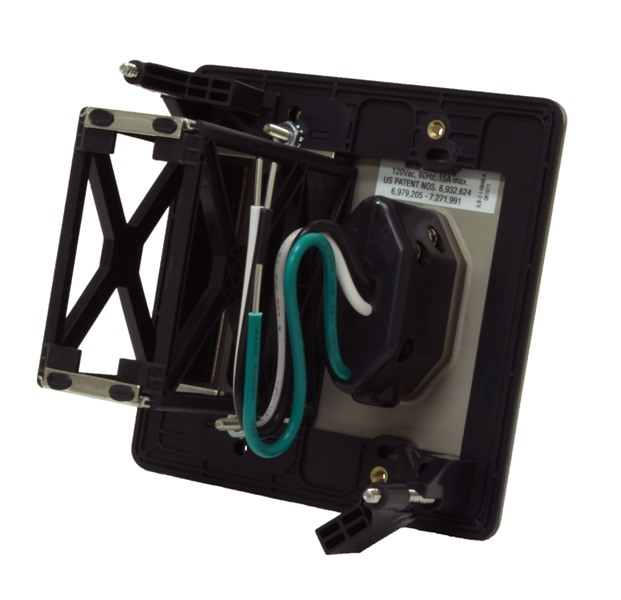 Panamax-Furman has the solution to your
projector woes with the MIW-XT power extension kit. What this basically does is
put a female outlet near your projector and a male IEC one near your gear. This
way, you can plug your projector into the wall, run an up-to-code run of Romex
or 12/2 through the wall to the second outlet, and use a second cable to plug
into your UPS. What you are left with is essentially an in-wall extension cord
that won't burn down your house.
Panamax-Furman has the solution to your
projector woes with the MIW-XT power extension kit. What this basically does is
put a female outlet near your projector and a male IEC one near your gear. This
way, you can plug your projector into the wall, run an up-to-code run of Romex
or 12/2 through the wall to the second outlet, and use a second cable to plug
into your UPS. What you are left with is essentially an in-wall extension cord
that won't burn down your house.
While the obvious application is for projectors and longer runs, the MIW-XT is perfect for others as well. Included with the package is a small three-prong jumper. This is perfect if you are just looking to plug the MIW-XT into the wall. You place the female receptacle near the device and the male near a second outlet. Mostly, though, this sort of system is useful for flat panel displays. The jumper (or a normal power cord) can be used to run from the back of the display to the wall unit and then down the wall and out near the rest of your gear. Have you ever wondered how they have those floating flat panels on HGTV? This is how.
Panamax-Furman didn't stop with power however. They've included in insert that will fit a single gang Decora-style plate. This gives you a lot of flexibility in connection options. For something like a projector, we always suggest running at least HDMI and component video. While you may never need to use the component connection, for gaming, the lag that can be created by upconversion or even simple HDMI repeating functions on a receiver (where it reads the audio from the HDMI cable) can make certain types of games (specifically rhythm games like Guitar Hero or Rock Band) nearly unplayable. Connecting them differently to your game system will eliminate that lag. All you need to do is plan out your connection configuration and buy the right insert.
Please, do buy the right insert.
We suggest a couple of things to think about:
- Do you have a gaming system? If so, it may be advisable to have a dedicated video connection for each game system, or to at least run analogue video for these systems.
- Are you
going to be running more than one of the same type of connection? Might you
want an HDMI input from your receiver and a second one (component/YPbPr) for a game system or
upconverting DVD player? For flat panels, don't forget audio and cableTV!
- Over what outputs does your receiver/sources display on-screen menus? You'll want to make sure you have one of these connected.
- For a projector, are you interested in setting up a 12 volt trigger? Might you want one in the future?
- What inputs are on the back of the display? Having more than you need in the wall is far preferable to not enough, especially if you decide to upgrade down the road
Taking a closer look at the MIW-XT wall plates we find two basic parts, the front plate and the wall mount. The wall mount should look mostly familiar to anyone that has added a low voltage line (like speaker cables) to their walls. It's basically an old work frame. The difference is there is a large cage on one side and a blank space on the other. More on that later. You'll notice very familiar dog ear lockdowns for connecting the frame to the drywall.
The MIW-XT wall plates are constructed out of very sturdy nickel plated steel which means they are rugged, durable... and probably match nothing else on your wall. One side has the power connection while the other has a rubber grommet for cable pass-through. You can cut a slice in the rubber and push your cabling through or use the included keystone adapters for up to two connections (which is not going to be enough more than likely) or replace them with the Decora-style inserts. While you'll be surprised how many connections you'll be able to make with a single insert, it's going to be hard to find anything other than white or ivory. Black is available but you'll most likely have to order it online and usually at a premium. Hopefully, the placement of the wall plates will be somewhere unobtrusive or out of sight (like it was in our installation).
Installation
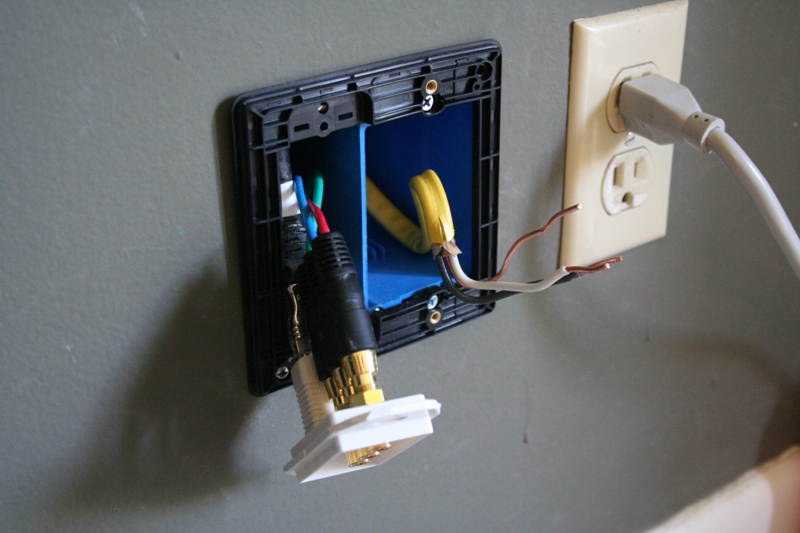 The hardest part of installing the MIW-XT wall plates is reading through
the directions. The mounting plate has a number of accessories and attachments
that can be removed or added based on what you want to do. The basic thing to
remember is that you do NOT need a back box for the low voltage connections
(like video and audio) but you do for the power. For this, you don't need a
full double gang box but just a single for the power side. Panamax-Furman
recommends:
The hardest part of installing the MIW-XT wall plates is reading through
the directions. The mounting plate has a number of accessories and attachments
that can be removed or added based on what you want to do. The basic thing to
remember is that you do NOT need a back box for the low voltage connections
(like video and audio) but you do for the power. For this, you don't need a
full double gang box but just a single for the power side. Panamax-Furman
recommends:
|
|
New Work |
Old Work |
|
Plastic |
Carlon SC200DV |
Carlon B114R |
|
Metal |
Raco 8355 |
Raco 508 |
Once you connect the backbox and run the wires, you'll just need to install the mounting plate on the wall, connect the wires from the power terminal on the faceplate to the 12/2 power cable, the connection on the Decora plate to the wires, and attach the faceplate. We recommend you seriously think about the terminals on your in-wall wire when choosing. A lot of times there is not much room to make the 90 degree turn you need from the back of the Decora plate. For component, composite, 12 volt, and others, this isn't much of a problem. But HDMI has been notoriously unwieldy in such situations. Make sure you have room to make your turn or a cable that is more flexible. Alternatively, you can buy one of those right angle HDMI adapters and use that for the connection. Regardless, careful planning will make this entire process a lot less stressful.
Use
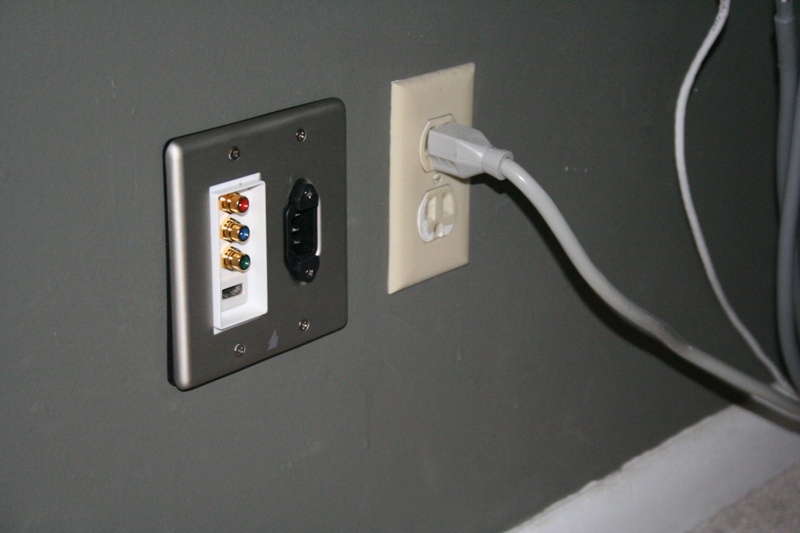 You would do well
to make all your connections and test the MIW-XT before you install it
but you probably won't. We didn't. Running 12/2 power cable is a fairly
straightforward and simple process and as long as you don't damage the wire and
make good connections you should be fine. As you'd expect, once everything was
installed, we had little trouble. Since we hid the plate behind an acoustic
panel that had an air gap, aesthetics didn't matter. The three prong IEC
receptacle had no problems accepting an aftermarket cable that we purchased for
extra length over the one provided.
You would do well
to make all your connections and test the MIW-XT before you install it
but you probably won't. We didn't. Running 12/2 power cable is a fairly
straightforward and simple process and as long as you don't damage the wire and
make good connections you should be fine. As you'd expect, once everything was
installed, we had little trouble. Since we hid the plate behind an acoustic
panel that had an air gap, aesthetics didn't matter. The three prong IEC
receptacle had no problems accepting an aftermarket cable that we purchased for
extra length over the one provided.
When connecting the video cables, you're going to want to be careful of the force you use. Many manufacturers get a little overzealous in the tightness of the connection. We've had RCA style connectors literally pull the terminals off the back of a receiver before - they'll have little problem doing the same here if you are not careful. we found that the power connection was solid even if the cord was pulled slightly out from the terminal. This gives you a little wiggle room at the connection point.
Conclusion
Overall, the Panamax-Furman MIW-XT Remote Power kit does everything you want. It may be a little on the pricey side, but it gives you a foolproof and up-to-code way of running power to your display or other devices. It also provides the convenience of the included Decora insert compatibility. While the metal faceplate may not match anything else in you theater (including the Decora faceplate), maybe it won't have to. All in all, it is a very good solution to an increasing common problem.
Panamax-Furman MIW-XT Remote Power
$149.95
1690 Corporate Circle
Petaluma, CA. 94954
Toll Free: 800-472-5555
Phone: 707-283-5900
www.panamax.com – www.furmansound.com
About Panamax ~ Furman
Panamax and Furman have been
international leaders in providing award-winning, innovative power management
products for more than 35 years. Their power management products give
audio/video systems the pure, noise-free power they need for superlative
performance, providing longevity to the components connected while protecting
them from damage caused by power surges and lightning. Together, as part of
Panamax, Inc., Panamax, Furman, and PFPower (a Panamax/Furman brand) address
all major electronic markets, including home theater, professional audio and
music, broadcasting, audio/video recording, OEM, and office equipment. The company
is based in Petaluma, Calif., and sells through an international dealer network
and through select retail outlets. More information is available at www.furmansound.com and www.panamax.com.
The Score Card
The scoring below is based on each piece of equipment doing the duty it is designed for. The numbers are weighed heavily with respect to the individual cost of each unit, thus giving a rating roughly equal to:
Performance × Price Factor/Value = Rating
Audioholics.com note: The ratings indicated below are based on subjective listening and objective testing of the product in question. The rating scale is based on performance/value ratio. If you notice better performing products in future reviews that have lower numbers in certain areas, be aware that the value factor is most likely the culprit. Other Audioholics reviewers may rate products solely based on performance, and each reviewer has his/her own system for ratings.
Audioholics Rating Scale
 — Excellent
- — Very Good
- — Good
- — Fair
- — Poor
| Metric | Rating |
|---|---|
| Build Quality | |
| Ergonomics & Usability | |
| Ease of Setup/Programming/Integration | |
| Fit and Finish | |
| Performance | |
| Value |  |
As Associate Editor at Audioholics, Tom promises to the best of his ability to give each review the same amount of attention, consideration, and thoughtfulness as possible and keep his writings free from undue bias and preconceptions. Any indication, either internally or from another, that bias has entered into his review will be immediately investigated. Substantiation of mistakes or bias will be immediately corrected regardless of personal stake, feelings, or ego.
View full profile Subscribe to our newsletter