


Kimber Kable 4PR & 8PR Speaker Cable Review
- Product Name: Kimber Kable 4PR & 8PR Speaker Cable
- Manufacturer: Kimber Kable
- Performance Rating:

- Value Rating:
- Review Date: May 19, 2009 21:35
- MSRP: $ 5.6 per foot + terminations for 8PR / $2.9/ft + terminations for 4PR
Kimber Kable 8PR Speaker Cables:
- 8 brown and 8 black braided conductors made with high purity copper
- 2 x 10awg aggregate gauge
- polyurethane dielectric
Basic
Electrical Specifications
DUT: 8PR 2.5m bare wire ends.
- (Cp) parallel capacitance: 742.0 pF @ 20 kHz
- (Ls) series inductance: 0.459 H @ 20 kHz
- (Rdc) dc loop resistance: 0.021
- (Xt) total reactance: 0.057 @ 20 kHz
- Frequency response ± 0.5 dB dc - 50 kHz
Kimber Kable 4PR Speaker Cables:
- 4 brown and 4 black braided conductors made with high purity copper
- 2 x 14awg aggregate gauge
- Polyethrirne dielectric
Basic Electrical
Specifications
DUT: 4PR 2.5m bare wire ends.
- (Cp) parallel capacitance: 312.0 pF @ 20 kHz
- (Ls) series inductance: 0.654 H @ 20 kHz
- (Rdc) dc loop resistance: 0.041
- (Xt) total reactance: 0.0825 @ 20 kHz
- Frequency response ± 0.5 dB dc - 100 kHz
Pros
- Excellent measurable performance
- The best banana terminations in the business
- Exotic Cables without the hype
Cons
- Pricey
- Brown conductors
Kimber Kable 4PR & 8PR Speaker Cable Introduction
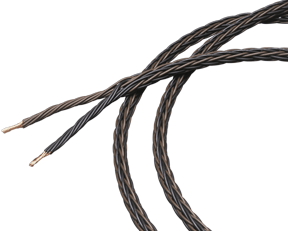 It’s a pretty well
established fact that the Audioholics magazine is one of the toughest critics
of cable snake oils and voodoo. For a
list of the common snake oil we have so far uncovered, I recommend reading the
following article I authored:
It’s a pretty well
established fact that the Audioholics magazine is one of the toughest critics
of cable snake oils and voodoo. For a
list of the common snake oil we have so far uncovered, I recommend reading the
following article I authored:
Top Ten Signs a Cable Vendor is Selling You Snake Oil
As a result, many exotic cable vendors are unwilling to submit products for review to us while others have even referred to us as the anti-Christ at tradeshow events. It’s flattering to elicit such emotional response from folks selling something as mundane as copper cable wrapped in nonsensical technobabble to satiate the geekiest of Star Trek fans just to justify their exorbitant asking prices. As I’ve always said in the past, sell your product for whatever consumers are willing to pay, just keep the BS to a minimum and set your phasers on stun.
Enter Kimber Kable. Kimber is well revered among the most critical of Audiophiles. They are a Utah based company that has been around since the dawn of the exotic cable market which was birthed by no other than Noel Lee of Monster Cable (don't sue us please) back in the 80s. Unlike Monster, Kimber isn’t litigation happy. Their sole function is to sell high quality, and usually high priced cabling. Where Kimber differs than most of the exotic cable market is they don’t wrap their cables in fancy snake oil jargon. They offer cables at all price points to reach a broader audience. If you want a garden hose sized cable, then check out their bi and tri-focal products. I instead chose to review their more down to Earth, reasonably priced solutions, the 4PR and 8PR cable products. I was curious to see if they would at least measure up to standard 12AWG zip cord which is a criteria I have found many exotic cable vendors simply can’t live up to.
Kimber Kable 4PR & 8PR Overview
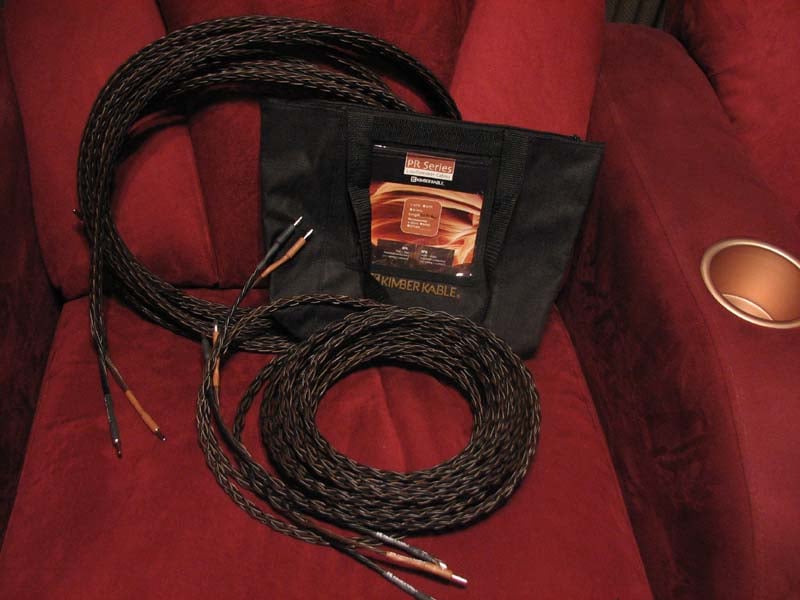 Kimber doesn’t employ a lot
of voodoo that so many of their competitors seem to do in droves. You won’t find any batteries slapped on their
cables, nor will you receive notification that your cables were soaked in
kosher chicken fat blessed by a Rabbi when you purchase their cables. Instead, they utilize real proven braiding
techniques to interweave their speaker cables in such a way as to reduce
inductance which if left unchecked can act as a low pass filter, thus creating
excessive signal loss at high frequencies when connected to your
loudspeakers.
Kimber doesn’t employ a lot
of voodoo that so many of their competitors seem to do in droves. You won’t find any batteries slapped on their
cables, nor will you receive notification that your cables were soaked in
kosher chicken fat blessed by a Rabbi when you purchase their cables. Instead, they utilize real proven braiding
techniques to interweave their speaker cables in such a way as to reduce
inductance which if left unchecked can act as a low pass filter, thus creating
excessive signal loss at high frequencies when connected to your
loudspeakers.
There are a few methods of producing low inductance speaker cables including:
- Sandwiching two flat conductors on top of each other with a thin dielectric between them
- Cross connecting coax cables
- Braiding multiple conductors
Kimber employs the braided technique on most of their speaker cable products, including the 4PR and 8PR reviewed here. This is the preferred method to the others listed above in my opinion. Sandwiching flat conductors, although the best way of reducing cable inductance, also produces the highest cable capacitance which can lead to amplifier stability problems for long runs of cables and not so well designed amplifiers. Cross connecting coax cables generally results in too much cable resistance (ie. using two 18AWG coax yields an equivalent cable AWG of 15AWG) which has appreciably higher losses than simple 12AWG zip cord. It’s also rather inflexible making it difficult to route into A/V racks or through tight spaces.
Kimber 4PR utilizes 4 pairs of conductors to yield an effective gauge of 14AWG while the 8PR utilizes 8 pairs of conductors to yield an effective gauge of 11AWG. If you’ve read any of my technical articles about cables, you would know that the dominant metric governing performance of speaker cables is resistance. It’s because of this fact that I would really recommend serious audiophiles consider the 8PR over the 4PR cables especially if you are using longer runs of cable (> 20ft) and can afford the price difference.
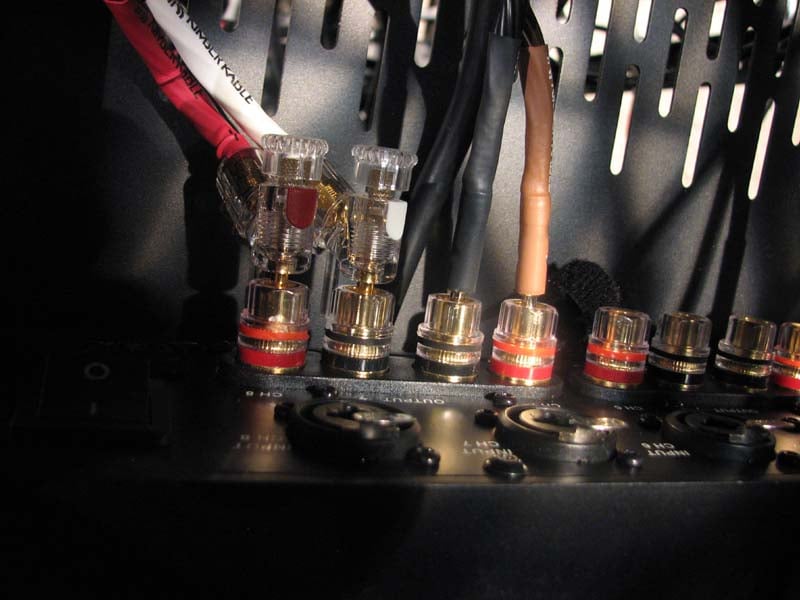
Cable metrics aside, in my opinion, Kimber has the edge over virtually all of their competitors in terms of quality of terminations. Their standard banana plug fit perfectly snug on all of my amplifiers and loudspeakers in my reference system. I typically find non compression bananas either come off the attached equipment too easily or don’t bite all the way down into the connector. The pictures below reveal this was NOT the case with the standard Kimber banana connector.
For an additional premium you can step up to their wonderful compression WBT banana connector which unlike the generic spin offs used by many vendors (ie. Bluejeans Cable, Impact Acoustics, RAM Electronics, etc) these actually lock down by simply turning a screw on the back of the connector. Kimber was the first manufacturer to my knowledge that offered compression RCA and banana plug connectors. When I was first introduced to them I was in awe at how cool they were. I later tested the previously mentioned spin offs with good initial success but lately have found them to be a mixed bag since they often lock up or don’t really tighten down well unless you hold the barrel of the connector down with an adjustable wrench while tightening. Years later, now being re-introduced to Kimbers solution, I am once again in awe. It’s my opinion that Kimber has some of the best quality terminations in the cable business. They alone virtually justify the premium price tag of Kimber products!
Kimber Kable 4PR & 8PR Listening Tests
I am not one who attempts to discern the subtle sonic differences cables convey on an audio system. I am a firm believer that only poorly designed cables can under the right conditions be sonically distinguishable. That being said, my listening tests focused on pure enjoyment of the sound quality of my reference system. At no point did I feel the Kimber cables were adding a level of realism I’ve never heard before with my standard 10AWG Blue Jeans zip cord. Never did I feel the midrange got more chocolatey or a magic veil was lifted. My wife never claimed she could hear the difference all the way from the kitchen while she was cooking up some chicken Marsala.
I used the Kimber 8PR for all of my listening comparisons between the Axiom A1400-8 and my Denon POA-A1HDCI reference amplifier. The Denon AVP-A1HDCI served preamp duties, while the Denon DVD-5910CI and Yamaha MCX-2000 were the sources. All of my electronics were plugged into my APC S20 power conditioners each individually connected to a dedicated 20A line. I utilized my RBH Signature T30-LSE reference series speaker system and threw in my Status Acoustics Decimo bookshelf speakers for comparative purposes. Critical listening tests were conducted mostly for two-channel sources such as CD’s and SACD’s. Multi-channel listening tests were conducted for extended periods of time at reference levels to ensure the amplifier was capable of unfaltering sustained output in my theater room.
CD: Fourplay – The Best Of Fourplay
 I always like a little Fourplay before really getting
into the thick of things. Track #5 “The Chant” is a song I often use to separate the
men from the boys in loudspeakers.
The bass energy of the kick drums will either reward you with an adrenaline
surge or have you covering your ears
from the horrible sound of woofer bottoming right before it plays for the very
last time. Of course this isn’t a
problem for my reference speakers but I wanted to see just how far the A1400-8
could push them and get their four 10” high excursion subwoofer drivers
moving. The A1400-8 delivered thunderous
bass response with
aplomb. The
transient response was lightening quick extracting all of the decay of the kick
drums making it feel more like a live performance right in my own theater room
than listening to an actual recording.
The wood percussion instruments were delicately reproduced with all of
the subtle nuances preserved. In comparison
to my Denon POA-A1HDCI, I felt the Axiom amp was a bit more lively and crisp
but the soundstage on the Denon seemed a bit wider and more open.
I always like a little Fourplay before really getting
into the thick of things. Track #5 “The Chant” is a song I often use to separate the
men from the boys in loudspeakers.
The bass energy of the kick drums will either reward you with an adrenaline
surge or have you covering your ears
from the horrible sound of woofer bottoming right before it plays for the very
last time. Of course this isn’t a
problem for my reference speakers but I wanted to see just how far the A1400-8
could push them and get their four 10” high excursion subwoofer drivers
moving. The A1400-8 delivered thunderous
bass response with
aplomb. The
transient response was lightening quick extracting all of the decay of the kick
drums making it feel more like a live performance right in my own theater room
than listening to an actual recording.
The wood percussion instruments were delicately reproduced with all of
the subtle nuances preserved. In comparison
to my Denon POA-A1HDCI, I felt the Axiom amp was a bit more lively and crisp
but the soundstage on the Denon seemed a bit wider and more open.
Regardless of how loudly I played either amplifier, my system sounded effortless and unstrained revealing excellent sustain and decay of the kick drums and percussion instruments. The Kimber cables were proving to deliver all of the juice my high current amplifiers were capable of dishing out to my speakers.
Dianne Reeves Never Too Far
 When I want a quick
reference for gauging accuracy in bass response of loudspeakers and even
amplifiers, I turn to this CD. The bass
in track in Track #2 “Never Too Far” will sound muddy or weak on an improperly
set up or inadequate system. I have
this song pinned into my head as to how the bass should sound so I wanted to
directly compare it on the two amplifiers.
A back and forth comparison between these amplifiers on my reference
speakers revealed that the Axiom amp was a bit leaner in the bass department
but much tighter and more lively. The
decay of the bass drum sounded stereophonic to me when listening on the
A1400-8. I couldn’t help but to really
punch up the volume and give my speakers the workout they’ve been waiting
for. Track #3 “Come In” again revealed
the Axiom’s very well mannered bass
response with less apparent overhang that I was hearing on my reference
amplifier. However, I did feel that the
Denon was offering up a slightly
smoother more spacious top end. Ironically when I switched over to my
bookshelf speakers to make the comparison, I conversely preferred the bass I
was hearing from the Denon amp which seemed fuller to me. Perhaps on smaller less bass capable
speakers, I preferred the warmer sound the Denon amp was offering. It’s
also possible that the Axiom amp preferred the lower impedance (dips to 2 ohms)
of my tower speakers over my 8 ohm bookshelf speakers. Needless to say the sonic differences between
the two amps thus far were subtle but noteworthy. The A1400-8 reminded me how far Class D amps
have come and really shattered my misconception of them for full range high
fidelity audio applications. Until I
heard this amplifier, I was unconvinced that Class D would ever be a serious
contender against good old fashion linear designs. The Kimber cables once again proved to be
transparent enough for me to discern the subtle sonic differences I was hearing
between these two fine amplifiers I had under review.
When I want a quick
reference for gauging accuracy in bass response of loudspeakers and even
amplifiers, I turn to this CD. The bass
in track in Track #2 “Never Too Far” will sound muddy or weak on an improperly
set up or inadequate system. I have
this song pinned into my head as to how the bass should sound so I wanted to
directly compare it on the two amplifiers.
A back and forth comparison between these amplifiers on my reference
speakers revealed that the Axiom amp was a bit leaner in the bass department
but much tighter and more lively. The
decay of the bass drum sounded stereophonic to me when listening on the
A1400-8. I couldn’t help but to really
punch up the volume and give my speakers the workout they’ve been waiting
for. Track #3 “Come In” again revealed
the Axiom’s very well mannered bass
response with less apparent overhang that I was hearing on my reference
amplifier. However, I did feel that the
Denon was offering up a slightly
smoother more spacious top end. Ironically when I switched over to my
bookshelf speakers to make the comparison, I conversely preferred the bass I
was hearing from the Denon amp which seemed fuller to me. Perhaps on smaller less bass capable
speakers, I preferred the warmer sound the Denon amp was offering. It’s
also possible that the Axiom amp preferred the lower impedance (dips to 2 ohms)
of my tower speakers over my 8 ohm bookshelf speakers. Needless to say the sonic differences between
the two amps thus far were subtle but noteworthy. The A1400-8 reminded me how far Class D amps
have come and really shattered my misconception of them for full range high
fidelity audio applications. Until I
heard this amplifier, I was unconvinced that Class D would ever be a serious
contender against good old fashion linear designs. The Kimber cables once again proved to be
transparent enough for me to discern the subtle sonic differences I was hearing
between these two fine amplifiers I had under review.
CD: Special EFX - Collection
 This is an old favorite of mine not only because of the excellent
musical content, but of the pristine fidelity that really helps gauge a systems
frequency range. On track #2 “Jamaica, Jamaica”, the Triangles seemed to
spread out beyond the plane of the speakers on both amps but with perhaps a bit
more 3 dimensional depth on the Denon amp.
While I thought I heard slightly better separation of the instruments on
my Denon amp, the Axiom sounded more vivacious.
On the A1400-8, the plucks of Chieli Minucci’s
guitar seemed more vibrant while the bass was also snappier, especially at
higher listening levels. In contrast,
switching over to my Decimo speakers had me preferring the dare I say more
sluggish bass response of the Denon amp which made those little bookshelf
speakers sound more grandiose.
This is an old favorite of mine not only because of the excellent
musical content, but of the pristine fidelity that really helps gauge a systems
frequency range. On track #2 “Jamaica, Jamaica”, the Triangles seemed to
spread out beyond the plane of the speakers on both amps but with perhaps a bit
more 3 dimensional depth on the Denon amp.
While I thought I heard slightly better separation of the instruments on
my Denon amp, the Axiom sounded more vivacious.
On the A1400-8, the plucks of Chieli Minucci’s
guitar seemed more vibrant while the bass was also snappier, especially at
higher listening levels. In contrast,
switching over to my Decimo speakers had me preferring the dare I say more
sluggish bass response of the Denon amp which made those little bookshelf
speakers sound more grandiose.
Track #5 “Udu Voodoo” seems surreal as I got lost in the textures of the percussive instruments and the ping pong effect between the front speakers that the A1400-8 conveyed. Self restraint with the volume control became quite difficult for me as the sound was just effortless at all power levels. My T30-LSE’s simply craved the unadulterated power that the Axiom amplifier was providing. The A1400-8 was proving it was right at home with the rich and complex textures of jazz music which dominates much of my listening preferences. The Kimber cables were also gingerly handling all of the subtleties and nuances that my gear was able to reproduce for total music enjoyment and envelopment.
Kimber Kable 4PR & 8PR Measurements and Analysis
Using our Wayne Kerr 6420 Impedance Analyzer which graces our Test Equipment Laboratory, I measured all of the critical metrics which directly affect cable performance. I charted the results with some of the most recent speaker cables we’ve reviewed for comparative purposes.
Cable Metric Definitions
| Rdc- |
Commonly referred to DCR which is the series resistance of a cable at zero frequency. |
| Rac - | The resistive portion of the cables series resistance as a function of frequency due to skin effect. |
| Rs - | Total Series Resistance (mohms) measured tip to tip at one end of the cable while the other end is shorted. Note: Rs = Rac + Rdc (minus instrumentation inaccuracies identified below) |
| Ls - | Series Inductance (uH) measured tip to tip at one end of the cable while the other end is shorted. |
| Cp - | Parallel Capacitance (pF) measured tip to tip at one end of the cable while the other end is open circuited. |
Note about electrical cable resonance
Editorial Note on Cable Measurement Test Set-up
All of the measurements were completed on a fully calibrated and certified, Wayne Kerr 6420 Impedance Analyzer. The 6420 was calibrated for full frequency bandwidths and for greater accuracy the measurements and calibration process was repeated twice for consistency.
All cable lengths measured were 20 feet and divided by their length for a normalized per foot measurement. At low frequencies the results illustrate Rs being lower than Rdc, which is inaccurate, as Rs tends towards Rdc as frequency approaches zero or DC. The LCR measurement derives Rs from signal phase and amplitude, while a DC meter measures exactly what it is looking for, thus this discrepancy is likely due to a meter resolution issue, as the meter in AC mode does not sport the high accuracy it would in DC mode. The cable should ideally be modeled as multiple parallel resistors, and those resistors treated as a lumped element in series with an ideal inductor.
Each resistor is a frequency dependent element, and the inner ones fall out as the frequency increases. It is important to note the difference in measuring techniques, and caution the reader not to attempt to derive any relationships with the two numbers, as the absolute accuracy between the methods has not been established. However, the rising trend of Rs vs frequency is indicative of increased Rac due to skin effect and should also be noted.
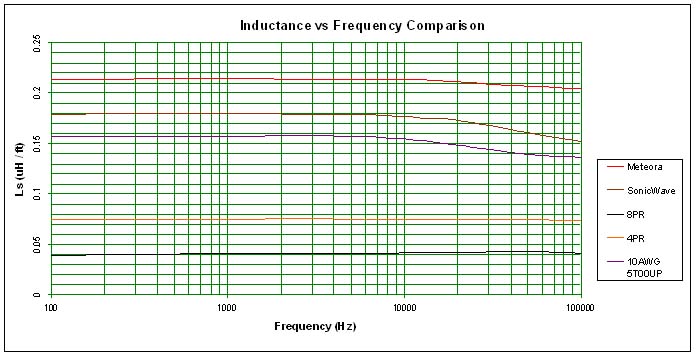
Inductance vs Frequency
Both the Kimber 4PR and 8PR were among the lowest inductance cables in this comparison. Due to the braided geometry of these cables, not only are they the lowest inductance, but their inductance profile vs frequency was ruler flat for the entire audio band. By weight of comparison, the inductance of the 8PR was a mere .041uH/ft which was nearly four times lower than the 10AWG Bluejeans speaker cables that I revere so much. Interestingly Kimber rates the inductance of these cables as .056uH/ft which is slightly higher than I measured but shows they are conservative in their ratings.
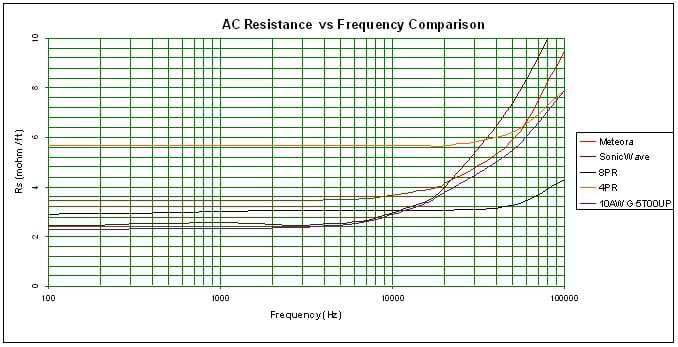
AC Resistance vs Frequency
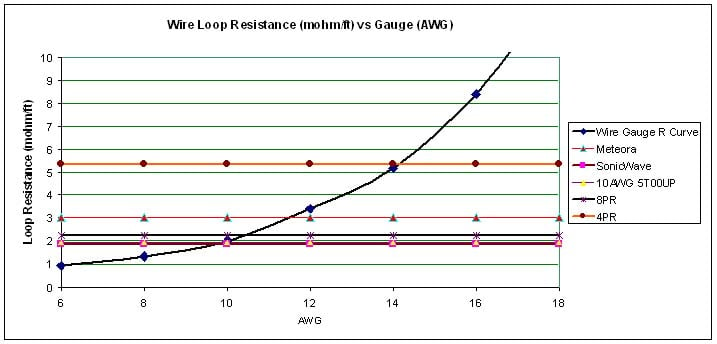
Resistance vs Gauge
The Kimber 4PR have the highest resistance out of all of the cables in this comparison. The effective gauge of these cables is around 14AWG which isn’t terrible but for considerably less cost one could get some of the competing lower resistance brands in this comparison. The Kimber 8PR’s effective gauge is around 11AWG which is significantly lower than the 4PR and close to the Bluejeans 5T00UP 10AWG cables. What is very interesting about both Kimber products is that they are the only speaker cables in this comparison with a relatively flat AC resistance profile. Both products don’t start to show appreciable signs of skin effect until arounf 50kHz which is well above the audio band. At 100kHz the AC resistance of the 14AWG Kimber 4PR cables is equivalent to the Bluejeans 5T00UP 10AWG cables. While this is purely academic, it is noteworthy that Kimber products are by design less prone to skin effect than the other cables even though they don’t post nonsensical arguments on their website about how this parameter can cause deleterious effects at audio frequencies.
For a more detailed discussion on Skin Effect, see:
Skin Effect Relevance in Speaker Cables
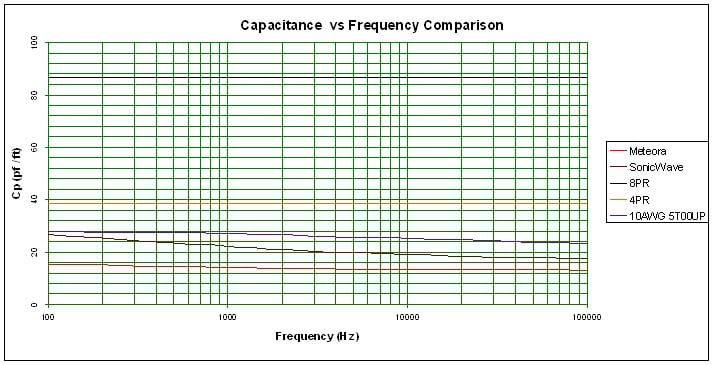
Capacitance vs Frequency
It is no surprise that when a cable is designed to be low inductance that its capacitance will be proportionally higher as a result. Unlike cables that sandwich their conductors together, the Kimbers manage to keep capacitance in check without the necessity of adding a zobel network on the speaker side of the cable to assure amplifier stability. Kimbers published capacitance spec is 38pF for the 4PR and 90pF/ft for the 8PR. This is about what I measured as well as you can see from the graph above. The Kimber 8PR is about four times higher in capacitance than the Sonicwave or 5T00UP cables, and twice as high as its 4PR sibling. Again I don’t see this as a show stopper especially since most people purchasing these type of cables are doing so for short runs (under 50 ft) and are likely using high quality amplification that doesn’t have stability issues driving moderately high capacitive cables.
Kimber Kable 4PR & 8PR Recommendations
 People shopping exotic cables aren’t typically factoring value into the
equation. They want peace of mind that
their cables will do no harm to their system and some even take it to the
extreme thinking they will improve the transmission of the signal from their
amplifiers to their loudspeakers. Of
course there is a psychological term for this type of thinking, but since I am
not a physician of medicine, I will leave that prognosis to a qualified MD. The Kimber 4PR and 8PR although pricey,
probably offers some of the highest quality to value ratio I’ve seen in exotic
cables. Not only does Kimber not refute
the importance of quantifying the performance of their products, but they
provide you with very conservative measurements to boot. They don’t wrap their products in warm or
fuzzy technobabble. For those in seek of
such dribble, I encourage you to check out the new Star Trek movie as you will likely also find more realism while
also enjoying some quality entertainment.
People shopping exotic cables aren’t typically factoring value into the
equation. They want peace of mind that
their cables will do no harm to their system and some even take it to the
extreme thinking they will improve the transmission of the signal from their
amplifiers to their loudspeakers. Of
course there is a psychological term for this type of thinking, but since I am
not a physician of medicine, I will leave that prognosis to a qualified MD. The Kimber 4PR and 8PR although pricey,
probably offers some of the highest quality to value ratio I’ve seen in exotic
cables. Not only does Kimber not refute
the importance of quantifying the performance of their products, but they
provide you with very conservative measurements to boot. They don’t wrap their products in warm or
fuzzy technobabble. For those in seek of
such dribble, I encourage you to check out the new Star Trek movie as you will likely also find more realism while
also enjoying some quality entertainment.
As much as I like the WBT compression banana connectors, they come at a hefty premium of $72/pair. There is no sonic advantage to these connectors over their standard banana plug which runs $10/pair. I did find their standard banana plug to make excellent contact with my amplifier and speaker terminals so unless you need a connector that can withstand some serious pulling force, or you just dig the look and feel of the WBT’s, save your coin and opt for their standard banana plug which is one of the best banana’s in terms of form and function that I’ve tested to date. Although there is a slight cost savings buying these cables unterminated (cost per foot), I’d highly recommend specifying your desired length and having Kimber terminate them for you regardless of which termination option you ultimately settle on. I loath the idea of individually stripping and twisting 64 conductors for the 8PR / 32 for the 4PR and then trying to properly terminate them. You’re already paying a premium for these quality cables so why not have them finished off the right way?
Given the choice between the 4PR and 8PR, I would chose the latter to wire my front three channels and use more economical cabling for the surrounds (ie. Bulk 12AWG zip cord) as neither of these solutions make practical sense for very long speaker runs. The fit and finish of these cables is excellent with my only major grip being with brown color of the + conductors. I would have preferred standard red and black but that is just a personal preference. For a nominal fee, Kimber can shrink wrap your cables to improve their aesthetics. If you spend a lot of time staring at your speaker cables or showing them off to your audiophile friends, this may be an upgrade option worth considering.
Conclusion
Overall I am a big fan of the Kimber 8PR speaker cables and I plan on utilizing my review samples in my reference system quite heavily not just because they perform well but because the package as a whole is of excellent quality and design. I fell in love with their banana terminations and wish that their competition would go back to the drawing board and make more cost effective cloned solutions. If you are on the market for high end exotic cables and your goal is transparency over glorified tone controls, then I highly recommend the Kimber 8PR speaker cables. It’s refreshing to find an exotic cable vendor that discloses all performance metrics of their products, doesn’t wrap them in snake oil and delivers a reference level performing product that scores high in pride of ownership. Highly recommended!
Kimber Kable 4PR & 8PR Cable
Review
MSRP:
8PR: $5.6 per foot + terminations / 4PR: $2.9/ft + terminations
2752 South 1900 West
Ogden, Utah
84401
(801) 621-5530
The Score Card
The scoring below is based on each piece of equipment doing the duty it is designed for. The numbers are weighed heavily with respect to the individual cost of each unit, thus giving a rating roughly equal to:
Performance × Price Factor/Value = Rating
Audioholics.com note: The ratings indicated below are based on subjective listening and objective testing of the product in question. The rating scale is based on performance/value ratio. If you notice better performing products in future reviews that have lower numbers in certain areas, be aware that the value factor is most likely the culprit. Other Audioholics reviewers may rate products solely based on performance, and each reviewer has his/her own system for ratings.
Audioholics Rating Scale
 — Excellent
- — Very Good
- — Good
- — Fair
- — Poor
| Metric | Rating |
|---|---|
| Ease of Setup | |
| Audio Performance | |
| Build Quality | |
| Appearance | |
| Performance | |
| Value | |
Gene manages this organization, establishes relations with manufacturers and keeps Audioholics a well oiled machine. His goal is to educate about home theater and develop more standards in the industry to eliminate consumer confusion clouded by industry snake oil.
View full profile Subscribe to our newsletter