


Impact Acoustics SonicWave Speaker Cable Review
SonicWave speaker cables
- Product Name: SonicWave Speaker Cables
- Manufacturer: Impact Acoustics
- Performance Rating:


- Value Rating:
- Review Date: October 04, 2006 19:00
- MSRP: $ 109 (12' terminated)
- Maximum performance through advanced cable design, construction and materials
- Multiple connector configurations for the most common high-end speaker applications; 5/16in Spade Terminals and Banana Plugs
- 24K Gold-Plated Terminals
- Oxygen-free copper ensures maximum fidelity.
- Ideal for Home Theater and music applications.
- Packaged individually so you can customize to your unique installation
- 10AWG oxygen-free copper is constructed from 7 bundles of 18AWG conductors
Pros
- Snake oil free, no nonsense cables
- Excellent all inclusive and interchangeable terminations
- Great build quality
Cons
- Obtrusive plastic block on each end of cable
Impact Acoustics SonicWave Speaker Cable Introduction
 Does your speaker wire suffer from gauge
envy?
You know the kind -
the dental floss cable that is typically thrown in for free when
you buy that HTIB system that's supposed to replace your rack of equipment.
Does your speaker wire suffer from gauge
envy?
You know the kind -
the dental floss cable that is typically thrown in for free when
you buy that HTIB system that's supposed to replace your rack of equipment.
Well there is another kind of cable that also suffers this fate. Sadly it's the kind that a so called audiophile will gladly shell out thousands of dollars on because they were sold a great story about how this new magic cable would transform their sonically lifeless system into a botanical garden of musical delight.
"Don't waste your money on room treatments or better speakers till you try our magic cables . Measurements? Nah, we don't do those since they are meaningless. Trust your ears. - Ask any Scientologist, oops I mean any "Cable Expert" and they will tell you.
While the debate rages on with the "Cable Experts" or those whom I usually refer to as "Cable Soothsayers", its nice to know Impact Acoustics is on the same mission as Audioholics' a "no BS" approach while delivering the best products and/or services.
Note: For a list of the common snake oil we have so far uncovered, I recommend reading the following Audioholics article Top Ten Signs a Cable Vendor is Selling You Snake Oil .
Refreshingly, Impact Acoustics Cables are fully "snake oil free" and we have so much confidence in their products and methodologies that we actually syndicate some of their editorials on our website.
Impact Acoustics SonicWave Cables Packaging and Design
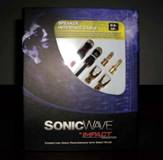 While most esoteric cable companies will jump through hoops to deliver the most aesthetically pleasing
cable designs, they often overlook the packaging.
In the great tradition of SonicWave
Impact Acoustics products, their packaging is top notch.
It's almost a crime to discard
their magnetically sealed boxes after you pull out the cables for usage.
I suggest keeping them as
a memento for choosing a product that spares no expense in detail from design, material usage all the way
to its wrappings.
You can always store your discarded exotic battery powered,
strand-jumping-reducing exotic cables in it as a reminder to never let marketing misguide your purchasing
decision again.
While most esoteric cable companies will jump through hoops to deliver the most aesthetically pleasing
cable designs, they often overlook the packaging.
In the great tradition of SonicWave
Impact Acoustics products, their packaging is top notch.
It's almost a crime to discard
their magnetically sealed boxes after you pull out the cables for usage.
I suggest keeping them as
a memento for choosing a product that spares no expense in detail from design, material usage all the way
to its wrappings.
You can always store your discarded exotic battery powered,
strand-jumping-reducing exotic cables in it as a reminder to never let marketing misguide your purchasing
decision again.
Terminations to Please the Terminator
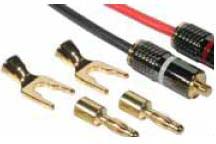 Just like we found with their Meteora speaker cables, this is no girlie man
cable solution.
Wimpy spade connectors that won't fit a standard speaker or amplifier binding
post have no place here.
Until I tested these 5/16-inch spade connectors, I wasn't a fan of
spade connectors.
Most slid off even after tightening down the binding post, or simply didn't
make a good connection with the binding post.
This was NOT the case with the SonicWave cable spade
terminations.
Just like we found with their Meteora speaker cables, this is no girlie man
cable solution.
Wimpy spade connectors that won't fit a standard speaker or amplifier binding
post have no place here.
Until I tested these 5/16-inch spade connectors, I wasn't a fan of
spade connectors.
Most slid off even after tightening down the binding post, or simply didn't
make a good connection with the binding post.
This was NOT the case with the SonicWave cable spade
terminations.
Don't like spade connectors? No problem, check out their excellent banana plugs which, although aren't the locking type, do make excellent contact and provide a snug fit with every speaker terminal I tried including receivers from Denon and Yamaha; amplifiers from Emotiva and Panasonic; and loudspeakers from Axiom, Rocket and RBH Sound.
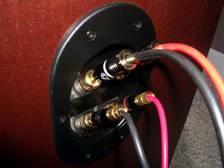
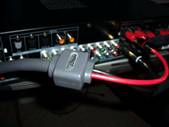
RBH T-30LSE (left) and Panasonic SA-XR50 Receiver (right)
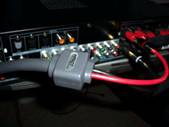 Changing out terminations on the SonicWave cable system was a breeze.
All you do
is screw on/off the connector(s) of your choice and you're good to go.
If you are snaking the
cable behind your equipment rack or speakers, I recommend doing so unterminated. Applying the
terminations just before you make the connection to your components and speakers is a good measure to
avoid accidentally losing a connector should it come loose during the cable installation process.
I
did however find that once you firmly tightened down the connector by hand, it remained locked in place
just fine.
As an extra precaution, you may wish to further tighten with a pair of pliers once
you make up your mind which terminations work best for you.
Changing out terminations on the SonicWave cable system was a breeze.
All you do
is screw on/off the connector(s) of your choice and you're good to go.
If you are snaking the
cable behind your equipment rack or speakers, I recommend doing so unterminated. Applying the
terminations just before you make the connection to your components and speakers is a good measure to
avoid accidentally losing a connector should it come loose during the cable installation process.
I
did however find that once you firmly tightened down the connector by hand, it remained locked in place
just fine.
As an extra precaution, you may wish to further tighten with a pair of pliers once
you make up your mind which terminations work best for you.
About the only thing I wasn't too keen on was their bulky plastic square blocks located towards the end of each cable before they terminate to the connectors. This is a constant theme or should I say fad of SonicWave products that I wish Impact Acoustics would let die with the likes of Bell Britney Spears music, 8-Track tape and the Atkins diets. Seriously this is a hindrance to any custom install application where the Installer wishes to work cables through a conduit or component rack. I'd much prefer a nice flexible sleeving to finish off these cables.
The Cable Design
There is no rocket science to this cable design, nor should there be for any good speaker cable design. Remember the Borg mantra "Resistance is futile" and you are halfway there to designing a good cable since that is the dominant metric which governs good speaker cable design. The SonicWave speaker cable is good old-fashioned twin feeder (10 AWG oxygen-free copper cable that, according to Impact Acoustics, is constructed from seven bundles of 18AWG conductors for maximum flexibility. A 12mm PVC jacket envelopes both cables which also serves twofold: protecting the cable and enhancing the aesthetics.
Though Impact Acoustics doesn't specify their cable metrics, they are easy to figure out by simple inspection based on our articles authored on cable inductance and capacitance titled "Calculating Cable Inductance in Speaker Cables" and "Dielectric Absorption in Cables Debunked"
...inductance and capacitance values are interrelated and based on the dielectric and conductor spacing between the (+) and (-) conductors.
I was unable to inspect conductor spacing since the cables were encased with PVC, thus I made detailed measurements to determine the specifications.
Impact Acoustics SonicWave Measurements and Conclusion
Using our Wayne Kerr 6420 Impedance Analyzer which graces our Reference System 1 lab, I measured all of the critical metrics which directly affect cable performance.
Cable Metric Definitions
|
Rdc - |
Commonly referred to DCR which is the series resistance of a cable at zero frequency. |
|
Rac - |
The resistive portion of the cable's series resistance as a function of frequency due to skin effect. |
|
Rs - |
Total Series Resistance (mohms) measured tip to tip at one end of the cable while the other end is shorted. Note: Rs = Rac + Rdc (minus instrumentation inaccuracies identified below) |
|
Ls - |
Series Inductance (uH) measured tip to tip at one end of the cable while the other end is shorted. |
|
Cp - |
Parallel Capacitance (pF) measured tip to tip at one end of the cable while the other end is open circuited. |
Cable Measurement Test Set-Up Notes
All of the above measurements were completed on a fully calibrated and certified, Wayne Kerr 6420 Impedance Analyzer . The 6420 was calibrated for full frequency bandwidths and for greater accuracy the measurements and calibration process was repeated twice for consistency.
All cable lengths measured were 20 feet and divided by their length for a normalized per foot measurement. At low frequencies the results illustrate Rs being lower than Rdc, which is inaccurate, as Rs tends towards Rdc as frequency approaches zero or DC. The LCR measurement derives Rs from signal phase and amplitude, while a DC meter measures exactly what it is looking for, thus this discrepancy is likely due to a meter resolution issue, as the meter in AC mode does not sport the high accuracy it would in DC mode. The cable should ideally be modeled as multiple parallel resistors, and those resistors treated as a lumped element in series with an ideal inductor.
Each resistor is a frequency dependent element, and the inner ones fall out as the frequency increases. It is important to note the difference in measuring techniques, and caution the reader not to attempt to derive any relationships with the two numbers, as the absolute accuracy between the methods has not been established. However, the rising trend of Rs vs frequency is indicative of increased Rac due to skin effect and should also be noted.
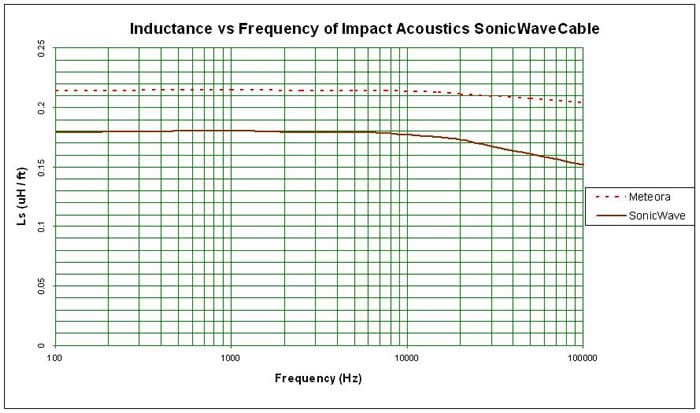
Figure 1.
Inductance vs Frequency of SonicWave Cable
One of the benefits of using lower gauge wire spaced closely together is reduced inductance as can be seen in the comparison of the Meteora (12AWG) vs the SonicWave (10AWG) cable in this example. Inductance was about 16% lower on the SonicWave Cable (around 0.18uH/ft) compared with their Meteora cable previously reviewed here. We like to see cable inductance below .200uH/ft to minimize high frequency rolloff for long cable runs and SonicWave comfortably meets our criteria. The slight decrease in cable inductance above 20kHz is a result of minimized internal inductance due to skin effect. This is an inaudible and barely measurable phenomenon and is only discussed herein for academic purposes.
For a more detailed discussion on Cable Inductance, please see our article on Calculating Speaker Cable Inductance.
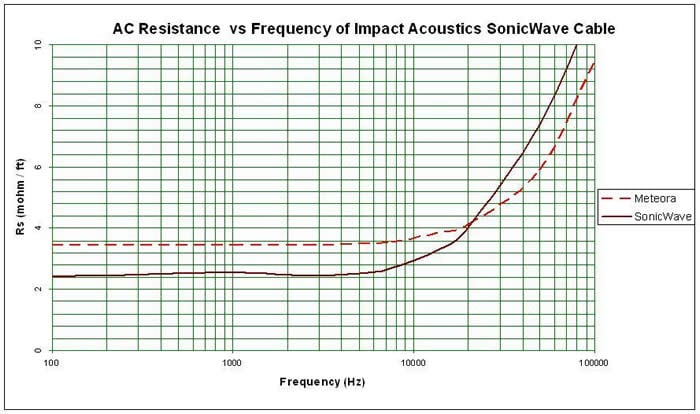
Figure 2. AC Resistance vs Frequency of SonicWave Cable
The resistance of the SonicWave measures just below 2mohms/ft (1.87mohm/ft actually) which represents an equivalent effective gauge of around 10 AWG at DC as specified by Impact Acoustics. This is a very low resistance speaker cable making it ideal for long runs throughout the home with minimized losses. We see a rise in AC resistance with frequency above 20 kHz attributed to skin effect, but practically speaking a non-issue for the application of high fidelity audio. What's important is the AC resistance at audio frequencies is appreciably lower on SonicWave than the Meteora cable, though both cables have excellently low AC resistance, significantly lower than many costlier esoteric designs that claim to "reduce" skin effect.
For a more detailed discussion on Skin Effect, see our article on Skin Effect Relevance in Speaker Cables
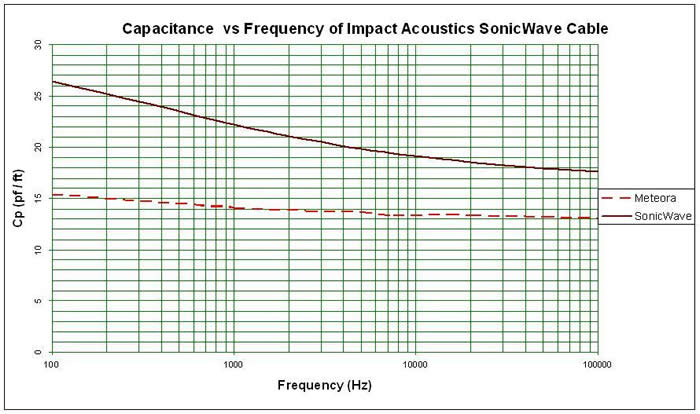
Figure 3. Capacitance vs Frequency of SonicWave Cable
Capacitance was very low, weighing in around 20pF/ft only slightly higher than that of the Meteora speaker cable. We like to see cables measure under 50pF/ft, a spec which SonicWave comfortably meets. This ensures there won't be any stability or frequency peaking issues for long runs on marginally stable amplifiers with high unity gain crossing, or excessive high frequency rolloff on amplifiers with high output impedances driving a reactive loudspeaker load. The reason for the slight decrease in capacitance with increasing frequency is likely attributed to measurement error of measuring a distributed device (speaker cable) with a measurement tool (Magnetics Analyzer) designed to measure lumped elements (magnetics, electrical circuits, etc). Rest assured this cable has very low capacitance and can be connected to virtually any amplifier without risk of loss of stability or frequency peaking or roll off regardless of amplifier characteristics.
Conclusion
If you're after a true high performance cable that measures better than most of the costlier esoteric designs, but don't want to break the bank, the SonicWave cable should be on your short list. While it isn't as cheap as a DIY type alternative, folks less inclined to prep and terminate their own cables should find their convenience worth the cost added. Audiophiles demanding the best performance from their systems should flock in droves to these cables. Aesthetically they are nice, though not as fancy as some of the exotics named after snakes or tropical resorts but they will finish off your system nicely. Will they lift a veil of lifelessness from your system? Highly doubtful. They also won't, however, act as a tone control like so many esoteric cables tend to. Instead, they will transmit the electrical signal from your amplifier to your speakers unadulterated.
Until cable companies can produce affordable super conductors or lossless RF technology to transmit the signal from your amplifier to your speakers, you can rest assured you have just about the best cost-effective cabling solution on your hands with SonicWave. Save the dental floss for the bathroom and pocket the money you save from the more expensive exotic cables that will likely underperform. Get the SonicWave cables if you're serious about high performance with a cable that will do NO harm to the fidelity of your system. Highly Recommended!
MSRP: $109.99 per 12ft terminated cable
Impact Acoustics
1501 Webster Street
Dayton, OH 45404
http://www.impactacoustics.com
The Score Card
The scoring below is based on each piece of equipment doing the duty it is designed for. The numbers are weighed heavily with respect to the individual cost of each unit, thus giving a rating roughly equal to:
Performance × Price Factor/Value = Rating
Audioholics.com note: The ratings indicated below are based on subjective listening and objective testing of the product in question. The rating scale is based on performance/value ratio. If you notice better performing products in future reviews that have lower numbers in certain areas, be aware that the value factor is most likely the culprit. Other Audioholics reviewers may rate products solely based on performance, and each reviewer has his/her own system for ratings.
Audioholics Rating Scale
 — Excellent
- — Very Good
- — Good
- — Fair
- — Poor
| Metric | Rating |
|---|---|
| Audio Performance | |
| Build Quality | |
| Ease of Setup/Programming/Integration | |
| Performance |  |
| Value | |
Gene manages this organization, establishes relations with manufacturers and keeps Audioholics a well oiled machine. His goal is to educate about home theater and develop more standards in the industry to eliminate consumer confusion clouded by industry snake oil.
View full profile Subscribe to our newsletter