


Blue Jeans 5T00UP 10AWG Speaker Cable Review
Blue Jeans Cable 10AWG Speaker Cables
- Product Name: 5T00UP 10AWG Speaker Cable
- Manufacturer: Blue Jeans Cable
- Performance Rating:


- Value Rating:
- Review Date: February 28, 2006 18:00
- MSRP: $ 32.40
|
Electrical Characteristics
|
|
Pros
- Snake Oil Free, no nonsense cables
- Excellent measured performance
- High value
- CL3 approved for in-wall installations
Cons
- Thick wire hard to terminate
- Plain styling
Blue Jeans 5T00UP Introduction
It's no secret we are fans of Blue Jeans Cable. In fact, scan forum threads throughout the Internet and you will usually find people mentioning Blue Jeans Cable and Audioholics in the same sentence. This is no coincidence. Blue Jeans Cable and Audioholics are on the same mission - a "no BS" approach while delivering the best products and/or services.
For a list of the common snake oil we have so far uncovered, we recommend reading the Audioholics article titled Top Ten Signs a Cable Vendor is Selling You Snake Oil
Refreshingly, Blue Jeans Cables are fully snake oil free and we have so much confidence in their products and methodologies that we actually syndicate some of their editorials on our website.
Blue Jeans offers two options when purchasing their cables:
- Buy in bulk
- Buy in specific lengths pre-terminate
Blue Jeans 5T00UP Locking Terminations & Cable Design
Finding a banana plug to snugly mate with female banana receptacles on my home theater wall plates is a challenge to say the least. This is why I am such a big fan of locking style banana terminations. Their locking banana plug can accommodate pretty much any binding post out there. All you have to do is keep twisting the terminal until the banana plug firmly connects to your amp or speaker's binding posts. Once tightened, I was unable to pull the cables off of my speakers or wall plate connectors. Having a solid termination is critical to minimizing contact resistance and also reducing potential bad connections caused by moving equipment back in place after hooking it all up. I have seen far too many poorly designed spade/banana plug terminations used by exotic cable vendors that either fall off the connectors, or simply add excessive series resistance which they are allegedly trying to minimize in their cable design. I consider this counterproductive and it appears Blue Jeans Cable is in agreement as evidenced by their locking banana plug termination which is now popularized by many of the better cable manufacturers out there. These terminations aren't cheap at $5.25/pair, but in this case you get what you pay for. I highly recommend the added expenditure if your setup is susceptible to loose connections. However, for those on a tight budget, you can still opt for traditional banana or spade terminations for a fraction of the cost.
The Cable Design
There is no rocket science to this cable design. Its good old fashioned Belden 10AWG twin feeder cable used worldwide in many of the top notch recording studios and pro installations more concerned with performance and durability over market appeal and aesthetics.
Though Blue Jeans doesn't specify their cable metrics, they are easy to figure out by simple inspection. You can learn more about this by reading up on the following Audioholics articles regarding cable inductance and capacitance:
...inductance and capacitance values are interrelated and based on the dielectric and conductor spacing between the (+) and (-) conductors.
Without a caliper on hand to measure conductor to conductor spacing, I eye balled around .17uH/ft inductance and 25pF/ft capacitance. Given its 10AWG specification, this cable should measure around 2mohm/ft (loop resistance).
Belden's standard version of these cables is available only in a gray jacket, with white and black inner conductors; however, Blue Jeans had Belden build a slightly modified version of each, with a white outer jacket (less conspicuous in many installations) and red and black inner conductors. Both the 10-gauge and 12-gauge versions consist of two separately insulated conductors, twisted together and wrapped in an outer PVC sleeve. Whether in white or gray, or 10 or 12 AWG, all of these cables are UL-listed and NEC-rated for in-wall use (the NEC rating for 5000UE and Twelve White is CL3R; for 5T00UP and Ten White, it's CL2). This is a critical metric for installers wanting to run cables behind drywall for new construction.
Blue Jeans 5T00UP Cable Measurements
Using our
Wayne Kerr 6420
Impedance Analyzer
which graces our
Reference System 1, I measured all of the critical metrics which directly affect cable
performance.
Cable Metric Definitions
|
Rdc |
Commonly referred to DCR which is the series resistance of a cable at zero frequency. |
|
Rac |
The resistive portion of the cables series resistance as a function of frequency due to skin effect. |
|
Rs |
Total Series Resistance (mohms) measured tip to tip at one end of the cable while the other end is shorted. Note: Rs = Rac + Rdc (minus instrumentation inaccuracies identified below) |
|
Ls |
Series Inductance (uH) measured tip to tip at one end of the cable while the other end is shorted. |
|
Cp |
Parallel Capacitance (pF) measured tip to tip at one end of the cable while the other end is open circuited. |
Cable Measurement Test Set-Up Notes
All of the above measurements were completed on a fully calibrated and certified, Wayne Kerr 6420 Impedance Analyzer . The 6420 was calibrated for full frequency bandwidths and for greater accuracy the measurements and calibration process was repeated twice for consistency.All cable lengths measured were 20 feet and divided by their length for a normalized per foot measurement. At low frequencies the results illustrate Rs being lower than Rdc, which is inaccurate, as Rs tends towards Rdc as frequency approaches zero or DC. The LCR measurement derives Rs from signal phase and amplitude, while a DC meter measures exactly what it is looking for, thus this discrepancy is likely due to a meter resolution issue, as the meter in AC mode does not sport the high accuracy it would in DC mode. The cable should ideally be modeled as multiple parallel resistors, and those resistors treated as a lumped element in series with an ideal inductor.
Each resistor is a frequency dependent element, and the inner ones fall out as the frequency increases. It is important to note the difference in measuring techniques, and caution the reader not to attempt to derive any relationships with the two numbers, as the absolute accuracy between the methods has not been established. However, the rising trend of Rs vs frequency is indicative of increased Rac due to skin effect and should also be noted.
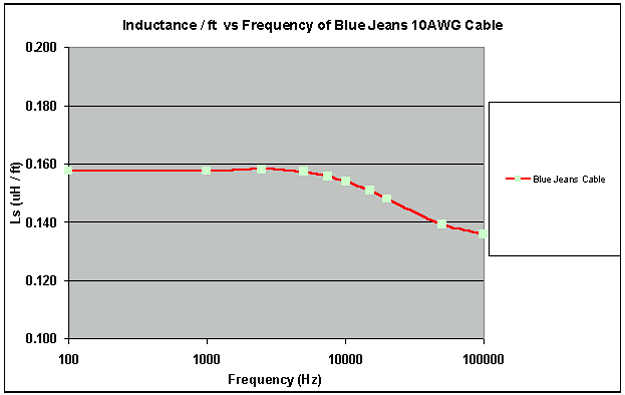
Inductance was about what I expected - around 0.160uH/ft. We like to see cable inductance below .200uH/ft to minimize high frequency rolloff for long cable runs. This cable is well within our guidelines. The slight decrease in cable inductance above 20kHz is a result of minimized internal inductance due to skin effect. This is an inaudible and barely measurable phenomenon and is only discussed herein for academic purposes.
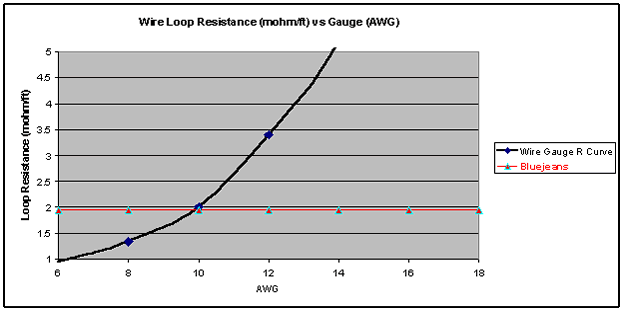
The DC resistance of the 5T00UP measure just a tad under 2mohms/ft which is 10AWG equivalent at DC as specified by Blue Jeans Cable. This is an extremely low resistance speaker cable making it ideal for long runs throughout the home with minimized losses.
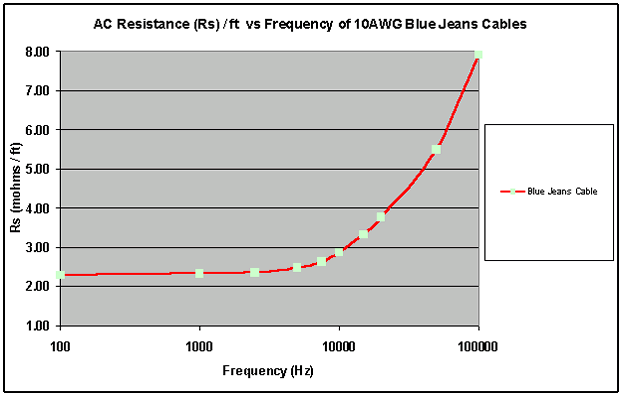
We see a slight rising AC resistance with frequency above 20kHz attributed to skin effect, but practically speaking a non-issue for the application of high fidelity audio especially since even at 50kHz it maintains an equivalent 14AWG resistance.
For a more detailed discussion on Skin Effect, see our article on Skin Effect Relevance in Speaker Cables.
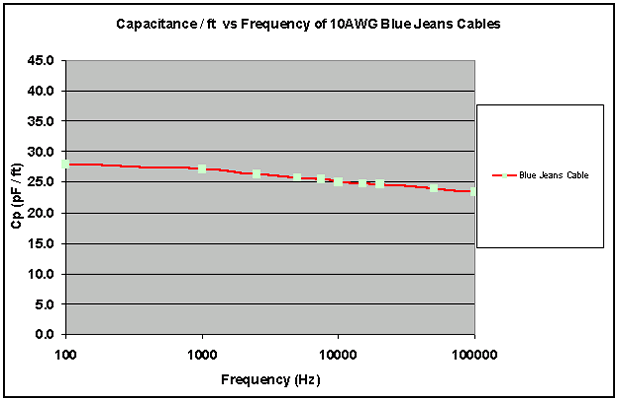
Capacitance was about what I suspected, ringing in at 25pF/ft. We like to see cables measure under 50pF/ft. This ensures there won't be any stability issues for long runs on marginally stable amplifiers with high unity gain crossing, or excessive high frequency roll off on amplifiers with high output impedances driving a reactive loudspeaker load. The reason for the slight decrease in capacitance with increasing frequency is likely attributed to measurement error of measuring a distributed device (speaker cable) with a measurement tool (Magnetics Analyzer) designed to measure lumped elements (magnetics, electrical circuits, etc).
Cable Assembly
Blue Jeans Cable offers you the option of buying cable in bulk which gives you cost savings and allows you to pre-terminate and cut each cable your desired length or buy them pre-terminated by them into whatever lengths you desire. If you are tight on time, you may wish to opt for having them pre-terminate your cables and pay the extra in favor of wasting time for assembly. It took me about five minutes per cable to cut and terminate both ends. Do this 50 or 100 times and you've just wasted a days worth of work and inherited tired hands and a dirty floor sprinkled in conductor flaxes and cable jacket refuse. Given the choice, I would go pre-terminated and I am sure the wife wholeheartedly agrees.
For those DIY-ers here is how you terminate these cables:
- Step #1: Cut the cables to desired length
-
Step #2; Using a utility blade, make about a 3 inch slit in the center of the PVC jacket .
Note: Be careful not to slice the conductors.
- Step #3: Cut away excessive PVC tubing.
-
Step #4: Shave off about 3/4" insulation from all four conductors on each cable
-
Step #5: Using a small flat head screw driver, loosen the two screws in the locking banana plug
-
Step #6: Remove the green pvc tube insert (why they have these I have no idea, but they are frustrating to remove after doing it more than a half dozen times)
-
Step #7: Insert the termination barrel into the cable conductor (make sure you do this before attaching the connector assembly).
-
Step #8: Tighten down the screws on each connector (double check your polarity is consistent on both ends of the cable)
-
Step #9: Give a tug on all connectors to ensure a tight fit has been achieved.
-
Step #10: Repeat steps #1-9 for next cable.
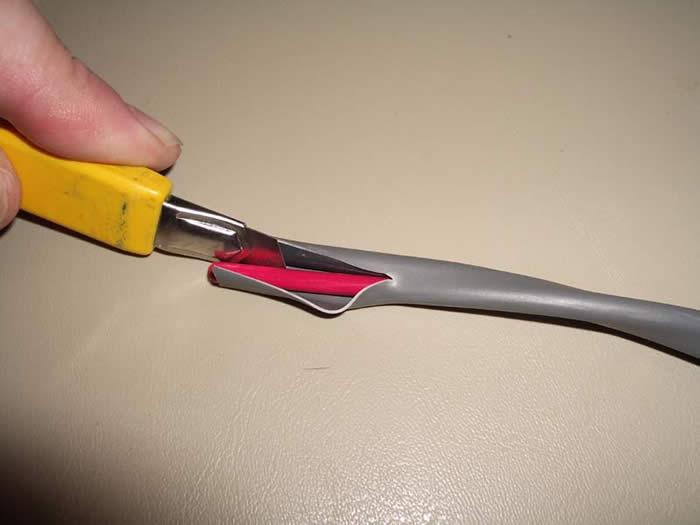
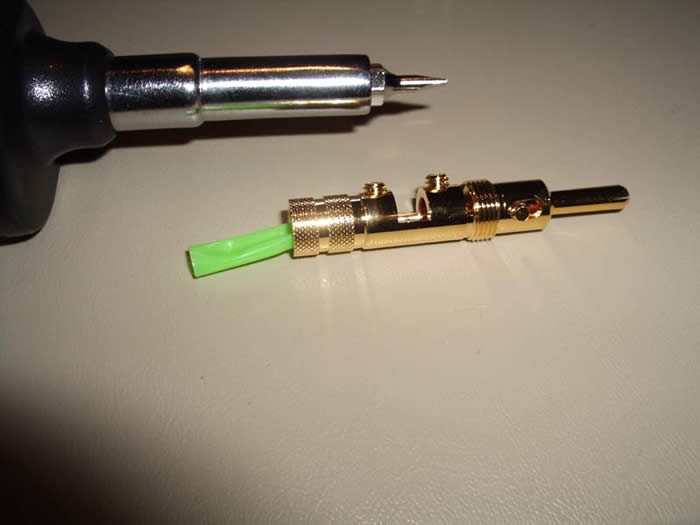
(Step #2) (Step#6)
Blue Jeans 5T00UP Cable Listening Tests and Conclusion
 Listening tests on
cables?
You gotta be kidding.
Not really.
Cables can and do sound different - bad ones
that is.
Bad and Blue Jeans aren't synonymous terms.
Despite these cables
measured
well as predicted, I decided to do some listening tests to appease the audiophiles that pray to their
cables.
Listening tests on
cables?
You gotta be kidding.
Not really.
Cables can and do sound different - bad ones
that is.
Bad and Blue Jeans aren't synonymous terms.
Despite these cables
measured
well as predicted, I decided to do some listening tests to appease the audiophiles that pray to their
cables.
With my whole system wired up in this cable, I popped in Pat Metheny's The Way Up CD. This is a phenomenal CD, and in my opinion contains some of Pat Metheny's finest work to date. Playing the 26 minute song titled Part 1 in PLIIx Music Mode sounded superb. Pat's guitars sounded chocolately. Just kidding. Music reproduction using the Blue Jean 10AWG speaker cables was as good as I ever heard on my reference system. Bass was tight and full, guitars were fluid and articulate, drums were dynamic, cymbal crashes were airy just as they should be on a great system with quality room acoustics and of course quality cables.
Conclusion
If you are looking for a beautiful cable that will dazzle your friends and transform your system into musical nirvana, look elsewhere. These cables aren't for you. If however, you are looking for a no-nonsense, affordable cable that will do no harm to your system, make no pretenses of splitting the atom, or redefining the laws of relativity, than look no further than Blue Jeans Cable.
With the flexibility of customizing cable lengths, termination types to your needs, CL3 approval for behind drywall installations, and choosing between pre-terminated convenience or self terminating cost savings options, you simply cannot go wrong. Their sliding price scale which decreases with increasing order size makes for a great solution for custom installers running cabling through a pre-construction house for whole home audio solutions. Highly Recommended!
Blue Jeans Cable
5T00UP 10AWG Cable Review
Blue Jeans Cable
1419 Elliott Ave. W, Suite C
Seattle WA 98119
(206) 284-2924 voice
(206) 284-2931 fax
The Score Card
The scoring below is based on each piece of equipment doing the duty it is designed for. The numbers are weighed heavily with respect to the individual cost of each unit, thus giving a rating roughly equal to:
Performance × Price Factor/Value = Rating
Audioholics.com note: The ratings indicated below are based on subjective listening and objective testing of the product in question. The rating scale is based on performance/value ratio. If you notice better performing products in future reviews that have lower numbers in certain areas, be aware that the value factor is most likely the culprit. Other Audioholics reviewers may rate products solely based on performance, and each reviewer has his/her own system for ratings.
Audioholics Rating Scale
 — Excellent
- — Very Good
- — Good
- — Fair
- — Poor
| Metric | Rating |
|---|---|
| Build Quality | |
| Ease of Setup/Programming/Integration | |
| Performance |  |
| Value | |
Gene manages this organization, establishes relations with manufacturers and keeps Audioholics a well oiled machine. His goal is to educate about home theater and develop more standards in the industry to eliminate consumer confusion clouded by industry snake oil.
View full profile Subscribe to our newsletter