


Pass Labs X350.5 Stereo Power Amplifier Review
- Product Name: X350.5 Stereo Power Amplifier
- Manufacturer: Pass Labs
- Performance Rating:


- Value Rating:
- Review Date: October 23, 2012 22:35
- MSRP: $ 11k
- Number of Channels: 2
- Voltage Gain: 26 dB
- Power Output /ch: 350 watts (8 ohms) / 700 watts (4 ohms)
- Class A Power up to 40 watts (peak)
- Input Impedance: 30 kohm / 20 kohm
- Power Consumption : 600 watts (idle)
- Dimensions (W x H x D): 19” x 11.2” x 22.5”
- Unit Weight: 132 lbs
- Ship Weight: 150 lbs
Pros
- Phenomenal audio fidelity
- Visually striking
- Built by Cybertronians
Cons
- Expensive
- Big and heavy
- Power-hungry
Pass Labs X350.5 Introduction
I’ve been on a high-end kick as of late, getting my hands on some of the industry’s best and most expensive gear just to find out how far the envelope of performance could be pushed. I’ve always heard great things about Pass Labs amplifiers so I was eager to check out their 350wpc X350.5 two-channel power amplifier. I realized this amp was large from the online pictures but the pictures didn’t covey how beastly this 132lbs amplifier really was. It was an effort to lug this baby up my flight of steps to the Audioholics showcase theater room, one that I felt was well worth it. The X350.5's massive chassis and heatsink is necessary given its high Class A bias and ability to drive over 700 watts into a 4 ohm load. It was clearly designed to power the most brawny speakers out there.
The Pass Labs X350.5 has the appearance like it was sculpted by Cybertronians. But, would this be the amplifier choice of Optimus Prime if he was an audiophile looking for a no holds barred high end stereo amplifier? Read our review to find out.
Pass Labs X350.5 Stereo Amplifier Design Overview
Pass Labs electronics are designed and built in Foresthill, CA USA. Their boards are made in the US and they stuff the chassis themselves at their factory. Pass Labs uses local machine and sheet metal shops and source as much as possible locally. This is rarity worth mentioning and although it’s a more costly endeavor to produce products in the USA, it puts fellow Americans to work, which is something our country needs right now. I commend Pass Labs for this effort. This should make forum trolls think twice about bashing the price of this amplifier.
The X350.5 is touted as a minimalist design, which in terms of circuit complexity may be true, but the quality of craftsmanship and the layout of the components is an engineering marvel. They use very high quality output devices and tight tolerance parts to help minimize the excessive reliance on negative feedback which they claim improves transient response, bandwidth linearity and stability by not having to employ additional gain stages. The X350.5 is heavily biased into Class A operation up to 40 watts/ch peak or 20 watts/ch continuously. Pass Labs’ recommends a warm-up period of about an hour before conducting critical listening tests. At higher power levels, the X350.5 operates in Class AB for increased efficiency.
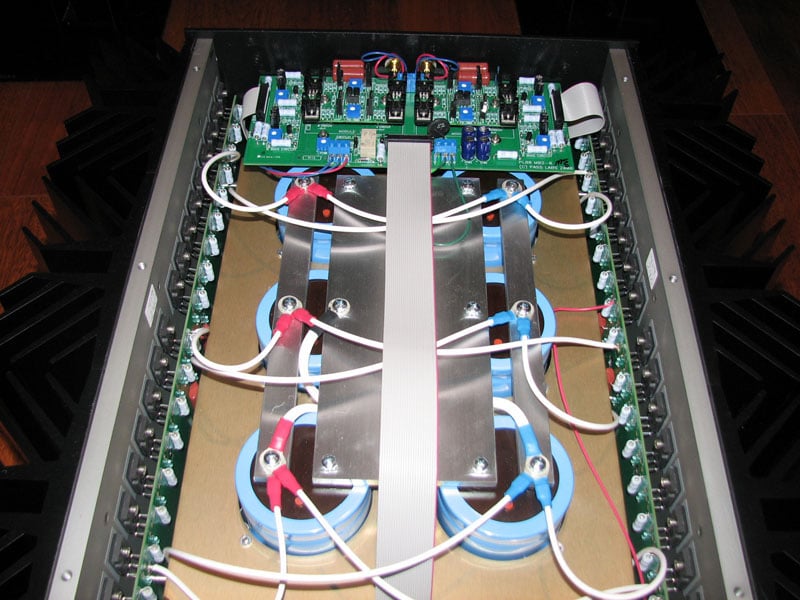
Pass Labs X350.5 Top View
Removing the top plate, a peek inside the X350.5 amplifier showed it to be a work of beautiful art. The capacitors are connected via sheets of metal which serve as low electrical resistance connection points and heatsinks to keep them cool even during high amplifier output conditions. The six (6) very large 25,000uF / 75V power supply capacitors are connected in parallel, yielding a total capacitance 150,000uF. Pass Labs’ literature states a max voltage output of 76V, but that’s not the actual rail voltage. The rails are actually +-55V which yields almost a 20V margin for the capacitors. This ensures longevity in the capacitors by not running them steady state at their max allowable voltage limits.
The power transformer is a hefty1.5kVA toroid, which is not visible from this picture as it’s mounted at the bottom of the chassis underneath the heatsink flanking the power supply capacitors. Each channel has 36 output devices (18 on top as pictured and 18 on the bottom). The output stage is fully differential, which if properly implemented can be a huge advantage for noise immunity and distortion reduction. Only the very best amplifiers are fully differential from input to output and the Pass Labs is in good company here.
The X350.5 amplifier is CE certified, meaning it meets or exceeds all safety standards for domestic and international markets. The X350.5 is not user selectable for 120V/220V operation like some amplifiers we’ve tested.
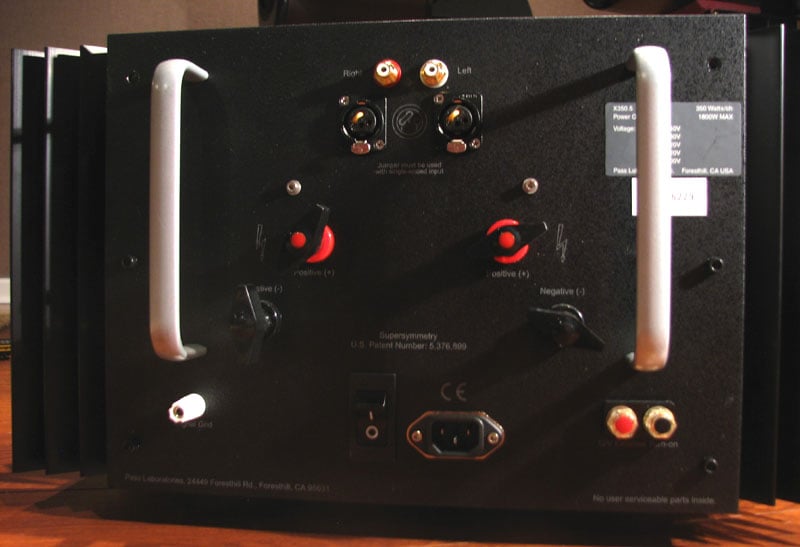
Pass Labs X350.5 Back View
The Pass Labs X350.5 has quite a striking rear end. It’s equipped with two large handles for “easier” transportation of this anvil-sized amplifier. The X350.5 has both balanced and unbalanced input connections, a detachable power cord, and ground and trigger connections. The balanced/unbalanced input connections aren’t switchable so be careful about accidentally using both input types simultaneously. The balanced connections come with a shorting plug installed for this very purpose and to also minimize noise pick up of the unused input connections.
There is only one set of speaker terminals on the X350.5 and they only accept spades (no bare wire and no bananas). This means you can’t bi-wire or run two pairs of speakers simultaneously unless you construct a breakout cable to do so. I am not a fan of spade terminations as they can be dislodged with a minor jostle even when twisted down. It was difficult to get my Kimber 8TC cables tightened down while twisting the lugs as they rubbed against the terminations. I would have preferred conventional 5-way binding posts, but Pass Labs claims they use this connection scheme for safety purposes. I don’t get this since they could have still used binding posts affixed to plastic standoffs to prevent arching like high power amplifiers produced by other manufacturers often do.
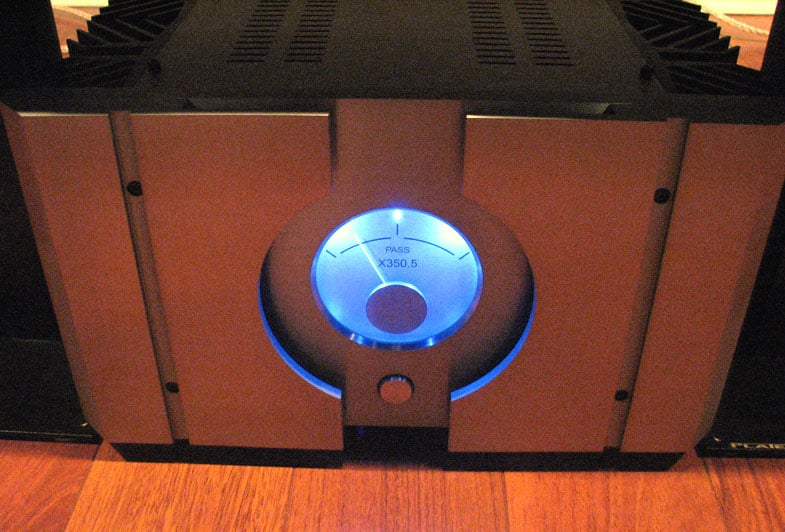
Pass Labs X350.5 Front View
Perhaps the most striking feature to the Pass Labs X350.5 is the large round blue backlit meter that actually tracks current consumption instead of power. The sculpted aluminum faceplate is simply stunning and is instantly noticed by visitors when they enter the room. Both sides of the amp are completely flanked with extruded heatsinks that serve their purpose to draw off heat from the output devices but also give it that badass look. I have to admit I found myself quite infatuated with the blue hue of the front panel glass on this amplifier during my extensive listening sessions.
Set-Up
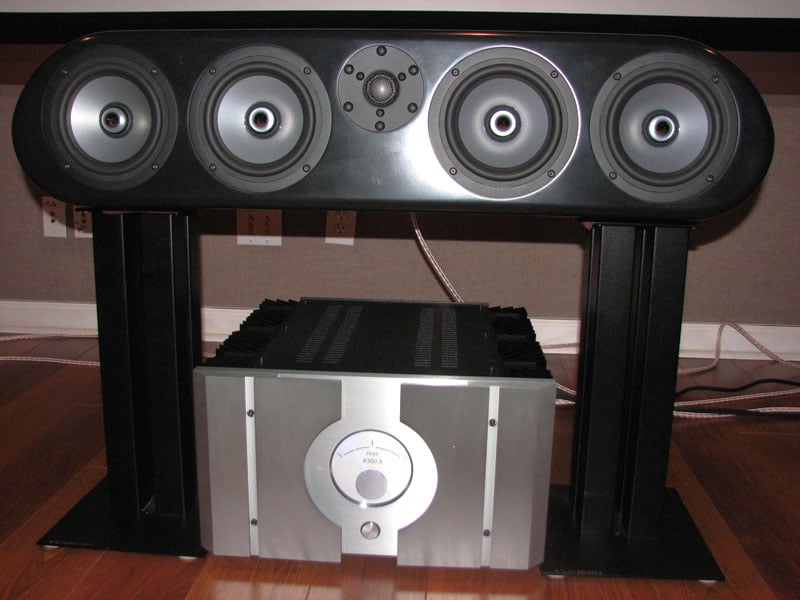 Unboxing
and moving around the X350.5 was arduous.
It was grueling lugging this 132 lbs behemoth up the flight of steps for
testing in the Audioholics Showcase Theater room. I connected the X350.5 to my Marantz PM-11S2
integrated amplifier via Bluejeans Cable interconnects and Kimber 8PR speaker
cables with compression WBT banana plugs to the new Status Acoustics 8T speaker
system I currently have under review.
The source devices included the Marantz TT-15S1 turntable and Oppo
BDP-95 Blu-ray player via the analog balanced outputs. The listening space is a 6,000 ft3
room that is moderately acoustically treated, courtesy of Auralex Acoustics.
Unboxing
and moving around the X350.5 was arduous.
It was grueling lugging this 132 lbs behemoth up the flight of steps for
testing in the Audioholics Showcase Theater room. I connected the X350.5 to my Marantz PM-11S2
integrated amplifier via Bluejeans Cable interconnects and Kimber 8PR speaker
cables with compression WBT banana plugs to the new Status Acoustics 8T speaker
system I currently have under review.
The source devices included the Marantz TT-15S1 turntable and Oppo
BDP-95 Blu-ray player via the analog balanced outputs. The listening space is a 6,000 ft3
room that is moderately acoustically treated, courtesy of Auralex Acoustics.
Pass Labs X350.5 Stereo Amplifier Sound Quality Tests
I let the Pass Labs X350.5 warm up for about 1 hour and started out my listening session with some vinyl.
LP: Miles Davis: Kind  of Blue (180G)

Despite this being a recording from 1959, it is recognized as a benchmark for vinyl even by today’s standards and is the best selling jazz album of all time. Accompanying Miles are jazz legends such as Bill Evans on piano and John Coltrane on tenor saxophone. This album is based on modality and was recorded live in the studio with little to no rehearsal making it almost entirely improvisational. Track #1 “So What” sets the mode for this album, which is just a feel-good laid back experience that is best accompanied by a good glass of red. Jimmy Cobb’s cymbal brushes were delicate and airy while the back and forth between Miles on trumpet and Coltrane on sax was exhilarating. It’s hard to believe such an old recording on vinyl had so much dynamic range, seemingly more so than the majority of CD’s recorded today. The X350.5 was loving pumping the juice to my Status 8T speakers as I turned the volume up to lifelike SPLs. Closing my eyes, I really felt like I was in a jazz cellar in NYC listening to this sextuplet grace me with their phenomenal performance. Track #2 “Freddie Freeloader” is my favorite song on the whole album. It just oozes coolness and if you’re foot isn’t tapping on this tune, someone needs to check your pulse. Bill Evan tickles the ivories with a surgeon’s precision. I got instant goose bumps when Miles’ trumpet kicked in. I just couldn’t get over how lifelike and vivacious it sounded, especially when Coltrane answered Miles in his solo. I was truly getting that “better than being there” experience found only from properly setting up and pairing the best electronics and loudspeakers in a great sounding room with exceptional source material. The X350.5 just loved showing off its sonic chops with this album.
LP: Richard
Marx

I’ve always liked hearing Richard Marx songs on the radio, but never purchased any of his albums because I felt his stuff was a bit too poppy and overplayed. When my wife bought the LP version of his self titled album, I figured I’d give it a shot. I was pretty floored not only by the musical content of this LP, but its sound quality. Side 2 contained songs rarely (if ever) played on the radio and they were much harder hitting than his more well-known radio pop songs. Track #5 “Have Mercy” starts out with some great drumming and a catchy hard rock guitar theme. This song just rocks and begs to be played loudly. Richard’s voice came through very vibrantly and the band just sounded excellent together. This is power rock at its finest and something hard to find today from mainstream music. Although it sounded a bit edgy at high listening levels, it was never fatiguing or overly bright. Instead, I felt like I was thrust into a live performance with the music enveloping all around me, despite the fact that I was listening in two-channel. Track #6 “Remember Manhattan” was a big WOW for me. I didn’t know vinyl could produce so much bass and certainly not from an album like this. But here I was with chest pounding bass providing the framework for this awesome song. Dynamic, bold, lifelike, the X350.5 showed no limits in how hard it could drive my reference speakers, which dip down to 2 ohms at bass frequencies. If you’re not a Richard Marx fan, I can assure you will be after hearing the entire second side of this album. Check it out!
SACD:
Grover Washington JR – Prime Cuts

I’m not even sure how I acquired a copy of this rare SACD but it’s a sonic masterpiece and a must have in your collection if you’re serious about sound and a jazz aficionado like myself. Track #1 “Take Five” has a lot of stuff going on at once, including a deeply rich bass track. Grover’s saxophone came through with pristine clarity while the percussive effects popped out into a very three dimensional landscape. Track #6 “Summer Nights” bore a similar resemblance to “Pyramid” from another great album called Close Up by David Sanborn. I loved the ping pong effect of the percussion instruments between the speakers. The Pass Labs amp was just pumping clean power to my speakers and rewarding me with an unrivaled sonic landscape. You could hear the triangles slowly decay instead of just sharply fading away, which would otherwise be lost on lesser-designed gear. The noise floor was dead silent which really helped showcase the dynamic range of this excellent recording.
SACD/ Blu-ray: Jienat - Mira
Last month I wrote
about  the sonic wonders this Blu-ray disc posesses. Well, an SACD copy is also included with
purchase so I cued up the two-channel track to give the Pass Labs amp a real
workout. I caution anyone to use the volume control
sparingly when playing this disc on their systems as it has extreme dynamic
range that most speakers are incapable of reproducing at reference volume levels. The vocals were pinned dead center in Track
#1 “Sissel” as if I had my center
channel engaged. The bass was thunderous
and the stereo separation seemed to extend well beyond the width of the
speakers. Track #6 “Fredrik Albert” showed off the fabulous transient response of the
X350.5. The immediacy of the percussion
and depth of the bass was simply spectacular and it’s not something that can
fully be conveyed in writing without actually hearing for yourself. I don’t know the language spoken in this
recording (in fact only about 500 people speak this dielect so chances are you
won’t understand it either), but somebody must have a really great “uncle”
since some incarnation of that word seems to be a constant theme in this
song. I love it!
the sonic wonders this Blu-ray disc posesses. Well, an SACD copy is also included with
purchase so I cued up the two-channel track to give the Pass Labs amp a real
workout. I caution anyone to use the volume control
sparingly when playing this disc on their systems as it has extreme dynamic
range that most speakers are incapable of reproducing at reference volume levels. The vocals were pinned dead center in Track
#1 “Sissel” as if I had my center
channel engaged. The bass was thunderous
and the stereo separation seemed to extend well beyond the width of the
speakers. Track #6 “Fredrik Albert” showed off the fabulous transient response of the
X350.5. The immediacy of the percussion
and depth of the bass was simply spectacular and it’s not something that can
fully be conveyed in writing without actually hearing for yourself. I don’t know the language spoken in this
recording (in fact only about 500 people speak this dielect so chances are you
won’t understand it either), but somebody must have a really great “uncle”
since some incarnation of that word seems to be a constant theme in this
song. I love it!
Even in the two-channel recording of Track #4 “DanceHall”, you’re enveloped in the middle of the room with singers all around you. The percussion was full of life and vibrancy that you rarely ever hear in any recording. Most playback systems are incapable of reproducing the dynamic range of this album, but the X350.5 did a fabulous job delivering the power necessary for the Status 8T speaker system to accomplish this goal with utter ease. Towards the end of the recording, the electric bass kicked in which literally blew me away as I was belted with sustained tactile bass that was not only heard but rattled the core of my bones. This was the first time I saw the current meter jump up and sustain past the half-way mark on the X350.5. The blue led was actually flickering as the amp just sucked current from my 20A wall outlet and fed it virtually unadulterated to my speakers. While I was unable to instantly compare how the X350.5 sounded to the Classe CT-2300 I also had in for review, I did make some notes. I found the Classe amp put forth a more laid back presentation while the Pass Labs amp seemed a bit more forward tonally. Both amps sounded great and were able to drive my speakers with aplomb. But, sonically I couldn’t necessarily declare an absolute winner as much as note there were perceived differences. Depending on source material, I found myself preferring one over the other by a small margin. I felt the Pass Labs X350.5 was a bit more transparent at revealing subtle nuances while the Classe CT-2300 provided a sometimes smoother and more natural presentation. For this track however, I was still craving both company’s flagship amplifiers to feed my speakers even more clean power. My wife says I’m nuts but isn’t that what being an Audioholic is all about?
Pass Labs X350.5 Stereo Amplifier Power and Distortion Measurements
All measurements were conducted using our Audio Precision APx585 8 Channel HDMI Audio Analyzer following our rigid Amplifier Measurement Test Protocol.
I measured the voltage gain of the X350.5 and found it to be 26.5dB, which confirms Pass Labs’ spec of 26dB. The gain does not change between unbalanced or balanced connectors. In order to hit full power the X350.5 needed about 2.7Vrms so make sure the preamp you couple this baby with can give you clean output of at least 3Vrms.
Signal to Noise Ratio
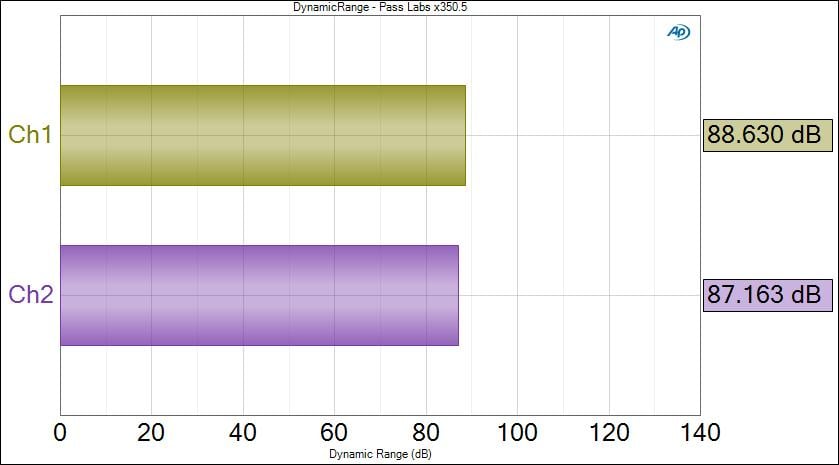
Pass Labs X350.5 SNR @ 1 watt (A-weighted)
The X350.5 exhibited a very good low noise floor. At 1 watt, I measured 88dB (A-weighted). At rated power (350 watts), I measured 113dB.
Frequency Response

Pass Labs X350.5 Frequency Response @ Full Rated Power
The Pass Labs X350.5 exhibited ruler flat bandwidth from 10Hz to 40kHz with a gradual roll-off of about -2dB at 80kHz. Pass Lab’s claims a bandwidth of 1.5Hz to 100kHz but doesn’t specify a tolerance. This sweep was taken at 358 watts at full bandwidth from 10Hz to 80kHz with both channels driven. Lesser designed amplifiers would shut down or not be able to deliver such a ruler flat response at this power level. Frequency response linearity between both channels at 1 watt and full rated power was +/-0.06dB for 8 ohm loads and +/-0.08 dB for 4 ohm loads from 20Hz to 20kHz for 8 ohm loads, which is superb. This indicates very tight tolerances in parts selection and excellent overall engineering. Because of this incredible linearity, I found the continuous full power bandwidth measurements tracked very closely with the 1kHz sweep power tests and thus only reported power figures for those test results.
Power Measurements
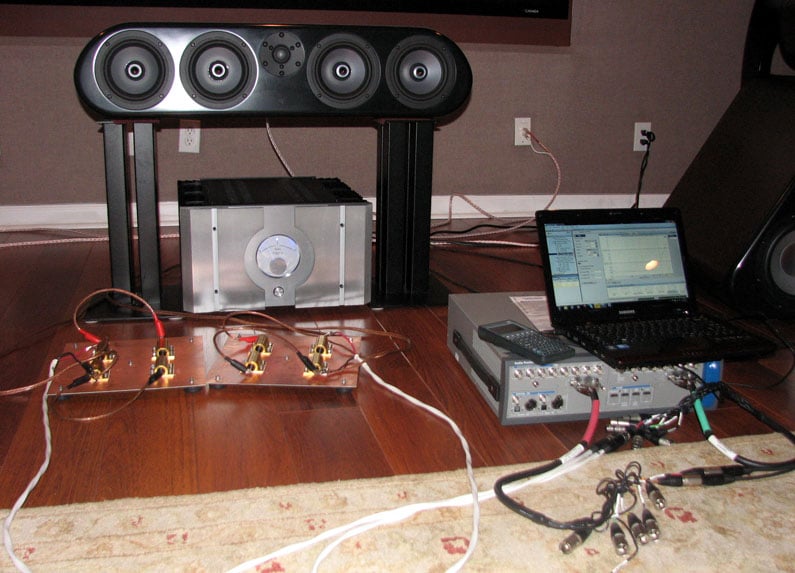 Using
our Audio Precision APx585 8-channel HDMI analyzer, I conducted a full barrage
of multi-channel amplifier tests on the Pass Labs X350.5. We tested power using
three methods all of which were taken at < 0.1% THD + N:
Using
our Audio Precision APx585 8-channel HDMI analyzer, I conducted a full barrage
of multi-channel amplifier tests on the Pass Labs X350.5. We tested power using
three methods all of which were taken at < 0.1% THD + N:
-
Continuous Full Power Bandwidth (CFP-BW) from 20Hz to 20Khz into 8 and 4-ohm loads (up to two-channels)
-
1kHz Power Sweep vs. Distortion (1kHz PSweep) - popularized by the print magazines, this is an instantaneous power vs. distortion test at 1kHz. The problem with this test is it often masks slew-related and/or frequency response problems some amplifiers exhibit at the frequency extremes, and thus inflates the measured power results. It does provide an instant gratification number for consumers to argue over on the forums, so we are now incorporating this test to please the masses.
-
Dynamic PWR - 1kHz CEA-2006 Burst Method testing. This is a dynamic power measurement adopted from the car industry similar to IHF method only a bit more difficult for an amplifier and more representative of real musical content.
Keep in mind most review publications don't do continuous power measurements and they usually publish power measurements into clipping at 1% THD + N. Our measurements are very conservative as we use a dedicated 20A line with no Variac to regulate line voltage. We constantly monitor the line to ensure it never drops more than 2Vrms from nominal which in our case was 120Vrms.
For more info on amplifier
measurements, see: The
All Channels Driven (ACD) Test


Pass
Labs X350.5 Power vs Distortion Sweep Test 1kH
2CH Driven, 8 ohms (top pic); 1CH Driven, 4
ohms (bottom pic)
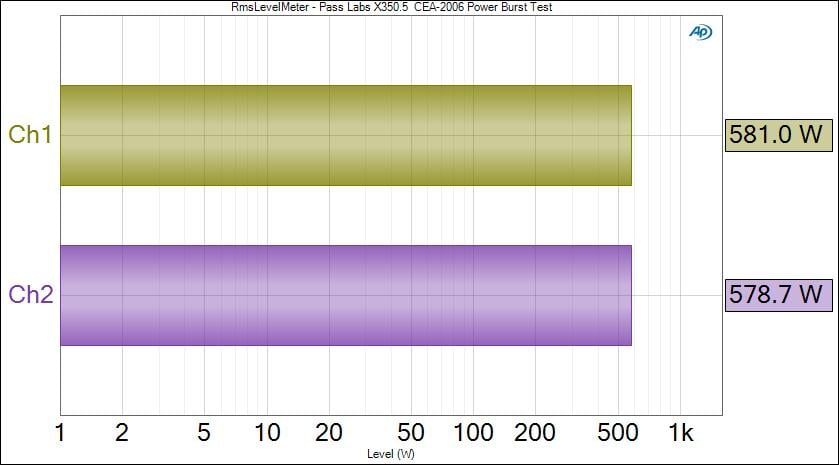

Pass
Labs X350.5 Dynamic Power Test (1kHz)
Top Pic: 2CH
driven, 8 ohms; Bottom Pic: 2CH driven,
4 ohms
| # of CH | Test Type | Power | Load | THD + N |
| 1 | 1kHz Psweep | 440 watts | 8 ohms | 0.1% |
| 1 | 1khz PSweep | 480 watts | 8 ohms | 1% |
| 2 | 1kHz Psweep | 372 watts | 8 ohms | 0.1% |
| 2 | 1kHz Psweep | 405 watts | 8 ohms | 1% |
| 1 | 1kHz Psweep | 550 watts | 4 ohms | 0.1% |
| 1 | 1kHz Psweep | 675 watts | 4 ohms | 1% |
| 2 | 1kHz Psweep | 490 watts | 4 ohms | 0.1% |
| 2 | 1kHz Psweep | 550 watts | 4 ohms | 1% |
| 1 | Dynamic PWR | 595 watts | 8 ohms | 1% |
| 2 | Dynamic PWR | 580 watts | 8 ohms | 1% |
| 1 | Dynamic PWR | 700 watts | 4 ohms | 1% |
| 2 | Dynamic PWR | 695 watts | 4 ohms | 1% |
Pass Labs X350.5 Power Measurement Table
Pass Labs rates the X350.5 as follows:
- 350 watts @ 8 ohms; 1 kHz, 1% THD + N
- 700watts @ 4-ohm , 1kHz, 1% THD + N
Note: Pass Labs doesn't specify the number of channels driven for their power spec.
8 ohm Power Results:
My measurements revealed that the X350.5 is a true powerhouse that lives up to the somewhat vague published power figures Pass Labs specifies for this amplifier. This was especially true with 8 ohm loads as the X350.5 exhibited over +2dB of dynamic headroom into 8 ohm loads over the manufacturer’s 350wpc spec.
As previously stated, X350.5 produced virtually identical full power bandwidth and 1kHz power sweep tests indicating that the power supply and output devices were robust enough to deliver full rated power at any audio frequency, not just a sweet spot. This is just one of many hallmarks indicating the X350.5 is a seriously great amplifier.
4 ohm Power Test Results:
Even though I was running a dedicated 20A line, it was slightly hindering the accuracy of my power vs. distortion measurements into 4 ohm loads (both channels driven) as the line voltage sagged since we don’t use a VARIAC to hold line voltage constant. Think about it, 120V * 20A = 2400 watts / 0.5% (typical Class AB efficiency) and you’re left with only 1200 watts or 600wpc which is right about where the limitations of my power testing was occurring. Of course the amplifier’s max power consumption is rated for 1800 watts so it’s unclear just how much more power the X350.5 would have delivered into 4 ohm loads even under ideal bench test conditions.
Although the amp was showing 1% distortion driven at full power into 4 ohms, the analog waveform was still very smooth and unclipped. The dynamic power results were only marginally better into 4 ohms than they were in 8 ohms. I suspect the power into 4 ohm loads was somewhat limited by the transformer since it was optimized to drive 8 ohm loads. I would have liked to see a large KVA transformer on this amplifier given the caliber of this product. At these power levels, most people probably wouldn’t miss any additional juice. The X350.5 could drive virtually any speaker load. I didn’t need these test results to be convinced after just a few short listening sessions powering my new Status Acoustics 8T reference speakers.
FFT Distortion Analysis
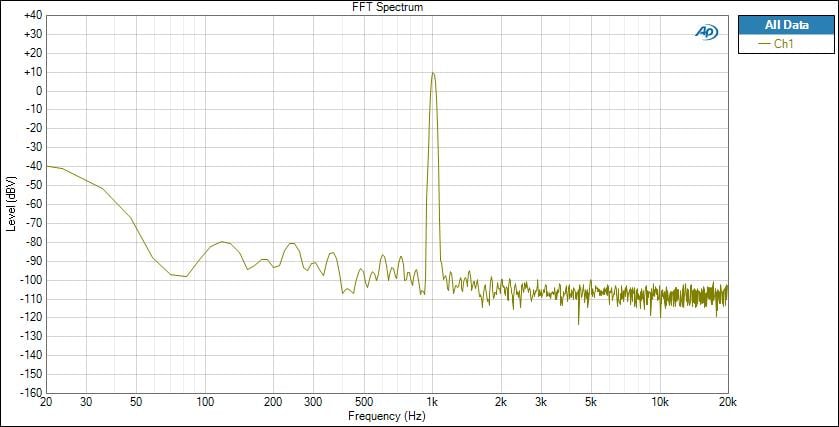
Pass Labs X350.5 FFT Distortion Analysis @ 1 watt
I ran FFT distortion plots at 1 watt (top pic) and full rated power (bottom pic) to determine how clean this amplifier really is. At 1 watt, the spectral distortion was below the noise floor of my measurement equipment which is another way of saying “awesome”!

Pass Labs X350.5 FFT Distortion Analysis @ 20 watts
In fact, the measured distortion spectra were excellent for the entire Class A operation of this amplifier (up to 40 watts peak). You can see how down in the mud the distortion components are (-96dB for the 3rd harmonic below the fundamental).

Pass Labs X350.5 FFT Distortion Analysis @ 420 watts
At 420 watts, 8 ohms (which is above the 350wpc power rating) the X350.5 displayed a not so pretty distortion harmonic spectrum. I observed the 3rd harmonic (35.251 + 37.57) dBV being 72.8dB down from the fundamental. This unusually high distortion product is likely somewhat a deliberate result of employing minimal feedback in this amplifier design. The results looked better at rated power but still not stellar from an FFT distortion measurement standpoint. Despite this, the amp sounded fantastic at all power levels. It just goes to show measurements and real world listening experiences rarely line up as one expects.
Crosstalk
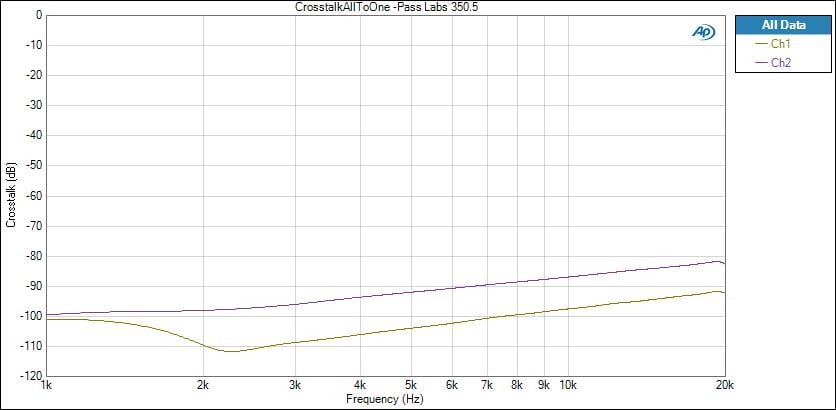
Pass Labs X350.5 Crosstalk vs Frequency at full rated power
The sweep tests I ran on the X350.5 produced excellent results being less than 100dB at 1kHz and 80dB at 20kHz. I consider anything less than -40dB @ 10kHz acceptable and anything less than -80dB to be superb. The X350.5 met the superb minimum requirement at 20kHz no less. Pass Labs did their homework with respect to board layout and component isolation to ensure minimal crosstalk which also assures excellent stereo separation.
Recommendations
The Pass Labs X350.5 is a big, heavy, power-hungry amplifier. It’s difficult to transport requiring either
one herculean mover or two normal people to set it in place. Because of its high bias into class A
operation, it’s also very power-hungry.
I measured a steady state power consumption of 500 watts with the amp
just sitting there in idle. Pass Labs
specifies a 600 watt idle power consumption which is likely based on long term
operation after the amp is fully warmed up.
The X350.5 runs very hot so be sure to give it plenty of ventilation. Green activists won’t be too keen on that and quite frankly I wish Pass Labs would offer the option to lower the bias current for more power conscious audiophiles. This is the type of amplifier I’d recommend for critical two-channel installations as it would prove too costly and too energy demanding to setup a full multi-channel system employing several of these units. A top shelf component like this deserves the very best accompanying equipment to show off its true potential. Make sure you have worthy speakers, good room acoustics and a solid preamp capable of at least 3Vrms unclipped drive output with a very low noise floor.
Pass Labs X350.5 Stereo Amplifier Conclusions
My time with th e Pass Labs X350.5 two-channel
amplifier has been a marvel both sonically and visually. Anytime a visitor would stop by they would
literally pause as the sheer beauty and size of this amplifier caught their
attention. It portrays a commanding
presence and is built like a tank, pegging the scale in the pride of ownership
department. Its pristine sonic virtues, ability to drive even the most
challenging of speaker loads beyond reference levels, is even more impressive
than its overall excellent bench test results.
e Pass Labs X350.5 two-channel
amplifier has been a marvel both sonically and visually. Anytime a visitor would stop by they would
literally pause as the sheer beauty and size of this amplifier caught their
attention. It portrays a commanding
presence and is built like a tank, pegging the scale in the pride of ownership
department. Its pristine sonic virtues, ability to drive even the most
challenging of speaker loads beyond reference levels, is even more impressive
than its overall excellent bench test results.
About the only thing I can ding physically on the X350.5 is its somewhat thin top cover plate as it doesn’t make a deadening thud when you tap on it. I would have liked to have seen a slightly heavier gauge metal used or at least some sort of dampening lining the sheet to sonically deaden it. While I don’t think this would in any way affect the sonic attributes of the amplifier, it does boost the pride in ownership factor which this amp already has in droves. I’m just picking nits here of course, but it is not, after all, an inexpensive amplifier.
Incredible looks, pristine fidelity, plenty of juice, the Pass Lab’s X350.5 will surely satisfy even the most discriminating listener. It took me over two months of listening to commit anything to writing as I was enjoying my experience with this amplifier that much. I am confident Optimus Prime would be equally impressed with this amplifier. Audioholic & Audiophile Recommended!
Pass Laboratories
24449 Foresthill Rd.
Foresthill, CA 95631 USA
Telephone
530.367.3690
Facsimile
530.367.2193
X350.5 Review
MSRP: $11k
The Score Card
The scoring below is based on each piece of equipment doing the duty it is designed for. The numbers are weighed heavily with respect to the individual cost of each unit, thus giving a rating roughly equal to:
Performance × Price Factor/Value = Rating
Audioholics.com note: The ratings indicated below are based on subjective listening and objective testing of the product in question. The rating scale is based on performance/value ratio. If you notice better performing products in future reviews that have lower numbers in certain areas, be aware that the value factor is most likely the culprit. Other Audioholics reviewers may rate products solely based on performance, and each reviewer has his/her own system for ratings.
Audioholics Rating Scale
 — Excellent
- — Very Good
- — Good
- — Fair
- — Poor
| Metric | Rating |
|---|---|
| Frequency Response Linearity | |
| SNR | |
| Measured Power (8-ohms) | |
| Measured Power (4-ohms) | |
| Multi-channel Audio Performance | |
| Build Quality | |
| Fit and Finish | |
| Ergonomics & Usability | |
| Performance |  |
| Value | |
Gene manages this organization, establishes relations with manufacturers and keeps Audioholics a well oiled machine. His goal is to educate about home theater and develop more standards in the industry to eliminate consumer confusion clouded by industry snake oil.
View full profile Subscribe to our newsletter