


Emotiva UPA-500 Five Channel Power Amplifier Review
- Product Name: UPA-500 Five Channel Power Amplifier
- Manufacturer: Emotiva
- Performance Rating:

- Value Rating:
- Review Date: August 08, 2012 21:00
- MSRP: $ 399
-
Number of Channels: 5
-
Amplifier Gain: 29dB
-
Input Sensitivity: 850mv (full rated power, 8 ohms)
-
Signal to Noise Ratio: Full Power (A-wt): 117db
-
Input Impedance: 47kohms
-
Transformer Size: 350VA
-
Secondary Capacitance: 40,000uF
-
Output Devices: 2 per channel Topology: Fully Discrete, Dual Differential, High Current, Short Signal Path Class A/B
-
Power output (all channels driven):
120 watts RMS @ 4-ohm (0.01% THD)
80 watts RMS @ 8-ohm (0.01% THD) -
Frequency Response: 10Hz to 70kHz +0/-3dB
-
Rated Power Band Response: 10 Hz to 20 kHz +-.06db deviation at rated power
-
Broadband Frequency Response (-3db): 5Hz to 150kHz
-
Power Requirements: 115 VAC or 230 VAC +/- 10% @ 50 / 60 Hz (automatically detected and switched)
-
Protection: protected against excessive operating temperature, shorted speaker connections, ground faults, and other common fault conditions.
-
Size: 17” W x 4. 1/16” H x 16 5/16” D
-
Weight: 22.9lbs (29.4lbs boxed)
Pros
- Quality power on the cheap
- Lightweight
- Emotiva Durability
Cons
- None at this price
Emotiva UPA-500 Introduction
When a box unexpectedly showed up at my door from Emotiva, I thought it was a preamp, given its unusually compact size. Instead I was surprised to discover it was their new UPA-500 five channel power amplifier. I’ve never been able to one arm an Emotiva up my flight of steps to the Audioholics Showcase Theater Room for testing until now. This little guy weighs less than a mid-fi receiver (about 23 lbs), making it very manageable to lug around and install in tight spaces. But can it pack a punch? Rated at 80wpc x 5 into 8 ohms and 120wpc into 4 ohms it certainly sounds like it does on paper but, let’s find out.
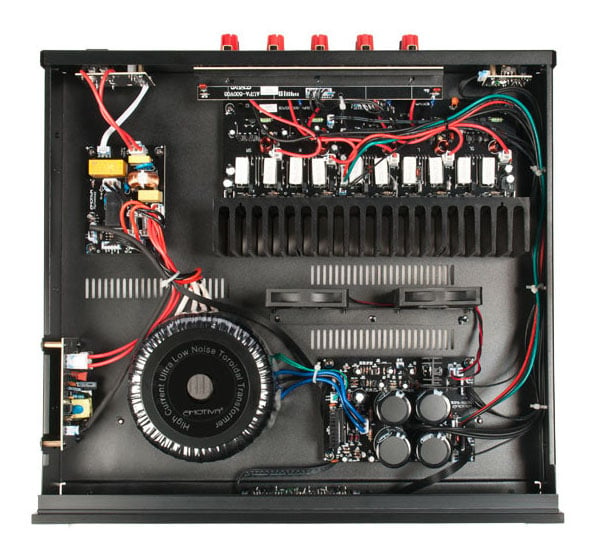
Emotiva UPA-500 Top View (cover removed)
Design Overview
The Emotiva UPA-500 is a traditional class A/B amplifier design utilizing a single large 350VA toroidal power transformer and large capacitance bank for its power supply. Having a singular larger sized power supply is an advantage that allows the amplifier to deliver more power to any given channel if the output devices can handle it. This, in turn, provides more available headroom, which is critical for effortlessly producing large dynamics and peaks in music and movies. Emotiva claims the UPA-500 has 40,000uF total power supply capacitance and, peering under the hood, you could see their claim is correct with the four 10,000uF, 63V parts connected in parallel. 63V parts provide more than enough margin above the rail voltage needed to hit the 80wpc rating that Emotiva is claiming. The amp module topology is very similar to its bigger XPA series sibling, but in a more compact surface mount form factor. Emotiva also employs a trick circuit that senses the line voltage and automatically switches between 120VAC and 220VAC. Why more amplifier manufacturers don’t do this is beyond me. The UPA-500, like all Emotiva amplifiers, has the CE mark which is a rigorous international safety and regulatory test to ensure the amp will cause no harm to your home or interfere with any of your household electronics or pacemaker (should you have one).
Emotiva UPA-500 Five Channel Power Amplifier Overview and Setup
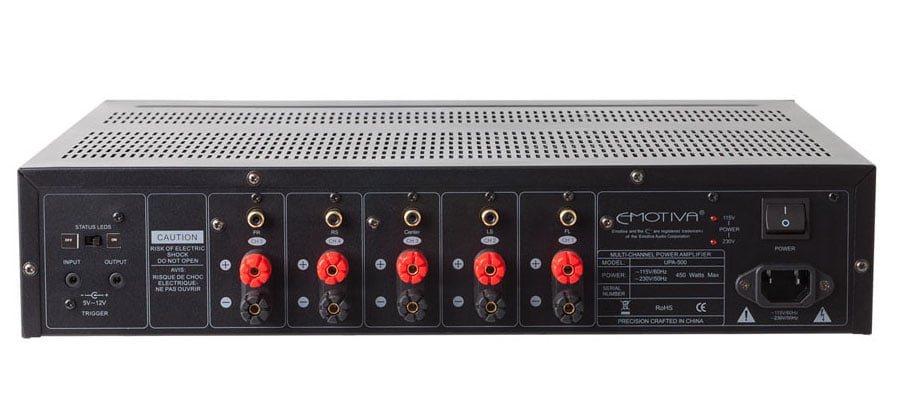
Emotiva
UPA-500 Back view
The back view of the UPA-500 is a bit pedestrian, but the connector spacing is well laid out. The speaker 5-way binding posts and analog RCA connections are all spaced apart 1.5". Try tugging on any of the connectors and you will notice how firmly planted they are into the back panel. Emotiva really knows how to build a durable amp. The UPA-500 doesn’t have balanced inputs, but would you expect otherwise at this price? Most users considering this amp are mating it with a budget A/V receiver or pre/pro that also doesn’t feature balanced connectors. There is a 3.5mm mini-plug trigger input compatible for 5-12V systems and the UPA-500 comes with a detachable two-prong 18AWG power cord.
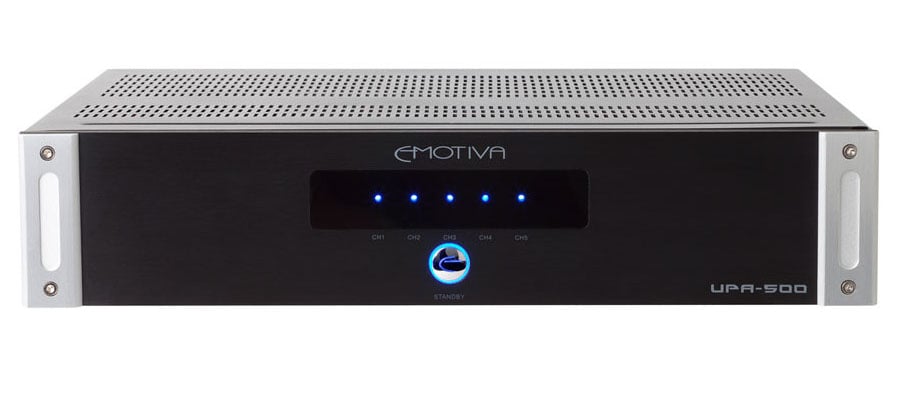
Emotiva
UPA-500 front panel View
The front panel sports Emotiva's same industrial look found in all of their current products. It includes their infamous silver power switch embroidered backlit with their logo (yellow for 'off' state, blue for 'on' state). There are five defeatable LED indicators (one for each channel) that illuminate blue when the amplifier is operating under normal conditions and flash red when all hell breaks loose. I was unable to create such a fault condition in my testing until I accidentally shorted the amp to the ground plate of my lab's 8-ohm test resistors and attempted to conduct a power sweep. Emotiva states that this amplifier is protected from all fault conditions which, to me, is very important and often overlooked by product engineers. I can't tell you how many times I've swapped cables during comparative listening tests where I accidentally shorted the leads. On competently designed amplifiers such as the UPA-500, the amplifier will simply shut down and protect itself and the foolish consumer (or in my case, reviewer) who forget to shut it off before swapping speaker connections. On poorly designed amplifiers, they will either blow output devices or... um, catch fire. In the 12+ years of reviewing amplifiers, I am proud to say I've only blown up one not so well engineered amplifier, which is a testament to all of other brands engineering their products correctly with consumer safety being of utmost importance. Of course, I blew up three samples of that one particular amp, but, moving on...
Set-Up
The UPA-500 was as easy as pie to move around. In fact, I consider it a one-hander amp - even for users ridden with back issues like myself. I connected the UPA-500 to my Marantz SR6004 A/V receiver and Yamaha MCX-2000 MusicCAST and tried it out on a pair of Infinity P363’s I had in for review along with a set of older JBL Pro III surround speakers. This represented a pretty tough load for the UPA-500, since all four speakers are rated at 4-ohms. All speaker cables were Kimber 8PR's along with Impact Acoustics Sonicwave interconnects. The listening tests were conducted in the Audioholics Showcase Theater Room which is a moderately acoustically treated 6,000 ft^3 room courtesy of Auralex Acoustics.
Emotiva UPA-500 Five Channel Power Amplifier Listening Tests
Fourplay - Chant
I use this song to test how prone a speaker is to bottoming out, but it’s also a good indicator of an amplifier's ability to deliver sustained low end bass. The UPA-500 provided plenty of power to drive the Infiniti's to the limits where I heard the speakers begin to compress. Bass was well controlled and there was good clarity. I did, however, feel that my much more expensive Marantz PM-11S2 Integrated amp drove these speakers more pristinely but, at nearly 12X the price of this little Emotiva, that shouldn’t come as any surprise.
Pat
Metheny / John Scofield - Say
the Brother's Name
I love the reverb of Pat Metheny’s guitar in this song. A really good audio system will instantly transport you into a small jazz club in NY. The Infinity P363’s put forth a valiant effort at placing me there and the Emotiva UPA-500 was right at home supplying the power to make it happen. The brushes on the high hats were very detailed and forward and the reverb from the guitar was smooth. Switching to 4CH stereo, I gave the UPA-500 quite a workout in my large room, but it still didn’t falter. It was quite impressive to hear such an inexpensive and compact multi-channel amp belting out this much muscle to a moderately efficient speaker system in a large listening space.
 Next,
I deviated a bit from my reference disc and just hand selected some
great tunes off my Yamaha MCX-2000 MusicCast media server. I cued
up a few Marc Anthony tracks, starting with “Ahora
Quien”.
The UPA-500 showed off its power and fineness, delivering all of the
detail of this complex recording with very good stereo separation.
The trumpets sounded a bit edgy but that was more a blame of the
speakers than the amp. “Tu
Amor Me Hace Bien”,
another classic Marc Anthony song showcased the UPA-500’s ability
to extract all of the subtle details of the recording. The percussion
in this track sounded fabulous and I didn’t fear cranking the
volume up as there was headroom to spare. The stereo separation of
the trumpets and shakers was particularly excellent.
Next,
I deviated a bit from my reference disc and just hand selected some
great tunes off my Yamaha MCX-2000 MusicCast media server. I cued
up a few Marc Anthony tracks, starting with “Ahora
Quien”.
The UPA-500 showed off its power and fineness, delivering all of the
detail of this complex recording with very good stereo separation.
The trumpets sounded a bit edgy but that was more a blame of the
speakers than the amp. “Tu
Amor Me Hace Bien”,
another classic Marc Anthony song showcased the UPA-500’s ability
to extract all of the subtle details of the recording. The percussion
in this track sounded fabulous and I didn’t fear cranking the
volume up as there was headroom to spare. The stereo separation of
the trumpets and shakers was particularly excellent.
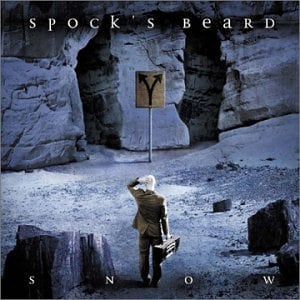
CD: Spock’s Beard – Snow
I took a liking to this band after my brother told me to take a listen to their concept album called Snow. They have clear influenced progressive roots from the likes of 70’s era Genesis and Yes along with very spiritual and deep lyrics to compliment their extraordinary musicianship. “Solitary Soul” is my favorite track on the double disc set. This track builds on the constant theme in the album about a young albino priest with special healing powers struggling to find his way into the world. The acoustical guitars were reproduced with excellent separation. Hearing the singer repeat the hook “love beyond words” just sent chills down my spine. What a moving song and the Emotiva amp powering the Infinity speakers made you really feel the emotion. This 7:34 minute masterpiece just flew by.
Emotiva UPA-500 Five Channel Power Amplifier Measurements and Analysis
All measurements were conducted per the Audioholics Amplifier Measurement Standard using our Audio Precision APx585 8 Channel HDMI Audio Analyzer. When Emotiva found out we were using this test gear, they went out Nicky Santoro style (played by Joe Pesci) from Casino and bought the very same test gear. This is a considerable investment in test gear that no other home theater publication and only a select few consumer A/V manufacturers make, which shows how serious Emotiva is about amplifier design and testing.
I did some quick spot-checking on the UPA-500 amplifier gain structure to ensure it could be properly driven with a wide assortment of preamps or receivers. My personal criteria for amplifier gain structure is that it should be able to hit full power when driven with 2Vrms. The UPA-500 hits full gain much sooner per my measurements which confirm Emotiva’s claim of 850mV. Seeing how most budget receivers preamp outs cannot deliver a full 2Vrms, this extra sensitivity Emotiva employed makes a lot of sense. I measured 29.7dB voltage gain (8 ohm loaded) which was very close to Emotiva’s 29dB specification.
Signal to Noise Ratio
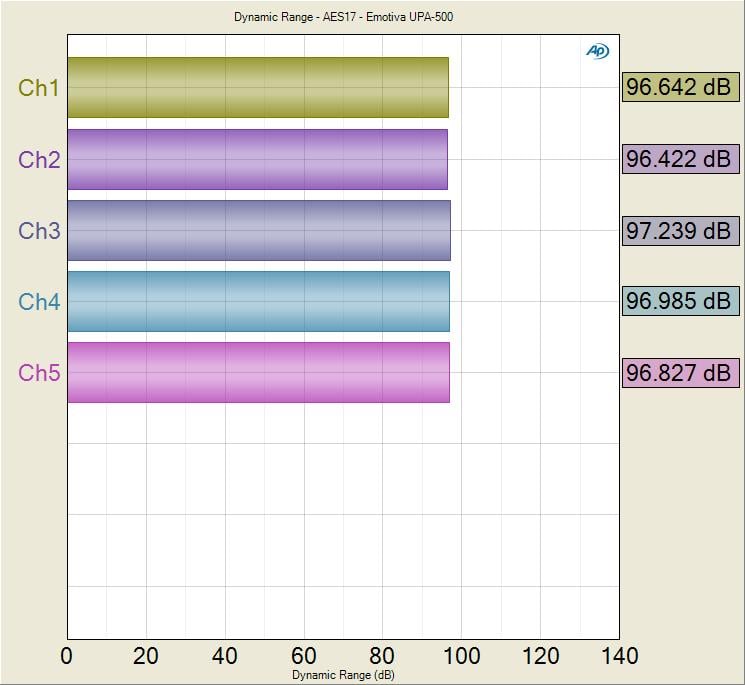
Emotiva UPA-500 SNR @ 1 watt (A-weighted)
Just like past UPA series amps from Emotiva, the UPA-500 exhibited a commendably low noise floor. At 1 watt, I measured 97dB (A-weighted) which is what Emotiva specs for this amp. If you want the un-weighted noise floor, you can subtract about 10dB from this measurement. At 117 watts, I measured 117dB (A-weighted).
Frequency Response
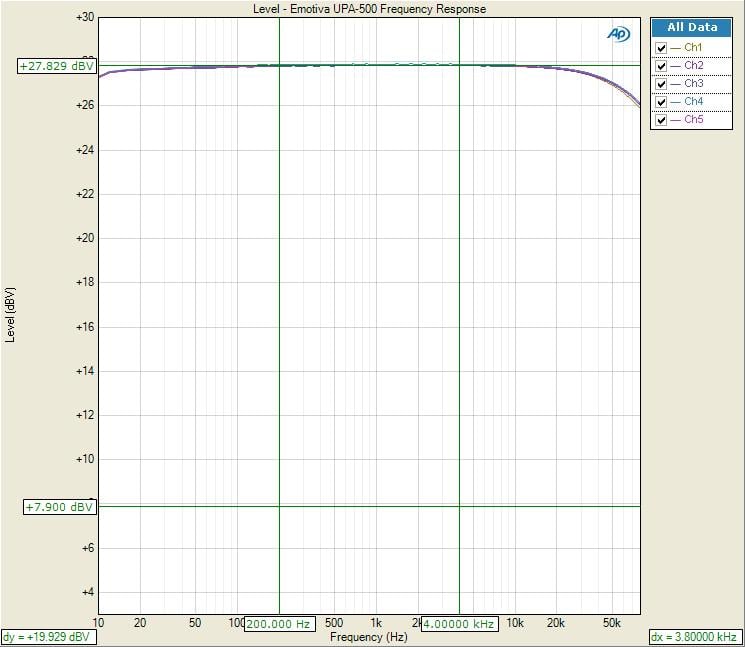
Emotiva UPA-500 Frequency Response @ Full Rated Power
It was no surprise to me that the Emotiva UPA-500 exhibited ruler flat bandwidth from 10Hz to 50kHz with a gradual roll-off of about -1dB at 80kHz which is the bandwidth limitation of my test equipment. Emotiva claims the -3dB is 70kHz but I suspect it’s a bit higher based on what I measured here. What I found quite remarkable was the very tight channel to channel frequency response deviation of +/-0.081dB at 1 watt and +-0.10dB at full power. This indicates very tight tolerances in parts selection and excellent overall engineering.
Power Measurements
Using our Audio Precision APx585 8-channel HDMI analyzer, we conducted a full barrage of multi-channel amplifier tests on Emotiva UPA-500. We tested power using three methods all of which were taken at < 0.1% THD + N:
-
Continuous Full Power Bandwidth (CFP-BW) from 20Hz to 20Khz into 8 and 4-ohm loads (up to two-channels)
-
1kHz Power Sweep vs Distortion (1kHz PSweep) - popularized by the print magazines, this is an instantaneous power vs distortion test at 1kHz. The problem with this test is it often masks slew related and or frequency response problems some amplifiers exhibit at the frequency extremes, and thus inflates the measured power results. It does provide an instant gratification # for consumers to argue over on the forums so we are now incorporating this test to please the masses.
-
Dynamic PWR - 1kHz CEA-2006 Burst Method testing. This is a dynamic power measurement adopted from the car industry similar to IHF method only a bit more difficult for an amplifier and more representative of real musical content.
Keep in mind most review publications don't do continuous power measurements and they usually publish power measurements into clipping at 1% THD + N. Our measurements are very conservative as we use a dedicated 20A line with no Variac to regulate line voltage. We constantly monitor the line to ensure it never drops more than 2Vrms from nominal which in our case was 120Vrms.
For more info on amplifier measurements, see: The All Channels Driven (ACD) Test
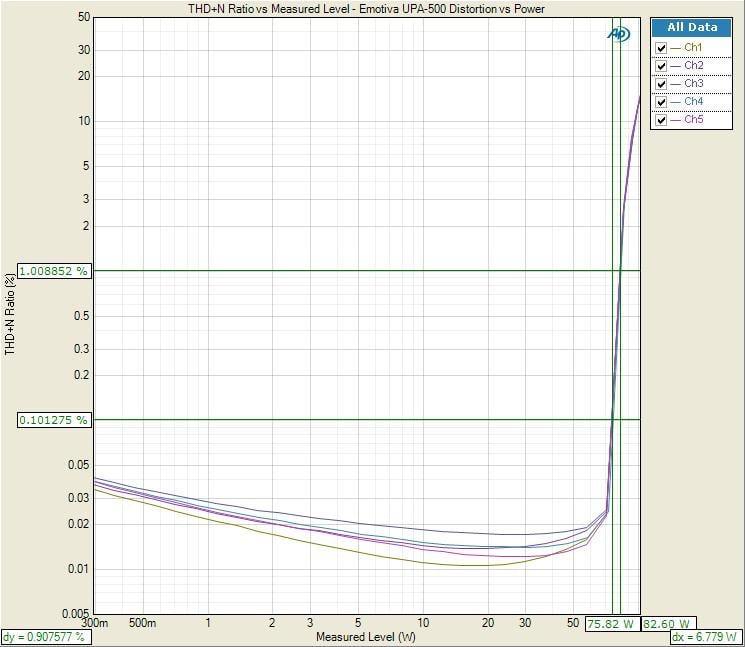
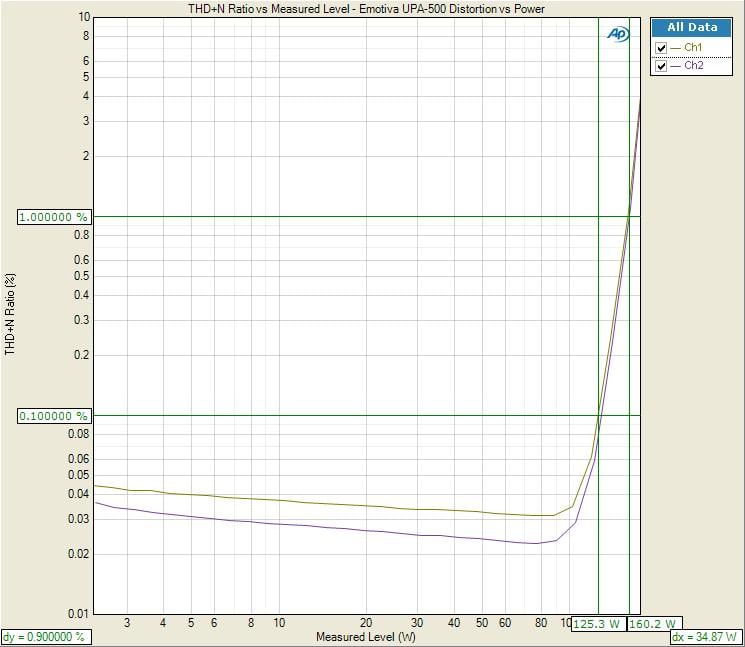
Emotiva
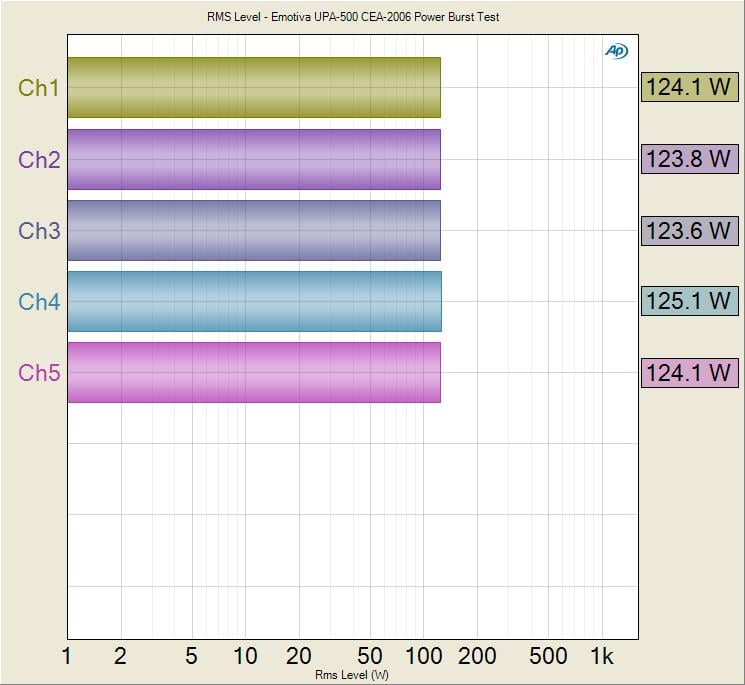
UPA-500 1kHz Power Test
Left
Pic: ACD, 8 ohms; Right Pic: 2 Channels driven, 4 ohms
Emotiva
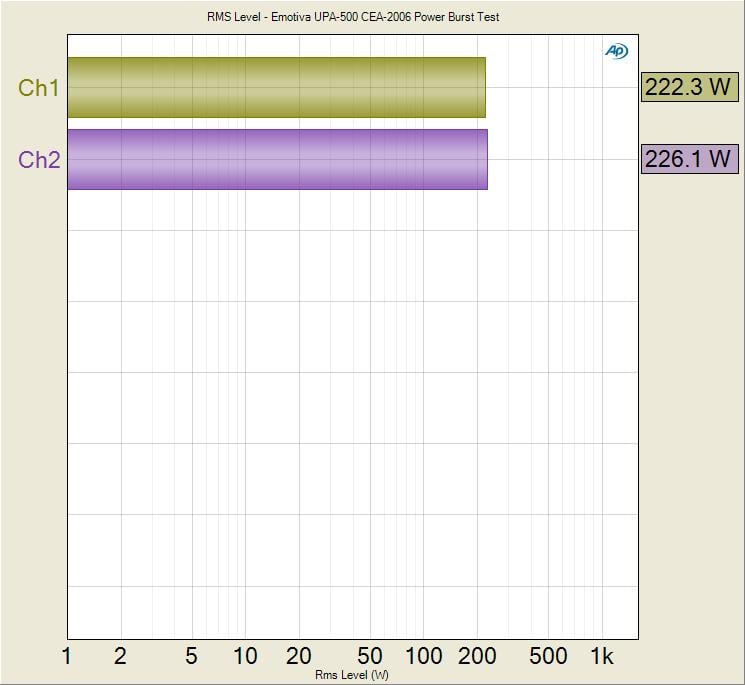
UPA-500 Dynamic Power Test (1kHz)
Left
Pic: ACD, 8 ohms; Right Pic: 2 Channels driven, 4 ohms
-
# of CH Test Type Power Load THD + N 1 CFP-BW 117 watts 8-ohms 1% 1 CFP-BW 225 watts 4-ohms 1% 5 1kHz Psweep 75 watts 8-ohms 0.1% 5 1kHz Psweep 82 watts 8-ohms 1% 2 1kHz Psweep 125 watts 4-ohms 0.1% 2 1kHz Psweep 160 watts 4-ohms 1% 5 Dynamic PWR 125 watts 8-ohms 1% 2 Dynamic PWR 225 watts 4-ohms 1%
Emotiva UPA-500 Power Measurement Table
Emotiva rates the UPA-500 as follows:
-
80 watts x 5 continuous @ 8-ohm (0.01% THD)
-
120 watts x 5 continuous @ 4-ohm (0.01% THD)
Emotiva doesn't specify at what frequency they rate their power output, but I assume they mean 1kHz which is how most manufacturers specify all channels driven power claims. My measurements in this scenario verified Emotiva’s power claims but mine were higher in distortion which is likely due to the fact that Emotiva does their power tests holding the line voltage constant whereas we don’t. If you compare our power sweep results to the dynamic power results you get about 1.8dB of headroom for all channels driven into an 8 ohm load and 2.5dB of dynamic headroom into 4 ohms for two channels driven. The power supply exhibits good headroom to deliver quick bursts of dynamic power when the program material calls for it.
FFT Distortion Analysis
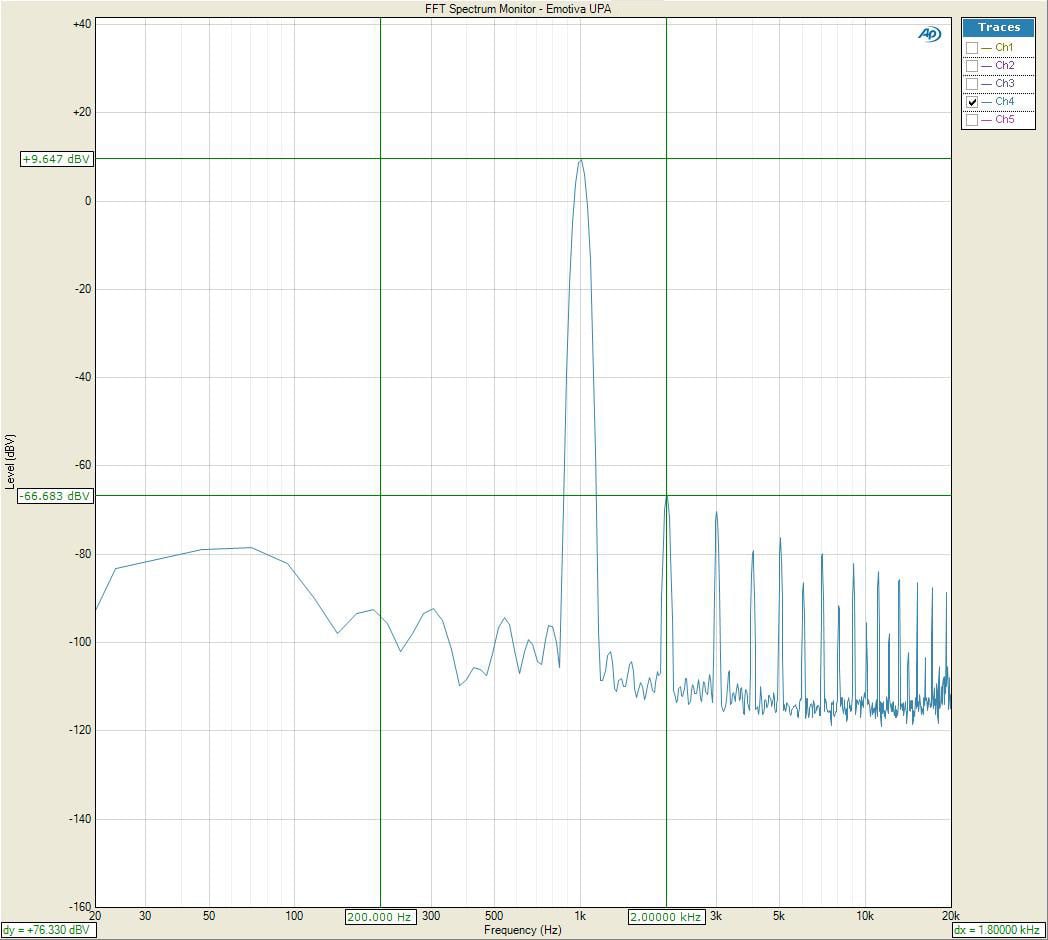
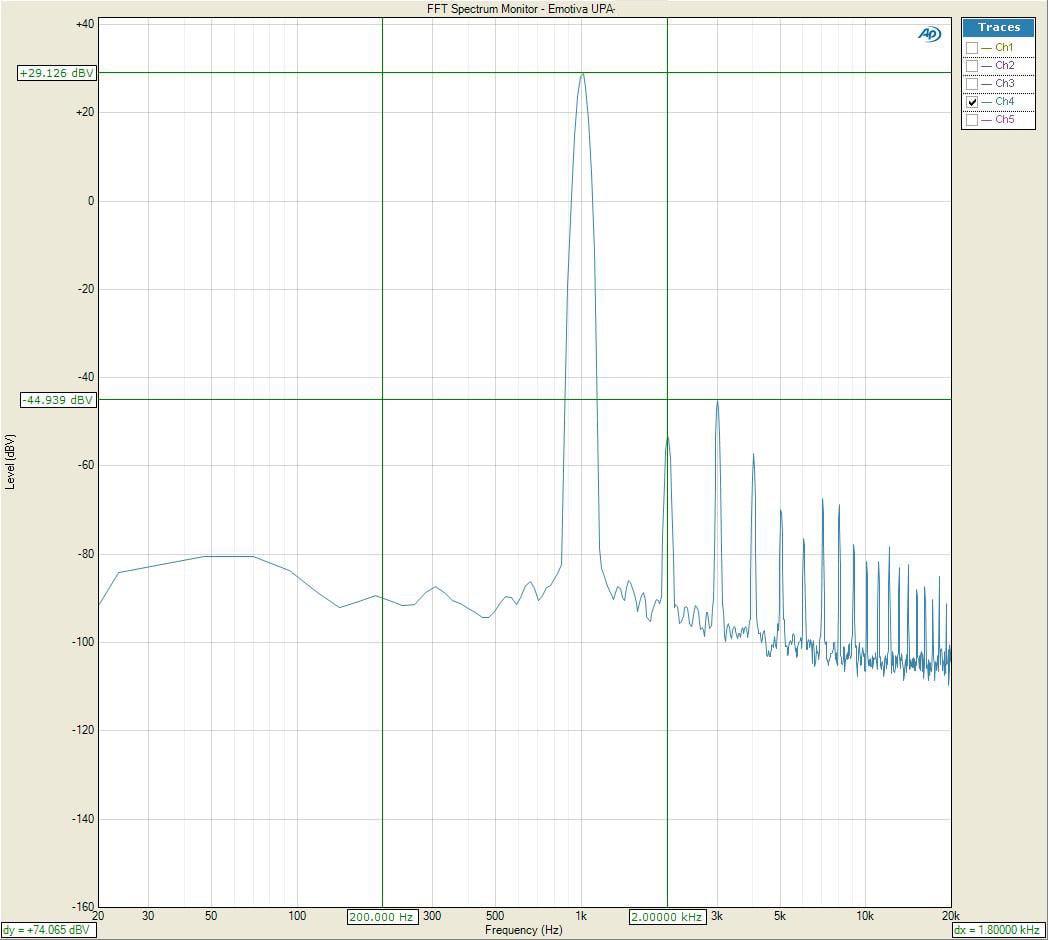
Emotiva
UPA-500 FFT Distortion Analysis
(left
image @ 1 watt ; right image @ full rated power)
I ran FFT distortion plots at 1 watt (left pic) and full rated power (right pic) to determine how clean this amplifier really is. At 1 watt, the spectral distortion wasn’t exactly stellar with the second order harmonic (9.55 + 66.58)dB being 76.2dB down from the fundamental or 100*alog^-1(-76.2/20) = .016%. At 106 watts, I observed (29.13 + 44.94)dBV being 74.1dB down from the fundamental or 100*alog^-1(-74.1/20) = .0040% The odd order harmonics start dominating as the amp starts hitting the rails and becoming slew rate limited at very high frequencies. These are decent measurements, but certainly not the cleanest distortion spectrum I've seen compared to some much higher priced well-executed designs.
Crosstalk
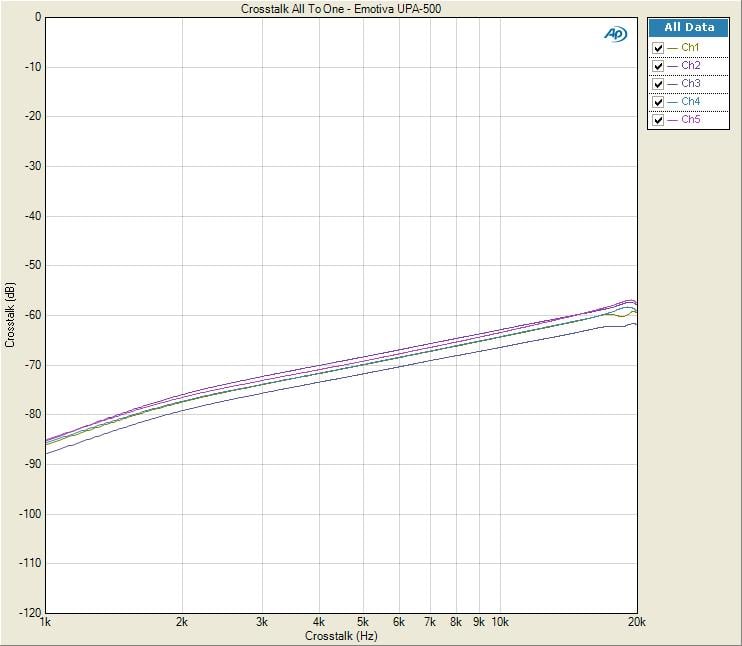
UPA-500 All-to-One Crosstalk at Rated Power
The UPA-500 exhibited very good channel to channel crosstalk performance, much improved over the older and more expensive UPA-7 actually. With all channels acting as the noise source or disturber, I measured each idle channel one at a time to determine the worst case channel to channel crosstalk. At 1kHz the UPA-500 yielded -85dB @ 1kHz and -60dB at 20kHz for its noisiest channel. I consider anything less than -40dB @ 10kHz acceptable so the UPA-500 met that minimum requirement with over 20dB to spare. With only 1 channel acting as the disturber, the adjacent channel produced -95dB at 1kHz and -70dB @ 20kHz, again very good results.
Emotiva UPA-500 Five Channel Power Amplifier Conclusion
The Emotiva UPA-500 is NOT a perfect amplifier.
It doesn’t turn milk chocolate to dark. It won’t part the Red
Sea, nor will it reverse climate change. It will, however, redefine
the quality one comes to expect from a budget amplifier. The UPA-500
delivers clean, low noise, meaty amplification that will
surely bring new life to a whimpering department store A/V receiver.
It’s honestly rated and has no issues driving low impedance loads
while remaining cool in operation even under the most strenuous test
conditions on the bench. If you’re looking for a step up in sound
quality and power on the cheap, I can’t think of a better option on
the market. Highly recommended!
Emotiva
Audio Corporation
135 Southeast Parkway Court
Franklin, TN
37064
615-790-6754 | 877-EMO-TECH (877-366-8324)
UPA-500
Review
MSRP: $399
The Score Card
The scoring below is based on each piece of equipment doing the duty it is designed for. The numbers are weighed heavily with respect to the individual cost of each unit, thus giving a rating roughly equal to:
Performance × Price Factor/Value = Rating
Audioholics.com note: The ratings indicated below are based on subjective listening and objective testing of the product in question. The rating scale is based on performance/value ratio. If you notice better performing products in future reviews that have lower numbers in certain areas, be aware that the value factor is most likely the culprit. Other Audioholics reviewers may rate products solely based on performance, and each reviewer has his/her own system for ratings.
Audioholics Rating Scale
 — Excellent
- — Very Good
- — Good
- — Fair
- — Poor
| Metric | Rating |
|---|---|
| Frequency Response Linearity | |
| SNR | |
| Measured Power (8-ohms) | |
| Measured Power (4-ohms) | |
| Multi-channel Audio Performance | |
| Build Quality | |
| Fit and Finish | |
| Ergonomics & Usability | |
| Features | |
| Performance | |
| Value | |
Gene manages this organization, establishes relations with manufacturers and keeps Audioholics a well oiled machine. His goal is to educate about home theater and develop more standards in the industry to eliminate consumer confusion clouded by industry snake oil.
View full profile Subscribe to our newsletter