


Thule Audio PA350B Multi Channel Amplifier Review
Thule Audio PA350B
- Product Name: PA350B
- Manufacturer: Thule Audio
- Performance Rating:

- Value Rating:
- Review Date: August 27, 2006 19:00
- MSRP: $ 3995
- Power output, 20-20k Hz, 8 ohm: 2x 350W / 5x 120W
- Power output, 20-20k Hz, 4 ohm: 2x 500W / 5x 160W
- Peak current capacity, 1ms, 0.6ohm: +/- 45A
- Frequency range: 20-20kHz +0/-0.5dB
- THD 20-20k Hz, -10dB, 8 ohms: 0.004%
- S/N 0dB: 112dBA
Pros
- Excellent measured and audio performance in 2CH bridged mode
- Lightweight and compact design
- Runs relatively cool
Cons
- Very expensive
- Average 5CH power performance
- No +12V or Music trigger
- Doesn’t retain input selection on power cycle in 2CH mode
Thule Audio PA350B Introduction
We have had the good fortune of testing some of the
industry's best multi-channel amplifiers.
If you are from the camp that all amps sound the
same, then don't waste your time reading
another amplifier review.
The truth is, most amps
sound similar if
they: a) have wide enough bandwidth, b) low enough noise floor, c) are
not
driven beyond their linear operating region,
and d) are capable of sourcing enough steady state power
without clipping dynamics to satisfy your
listening needs.
The question remains however, "what is good enough"?
Thule seems to think their design approach meets these
criteria nicely and, best of all, does so in
a reasonably-sized efficient package that likely
won't invoke a hernia to the installer.
Their solution is a multi-channel amplifier that
can be configured for 5- or 7-channels or be
bridged for an ultra high power two-channel amp.
With rack space being a premium these days, and heat being of paramount
concern, this amplifier design
certainly piqued my interest.
I was eager to find out how this Danish-made amplifier would
perform in the
Audioholics -
Premier Showcase
system
.
Thule Audio PA350B Design Overview
Design Overview
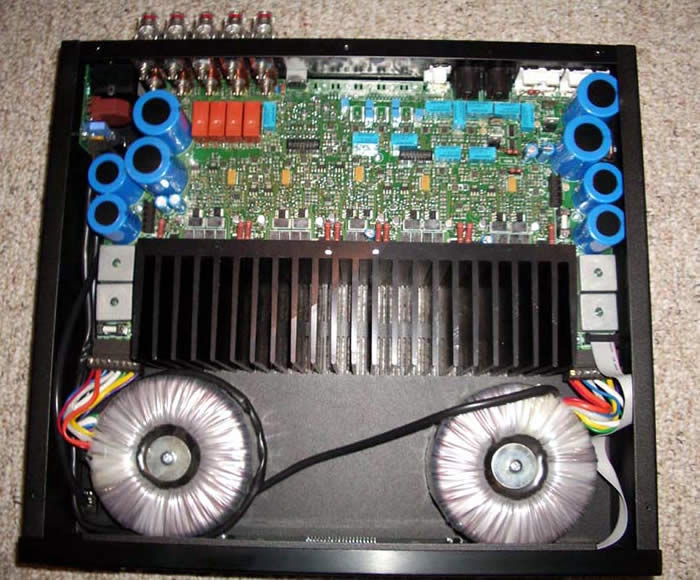 Thule refers to the PA350B
as a "Virtual Class A"
amplifier design.
Upon inspecting their literature and also
popping the top cover off, the best I could make of this claim is that the amp is a rail switcher which
is biased into Class A (100mA of bias current is always flowing through the transistors according to
the manufacturer) to eliminate cross over distortion caused by the on/off switching of a push pull
transistor scheme found in most traditional Class B amps.
This is nothing revolutionary as most
modern linear amps these days are of a Class A/B design where the amp operates in Class A for low power
levels.
Although Thule was able to achieve a higher bias into Class A while preventing excessive
heat build up by rail switching at higher power levels.
Thule refers to the PA350B
as a "Virtual Class A"
amplifier design.
Upon inspecting their literature and also
popping the top cover off, the best I could make of this claim is that the amp is a rail switcher which
is biased into Class A (100mA of bias current is always flowing through the transistors according to
the manufacturer) to eliminate cross over distortion caused by the on/off switching of a push pull
transistor scheme found in most traditional Class B amps.
This is nothing revolutionary as most
modern linear amps these days are of a Class A/B design where the amp operates in Class A for low power
levels.
Although Thule was able to achieve a higher bias into Class A while preventing excessive
heat build up by rail switching at higher power levels.
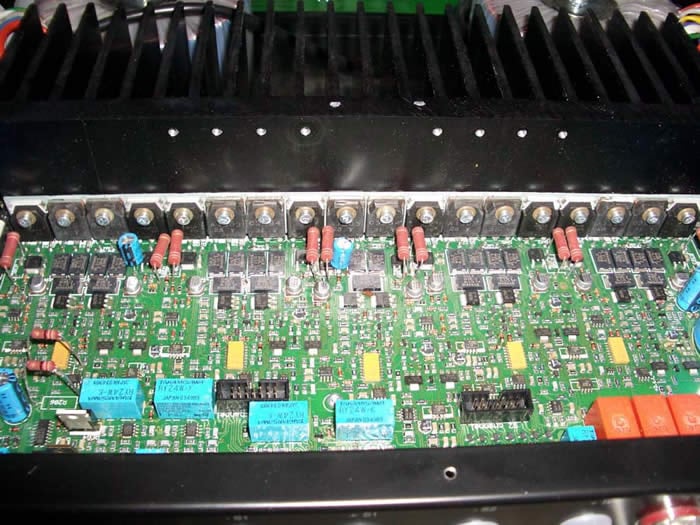 This amp employs a rail switching scheme where at low power levels it operates on +-
20V rails and switches over to +-40V rails for high output conditions. This is a typical design scheme
of many modern Class G amps such as those from Outlaw Audio, Emotiva, Sherbourn, etc and if executed
properly, can significantly increase efficiency and reduce heat dissipation without any audible audio
penalties.
This amp employs a rail switching scheme where at low power levels it operates on +-
20V rails and switches over to +-40V rails for high output conditions. This is a typical design scheme
of many modern Class G amps such as those from Outlaw Audio, Emotiva, Sherbourn, etc and if executed
properly, can significantly increase efficiency and reduce heat dissipation without any audible audio
penalties.
Thule takes this design approach one welcomed step further by executing a TRUE fully balanced input to output topology from line level all the way to speaker level. They also caution the end user NOT to connect a ground reference to the speaker outputs. I paid careful attention to ensure that my Audio Precision Audio Analyzer was in balanced mode when testing this amplifier. There are a number of advantages to designing a fully balanced amplifier topology including, reducing distortion (cutting it in half) and noise (reducing it up to 6dB). The downside is increased circuit complexity and parts usage that most manufacturers opt not to undergo.
Editorial Note on the PA350B Amplifier Design
- The PA350B is basically a Class G rail switching amp design.
- It contains two 500VA toroidal power supplies each with their own capacitor banks as indicated below.
- It has 2 x 15,000uF 50V caps for the +-40V HIGH rails and 2 x 15,000uF 25V caps for the LOW rails assigned to each power transformer. The manufacturer claims a whopping 120,000 uF of total power supply capacitance but since they operate each pair of capacitor banks on different rails, I consider the total effective supply capacitance to be ½ of this stated claim.
- The PA350B has a total of 36 output devices (2 pairs of which are reserved for upgrading this unit to 7 channels). I would presume that 2 output device pairs are allocated per channel while the amp gangs up 4 pairs per channel when bridged into 2CH high power mode. Only 18 output devices are visible in the top view picture, though I suspect the other 18 are below the circuit board mounted to the heat sink.
- In order to do 350wpc a minimum recommended cap voltage of sqrt(2)*53 + 5 = 80V should be used. But because of the balanced amplifier topology, the required working voltage of the power supply and Caps is only ½ that. Thus 50V caps for the HIGH rail has sufficient design margin to achieve their sustained high power specification.
- The bridged output topology of this amplifier greatly increases efficiency and reduces heat dissipation compared to conventional amplifier designs.
- Care must be taken however when driving low impedance loads as most bridged amplifiers cannot safely drive loads below 2 ohms. Thule warns about this scenario as it will cause the amp to turn off if you present it with an impedance below 2 ohms.
Editorial Note on Balanced vs Unbalanced Connections
I measured the voltage gain of the Thule PA350B via balanced and unbalanced inputs and found the following:Unbalanced: Av = 29.8dB (about 0.8dB higher than THX standard)
Balanced: Av = 23.8dB (6 dB lower than unbalanced)
This is a standard practice in most consumer and pro audio. The preamp therefore usually has a +6dB boost via the balanced outputs to compensate. If you are using unbalanced to balanced connection scheme that I used in order to interface my receiver with this amp in bridged mode, you will likely find that you have to increase the channel trims of your main speakers to +6dB to compensate for the level offset.
My personal criteria for amplifier gain structure is that it should be able to hit full power when driven with 2-3Vrms. The PA350B fell well within this criteria
Check out our Balanced vs. Unbalanced Connections Article for more information.
Thule Audio PA350B Setup and Operation and Listening Tests
The Thule PA350B is a rather unique amplifier in the sense that it is the first I've run across with 3 power switches! That's no typo, there is a Mains power switch located on the back of the chassis, a Fault switch located below the unit, and a Stand By front panel power switch. I can appreciate the manufacturer's passion for safety, but I found the bottom chassis fault switch to be more of a nuisance than a benefit, especially after I loaded the unit in my Middle Atlantic Rack and found out the hard way it wouldn't power up because I accidentally disengaged power to the fault switch when installing the 48lb amp at the top of my rack.
According to the manual, the PA350B requires an unusually long 2-4 hours to warm up and reach peek performance if cold started from the mains power switch, but only requires 10-15 minutes of warm up time if the unit is left in standby mode and then becomes active. While I can understand the benefits of allowing an amplifier to reach thermal equilibrium, I am uncertain as to why it would take as many hours as the manufacturer claims from a cold start. Nonetheless, I left the amp on for several hours before engaging in any critical listening tests or undergoing my power measurements.
The PA350B can be triggered to toggle between 2CH and 5CH mode in three ways:
- Auto sense mode - if it detects signal on center channel it automatically switches to 5/7 CH mode
- Manually on front knob by pressing the 2CH/5CH button
- Their proprietary data port which interfaces with their matching preamplifier
One operational quark that irked me regarding the bridged 2CH mode is that the unit automatically reverted back to balanced inputs each time it was power cycled. Since I wasn't using their matching preamp to provide it data logic, I had to use some nifty Impact Acoustics unbalanced to balanced cables between the preamp of my Denon AVR-5805 receiver to this unit to always ensure I had audio signal present.
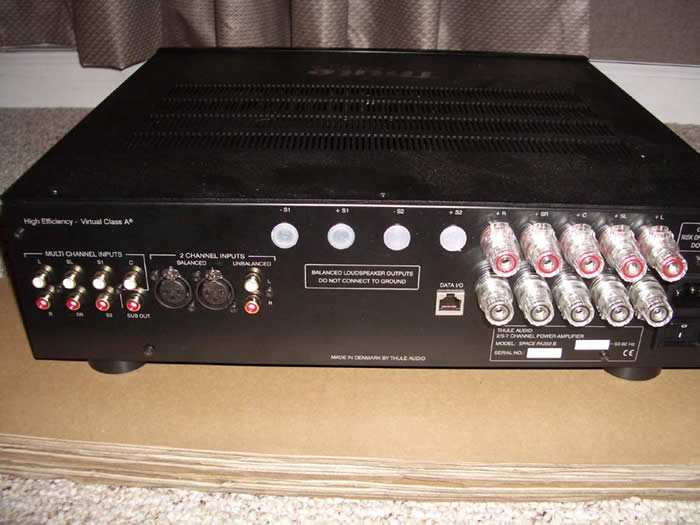
The PA350B sports all high quality WBT style banana speaker terminals and gold plated RCA jacks with two balanced inputs for the high power 2CH bridged mode. It has no 12V trigger options (a disappointment to me) though the unit can be trigged via the proprietary data port connection if you are using their matching preamp. The S1 & S2 connections are intended for upgrading this unit to 7 channels of amplification.
Subjective Listening Tests
I spent most of my time listening to the PA350B is 2CH bridged mode connected to the top portion of my new RBH Sound T30-LSE system. This is a special anniversary edition of the T2P System fitted with Status Acoustics driver upgrades and enhanced high excursion dual 10" subwoofers. There are also other upgrades in the crossovers and increased box volume for the bass drivers. Audio nirvana has been reached, but pairing these babies with quality amplification is a must. I used the Thule PA350B and some new, soon to be released, 1U high subwoofer amplifiers from Earthquake to power the bass modules.
When switching between 5CH mode and 2CH bridged mode, the latter seemed much more dynamic, and lively. The 5CH mode of this amp simply didn't have enough oomph to drive my 4 ohm speakers to reference levels in my nearly 6,000 ft^3 Auralex-treated Audioholics Showcase Room . While the PA350B didn't sound bad in 5CH mode, it simply didn't have the heavyweight feeling it took on once it was switched over to 2CH bridged mode. If there were ever a case of Dr. Jekyll & Mr. Hyde in amplifiers, this was it! In 5CH mode the PA350B was a mild mannered amplifier much like those found in very good mid-priced receivers. A quick switch over to 2CH bridged mode revealed the true dynamic nature of the beast while at the same time proving muscle could be matched with finesse with its dead silent noise floor and very open and natural sound. The PA350B loved to be cranked and had all of the dynamics and clarity needed to power my new reference speakers to SPL levels beyond that of what most mere mortals (including myself) could bear to listen too.
I didn't want to baby this amp, so I threw the most dynamic material in my collection at it from the likes of Patricia Barber, Diana Krall, Jaco Pastorius and Pat Metheny. The Pat Metheny & John Scofield - I Can See Your House From Here to this day remains one of my favorite CDs to listen to for critical 2CH audio evaluations. This disc quickly reveals the dynamic nature of a hifi system from amplifier stage all the way to the speakers. Wimpy amps will clip or sound stringent during drum solos and cymbal crashes. This was not the case with the Thule PA350B amplifier when bridged in 2CH mode. It was able to convey all of the dynamic nature of Track #4 "Everybody's Party" with ease. The cymbal crashes were liquid and transparent while the brush strokes retained their airy sonic signature I was familiar with when evaluating this CD on other excellent components that have graced my reference system in the past.


I have recently become acquainted with the late and great Jaco Pastorius who is quickly becoming one of my favorite bass players... yes I am a sucker for fretless bass. My neighbor brought over a multichannel SACD from him, not knowing what he had in his possession; we popped it in for a listen. It became readily apparent we had reference multi-channel material on our hands. This is perhaps one of the best sounding multi-channel recordings I've heard to date. The Thule PA350B seemed to love this SACD as well as it belted out plenty of clean and dynamic sound throughout the entire listening session.
kinda JAZZY kinda FUNKY from HighNote Records is a groovy compilation of jazz that you just don't get on the radio, and rarely have the opportunity to hear live (at least in my neck of the woods). The jazz organ was reproduced with amazing clarity and fluidity on track #7 "Peach Cobbler" by Bill Heid. The trumpet solos were so vibrant and real, I felt like I was at the Old Jazz Cellar I used to visit in Ybor City back in my college days. All I was missing in this listening session was a pint of my favorite brew.
For fun, I decided to run my RBH T30-LSE system entirely off the Thule PA350B in 2CH bridged mode, thus bypassing the Earthquake amps that were powering the subwoofer portions of my speakers. I couldn't think of a better torture test than using the Dianne Reeves Never too Far CD I had on hand.
Dianne Reeves Track#1 "Hello (Haven't Seen You Before)" bass line is quick and sustained. It tests transient response of speaker system. With the Thule PA350B running my main speakers full range, the bass was incredibly tight and well pronounced, despite the fact I shut off my additional 2 subwoofers which were strategically placed in the room to provide more uniform bass in the listening area. I was a little unsure at first if the PA350B would be up for running my speakers full range since the internal subwoofers in the system don't have a crossover network. They were designed to roll off based on the natural acoustical slopes of the drivers. As a result, they have stellar transient response but also represent a difficult load to wimpy amps since they are highly inductive. The PA350B had no qualms about accepting this challenge and effortlessly drove my speakers with ample and well-controlled bass and nuclear highs. It revealed its "Hyde" character when called upon to do so.
In track #2, "Never too Far", the chorus sounded like it emanated from the side channels. If I hadn't confirmed my processor was set to 2CH, I'd think I was listening in PLIIx Music Mode. The stereo separation was excellent and I was rewarded with a naturally LARGE soundstage just like I would expect from any well engineering amplifier.
Track #3 "Come In" literally shook the floor of my 6,000 ft^3 reference room. Plenty of power taxing bass was present while at the same time excellent vocal clarity and non sibilant highs were consistently reproduced.
Switching this amp to 5CH mode simply revealed the Dr. Jekyll side of this amplifier. The amp simply couldn't keep up with the demand of my speakers. The bass was no longer as punchy and the transients weren't nearly as dynamic. I also noticed the noise floor was audibly higher and the amp simply didn't sound as refined or effortless. For small satellite speaker systems this will likely be of no consequence, but for those budding audiophiles who require raw power for their monster-sized speaker systems, 2CH bridged mode with this product is your only logical recourse.
Recommendations
The Thule PA350B multi-channel amplifier left me with mixed recommendations. As a 2CH bridged amplifier, it is a very fine amplifier. Its performance and sound quality is excellent, and its cool running compact chassis is appealing for those with limited rack space and the lack of desire to lug a 100lb amp up a flight of steps to get to their theater room.
However, as a 5CH amp, it falls short of its published power specifications though still performing above average. It didn't have quite enough juice to power my reference system in the large sized room I was using it in, but may be sufficient for smaller scale installations where the user is running a bass managed satellite speaker system with multiple subs.
Thule employed a fully complimentary circuit topology from input all the way to the speaker outputs. This is very rare in the audio industry as it greatly increases component costs and circuit complexity. However, it pays dividends in achieving exemplary low distortion figures. As you can see in my test results, the Thule amp produced some of the lowest distortion figures we've seen to date regardless of price or proclaimed power. My hats off to them for designing a truly fully balanced amplifier - the only way to do it in telecom industry in order to accurately pass distortion free data over long distances. Their efforts in this capacity certainly paid off in the amplifier's sonic signature which to me seemed very laid back, natural and unstressed in 2CH bridged mode.
Considering its asking price of $4k, it's not the bargain basement of amplifier brands you may be accustomed to when dealing with many of the online manufacturers. As is the case with most European products, while you may have to pay through the nose to get these products you are sure to find a compact design that can competently serve your 2CH and multi-channel needs. If this describes you, then you should take this baby out for a test drive.
Thule Audio PA350B Measurements & Analysis
Amplifier Efficiency Measurements ranged from as low as 38% in 5CH mode when driving just one channel at full unclipped power, all the way up to 54% when driving 2 channels at full, undistorted power into 4 ohms. In 2CH mode I achieved nearly 51% efficiency when driving a single channel at full power into a 4 ohm load. These are pretty decent efficiency #'s and certainly a bit higher than most conventional linear AB amplifier designs. As you can see in the tabulated data below, the closer to drive an amplifiers power supply to full load condition, the more efficient the power delivery becomes.
|
Mode |
# Ch
|
Power Consumption |
Power Delivered |
Load |
Efficiency |
|---|---|---|---|---|---|
|
5CH |
1 |
225 watts |
86 watts |
8 ohms |
38 % |
|
5CH |
2 |
360 watts |
172 watts |
8 ohms |
47 % |
|
5CH |
2 |
612 watts |
330 watts |
4 ohms |
54 % |
|
2CH |
1 |
1116 watts |
566 watts |
4 ohms |
51 % |
Editorial Note On Amplifier Efficiency Data
I suspect the slightly lower efficiency of the 566 watt power delivery scenario was a result of excessive heat losses in the power supply and amp section. This test was overexceeding the power consumption specification from the manufacturer by over 116 watts and was likely a bit too much for the heat sinks to dissipate and the power transformers to handle under continuous loading.
Power Bandwidth
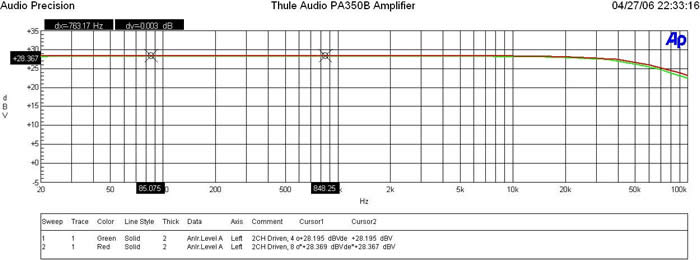
5CH Mode Power vs Frequency Response
The -3dB point of this amp is around 60kHz when driven to full unclipped continuous power 85wpc (0.1% THD + N) into 2 channels driven or 165wpc into 4 ohms with 2 channels driven. 85wpc was a bit shy (-1.5dB) of their 120wpc claim into 8 ohms but they did deliver rated power into 4 ohm loads. I was unable to sweep down to 10Hz at full power because amp kept switching into protection mode in 5CH Mode.
This did not occur in 2CH Bridged Mode however.
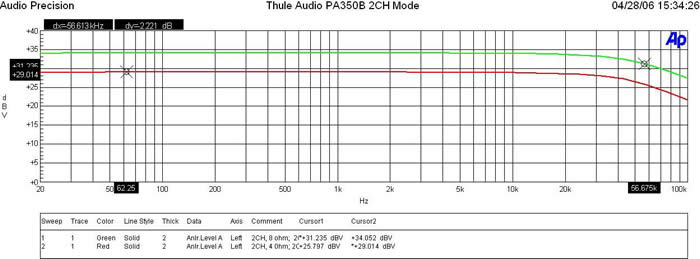
2CH Bridged Mode Power vs Frequency Response
In 2CH bridged mode, the PA350B was able to achieve a whopping 317wpc with two channels driven continuously above 50Hz (-3dB point around 53kHz) with less than 0.1% THD + N into 8 ohms. However, when driving 2 channels simultaneously, I was unable to exceed 265wpc x 2 without having the amp shut off if driving any greater power levels at low frequencies (below 50Hz) for sustained continuous conditions. This isn't surprising since in order to deliver 317wpc x 2 continuously, the power supply would have to be capable of delivering (317 x 2 / .5) = 1268 watts which the two 500VA transformers in this amplifier aren't capable of delivering. The amp would require at least 750VA dual transformers to accomplish such a feat. This would likely never be an issue in real world since we don't listen to continuous correlated test tones.
I was able to achieve unclipped 500wpc continuously at (0.1% THD + N) into 1 channel driven at 4 ohms. Unfortunately, the amplifier didn't have a large enough power supply to deliver its full power rating continuously into 2 channels. If I drove it any higher than 200wpc x 2 continuously at full bandwidth into 4 ohms, the amplifier would shut off. This is an unlikely real world scenario but something to be mindful of if you have an appetite for achieving LOUD SPL levels from 4 ohm, moderately sensitive ( < 89dB @ 1 watt/meter) into a large theater room (3000 ft^3 or more). Also keep in mind most review publications don't do continuous power measurements and this observation would have went unnoticed in their test procedures.
The PA350B is rated to deliver 350wpc x 2 into 8 ohms or 500wpc x 2 into 4 ohms but the manufacturer doesn't specify if this is a continuous rating with both channels driven, though its kinda obvious it isn't given the size of the power supply, and the rated max power consumption of 1000 watts, thus one cannot call the ACD power police on them for not meeting their power specification since I was able to validate it for at least 1 channel driven into 8 and 4 ohm loads on a continuous full bandwidth basis at 0.1% THD + N despite the manufacturer didn't even specify distortion limits of their ratings.
FFT Distortion Analysis
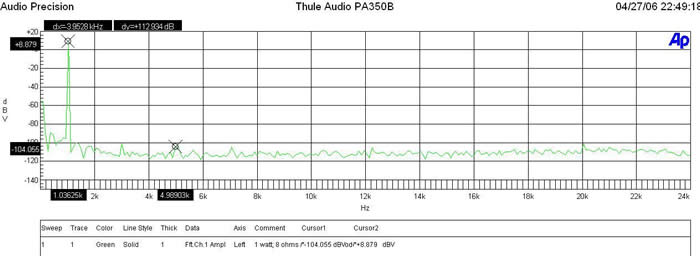
5CH Mode FFT Analysis
At 1 watt into 8 ohms, the PA350B exhibited impressively low distortion (8.879+104.055)dBv = 112.9dBv or 100*alog^-1(-112.9/20) = .00026% This is one of the lowest distortion measurements we've seen and a tribute to the fully balanced output design topology of this amplifier.
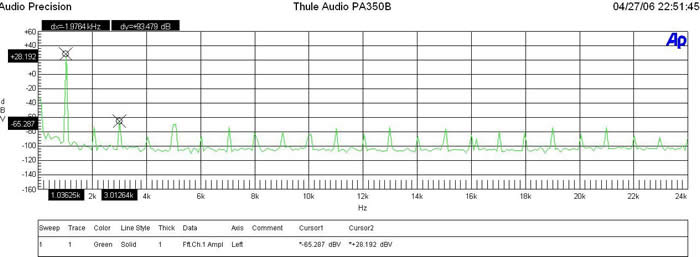
2CH Bridged Mode FFT Analysis
At 550wpc into 4 ohms, the PA350B didn't falter at providing excellently low distortion, unadulterated power. (33.492+47.677)dBv = 81.169dBv or 100*alog^-1(-81.169/20) = .0087% A rare achievement for amplifiers running at full rated power and again attributed to its fully complementary output topology.
Signal To Noise Ratio (SNR) Tests
|
Amplifier Mode |
Input Connection |
Power Level |
SNR (unweighted) |
|---|---|---|---|
|
5CH |
Unbalanced |
1 watt |
70 dB |
|
5CH |
Unbalanced |
86 watts |
88.64 dB |
|
2CH Bridged |
Unbalanced |
1 watt |
76.5 dB |
|
2CH Bridged |
Unbalanced |
285 watts |
100 dB |
|
2CH Bridged |
Balanced |
1 watt |
80 dB |
|
2CH Bridged |
Balanced |
285 watts |
104 dB |
In 5CH mode, the PA350B exhibited about average SNR performance from what we've come to expect of high performance amplifiers. 2CH bridged mode however exhibited a significant improvement in amplifier noise floor which is most apparent by the 6dB improvement at 1 watt. Using the balanced inputs further lowered the noise floor another 4dB or so to achieve a very respectable 80dB SNR @ 1 watt unweighted. The manufacturers SNR specification of 112 dBA seems about right for a full power measurement using A-weighted filtering.
Amplifier Output Impedance
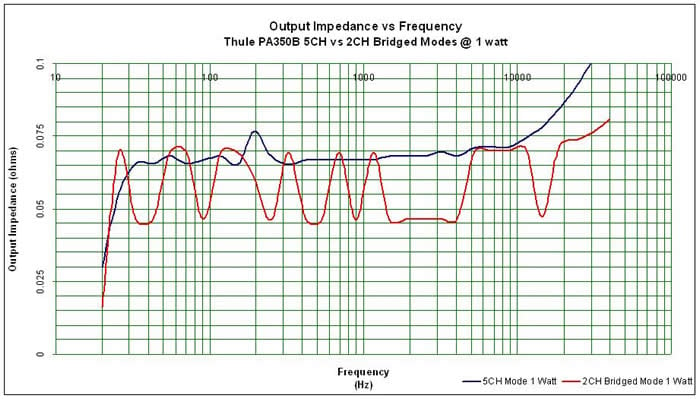
The amplifier output impedance was superb in both 5CH Mode and 2CH Bridged Mode. It maintained well under 100 mohms (our benchmark #) for the entire audio frequency range. This amplifier should sound very consistent between different speaker types assuming it isn't driven beyond its power limits.
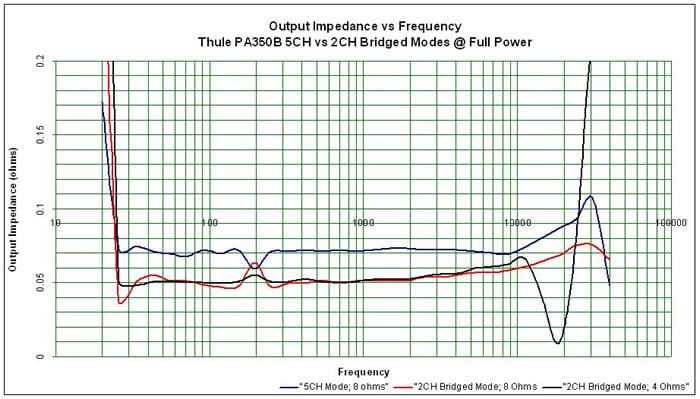
The amplifier output impedance was again under 100mohns in 5CH mode and about half that in bridged mode. The increased output impedance below 20Hz indicated perhaps where they chose the pole for high pass filtering the low end response to block DC. Incidentally this is the frequency area that caused the amp to shut off if swept at full power - again a non likely real world scenario. The accentuated output impedance at 40kHz into a 4 ohm load in Bridged mode was a bit peculiar but since it was well out of the audio range, I didn't give it much thought for further investigation.
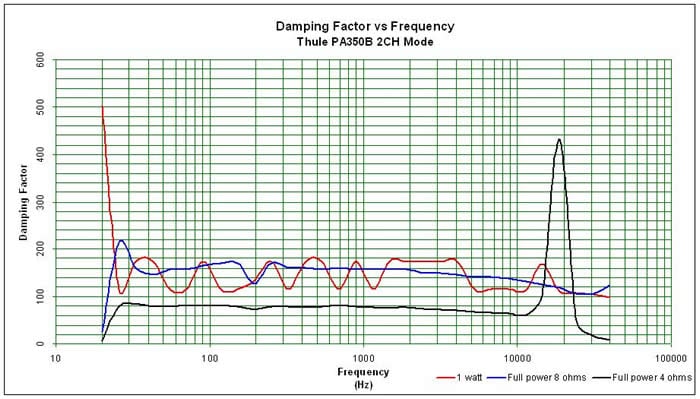
The damping factor of the Thule amp in 2CH bridged mode was uniformly excellent at all power levels and load impedances as was expected based on the measured output impedance. I was a bit puzzled as to why the amps output impedance had such a sharp rise at 20Hz, causing poor damping, when driven to full power. I could only assume it was some intentional protective measure to NOT overdrive the amplifier. This did not cause any audible hiccups in my listening tests however.
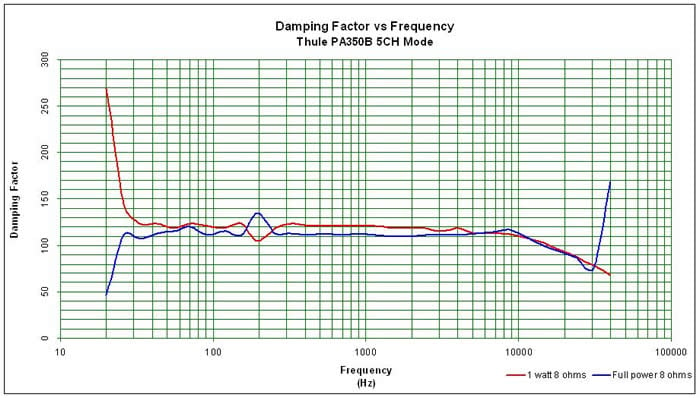
Even in 5CH mode, the Thule amp exhibited excellent damping characteristics, though the puzzling 20Hz loss of damping at high power was also prevalent.
The Score Card
The scoring below is based on each piece of equipment doing the duty it is designed for. The numbers are weighed heavily with respect to the individual cost of each unit, thus giving a rating roughly equal to:
Performance × Price Factor/Value = Rating
Audioholics.com note: The ratings indicated below are based on subjective listening and objective testing of the product in question. The rating scale is based on performance/value ratio. If you notice better performing products in future reviews that have lower numbers in certain areas, be aware that the value factor is most likely the culprit. Other Audioholics reviewers may rate products solely based on performance, and each reviewer has his/her own system for ratings.
Audioholics Rating Scale
 — Excellent
- — Very Good
- — Good
- — Fair
- — Poor
| Metric | Rating |
|---|---|
| Frequency Response Linearity | |
| SNR | |
| Output Impedance | |
| Measured Power (8-ohms) | |
| Measured Power (4-ohms) | |
| Multi-channel Audio Performance | |
| Two-channel Audio Performance | |
| Build Quality | |
| Fit and Finish | |
| Ergonomics & Usability | |
| Features | |
| Performance | |
| Value | |
Gene manages this organization, establishes relations with manufacturers and keeps Audioholics a well oiled machine. His goal is to educate about home theater and develop more standards in the industry to eliminate consumer confusion clouded by industry snake oil.
View full profile Subscribe to our newsletter