


Sherbourn 7/1250A Amplifier Review
Sherbourn 7/1250A Amplifier
- Product Name: 7/1250A 7-channel Amplifier
- Manufacturer: Sherbourn Technologies
- Performance Rating:

- Value Rating:
- Review Date: February 13, 2005 18:00
- MSRP: $ 2000
- Continuous Power Output: 125 wpc (20Hz-20kHz) All channels
driven
- Speaker
Impedance: 4-ohms,
minimum
- SNR: Input
Impedance/Sensitivity: 104dBa (full
power) / 40 kohms
- Power
Requirements: 115V, 60Hz (US);
230V, 50Hz (European)
- Dimensions: 17.7" x 18.2" x
7" (WxDxH)
- Weight: 62 lbs
Pros
- More power than stated
- Reasonably lightweight
- Runs cool
Cons
- Can sound bright on some speakers
- Slight hiss at low volumes
Sherbourn 7/1250A Introduction
It seems apparent these days that home theater has pushed beyond the boundaries of “excessive” as evident by the almost endless options of surround processing, video formats, and the number of channels present in a typical home theater system. This has caused manufacturers to be smarter ergonomically by squeezing out every last option and feature into the smallest footprint possible while keeping the price within the boundaries of most consumers. Sherbourn is no stranger to this design concept, as we learned when reviewing their venerable 5/1500A and 7/2100A multi-channel amplifiers. Their previous amps were true mono block designs with completely independent power supplies for each channel. Unfortunately these amps weighed over 100lbs, making installations a bit of a challenge and transportation even more so. In order to get the size, weight and price down, Sherbourn designed a slightly less powerful version of its big brother 7/2100A, but with dual power supplies to feed all of the seven channels. As you will see later in the measurements section of this review, there are advantages to this design approach in addition to the obvious space and cost savings.
Build Quality
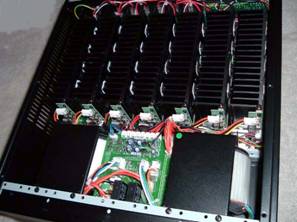
Open up the 7/1250A amp and you’ll be greeted with a densely-packed assembly of solid state technology. The first thing that should catch your eye are the dual 1kVA toroidal transformers and row of aluminum tapered heatsinks. Upon first glance I couldn’t find the power supply capacitors and for a brief moment pondered if Sherbourn defied the laws of physics. Upon closer inspection, I found the 80V, 6800uF capacitors neatly tucked just below each row of heatsinks . You won’t be able to get a good look at them due to their location within the enclosure, so take my word on it. The 7/1250A also employs 28 power transistor output devices. 14 are configured as PNP and 14 as NPN making a push-pull class AB amplifier design.
Editorial Note: Details on Sherbourn Amplifier Design
- Four high current complementary output power BJTs per channel – paralleling multiple BJTs is a good method of ensuring amplifier output impedance is low enough to deliver high current while driving low impedance loads
- Multiple high voltage (80V) capacitors (2 x 6,800uF = 13,600uF per channel). In order to do 125wpc a minimum recommended cap voltage of sqrt(2)*31.6 + 5 = 50V should be used. Using 80V gives them plenty of design margin and added headroom since the rails are set for +/60V.
- Dual 900VA transformers ensures this amp can utilize the full rated power from the wall outlet (120V,15A) if called upon.
Sherbourn 7/1250A Measurements and Analysis

The rising output impedance with frequency is indication that Sherbourn may have placed a series inductor after the feedback stage and prior to the speaker terminals for added stability and noise reduction. This is not an uncommon practice in amplifier design.


Damping factor remained stable and uniform at full unclipped power into an 8 ohm and 4 ohm load. It dipped with frequency slightly into a 4 ohm load, but was close to our minimum recommendation of 50. For more information on this topic, read our article on Damping Factor: Effects on System Response.
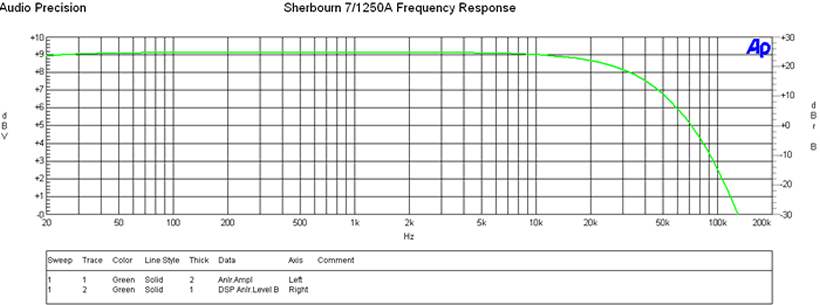
Sherbourn 7/1250A Frequency Response @ 1 watt, 8 ohms
The Sherbourn 7/1250A exhibited reasonably flat frequency response, with a small amount of roll off at high frequency (about -0.45dB at 20kHz) when driving an 8 ohm resistor at one watt. The -3dB point was around 60kHz.
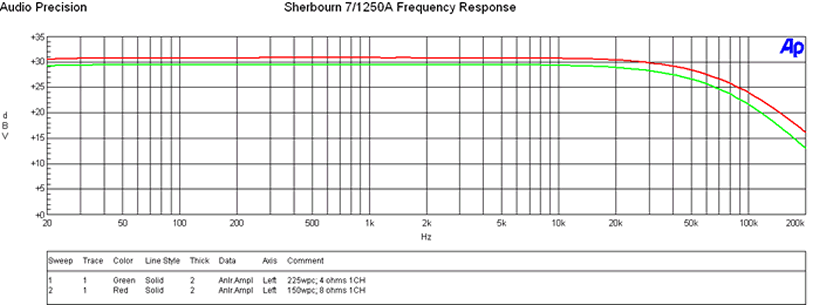
The output power of the 7/1250A was most surprising since it exceeded the manufacturers specification of 125 watts RMS by more than 25 watts! With two channels driven it was able to achieve 140wpc into 8 ohms but I noticed my line voltage began sagging from 120V to 118V. Into a 4 ohm load it delivered over 225 watts RMS and only slightly less into two channels. By employing two larger power supplies as opposed to multiple smaller units for each amplifier, allowed for the amp to exceed its power rating when only one or two channels were driven at full tilt into 4 ohms.
The power supply in the 7/1250A is certainly up to task for delivering its rated power and then some. For all you power nuts that love to see “All Channels Driven” tests conducted, by now you realize we don’t believe in that test condition thus you wont find it in this analysis. Besides, unless your wall outlet is capable of delivering in excess of 20 amps of current and you have a variac to hold the line voltage constant, you will never be able to achieve this test scenario, and you certainly are unlikely to simulate it listening to music or movies.

The frequency response at full power was at least as good as what I measured at one watt. Ideally all of the curves would line up with a variance of no more than +-0.5dB being tolerable. The Sherborn fell right within this window. Though the response looks slightly worse at 1 watt, I chalk it up to inaccuracies in my test setup and variance in the RMS meter when recording the data. Overall the linearity exhibited here is good especially considering I was driving the amp to more than its rated power without any signs of stress or distortion.
Sherbourn 7/1250A Setup, Listening Tests and Conclusion
 Inputs
and Outputs
Inputs
and Outputs
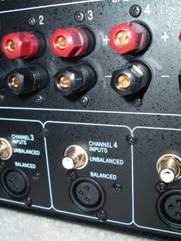
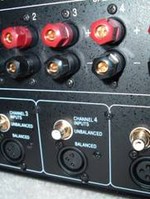
The backpanel of the Sherbourn 7/1250A is pretty standard of multi-channel amplifiers in this price class. I would have preferred to have seen WBT 5-way binding posts rather than the typical red/black generic lugs. The reason I prefer WBT is they seem to make a better fit with various types of banana plugs and, should you choose to utilize bare speaker wire, the holes in each of the speaker connector shafts can be situated so that all cables will be vertically-oriented – a nice touch, resulting in a cleaner cable assembly.
The 7/1250A allows for both balanced XLR and unbalanced RCA input signals, so if you have a high-end processor with balanced XLR outputs you can maximize your potential. A 12V trigger connection for the amplifier is provided via two wire connection with options for On (always on), Music (triggers on line level input), or 12V (triggers on DC trigger from preamp or power center). The power cord is a 3-way detachable.
Set Up
Set up for this amp was a breeze. The 7/1250A is reasonably compact enough so that it can be carried in one arm with little difficulty, and the amplifier fits into a standard 19”rack. Quick, simple set-up was accomplished by making all of my balanced line level connections, speaker level connections, setting the trigger to “music” and finally plugging the power cord in. Voila, the soothing blue front panel lights came on immediately after I fired up a CD. For those who wish to maintain a low profile, Sherbourn provisions a front panel button to disable the LED display.
Listening Tests

I began my review
with some familiar tunes from
a CD I picked up in Canada visiting
Axiom Audio called “Mediterranean Nights” by
Vehkavaara &
Piltch. I spent a lot of good listening time on another
amplifier we currently have under
review, the Emotiva MPS-1. However, when I switched over to the
Sherbourn 7/1250A I immediately noticed about
a 3dB raise in SPL
for the same given volume level, thus I had to
recalibrate my
channel trims to match
subwoofer levels before
proceeding. I did note a slightly elevated noise
floor when compared to the Emotiva
amp, but it was
barely noticeable
at the listening position. However, I do
caution users of highly efficient speakers
(>92dB SPL @ 1 meter), in close proximity to the listening position (4 to 6
feet) that this may become
an audible
concern especially during quite music or movie passages.
I continued on with my listening evaluation taking note of how dynamic and punchy the Sherbourn amp sounded. However,I did feel the sound was more sterile or analytical on this amp when compared to the Emotiva. I also felt the 7/1250A had a more forward (in your face) sound character to it and again advise users of aggressive/bright sounding speakers to perhaps look into other options. Overall, the 7/2150A did a commendable job with music, but it would have better mated with a more laid back sounding speaker than my reference speakers. The RBH Sound T-System is a very dynamic and revealing speaker system that can sound aggressive when mated with certain electronics. I discovered this amp was a better compliment to a pair of Von Schweikert VR-1s I had in house from a previous review. My advice is to demo this amp in your own setting before fully committing to it.
Moving on to next stage of review, the cinema, I engaged Star Trek Nemesis for two reasons: 1- it has some cool sounding battle scenes, 2 – I am a closet Trekkie J The 7/1250A had no problems driving my system to theatrical levels without breaking a sweat. After about an hour of watching the Enterprise get pounded by the Reman Schimitar, I brushed my hand across the 7/1250A and found it to be only warm to the touch. With moderate ventilation, this amp ran cool driving all 4 ohm speakers in a 3,000+ cubic foot room flawlessly. My overall enjoyment of this film was unadulterated using this amp. If your main focus is home theater, the Sherbourn 7/1250A will not be a disappointment.
Conclusion
The Sherbourn 7/1250A proved to be a competent performer. Reasonably lightweight in design in a manageably sized package is certainly a highlight when considering a seven channel amplifier. Though I found the 7/1250A was a bit finicky about what speakers it liked to drive for critical music listening, it did an admirable job with home theater and it had plenty of power reserves to achieve theatrical levels not requiring any special cooling or ventilation to keep it running cool. I missed the LDS feature previously found on the 7/2100A which was useful for detecting system shorts or mis-wirings, but in the advent of today’s processors and receivers with auto setup, it likely won’t be an issue.
This amplifier has enough voltage gain (I measured about 30dB) and high enough input impedance (40kohms) for any moderately priced receiver to drive without issues. My preference would have been for about 2dB or so less gain, or at least an adjustable global setting to lower the noise floor slightly but this is more of a nitpick than a strike against the design. THX gain structure actually recommends 29dB of gain, so the 7/1250A falls right in line.
The 7/1250A is a dynamic, cool running amplifier that exceeds its power rating and will have no issues fitting in standard racks or home entertainment centers. Sherbourn’s proven product reliability, and conservative rating methods, is only equaled by their excellent customer service and dealer support. If you are looking for an amplifier upgrade for your existing A/V receiver, or simply wishing to upgrade your system to seven channel surround, you should check out this amplifier to determine if it’s right for you.
The Score Card
The scoring below is based on each piece of equipment doing the duty it is designed for. The numbers are weighed heavily with respect to the individual cost of each unit, thus giving a rating roughly equal to:
Performance × Price Factor/Value = Rating
Audioholics.com note: The ratings indicated below are based on subjective listening and objective testing of the product in question. The rating scale is based on performance/value ratio. If you notice better performing products in future reviews that have lower numbers in certain areas, be aware that the value factor is most likely the culprit. Other Audioholics reviewers may rate products solely based on performance, and each reviewer has his/her own system for ratings.
Audioholics Rating Scale
 — Excellent
- — Very Good
- — Good
- — Fair
- — Poor
| Metric | Rating |
|---|---|
| Frequency Response Linearity | |
| SNR | |
| Output Impedance | |
| Measured Power (8-ohms) | |
| Measured Power (4-ohms) | |
| Multi-channel Audio Performance | |
| Two-channel Audio Performance | |
| Build Quality | |
| Fit and Finish | |
| Ergonomics & Usability | |
| Features | |
| Performance | |
| Value | |
Gene manages this organization, establishes relations with manufacturers and keeps Audioholics a well oiled machine. His goal is to educate about home theater and develop more standards in the industry to eliminate consumer confusion clouded by industry snake oil.
View full profile Subscribe to our newsletter