


Rotel RMB-1085 Power Amplifier Review
Rotel RMB-1085
- Product Name: RMB-1085
- Manufacturer: Rotel
- Performance Rating:

- Value Rating:
- Review Date: June 12, 2008 09:55
- MSRP: $ 1199
- Power Configuration: 5 x 100 watts
- Watts/Channel: all channels driven, with 20kHz filter, 8 ohm load, 20Hz to 20kHz, <0.2% THD: 100 watts 4 ohm load, 1kHz, <1% THD: 180 watts
- Peak Output Current: 11 amps
- Total Harmonic Distortion At rated power, 20Hz-20kHz: < 0.2%, At one-half rated power, 20Hz-20kHz: < 0.03%, At 1 watt per channel, 20Hz-20kHz: < 0.03%, Intermodulation Distortion at rated power, 60Hz:7 kHz, 4:1: < 0.03%
- Damping Factor 8 ohms: 200
- Amplifier Gain: 27.2dB
- Input Sensitivity/Impedance: 1.25V/8.2 kohms
- Frequency Response ±3dB: 10Hz–40kHz
- Signal to Noise Ratio IHF A network: 105dB
- Power Requirements: 110-240 volts
- Power Consumption: 250 watts
- Idling Power Consumption: 30 watts
- Standby Power Consumption: 6 watts
- Dimensions (W x H x D) 432 x 72 x 382 mm, 17 1/8 x 2 3/4 x 15 1/8 in
- Front Panel Height (for rack mount): 60mm
- Weight (net): 5.4 kg, 11.9 lb.
Pros
- Easy setup
- Clean power
- Small size
- Light power consumption
Cons
- Back panel could be better organized
- Expensive
Rotel RMB-1085 Introduction
There are few names that are both as well known and associated with high-end as Rotel. They have a reputation for quality and power and great aesthetics. We haven't done a Rotel review around here in quite some time so we were all excited (and lined up) when they expressed an interest in having their new Class D RMB-1085 amp reviewed. Somehow, through a combination of luck, bribery, and begging, I got the review sample, shipped overnight no less.
Build Quality
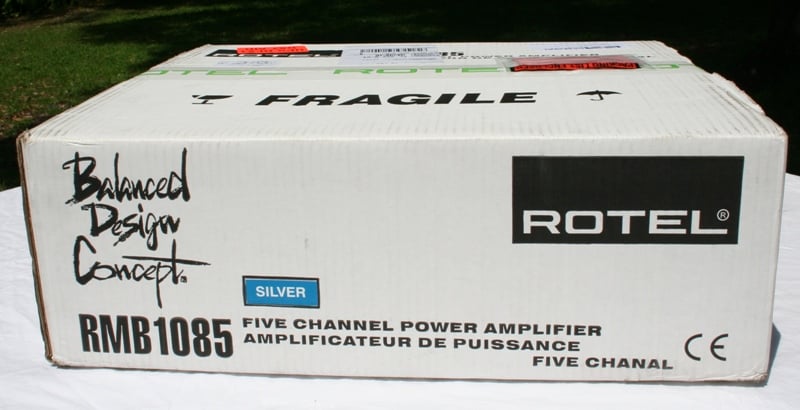 Opening
up the RMB-1085 box, it is easy to see that they care about whether the amp arrives undamaged. Even though "digital"
amps are notoriously lighter (because they are much more efficient that
traditional Class A or A/B amps and don't require the massive heat sinks
typically found in linear amp designs), it was still packed extremely well.
There is both a top and bottom foam cap that completely surrounds the amp
protecting it from all sides. The cables are tucked in the back between the
foam and box (not touching the amp at all) and the amp is sheathed in a plastic
bag to help protect it from the elements. The manual was on top of the amp and
was held down tightly enough that is was still perfectly center on the top of
the amp when I removed the top foam cap.
Opening
up the RMB-1085 box, it is easy to see that they care about whether the amp arrives undamaged. Even though "digital"
amps are notoriously lighter (because they are much more efficient that
traditional Class A or A/B amps and don't require the massive heat sinks
typically found in linear amp designs), it was still packed extremely well.
There is both a top and bottom foam cap that completely surrounds the amp
protecting it from all sides. The cables are tucked in the back between the
foam and box (not touching the amp at all) and the amp is sheathed in a plastic
bag to help protect it from the elements. The manual was on top of the amp and
was held down tightly enough that is was still perfectly center on the top of
the amp when I removed the top foam cap.
The RMB-1085 is a thin, fairly light (under 12 lbs.) unit that I had no problems palming as I was moving it around. The front face is a light grey with only a single power button and two lights. The blue light indicates power and the red a fault of some kind when the unit is powered on or standby mode when it is powered down. The only other adornment to the front of the unit is the Rotel logo and model number on the front and an embossed logo on the top. The unit stands less than 3 inches high.
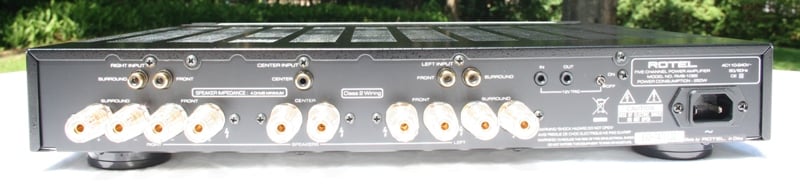 The
rear of the unit has five RCA style inputs and five sets of 5-way binding
posts. There are no balanced inputs for this amplifier. The rear also sports a
removable power cord, a 12 volt trigger input and output, and an on/off switch
for the 12 volt trigger. The right main and surround were grouped as was the
left main and surround. The center channel input and outputs were alone. The
only point on concern here was that with the grouped inputs, the positive was
always on the outside with the negative in the center forcing you to switch the
order of the speaker cables. Rotel stays that they do this to reduce the chance of shorting positive to negative. The 12 volt trigger is used to turn the amp on and
off automatically when another piece of gear is powered up. Setting the switch
to "Off" ensures that the amp is only turned on manually while in the
"On" position, the amp is looking for input from the trigger input.
The
rear of the unit has five RCA style inputs and five sets of 5-way binding
posts. There are no balanced inputs for this amplifier. The rear also sports a
removable power cord, a 12 volt trigger input and output, and an on/off switch
for the 12 volt trigger. The right main and surround were grouped as was the
left main and surround. The center channel input and outputs were alone. The
only point on concern here was that with the grouped inputs, the positive was
always on the outside with the negative in the center forcing you to switch the
order of the speaker cables. Rotel stays that they do this to reduce the chance of shorting positive to negative. The 12 volt trigger is used to turn the amp on and
off automatically when another piece of gear is powered up. Setting the switch
to "Off" ensures that the amp is only turned on manually while in the
"On" position, the amp is looking for input from the trigger input.
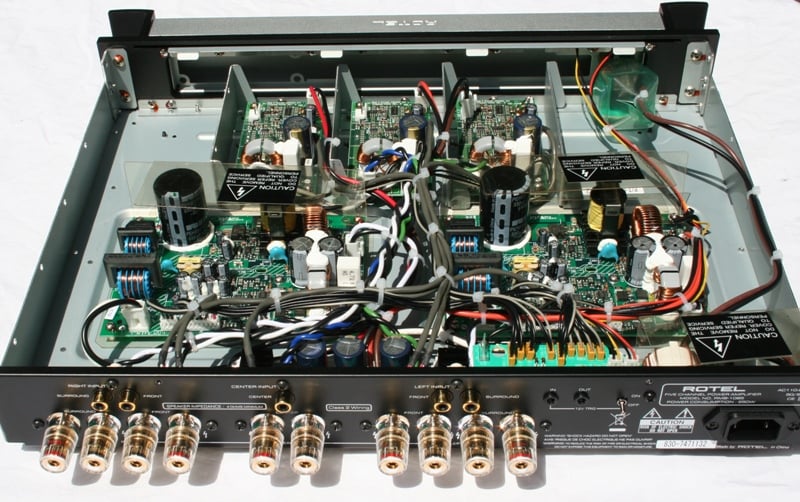 Cracking
open the amp, we can see just how compact the Class D amps are. No where to be
found is the huge toroidal power supply we see in Class A/B amps. Instead, just
three small circuit boards with minimal heat sinking. The power supply is an SMPS type with two switchers and the amp section
consists of three two channel modules, one of which apparently isn’t being used
in this design. While I understand that 6-channel amps tend to confuse people,
the lack of use of this 6th channel seems wasteful to me. Of course, for $400
more you can pick up the RMB-1076 which activates this 6th channel, adds the
input and output, and three level knobs on the front. The 1076 seems to be more
tailored to audio distribution with the lower quality binding post and volume
controls but we're willing to bet that the internals are nearly identical. The
top of the RMB-1085 has vents for cooling but there is no fan. Since switching
amps are much more efficient than conventional amp designs, this is to be
expected.
Cracking
open the amp, we can see just how compact the Class D amps are. No where to be
found is the huge toroidal power supply we see in Class A/B amps. Instead, just
three small circuit boards with minimal heat sinking. The power supply is an SMPS type with two switchers and the amp section
consists of three two channel modules, one of which apparently isn’t being used
in this design. While I understand that 6-channel amps tend to confuse people,
the lack of use of this 6th channel seems wasteful to me. Of course, for $400
more you can pick up the RMB-1076 which activates this 6th channel, adds the
input and output, and three level knobs on the front. The 1076 seems to be more
tailored to audio distribution with the lower quality binding post and volume
controls but we're willing to bet that the internals are nearly identical. The
top of the RMB-1085 has vents for cooling but there is no fan. Since switching
amps are much more efficient than conventional amp designs, this is to be
expected.
About Class D or Switching Amps and SMPS Power Supplies
Class D or Switching amps are sometimes mislabeled "digital." This is perhaps in part due to the "D" in the name. Really, it isn't any less analogue than other amp types but it utilizes an "on/off" typology rather than "as needed" for A/B amps. This makes them much more efficient but can introduce more distortion than other amp typologies. Initially, switching amps weren't considered of much use for home theater other than for subwoofers because they were susceptible to non-linearity based on the impedance of the speaker. In recent years, Switching amps claim to have overcome this limitation and so far have received a somewhat positive welcome by the home theater community. For more information, please read our article The Truth about (Class D) Amplifiers.SMPS (Switched Mode Power Supplies) are smaller and more efficient than traditional linear power supplies but typically are noisier and have less headroom. SMPS transformers run at higher frequency than linear power supplies which is why the transformer can be much smaller. But, they are also more challening to produce clean power for audio applications which is why they are usually reserved for PC and car audio or any application where space, efficiency and cost are the three primary concerns.
The Rotel RMB-1085 is a good looking amp with a very clean face. The light grey of the front means that unless you have other Rotel gear it will probably stand out. Luckily, the lights on the front aren't of the "nightlight" variety that we see so often with some gear. There is no way to dim them but it wasn't really needed in my room. It was the one piece of gear that both of my sons and my wife noticed the first day I set it up. It just looks that different from everything else.
Rotel RMB-1085 Setup and Listening Tests
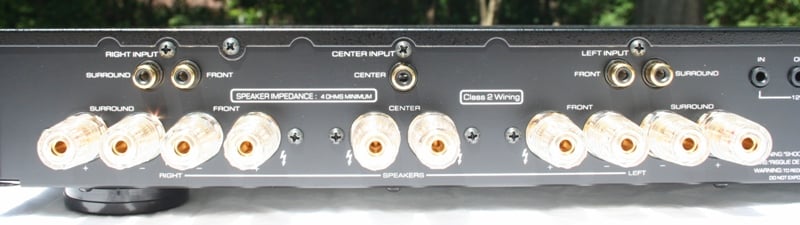 Setting
up the Rotel isn't exactly rocket science. You'll need to connect RCA cables
from your preamp/processor/receiver to the amp and speaker cables out to your
speakers. I used Blue Jeans Cables. There is a 12 volt trigger cable supplied
if you are planning on using that function. One thing that sort of irritated me
was the configuration of the speaker terminals. Switching the order of the
positive and negative just seemed like an unnecessary step that was just
begging for someone to reverse polarity on their rear speakers. Plus, the
grouping made everything a little tighter than it could have been. I'd much
prefer a visual separation (like a line on the back panel) with as much room given
to space out the inputs and outputs as possible. One of the things I hate about
most receivers is how you need to have the hands of a 12 year old anorexic boy
to get to the speaker terminals. I expect one of the bonuses for paying for
external amplification is more room to move. The grouping of the left and right
main and surrounds on the RMB-1085 felt nearly as cramped as some receivers
I've used.
Setting
up the Rotel isn't exactly rocket science. You'll need to connect RCA cables
from your preamp/processor/receiver to the amp and speaker cables out to your
speakers. I used Blue Jeans Cables. There is a 12 volt trigger cable supplied
if you are planning on using that function. One thing that sort of irritated me
was the configuration of the speaker terminals. Switching the order of the
positive and negative just seemed like an unnecessary step that was just
begging for someone to reverse polarity on their rear speakers. Plus, the
grouping made everything a little tighter than it could have been. I'd much
prefer a visual separation (like a line on the back panel) with as much room given
to space out the inputs and outputs as possible. One of the things I hate about
most receivers is how you need to have the hands of a 12 year old anorexic boy
to get to the speaker terminals. I expect one of the bonuses for paying for
external amplification is more room to move. The grouping of the left and right
main and surrounds on the RMB-1085 felt nearly as cramped as some receivers
I've used.
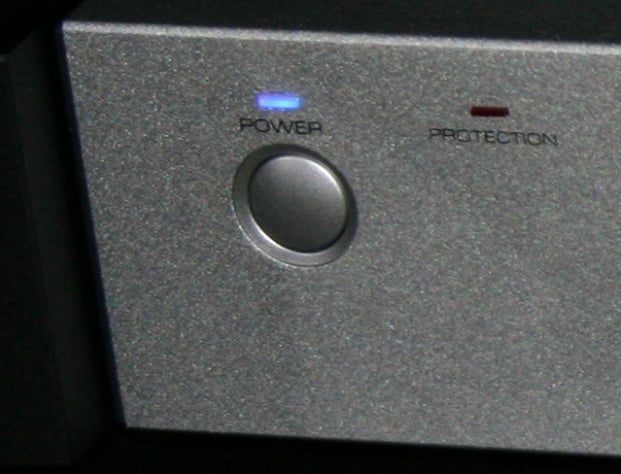 As
a reviewer, I often do things that others wouldn't. I needed to test how the
amp worked with and without the 12 volt trigger. So I connected the 12 volt
trigger cable and just flipped the switch back and forth from "Off"
and "On". What I found was that while in the "Off"
position, with the cable attached, the amp was still affected by the component
connected via 12 volt trigger (in this case it was a Denon AVR-2307CI).
For a while this made me think there was something wrong with the amp. While
this isn't likely to be a real world issue since most people will not connect
the trigger cable unless they are planning to use that feature, it is worth
mentioning. Rotel states that the amp shouldn't do this but I had two units do the same thing. There was never any audible sound as the amp switched back and
forth from standby mode and it was suitably responsive to the 12 volt trigger. The
RMB-1085 was always powered up before the receiver could finish its power up
cycle. The amp went from cold to ready in about 2 seconds if the lights on the
front are any indication.
As
a reviewer, I often do things that others wouldn't. I needed to test how the
amp worked with and without the 12 volt trigger. So I connected the 12 volt
trigger cable and just flipped the switch back and forth from "Off"
and "On". What I found was that while in the "Off"
position, with the cable attached, the amp was still affected by the component
connected via 12 volt trigger (in this case it was a Denon AVR-2307CI).
For a while this made me think there was something wrong with the amp. While
this isn't likely to be a real world issue since most people will not connect
the trigger cable unless they are planning to use that feature, it is worth
mentioning. Rotel states that the amp shouldn't do this but I had two units do the same thing. There was never any audible sound as the amp switched back and
forth from standby mode and it was suitably responsive to the 12 volt trigger. The
RMB-1085 was always powered up before the receiver could finish its power up
cycle. The amp went from cold to ready in about 2 seconds if the lights on the
front are any indication.
The RMB-1085 is 100 watts by five channels - fairly modest power from an external amp standpoint. What is important, of course, is how "clean" the power is. If you are getting an honest 100 watts - that is much better than some of these other receivers whose claims are dubious at best. One thing I noticed was that even if I ran my speakers full range at outrageous volumes, the power consumption on my APC H15 never got higher than 20% (which isn't that much higher than with the amp off). That's pretty impressive!
With only five channels, it is unlikely that someone would want to bridge the amp but it is possible. Unfortunately, the RMB-1085 is not bridgeable. Add to that the lack of balanced inputs and some of the more serious audiophiles might think twice about this amp. Rotel claims that the RMB-1085 is perfect for medium and large sized rooms. I would argue that this claim would be dependant on the speakers you own. Speakers with low sensitivity are going to require more power. The manual for the RMB-1085 suggests not pairing them with speakers with impedances that dip lower than 4 ohms which might be a concern for some. All you electrostat owners will have to look elsewhere for your amplifier needs.
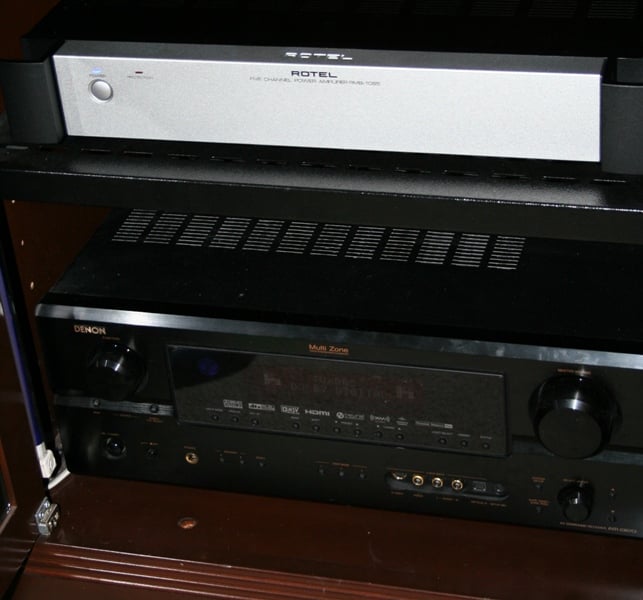 One thing the Rotel RMB-1085 really does have
going for it is size. You don't know how many potential amplifier reviews I've
turned down simply because there wasn't anywhere in my theater that I could
locate another receiver-sized box. This, of course, is the joy of Switching
amps - their usually physically smaller than their linear amp counterparts. At
less than three inches high, you can pretty much put it anywhere. Rotel
suggests a minimum of four inches of clearance and proper ventilation for the
amp and I agree. If you are thinking that Switching amps run cool so you can
shove them under your couch you're going to be disappointed. While I wouldn't
say the Rotel ran hot, it definitely wasn't cool. I had it located in a cabinet
with a fan blowing directly on it and after a few hours it was warm to the
touch. So warm that I thought I'd burn my hand? No. But definitely hot enough
that I thought it was too hot for a Class D amp. I wouldn't mind seeing Rotel
put some of that unused real estate in the RMB-1085 to use with a few heat sinks
to help cool it off.
One thing the Rotel RMB-1085 really does have
going for it is size. You don't know how many potential amplifier reviews I've
turned down simply because there wasn't anywhere in my theater that I could
locate another receiver-sized box. This, of course, is the joy of Switching
amps - their usually physically smaller than their linear amp counterparts. At
less than three inches high, you can pretty much put it anywhere. Rotel
suggests a minimum of four inches of clearance and proper ventilation for the
amp and I agree. If you are thinking that Switching amps run cool so you can
shove them under your couch you're going to be disappointed. While I wouldn't
say the Rotel ran hot, it definitely wasn't cool. I had it located in a cabinet
with a fan blowing directly on it and after a few hours it was warm to the
touch. So warm that I thought I'd burn my hand? No. But definitely hot enough
that I thought it was too hot for a Class D amp. I wouldn't mind seeing Rotel
put some of that unused real estate in the RMB-1085 to use with a few heat sinks
to help cool it off.
Listening Tests
As mentioned above, the Rotel RMB-1085 was fed by a Denon AVR-2307CI which was in turn fed by either a Motorola DCT3416I for HDTV, a Toshiba HD-A2 for HD DVD, or a Denon DVD-3910 for DVD-A. It was all powered and protected by an APC AV H15. All connections were accomplished via Impact Acoustics HDMI with the Oppo HM-31 providing switching duties. Since the AVR-2307CI sports 100 watts per channel, it was fairly easy to do a comparison. Unfortunately, this required manually switching the speaker cables which pretty much guarantees that only the most obvious of differences could be noticed. For speakers I used the Emotiva ER-series speakers consisting of three ERM-1s across the front and two ERD-1s set in dipole configuration for surround duties.
HDTV: Terminator: The Sarah Conner Chronicles Before I really got into the more serious tests
of the Rotel, I wanted to finally finish watching the season final of the Sarah Conner Chronicles which had been
sitting on my DVR for months. One of the joys of HDTV
(for me at least) is the surround sound. With some programs it isn't much of a
bonus but with an action oriented show like Terminator,
it can make a big difference. Plenty of bass, pans and enveloping music elevate
this series past most of the audio drivel on TV these days (especially with the
canceling of this years 24).
Before I really got into the more serious tests
of the Rotel, I wanted to finally finish watching the season final of the Sarah Conner Chronicles which had been
sitting on my DVR for months. One of the joys of HDTV
(for me at least) is the surround sound. With some programs it isn't much of a
bonus but with an action oriented show like Terminator,
it can make a big difference. Plenty of bass, pans and enveloping music elevate
this series past most of the audio drivel on TV these days (especially with the
canceling of this years 24).
While most of the vocals are centered in the front, what makes a big difference is the music. Whenever a terminator (good or bad) shows up, the soundtrack kicks in full force in all speakers. The Rotel RMB-1085 kept me involved and never ran out of power even when I cranked the volume. As we all know, advertisers love to bump up the volume on their ads compared to the shows. The Rotel didn't hiccup as the local car dealer started screaming at me and I went diving for the remote. Thank goodness for the DVRs and the fast forward button. This wasn't the most strenuous of tests but it did give the Rotel a chance to warm up for some of the other tests I had planned.
HD
DVD: Stardust There
are so few movies that are both available in the now defunct HD DVD format AND
I want to see, that I'm quickly running out of titles to order from Netflix. I
wasn't really excited about this movie even though Neil Gaiman, one of my
favorite comic book writers, wrote the novel it was based on. Honestly, if it
wasn't for the HD DVD version, I
probably would have skipped this movie. All in all, it was about what I
expected - moments of brilliance complete obscured by poor casting choices
(Robert De Nero as a gay pirate?) and a ridiculous premise (a guy promises a
falling star to this girl and when he finds out the star is really a different
girl, he still wants to give her to the first girl). This movie would probably
be enjoyable by young children but for everyone else, it just sort of doesn't
make sense.
There
are so few movies that are both available in the now defunct HD DVD format AND
I want to see, that I'm quickly running out of titles to order from Netflix. I
wasn't really excited about this movie even though Neil Gaiman, one of my
favorite comic book writers, wrote the novel it was based on. Honestly, if it
wasn't for the HD DVD version, I
probably would have skipped this movie. All in all, it was about what I
expected - moments of brilliance complete obscured by poor casting choices
(Robert De Nero as a gay pirate?) and a ridiculous premise (a guy promises a
falling star to this girl and when he finds out the star is really a different
girl, he still wants to give her to the first girl). This movie would probably
be enjoyable by young children but for everyone else, it just sort of doesn't
make sense.
Of course, the reason I was using this movie in the review was because of the enhanced audio. While it didn't have Dolby TrueHD, the Dolby Digital Plus was a nice step up from the usual audio I experience when watching a DVD. The first thing you'll notice when you step up to the higher definition audio formats is an increased dynamic range. The Rotel didn't disappoint providing all the power needed for the quick volume changes. Surrounds weren't used a lot during this movie though when they were it was to good effect. Each of the effects was well placed in the soundstage and separation was excellent. I was especially impressed with the lightning effects and how realistic they sounded. Even during the peaks which were a good 10dB louder than anything else on the soundtrack the Rotel never seemed strained.
Rotel RMB-1085 Listening Test Continued and Conclusion
Next I decided to move on to a few DVD-As from my collection
DVD-A: Lowen & Navarro
- carry on together When testing a mulitchannel amp or receiver,
you need some high quality multichannel recordings. Well, when I think of high
quality multichannel music recordings, I look no further than AIX records.
While their selection of music is a bit limited, for much of their music they
offer not only a CD and DVD-A versions, but also "stage" and
"audience" mixes. For this review, I chose the "stage" 96
kHz/24-bit mix. The stage mixes generally put you in the middle of the music
which I find to be more enveloping and involving than the audience mixes which
basically put the music out front striving to give you that "best seat in
the house" experience.
When testing a mulitchannel amp or receiver,
you need some high quality multichannel recordings. Well, when I think of high
quality multichannel music recordings, I look no further than AIX records.
While their selection of music is a bit limited, for much of their music they
offer not only a CD and DVD-A versions, but also "stage" and
"audience" mixes. For this review, I chose the "stage" 96
kHz/24-bit mix. The stage mixes generally put you in the middle of the music
which I find to be more enveloping and involving than the audience mixes which
basically put the music out front striving to give you that "best seat in
the house" experience.
The Rotel RMB-1085 really did this recording justice by pushing a very clean and noise-free signal. The silent passages (of which there are many) were truly silent. The responsiveness of the amp was evident as sudden volume changes were both convincing and forceful. One of the characteristics of AIX recordings is the faithfulness to the performance even when the performers make mistakes (not everyone uses Pro Tools to loop every track you know). With the RMB-1085, there was plenty of depth to the soundstage that I had no problems "drilling in" to the music and hearing these little flubs from time to time. The instruments all had a very lifelike and realistic quality with the proper decay and hold over (or not) intrinsic to its nature. Bongos sounded like bongos, guitars sounded like guitars, and I felt like I was sitting in the middle of a jam session. Quite an experience.
DVD-A:
Porcupine Tree - Deadwing Lastly,
I really wanted to push the amp so I decided to put in Porcupine Tree's Deadwing. While it isn't all at ear-bleed
levels, it definitely sneaks up on you. Tracks like Arriving Somewhere But Not Here start off fairly mellow but
eventually crank up to a more metal sound. This allowed my ears to adjust to a
loudish volume before the eventual reach for a remote to turn it down. Never
did I think that the amp was approaching clipping nor did it seem like the
speakers were being overly taxed. As we always say, too much power doesn't kill
speakers - clipping does. And the Rotel seemed fairly resistant to clipping.
Now, I have a smaller room which Rotel thinks their amp can more than handle. I
agree. I'm not so sure you're going to be able to put it in a cavern of a room
(like some of these "great" rooms that are more and more common)
without risking clipping, but in a small to medium room with reasonably
efficient speakers, you're going to be fine.
Lastly,
I really wanted to push the amp so I decided to put in Porcupine Tree's Deadwing. While it isn't all at ear-bleed
levels, it definitely sneaks up on you. Tracks like Arriving Somewhere But Not Here start off fairly mellow but
eventually crank up to a more metal sound. This allowed my ears to adjust to a
loudish volume before the eventual reach for a remote to turn it down. Never
did I think that the amp was approaching clipping nor did it seem like the
speakers were being overly taxed. As we always say, too much power doesn't kill
speakers - clipping does. And the Rotel seemed fairly resistant to clipping.
Now, I have a smaller room which Rotel thinks their amp can more than handle. I
agree. I'm not so sure you're going to be able to put it in a cavern of a room
(like some of these "great" rooms that are more and more common)
without risking clipping, but in a small to medium room with reasonably
efficient speakers, you're going to be fine.
Conclusion
While I can think of one or two five channel A/B amps on the market with more power and lower price points, the Rotel RMB-1085 seems to be about on par with most of the rest of the competition. While some of the other Switching amps on the market (as well as other Rotel offerings) sport Bang & Olufsen's ICEPower amplifier modules, the RMB-1085's proprietary Switching amplifiers seem more than up to the task of keeping up with the demands of today's modern home theater. At only 100 watts, I couldn't say that it was a huge improvement over the internal amps of my receiver with my 8 ohm speakers though with a harder speaker load, such differences may become more apparent. It does have an undeniable cool factor and plenty of power if your current amplification needs are inadequate or your speakers have lower impedance and are giving your current amp/receiver trouble. If you are looking to beef up your home theater or just have a touch of the upgrade bug, the RMB-1085 is a little firecracker of an amp that might be what you've been looking for.
Rotel RMB-1085 Power Amplifier
1,199
Rotel Electronics
54 Concord St.
North Reading, MA 01864-2699
978 664 3820
Read Consumer Reviews on
About Rotel
Rotel audio products are known
worldwide for their quality, reliability, value, and, above all, exceptional
sound reproduction. Since 1961, Rotel has utilized the resources of its
formidable international design team and has manufactured its products in its
own sophisticated production facilities. Rotel proudly offers a complete range
of electronics that have consistently received critical acclaim and coveted
industry awards. With substantial investment in new technologies and
manufacturing, Rotel is prepared to meet the challenges of an evolving
specialty electronics marketplace.
The Score Card
The scoring below is based on each piece of equipment doing the duty it is designed for. The numbers are weighed heavily with respect to the individual cost of each unit, thus giving a rating roughly equal to:
Performance × Price Factor/Value = Rating
Audioholics.com note: The ratings indicated below are based on subjective listening and objective testing of the product in question. The rating scale is based on performance/value ratio. If you notice better performing products in future reviews that have lower numbers in certain areas, be aware that the value factor is most likely the culprit. Other Audioholics reviewers may rate products solely based on performance, and each reviewer has his/her own system for ratings.
Audioholics Rating Scale
 — Excellent
- — Very Good
- — Good
- — Fair
- — Poor
| Metric | Rating |
|---|---|
| Multi-channel Audio Performance | |
| Build Quality | |
| Fit and Finish | |
| Ergonomics & Usability | |
| Features | |
| Performance | |
| Value | |
As Associate Editor at Audioholics, Tom promises to the best of his ability to give each review the same amount of attention, consideration, and thoughtfulness as possible and keep his writings free from undue bias and preconceptions. Any indication, either internally or from another, that bias has entered into his review will be immediately investigated. Substantiation of mistakes or bias will be immediately corrected regardless of personal stake, feelings, or ego.
View full profile Subscribe to our newsletter