


Onix Melody SP3 Tube Integrated Amplifier Review
Onix Melody Tube Integrated Amplifier
- Product Name: Melody SP3 Tube Integrated Amplifier
- Manufacturer: Onix
- Distributor: AV123
- Performance Rating:

- Value Rating:
- Review Date: April 29, 2006 19:00
- MSRP: $ 999
|
Power Output (8ohms): 38 watts per channel |
Input Sensitivity: 380 mV Input Impedance: 250 k Ohms Amplifier Power: 4 or 8 Ohms Dimensions (HxWxD): 8.1”x11.9”x13.25” Weight: 56 lbs |
Pros
- Smooth treble and warm midrange.
- Good bass output for power rating.
- Solid build quality, heavy.
- At maximum output, sound is still tolerable.
- All of the sonic advantages of tubes.
Cons
- Bass is not as tightly controlled as with comparable solid-state gear.
- Roll off in the upper treble.
- Low wattage limits maximum output.
- All of the sonic shortcomings of tubes.
Onix Melody SP3 Introduction
AV123 is of a new breed of direct internet retailers. Rather than simply offering common, run of the mill gear at internet discount prices, AV123 offers exclusive products to value conscious consumers who are looking for quality at a good price, and backs those products with customer service and advice not typically offered with the internet based sales model. Direct internet retailing allows them to minimize overhead and markup to provide pricing below what comparable products cost with brick and mortar retailers.
Onix is one of several brands exclusively distributed through AV123, and manufactures both loudspeakers and electronic components, such as CD players and integrated amplifiers, for sale through the site. The Melody SP3 is intended as a high value product aimed at budget minded Hi Fi enthusiasts who dream of esoteric gear but are grounded by simple economics.
The Onix Melody SP3 is actually a product of Melody Valve Hi-Fi Party, Ltd. of Melbourne, Australia. The unit is designed and engineered and in Australia and manufactured in China for Onix Ltd. who then distributes through AV123 exclusively in the United States.
Design and Construction
The Melody SP3 is an attractive retro design recalling the art deco era. The amplifier will certainly draw attention and start conversations if prominently displayed; perhaps as much attention from audiophytes who know very little about audio gear and have no idea what the SP3 is as well as Audioholics who know exactly what type of amplifier is before them. The SP3 has a lacquered silver finish with Onix in black lettering and one blue power LED centered on the faceplate. Rather than boxing the internal hardware, it is featured as part of the esthetics: on the top of the unit, to the front, are four larger tubes that are flanked by six smaller tubes with a pair of bulging output transformers at the back of the unit. All the covers and cages for the tubes are easily removable, allowing one to bask, if you will, in the warm glow of the tubes under power.
The SP3 is a ten tube stereo design that takes a minimalist approach; features are few which leads to a simplified audio path that many consider a source of improved fidelity. There are only three controls to operate and two inputs: the on/off rocker switch on the left side, an input selector rocker switch on the right side, the volume knob in the center of the faceplate, a CD input, and an auxiliary input.
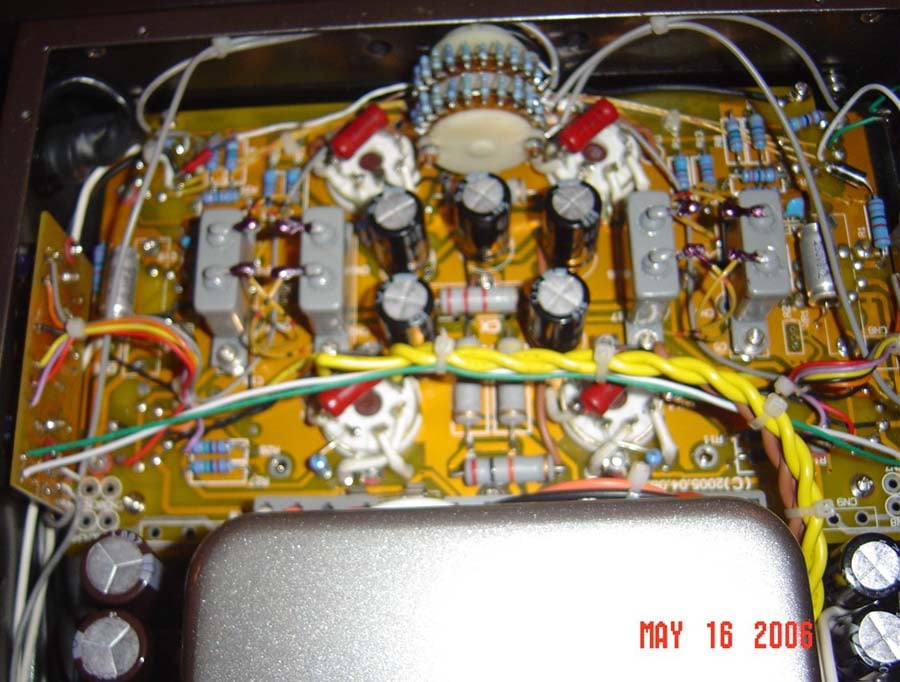
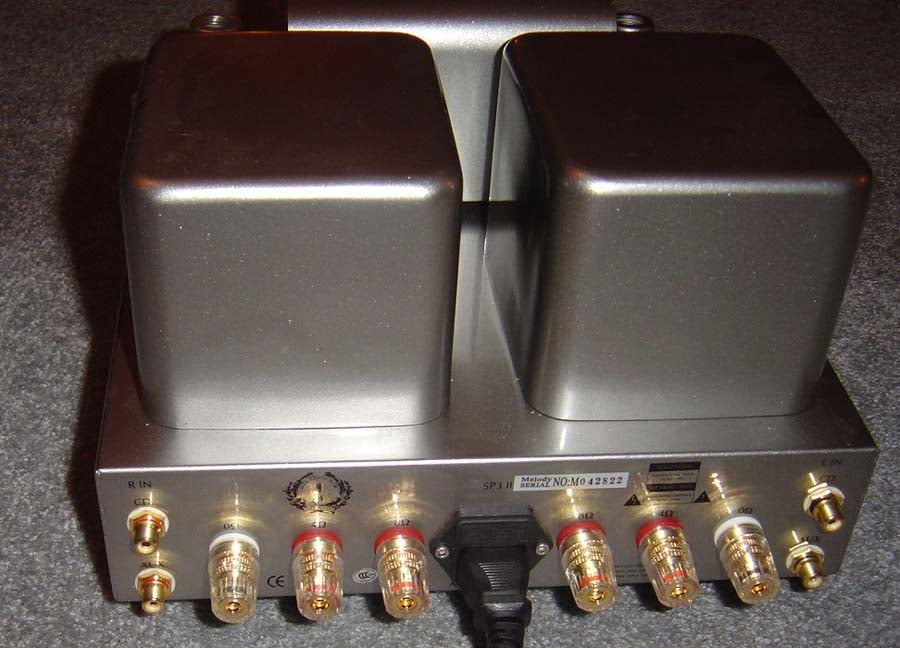
On the back there are six binding posts to hook up four speaker leads: two black and four red. A pair of red binding posts is grouped with each of black connectors, one post labeled 8 ohms and the other 4 ohms, relating to the two options for the output transformers. The two inputs are stacked vertically with the left and right channels at the outside of the chassis. The SP3 also has a detachable power chord that mounts at the center of the back panel.
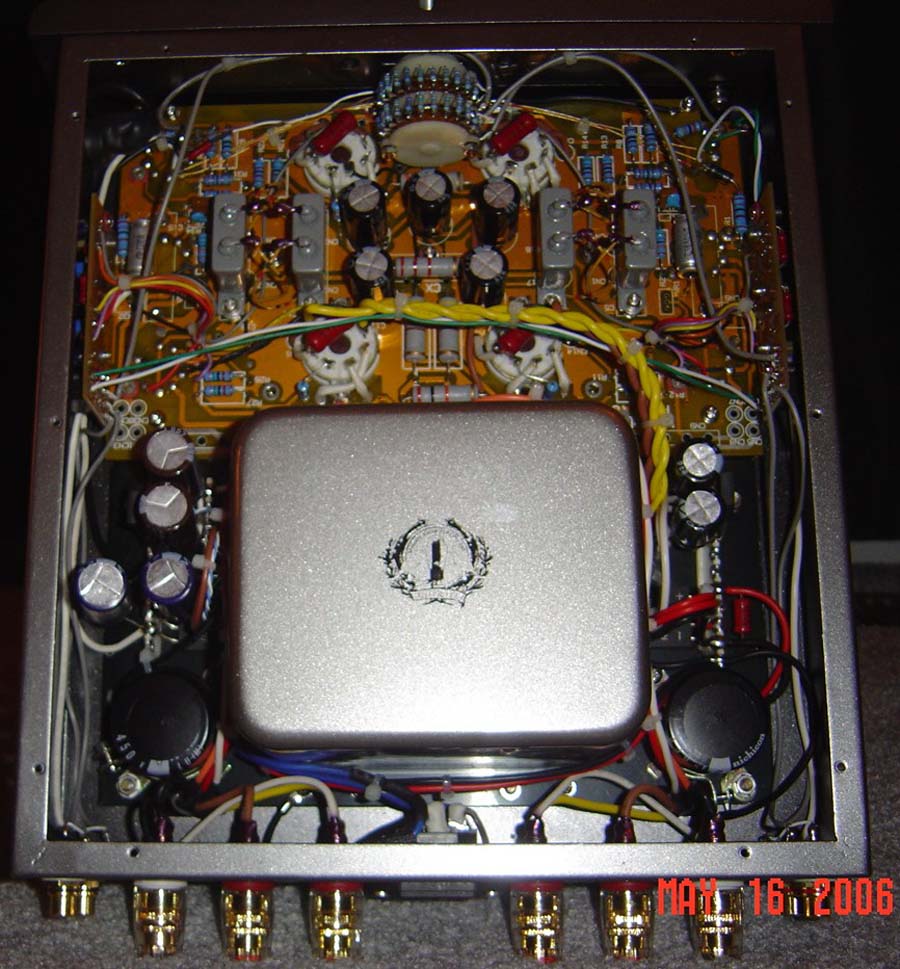
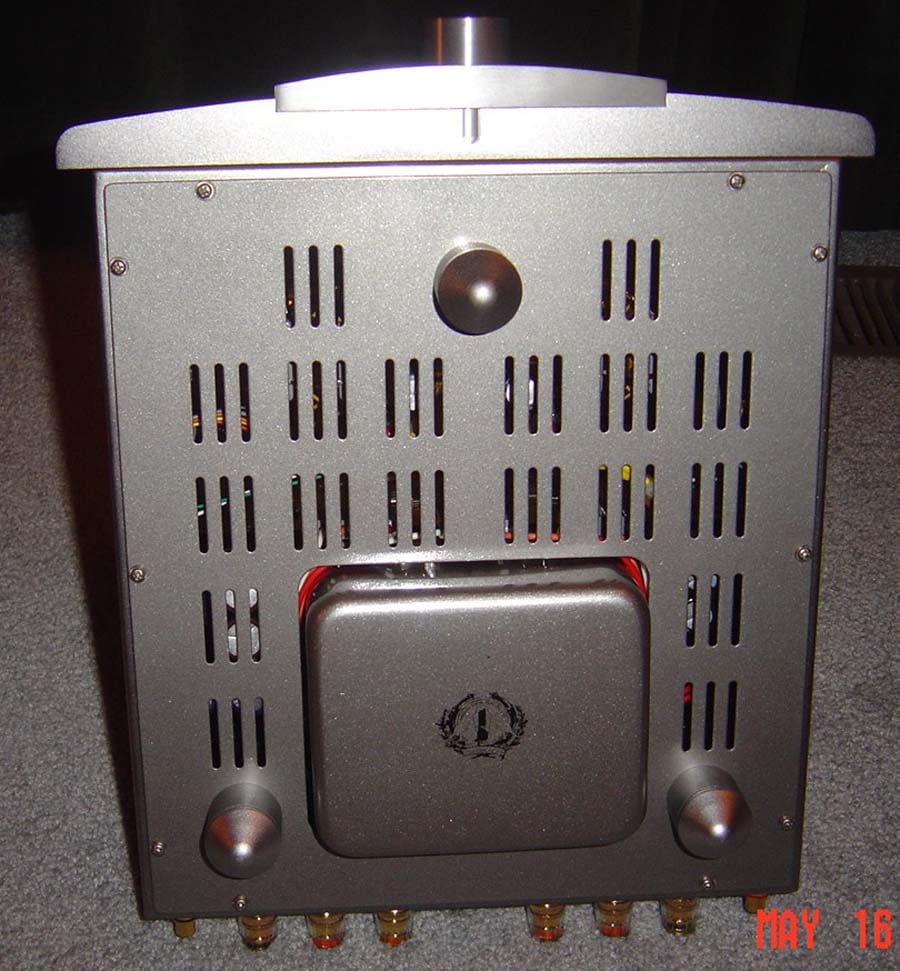
The tube compliment includes the four larger 5881 tubes in a push pull (AB) design and the six smaller tubes that include two each of 12AX7, 6922, and 12AU7 type tubes. The 5881 tubes are housed under a common cage attached to the chassis using banana plugs while the smaller tubes each have their own housing on spring clips.
Adjustable bias controls are provided for the left and right channels on the respective sides behind the rocker switches. There are two adjustment dials and three probe leads. Biasing adjustments for tube amplifiers regulates a negative voltage across the output tubes to optimize their performance. Typically, biasing is adjusted because sonic performance is dependant on these settings: new tubes need to be tuned because of tolerance issues even within the same specifications, as tubes age the specifications drift with deterioration requiring retuning for optimum performance, and audiophiles who really like tubes need something to play with. Care should be taken with bias adjustments where too much current across the tubes will damage them and too little will cause audible distortion.
This unit is fairly heavy; at 56 lbs, the SP3 easily outweighs most seven channel A/V receivers on the market and some two channel audiophile amplifiers. One issue that I would like to mention: the support feet, there are only three, two in the back and one in the front. This is a meta-stable support condition that leaves the unit more prone to tipping while moving it. The saving grace is that the large output transformers on the back do provide a resisting moment to counterbalance this condition to some extent. It would be a good idea to make sure that the SP3 s properly seated and upright any time it is relocated.
Onix SP3 Amp System Setup
System set up is minimal for the SP3, but may be hampered by the included manual for some. To say that the manual for the Melody SP3 is thin is an understatement. Not only is it thin but the manual also has very little printed on the few pages that are present. Fortunately, there are only three controls and they are labeled; if the user does not take notice of the labeling on the sides of the chassis, identifying the controls is left it up to trial and error.
One issue that may come up: with no information in the manual, those, who like me, own speakers with a 6 ohm nominal impedance are left to their own judgment as to which connection to make. In the case of the 6 ohm speaker, it may be prudent to use the 4 ohm lead to minimize the possibility of a higher current draw than the 8 ohm lead may be designed to safely provide.
The
specifications provided on AV123’s web site indicate that the unit
features a manually adjustable bias. There are two bias controls and
three probe points on each side of the amplifier behind the rocker
switches. The owner’s manual again gives no indication of such a
feature (though we were told AV123 is now shipping a supplementary
sheet explaining this function) or advice on how and why one would want
to make this adjustment. Moreover, because the external control for
the adjustment requires a voltmeter, anyone interested in making this
adjustment should keep in mind safety when messing with high voltage
sources, such as tube amplifiers, as it is potentially risky for those
unfamiliar with the innards of electronic devices. Incorrectly
adjusting bias can damage the tubes and the amplifier and a lack of
basic safety procedures can be damaging to the one making the
adjustment.
As a nice touch, the SP3 comes with a pair of white glove with the Melody name embroidered on them. Since the manual does not discuss why gloves are included, I will for the benefit of those who don’t already know. Use the gloves any time the tubes need to be directly handled, as with halogen lamps, any skin oil on the glass tubes will cause a localized temperature concentration that may cause them to crack under power.
Another item that perhaps should be included in the manual are manufacturer recommendations as to the what, where, and when for the tubes. Tubes occasionally get broken and they also deteriorate sonically over time. Because this product is intended as an introduction to the ‘wonderful world of tubes’, some information on electrical requirements for replacement tubes, the names for suppliers of compatible tubes, and recommendations on the useful life of the tubes supplied might be in order. Valuable information if this is a first experience owning and maintaining tube based gear. Granted, all the tubes that come stock with the unit say ‘Melody’ on them, but I saw no listing for replacement tubes under products on either the Melody or the AV123 websites.
As a public service, I am including some links to information regarding vacuum tubes and bias that I have found on the web. Many relate to musical instrument amplifiers but that is inconsequential. Keep in mind that I do not necessarily endorse anything said in these pages but provide them as a source of information for tube audiophytes.
Basic tube information:
Information on tube bias:
Tube types and manufacturers:
Onix SP3 Amp Listening Tests and Conclusion
I listened in to the SP3 using gear from my reference two channel setup. The source components were the CAL Audio transport and Wadia DAC with the amplifier driving moderately sensitive Infinity Kappa speakers. The Infinities run at a 90 dB sensitivity with 6 ohm nominal impedance. With a low powered amplifier, using speakers with a higher sensitivity becomes more crucial for dynamic range.
Sound quality of the SP3 was very good for its price class. The sonic characteristics prized by those who prefer tubes were all present, for good or bad. The sound was warm with additional presence in the midrange, treble was smooth and without etching, but rolled off at the very top, and the amplifier imaged well. The SP3 also did a good job revealing detail considering that tube designs typically are a trade between absolute resolution and warmer sound.
The sound stage was presented credibly, both in width and in depth. Stereo image width was well presented and images exceeded the speaker placement and depth was decent but not as three dimensional as I am accustomed to. However, the overall sonic signature, the level of instrumental separation and palpability, crossed the threshold into what an audiophile listens for to differentiate a product from mass market sound.
Dynamics were good for this price level with micro dynamics that were at a consistent level with the amount of detail and quality of imaging. Dynamics on the macro level were also good until the amplifier was pushed to its wattage limits. At this point, music simply did not get any louder, the audible telltale of compression. This is a distinct difference from solid state gear, which becomes noticeably harsh when overdriven to clipping. Busy musical passages also could get a little congested at volume. Despite only a 38 watt output in a tube design, there was a decent amount of bass output; control was softer than with solid state equipment but there was no loss of basic timbre in this register.
Emmylou Harris: Wrecking Ball
Emmylou
Harris’ 1995 release of ‘Wrecking Ball,’ under the guidance of producer
and collaborator, Daniel Lanois, represents a musical epiphany. A
musically unexpected album that can be best described as progressive
country; it is a combination of original works by Lanois and Harris and
covers by the likes of Jimi Hendrix, Steve Earle, and Neil Young, who
incidentally sings backup
on his own song. Subsequent releases by Harris have followed in this
same vein but have been primarily original material that was produced
and co written with Malcolm Burn, Lanois’ protégé. Production quality
is excellent on this album in addition to being good listening.
The album had all the warmth and fullness I expected. Daniel Lanois makes good recordings and if that is not obvious during listening, then something else is to blame. The sound character when using the SP3 was fairly natural but on occasion, this was off a bit, particularly with some of the vocals. To some extent, this sounded like a trade off for the warmth; remember that tubes technically exaggerate this particular sonic characteristic. Sound staging and detail were good and at times, Emmylou seemed to hang in the air with all the background singers around her and separated clearly. Detail and ambient effects in the recording were evident in the SP3’s reproduction despite the roll off in the upper treble.
Track one, “Where Will I Be”, is a Lanois composition and features his excellent guitar work. The guitar had a full, palpable sound and the SP3 resolved the ambient details in the recording. Vocals were smooth and full, Emmylou imaged as centered and forward of the other singers with the overall stereo image providing good localization and width. The SP3 also maintained bass detail and presented the punch in the bass drum, even if it was with a bit little less control. “May This Be Love” was warm and ambient on this amplifier. The tapestry of electric guitars, vocals, and percussion imaged well across the stage and had a good deal of realism. “Orphan Girl” was one case in point for Emmylou‘s vocals hanging in the air; the SP3 conveyed this immediacy well.
Blackfield: Blackfield
Blackfield
is one of the many side projects that Steve Wilson of Porcupine Tree is
engaged in. It is a collaboration between Wilson and Israeli composer
and pianist, Aviv Geffen. The tone is mellower than the most recent
Porcupine Tree albums, and features singing and songwriting efforts by
both musicians accompanied by a number of regulars from Wilson’s
various projects.
This album really was a nice compliment with the sound of the SP3; warm and full was well, warmer and fuller. Steve Wilson does a fair amount of harmonizing with himself and the character of his lighter voice fit well with the character of the SP3. The vocal presentation from the SP3 was typically natural and the harmonies were well separated, avoiding a potentially homogenized mush. At the same time, however, this album, like many of Wilson’s works, moves between extremes and the SP3 suffered from some dynamic compression and loss of separation when songs suddenly became heavy either in character or in the amount of instrumentation used in the arrangement.
On the opening track, “Open Mind”, the SP3 delivered a warm sound with good vocal separation. The wide array of instruments, including acoustic guitars, mellotron, with piano wafting over the top, localized well across the sound stage. Layers of electric piano, synthesizers, mellotron, and synthesized strings during “Glow” were well separated and realistic with the SP3. Vocals also benefited from an immediacy in how they were rendered. Bass extension was also good when this song picks up a bit. Following next, “Scars” also had natural sounding vocals on the SP3 with decent ambience within the layers of overdubbed harmonies. The sound stage was again wide and there was good detail in percussion and cymbals, which were clear but a bit of roll off was apparent. “The Hole in Me” opens with what sounds like a calliope and the SP3 gave a rich immediacy to the sound along with the acoustic guitars.
Roy Hargrove Quintet with the Tenors of Our Time
Roy Hargrove emerged in the ‘90’s as one of the finest young jazz
trumpeters of his generation. He was discovered by Winton Marsalis in
1987 when Winton visited Roy’s high school and was impressed enough to
let the boy sit in with his band. With musicians Cyrus Chestnut, Ron
Blake, Rodney Whitaker, and Gregory Hutchinson, Roy collaborates on
these charts with various well respected tenor saxophonists Johnny
Griffin, Joe Henderson, Branford Marsalis, Joshua Redman, and Stanley
Turrentine.
This album presents a good deal of venue ambience, real or otherwise generated, in the recording and the SP3 did well with it. The sound was typically warm and immediate throughout the listening, at ease and natural. There was no electronic edge anywhere in the sonic signature of the SP3. Sound stage localization and separation between instruments was handled well. Some roll off was evident with the acoustic instruments, but despite this, instruments with component frequencies into the upper treble were still clear and detailed. Bass output was solid, but there was a bit of emphasis in the upper bass frequencies that was not under complete control. Wind instrument timbres came through even to the level of detail of hearing shifts in embouchure, particularly with tenor reeds. Several songs also feature flugel horn rather than trumpet where both subtle and overt differences in timbre, between the conical pipe flugel and the straight pipe trumpet, were evident.
“Soppin’ the Biscuit” is the opener; the SP3 presented a sound that was natural and at ease. Saxophone and the trumpet parts were presented with warmth; the piano had a fullness of sound. During “Never Let Go”, the character of brushes used with the percussion was well conveyed and the character of the flugel horn was captured down to a good degree of subtlety. “April’s Fool” was a good example of the SP3’s abilities to recreate detail in a musician’s performance with quiet embouchure adjustments by the tenor player audibly reproduced.
Conclusions
The Onix Melody SP3 is an excellent introduction to tube based amplification. It is a solid performer at a price that is not prohibitive to own and represents a good value for a product of this type. This is an important market consideration for those who may be interested in trying out tube gear for the first time.
Despite limited wattage, the SP3 makes a good showing of itself. To avoid overdriving the amplifier for louder volume listening, it is probably advisable to consider higher efficiency speakers in the 93 dB or greater range. With the warmer sound of tube based gear, an amplifier like the SP3 also would lend itself to conditions where the listening environment is naturally a bit bright.
The quality of the sound from the SP3 has everything that draws aficionados to prize tubes; this is a good sounding piece of gear and while there are better quality examples of tube amplifiers available, they are just not available for this price. The perceived midrange warmth and treble smoothness draws many into the fold even with the tradeoff of decreased control and roll off in the upper treble compared to comparable solid state gear. The tube and solid state camps will continue to argue over perceived harshness verses sonic accuracy. If this approach to musical reproduction sounds appealing, the SP3 is definitely worth considering.
And for those readers who have been patiently waiting, in a word, the Onix Melody SP3 was definitely ‘chocolatey’.
The Score Card
The scoring below is based on each piece of equipment doing the duty it is designed for. The numbers are weighed heavily with respect to the individual cost of each unit, thus giving a rating roughly equal to:
Performance × Price Factor/Value = Rating
Audioholics.com note: The ratings indicated below are based on subjective listening and objective testing of the product in question. The rating scale is based on performance/value ratio. If you notice better performing products in future reviews that have lower numbers in certain areas, be aware that the value factor is most likely the culprit. Other Audioholics reviewers may rate products solely based on performance, and each reviewer has his/her own system for ratings.
Audioholics Rating Scale
 — Excellent
- — Very Good
- — Good
- — Fair
- — Poor
| Metric | Rating |
|---|---|
| Frequency Response Linearity | |
| Two-channel Audio Performance | |
| Build Quality | |
| Fit and Finish | |
| Ergonomics & Usability | |
| Features | |
| Performance | |
| Value | |
Professionally, David engineers building structures. He is also a musician and audio enthusiast. David gives his perspective about loudspeakers and complex audio topics from his mechanical engineering and HAA Certified Level I training.
View full profile Subscribe to our newsletter