


Marantz PM-11S1 Integrated Amplifier Review
PM-11S1 Integrated Amplifier
- Product Name: PM-11S1 Reference Integrated Amplifier
- Manufacturer: Marantz
- Performance Rating:

- Value Rating:

- Review Date: June 14, 2007 23:00
- MSRP: $ 4399
|
Continuous Power Output: 100 wpc x 2 (20Hz-20kHz, 8-ohms) Both
channels driven, continuous |
Bridged Mono Mode: Can Bi-amp Transformer Type: toroidal Control: RS-232C, D-Bus Remote (RC-5) In/Out (to sync multiple units) Power Requirements: 115V, 60Hz; 380W consumption Dimensions: 17 5/16” (W) x 6 1/2” (H) x 17 1/2” (D) Weight: 57.2 lbs (26 kg) |
Pros
- Best-in-Class Performance
- Elegant look and feel
- Balanced inputs
- Superb chassis and component shielding
- Hi-end binding posts
- Stereo and Bi-amp mode
- Preamp outputs for expandability
- Far exceeds its power spec
Cons
- Not inexpensive
- No DACs - analogue inputs only
- Remote not backlit
Marantz PM-11S2 Introduction
I drive a simple vehicle. It's a 2003 Jeep Liberty and I like it a lot. If I were offered the opportunity, however, to test drive a Hummer or Porsche Carrera - I'd do it in a heartbeat. Why? Because I'm not likely to fork out that kind of money in my lifetime and it's occasionally nice to see "how the other guy lives". The Marantz PM-11S1 is my Porsche Carrera this month. At a price tag of over $4k I'm not going to be able to afford to keep this baby in my reference system for long, but it is a superb machine with all the styling of a European sports car. It's the kind of product you don't want to leave fingerprints on and will find yourself taking extra time to install it into your system - not because it can't be manhandled or take the abuse, but because - like a fine work of art - you don't want to diminish its beauty in any way.
Build Quality
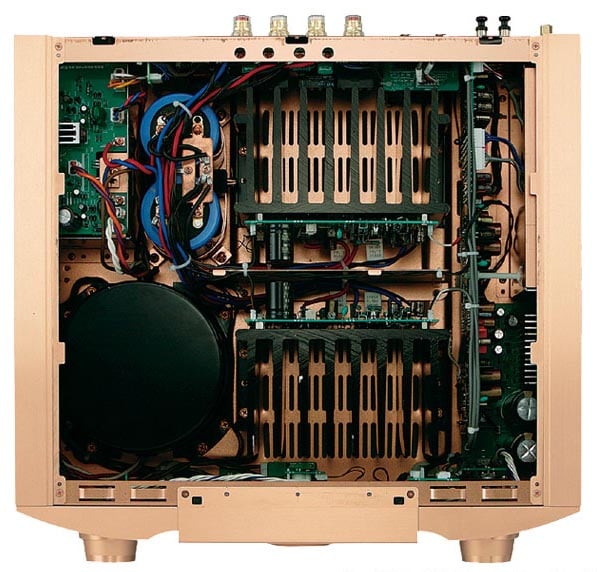 The PM-11S1 is nearly impossible to
open up, but we were able to get a look at the internal components and see what
makes this ~60 lb beast tick. Of first note, the
entire chassis is champagne-finished and copper-plated. And I mean it is
PLATED. Even the chassis screws are copper - making for a very rugged, yet
elegant, look. The PM-11S1 utilizes fully balanced pre-amplifier section, which
doesn't just slap on XLR inputs and route neutral to ground. The dual mono-block
power amplifier design assures that the unit can operate in either stereo or
mono "bi-amplification" mode. I suppose if you don't feel one of
these monsters is enough for your system you can always grab another. The
PM-11S1 also employs Marantz' new HDAM® SA2 system. HDAM stands for Hyper
Dynamic Amplifier Module, an ultra high-speed buffer amplifier that can operate
at 0 dB unity gain with an unparalleled slew rate of 200 V/micro-second. These
buffers are on all inputs and outputs of the unit. This is a proprietary
technology developed by Marantz to ensure smooth signal transfer to and from
the PM-11S1.
The PM-11S1 is nearly impossible to
open up, but we were able to get a look at the internal components and see what
makes this ~60 lb beast tick. Of first note, the
entire chassis is champagne-finished and copper-plated. And I mean it is
PLATED. Even the chassis screws are copper - making for a very rugged, yet
elegant, look. The PM-11S1 utilizes fully balanced pre-amplifier section, which
doesn't just slap on XLR inputs and route neutral to ground. The dual mono-block
power amplifier design assures that the unit can operate in either stereo or
mono "bi-amplification" mode. I suppose if you don't feel one of
these monsters is enough for your system you can always grab another. The
PM-11S1 also employs Marantz' new HDAM® SA2 system. HDAM stands for Hyper
Dynamic Amplifier Module, an ultra high-speed buffer amplifier that can operate
at 0 dB unity gain with an unparalleled slew rate of 200 V/micro-second. These
buffers are on all inputs and outputs of the unit. This is a proprietary
technology developed by Marantz to ensure smooth signal transfer to and from
the PM-11S1.
The volume is controlled by a Wolfson WM8816 high-precision linear system and a floating control bus system allows multiple units to be synchronized for use in a multi-channel environment. Even the LCD display is designed with zero noise technology to ensure nothing interferes with the sound output.
Editorial Note: Under the Hood
This amp has it where it counts. The PM-11S1 inherits its design from the venerated SC-7S1/MA-9S1 preamplifier/monaural power amplifier separates of days passed. It features a massive hybrid toroidal transformer which takes up residence towards the front of the unit, just behind the input selection knob. Marantz, not particularly concerned with size reduction or cost, opted to utilize a choke input system power supply circuit to increase power factor (real power) of the system. This amplifier is designed to "double down" - doubling its output as the loudspeaker impedance drops.
The interior layout of this integrated amplifier is magnificent, with huge heatsinks radiating out from the center, and sandwiched carefully between the ventilated top and bottom covers. This allows for optimal heat dispersal and is the reason this behemoth requires no internal fan system. Two large capacitors and the remaining electronics circuitry fill the remaining space. Airflow is primarily vertical through this amplifier, since there isn't a lot of wasted space within the chassis itself.
Fit, Finish and Connections
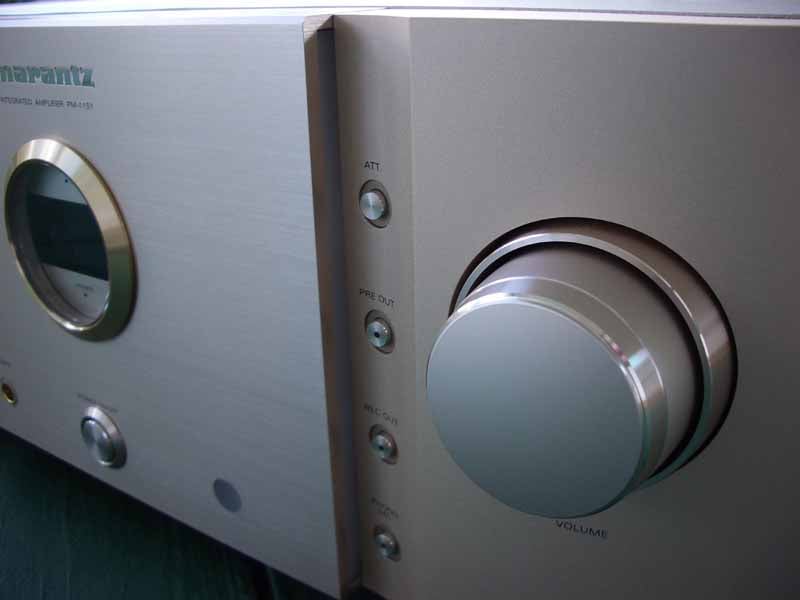 Moving once again to the exterior of the unit, the front panel has a
beautiful brushed aluminum finish, in the aforementioned champagne color. This is something special that really stands
out in a crowd, but in a way that will have you figuring out how to acquire the
rest of Marantz' Reference series components to not break up the look of your
system. The volume and input selection knobs feel rugged and allow you to turn
them without feeling like you will break them off. Buttons are firm but easily
accessible, and the centrally-located power button is nicely recessed against
accidental activation.
Moving once again to the exterior of the unit, the front panel has a
beautiful brushed aluminum finish, in the aforementioned champagne color. This is something special that really stands
out in a crowd, but in a way that will have you figuring out how to acquire the
rest of Marantz' Reference series components to not break up the look of your
system. The volume and input selection knobs feel rugged and allow you to turn
them without feeling like you will break them off. Buttons are firm but easily
accessible, and the centrally-located power button is nicely recessed against
accidental activation.
There is a nice blue backlighting on the main unit that serves to illuminate the primary buttons in a subtle, yet appealing manner. In addition, the lower three buttons on each side of the raised central panel have tiny central blue LEDs that light up enough to access the button, but not enough to blind you in a darkened room (these don't go off when the Display function is set to 'off'). Overall it's one of the nicer looking lighted systems I've seen - unobtrusive and elegant.
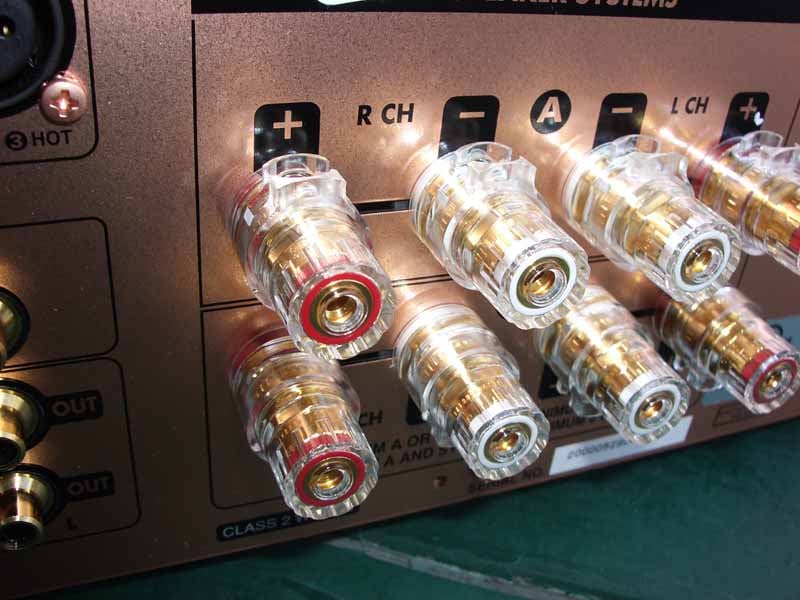 Taking a look at the rear of the Marantz PM-11S1 will show off the
high-quality WBT-style 5-way binding posts. These are the top of the line and
make it very easy to connect your speaker cables, regardless of type (banana,
spade, etc). There are 'A' and 'B' speaker connections, but these are primarily
for use with bi-wiring. If you have well-made speakers cables that are 10- or
12-gauge you shouldn't need to bi-wire. The rear of the unit is well laid-out,
with ample room for maneuvering your fingers where they need to be in order to
make connections and get all of your equipment connected properly. I liked the
simple vertical structure which laid out all of the inputs in a nice row, with
the outputs located in a separate column. The balanced XLR inputs (which I
utilized with Logitech's new Transporter network music player) are located on
their own, above the outputs, with ample room for making the connections.
Taking a look at the rear of the Marantz PM-11S1 will show off the
high-quality WBT-style 5-way binding posts. These are the top of the line and
make it very easy to connect your speaker cables, regardless of type (banana,
spade, etc). There are 'A' and 'B' speaker connections, but these are primarily
for use with bi-wiring. If you have well-made speakers cables that are 10- or
12-gauge you shouldn't need to bi-wire. The rear of the unit is well laid-out,
with ample room for maneuvering your fingers where they need to be in order to
make connections and get all of your equipment connected properly. I liked the
simple vertical structure which laid out all of the inputs in a nice row, with
the outputs located in a separate column. The balanced XLR inputs (which I
utilized with Logitech's new Transporter network music player) are located on
their own, above the outputs, with ample room for making the connections.
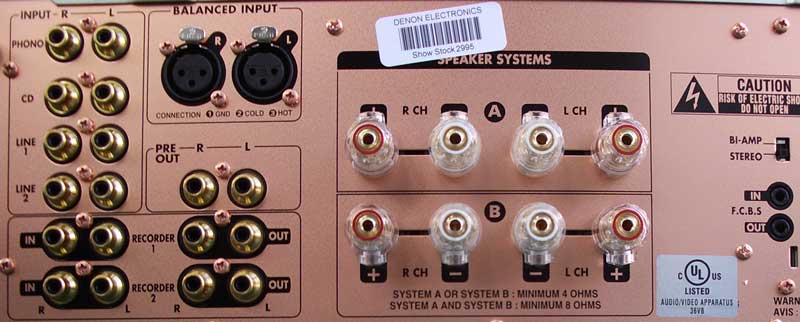
As is evident from this rear photo, there isn't much to confuse users here. Six (6) analogue RCA stereo inputs, a stereo XLR balanced input and 3 line level outputs (including a preamp out) make up the bulk of the back panel. Note that phono inputs are provided - which is key since this system is definitely targeting audiophiles who may still cling to their LP collection like a cat on a screen door. On the right side of the unit users will see the switch for using the system in bi-amp mode (assumes you have two or more of these integrated amplifiers in your system) as well as the Floating Control Bus System (F.C.B.S.) Unlike other things that end with "B.S." this is actually a useful feature when using two or more PM-11S1a in your system as it allows you to have a 'master' unit and control the slaves via a single remote.
Marantz PM-11S1 Setup and Sound Quality
For this review, we configured the Marantz PM-11S1 in two different listening environments. The first was in my own two-channel listening room using a Slim Devices Transporter and Denon DVD-3910 as source components. The Transporter sent balanced signal to the PM-11S1's XLR inputs while I fed the DVD player's analogue outputs into the "CD" input. I utilized a pair of RBH Sound 61-SE/R speakers which were configured on a pair of StudioTech Ultra Series speaker stands. In the second room we had a more challenging pair of RBH Sound T30-LSE speakers and had the added benefit of listening in a more treated environment with a measured response. This system utilized a Denon DVD-5900 player for its analogue source (using Pure Direct Mode). In the listening tests below, we'll indicate where we were located when conducting each listening test. Cables for both rooms used the Velocity series by Impact Acoustics.
We are able to perform an interesting experiment while in the second, treated listening room. We pitted the Marantz PM-11S1 against a couple of "competitors" we happened to have on hand. This wasn't so much of a shoot-out as it was a "let's see what a true hi-fi product does to the mid-fi and entry level stuff." We pulled aside a Yamaha RX-V2700 and a Panasonic SA-XR50 (considered by some to be a "magically esoteric" ~$200 receiver) and performed some comparisons.
Sound Quality Tests - Two-Channel System with RBH Sound 61-SE/Rs
The Marantz PM-11S1 is beautiful, well-built and looks to be perfectly suited for a high-end two-channel system. Now it was time to make sure the beauty of the sound output matched the exquisite styling of the unit itself. As I settled into my own listening room I queued up several familiar discs.
 Sting:
The Dream of the Blue Turtles CD
Sting:
The Dream of the Blue Turtles CD
Skipping to Track 2 "Love is
the Seventh Wave" I found that the introductory staccato notes portrayed a
wide soundstage (starting from the left) with drums and high hat filling in
from the right side. This launched the song into the main verse. A nice
trombone entered, playing a complimentary accompaniment to the melody which
rang true and, though positioned back in the mix, revealed itself with a very authentic
and 'live' feel. Percussion was rendered with definition and clarity that told
me the PM-11S1 was controlled and precise. In "Children's Crusade"
the widely panned drums showed off Omar Hakim's most articulate hat work while
Sting's vocals were full and the gentle reverb demonstrated a smooth roll off.
Branford Marsalis' excellent saxophone playing showed through with an
authenticity that found me closing my eyes to better take in the sound. Brief
and playful, "The Dream of the Blue Turtles" has an opening jazzy
feel that never really lets up. Clean Synclavier samples bass and drums make up
the bulk of this fast-moving piece. Its raw feel and divergent sound really
allowed the Marantz to produce nuances and subtleties that often get masked in
the more produced tracks.
 Steely
Dan: Gold CD
Steely
Dan: Gold CD
I kicked off this album with
the first track "Hey Nineteen". I'm very familiar with this album
(and this track) and listened for the super-wide backing vocals to kick in. I
wasn't disappointed. Male vocals sound wonderful on the PM-11S1 and I felt it
was able to articulate the challenging mid-bass range of frequencies while also
driving the highs with gusto and, more importantly, ample fidelity.
"Deacon Blues" began with a well-rendered cymbal bell and a full bass
guitar that maintained its somewhat gritty edge while still dipping to the
limits of my listening system. Horns and sax were spot-on and sounded very live
on my two-channel system (which is likely due to the somewhat ambient room
which lends itself to a sound that is ever so slightly 'live'.) The subtle use
of guitars in the bridge came through cleanly and the ability to pick out and
place instruments within the soundstage gave away how much finesse the Marantz
was capable of portraying. "Chain Lightning" has a thinner mix and gave
me some driving drums to listen to (again panned wide across the soundstage) as
well as cymbals which rolled smoothly, but quickly off into infinity. Electric
guitar revealed finger noises and a very authentic sound that begged your
attention. Piano, most notably on the song's lead-out, was clean, clear and
well-defined.
Steve
Miller Band: Fly Like an Eagle 30th Anniversary CD/DVD DigiPak
This disc was sent to me
some months back and has proven to be a decent reference disc. "Fly Like
an Eagle" has some very particular percussive bass as well as very high frequency
cymbal bells and effects that deliver almost too much to listen to at once.
Miller's clean vocals and the diversity of the track (which is never played the
same twice live) made this a difficult test which the PM-11S1 passed with
flying (pardon the pun) colors. "Wild Mountain Honey" has some interesting synth tracks and a
rather raw vocal that is breathy and up-front. There is a lot to pay attention
to (Steve Miller composes some rather complex pieces) and I felt the Marantz amplifier pushed my speakers
farther than I'd ever heard them go in terms of articulation of high-energy
playback material. Bass was tight and silky smooth with just a touch of finger
pull at times which gave a truly "being there" feel to the tracks.
Percussion was pervasive and authentic and, although it had the feel of a 60's
flashback (whatever that is) it provided plenty of excellent high fidelity
material for the PM-11S1 to faithfully reproduce.
 Yes:
Talk CD
Yes:
Talk CD
"I
Am Waiting" showed off a tremendously finessed presentation of Anderson's
vocals as well as Trevor Rabin's guitar prowess. Alan White's drumming and
Chris Squire's bass playing were absolutely punchy and powerful. This integrated
amplifier can truly handle driving beats without breaking a sweat and switch -
almost instantly – into a soft, detailed and gentle vocal. These transitions
were effortless and both ends of the spectrum were equally satisfying. If you
have a decent subwoofer for this track you'll be in for a treat as well. I
continued listening to this album for its duration. Some stand-outs included
the well-defined drumming and guitar playing in "State of Play", the
truly amazing vocals in "Walls" and the pervasive hand percussions in
"Where Will You Be." This is a great album and it was clear that the
Marantz was in control - rendering all facets of the music in a way that told
me this integrated amp is capable, controlled and worthy. Even though the
system is a conservative 100W/channel, it never gave even a hint of limiting,
distortion or compression - even when I cranked up 'The Dan' to somewhat
excessive levels. This is one meaty amplifier with plenty of headroom.
Marantz PM-11S1 Sound Quality - Cont
Sound Quality Tests - Two-Channel System with RBH Sound T30-LSEs
We were fortunate enough to listen to this amp in more than one setting. The second setting, where we were also able to run some product comparisons, allowed us to hear the PM-11S1 in a truly full-range two-channel system with integrated subwoofers - all powered by the single Marantz integrated amplifier.
 Patricia
Barber: Modern Cool SACD
Patricia
Barber: Modern Cool SACD
A 'dry' snare drives through the song along with raw cymbals and a main lyric that delivers
itself with a soft, gentle reverb that virtually slides off Patricia's vocals.
To call Patricia Barber's voice "sultry" is an understatement. A
blaring trumpet punches through after the verse and provides a melodic, jazzy
line which interacts with the drum kit. This was a wonderfully animated song
and we enjoyed every second in the Audioholics Reference System 1 treated room
listening to it through the full range RBH Sound T-30LSE speakers. "She's
a Lady" has a pervasive finger snap throughout that carries its own
natural, smooth decay and an acoustic bass provides a supporting undertone that
nicely backs the main vocals. The bass is played with authority and you could
hear the fingers on the strings as the notes sailed through the air. I could
have listened to this track all night.
 Dianne Reeves: Never Too Far CD
Gene introduced me to Dianne Reeves and I couldn't be happier. Without waiting a moment, track 1 "Hello (Haven't I See You Before)" launched us into vocals which were almost hyper-clean with cymbals that authentically recreated that crisp top-end heard in a studio recording session (before they get killed in mastering). The tight kick drum punched through the T30-LSEs subs and really made this full-range 2-channel system shine. I couldn't get over how much top-end was coming through in pristine detail - all without the fatigue that occurs when compression and distortion are evident. Tracks 4 "How Long" featured a plastic wood block sound that ringed out through the intro and had a most natural decay. Bass was very percussive complete with edgy finger detail and slapping sounds and the kick kept time with a nice, natural snap that was powerful yet crisp. Percussion was well-placed within the soundstage and the performance came into the room as Dianne's vocals imaged perfectly - in front of the instrumentation and backing vocals.
We decided it was time to run some comparisons to see what profound differences we would hear when running the PM-11S1 against some admittedly odd competition. It was a clear demonstration of how amplifiers do indeed sound very different from one another - especially when comparing a high-end system with a mid-fi system, and more so when comparing to an entry level product that exhibits more distortion than a Metallica concert. In comparing between the Yamaha RX-V2700 and the PM-11S1 the general description would be that the RX-V2700 sounded warmer, with looser bass and slightly less clear highs. The Yamaha still sounded good, but the Marantz was mind-blowing. For fun, we also connected the cult-status "audiophile" $200 Panasonic SA-XR50 receiver for an A-B-C level-matched comparison. The difference was now amazing. Nearly gone was the gentle reverb that followed the plastic wood block in Dianne Reeves' "How Long" track. As near as we could figure, this was due to the high output impedance (almost an ohm) as well as the increased noise floor of the poorly designed Panasonic digital amplifier. To be fair, having this low profile receiver driving a pair of T30-LSEs wasn't exactly a fair match in anyone's book, but surprisingly some “audiophiles” do this very thing and proclaim sonic nirvana. It was a fun, non-technical comparison but an educational one nonetheless.
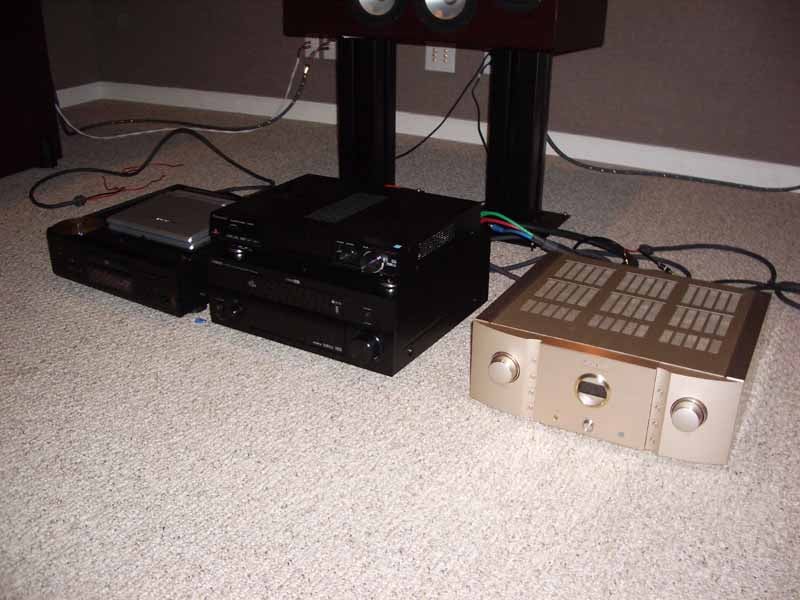
Marantz PM-11S1 Shootout between Yamaha RX-V2700 and Panasonic SA-XR50 Receivers
Marantz PM-11S1 Measurements & Analysis
Amplifier Efficiency
Amplifier efficiency measurements for linear A/B amps such as the ones employed in this receiver typically range from 40-50% depending on the load the power supply of the amplifier sees. The closer you get to full load, the higher the efficiency usually becomes (assuming you aren’t over taxing the power supply and power devices of the amp causing excessive thermal losses). The PM-11S1 achieved around 65% efficiency which is rare for a conventional linear amp design and indicates to me that Marantz implemented some serious power factor correction in their power supply and/or has very tight tolerance on power supply ripple.
|
# Ch Driven |
Power Consumption |
Power Delivered |
Load |
Efficiency |
|
1 |
280 watts |
179 watts |
8-ohms |
64% |
|
2 |
450 watts |
147.5 watts |
8-ohms |
65% |
Note: All power output figures above were conducted at 1kHz and 0.1% THD + N
Power Bandwidth
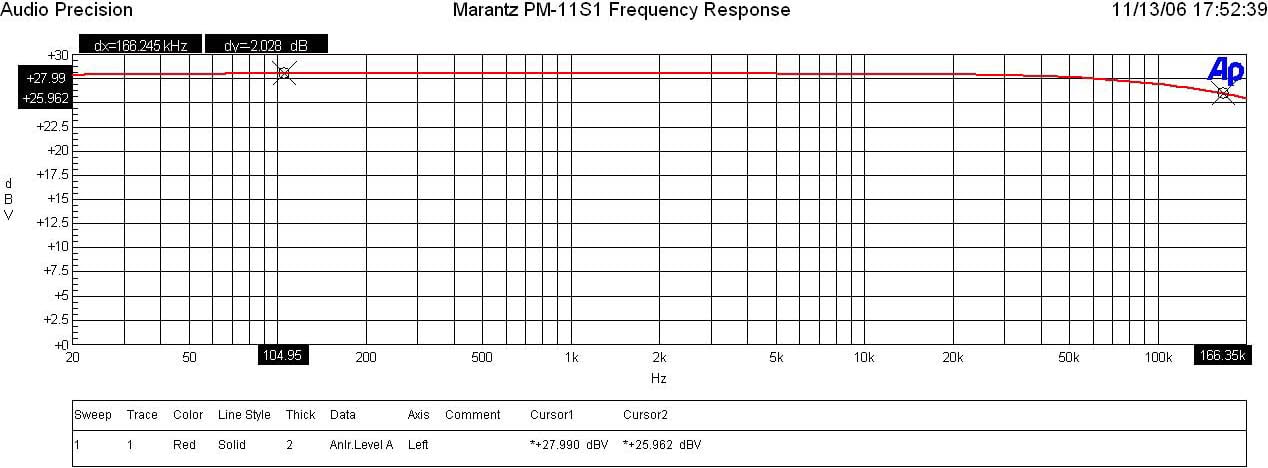
Marantz PM-11S1 Frequency Response
The Marantz PM-11S1 possesses a wide bandwidth amplifier topology with a -3dB point in excess of 170kHz. The frequency response was ruler flat as expected.
At full continuous unclipped power; 175wpc x 1; 8-ohms– full bandwidth with less than 0.1% THD+N, the PM-11S1 still maintained its excellent bandwidth linearity despite the fact we were driving this amplifier way beyond its rated 100wpc power specification. Into 4-ohms, the PM-11S1 was able to deliver continuous power levels at a whopping 295wpc x 1 with less than 0.1% THD + N. The amplifier section of this integrated amp seems purposely underrated to inspire reviewers like myself to praise its design merits and conservative ratings.
For more info on amplifier measurements, see: The All Channels Driven (ACD) Test
FFT Distortion Analysis
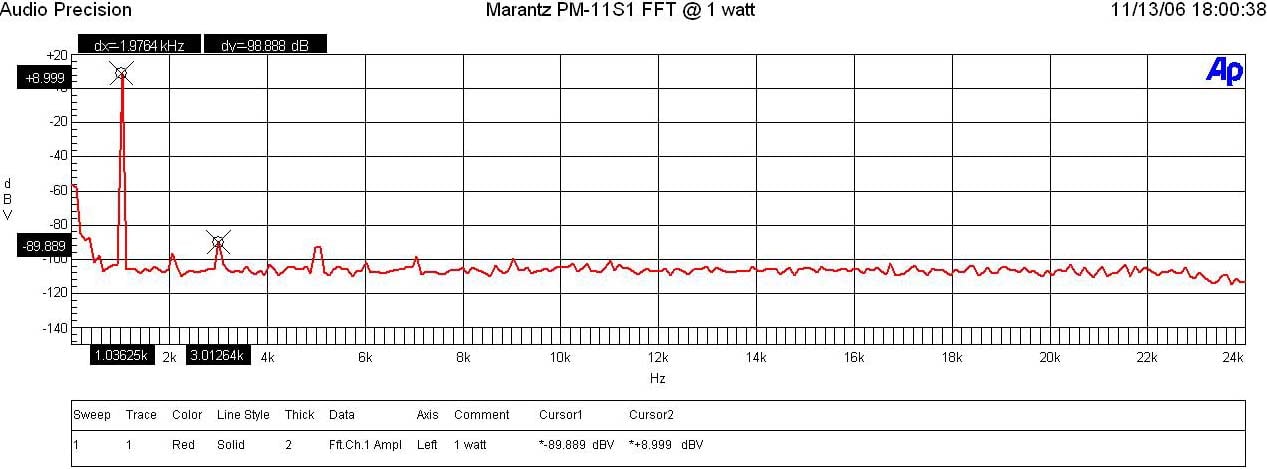
FFT Analysis @ 1 watt
At 1 watt into 8-ohms, the PA350B exhibited impressively low distortion (8.999+89.889)dBv = 98.888dbV or 100*alog^-1(-98.9/20) = .001% THD + N which is super clean as expected from a design of this caliber.
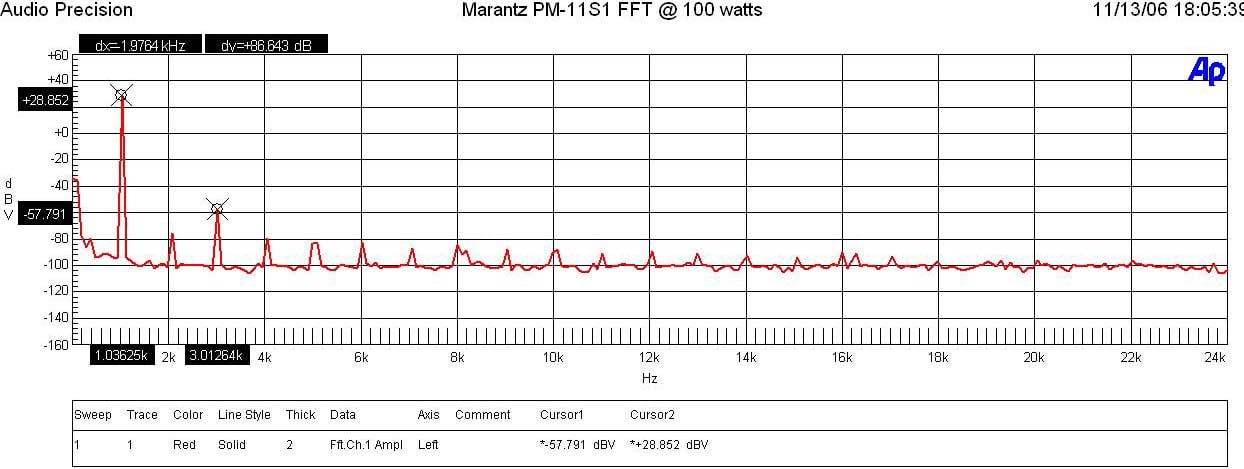
FFT Analysis @ 100 watts
(28.852 + 57.791)dBv = 86.64dBv or 100*alog^-1(-86.64/20) = .005% THD + N which indicates as per my power measurements, the amp section in this integrated amplifier is too conservatively rated.
Amplifier Output Impedance & Damping Factor
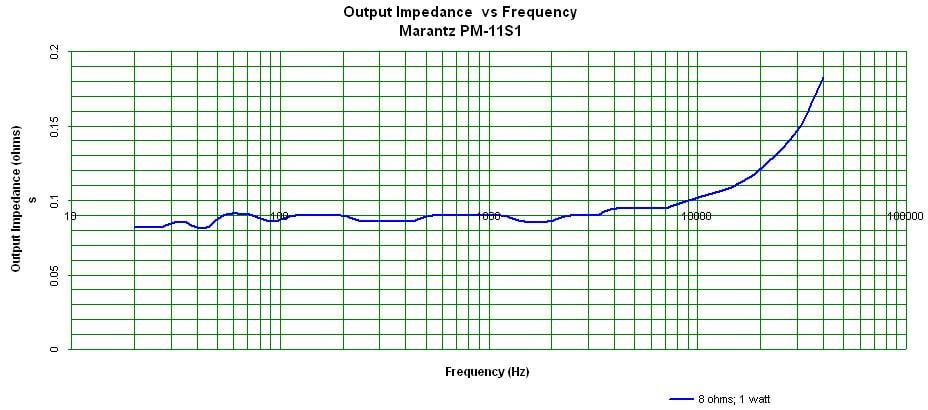
Amplifier Output Impedance
The amplifier output impedance fell right within our desired 100mohm or less mark for the entire audible bandwidth up to 10kHz with just a slight increase above at the upper 20kHz frequency range. This is the type of performance I like to see in any high quality amplification and it's obvious the Marantz PM-11S1 exemplifies this.
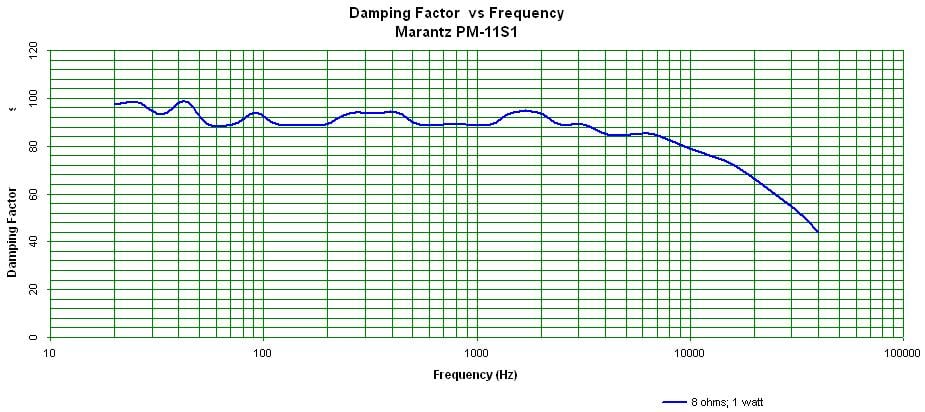
Amplifier Damping Factor
The amplifier damping factor is about what I expected based on the measured output impedance. It is uniformly good across the entire audio frequency range and hovers around the 100 mark we like to see on uncompromising designs. All in all, this is quite an impressive result and rivals many exotic amplifiers in this price range while exceeding our minimum 50 value we like to see in all amplifier designs.
Signal to Noise Ratio (SNR)
Channel A's signal to noise ratio came in at -107.32 dB below 31.79 dBV Reference Level (at 1.07 % THD+N). This was with a frequency response of <10 Hz - 22k Hz bandwidth, no option filter. This equates to a SNR of 84dB @ 1 watt
With a 200mVrms signal input and the output adjusted to 1 watt, I measured an excellent SNR of 84dB (unweighted). This didn’t surprise me as I knew this amp was clean from our listening tests.
Marantz PM-11S1 Conclusion and Ratings
I've spent a lot of time with the Marantz PM-11S1 and I can say it's one of the most beautiful pieces of gear I've come across. The measured power this integrated amplifier exhibits told us that Marantz plays fast and loose with its stated power specs - but in the consumer's favor. Its styling is unique to Marantz and really makes a statement in your reference system that says this is a serious piece of audio equipment. The $4000+ price tag means that this integrated amplifier is not for those looking for a bargain product, but rather for consumers looking to have the best as well as a showpiece that works almost as much as a piece of furniture as it does an audio component. The difference is, if you push an Italian sports car to its limits too often you'll likely end up in the shop. With the PM-11S1 - it'll just beg you for more. The Marantz PM-11S1 comes highly recommended from us to those brave enough to whip out their credit cards and take this 60+ pound box home with them. It's been nice driving this Italian sports car of an amplifier for these past several weeks - I'm certainly not looking forward to waving goodbye and driving back home in my Jeep.
Marantz PM-11S1 Integrated Amplifier
MSRP: $4399
Marantz of America
100 Corporate Drive
Mahwah, N.J. 07430-2041
http://us.marantz.com
About Marantz of America
Marantz
America
is committed to upholding the tradition of technological superiority initiated
by founder Saul Marantz. In keeping with this emphasis on quality, Marantz
audio and video components are carried only by the nation’s premier independent
audio/video specialty retailers. Additional information is available at www.marantz.com.
Marantz America is a wholly owned subsidiary of D&M Holdings Inc.
The Score Card
The scoring below is based on each piece of equipment doing the duty it is designed for. The numbers are weighed heavily with respect to the individual cost of each unit, thus giving a rating roughly equal to:
Performance × Price Factor/Value = Rating
Audioholics.com note: The ratings indicated below are based on subjective listening and objective testing of the product in question. The rating scale is based on performance/value ratio. If you notice better performing products in future reviews that have lower numbers in certain areas, be aware that the value factor is most likely the culprit. Other Audioholics reviewers may rate products solely based on performance, and each reviewer has his/her own system for ratings.
Audioholics Rating Scale
 — Excellent
- — Very Good
- — Good
- — Fair
- — Poor
| Metric | Rating |
|---|---|
| Frequency Response Linearity | |
| SNR | |
| Output Impedance | |
| Measured Power (8-ohms) | |
| Measured Power (4-ohms) | |
| Two-channel Audio Performance | |
| Build Quality | |
| Fit and Finish | |
| Ergonomics & Usability | |
| Features | |
| Performance | |
| Value |  |
Clint Deboer was terminated from Audioholics for misconduct on April 4th, 2014. He no longer represents Audioholics in any fashion.
View full profile Subscribe to our newsletter