


Integra Research RDA-7.1 Amplifier Review
Integra Research RDA-7.1 Amplifier
- Product Name: RDA-7.1
- Manufacturer: Integra Research
- Performance Rating:

- Value Rating:
- Review Date: March 08, 2005 18:00
- MSRP: $ 5000
- 150wpc 8 ohms ; 300wpc 4 ohms x 7
- THD: .03% all channels
- Bandwidth: 3.5 Hz to 250 kHz : +1 dB/ -3 dB (8 ohms)
- Damping Factor: 40 @ 1kHz
- Power Supply: AV 120V, 60Hz
- Power Consumption: 5.3A (two channels driven)
- Dimensions (W x H x D): 17-11/16" x 7-3/4" x
23-11/16"
- Weight: 155.7lbs (packaged) 115lbs (unpackaged)
Pros
- Phenomenal Performance & Fidelity
- Exceeds Power Ratings
- Better Performance than Indicated
- THX Ultra2 Certified
Cons
- Big and Heavy
- Pricey
- No Music Mode Trigger
Integra Research RDA-7.1 Introduction
 I have always been a fan of products that boast certain
specifications on paper that when benched, comfortably outperform those numbers.
It's a rarity to
say the least, and even more so when the product actually exceeds its specifications by a wide
margin.
When this occurs, a total solar eclipse is usually not far behind.
Fortunately we
can bask in the awe of the beautiful sight of just such an occurrence without fear or losing or
damaging our eyesight.
Our hearing on the other hand is another story and, while we don't condone
the adrenalin rush of sustained loud listening levels, it's nice to know a company provides this
capability for the hearing impaired.
Not surprisingly, this company is no other than Integra
Research, the upscale division of Onkyo electronics.
I have always been a fan of products that boast certain
specifications on paper that when benched, comfortably outperform those numbers.
It's a rarity to
say the least, and even more so when the product actually exceeds its specifications by a wide
margin.
When this occurs, a total solar eclipse is usually not far behind.
Fortunately we
can bask in the awe of the beautiful sight of just such an occurrence without fear or losing or
damaging our eyesight.
Our hearing on the other hand is another story and, while we don't condone
the adrenalin rush of sustained loud listening levels, it's nice to know a company provides this
capability for the hearing impaired.
Not surprisingly, this company is no other than Integra
Research, the upscale division of Onkyo electronics.
Build Quality
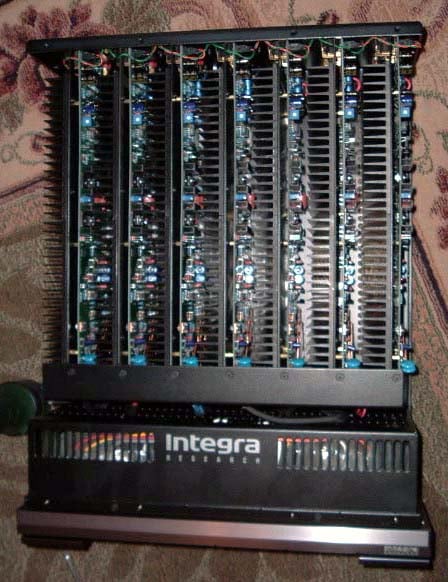 When amplifiers approach
the price class of the Integra Research RDA-7.1, I expect nothing short of superb build quality both
mechanically and electrically, as well as good ergonomics and a pleasing fit and finish.
The
RDA-7.1 had no problems delivering in this respect.
This amp is solidly constructed and has a
commanding appearance.
I could only find one minor nitpick,
85 degree C capacitors were
used throughout the design.
This is common in consumer audio, but I prefer to see 105 degree C
rated capacitors as they typically have longer lifespans since they can better cope with the heat, and
have lower ESR (effective series resistance) ratings.
As you will later see in this review, this
amp ran cool even under demanding loads, thus my concerns about the capacitor temperature ratings are
mostly academic.
When amplifiers approach
the price class of the Integra Research RDA-7.1, I expect nothing short of superb build quality both
mechanically and electrically, as well as good ergonomics and a pleasing fit and finish.
The
RDA-7.1 had no problems delivering in this respect.
This amp is solidly constructed and has a
commanding appearance.
I could only find one minor nitpick,
85 degree C capacitors were
used throughout the design.
This is common in consumer audio, but I prefer to see 105 degree C
rated capacitors as they typically have longer lifespans since they can better cope with the heat, and
have lower ESR (effective series resistance) ratings.
As you will later see in this review, this
amp ran cool even under demanding loads, thus my concerns about the capacitor temperature ratings are
mostly academic.
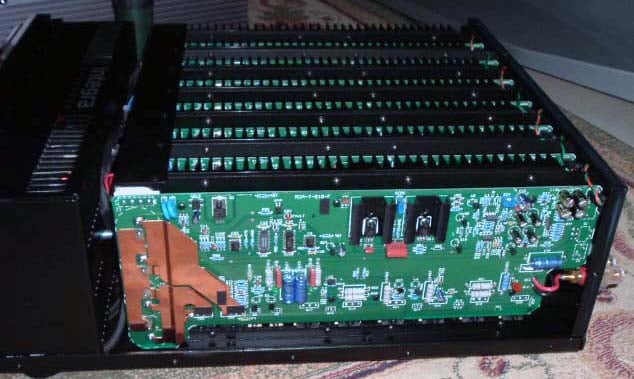 Notice the ground strapping on
each individual power amp module.
The transformers are fully isolated away from the amp
modules.
There is plenty of good old fashion heatsinking to keep each module running cool, even
during demanding power loads.
Notice the ground strapping on
each individual power amp module.
The transformers are fully isolated away from the amp
modules.
There is plenty of good old fashion heatsinking to keep each module running cool, even
during demanding power loads.
Editorial Note: Notables on the RDA-7.1 Amplifier Design
- Eight high current complementary output power BJTs per channel - paralleling multiple BJTs is a good method of ensuring amplifier output impedance is low enough to deliver high current while driving low impedance loads. It's also an effective way of minimizing frequency response variations which can occur when driving highly reactive speaker loads and exotic cabling.
- Multiple high voltage (80V) capacitors (2 x 20,000uF = 40,000uF per channel). In order to do 150wpc a minimum recommended cap voltage of sqrt(2)*34.64 + 5 = 54V should be used. Using 80V gives them plenty of design margin and added headroom since the rails can swing much higher.
- Dual massive torodial transformers ensures this amp can utilize the full rated power from the wall outlet (120V,15A) if called upon.
Connections
The back panel of the Integra Research RDA-7.1 is pretty standard of multi-channel amplifiers in this price class. The WBT 5-way binding posts invoke the high end appeal audiophiles love and make me happy too since I have always found them to mate better with various types of banana plugs. Should you choose to utilize bare speaker wire, the holes in each of the speaker connector shafts can be situated so that all cables will be vertically-oriented - a nice touch, resulting in a cleaner cable assembly.
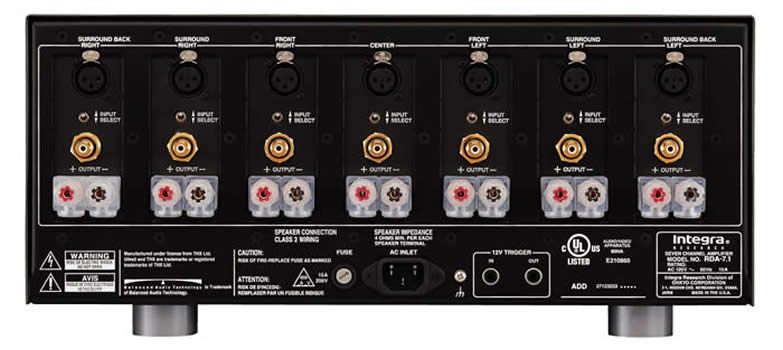
The RDA-7.1 allows for both balanced XLR and unbalanced RCA input signals, so if you have a high-end processor with balanced XLR outputs you can maximize your potential. Please note the proper switch setting of each amplifier module (up for balanced, down for unbalanced). A 12V trigger connection for the amplifier is provided via single 1/8" mini plug. I would have preferred the inclusion of a Music trigger (triggers on line level input) typically found on other amplifiers for those who simply can't get a trigger line to the amplifier. The power cord is a 3-way detachable allowing audiophiles to install their aftermarket exotic cables, though I recommend putting your money to better use such as room acoustics or adding another subwoofer.
Integra RDA-7.1 Setup and Listening Tests
Set-up was a bit of a hassle. This amplifier is extremely deep (almost 2 feet in depth) and heavy (over 115 lbs!) This is a certain recipe for a hernia if you dare move it by yourself. Use caution (though I don't always practice what I preach and am usually too impatient to wait for others to help.) In typical fashion I opted to install the amp myself, lifting it onto my rack above my head. It was no fun and I still have a reminiscent back ache and strain to remind me. Be careful!
Aside from the enormous girth of the RDA-7.1, it had an ergonomically laid out back panel with plenty of separation of line level and speaker level connections between amplifiers. Since I was reviewing the new Integra Research RDC-7.1 matching processor I opted to connect it via the balanced inputs.
Editorial Note on Balanced vs Unbalanced
I measured the voltage gain of the RDA-7.1 via balanced and unbalanced inputs and found the following:Unbalanced: Av = 29dB (THX standard)
Balanced: AV = 23dB (6 dB lower than unbalanced)
This is a standard practice in most consumer and pro audio. The preamp therefore usually has a +6dB boost via the balanced outputs to compensate. I verified the RDC-7.1 pumped out over 7Vrms via unbalanced and a whopping +15Vrms via balanced unclipped signal which was over 3 times the amount needed to drive this amp into clipping. Check out our Balanced vs. Unbalanced Connections Article for more information.
Listening Tests
I have always been of the viewpoint that sonic differences between well-designed amplifiers are very difficult to discern, provided that they are operated in their linear operating region. Get the output impedance and noise floor low enough, and the amplifier will generally not hiccup at any speaker load, allowing itself to be removed from the sonic chain of the system. That being said, I felt the RDA-7.1 was extremely neutral and transparent. It had the sonic quality of my old Aragon 8008 series (an amp I am dearly fond of) in that it sounded very BIG, crisp, dynamic and real, while at the same time quite, delicate and fluid. Feed it a good source and be rewarded with excellent sound, feed it a garbage source and be equally rewarded with garbage sound. It's that simple.
Two-channel Audio

As I have mentioned in other reviews, this SACD remains one of my benchmark discs for good reason - lumpy jazz in a smooth jazz environment. You won't find repetitive and annoying saxophone scales, single stroke drumming, and simplistic guitar rifts. Instead you're showered with snappy jazz and provocative lyrics, slamming drums and memorable instrumental solos. The SACD layer of Track #2, "Morning Grace" sounded about as good as I've ever heard which in one word would best be summed up as "phenomenal". The RDA-7.1 had no problems conveying all of the dynamics of this recording without introducing any coloration, all without breaking a sweat. I was hitting unstrained SPL peaks of over 105dB at my listening position without incident. I found myself cranking the volume higher without the typical listening fatigue when listening to lesser designs.

I put in another reference disc, which again happens to be a Patricia Barber Modern Cool from Premonition Records. If you really want to show off your system's dynamics capabilities, this is a must have disc.
Track#7 "Company" will reward time after time, especially during the explosive drum solo half way into the song. Wimpy speakers dare not play this track, and the same applies for flea watt amps. The RDA-7.1 really shined with this recording and was able to drive my reference system as well as the best gear I have had the fortune of reviewing.
Multi-Channel Audio
After expending considerable thought, testing and evaluating amplifiers over the past couple of years I have come to the conclusion that if a multi-channel amp can deliver solid two-channel performance, has a robust enough power supply to almost double power as load impedance halves, it will equally shine in multi-channel applications. After my two-channel listening experiences with the RDA-7.1, I came in with high expectations for multi-channel performance and it certainly didn't disappoint.

I am a sucker for instrumentals, especially those emphasizing drum ballads. The multi-channel DTS DVD Audio disc of Blue Man Group - The Complex is a shining example of such a recording. Track#3 on the DVD-A layer featuring Dave Matthews is a killer sounding song and is even cooler on the DTS side since you get to see the Blue Man Group in action spraying paint on each other, playing unconventional instruments, and watching the world around Dave Matthews transform between reality and cartoon. Very cool indeed. Track #1 jumps right out at you and gives your system quite a workout.
The RDA-7.1 was up for the challenge and continuously belted out the tunes without missing a beat. I found myself listening to the drum ballad on the DTS DVD Video layer over and over in awe at how cool it sounded, particularly on the Integra Research RDC-7.1 and RDA-7.1 combo overlaid in Pro Logic IIx Music Mode. This was a truly phenomenal experience.
Integra RDA-7.1 Measurements and Analysis
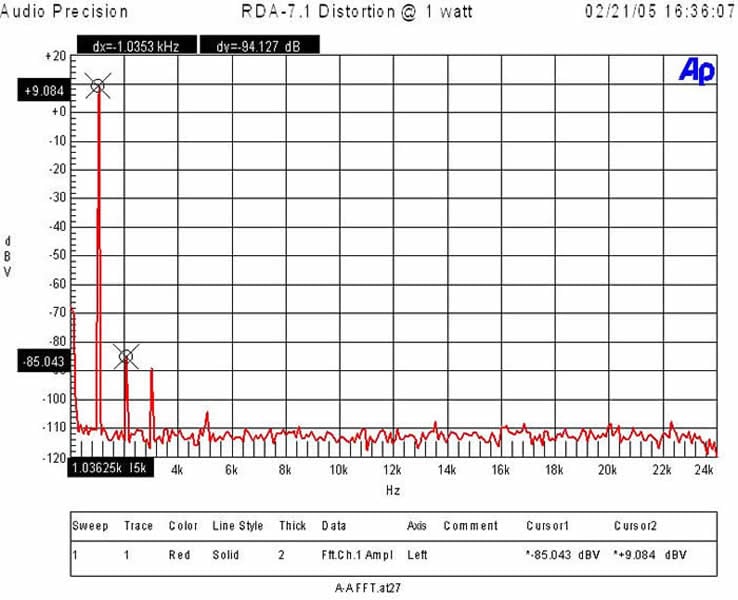
The RDA-7.1delivered a whopping 188wpc into 8 ohms at < 1% distortion (onset of clipping) with an equivalent Signal to Noise Ratio (SNR) of 114dB (unweighted) which translates down to 91dB @ 1 watt. The RDA-7.1 delivered 320wpc at clipping with similar SNR figures. These are excellent measurements demonstrating the amplifier delivered more than speced power and more importantly had an extremely low noise floor which is critical when listening at low power levels to preserve detail ensuring all of the musical nuances may be heard.
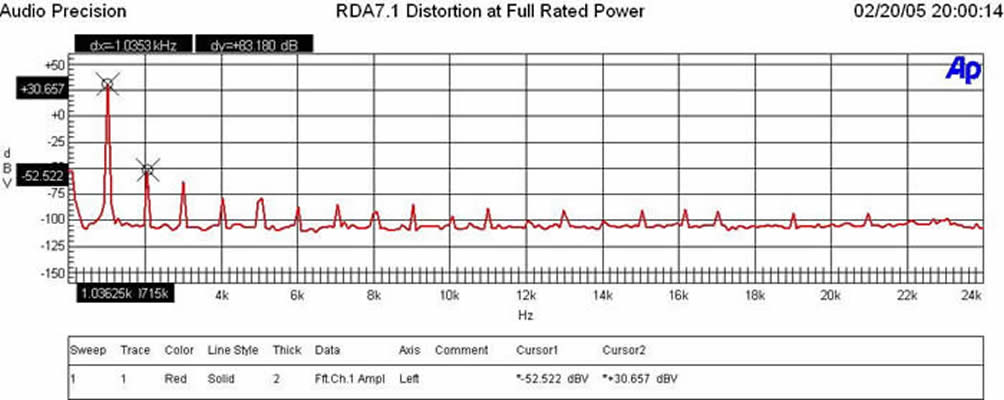
At the manufacturers rated power of 150wpc into 8 ohms, the RDA-7.1 exhibited impressively low distortion (30.657+52.55dBv)dBv = 83.2dBv or 100*log^-1(-83.2/20) = .007%
At the manufacturers rated power of 300wpc into 4 ohms, the RDA-7.1 exhibited similarly low results (30.656+49.508)dBv = 80.16dBv or 100*log^-1(-80.16/20) = .01%.
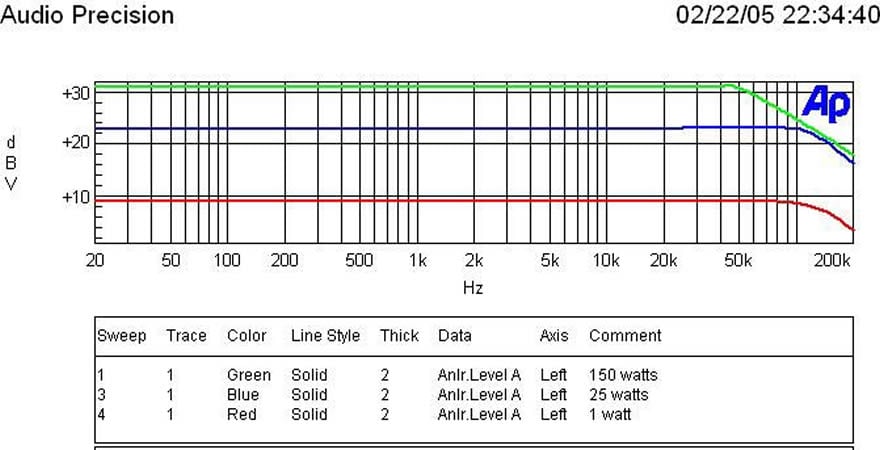
Gain Product Bandwidth (GPB) of this amplifier is excellent. Even at near full power levels, we see a -3dB point above 100kHz.

The RDA-7.1's output impedance is well under 100mohms throughout the entire audio bandwidth. This requires the right amount of negative feedback and usage of multiple power transistors to achieve this feat. The benefits of 8 BJT's per channel are clearly evident here. The reason we emphasis so much importance on minimizing amplifier output impedance is because the lower the impedance, the less chance of system frequency response variation when driving reactive loads such as speakers and/or many exotic cables.

An amplifier that exhibits low output impedance will also exhibit excellent damping factor. The RDA-7.1 maintained an impressive damping factor of over 125 throughout the entire audio bandwidth. These type of measurements are uncharacteristic of tube amplifiers which is where they usually fall apart when attempting to drive low impedance, inefficient speaker loads. This design is a far departure of that design characteristic.
Although the faceplate of the RDA-7.1 has the name Balanced Audio Technologies (a company known for its tube amplifiers), the bulk of the real circuit design was done by ATI Amplifier Technologies. Note that the published spec of this amp claims a damping factor of a meager 40, implying a much higher output impedance. I suspect this is a case where marketing is under-exaggerated to gain audiophile appeal for tube lovers that believe esoteric amps sound more "chocolately." Conversely, we were relieved in the performance seen here. While tube amps may have their place for esoteric two-channel audio, they don't cut the mustard for dynamic home theater environments. Rest assured, this amp has no such issues.
Update (11/13/05): According to BAT, the RDA-7.1 is their design, but the manufacturing was done by ATI.
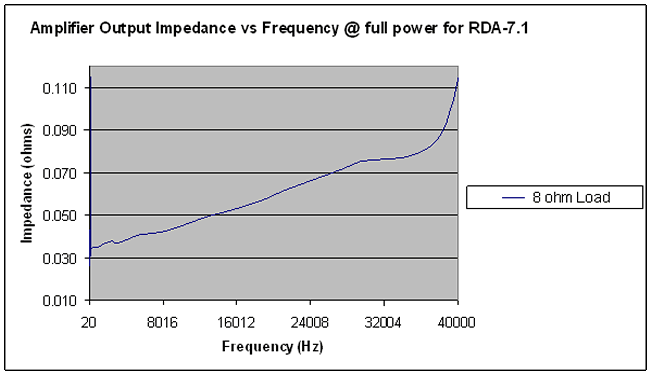
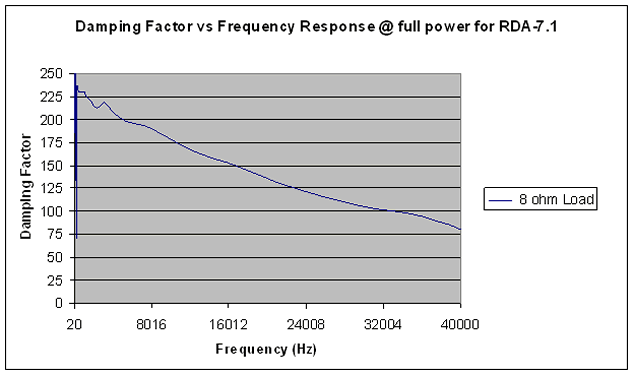
At full power we see the RDA-7.1 maintains its composure into an 8 ohm load.
The true test is how well an amp will hold up into low impedance loads. Ideally and amplifier should act like an ideal voltage source meaning power will double as load impedance halves since output voltage will remain constant. In order to do this, the amplifier output impedance must maintain a low enough level to not be the limiting factor. It takes more than just negative feedback to keep a low output impedance, especially when driving low impedance loads at high power. You need a good stable power supply, lots out output devices and heat sink area.

As you can see, the output impedance is very similar to the 8 ohm full power test!
Based on the principle of voltage divider, we should see about 1/2 the damping factor from our 8 ohm case.

No surprises there! This amp delivered the goods.
There is no substitute for good old fashion amplifier design with plenty of power devices to maintain a low output impedance at high power levels, an ample power supply to keep the source resistance low and a well laid out circuit topology to keep the noise floor down in the mud.
Integra RDA-7.1 Conclusion
The Integra Research RDA-7.1 is a dynamic, low noise, cool-running, audiophile-sounding amplifier that exceeds its power ratings. It can compete with many of today's best multi-channel designs regardless of price. The THX Ultra2 certification is an added bonus which ensures system compatibility with other THX products, and has the stamp of approval that it satisfies their performance criteria, though I am very certain it exceeds them by a comfortable margin.
The downside is this amplifier is enormous and will have issues fitting in most standard racks or home entertainment centers. I am uncertain why Integra Research didn't locate the dual power transformers on the bottom of the amp just under the heatsink modules. This would have shaved at least four inches off the depth at the penalty of adding more height which is usually not the limiting factor for shelf space.
Careful planning must be facilitated if you plan integrating this amplifier into your home theater system. The sound quality is among the best I have heard, as is the build quality, fit and finish. The RDA-7.1 will likely satisfy any audiophile and home theater enthusiast alike. The hard part will be convincing your significant other of the necessity of this monstrous amp in your home theater system. It doesn't come cheap, but as a dear friend once told me "it's never cheap to be cool". This amp certainly has a cool factor to it and in this instance I am in full agreement. Finding a product that outshines its specifications by a wide margin is rare. The question remains does this occur as often as a Solar Eclipse? I think not.
The Score Card
The scoring below is based on each piece of equipment doing the duty it is designed for. The numbers are weighed heavily with respect to the individual cost of each unit, thus giving a rating roughly equal to:
Performance × Price Factor/Value = Rating
Audioholics.com note: The ratings indicated below are based on subjective listening and objective testing of the product in question. The rating scale is based on performance/value ratio. If you notice better performing products in future reviews that have lower numbers in certain areas, be aware that the value factor is most likely the culprit. Other Audioholics reviewers may rate products solely based on performance, and each reviewer has his/her own system for ratings.
Audioholics Rating Scale
 — Excellent
- — Very Good
- — Good
- — Fair
- — Poor
| Metric | Rating |
|---|---|
| Frequency Response Linearity | |
| SNR | |
| Output Impedance | |
| Measured Power (8-ohms) | |
| Measured Power (4-ohms) | |
| Multi-channel Audio Performance | |
| Two-channel Audio Performance | |
| Build Quality | |
| Fit and Finish | |
| Ergonomics & Usability | |
| Features | |
| Performance | |
| Value | |
Gene manages this organization, establishes relations with manufacturers and keeps Audioholics a well oiled machine. His goal is to educate about home theater and develop more standards in the industry to eliminate consumer confusion clouded by industry snake oil.
View full profile Subscribe to our newsletter