


Emotiva UPA-2 Stereo Amplifier Review
Emotiva UPA-2 amplifier
- Product Name: UPA-2 Two-Channel Amplifier
- Manufacturer: Emotiva
- Performance Rating:


- Value Rating:
- Review Date: April 16, 2009 08:05
- MSRP: $ 299
|
125
watts/channel (8-ohms)/ 185 watts/channel (4-ohms) |
Input
Impedance: 47K ohm External Trigger: 3-12 Volts DC (tip positive) DC Offset: <1mV servo corrected Crosstalk: >80db Fully protected from all fault conditions External trigger input/output (5-12 Volts DC - tip positive) Preamp in/out loop for daisy chaining Soft touch power switch 2RU chassis w/ solid milled aluminum faceplate IEC power inlet, 120/230 VAC configurable 17” W x 3 7/8” H (3.46" without feet ) x 18" D Weight: 30 lbs (13.6 kg) |
Pros
- Big amplification in a small package
- External DC trigger input
- Output level control
- 5-year warranty
Cons
- Not bridgeable
- Binding posts very close together
Emotiva UPA-2 Introduction
Emotiva is a name that is up-and-coming in the world of audio electronics. Manufacturing amplifiers and now loudspeakers, Emotiva is a brand that is moving beyond the fascination of the Internet Direct crowds and settling into the living rooms of mainstream consumers. These days manufacturers are adding more and more features into mid-fi and budget-level AV receivers. The trade-off, however, is usually in respect to amplifier power and quality. So what' a consumer to do if they want to achieve the maximum features with the maximum punch? Well one solution is to get a feature-rich A/V receiver and then mate it to a high quality two-channel amplifier. Best of both worlds? Absolutely, and for far less than buying a flagship AV receiver.
Build Quality
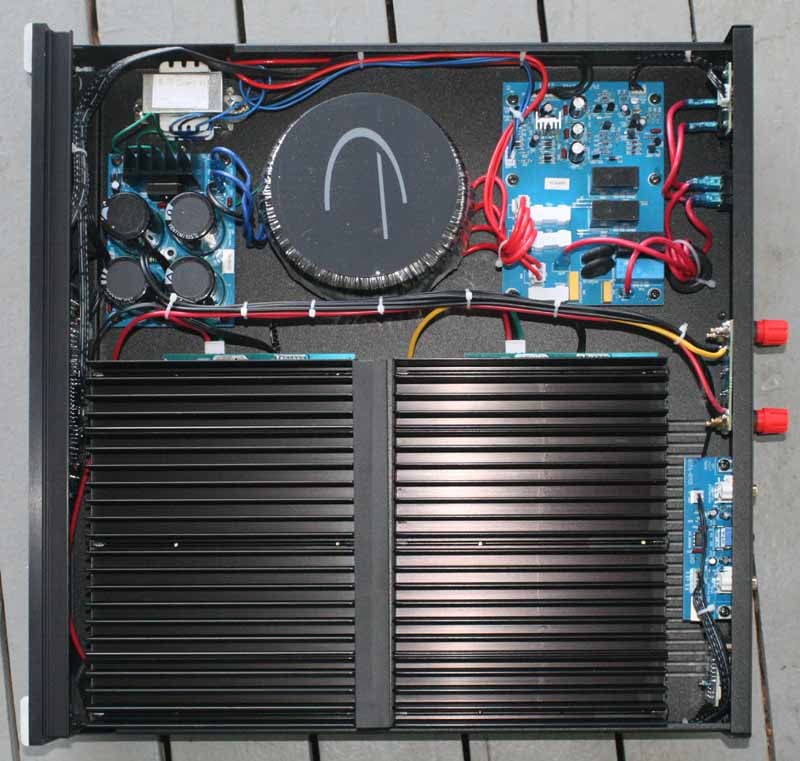
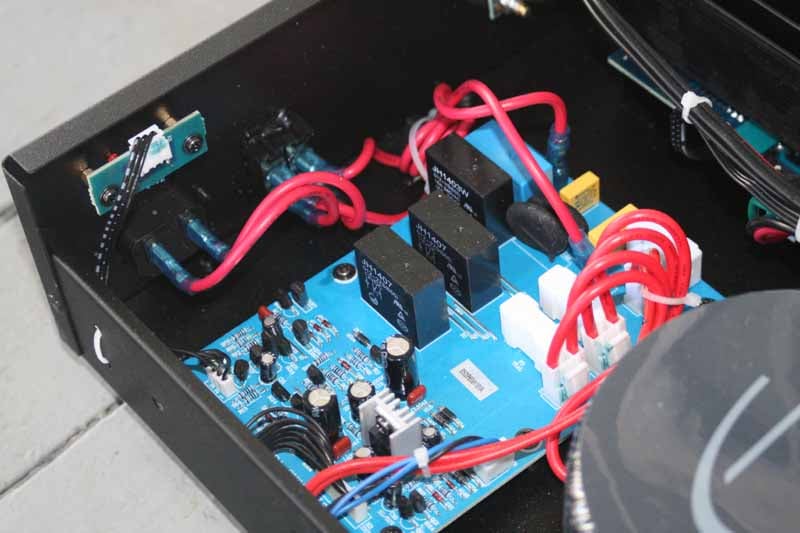
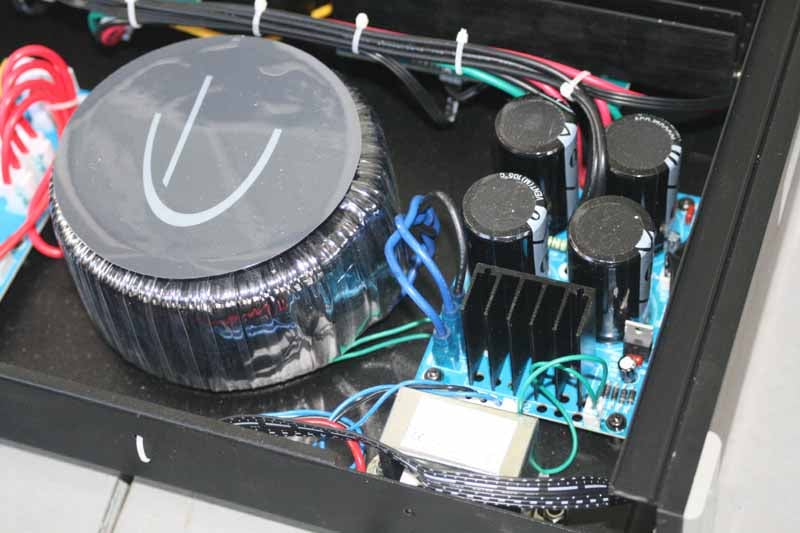 Packaging
for the UPA-2 was excellent. The amplifier arrived in the standard robust
Emotiva packaging with engineered foam surrounds and ample protection. The amp
looked like it could survive even the worst abuse from a local carrier (and
we've seen some doozies). The UPA-2 weighs a hefty, but reasonable 30 pounds,
most of that due to a large toroidal transformer and the chassis (with a solid
milled aluminum faceplate). The amp comes with 4 large 10,000 uF capacitors and
a discrete laminated core transformer in addition to the seemingly b2-ton
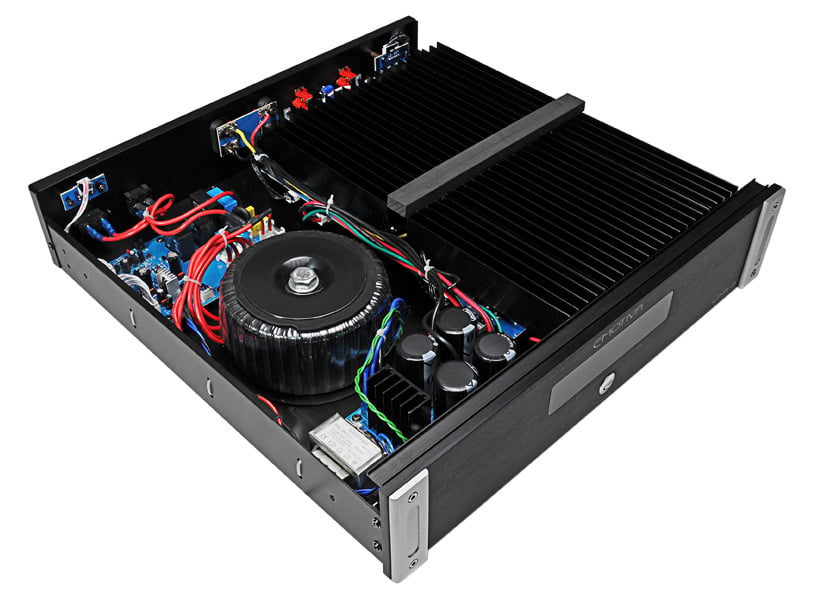
toroidal. The interior of the amp is clean, with twin heatsinks that take up
approximately 50% of the square footage of the internals. The transformer nabs
another sixth and the rest of the chassis is filled with circuit boards and the
remaining power supply for the dual differential class AB amplifiers.
Ventilation seemed more than adequate, though the seemingly inefficient position
of the fins seemed to indicate that air-flow should be left to right instead of
vertical as the venting suggests. In either case I never experienced any
shut-downs so it appears to be a non-issue provided you're not boxing the
amplifier into a sealed space with little ventilation.
Packaging
for the UPA-2 was excellent. The amplifier arrived in the standard robust
Emotiva packaging with engineered foam surrounds and ample protection. The amp
looked like it could survive even the worst abuse from a local carrier (and
we've seen some doozies). The UPA-2 weighs a hefty, but reasonable 30 pounds,
most of that due to a large toroidal transformer and the chassis (with a solid
milled aluminum faceplate). The amp comes with 4 large 10,000 uF capacitors and
a discrete laminated core transformer in addition to the seemingly b2-ton
toroidal. The interior of the amp is clean, with twin heatsinks that take up
approximately 50% of the square footage of the internals. The transformer nabs
another sixth and the rest of the chassis is filled with circuit boards and the
remaining power supply for the dual differential class AB amplifiers.
Ventilation seemed more than adequate, though the seemingly inefficient position
of the fins seemed to indicate that air-flow should be left to right instead of
vertical as the venting suggests. In either case I never experienced any
shut-downs so it appears to be a non-issue provided you're not boxing the
amplifier into a sealed space with little ventilation.
The UPA-2 is a traditional class AB design (like all current Emotiva amplifiers except the MPS-2 which uses a multi-rail class "H" design scheme). Class AB amps typically retain a more linear response but sacrifice efficiency (they're not as "green" if you care about that sort of thing in your amplifiers). Sticking with class AB was a smart move by Emotiva. While it didn't save them any weight or heat, it (along with class A) is the preferred design of choice among audiophiles everywhere. This is a solid amplifier and Emotiva even took some care in making design choices that ensure it runs as efficiently as possible.
The UPA-2 contains a single, large central power supply for both channels. This design philosophy is carried through for all UPA and XPA series amps such as the 5-channel XPA-5 and 7-channel UPA-7. While it was trendy a few years back (and still with some manufacturers) to build true multi-channel mono block designs (which can offer better channel to channel isolation), a huge advantage to these centralized power supplies is more available headroom. With a central power supply, the amplifier is able to deliver more output to any single channel since each can tap into the robust power supply for its needs. With amps, headroom is king, so we heartily endorse this method over others as a general rule.
The front of the unit is nicely adorned with Emotiva's revamped aesthetics, featuring the embossed aluminum side plates and solid brushed aluminum faceplate. The front panel LED display is large for its function. It has LEDs that indicate the power state of the amplifier (blue LED on/off), normal operation and a fault condition (red LED). The round power switch on the front bears the Emotiva emblem and lights up amber when the unit is in Standby mode. When powered up, the emblem is blue. Graphics are limited primarily to the Emotiva logo at the top center and the model number which is located at the bottom right of the front panel. Small text, including Standby, CH1 and CH2 are designated where appropriate with small white lettering.
The rear of the UPA-2 has two output terminals for loudspeaker connections. These are 5-way binding posts, but they are red & black plastic and not of the "fancier" style you'll find on Emotiva's higher-end amplifiers like the XPA-2. They screw down easily enough, but they are spaced closely together, so it's hard to screw them down with bare wire. You'll want to use banana connectors for best results. The status LEDs can be turned off via a switch on the back of the unit - a boon for those looking to place the amp in the room and eliminate any possible lights from the device (I turned them off almost immediately). The amp features input and output connections for 12VDC connections, and can actually handle anywhere from 3-12VDC (user manual says 5-12VDC) with the tip designated as the positive terminal (as we'd expect). Trigger inputs are excellent for integrated amps and preamp systems that can send out a 12V trigger signal to "wake-up" the amp automatically when it receives a signal.

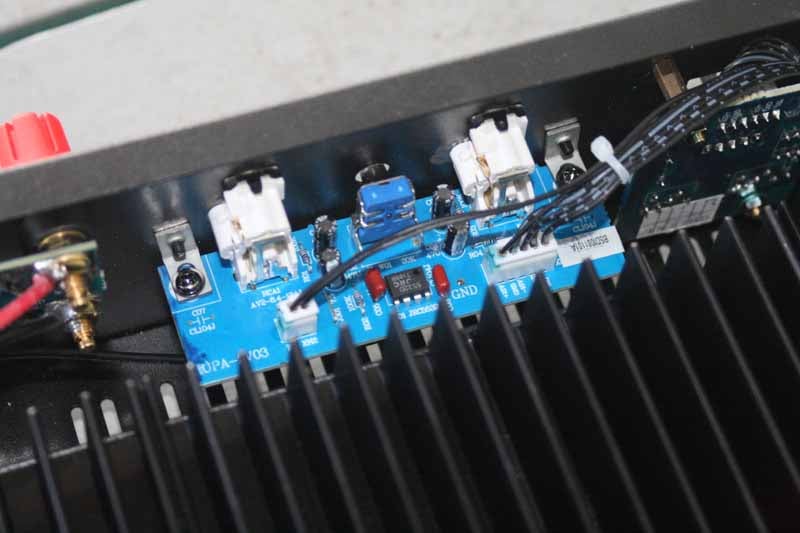
The Emotiva UPA-2 has both analogue RCA inputs as well as outputs, allowing it to be daisy chained off the same input signal. This presents some unique opportunities such as running these amps to power multiple zones in your home off the same source. There are no balanced inputs, so you'll want to look at a higher-level amplifier (like the XPA-2 or XPA-3) if you're matching it to a preamplifier with balanced outputs. What really sets this amplifier apart, however is the presence of an output level control, which means that you can level match this amplifier to another should the need arise. We used these controls extensively in our recent floorstanding tower speaker shootout. The amplifier has a hard power switch and uses a standard 2-prong IEC power cable (yeah!) which, like it or not, has typically yielded far less ground loops in our experiences than those amps using 3-prong power. This shouldn’t be the case, but it seems that manufacturers in general have a harder time making the 3-prong systems work correctly without creating or revealing ground loops. In our system we noticed no ground loop issues whether we plugged the amp directly into the wall or into our APC S15 home theater UPS system. The UPA-2 requires 5 amps to operate at full capacity which assuming a 50% amplifier efficiency will easily allow this amplifier to deliver its rated125wpc x 2 simultaneously.
Overall, the UPA-2 is simply a striking amplifier whose comfortable size belies its powerful internals. The defeatable LED lights make it the perfect addition for an in-room amplifier solution as well as a great product for a rack-based system that can be daisy-chained to power multiple zones of audio.
Emotiva UPA-2 Setup Listening Tests
It's not difficult to configure this amplifier for use, especially since it’s not bridgeable (where you can double down the power by using both amps to drive a single channel). For those wanting to beef up their AV receiver (as we did) you just connect the RCA preamplifier outputs of the receiver to the RCA inputs of the UPA-2. We recommend running the amplifier full-out with the gain set to maximum. In this way you are guaranteeing you'll get everything it has to offer. Level control should be set via the receiver and you can use the channel level controls (in the receiver's setup menu) to ensure you are at the correct reference levels for all speakers in a multi-channel system. If you have the ability to use the 12V trigger system, we recommend doing it. This involves making the physical connection with a 1/8-inch mono mini cable and also configuring the AV receiver to trigger the amplifier in the proper way (see your receiver's user manual to understand the specifics of how this can work).
We connected the speakers to the amplifier using a pair of River Cable StarFlex SPX speaker cables. I like the positive lock these provide, though the proximity of the amplifier's binding posts made me consider using something with a plastic (rather than metal) shield to avoid accidental shorts. It also made me wonder why Emotiva mounted them that close together when they had an almost limitless amount of spacing available to them. In any case, should your amplifier shut down for any reason and you know it to be well-ventilated, take a look at your speaker cables and make sure they aren't shorting out (touching each other at the amplifier). My theory is that this "flaw" is a diversion. Sure, give the reviewer an obvious negative and he'll jump all over it, leaving the rest of the amplifier open for criticism-free adoration. Well the joke is on them, since this amplifier IS fairly criticism-free and performance-rich. Yeah, I sure showed them.
When the UPA-2 powers up (either with the front panel switch or the 12V trigger input, the front panel LED will go from red (5 seconds) to blue. This is normal and indicates the amplifier is functioning normally and ready to receive input signals. If the LED light doesn't come on or it blinks red (protection mode) then you have some kind of fault. We never encountered this, but it could happen due to a short or if the amplifier overheats.
Listening Tests
For our listening tests we bypassed any potential processing by utilizing a Denon DVD-2930CI universal DVD player to feed signal directly to the amp. We connected the UPA-2 to a pair of Dali LEKTOR 8's which we are intimately familiar with (no, not that intimate!) This particular setup eliminated most non-room issues from interfering with our listening tests and allowed us to hone in on how well the amplifier alone drove the speakers. In each of the tests we also did direct comparisons back and forth with a Harman Kardon AV154, which has a 40 wpc amplifier (x7) and 10 times the THD (0.07% at 20kHz bandwidth) of the Emotiva amplifier (0.007% at 80kHz bandwidth). Additionally, the HK features 40dB of crosstalk separation while the Emotiva has 80dB. All tests and comparisons were done in two-channel mode and we split the output of the DVD player so that AB comparisons could be made as quickly as possible. All in all this was an excellent test to show what advantages the amplifier might have over the entry level receiver. Our results were eye-opening.
HDTV: The Sarah Conner
Chronicles This show is shaping up, after having
some hesitant fits and starts throughout its first season. While not exactly
high fidelity, The Sarah Conner Chronicles offers a dynamic soundtrack that is
much different than most musical discs can deliver. In the second season episode
that aired during my review period there was a scene where John Henry, the
"learning" robot gets compromised and the room erupts in a flurry of
activity and power spikes as Henry "comes online" and begins to
respond to an outside hacker. Throughout the scene there are computer chirps,
dramatic mid-bass sweeps and even John Henry's voice takes on a bassy tone as
he voices his acknowledgement of what's occurring. With the Harman, the effects
in the scene were pronounced, with the sparking effects coming through cleanly
and John Henry's bassy voice really pushing the LEKTOR 8's so that they
resonated fully into the living room. When I switched over to the Emotiva,
however, the highs seemed to clear up and get more airy and the bass seemed to
be a tad tighter and more pronounced. I replayed the shutdown sequence over and
over again (thank goodness for DVR!), which was essentially a downward sweep,
and felt that the Emotiva did a much better job of controlling the LEKTOR 8
speakers and allowing them to deliver the sweep completely and with more
control.
This show is shaping up, after having
some hesitant fits and starts throughout its first season. While not exactly
high fidelity, The Sarah Conner Chronicles offers a dynamic soundtrack that is
much different than most musical discs can deliver. In the second season episode
that aired during my review period there was a scene where John Henry, the
"learning" robot gets compromised and the room erupts in a flurry of
activity and power spikes as Henry "comes online" and begins to
respond to an outside hacker. Throughout the scene there are computer chirps,
dramatic mid-bass sweeps and even John Henry's voice takes on a bassy tone as
he voices his acknowledgement of what's occurring. With the Harman, the effects
in the scene were pronounced, with the sparking effects coming through cleanly
and John Henry's bassy voice really pushing the LEKTOR 8's so that they
resonated fully into the living room. When I switched over to the Emotiva,
however, the highs seemed to clear up and get more airy and the bass seemed to
be a tad tighter and more pronounced. I replayed the shutdown sequence over and
over again (thank goodness for DVR!), which was essentially a downward sweep,
and felt that the Emotiva did a much better job of controlling the LEKTOR 8
speakers and allowing them to deliver the sweep completely and with more
control.
DVD-Audio: Seal IV "Let Me Roll" was a song
that really pushed the 'groove index' of the Dali speakers. The Emotiva was
able to push an insane amount of bass out of this track while the vocals came
through with texture and grit that marked Seal's style throughout this album.
The entry level receiver did a fine job, but lacked the tightness in the bass
or the finesse in the highs exhibited by the UPA-2. The upper frequency range was
slightly aggressive in that it felt more tinny and sibilant with the entry
level receiver compared to the same track played directly through the Emotiva
amplifier. "Love's Divine" furthered this impression, with the reverb
of the track taking on a more open and "overhead" feel with the
UPA-2. During fuller tracks like "Waiting for You" the Emotiva seemed
to offer a slightly clearer track with easier differentiation between instruments.
These differences were more subtle than they may sound here, but there were
apparent after several back and forth sessions.
"Let Me Roll" was a song
that really pushed the 'groove index' of the Dali speakers. The Emotiva was
able to push an insane amount of bass out of this track while the vocals came
through with texture and grit that marked Seal's style throughout this album.
The entry level receiver did a fine job, but lacked the tightness in the bass
or the finesse in the highs exhibited by the UPA-2. The upper frequency range was
slightly aggressive in that it felt more tinny and sibilant with the entry
level receiver compared to the same track played directly through the Emotiva
amplifier. "Love's Divine" furthered this impression, with the reverb
of the track taking on a more open and "overhead" feel with the
UPA-2. During fuller tracks like "Waiting for You" the Emotiva seemed
to offer a slightly clearer track with easier differentiation between instruments.
These differences were more subtle than they may sound here, but there were
apparent after several back and forth sessions.
CD: Steely Dan - Gold As
always, I started off with "Hey Nineteen" and listened to the punchy
bass through the receiver, which came across as I expected it. When I flipped
to the UPA-2, what I quickly realized was that some of the mid-bass had been a
tad recessed. With the switch the mid-bass, which drives
the rhythmic bass line throughout the song, was restored. The staccato guitar
strums were clear on the HK, but really seemed to sharpen up when I flipped
over to the Emotiva amp. I could say the same for the high hat and cymbals
except that these seemed to lose their tinny and thin nature and take on a
softer, loftier tone which gave the CD a more "live" feel. "Deacon
Blues" had very reverberant keys which exhibit a smooth decay on high
fidelity systems. The Emotiva did great job at revealing all of the gentle roll
off of each chord. "Deacon Blues" also made it very apparent that the
Emotiva UPA-2 increased the soundstage dramatically and opened up the mix,
allowing for a wider representation of the music and filling the room more
fully. This was perhaps the biggest and most easily perceived difference
between the dedicated amplifier and the internal amps of the entry level
receiver.
As
always, I started off with "Hey Nineteen" and listened to the punchy
bass through the receiver, which came across as I expected it. When I flipped
to the UPA-2, what I quickly realized was that some of the mid-bass had been a
tad recessed. With the switch the mid-bass, which drives
the rhythmic bass line throughout the song, was restored. The staccato guitar
strums were clear on the HK, but really seemed to sharpen up when I flipped
over to the Emotiva amp. I could say the same for the high hat and cymbals
except that these seemed to lose their tinny and thin nature and take on a
softer, loftier tone which gave the CD a more "live" feel. "Deacon
Blues" had very reverberant keys which exhibit a smooth decay on high
fidelity systems. The Emotiva did great job at revealing all of the gentle roll
off of each chord. "Deacon Blues" also made it very apparent that the
Emotiva UPA-2 increased the soundstage dramatically and opened up the mix,
allowing for a wider representation of the music and filling the room more
fully. This was perhaps the biggest and most easily perceived difference
between the dedicated amplifier and the internal amps of the entry level
receiver.
Emotiva UPA-2 Review Conclusion
 I can't help but jump in at this point
and suggest, clearly and concisely, how I feel this product should be used. It's
a way to take a feature-rich AV receiver that lacks main channel power and supplement it - delivering the best of both worlds to the consumer. An
advantage this amplifier has over much of the competition is its bang-for
the-buck ratio and its rather reasonable size. It's a stout amp in a small
package, and for under $300 it's hard to imagine this little thing not flying
off shelves to AV enthusiasts everywhere looking to beef up their new
receiver-driven systems. Let's say you just purchased a $500
name-brand AV receiver. It comes with all the bells and whistles you could
want: 4 HDMI inputs, upconversion to 1080p (via HDMI), iPod compatibility,
support for the latest lossless HD audio CODECs, and a powered second Zone. But
one area in which it lacks is power. Manufacturers, in trying to keep costs contained,
have begun to back off on power in order to provide more audio and video
features consumers are requesting. Thanks to inexpensive amplifiers from
companies like Emotiva, that may not be so much of a problem. By adding a $300
UPA-2 (or perhaps a 3-channel XPA-3
or 7-channel UPA-7 for a tad more)
you've just given yourself more clean power where it counts - in your main channels. Try and find an equivalent AV receiver that
does that for $799. Go ahead, try… we'll wait.
I can't help but jump in at this point
and suggest, clearly and concisely, how I feel this product should be used. It's
a way to take a feature-rich AV receiver that lacks main channel power and supplement it - delivering the best of both worlds to the consumer. An
advantage this amplifier has over much of the competition is its bang-for
the-buck ratio and its rather reasonable size. It's a stout amp in a small
package, and for under $300 it's hard to imagine this little thing not flying
off shelves to AV enthusiasts everywhere looking to beef up their new
receiver-driven systems. Let's say you just purchased a $500
name-brand AV receiver. It comes with all the bells and whistles you could
want: 4 HDMI inputs, upconversion to 1080p (via HDMI), iPod compatibility,
support for the latest lossless HD audio CODECs, and a powered second Zone. But
one area in which it lacks is power. Manufacturers, in trying to keep costs contained,
have begun to back off on power in order to provide more audio and video
features consumers are requesting. Thanks to inexpensive amplifiers from
companies like Emotiva, that may not be so much of a problem. By adding a $300
UPA-2 (or perhaps a 3-channel XPA-3
or 7-channel UPA-7 for a tad more)
you've just given yourself more clean power where it counts - in your main channels. Try and find an equivalent AV receiver that
does that for $799. Go ahead, try… we'll wait.
Of course you can always use the UPA-2 as a dedicated Zone 2 amplifier or daisy chain more than one to drive multiple zones in a larger home. Either way it seems like an easy and versatile amp that fits with a standard 2RU (rack unit) space and has lots of potential.
Conclusions
This is a nicely powerful amplifier that can turn any feature-rich but underpowered system into a force to be reckoned with. It has some very nice features, such as 12VDC trigger input and level control that make it compelling, but lack of balanced inputs and a bridgeable mode may make it less attractive to audiophile users looking to mate the amp to a high-end pre-amplifier. And that's OK, because they probably have more money to spend and Emotiva will gladly sell them a higher-priced product that does all that and more. For the rest of us, this presents an incredible solution to turn a $500 AV receiver into a real powerhouse - and for FAR less money than it would cost to buy a comparable quality flagship product. All I can say is: go get one.
Emotiva
Audio Corporation
106 Mission Court
Suite 101
Franklin, TN
37067
877-EMO-TECH
Read Consumer Reviews on
About Emotiva
Emotiva
is a company comprised of true audio enthusiasts, engineers, and product
specialists. We run a lean organization without excess overhead and redundant
levels of management. Everyone in the company from the engineering team, to the manufacturing group, to the support
staff, has your ultimate home entertainment experience in mind. This is what
makes Emotiva different from
many other home entertainment manufacturers. Our people are passionate
enthusiasts who enjoy the experience of using Emotiva products equally as much as designing and building them.
Bottom line; we love the home entertainment experience as much as you do. When
we are not designing and building Emotiva
products, we are more than likely at home enjoying them with our families and
friends.
The Score Card
The scoring below is based on each piece of equipment doing the duty it is designed for. The numbers are weighed heavily with respect to the individual cost of each unit, thus giving a rating roughly equal to:
Performance × Price Factor/Value = Rating
Audioholics.com note: The ratings indicated below are based on subjective listening and objective testing of the product in question. The rating scale is based on performance/value ratio. If you notice better performing products in future reviews that have lower numbers in certain areas, be aware that the value factor is most likely the culprit. Other Audioholics reviewers may rate products solely based on performance, and each reviewer has his/her own system for ratings.
Audioholics Rating Scale
 — Excellent
- — Very Good
- — Good
- — Fair
- — Poor
| Metric | Rating |
|---|---|
| Two-channel Audio Performance | |
| Build Quality | |
| Fit and Finish | |
| Ergonomics & Usability | |
| Features | |
| Performance |  |
| Value | |
Clint Deboer was terminated from Audioholics for misconduct on April 4th, 2014. He no longer represents Audioholics in any fashion.
View full profile Subscribe to our newsletter