


Emotiva Reference Theater Series IPS-1 Amplifier Review
IPS-1 Front View
- Product Name: Reference Theater Series IPS-1
- Manufacturer: Emotiva
- Performance Rating:


- Value Rating:
- Review Date: May 02, 2007 10:10
- MSRP: $ 1199
- 150 Watts x 7 into 8 Ohms
- 200 Watts x 7 into 4 Ohms
- Completely stable into 2 ohm loads
- Each channel features independent 250VA, low noise toroid power transformers w/ high speed rectifiers and low ESR 105°C filter capacitors
- High efficiency Class H power amplifier design, minimizes power losses and allows cool and efficient operation
- Complementary, discrete power amplifier design incorporating high current, high speed, Toshiba power devices
- RCA inputs
- Silent turn on/off - No audible transients
- THD less than .015%, 20Hz-20kHz with 80kHz measurement bandwidth
- DC offset, less than 1mv, servo controlled.
- Crosstalk between ANY two channels – greater than 120dB
- All aluminum capacitors are premium quality, low ESR, 105°C rated for high reliability and performance
- Doubled sided, plate through, glass epoxy, FR4 PCB’s used throughout with 2 ounce poured copper on all power sections and ground planes
- Individual channel status indicators for standby, operate, and fault behind tinted acrylic panel
- Fully protected from all fault conditions
- Soft start circuitry
- Signal sensing auto turn-on or remote 12 VDC trigger.
- Soft touch power switch
- 3RU chassis w/ solid milled aluminum faceplate
- IEC power inlet, 120/230 VAC user configurable
- Dimensions: (HxWxD) 6” x 17.00 ” x 16 7/16"
- Weight - 81 lbs.
Pros
- Excellent Performance & Fidelity
- Very efficient
- Attractive styling
Cons
- None at this price
Emotiva IPS-1 Introduction
When Dan Laufman, President of Emotiva, phoned me about a new cost reduced version of their Professional Series separates system (DMC-1 and MPS-1) he got my attention. Why? Because the new separates sported updated cosmetics and HDMI switching, in a more compact form factor for roughly $800 less,. When he then announced his 40% discount processor trade up program for Audioholics readers, I had him rush deliver me a pair to check them out. Imagine getting an updated version of the DMC-1 pre/pro and a 7CH power amp based on the design of the venerable MPS-1 for $800 less than the DMC-1 sold for only two years ago. If that isn’t enough, also picture upgrading to their next generation processor that can decode TrueHD and DTS HD for 40% off MSRP while getting to keep your existing MMC-1 for another room or to give away to a close friend or family member. Folks, if this isn’t the deal of the year, I don’t know what is. But before you whip out your credit card and call Big Dan, let's take these babies for a test drive to see if they can live up to the standard of an Audioholic.
Set-Up
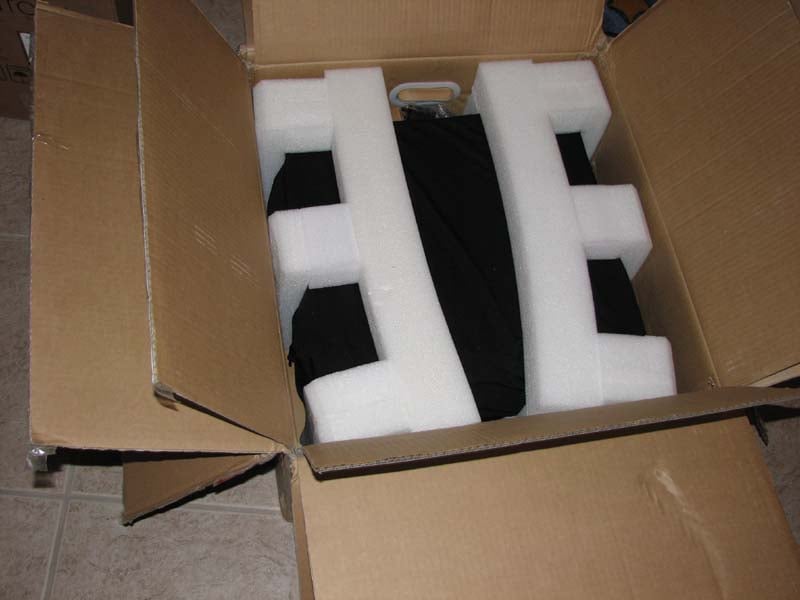 Normally I am
not one that shows pictures of product packaging in my reviews (in fact, I’ve
been known to make fun of this when my reviewers include them), but I must say,
I was quite taken by the very thorough packing job Emotiva did on these
products. Not only were the IPS-1 and
MMC-1 double boxed, but the inner box had thick stryofoam molded inserts to
ensure the products were safe and snug – a great preventative countermeasure
against the tyranny of the disgruntled shipping guy who is working overtime delivering
your heavy package late in the day.
Normally I am
not one that shows pictures of product packaging in my reviews (in fact, I’ve
been known to make fun of this when my reviewers include them), but I must say,
I was quite taken by the very thorough packing job Emotiva did on these
products. Not only were the IPS-1 and
MMC-1 double boxed, but the inner box had thick stryofoam molded inserts to
ensure the products were safe and snug – a great preventative countermeasure
against the tyranny of the disgruntled shipping guy who is working overtime delivering
your heavy package late in the day.
The IPS-1 was certainly a more manageable amplifier to move around and setup than the MPS-1. Weighing in at 80 lbs, roughly 33% less than the MPS-1, the IPS-1 was light enough for me to carry with one arm up my flight of steps to my reference theater room system.
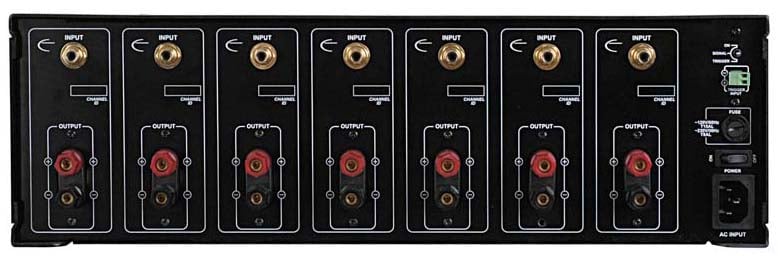
IPS-1 back panel view
The IPS-1 doesn’t have balanced inputs like its big brother, but I didn’t miss them since the MMC-1 didn’t have them either. The back panel layout was well marked and had a clean design, with plenty of space between speaker binding posts and line level inputs. The IPS-1 also sports a trigger system with a locking connector (supplied) which can support +12V logic or be triggered by a signal. I highly recommend using the +12V trigger if your receiver or processor also has one. This will save you the headache of accidentally frying a tweeter in one of your speakers if you happen to be fiddling with the line level connections and short them out while the unit is powered up. It will also prevent the occurrence of the amplifier turning off during quiet passages of the movie only to re-engage a second or two after the dialogue in the movie picks up.
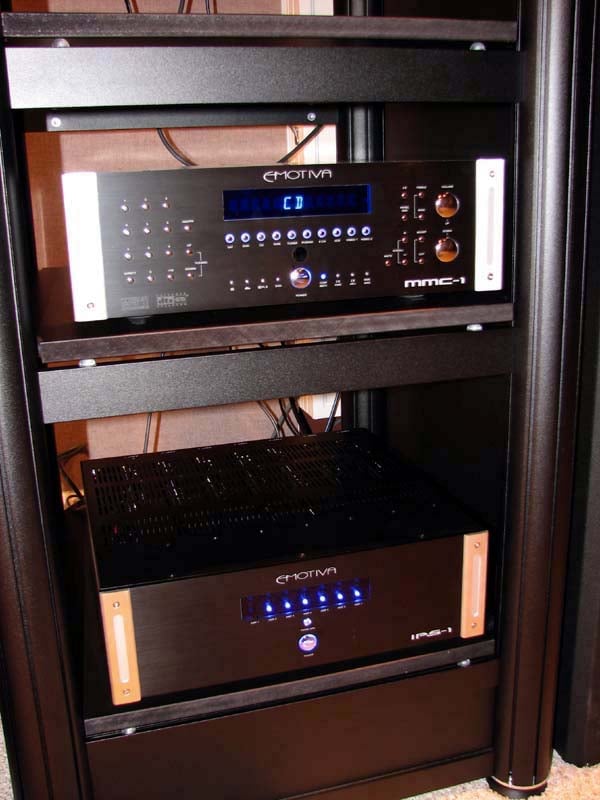 I placed the IPS-1 and MMC-1 on my new Crystal
rack from Audiav and sat in awe
at how impressive they looked once installed in this masterful rack. I had comments from many industry folks that walked in my
room and saw the Emotiva system powered on in my rack. They almost always asked about the cost and
were dumbfounded when showed them the MSRP.
“Surely they cant sound that good
at that price,” they’d say. I'd reply,
“Sit down for a listen… and don’t call me
Shirley.”
I placed the IPS-1 and MMC-1 on my new Crystal
rack from Audiav and sat in awe
at how impressive they looked once installed in this masterful rack. I had comments from many industry folks that walked in my
room and saw the Emotiva system powered on in my rack. They almost always asked about the cost and
were dumbfounded when showed them the MSRP.
“Surely they cant sound that good
at that price,” they’d say. I'd reply,
“Sit down for a listen… and don’t call me
Shirley.”
I connected the system up to my Denon DVD-5910CI and utilized a host of speakers under review as well as my own reference speaker system (RBH Sound T-30LSE and speaker package, Velodyne DD-15 subwoofer). All cables were furnished by Impact Acoustics (Sonicwave toslink) and Bluejeans Cable (10AWG speaker cable and analog interconnects).
I tested the IPS-1 in several scenarios including 7-channels for home theater, two-channels in various listening systems currently under review, and critical two-channel evaluations with my main speakers bi-amped. While the IPS-1 amplifier did exceedingly well in all testing scenarios, I found a special liking to the last scenario – bi-amping my RBH T-30LSE system. This created a rigorous testing condition since my reference speakers are rather power hungry, containing dual 10” subwoofers and dip down in the near 2-ohm area in the upper frequencies. Unlike our friends that utilize speakers that run into thermal compression at high power levels, I haven’t found an amp yet that can exercise the full dynamic capability of these speakers. Needless to say, I was quite floored by the IPS-1’s ability to effortlessly drive my speaker system to reference levels without faltering or sounding stringent. As a result, I focused most of my subjective evaluation on this setup which allowed me to be as critical as possible of the IPS-1’s sonic attributes.
Design Overview
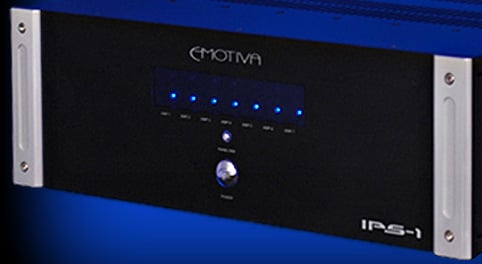 The Emotiva IPS-1 hosts many of the virtues of the
MPS-1 including the double-sided plate-through glass epoxy PCB boards with 2
ounce copper on all of the power sections and ground planes, as well as 1%
metal film resistors, 105 degree C-rated capacitors (a rarity for consumer
audio products at any price point). The
Reference Theater Series chassis construction is most impressive. Its no nonsense build quality gives the look
and feel of much costlier designs and certainly adds credence to pride of
ownership. The chassis is not your run
of the mill cheap thin steel found on most receivers. Instead, it's built solid
and is accented by silver metal vertical bars that dress up the amplifier nicely. Though, be careful as I found they do have
sharp edges - an issue I made Emotiva aware of and which they claim are
smoothing out in the next production run.
The Emotiva IPS-1 hosts many of the virtues of the
MPS-1 including the double-sided plate-through glass epoxy PCB boards with 2
ounce copper on all of the power sections and ground planes, as well as 1%
metal film resistors, 105 degree C-rated capacitors (a rarity for consumer
audio products at any price point). The
Reference Theater Series chassis construction is most impressive. Its no nonsense build quality gives the look
and feel of much costlier designs and certainly adds credence to pride of
ownership. The chassis is not your run
of the mill cheap thin steel found on most receivers. Instead, it's built solid
and is accented by silver metal vertical bars that dress up the amplifier nicely. Though, be careful as I found they do have
sharp edges - an issue I made Emotiva aware of and which they claim are
smoothing out in the next production run.
As with the Emotiva MPS-1, the IPS-1 displays channel status with LEDs which, when operating normally, will illuminate blue or will turn red during fault conditions. Gone, however, was the very thoughtful and costly soft clipping circuitry which was basically inactive in all but the most demanding operating conditions. The reason being is Emotiva fielded numerous calls from MPS-1 users whose listening habits bordered on sheer insanity managing to shut their amplifiers down using moderately efficient highly reactive 4-ohm tower speakers in large listening rooms. Because of this, Emotiva decisively removed the soft clipping circuit so these users could rejoice in the sonic bliss of speaker compression and constant amplifier clipping while they enjoy their compressed MP3 downloaded music from Napster.
Editorial Note on Amplifier Clipping
Once an amp runs out of headroom it enters a mode commonly referred to as “clipping”. When an amplifier clips it essentially sends a square wave response or DC voltage to the speaker which after only a few short cycles can fry the tweeters voice coil or burn out series inductors in the crossover sections.
IPS-1 Amplifier Design
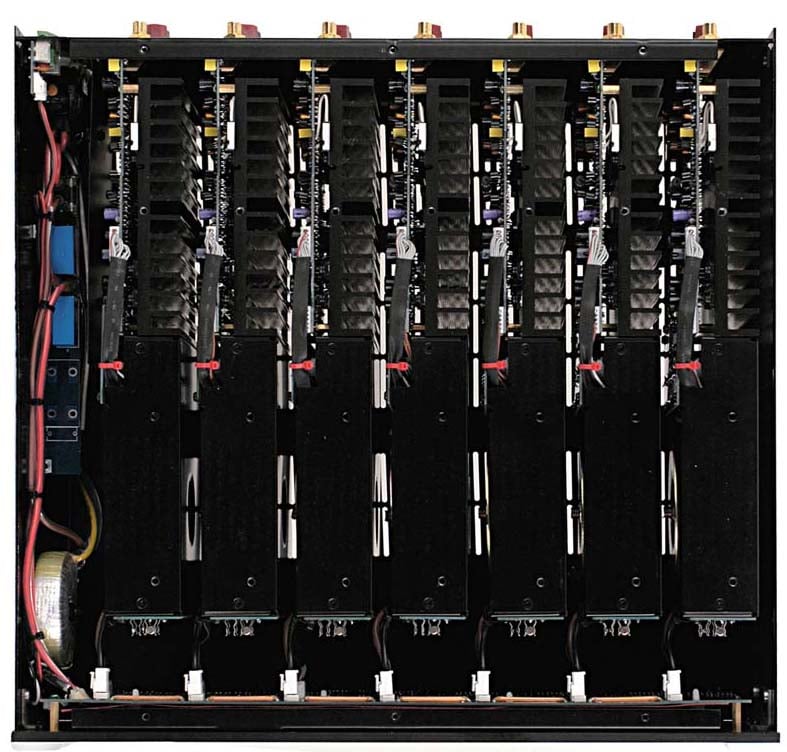
The IPS-1 utilizes a class H design. Similar to class G, but potentially more efficient, it modulates the power supply rail voltage just slightly higher than the output signal, keeping the voltage across the transistors small and the output transistors cool. This results in a very efficient and cool running design, commonly referred to as a ‘tracking amp’ because the power supply tracks the input voltage and supplies the correct output current. The modulating power supply rail voltage is created by similar circuitry that you would find in a simple power amplifier. In terms of complexity, this type of amplifier could be thought of as multiple power amplifiers driving a class AB amplifier and is therefore fairly complex and expensive to properly manufacture and execute.
The amp has four high current complementary output power BJTs per channel. Paralleling multiple BJTs is a good method of ensuring amplifier output impedance is low enough to deliver high current while driving low impedance loads. It’s also an effective way of minimizing frequency response variations which can occur when driving highly reactive speaker loads or exotic cabling.
One of the biggest advantages of the Class H amplifier topology employed in the IPS-1 is its much higher efficiency when compared to typical linear Class A/B amp designs.
The IPS-1
has multiple high voltage (50V) capacitors in series, yielding 100V, 6,800uF equivalent per
channel.
Individual
large 250VA toroidal transformers for each amplifier module ensures that this amp can drive 4-ohm loads with no
problems, while also providing excellent channel-to-channel crosstalk
immunization, especially at high power levels.
One of the biggest advantages of the Class H amplifier topology employed in the IPS-1 is its much higher efficiency when compared to typical linear Class A/B amp designs. Emotiva reports an efficiency in the high 60% range during normal music listening. Of course if you pegged the amp at full power with a sine wave test or constant clipping (think of our MP3 listener) like I did later in the review, the efficiency advantage of this multi rail design disappears and it becomes about the same efficiency of a traditional linear class AB design (40-50%).
Emotiva Reference Theater Series IPS-1 Listening Tests
CD: Dianne Reeves Never Too Far
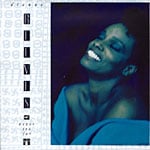 You may have noticed this CD pop up in several of my most
recent reviews. There is good reason for
my repetitiveness here. Many of the
tracks in this CD are an awesome test for a system's bass response and
accuracy. The bass track in Track #2 “Never
Too Far” will sound muddy on an improperly set up or mediocre system. I must have listened to this track 100 times
when tuning my reference system's subwoofers - all four of which run in mono,
cross over at 80Hz and are equalized through Audyssey MultEQ Pro. Turning off my two Velodyne DD-15 subs to do
a strict two-channel evaluation, I listened to the track again with only the
subs in my T30-LSE system handling the bass which were powered by the
Earthquake XJ-600R digital amplifiers. When I switched over to the IPS-1 in bi-amp
mode to power my T-30LSE system, I was awed by how much snappier and articulate
the upper bass response became. Some of
this was a result of me limiting the RBH subs' output to 80Hz, so I defeated
the Audyssey correction and bass management and redid the comparison. Overall I still felt the less powerful
Emotiva amp was driving the subs in my reference speakers more accurately than
the Earthquake digital amplifier. With
the IPS-1, the bass response was amazingly tight and retained excellent decay
properties I didn’t hear when running the subs on the digital amp setup.
You may have noticed this CD pop up in several of my most
recent reviews. There is good reason for
my repetitiveness here. Many of the
tracks in this CD are an awesome test for a system's bass response and
accuracy. The bass track in Track #2 “Never
Too Far” will sound muddy on an improperly set up or mediocre system. I must have listened to this track 100 times
when tuning my reference system's subwoofers - all four of which run in mono,
cross over at 80Hz and are equalized through Audyssey MultEQ Pro. Turning off my two Velodyne DD-15 subs to do
a strict two-channel evaluation, I listened to the track again with only the
subs in my T30-LSE system handling the bass which were powered by the
Earthquake XJ-600R digital amplifiers. When I switched over to the IPS-1 in bi-amp
mode to power my T-30LSE system, I was awed by how much snappier and articulate
the upper bass response became. Some of
this was a result of me limiting the RBH subs' output to 80Hz, so I defeated
the Audyssey correction and bass management and redid the comparison. Overall I still felt the less powerful
Emotiva amp was driving the subs in my reference speakers more accurately than
the Earthquake digital amplifier. With
the IPS-1, the bass response was amazingly tight and retained excellent decay
properties I didn’t hear when running the subs on the digital amp setup.
When I switched over to the IPS-1, I was awed by how much snappier and articulate the upper bass response became.
The tonal balance was slightly more forward on the IPS-1 then it was when the amps in my Denon AVR-5805 were powering the top end of my speakers but it wasn’t annoying or shrill sounding. I found the IPS-1 displayed excellent stereo separation portraying Dianne’s powerful vocals dead center as they should be. The drums had a nice pop to them while the saxophones exhibited a nice bite giving you that “live” feeling. The soundstage was very expansive making me feel the “never to far…" chants from the backing vocals where emanating from my side channels despite I was only listening in two-channel playback. The IPS-1 maintained a very clean composure even when driven to LOUDER than comfortable listening levels in my 6,000uF Auralex acoustically treated listening room sitting 15ft away from my speakers.
CD: Harry Connick – When Harry Met Sally
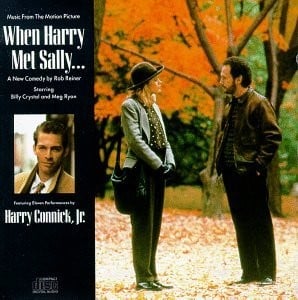 Track #2 “Love
is Here to Stay” sounded fabulous with the IPS-1 powering my speakers. The brass instruments had a very airy feel to
them while the cymbal hits were reproduced in a very 3-dimensional listening
plane. The IPS-1 conveyed a soundstage
several feet back from the plane of my reference speakers similar to the very
best amplification I have tested them with.
Track #2 “Love
is Here to Stay” sounded fabulous with the IPS-1 powering my speakers. The brass instruments had a very airy feel to
them while the cymbal hits were reproduced in a very 3-dimensional listening
plane. The IPS-1 conveyed a soundstage
several feet back from the plane of my reference speakers similar to the very
best amplification I have tested them with.
The IPS-1 reproduced a very distinct sound to the strings in the bass of Track #9 “Let’s Call the Whole Thing Off”. The piano sounded very real, containing all of the harmonics typically only heard in live un-amplified performances or reproduced on only the finest speaker systems in an acoustically neutral listening room powered by superb amplification. Near the end of this track was a solo between the bassist and drummer. The sound of the metal brush on the cymbals buttressed by the bass notes was so real sounding, it was scary. Closing my eyes, I felt as if I were in a small jazz bar listening to the real deal. Imagine that, Harry was right there performing just for me – very cool.
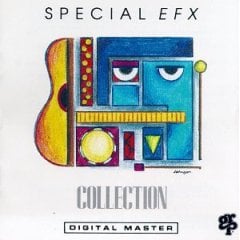 Track #2 “Jamaica Jamaica” revealed that the IPS-1
was reproducing its excellent stereo imaging characteristics. Bass was tight and well-extended. It was obvious to me that, despite the rather
modest power ratings bestowed upon the IPS-1, it liked to be driven hard. No matter how I tried to abuse this
amplifier, it never sounded ragged as some amplifiers of this design class and
budget I have heard. Track #6 “Ballering” guitarist
Chieli Minucci really demonstrates what a fabulous guitarist he is. All of
the great percussion work of George Jinda strumming alongside with Chieli was
both a sonic delight and musical marvel.
Come to think of it, while my intentions where only to sample a few
songs on this CD to test out the IPS-1, I found about an hour later, I had nearly
listened to the whole disc.
Track #2 “Jamaica Jamaica” revealed that the IPS-1
was reproducing its excellent stereo imaging characteristics. Bass was tight and well-extended. It was obvious to me that, despite the rather
modest power ratings bestowed upon the IPS-1, it liked to be driven hard. No matter how I tried to abuse this
amplifier, it never sounded ragged as some amplifiers of this design class and
budget I have heard. Track #6 “Ballering” guitarist
Chieli Minucci really demonstrates what a fabulous guitarist he is. All of
the great percussion work of George Jinda strumming alongside with Chieli was
both a sonic delight and musical marvel.
Come to think of it, while my intentions where only to sample a few
songs on this CD to test out the IPS-1, I found about an hour later, I had nearly
listened to the whole disc.
SACD: Patricia Barber – Modern Cool
 What good is critical music evaluation without
testing out some high resolution source material such as one of my trusty
Patricia Barber SACDs? Modern Cool is a superb sounding SACD
that in my opinion every jazz lover should add to their collection. Track #7 “Company” is a reference track I use
to separate REAL speakers from wimpy
ones. The same can be said with upstream
electronics, particularly amplification.
When listening to this track, I closed my eyes to attempt to place where
all of the instruments were coming from.
The trumpets were dead center (thanks to the magnificent imaging
capabilities of my reference speakers).
They came at you crystal clear with a bit more of a bite to them then I
recalled using the amplifiers in my Denon AVR-5805. The snare drums had plenty of snap to them
and seemed to be emanating around and behind the speakers. Cymbal crashes were effortless and well delineated. Listening to the drum solo and twanging of
the bass with my eyes closed gave me that “better
than being there” experience placing me right in front of the drum kit in a
cozy jazz cellar. All I was missing was
a brandy Sniffer and a fine Cuban (cigar that is). The IPS-1 had no problems being pushed hard
on this song and the dual 10”s in my RBH T-30LSE’s loved the workout.
What good is critical music evaluation without
testing out some high resolution source material such as one of my trusty
Patricia Barber SACDs? Modern Cool is a superb sounding SACD
that in my opinion every jazz lover should add to their collection. Track #7 “Company” is a reference track I use
to separate REAL speakers from wimpy
ones. The same can be said with upstream
electronics, particularly amplification.
When listening to this track, I closed my eyes to attempt to place where
all of the instruments were coming from.
The trumpets were dead center (thanks to the magnificent imaging
capabilities of my reference speakers).
They came at you crystal clear with a bit more of a bite to them then I
recalled using the amplifiers in my Denon AVR-5805. The snare drums had plenty of snap to them
and seemed to be emanating around and behind the speakers. Cymbal crashes were effortless and well delineated. Listening to the drum solo and twanging of
the bass with my eyes closed gave me that “better
than being there” experience placing me right in front of the drum kit in a
cozy jazz cellar. All I was missing was
a brandy Sniffer and a fine Cuban (cigar that is). The IPS-1 had no problems being pushed hard
on this song and the dual 10”s in my RBH T-30LSE’s loved the workout.
Emotvia Reference Theater Series IPS-1 Measurements & Analysis
I did some quick spot-checking on the IPS-1 amplifier gain structure to ensure it could be properly driven with a wide assortment of preamps or receivers. My personal criteria for amplifier gain structure is that it should be able to hit full power when driven with 2Vrms. The IPS-1 fell well within this criteria.
Amplifier Power & Efficiency
Due to the inherent multi rail switching scheme of the IPS-1, my efficiency measurements are much lower than actual for this amplifier design since I use continuous sine wave testing. My measurements indicated how efficient the amp is when driven continuously at full power (0.1% THD + N), hence when the amplifier is operating in linear A/B mode. During normal music listening, expect to see around 65-67% efficiency which is about the best you can get from a linear amplifier design.
| # of CH | Power Consumption | Power Delivered | Load | Efficiency |
| 1 | 288 watts | 146 watts | 8 ohms | 51 % |
| 1 | 409 watts | 188 watts | 4 ohms | 46 % |
| 2 | 504 watts | 142 x 2 watts | 8 ohms | 56 % |
As you can see, I measured the IPS-1 to deliver about 145wpc into 8-ohms and 188 watts into 4-ohms at 0.1% THD + N using my APC S-15 and SBATT to ensure the line stayed at 120V +- 2V. Keep in mind most review publications test at clipping and don’t do continuous power measurements so our power numbers are usually a lot more conservative than what you typically find from other reviewers.
For more info, see: The All Channels Driven (ACD) Test
The Emotiva website specs this amp as a 150 / 200 wpc (8/4 ohm; respectively) amplifier but upon further inspection, I have come to realize their power ratings are based on a 1% THD + N rating which explains why I measured less.
I asked Emotiva to furnish their power measurements at a constant 0.1% THD + N fidelity firewall to see if their ratings jived with my findings.
Emotiva Power Measurements
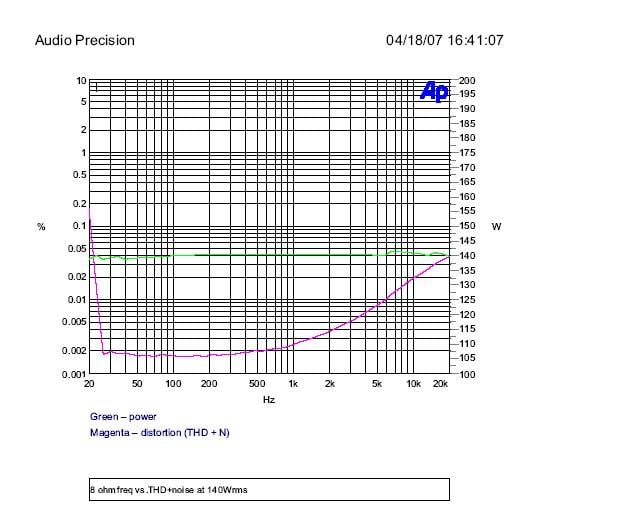
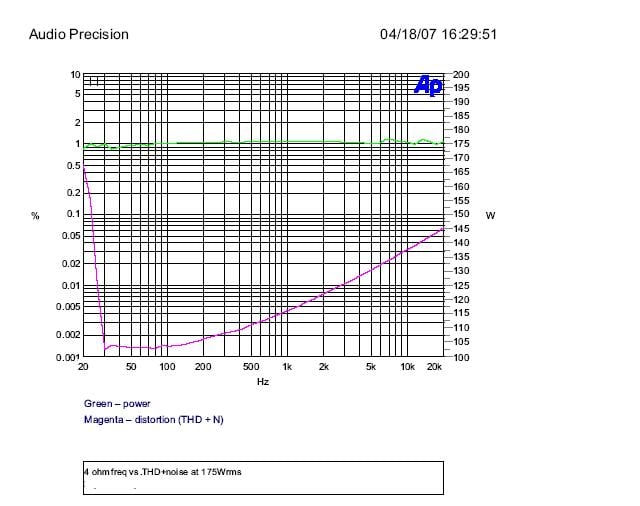
Figure 1. Emotiva Power Measurements vs 0.1% THD + N
As you can see, the true continuous power rating of this amplifier (Audioholics style at least) is 140wpc into 8-ohms and 175wpc into 4-ohms at 0.1% THD + N. Their data is very consistent with my own, except I actually measured a tad more power into a 4-ohm load.
Frequency Response
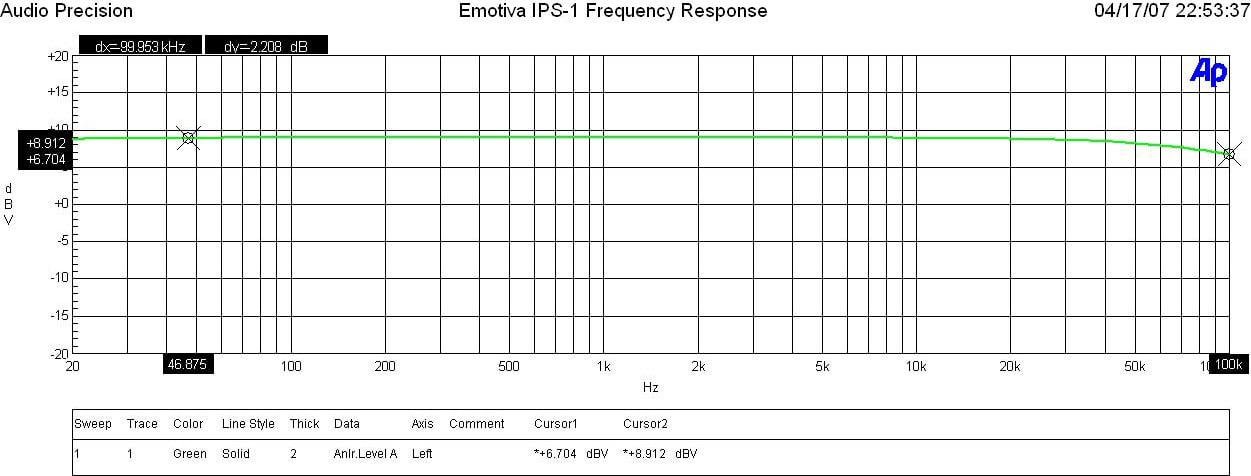
Figure 2. IPS-1 Frequency Response
The frequency response was smooth and extended to a -3dB point of 125kHz.
FFT Distortion Analysis
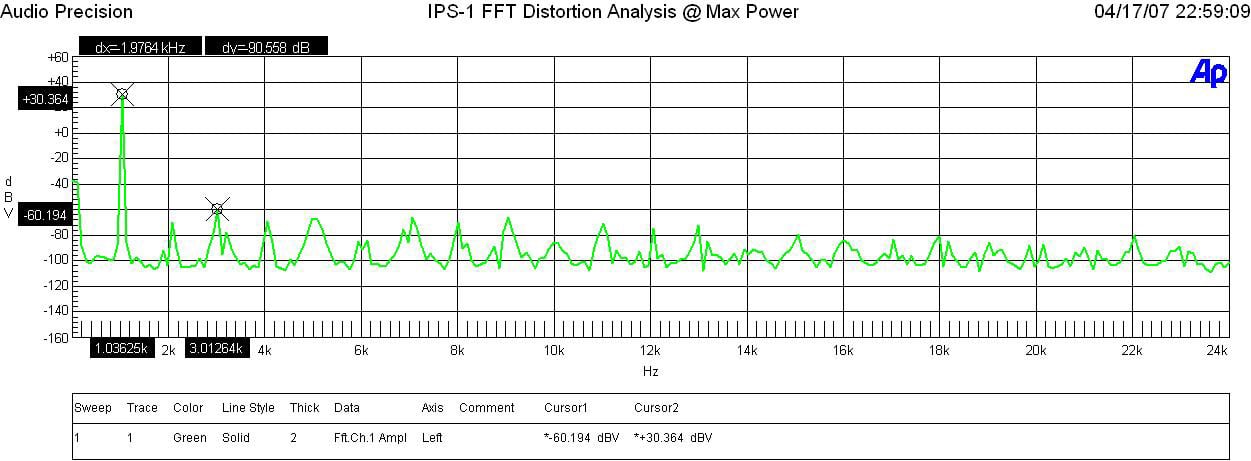
Figure 3. FFT Distortion Analysis at Full Power
At near full rated power (140wpc) into 8-ohms, the IPS-1 exhibited impressively low distortion (30.364+60.194)dBv = 90.6dBv or 100*alog^-1(-99.2/20) = 0.003% This figure is even lower than what I measured on the MPS-1 (.008%) under similar load conditions. I suspect the removal of the soft clipping circuit has paid dividends in this regard (lower noise floor, lower distortion).
As many amps approach their full power rating, their power supplies tend to run out of gas and show large harmonic nasties of the fundamental test tone. This was not the case with the IPS-1 and perhaps one of many indications as to why this amp maintains excellent composure at high power levels and sounds more powerful than it really is.
Output Impedance and Damping Factor
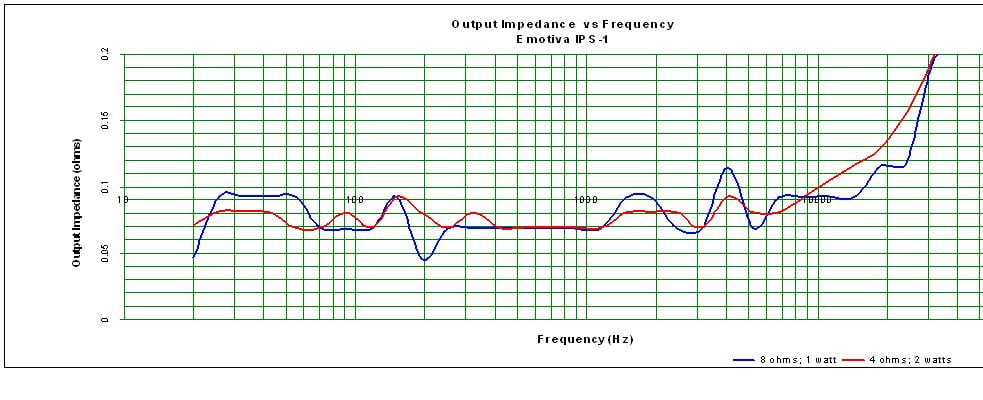
Figure 4. Amplifier Output Impedance vs Frequency
Amplifier output impedance when the IPS-1 was driving an 8-ohm load at 1 watt was below 100 mohm for almost the entire audio bandwidth with a gradual rise above 20kHz. We like to see amplifier maintain 150 mohm output impedance or less so that it will sound consistently good for a larger variety of speaker and cable loads with rather complex impedance profiles. This is a very good measurement and one of the primary design attributes as to why I felt the transient bass response of this amplifier was excellent, rivaling my more powerful digital subwoofer amplifiers I am currently using to power the subs in my reference speakers.
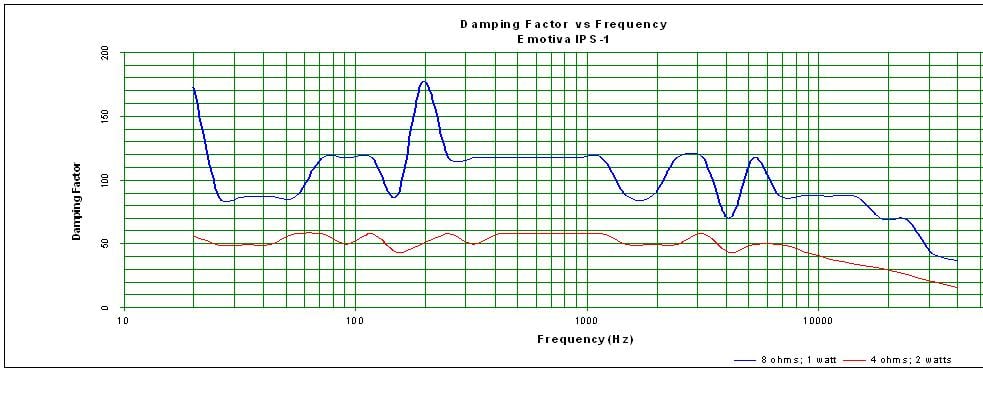
Figure 5. Amplifier Damping Factor vs Frequency
Again the
IPS-1 did NOT disappoint. An amplifier
with a low output impedance will also maintain excellent damping
characteristics since these are related metrics. The IPS-1 maintained a damping factor of
around 100 for 8 ohm loads and ½ that as expected for 4-ohm loads. This fell right within our benchmark
criteria.
Signal to Noise Ratio (SNR) Measurements
The IPS-1 maintained very good SNR performance (about 2dB better than the MPS-1). SNR @ 1 watt: 127mVin / 1 watt out was 75.7dB unweighted or 83dB using 40kHz SPCL filter in my AP. Normally, I’d like to see an amplifier measure below 80dB at 1 watt unweighted, but I never found the IPS-1’s noise floor to stand out during critical music listening, or just idling by.
Emotiva Reference Theater Series IPS-1 Conclusion
 The Emotiva
IPS-1 7CH amplifier has proven to be a solid performer. It’s a cool running amplifier that doesn’t
need a great deal of ventilation under most operating conditions, making it
ideal for shelf or rack installations.
This amplifier can be utilized with moderately efficient 8- or 4-ohm
speakers and will likely drive them with more composure and grace than
comparably priced receivers and certainly as good as any dedicated multi-channel
amplifier in this price class. In fact,
one of its closest competitors, its own big brother the MPS-1, is very similar
in design to the IPS-1 but has more power and completely independent card based
modules and sells for mere $500 more, but I actually think I prefer the
cheaper, less powerful IPS-1! The IPS-1
is in a more manageable form factor making it easier to transport and
setup. The IPS-1 has about a 2dB lower
noise floor than the MPS-1 thanks to the absence of a limiter circuit. You can also beat the snot out of it without
fear of the amplifier shutting down. I felt both amplifiers sounded much LARGER
than they measured or their price tag indicated and believe either unit would serve
as an excellent power center for all but the largest scale home theater
installations.
The Emotiva
IPS-1 7CH amplifier has proven to be a solid performer. It’s a cool running amplifier that doesn’t
need a great deal of ventilation under most operating conditions, making it
ideal for shelf or rack installations.
This amplifier can be utilized with moderately efficient 8- or 4-ohm
speakers and will likely drive them with more composure and grace than
comparably priced receivers and certainly as good as any dedicated multi-channel
amplifier in this price class. In fact,
one of its closest competitors, its own big brother the MPS-1, is very similar
in design to the IPS-1 but has more power and completely independent card based
modules and sells for mere $500 more, but I actually think I prefer the
cheaper, less powerful IPS-1! The IPS-1
is in a more manageable form factor making it easier to transport and
setup. The IPS-1 has about a 2dB lower
noise floor than the MPS-1 thanks to the absence of a limiter circuit. You can also beat the snot out of it without
fear of the amplifier shutting down. I felt both amplifiers sounded much LARGER
than they measured or their price tag indicated and believe either unit would serve
as an excellent power center for all but the largest scale home theater
installations.
I felt the IPS-1 sounded much larger than it measured....
From its excellent sonic characteristics, to its no-nonsense build quality, fit and finish, Emotiva has once again demonstrated via the IPS-1 that you don’t have to break the bank to get quality electronics that rival many of the more well known brands at a fraction of the cost. If you’re looking for a solid sub-$2k multi-channel amplifier for bi-amplifying your stereo speakers, or for powering your sophisticated 7.1 channel home theater that won’t falter on tough power demands, save $800 bucks and buy the Emotiva IPS-1. Your ears and your wallet with certainly thank you.
The Score Card
The scoring below is based on each piece of equipment doing the duty it is designed for. The numbers are weighed heavily with respect to the individual cost of each unit, thus giving a rating roughly equal to:
Performance × Price Factor/Value = Rating
Audioholics.com note: The ratings indicated below are based on subjective listening and objective testing of the product in question. The rating scale is based on performance/value ratio. If you notice better performing products in future reviews that have lower numbers in certain areas, be aware that the value factor is most likely the culprit. Other Audioholics reviewers may rate products solely based on performance, and each reviewer has his/her own system for ratings.
Audioholics Rating Scale
 — Excellent
- — Very Good
- — Good
- — Fair
- — Poor
| Metric | Rating |
|---|---|
| Frequency Response Linearity | |
| SNR | |
| Output Impedance | |
| Measured Power (8-ohms) | |
| Measured Power (4-ohms) | |
| Multi-channel Audio Performance | |
| Build Quality | |
| Fit and Finish | |
| Ergonomics & Usability | |
| Features | |
| Performance |  |
| Value | |
Gene manages this organization, establishes relations with manufacturers and keeps Audioholics a well oiled machine. His goal is to educate about home theater and develop more standards in the industry to eliminate consumer confusion clouded by industry snake oil.
View full profile Subscribe to our newsletter