


Axiom Audio A1400-8 Digital Multi-Channel Amplifier Review
- Product Name: Axiom Audio A1400-8 Digital Multi-Channel Amplifier
- Manufacturer: Axiom Audio
- Performance Rating:

- Value Rating:

- Review Date: April 14, 2009 21:40
- MSRP: $ 3,850 (amp discontinued due to reliability issues)
-
Amplifier Type: Class D
Power (1 channel driven)
-
8 ohms - 350 watts
-
4 ohms - 700 watts
-
2 ohms - 1,200 watts
Power (1 channel full and6 channels at 1/8 power)
-
8 ohms - 350 watts per channel
-
4 ohms - 700 watts per channel
-
2 ohms - 800 watts per channel
Power (7 channels driven)
-
All impedances - 200 watts per channel
-
H x W x D (inches) = 4 x 18 x 17.5
-
Weight: 58lbs
-
Capacitance - 140,000 microfarads
-
Warranty: 5 Years
Pros
- A true powerhouse with sonic chops to match
- Superb bass response that rivals competitor linear amp designs
- A true space saver
- Energy efficient
Cons
- Susceptible to ground loops via unbalanced connections
- Easier than most amplifiers to blow out/damage due to negligence
- Too wide for standard 17” rack mounts
Axiom Audio A1400-8 Introduction
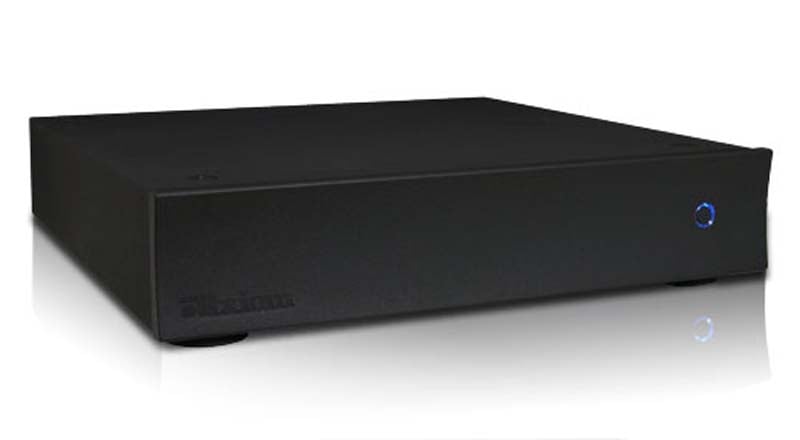 Technological progress is a wonderful thing. Over the past 40 years or so, we’ve seen
computers that filled an entire room get eclipsed in processing power by ones
that can fit in your wristwatch though I’d never admit to wearing one. Thanks to Bell Labs and the invention of the
transistor, this and more has become a reality and the reason why today we can
get such powerful and reliable amplification. By contrast, years ago 30
watts/channel meant large bulky tube
amps that generated lots of heat and often required constant upkeep. For the last couple of decades, solid-state
amplifier technology has been pushed to its technological limit. Incredible sound and reliable operation are
all hallmarks of the very best designs.
However, the problem of bulkiness remains, and they generate lots of
heat. Class D amplifiers have been
working their way into the consumer marketplace to address these issues. The promised advantage is up to 95%
efficiency (at full power), and thus less heat generation, and a smaller
footprint. Until recently, Class D amps
were used almost exclusively for powered subwoofers and car audio because they
were best suited for low-frequency and non-critical audio applications. A lot has changed since the introduction of
these amps. With the very same silicon advances we observed in the computer
industry, we are seeing a similar trend now for audio. We’ve tested numerous Class D amplifier
designs that have achieved mixed results both sonically and objectively. But Axiom claims their Class D amp is of a
different breed. What makes the Axiom
Class D amp any different and will it be able to sit aside the very best linear
amplifiers? Continue reading to find
out….
Technological progress is a wonderful thing. Over the past 40 years or so, we’ve seen
computers that filled an entire room get eclipsed in processing power by ones
that can fit in your wristwatch though I’d never admit to wearing one. Thanks to Bell Labs and the invention of the
transistor, this and more has become a reality and the reason why today we can
get such powerful and reliable amplification. By contrast, years ago 30
watts/channel meant large bulky tube
amps that generated lots of heat and often required constant upkeep. For the last couple of decades, solid-state
amplifier technology has been pushed to its technological limit. Incredible sound and reliable operation are
all hallmarks of the very best designs.
However, the problem of bulkiness remains, and they generate lots of
heat. Class D amplifiers have been
working their way into the consumer marketplace to address these issues. The promised advantage is up to 95%
efficiency (at full power), and thus less heat generation, and a smaller
footprint. Until recently, Class D amps
were used almost exclusively for powered subwoofers and car audio because they
were best suited for low-frequency and non-critical audio applications. A lot has changed since the introduction of
these amps. With the very same silicon advances we observed in the computer
industry, we are seeing a similar trend now for audio. We’ve tested numerous Class D amplifier
designs that have achieved mixed results both sonically and objectively. But Axiom claims their Class D amp is of a
different breed. What makes the Axiom
Class D amp any different and will it be able to sit aside the very best linear
amplifiers? Continue reading to find
out….
Design Overview
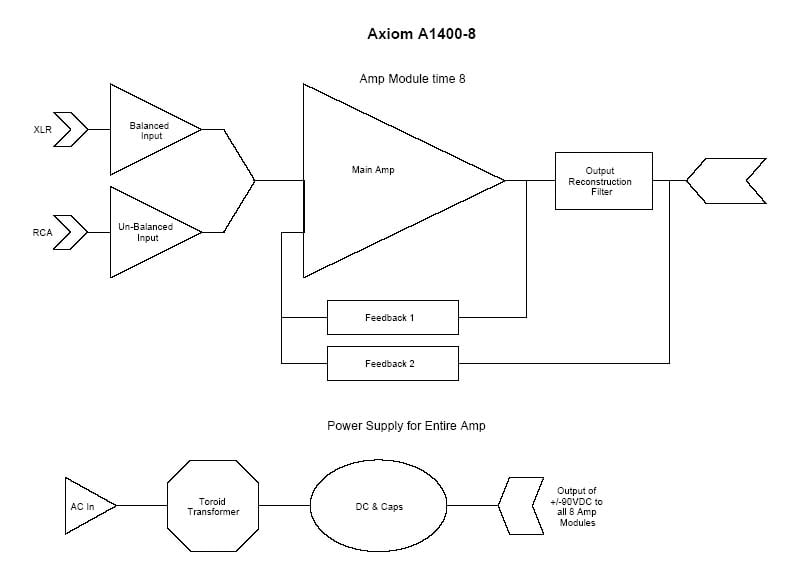 The Axiom A1400-8 is a Class D switching
amplifier. But it’s not your typical run
of the mill digital design. Most
companies simply repackage the B&O ICE module with a switching power supply
and call it a day. While this approach can
certainly offer respectably good amplification for low cost, it does have design
compromises that Axiom felt were too great to put their name on. The A1400-8 is Axiom’s very own proprietary
design. It switches at a much higher
frequency than most other switching amps, which in this case is between 450kHz
– 500kHz. Switching higher in frequency
like this allows the clocking transients to be far outside of the audible
range. The feedback topology on the
A1400-8 is also very different than most other designs. The A1400-8 uses a dual
feedback loop as can be seen in the block diagram: One very low for wideband
audio frequencies and one that is rather high from 2Hz to DC to minimize DC
offset dynamically. This allows the speakers to reach their full x-max or
excursion, which eliminates Doppler distortion due to the DC shifts of the
amplifier. Getting the feedback right on
these types of amplifiers is very critical. Few companies have the math skills
and/or resources to really implement this correctly. We’ve seen Class D designs with no local
feedback at all, which lead to a very high output impedance (approaching 1 ohm)
within the entire audio band causing the amp to sound drastically different
depending on the loudspeaker it was driving.
The A1400 uses state of the art power
devices from a company called International Rectifier that were specifically
designed for audio applications. The driver IC has zero over-shoot or
under-shoot at the full clock frequency. The output devices are especially designed
for very low gate capacitance that allows them to switch very accurately and
quickly follow the musical input in its most intricate nuances.
The Axiom A1400-8 is a Class D switching
amplifier. But it’s not your typical run
of the mill digital design. Most
companies simply repackage the B&O ICE module with a switching power supply
and call it a day. While this approach can
certainly offer respectably good amplification for low cost, it does have design
compromises that Axiom felt were too great to put their name on. The A1400-8 is Axiom’s very own proprietary
design. It switches at a much higher
frequency than most other switching amps, which in this case is between 450kHz
– 500kHz. Switching higher in frequency
like this allows the clocking transients to be far outside of the audible
range. The feedback topology on the
A1400-8 is also very different than most other designs. The A1400-8 uses a dual
feedback loop as can be seen in the block diagram: One very low for wideband
audio frequencies and one that is rather high from 2Hz to DC to minimize DC
offset dynamically. This allows the speakers to reach their full x-max or
excursion, which eliminates Doppler distortion due to the DC shifts of the
amplifier. Getting the feedback right on
these types of amplifiers is very critical. Few companies have the math skills
and/or resources to really implement this correctly. We’ve seen Class D designs with no local
feedback at all, which lead to a very high output impedance (approaching 1 ohm)
within the entire audio band causing the amp to sound drastically different
depending on the loudspeaker it was driving.
The A1400 uses state of the art power
devices from a company called International Rectifier that were specifically
designed for audio applications. The driver IC has zero over-shoot or
under-shoot at the full clock frequency. The output devices are especially designed
for very low gate capacitance that allows them to switch very accurately and
quickly follow the musical input in its most intricate nuances.
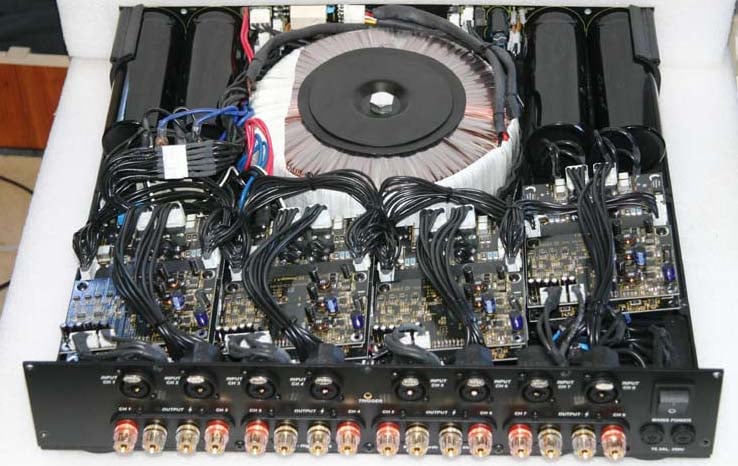 The A1400-8 chassis is die cast aluminum instead of cheap stamped steel typically found on most A/V receivers
and budget amplifiers. This rugged and strong chassis translates into a more
stable platform for the electronics, which reduces mechanical vibrations and
increases longevity while also allowing heat to pass through it more efficiently. The A1400-8 power
supply is a linear topology similar to what is used on very high power class
A/B amplifiers. Axiom chose to go with a
linear design instead of an SMPS
(switch mode) power supply to ensure greater dynamic headroom and sustainable
power levels that could be achieved with very low noise residuals. It was designed with a very high current,
high voltage specially wound toroidal transformer. The power supply capacitors
are all 105°C 100WVDC caps. Their total capacitance is over 148,000uF meaning
the reserve energy charge (Coulombs) is more than enough for any demanding
music or movie listening experience. The power supply of the A1400-8 is also
designed to act as a line conditioner as well as a line filter. This eliminates
the added expense of a separate line-conditioning box.
The A1400-8 chassis is die cast aluminum instead of cheap stamped steel typically found on most A/V receivers
and budget amplifiers. This rugged and strong chassis translates into a more
stable platform for the electronics, which reduces mechanical vibrations and
increases longevity while also allowing heat to pass through it more efficiently. The A1400-8 power
supply is a linear topology similar to what is used on very high power class
A/B amplifiers. Axiom chose to go with a
linear design instead of an SMPS
(switch mode) power supply to ensure greater dynamic headroom and sustainable
power levels that could be achieved with very low noise residuals. It was designed with a very high current,
high voltage specially wound toroidal transformer. The power supply capacitors
are all 105°C 100WVDC caps. Their total capacitance is over 148,000uF meaning
the reserve energy charge (Coulombs) is more than enough for any demanding
music or movie listening experience. The power supply of the A1400-8 is also
designed to act as a line conditioner as well as a line filter. This eliminates
the added expense of a separate line-conditioning box.
Editorial Note about PWM Class D Amplification & the Low Pass Filter (LPF)
The most common modulation technique used in Class-D is called PWM (Pulse Width Modulation) - a square wave is produced that has a fixed frequency. The PWM signal contains harmonics of the switching frequency along with a copy of the input signal. A power low-pass LC passive filter is used to remove the unwanted harmonic components. The output filter helps maintain efficiency and also suppresses RF interference produced by the fast output transitions. Getting this filter right is imperative for a good Class D amplifier design to ensure the amplifier will sound good regardless of what loudspeaker impedance is presented.
Axiom Audio A1400-8 Setup
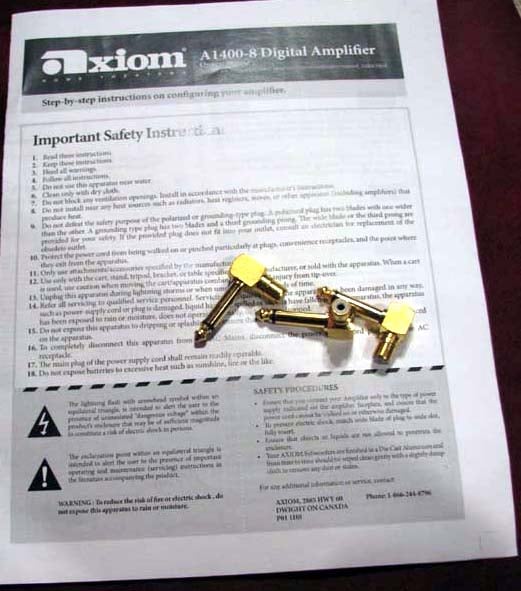 Moving the Axiom
A1400-8 amp around my test bench and home theater rack proved much easier than
the typical power amplifier I review.
Despite its enormous power supply and bodacious output capability, it’s
a lightweight on the scale, barely hitting 60lbs. This is just the way I like
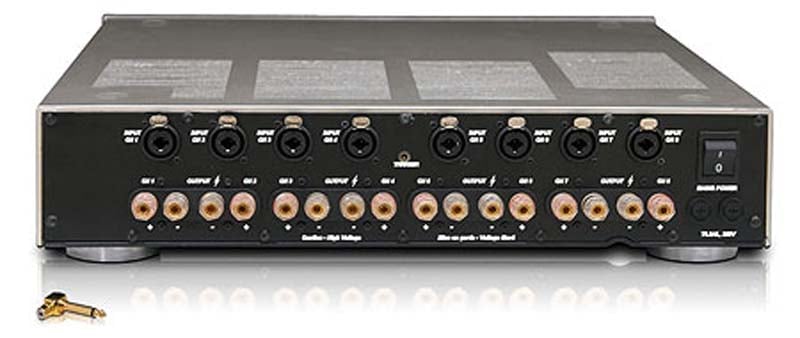
electronics to be given my numerous back issues caused by years of abusive weight training and lifting heavy Class A/V amplifiers. The one unusual thing you will find about
this amp is the absence of unbalanced connectors. When I first heard about this, I thought to
myself, are they kidding? Nope they
weren’t. In order to minimize chassis
height, they went with all balanced connectors and included gold-plated
straight and right angled unbalanced phono and RCA mating connectors. I’ve never seen this approach before with
consumer gear but I liked it. I tested
both the balanced locking connectors and the RCA mating connectors and they fit
nice and snug. The speaker binding posts
are a bit cramped in the chassis but luckily each adjacent-channel pair speaker connector is the ground side to
prevent arcing or shorting.
Moving the Axiom
A1400-8 amp around my test bench and home theater rack proved much easier than
the typical power amplifier I review.
Despite its enormous power supply and bodacious output capability, it’s
a lightweight on the scale, barely hitting 60lbs. This is just the way I like
electronics to be given my numerous back issues caused by years of abusive weight training and lifting heavy Class A/V amplifiers. The one unusual thing you will find about
this amp is the absence of unbalanced connectors. When I first heard about this, I thought to
myself, are they kidding? Nope they
weren’t. In order to minimize chassis
height, they went with all balanced connectors and included gold-plated
straight and right angled unbalanced phono and RCA mating connectors. I’ve never seen this approach before with
consumer gear but I liked it. I tested
both the balanced locking connectors and the RCA mating connectors and they fit
nice and snug. The speaker binding posts
are a bit cramped in the chassis but luckily each adjacent-channel pair speaker connector is the ground side to
prevent arcing or shorting.
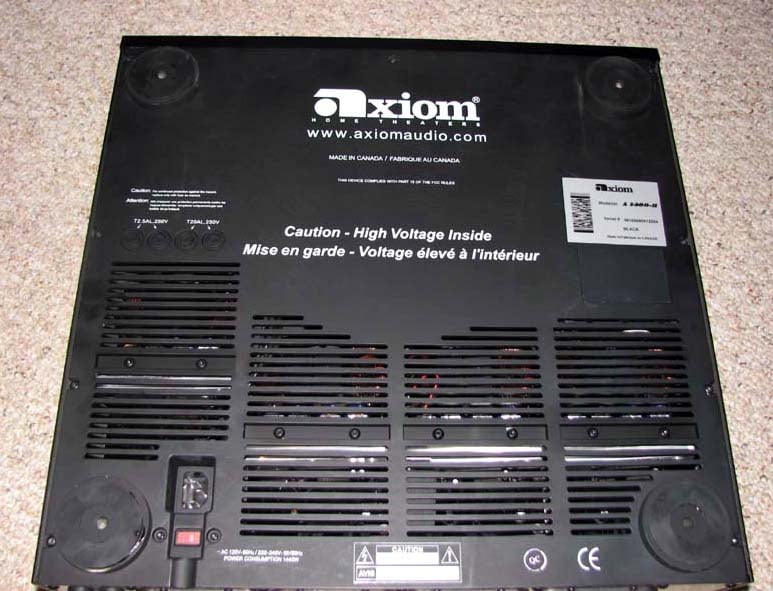
Speaking of shorting, I’ve never seen so many warning labels slapped onto an amplifier before. There are numerous shock hazard logos and high voltage notifications placed on the amp chassis and user manual and they made it exceedingly hard to remove the top chassis cover to get a peek inside. Considering that the power supply working voltage is very close to the rated wall voltage and this sucker is capable of dumping all of that current into any given channel at a time, I certainly understand their cautionary notes and encourage all users to heed their warnings.
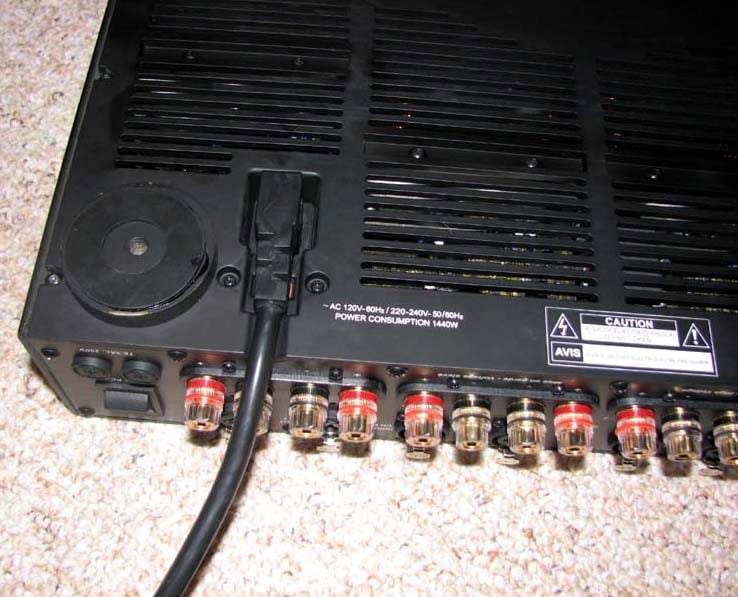 The power receptacle is located at the bottom of the chassis making
this amp difficult to rack mount (more on this later) and the unit comes with a
6-ft 14AWG 3-prong power cord. The
master switch is located on the back panel and the amp has trigger capability
via a mini plug. The trigger worked
correctly only when the front panel standby button was depressed as stated in
step 6 of the slim but useful user manual.
The power receptacle is located at the bottom of the chassis making
this amp difficult to rack mount (more on this later) and the unit comes with a
6-ft 14AWG 3-prong power cord. The
master switch is located on the back panel and the amp has trigger capability
via a mini plug. The trigger worked
correctly only when the front panel standby button was depressed as stated in
step 6 of the slim but useful user manual.
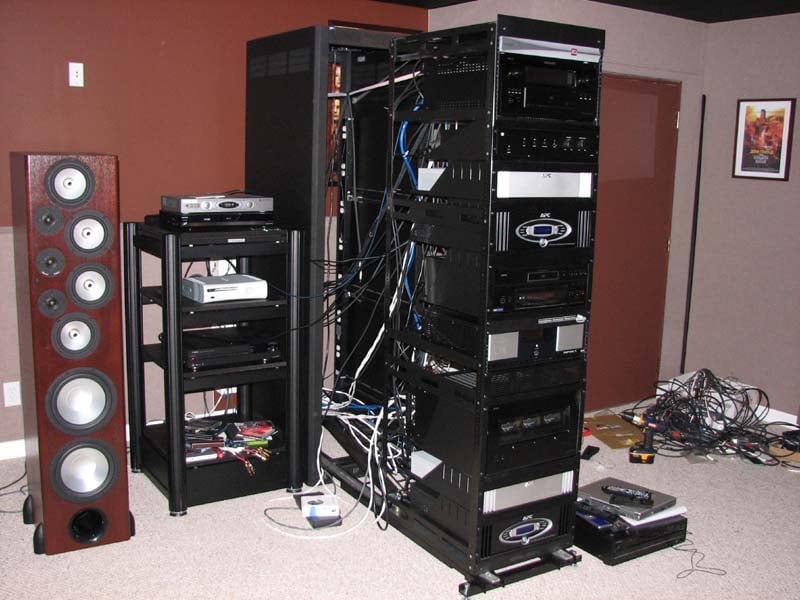
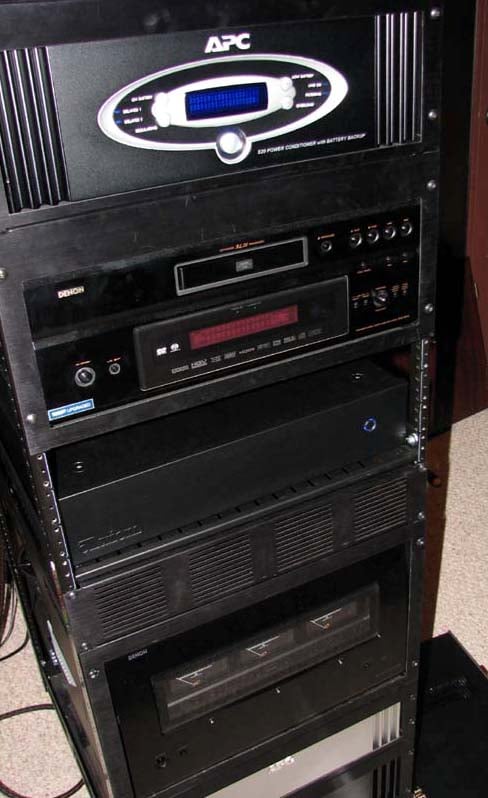
I placed the A1400-8 on my esoteric Audiav Crystal Series C4 AV Rack and connected it up with Kimber 8PR speaker cable, Sonicwave balanced cables and Blue Jeans 1694A composite RCA cables when conducting unbalanced tests. I used my Denon AVP-A1HDCI and Denon AVR-5805mkII as the preamps, the Denon DVD-5910CI and Yamaha MCX-2000 as the sources. The A1400-8 was powered by my APC S20 power conditioner that had no troubles at all powering this amplifier even with its enormous inrush current draw during power up. Axiom recommends NOT plugging this amp into a power conditioner, which for 90% of the ones on the market, I’d tend to agree with, the APC S20 being one of the few exceptions. I utilized my RBH Signature T30-LSE reference series speaker system and threw in my Status Acoustics Decimo bookshelf speakers for comparative purposes.
Axiom Audio A1400-8 Listening Tests
 All of my direct listening comparisons between the A1400-8
and my much more expensive Denon POA-A1HDCI amplifier (MSRP: $7500) was with
the latter being configured into bridged mode.
This put the Denon amplifier on near equal power footing with the
A1400-8. The preamp gain was adjusted
-4dB when listening to the Axiom amp for proper level matching. On average it took me about 20 seconds to
swap the cables and level match when doing direct comparisons between the two
amplifiers making it a very difficult task to point out the subjective
differences I was hearing since both amplifiers exhibited exemplary
fidelity. Listening comparisons between
the Denon and Axiom amps were not done for multi-channel
due to the complexity of changing cables and level matching and the fact that
it’s easier to discern sonic differences in stereo as opposed to multi-channel. This
is especially true since both amplifiers have huge power supplies and are fully
capable of hitting reference levels in my theater room without sacrificing
performance whether powering two or
all seven speakers.
All of my direct listening comparisons between the A1400-8
and my much more expensive Denon POA-A1HDCI amplifier (MSRP: $7500) was with
the latter being configured into bridged mode.
This put the Denon amplifier on near equal power footing with the
A1400-8. The preamp gain was adjusted
-4dB when listening to the Axiom amp for proper level matching. On average it took me about 20 seconds to
swap the cables and level match when doing direct comparisons between the two
amplifiers making it a very difficult task to point out the subjective
differences I was hearing since both amplifiers exhibited exemplary
fidelity. Listening comparisons between
the Denon and Axiom amps were not done for multi-channel
due to the complexity of changing cables and level matching and the fact that
it’s easier to discern sonic differences in stereo as opposed to multi-channel. This
is especially true since both amplifiers have huge power supplies and are fully
capable of hitting reference levels in my theater room without sacrificing
performance whether powering two or
all seven speakers.
Critical listening tests were conducted mostly with two-channel sources such as CDs and SACDs. Multi-channel listening tests were conducted for extended periods of time at reference levels to ensure the amplifier was capable of unfaltering sustained output in my theater room.
CD: Fourplay – The Best Of Fourplay
I always
like a little Fourplay before really getting into the thick of things. Track #5 “The Chant” is a song I often use to
separate the men from the boys in loudspeakers.
The bass energy of the kick drums will either reward you with an
adrenaline surge or have you covering
your ears from the horrible sound of woofer bottoming just before it plays for
the very last time. Of course this isn’t
a problem for my reference speakers but I wanted to see just how far the
A1400-8 could push them and get their four 10” high excursion subwoofer drivers
moving. The A1400-8 delivered thunderous
bass response with aplomb. The transient
response was lightning quick, extracting all of the decay of the kick drums,
making it feel more like a live performance in my own theater room than
listening to an recording. The
wood percussion instruments were delicately reproduced with all of the subtle
nuances preserved. In comparison to my
Denon POA-A1HDCI, I felt the Axiom amp was a bit more lively and crisp but the
soundstage on the Denon seemed a bit wider and more open.
always
like a little Fourplay before really getting into the thick of things. Track #5 “The Chant” is a song I often use to
separate the men from the boys in loudspeakers.
The bass energy of the kick drums will either reward you with an
adrenaline surge or have you covering
your ears from the horrible sound of woofer bottoming just before it plays for
the very last time. Of course this isn’t
a problem for my reference speakers but I wanted to see just how far the
A1400-8 could push them and get their four 10” high excursion subwoofer drivers
moving. The A1400-8 delivered thunderous
bass response with aplomb. The transient
response was lightning quick, extracting all of the decay of the kick drums,
making it feel more like a live performance in my own theater room than
listening to an recording. The
wood percussion instruments were delicately reproduced with all of the subtle
nuances preserved. In comparison to my
Denon POA-A1HDCI, I felt the Axiom amp was a bit more lively and crisp but the
soundstage on the Denon seemed a bit wider and more open.
Regardless of how loudly I played the A1400-8, it sounded effortless and unstrained revealing excellent sustain and decay of the kick drums and percussion instruments. In fact it wasn’t until I really cranked up the volume that the bass differences between the two amps became more apparent with my preference leaning more towards the Axiom’s “quicker” more “lively” rendering.
CD: Dianne Reeves Never Too Far
 When I want a quick reference for
gauging accuracy in bass response of loudspeakers and even amplifiers, I turn
to this CD. The bass in track #2 “Never Too Far” will sound muddy or weak on an improperly set up or
inadequate system. I have this song
pinned into my head as to how the bass should sound so I wanted to directly
compare two the amplifiers. A back
and forth comparison between these amplifiers on my reference speakers
revealed that the Axiom amp was a bit leaner in the bass department but much
tighter and more lively. The decay of
the bass drum was so detailed that it sounded stereophonic to me when listening on the A1400-8. I couldn’t help but to really punch up the
volume and give my speakers the workout they’ve been waiting for. Track #3 “Come In” again revealed the Axiom’s
very well mannered bass response
with less apparent overhang that I was hearing on my reference amplifier. However, I did feel that the Denon was offering up a slightly smoother, more spacious top
end. Ironically when I switched over to
my bookshelf speakers to make the comparison, I conversely preferred the bass I
was hearing from the Denon amp which seemed fuller to me. Perhaps on smaller less bass capable
speakers, I was preferring the warmer sound the Denon amp was offering. It’s
also possible that the Axiom amp preferred the lower impedance (dips to 2 ohms)
of my tower speakers over my 8 ohm bookshelf speakers. Needless to say the sonic differences between
the two amps thus far were subtle but noteworthy. The A1400-8 reminded me how far Class D amps
have come and really shattered my misconception of them for full range high
fidelity audio applications. Until I
heard this amplifier, I was unconvinced that Class D would ever be a serious
contender against good old fashioned linear designs.
When I want a quick reference for
gauging accuracy in bass response of loudspeakers and even amplifiers, I turn
to this CD. The bass in track #2 “Never Too Far” will sound muddy or weak on an improperly set up or
inadequate system. I have this song
pinned into my head as to how the bass should sound so I wanted to directly
compare two the amplifiers. A back
and forth comparison between these amplifiers on my reference speakers
revealed that the Axiom amp was a bit leaner in the bass department but much
tighter and more lively. The decay of
the bass drum was so detailed that it sounded stereophonic to me when listening on the A1400-8. I couldn’t help but to really punch up the
volume and give my speakers the workout they’ve been waiting for. Track #3 “Come In” again revealed the Axiom’s
very well mannered bass response
with less apparent overhang that I was hearing on my reference amplifier. However, I did feel that the Denon was offering up a slightly smoother, more spacious top
end. Ironically when I switched over to
my bookshelf speakers to make the comparison, I conversely preferred the bass I
was hearing from the Denon amp which seemed fuller to me. Perhaps on smaller less bass capable
speakers, I was preferring the warmer sound the Denon amp was offering. It’s
also possible that the Axiom amp preferred the lower impedance (dips to 2 ohms)
of my tower speakers over my 8 ohm bookshelf speakers. Needless to say the sonic differences between
the two amps thus far were subtle but noteworthy. The A1400-8 reminded me how far Class D amps
have come and really shattered my misconception of them for full range high
fidelity audio applications. Until I
heard this amplifier, I was unconvinced that Class D would ever be a serious
contender against good old fashioned linear designs.
CD: Special EFX - Collection
 This is an old favorite of mine not only because of
the excellent musical content, but of the pristine fidelity that really helps
gauge a system’s frequency range. On
track #2 “Jamaica, Jamaica”,
the triangles
seemed to spread out beyond the plane of the speakers on both amps with perhaps
a bit more 3-dimensional depth on the Denon amp. While I thought I heard slightly better
separation of the instruments on my Denon amp, the Axiom sounded more vivacious. On the A1400-8, the plucks of Chieli Minucci’s guitar seemed more vibrant while the bass
was also snappier, especially at higher listening levels. In contrast, switching over to my Decimo
speakers had me preferring the (dare I say?) more sluggish bass response of the
Denon amp that made those little bookshelf speakers sound more grandiose.
This is an old favorite of mine not only because of
the excellent musical content, but of the pristine fidelity that really helps
gauge a system’s frequency range. On
track #2 “Jamaica, Jamaica”,
the triangles
seemed to spread out beyond the plane of the speakers on both amps with perhaps
a bit more 3-dimensional depth on the Denon amp. While I thought I heard slightly better
separation of the instruments on my Denon amp, the Axiom sounded more vivacious. On the A1400-8, the plucks of Chieli Minucci’s guitar seemed more vibrant while the bass
was also snappier, especially at higher listening levels. In contrast, switching over to my Decimo
speakers had me preferring the (dare I say?) more sluggish bass response of the
Denon amp that made those little bookshelf speakers sound more grandiose.
Track #5 “Udu Voodoo” seems surreal as I got lost in the textures of the percussive instruments and the ping-pong effect between the front speakers that the A1400-8 conveyed. Self-restraint with the volume control became quite difficult for me as the sound was just effortless at all power levels. My T30-LSE’s simply craved the unadulterated power that the Axiom amplifier was providing. The A1400-8 was proving it was right at home with the rich and complex textures of jazz music, which dominates much of my listening preferences.
CD: Randy Johnson – Hit & Run
 Opening up
with track #1 “Down Time”, the A1400-8 did a fabulous job of transporting me
into an intimate jazz cellar enjoying a nice Brandy snifter with my foot
tapping to some funky Jazz you simply can’t find on terrestrial radio these
days. The snare rolls popped right out
at me providing a very bold, in-your-face experience typically only heard at live
events. Track #4” The Hat Man” had me
putting on my Fez
in no time. This CD sounded absolutely
fantastic on both amplifiers and at this point it was really about splitting
hairs; at times I felt the depth of the soundstage favored the Denon amp while
the Axiom got the nod for more boldness and vibrancy.
Opening up
with track #1 “Down Time”, the A1400-8 did a fabulous job of transporting me
into an intimate jazz cellar enjoying a nice Brandy snifter with my foot
tapping to some funky Jazz you simply can’t find on terrestrial radio these
days. The snare rolls popped right out
at me providing a very bold, in-your-face experience typically only heard at live
events. Track #4” The Hat Man” had me
putting on my Fez
in no time. This CD sounded absolutely
fantastic on both amplifiers and at this point it was really about splitting
hairs; at times I felt the depth of the soundstage favored the Denon amp while
the Axiom got the nod for more boldness and vibrancy.
Miscellaneous CDs
I ran through a gamut of CDs and SACDs during my listening sessions and took notes on the stuff that stood out the most to me. Listening to the Lee Ritenour & Larry Carlton duo, particularly “Remembering JP” really showed off the A1400-8’s abilities to faithfully playback dynamic program material. Percussive instruments were explosive on this amp giving you that “better than being there” experience I always seek out on the very best equipment that I review. I spent a good deal of time listening to a few tracks on an Usher CD sampler that was handed to me at the CES trade show a couple of years back. In particular track #6, “Don Juan,” revealed the superb transient bass response of the A1400-8 in droves. The guitar strumming attack and decays were simply mind-boggling. I felt like the bongos had more pop to them on the A1400-8 then they did on my POA-A1HDCI amplifier but the separation between the shakers seemed a bit wider on the Denon amp.
 I threw on some bass-heavy techno type music from the likes of Depeche
Mode and Roger Powell. “Only When I Lose
Myself” is one of those Depeche Mode mixes that they brilliantly spin a CD off
the hit single with remix options some of which work while others don’t. The “Gus Gus Longplay” is pretty trick so I
went with that. The bass in this song is
extremely deep and highly distorted. On
most systems it sounds like mud and will easily send wimp woofers on a trip
past their excursion limitations. I was
expecting the Axiom amp to walk all over my Denon amp on this song but I was
instead thrown a curve ball. I preferred
the looser more bass heavy presentation that the Denon was portraying. The bass seemed a bit thin on the Axiom amp
but ultimately it could have also been rendered more accurately as a
result. On track #2 “Fallout Shelter” of
Roger Powell's Fossil Poets, the
Axiom amp was my preferred amplifier of choice.
It loved to just belt out the power.
On the Axiom amp, the bass seemed to have better control and the sound
was just insanely dynamic. I had the
volume cranked so ridiculously loud that I actually saw the mids in my
T30-LSE’s moving from nearly 18 feet away.
In nearly three years of owning these speakers, I don’t think I’ve ever
driven them this hard. I was pleased to
not only see the Axiom amp’s effortless ability to do this but with my
speakers’ willingness to accept the power and not suffer from audible
compression or distress.
I threw on some bass-heavy techno type music from the likes of Depeche
Mode and Roger Powell. “Only When I Lose
Myself” is one of those Depeche Mode mixes that they brilliantly spin a CD off
the hit single with remix options some of which work while others don’t. The “Gus Gus Longplay” is pretty trick so I
went with that. The bass in this song is
extremely deep and highly distorted. On
most systems it sounds like mud and will easily send wimp woofers on a trip
past their excursion limitations. I was
expecting the Axiom amp to walk all over my Denon amp on this song but I was
instead thrown a curve ball. I preferred
the looser more bass heavy presentation that the Denon was portraying. The bass seemed a bit thin on the Axiom amp
but ultimately it could have also been rendered more accurately as a
result. On track #2 “Fallout Shelter” of
Roger Powell's Fossil Poets, the
Axiom amp was my preferred amplifier of choice.
It loved to just belt out the power.
On the Axiom amp, the bass seemed to have better control and the sound
was just insanely dynamic. I had the
volume cranked so ridiculously loud that I actually saw the mids in my
T30-LSE’s moving from nearly 18 feet away.
In nearly three years of owning these speakers, I don’t think I’ve ever
driven them this hard. I was pleased to
not only see the Axiom amp’s effortless ability to do this but with my
speakers’ willingness to accept the power and not suffer from audible
compression or distress.
DVD: Genesis - When in Rome
 Its no secret that I’m a huge
Genesis fan. I take all eras but really
prefer the late 70’s post-Gabriel musical period of their career. Luckily, when Genesis reuinted in 2007 they
played a lot of program material from that era.
Hearing the opening track of Duke in full 7.1 at reference levels was, to
put it mildly, an energizing experience.
The powerful cord progressions of Tony Banks' keyboards and drum rolls of
Chester Thompson and Phil Collins were perfectly rendered, sounding as good as
I’ve ever heard on my reference system.
“In the Cage” medley is a must-listen track for all true Genesis fans
despite its nearly 18-minute length.
With the A1400-8 powering my
system, 18 minutes never felt so good.
At all power levels, the A1400-8 delivered pristine sound, a large
surround envelope and just begged to flex its muscles to remind me it was on
call to deliver everything the wall outlet was capable of providing.
Its no secret that I’m a huge
Genesis fan. I take all eras but really
prefer the late 70’s post-Gabriel musical period of their career. Luckily, when Genesis reuinted in 2007 they
played a lot of program material from that era.
Hearing the opening track of Duke in full 7.1 at reference levels was, to
put it mildly, an energizing experience.
The powerful cord progressions of Tony Banks' keyboards and drum rolls of
Chester Thompson and Phil Collins were perfectly rendered, sounding as good as
I’ve ever heard on my reference system.
“In the Cage” medley is a must-listen track for all true Genesis fans
despite its nearly 18-minute length.
With the A1400-8 powering my
system, 18 minutes never felt so good.
At all power levels, the A1400-8 delivered pristine sound, a large
surround envelope and just begged to flex its muscles to remind me it was on
call to deliver everything the wall outlet was capable of providing.
DVD-Audio: Beatles Love
 Track #1 “Because” has
become one of my favorite Beatles tunes as it really exemplifies the uncanny
melodic nature of the Beatles that few if any bands today can match. I was immersed in the wonderful voices of The
Fab Four. It reminded me of being at the actual LOVE performance by
Cirque du Soleil in Vegas only it sounded much better in my own theater
room. The A1400-8 seemed like an
infusion of octane boost to my system when playing back tracks #5 “I am the Walrus” and #10
“The Benefit of Mr. Kite”. The bass
peaks seemed bolder than I’ve experienced on my very own reference amp while
the vocals were anchored and, although a tad analytical sounding at times,
extremely clear. I was quickly realizing
the A1400-8 was equally comfortable driving two or seven channels at listening levels beyond my ears’
capabilities without introducing graininess or mushy sound similar to what I’ve
heard from lesser-designed amplifiers.
Track #1 “Because” has
become one of my favorite Beatles tunes as it really exemplifies the uncanny
melodic nature of the Beatles that few if any bands today can match. I was immersed in the wonderful voices of The
Fab Four. It reminded me of being at the actual LOVE performance by
Cirque du Soleil in Vegas only it sounded much better in my own theater
room. The A1400-8 seemed like an
infusion of octane boost to my system when playing back tracks #5 “I am the Walrus” and #10
“The Benefit of Mr. Kite”. The bass
peaks seemed bolder than I’ve experienced on my very own reference amp while
the vocals were anchored and, although a tad analytical sounding at times,
extremely clear. I was quickly realizing
the A1400-8 was equally comfortable driving two or seven channels at listening levels beyond my ears’
capabilities without introducing graininess or mushy sound similar to what I’ve
heard from lesser-designed amplifiers.
Recommendations for Improvement
 As good as the
Axiom A1400-8 multi-channel
amplifier is, it could stand some improvements to make it even better. My experience with this amplifier has led me
to believe this is NOT a field tested design for the following reasons:
As good as the
Axiom A1400-8 multi-channel
amplifier is, it could stand some improvements to make it even better. My experience with this amplifier has led me
to believe this is NOT a field tested design for the following reasons:
- It’s too wide - The A1400-8 is unfortunately about ½” too wide to fit into a 17” shelf of a standard rack mount. This was an unfortunate oversight made by Axiom so be mindful of where you plan on installing this amplifier.
- Lots of internal wires instead of short low impedance returns to the power supply increases susceptibility for ground loops via unbalanced connections and also limits the channel to channel crosstalk performance. Axiom claims they’ve since then installed a low impedance grounding bar across all the speaker returns to eliminate this problem.
- Sensitivity to heat. Due to the precision internal clocking this amplifier needs to be installed into a cool location. I found when I had it about 6 inches above my Denon linear amp, the internal fan of the A1400-8 would often come on even during idling conditions. This was slightly audible at very low listening levels about 15 feet from my rack. It’s best to keep this amp away from heat generating sources.
- It’s more susceptible to damage under negligent usage than most conventional amplifiers.
- Aesthetically this amplifier doesn’t really stand out or scream high end. Its diminutive size is partly the reason, but I think Axiom could have dressed it up a bit by perhaps adding LED backlighting to the front panel logo. Personally I always go for function over form but in this market many audiophiles chose quite the opposite when selecting their products.
I completely destroyed the first sample Axiom sent me when I was doing a power sweep test and forgot to attach a test load. Once my test gear reached 20kHz, the unloaded amp hit a resonant peak (caused by the unloaded output filter) and blew up the output devices and zobel networks. Luckily Axiom had the foresight to design the amplifier to self contain the fire as I was in no immediate danger, but the smell was horrific and something I hope to never experience again. Granted my scenario is highly unlikely in the real world but the lack of protection for this type of scenario was a bit unsettling to me.
I managed to test my second unit without incident until I was swapping cables in my sound lab. I was comparing the Axiom A1400-8 and my Denon POA-A1HDCI amp on a pair of my bookshelf reference speakers while also switching over to my reference towers. Everything was fine until I decided to bi-amp my towers and move the cables over with both amps turned on. I never recommend this but as a reviewer trying to switch out as quickly as possible for the most accurate results, I got a bit reckless and took the risks for the benefit of our readers. On my towers, I had the Axiom A1400-8 powering the subs. As I switched over my live speaker cables from my Denon amp to the mid/tweet portion of my towers, I heard a loud popping sound and saw sparks come off the speaker cable and terminal lug of my speakers. I looked over to the rack and both amps were still on and no smoke or smell was evident. My speakers were also perfectly fine, no damage to any of the drivers! However, channels 5 and 6 of the Axiom amp were now dead. I have no idea what happened here but from my experience of accidentally shorting amplifiers out when powered on, they typically shut off and protect themselves. The user manual also warns that if this amplifier is shorted when outputting 200 watts or greater, serious damage will occur.
In speaking with Axiom, they informed me that since this amp has an unusually high switching frequency, it’s difficult to protect it from fault conditions without compromising sound quality. They could have very easily implemented the same current limiting protection that others such as B&O utilize but the performance tradeoffs simply weren’t worth the trade-off in fidelity. The reported failure rate on this amplifier is very low and I am certainly an unusual user but hopefully the technology will soon be available to have uncompromised protection for such circumstances. In the meantime, make sure the amplifier is always turned off when swapping out cables and don’t let anyone run sweep tones through your amp with no load attached.
Axiom Audio A1400-8 Measurements and Analysis
All measurements were conducted on the new Audio Precision APx585 8 Channel HDMI Audio Analyzer. Unless otherwise noted, the internal 40kHz HPF of the APx585 was utilized to obtain more accurate test data by limiting the potential of slew-rate-induced distortion caused by switching amplifiers.
I did some quick spot-checking on the A1400-8 amplifier gain structure to ensure it could be properly driven with a wide assortment of preamps or receivers. My personal criteria for amplifier gain structure is that it should be able to hit full power when driven with 2Vrms. The A1400-8 blew this notion out of the water with an unusually high voltage gain of 31.8dB. Axiom clearly understands that many A/V receivers lack sufficient output drive and thus purposely boosted the gain of this amp to work with a wider assortment of A/V receivers and dedicated preamps. The A1400-8 reached its full power with only about 1.35Vrms.
SNR
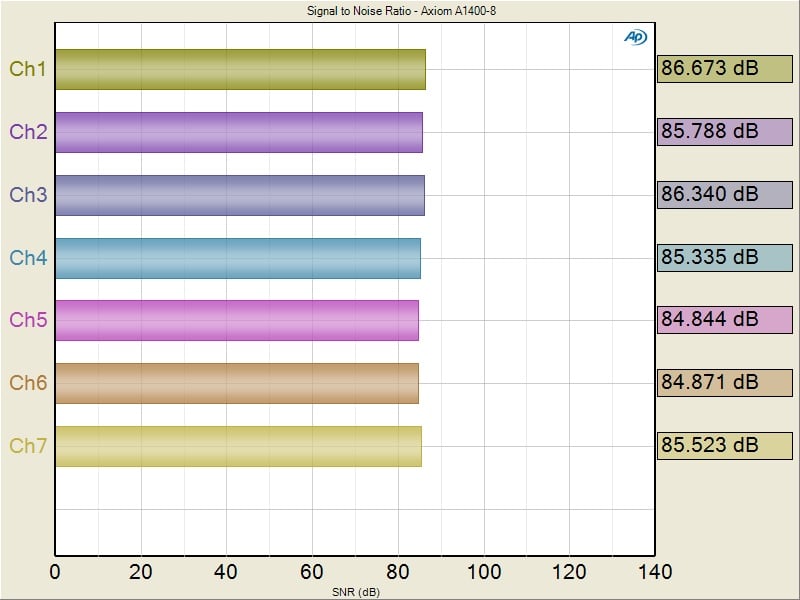
Figure 1. SNR @ 1 watt
I measured SNR at 1 watt output power with seven channels driven using A-weighting and recorded commendably good results as indicated in the graph above. Anything above 80dB at 1 watt is pretty much dead quite. Considering the high gain structure of this amplifier, I’d say this is quite an excellent achievement and explains why this amp was very clean at low power levels.
Frequency Response
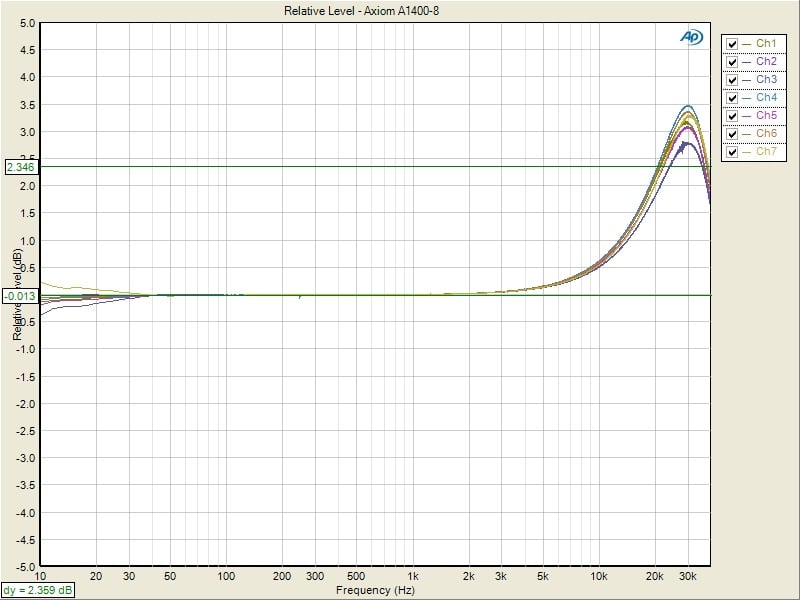
Figure 2. A1400-8 Frequency Response
I know what you’re thinking. How could there be such a big bump at 20kHz in an amplifier? The truth is all Class D amps that utilize an output filter exhibit this behavior to some varying degree. The A1400-8 showed anywhere between +2 to +2.3dB at 20kHz into an 8 ohm load and about -1.5dB when driving a 4 ohm load. This amplifier was optimized to drive low impedance loads though it will be right at home driving any load you throw at it. I do however wish Axiom had pushed the LPF response out a few kilohertz to reduce the load impedance interaction at 20kHz. As advancements in silicon progress and the switching frequency moves further out, so will the low pass filter poles, which will in turn flatten the response of these amps more akin to traditional linear amps but with the huge advantage of efficiency and power delivery.
Power vs Distortion
With the new APx585, we are now able to do a full barrage of multi-channel amplifier testing. We tested power using three methods all of which were taken at < 0.1% THD + N:
-
Continuous Full Power Bandwidth (CFP-BW) from 20Hz to 20Khz into 8 and 4 ohm loads (up to two-channels)
-
1kHz Power Sweep vs Distortion (1kHz PSweep) - popularized by the print magazines, this is an instantaneous power vs distortion test at 1kHz. The problem with this test is it often masks slew related and or frequency response problems some amplifiers exhibit at the frequency extremes, and thus inflates the measured power results. It does provide an instant gratification number for consumers to argue over on the forums so we are now incorporating this test to please the masses.
-
1kHz CEA-2006 Burst Method testing. This is a dynamic power measurement adopted from the car industry similar to IHF method but a more strenuous test condition on an amplifier and more representative of real musical content.
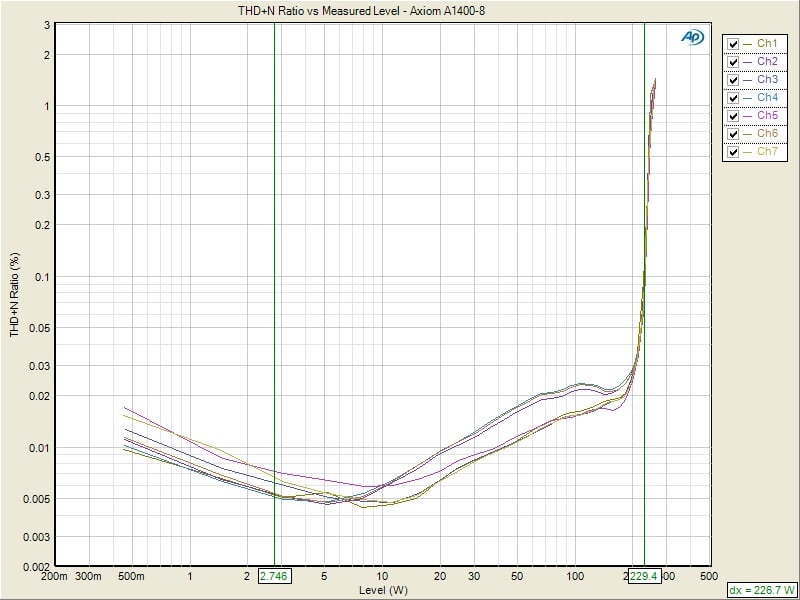
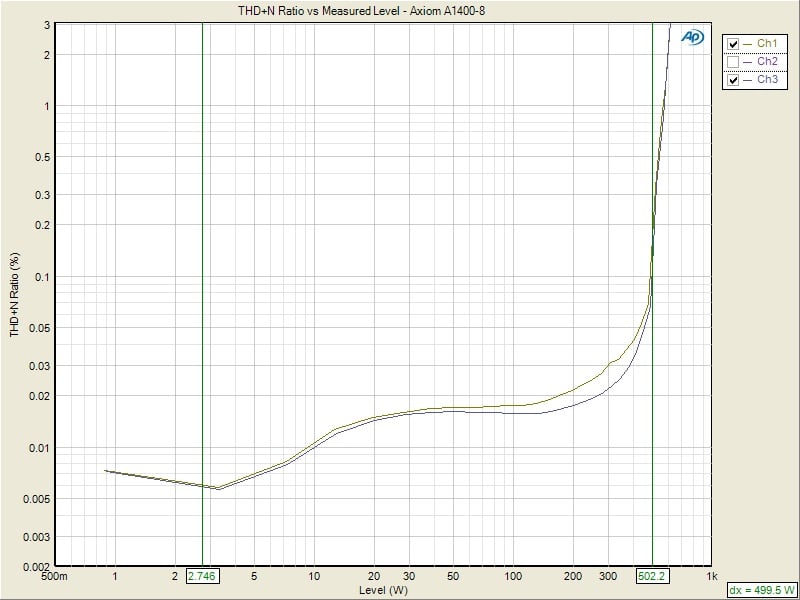
Figures 3& 4. A1400-8 PSweep-1kHz Power Testing
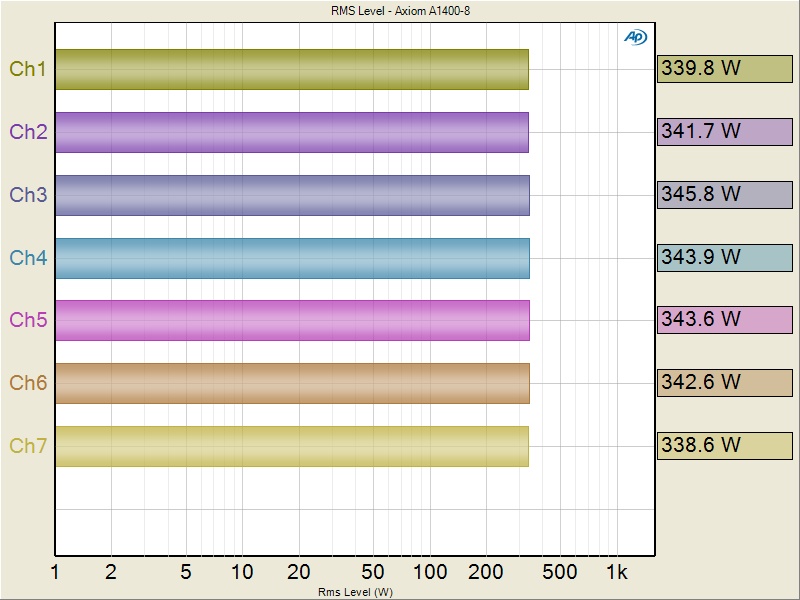
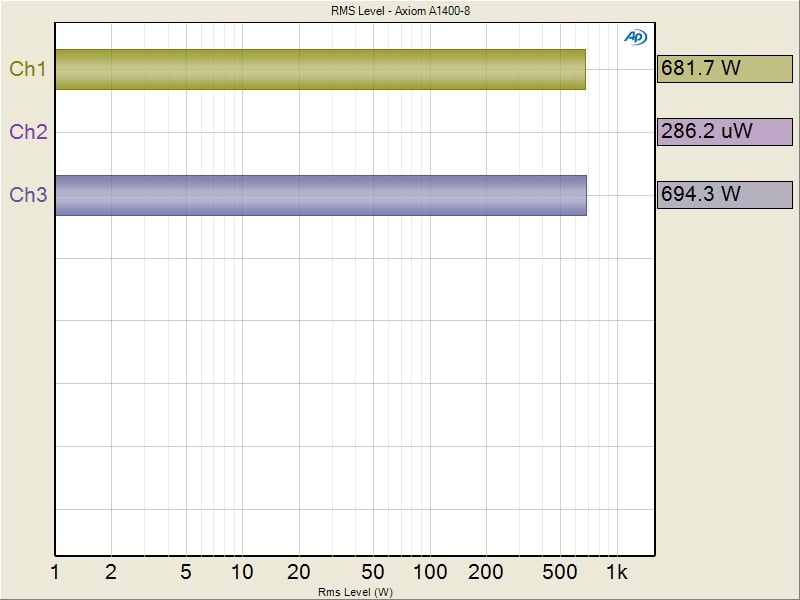
Figures 5 & 6. A1400-8 CEA2010 Dynamic Power Testing
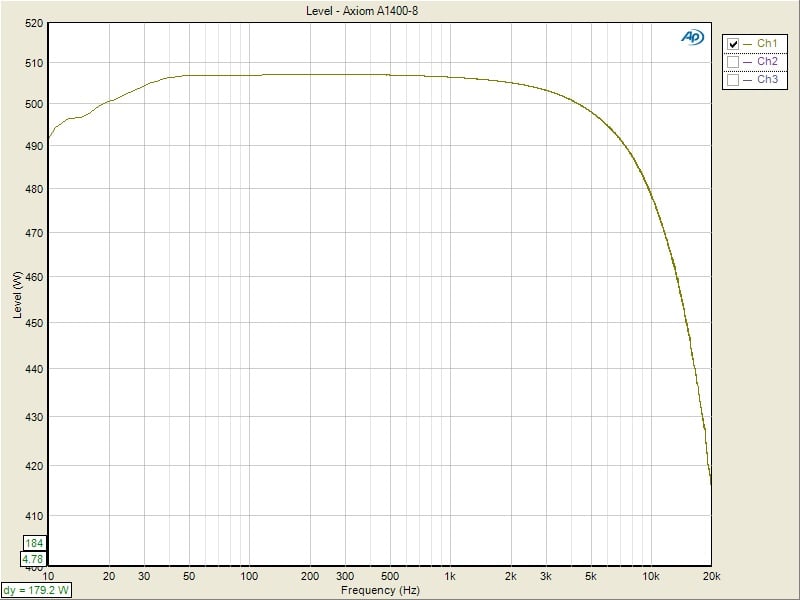
Figure 7. A1400-8 Continuous Power vs Frequency (4 ohms)
| # of CH | Test Type | Power | Load |
| 1 | CFP-BW | 312 watts | 8 ohms |
| 1 | 1kHz Psweep | 341 watts | 8 ohms |
| 1 | CFP-BW | 505 watts | 4 ohms |
| 1 | 1kHz Psweep | 572 watts | 4 ohms |
| 7 | 1kHz PSweep | 226 watts | 8 ohms |
| 2 | 1kHz PSweep | 500 watts | 4 ohms |
| 7 | 1kHz CEA-2006 | 340 watts | 8 ohms |
| 2 | 1kHz CEA-2006 | 690 watts | 4 ohms |
Table 1. A1400-8 Output Power Under Various Test Conditions
Note: I measured this amplifier to consume around 80 watts just idling which seemed a bit high to me for a Class D amp but certainly more energy efficient than other traditional multi channel amps I’ve measured.
Keep in mind most review publications test at clipping and don’t do continuous power measurements so our power numbers are usually a lot more conservative than what you typically find from other reviewers.
For more info, see: The All Channels Driven (ACD) Test
Upon my initial multi channel testing, I noted a couple of channels had a slightly reduced power level and pulled up the Oscope on the APx585 to see what was going on. The 1kHz sinewave was a bit distorted and it wasn’t until I realized that the alligator clip was shorting to the heatsink of my resistor boards that I was essentially feeding the A1400-8 a dead short and it was happily driving it at 7Vrms or nearly 50 watts. Most amps would have displayed significantly less output under this condition (if at all) but the A1400-8 was more than happy to deliver the current demand of a short circuit at this power level.
The A1400-8 is the most powerful multi-channel amplifier I’ve ever tested as indicated in the Table 1 test results. Axiom’s power claims into 8 and 4 ohm loads with one channel driven (350wpc / 700wpc, respectively) are a bit higher than I measured but they also don’t specify at what distortion level they test to. I limit my testing to 0.1% THD to be more conservative and although there seemed to be a lot more juice available, I didn’t want to risk blowing the amp out using full power bandwidth sweeps out to 20kHz.
Thanks to the A1400-8’s high efficiency (> 90%), it was able to drive two-channels at near equal power to the one channel ratings. I was unable to test all 8 channels simultaneously since I don’t have enough test loads, but running all seven channels, I achieved a whopping 226wpc at 0.1% THD + N which exceeds Axiom’s specifications of 200wpc x 7. Dynamic power testing using the 1kHz CEA-2006 method proved this amp had real headroom as claimed. Comparing the continuous power output to the dynamic power output (two-channels driven) showed 1.4dB of dynamic headroom which is darn good.
FFT Distortion Analysis
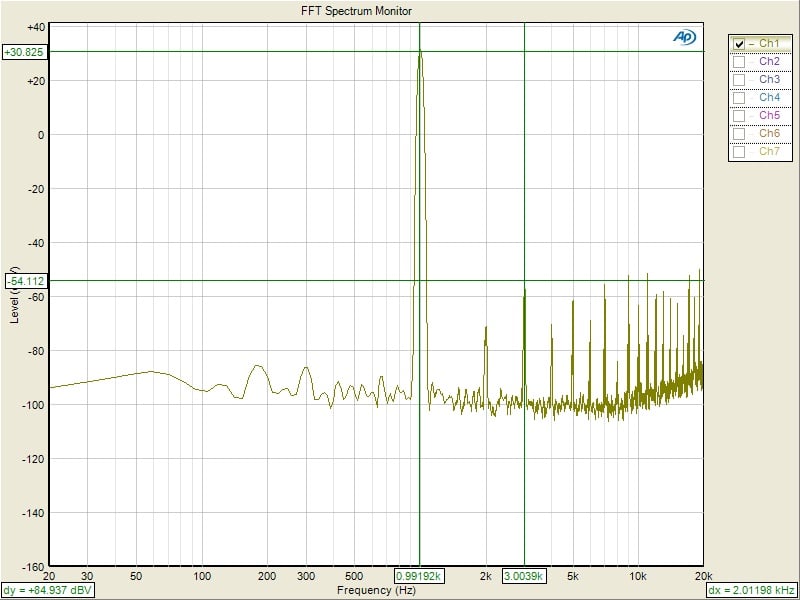
Figures 8 & 9. FFT Distortion Analysis
I ran FFT distortion plots at various power levels to determine how clean this amplifier really is. At 1 watt, the spectral plot was squeaky clean which really surprised me considering the topology of this amplifier and all the switching residuals typically associated. At high power the residual harmonics were about -80dB lower than the 1kHz fundamental. This is exceptionally clean performance for a linear amp let alone a switching one.
Crosstalk
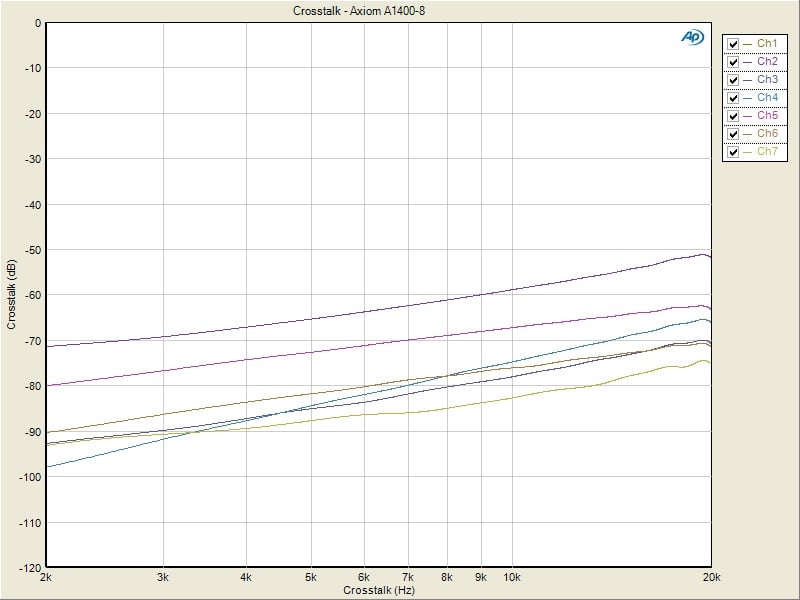
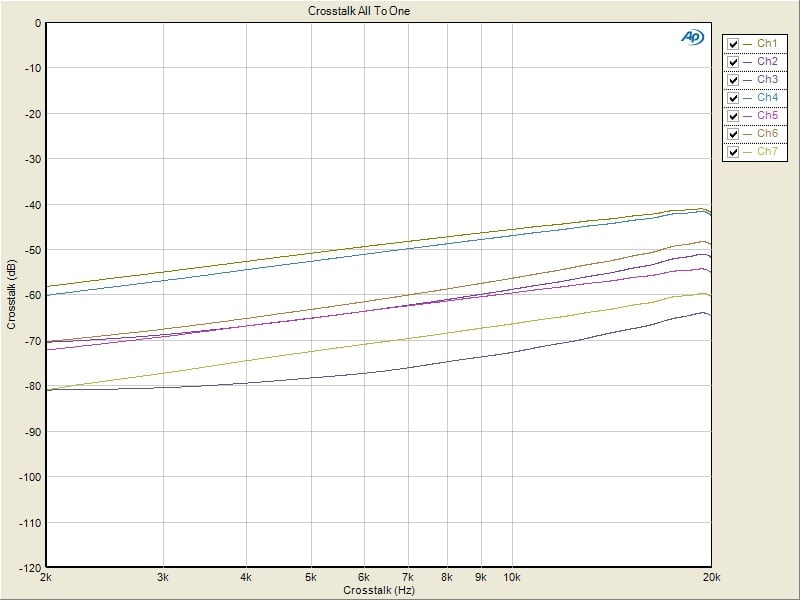
Figure 10 & 11. A1400-8 Crosstalk at 100wpc
Figure 10 depicts channel-to-channel crosstalk with only one channel as the disturber while figure 11 shows all but the particular test channel as disturbers to yield a worst-case scenario measurement. Unfortunately crosstalk performance of the A1400-8 was less than stellar when compared to other amplifiers we’ve reviewed. At 1kHz I observed anywhere between 75dB to 100dB depending on what channel pairs were under test. At 20kHz this translated between -50dB to -75dB. I’ve seen other less expensive multi-channel amplifiers utilizing a similarly single large centralized power supply produce much better figures than this (about 20-30dB better), so I feel Axiom has some room for improvement in this regard.
Upon closer inspection I found that when I set CH2 as the disturber, it polluted Channel 1 significantly worse than any other combination of channel pairs. I suspect it’s NOT a board level capacitive coupling problem since the other channel pairs measured significantly better. This is likely coupling in the wiring harness inside the amp. Thus I recommend running non-adjacent amplifier modules for the front channels to ensure you achieve the best stereo separation.
Output Impedance and Damping Factor
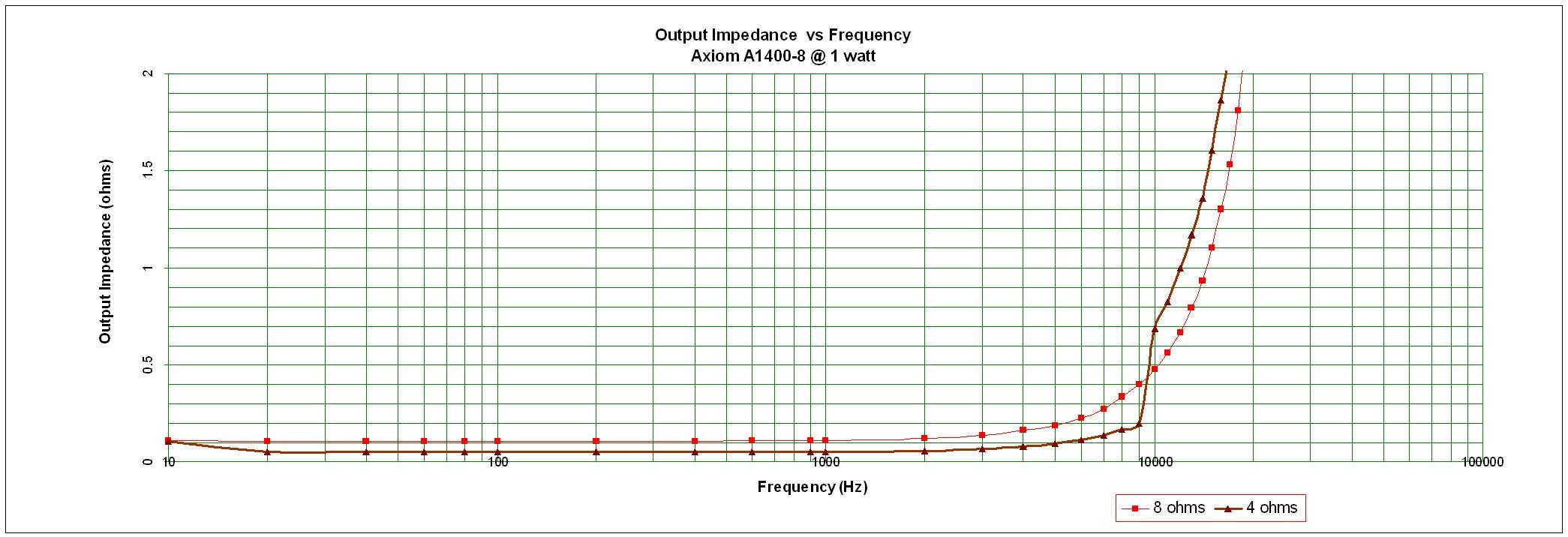
Figure 12. A1400-8 Amplifier Output Impedance vs Frequency
Amplifier output impedance of the A1400-8 is commendably low (especially for a Class D amp) until we see the effects of the output filter at around 10kHz where it jumps from around 100mohms to over 2 ohms. I’d again like to see the filter effects get pushed out of the audio band entirely but the highish output impedance above 10kHz didn’t seem to negatively impact my listening experience. This is likely because there is so little energy at those frequencies and most speakers exhibit rising output impedance due to the inductance of the voice coil making this more academic than a real world concern.
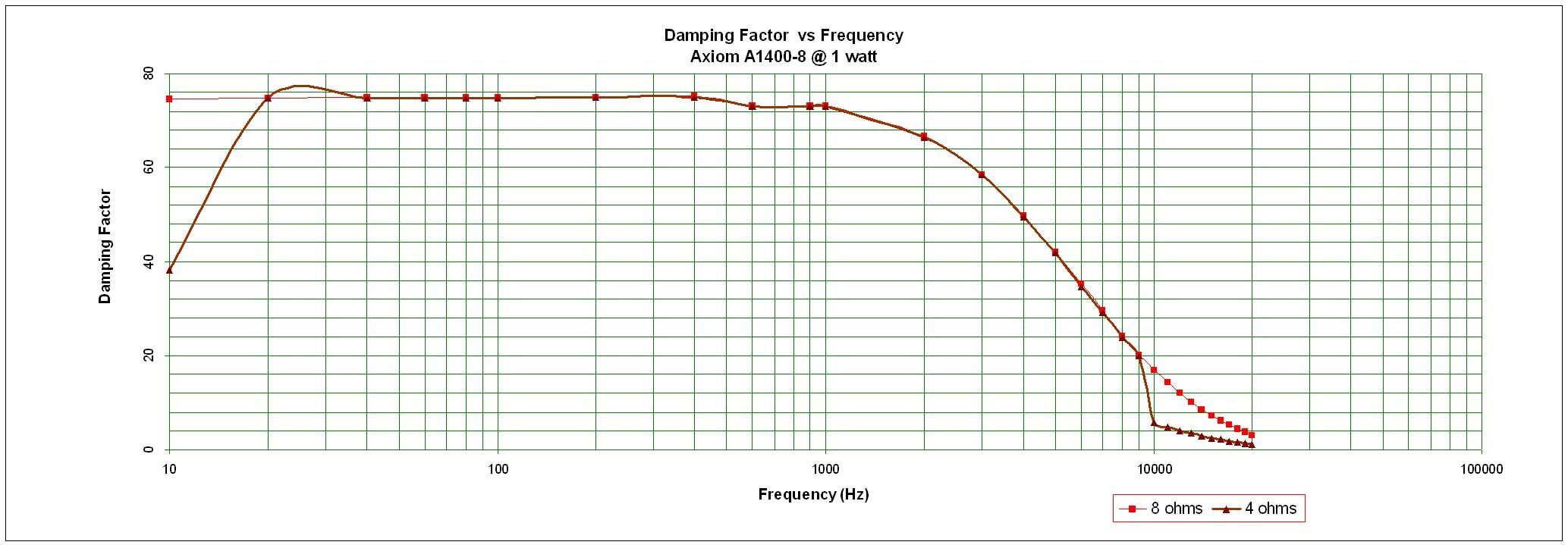
Figure 13. A1400-8 Amplifier Damping Factor vs Frequency
The damping factor of the A1400-8 was above the 50 mark we like to see for high performance amplifiers out to 10kHz. What is interesting to note is that it was virtually unchanged regardless of load impedance. Typically when you halve the load impedance we see the damping factor also go down proportionally. With the A1400-8, the amp behaved more like an ideal voltage source which may explain why it really exhibited phenomenal bass response into my 4 ohm speakers. This amp loves to be driven at low impedances and high power which are great attributes for stress free sound in all listening environments.
Axiom Audio A1400-8 Conclusions
Axiom Audio has
redefined performance expectations of Class D amplifiers with their
A1400-8. They have proven that a highly
efficient digital amplifier topology like this can not only hang with some of
the best traditional linear amplifier designs, but also surpass them in some
aspects such as dynamics, bass accuracy and power delivery. On the surface this amplifier seems pricey. However, when you think about the state of the art components that went into it this design to
offer top notch fidelity at power levels unachievable in linear amplifier
designs via a single power cord, the premium price tag becomes more understandable. Factor in that it would
take a stack of bulky linear amplifiers to equal the power offered by this slimline lightweight design and you’ve got a real space saver on your hands that is
also green friendly.
Though this amplifier isn’t flawless in execution, most of the issues I noted won’t present real world problems if you follow the installation guidelines in the user manual and my review. If you’re assembling an upscale home theater system with the design goals of uncompromised performance and dynamics, and your speakers are capable of handling its mighty power, you should definitely add the A1400-8 to your shortlist of high power multi-channel amplifiers for consideration. The digital revolution has come full circle with Axiom being one of the few pioneers truly breaking new ground with their first generation of high performance digital amplification.
A1400-8
MSRP: $3,850
Axiom
Audio
www.axiomaudio.com
Highway
60
Dwight, Ontario
Canada
P0A 1H0
About Axiom Audio
For more than two decades, Axiom Audio has made its reputation by achieving unprecedented performance quality. Founded in 1980, Axiom is counted as one of the cornerstones of the Canadian loudspeaker business. Using the world's most advanced computerized woodworking equipment, the company has become one of the world's premier manufacturers of quality loudspeakers. The company's home office and manufacturing facilities are located in the Muskoka district of Ontario.
The Score Card
The scoring below is based on each piece of equipment doing the duty it is designed for. The numbers are weighed heavily with respect to the individual cost of each unit, thus giving a rating roughly equal to:
Performance × Price Factor/Value = Rating
Audioholics.com note: The ratings indicated below are based on subjective listening and objective testing of the product in question. The rating scale is based on performance/value ratio. If you notice better performing products in future reviews that have lower numbers in certain areas, be aware that the value factor is most likely the culprit. Other Audioholics reviewers may rate products solely based on performance, and each reviewer has his/her own system for ratings.
Audioholics Rating Scale
 — Excellent
- — Very Good
- — Good
- — Fair
- — Poor
| Metric | Rating |
|---|---|
| Frequency Response Linearity | |
| SNR | |
| Output Impedance | |
| Measured Power (8-ohms) | |
| Measured Power (4-ohms) | |
| Multi-channel Audio Performance | |
| Build Quality | |
| Fit and Finish | |
| Ergonomics & Usability | |
| Features | |
| Performance | |
| Value |  |
Gene manages this organization, establishes relations with manufacturers and keeps Audioholics a well oiled machine. His goal is to educate about home theater and develop more standards in the industry to eliminate consumer confusion clouded by industry snake oil.
View full profile Subscribe to our newsletter