


GIK Acoustics 244 Absorption Panel Review
GIK Acoustics 244 Absorption Panels
- Product Name: 244 Absorption Panel
- Manufacturer: GIK Acoustics
- Performance Rating:

- Value Rating:
- Review Date: March 25, 2006 18:00
- MSRP: $ 59.99
- Dimensions: 24” W x 48” H x 5-3/4” D
- Weight: 25- lbs per panel
- Frame: Pine
wood
- Absorptive material: 8-lbs Mineral
Wool
- Fabric Cover: Heavy duty canvas
Pros
- Price
- Excellent absorption properties
- Easy to install
- Excellent customer service and support
- Certified by Riverbank Acoustical Laboratories
Cons
- Visible seam on top and bottom of panel
GIK Acoustics 244 Absorption Panel Introduction
As Audioholics, our pursuit of audio perfection seems never ending. We are always on the lookout for that next piece of gear that will improve our system. Many of us will spend our budgets dry and drive our significant others to the brink of the funny farm in this continuing journey. With all of this madness, however, the one area many of us overlook that can have significant impact in our system is room acoustics.
It may well be that the reason we overlook the importance of adding room treatment
is that we find spending a lot of cash on something that just hangs on the wall is pretty boring. I mean,
an acoustical wall panel has no flashing lights or twisty knobs to play with.

Many of us will finally give in and commit a small amount of our well-earned audiophile budget to a do-it-yourself acoustical wall panel project. We search the Internet for countless hours trying to find the perfect low cost recipe for our DIY panels. With material list in hand, our first stop is the hardware store. Our next stop is the fabric store. I don't know how you feel about entering a fabric store, but I feel as though I should be wearing a Groucho Marx mask to hide my identity when I enter one of these places.
With all materials in hand, we head out into the garage and assemble our panels. Many that have decent carpentry skills and patience will end up with pretty respectable looking panels. Others will find their projects in the woodpile. What if we told you that you could now purchase high performance acoustical panels for about the same price or lower than the DIY project? Hard to believe, isn't it? Read on.
GIK Acoustics 244 Panels Overview and Installation
Physical Characteristics
The recent upstart Internet-direct company, GIK Acoustics, has introduced two models of high performance, value-priced acoustical wall panels. The GIK 244 is a large panel and the GIK 242 is a thinner version. Both panels are available in the standard colors of black or white. Additional colors and fabric material choices are available for an additional cost.
The GIK 244 panels sell for the low price of $59.99/each plus shipping. The GIK 242 panels sell for $49.99/each plus shipping. Impressed with the low cost? So were we.
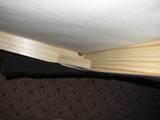
For this review, we ordered two GIK 244 panels. The 244s assembly, fit, and finish are pretty good considering the price point. The back outer frame is butt jointed and constructed from 1-inch x 2-inch pinewood with mitered braces at each corner. The 4-inch, 8-pound mineral wool absorption material is sandwiched in-between the frame. The front of the frame consists of floating plastic, and muslin material covers the back of the wool panel. The outer frame dimensions are 24-inches wide x 48-inches tall x 5-3/4-inches deep. The frame is covered with thick canvas material that is stapled to the back. On the top and bottom of the panel are seams where the material is folded over. Once the panel is installed on the wall, the seam is really not that noticeable but the seams are there nonetheless. Certainly, we can overlook this minor shortcoming considering the price of the panel.

Installation
 If you are going to obtain two panels, we suggest
you place them in the corners and use them as traps. The 244 is very effective at absorbing low frequency
information evenly from about 125Hz to 4000Hz, although the test data indicates the panel is effectively
absorbing low frequencies down to 50Hz.
If you are going to obtain two panels, we suggest
you place them in the corners and use them as traps. The 244 is very effective at absorbing low frequency
information evenly from about 125Hz to 4000Hz, although the test data indicates the panel is effectively
absorbing low frequencies down to 50Hz.
With four panels, we suggest you use two in the corners and two at the first reflection points. If you don't have sophisticated equipment to measure your room's acoustical properties, an easy way to find the approximate first reflection point on the sidewall is to use a mirror.
Sit in the primary listening position and have a helper walk along the sidewall with the mirror at the approximate height of the tweeters in your loudspeakers. As your helper is walking toward the speakers, look in the mirror. When you see the speaker's tweeter in the mirror, this is the location where you want to mount your panel. This method seems unscientific but it will get you in the general vicinity of the first reflection area. All that's left to do is mount the panel, insuring the correct height.
GIK Acoustics 244 Absorption, Listening Evaluation and Conclusion
Absorption Report
GIK Acoustical panels have been tested and certified by the Riverbank Acoustical Laboratories .
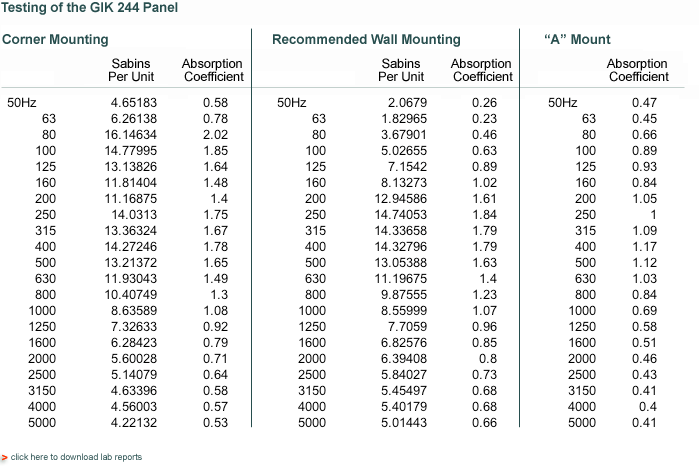 GIK Acoustic Panels submitted to two standard acoustic test methods: ASTM "A" and "J"
testing. For "A" testing, the acoustic panels are placed all together flat against a
surface and tested. "A" testing is the standardized testing method for the manufacturing industry. "J" testing simulates the recommended mounting of the product by the
manufacturer. GIK tested two set-ups:
GIK Acoustic Panels submitted to two standard acoustic test methods: ASTM "A" and "J"
testing. For "A" testing, the acoustic panels are placed all together flat against a
surface and tested. "A" testing is the standardized testing method for the manufacturing industry. "J" testing simulates the recommended mounting of the product by the
manufacturer. GIK tested two set-ups:
-
Panels straddled in corners.
- Panels spaced off the wall and mounted on stands.
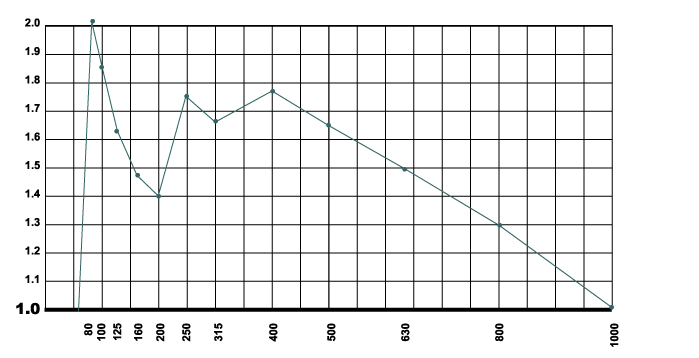
In an acoustic laboratory, absorption of sound is determined by measuring reverb decay time at specific frequencies (Hz). Reverb decay time is the time it takes for a standardized impulse sound to fall to a certain db. During a test, the reverb decay time for each impulse sound is recorded in specific areas of the room and at different heights. The data of the reverberation is calculated into Sabins. Based on the Sabins' numbers, the absorption coefficients can be calculated. The higher a number at a given frequency, the more sound is absorbed.
Listening Evaluation
Before beginning we would like to indicate that subjective listening evaluations are subject to
reviewers'
interpretations. Listening evaluations are not scientific but they may be helpful when
trying to make informed decisions about product performance and validity. The bottom line is that we
all hear things differently.

We selected the Pure Direct mode on the Yamaha RX-V4600 and started the listening evaluation with Steely Dan's oldie Aja . This is far from reference material, but this old CD has a lot of hard-hitting bass, instrumental passages and vocals - and to be honest we were in the mood for the music. The big Axiom M-80s belted out huge amounts of bass as the track "Black Cow" began. The Sax sounded awesome. It's hard to believe it's been almost 30 years since the release of this CD. The music is timeless and could easily fit in with today's music. Continuing with the tracks "Aja", "Deacon Blues" and "Peg" we found the listening experience to be quite pleasurable.
Placing the GIK 244s in the corners behind the big Axiom M-80s we started the listening evaluation again. From the very start of the track "Black Cow" we found the bass more controlled, focused and tighter. As good as Black Cow sounded without the absorption material, it sounded much better with it. The difference between the untreated listening session and the treated session was fairly dramatic.
We would say that the mid to upper bass frequencies sounded a lot more balanced with the 244 panels in the corners of the room.
 With the very positive results we obtained with the GIK panels in corners of the room we
wanted to see how they would perform at the first reflection point. We selected the Di Blasio CD
Piano de America
and began with track seven,
"Malaguena". This track contains
lighting fast trumpet, snare drum, piano, and cymbal passages that will levitate you to an alerted
state of reality if listened to on a decent system.
With the very positive results we obtained with the GIK panels in corners of the room we
wanted to see how they would perform at the first reflection point. We selected the Di Blasio CD
Piano de America
and began with track seven,
"Malaguena". This track contains
lighting fast trumpet, snare drum, piano, and cymbal passages that will levitate you to an alerted
state of reality if listened to on a decent system.
We listened to the track many times, never really being disappointed with the way it sounded with no room treatment in place at the first refection point.
Placing the GIK 244s at the first reflection point we started track seven, "Malaguena". Once again, as good as the music sounded without room treatment, it sounded much better with panels installed at the first reflection point. The presentation had less edginess and had better focus and clarity. The results were pretty revealing and it was amazing that just two acoustical panels placed in the correct location could have such a big impact on the way our system performed.
Conclusion
The GIK 244 panels are an outstanding bargain. There is little doubt that even two panels in our untreated room had an impact in our system's musical performance. The panels will not suit everyone's aesthetic needs but are well constructed. Even the most dedicated shopper would be hard pressed to even purchase the material necessary to complete a DIY panel for the cost of the 244 panels. The fact that the GIK panels are tested and certified by the prestigious Riverbank Acoustical Labs is another feather in the cap for this cost effective panel. Room acoustics play a very significant role in how your system will perform and with the low cost of the GIK panels there is really no excuse why the budding or expert Audioholic should do without this import piece of the audiophile puzzle. Highly Recommended to those on a budget.
GIK Acoustics 244 panels (pair)
MSRP: $59.99
2543 Raintree Dr.
Atlanta GA 30345
Tel:866-667-1569
Fax: 770-234-5919
About GIK Acoustics
GIK Acoustics is
committed to making sure all of our products have certified testing. Would you buy a monitor without a
data sheet? We think acoustics should be the same. All GIK products are tested at Riverbank Acoustical
Laboratories and we are able to provide you with certified absorption reports for the GIK 244 Acoustic
Panel and the GIK Monster Bass Trap.
The Score Card
The scoring below is based on each piece of equipment doing the duty it is designed for. The numbers are weighed heavily with respect to the individual cost of each unit, thus giving a rating roughly equal to:
Performance × Price Factor/Value = Rating
Audioholics.com note: The ratings indicated below are based on subjective listening and objective testing of the product in question. The rating scale is based on performance/value ratio. If you notice better performing products in future reviews that have lower numbers in certain areas, be aware that the value factor is most likely the culprit. Other Audioholics reviewers may rate products solely based on performance, and each reviewer has his/her own system for ratings.
Audioholics Rating Scale
 — Excellent
- — Very Good
- — Good
- — Fair
- — Poor
| Metric | Rating |
|---|---|
| Build Quality | |
| Ease of Setup/Programming/Integration | |
| Performance | |
| Value | |
 Subscribe to our newsletter