


Sherbourn PT-7000 Processor and 7/2100 Amplifier Review
Sherbourn PT-7000 processor
- Product Name: PT-7000 Processor and 7/2100 Amplifier
- Manufacturer: Sherbourn Technologies
- Performance Rating:


- Value Rating:
- Review Date: January 05, 2007 08:25
- MSRP: $ 4200
|
|
Pros
- Easy to operate
- 6CH input bass management
- Excellent sounding in all modes of operation
- Custom installers dream amp
- Superb Performance
- Endless dynamics and power reserves
Cons
- Triple crossover erroneous operations
- Limited to 1dB channel trim accuracy
- Limited to global channel trim and bass management settings
- 12V trigger interface different from mating processor
- Very heavy, complicated set-up
Sherbourn PT-7000 and 7/2100 Introduction
I recall our first introduction to Sherbourn electronics a few years ago was through their very impressive, powerful and value minded five channel 5/1500A power amplifier which was based on a modular mono block design with individual power supplies for each channel.
At that time, we were all living in a 5.1 channel world. However if the computer age has taught us anything it's that progress obsoletes absolutely. Consumers are always demanding to further push the envelope of technology, and manufacturers are always pleased to accommodate them. Thus as a result, the industry norm seems to now be converging on more and more channels in our home theater systems, which one day may eventually surpass those found in state of the art Cineplex's. This may sound funny to you, but lets turn the clocks back 20 years or so and try to envision a day when we would be cramming seven speakers, a subwoofer, and 103" projection screen in our living rooms. Still sound far fetched? For now however, my reference set-up remains in a 5.1 channel configuration, mostly because of limitations in my living room and the WAF (Wife Acceptance Factor) dictates enough is enough!
Separates or a Receiver ?
This has been a long time asked, but often not competently answered, question since manufacturers began producing mega receivers and separates at similar price points. There are inherent advantages and disadvantages to both, so let's do a little soul searching to find the answer to this grueling question.
It is obvious by the latest product offerings from Sherbourn that they understand the current industry trends, and as a result they have managed to intelligently design high performance products that fit quite nicely. Enter the PT-7000 7.1 Channel Preamp/Processor (MSPR: $1500) and the 7/2100 7CH 200wpc Power Amp (MSRP: $2850). This combined duo retails for $4350 and weighs in at a whopping 140lbs! At this price point, your alternative options are flagship receiver such as those from Denon, Pioneer Elite, B&K, etc, or separates from other manufacturers such as Outlaw, Adcom, Rotel, etc. This is an interesting price point to compete in as it is where a threshold is crossed between flagship home theater receivers and entry level separates. The receiver advantage is usually the convenience of an all-in-one box solution, a more sophisticated processor, THX Ultra 2 certification, better remote, and more features, etc, while the receiver disadvantage can sometimes be a less robust amplifier design unable to drive low impedance loads at high volume levels, less flexibility for future upgrading, and less snob appeal that many separates people often enjoy. Before deciding on which option is right for you, you need to ask yourself a few key questions.
- What type of speakers do you plan on using?
- What are your room size and listening level preferences?
- How often are you struck with the upgrade bug?
If your answer to these questions are as follows: "I am using low impedance, low efficient speakers in a reasonably large living room where I love to blast my neighbors while achieving THX reference levels, and often get struck with the upgrade bug when new technologies arrives.", then separates are usually a better choice for your needs. After a few years of usage, you can always dump the processor in favor for the latest and greatest, but can continue to use the monster power amp for all of your loudspeaker and listening needs. With that in mind, lets take an in depth look at the Sherbourn PT-7000 & 7/2100 combo to determine if it fits the bill for today's high performance home theater systems.
Company History (Brief)
Sherbourn was founded in 1998 by Ron Fone and Engne 'Tang'. The partnership is purely synergistic with 'Tang' heading up all aspects of design, engineering, manufacturing and technical support and Fone doing likewise for all commercial functions. 'Tang' was originally involved in engineering design with established audio companies such as NAD and Proton. In 1983, he moved to the USA and joined forces with Acoustic Research, then headed by Fone, to manage the engineering development of an electronics line. 'Tang' formed his own company in 1993, where he primarily designed subwoofer power amplifiers for some of the most well known companies in the industry.
Ron Fone, originally from England, moved to the USA in 1979 and for the next eight years presided over Acoustic Research . His involvement in the industry includes heading up Tera (a high end video company) and McIntosh, where he is credited with taking the famous company from its traditional two channel posture into the exciting world of multi channel home theater. After a period at A/D/S where he again inspired many innovative products, he and 'Tang' began discussing their long cherished dream of starting their own company. In 1998, they founded a small and personable high end audio company that is known to us today as Sherbourn.
Sherbourn PT-7000 and 7/2100 Setup and Listening Tests
I am sure everyone remembers the "Attack of the Clone Processors" article we wrote nearly a year ago, where I showed multiple hardware vendors selling a common processor platform and slapping their own logos and cosmetics on it. In fact, it was this very article on this processor that generated interest from Sherbourn for Audioholics.com to evaluate along with their new seven channel power amp. Ron Fone was very forthcoming, more so than Peter Tribeman from AtlanticTechnology / Outlaw, about the differences with the Sherbourn PT-7000 version of this East Tech Processor.
The one key advantage to the latest version of the Sherbourn PT-7000 processor is its improved analog section from its successor version, resulting in a reduced noise floor and more audiophile sound characteristic (more on this later). Ron also claims the price difference between this unit and the cheaper Outlaw unit has to do with the associated increased costs of the nicer cosmetics, upgraded video circuitry for extended bandwidth, and the different marketing model followed by the two companies (IE. Sherbourn-dealer based, Outlaw-internet based), as well as the fact that the Sherbourn unit comes already equipped with audio and video cables. I have to chastise Ron on his last point regarding the Sherbourn "cables". I would rather see the retail price of the Sherbourn PT-7000 drop by $100 than for Sherbourn to supply the so called "cables" that they do. Don't get me wrong, I am the last person to promote exotic cables and the lunatic theories that buttress many of them, but one has to draw the line between the "exotic" and the bare essential. The Sherbourn supplied cables are typical throw away patch cords that come standard with commercially purchased CD/DVD players. The supplied video cable is no different than the audio cables, other than the yellow color of the RCA connector. None of these cables meet our recommended Cable Budget Guidelines for serious audiophile set-ups. My advice, is to go out and buy or build your own audio and video cables to achieve maximum performance of your home theater systems. The PT-7000 is supplied with a more primitive version of the Home Theater Masters SL-8000 in that is doesn't have an LCD display window at the top of the remote to let the user know what device the remote is operating at any given time. I personally like that feature and wish the processor clone manufacturers would have unanimously decided for it. In any event, if it bothers you as much as it did me, you can remedy the situation by purchasing one of the excellent all-in-one remotes from Home Theater Masters or Phillips, etc starting at about $100 or so.
The Set-Up of the Sherbourn
PT-7000 Pre-processor
Making all of the connections was quite simple with the PT-7000. The
backpanel was well laid out and the connectors had adequate spacing between them
to accommodate all of my "exotic" (gasp) interconnects with ease.
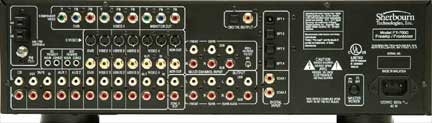
Back Panel of the Sherbourn
PT-7000 Preamp/Processor
Note the 6 CH-input defeatable bass management switch.
The PT-7000 has plenty of A/V I/O's to suite the majority of the most complex home theater systems.
Unlike the problems I had last month with the Yamaha RX-Z1's +12V trigger for my Aragon RPC-120 and Monster HTS-3500 Power Center, the Sherbourn PT-7000 had no trouble providing the current drive for these switching devices, making integration with my system as simple as a push of a button for total system power up and shut down. The On Screen Display (OSD) of the PT-7000 was both simple to use and effective while processor configuration was so easy that merely a glance or two at the manual was required for full proper configuration and set-up.
Bass Management & Speaker Configuration - The Good and the Bad
When setting up the PT-7000, its bass management limitations became apparent to me quite quickly. This processor does not allow subwoofer output in two channel if the front main speakers are set to large. I almost assumed by now that hardware vendors have overcome this oversight, but I suppose that's arrogant presumption on my part.
In comparison, my almost four year old dated Aragon Soundstage allowed subwoofer output in 2CH analog bypass with the main speakers set to large, as did the Yamaha RX-Z1, and even the vintage by today's standards, DSPA-3090 and successor DSP-A1 for that matter.
Based on this shortcoming, I had to configure my speaker system as follows:
- Front: Small; fc = 60Hz
- Center: Small; fc = 60Hz
- Surr: Small; fc = 60Hz
- Surr Rear: Off
- Subwoofer: On
On a positive note, the PT-7000 does have selectable crossover settings from 40-150Hz in six steps, and also incorporates Cirrus Logics "Triple Crossover" feature, which after experiencing it, I considered renaming it to "Triple Headache". In theory, the "Triple Crossover" is supposed to allow independent crossover settings for front, center and rear channels. One might wonder what crossover setting the subwoofer gets as a result. Well I was one who wondered and thus I tested this feature using my trusty Avia disc and Radio Shack SPL meter. What I found was the subwoofer crossover setting was dependent on the front main channels setting regardless if the front main channels were set to large or small. As a result, I found that if I had the rears and/or center set to say 160Hz, while the front mains were set to 60Hz, a gap of 100Hz of bass was prominent between the rear/center channels and the subwoofer. Thus the 100Hz gap of bass was not reproduced by any channel. For this reason, I recommend setting all channels crossover settings equal, or at least within 20Hz of each other.
I commend the effort the designers on the PT-7000 have made on incorporating bass management for the 6CH Channel Direct Mode. This is one of the first processors we have reviewed with full bass management for applications of DVD-A / SACD. The 6CH Direct Mode's bass management scheme is independent from all other modes of operation, and is an analog implementation with a fixed defeatable 80Hz 2 nd order HPF for the five main channels and a non defeatable 4 th order LPF for the subwoofer channel. I was pleased to see that the HPF's were defeatable while still retaining bass management for the subwoofer channel. However, I did note in my set-up that the subwoofer output in this mode seemed to be phase reversed by 180 degrees. If this becomes an audible problem with your set up, you may find yourself having to reverse the phase on your subwoofer every time you engage this mode.
Unfortunately the channel trims on the PT-7000 were only adjustable in 1 dB increments, which at times proved challenging to get all channels at equal loudness from my listening position. I would have liked to see 0.5dB trims which are very common in A/V receivers in this price range. What really irked me more than the 1dB trim accuracy was the fact that there was only one global setting for channel trims and crossover settings. This became most bothersome when switching between digital inputs decoding DD/DTS and 6CH analog input for listening to DVD-A / SACD due to the inherent level differences of the formats.
Each time I listened to the latter, I had to readjust the subwoofer output to achieve proper levels to compensate for the lower subwoofer level of DVD Audio inherent in many of today's DVD-A players. A separate channel trim configuration for this mode would have been nice, especially since the PT-7000 had two registers for channel level settings, but for some reason they were dependent on each other. This can be seen in the set-up / configuration menus. There is a speaker level setting named "Channel Calibrations" in the main set-up menu where you can adjust all of your levels via test tones, then for some illogical reason, there is a separate setting called "Channel Trim" which you can also adjust speaker levels on the fly, but when you change the levels in this mode, it also changes them in the prior set-up mode. Why?
Editor's Note: Workarounds for Bass Management Issues
- Set the subwoofer level control of the DVD-A/SACD player to maximum. However, do this with care as many of these players may clip their analog outputs, resulting in audible distortion, when their channel trims are maxed out.
The PT-7000 allowed for digital delay compensation for all channels via its digital inputs by entering distances relative to the primary listening position in feet or meters. I Would have liked to seen a setting for the subwoofer as well to compensate for any potential phasing issues that often arise when mating large front speakers with a subwoofer. For more on this topic, please review the article titled "The Marriage Between The Subwoofer and Tower Speakers".
Despite these configuration glitches, I still managed to set up the PT-7000 to achieve superb performance in all modes of operation. Despite the fact that I had to cross over my large main towers at 60Hz, my sub was more than capable to handle bass frequencies below that and I really didn't feel like I was missing anything.
Processing Modes
The PT-7000 is endowed with just about all of the latest surround sound modes, minus DTS 96/24. It even includes including Cirrus Logics "Extra Surround" which is a proprietary algorithm that creates 6.1 or 7.1 output from either matrix encoded or discrete audio signals.
I was particularly enamored with the Prologic II music mode when listening to normal CD's and the Prologic II and DTS Neo Movie modes when watching old VHS tapes or stereo TV. The PT-7000 seemed to handle all surround modes quite well. The five channel stereo feature was a nice option to use when hosting parties or when you prefer to rock your entire house with a room full of sound, but I preferred the more natural and balanced sound of DTS Neo and Prologic II. I actually preferred the Prologic II modes over the DTS Neo counterparts when using this processor. They just sounded more lively and realistic to me. This was quite surprising to me since I preferred the DTS Neo modes over the Prologic II ones when I reviewed the Yamaha RX-Z1. I suppose this may be subjective on my part, thus I recommend making this determination for yourself when comparing the two different processing modes
CD: Tubular Bells 2I found Mike Oldfields's Tubular Bells 2 CD sounded quite enveloping in Prologic II on the PT-7000. It added a sense of realism and depth to an already well recorded CD. There were times that I swore I was listening to a discrete recording when listening to this CD in Prologic II mode on the Sherbourn PT-7000 Processor. Since this CD was mastered with higher than normal dynamic range, free from compression artifacts, typically found in today's pop recordings, I had to crank the volume up quite high on the PT-7000 to compensate. This never presented excessive noise problems demonstrating that the PT-7000 had both a clean and quite analog preamp.
I spent a good deal of time listening to DVD movies with the Sherbourn combo. I can't tell you how many times exactly that I viewed my two year old daughter's favorites such Stuart Little 1 & 2, Disney's Beauty and the Beast, and Eric Clapton's "One More Car One More Rider".
While any sane person would grow tired of watching these videos over an over again, I didn't. Partly because I am not sane, after all, I am a father :-) Or, perhaps I really enjoyed the sound that the Sherbourn combo provided in my reference system.
Eric Clapton's concert DVD sounded absolutely stellar in DTS mode on the PT-7000. Track #2 "Reptile" contained such chillingly deep bass and flamboyant guitar textures that were all clearly conveyed on the PT-7000. In fact, I didn't really mind my large tower speakers being crossed over at 60Hz, due to the previously mentioned bass management limitations of the PT-7000, since my subwoofer was doing a bang up job filling the gap, and the system was properly phased to make any bass nulls between channels mostly undetectable to my ears and my handy SPL meter and Avia test set-up disc. All in all, the PT-7000 delivered all of the latest surround tricks quite admirably.
Sherbourn PT-7000 Analog Preamp Evaluation
One pleasant surprise of the Sherbourn PT-7000 pre-pro was its superb analog preamplifier for serious two-channel or multi-channel high resolution listening. The PT-7000 contains a true analog bypass that keeps all analog signals in the analog domain with no digital processing when engaged in this mode. When listening to my favorite SACD's and DVD Audio discs, I didn't hear any excessive noise or glare that is typical of many mass market receivers in this price range. I was curious about Sherbourn's latest hardware revisions implemented to this processor, and they were kind enough to provide me many of the technical details. For your convenience I have summarized the most important differences in the table below.
|
Analog Preamp Specification |
Original |
Latest |
|
Max Output |
6.3Vrms |
10.15Vrms |
|
Channel Separation (1kHz) |
82dB |
96dB |
|
Crosstalk between inputs |
86dB |
87dB |
|
Frequency Response |
20Hz to 20kHz +.22 / -.14dB |
10Hz to 20kHz +.0 / -.2dB |
|
S/N Ratio (Ref 2Vrms; A-wt) |
101dB |
103.5dB |
As we can see, the channel separation, output drive levels, and signal to noise ratios have all been improved with the latest hardware revision of the PT-7000.
The frequency response via the analog direct inputs is nearly ruler flat within the audio band and threshold of human hearing sensitivity. These characteristics seemed quite apparent to me when I was using the PT-7000 to play my latest SACD and DVD Audio recordings. The PT-7000 never sounded harsh or fatiguing, in fact I would characterize its sonic signature as "warm". It didn't have that typical mass market electronic signature which is something I was pleased to live without.
So what does this all translate to? The PT-7000 will not only serve well as a home theater processor, able to decode most of today's surround formats, but it appears to cater to the audiophile for those who demand uncompromised performance for their critical listening needs.
What surprised me about the PT-7000 was that it literally grew on me. I won't try to convince you on the wonders of "break in" like many exotic cable vendors attempt to do. Bottom line, cables do NOT break in. However, there is something to be said about electronics "break in" over time. Usually it is subtle, if at all audible. I suspect I experienced a combination of "break in" as well as endless successful tweaking to get the system to sound just right. Whatever it was, I found it somewhat difficult to box the PT-7000 for shipment back to Sherbourn at the end of my three month evaluation. It is a worthy contender for modest separates installs and for those who desire an alternative to the mega receivers.
Sherbourn PT-7000 and 7/2100 Amplifier Overview and Setup
We have to eventually reach a point in home theater where enough is enough! Just how many channels can us home theater enthusiasts support, and more importantly, how many of us have racks or cabinets that can physically support the weight of these mega metal multi channel monster amps (uh oh, tongue twister)? I would venture to say that Sherbourn has approached this limit with their new 7/2100 200 watt/ch x 7 channels, 110lbs heavy power amp. What is interesting about the 7/2100 is it shares the same footprint as their new 5/2100 ($2250) five channel power amp (3u height by 17.7" width). Also, should you decide on a 5/2100, you can always send it back to the dealer to upgrade it to a 7/2100 for an additional $900 or so, when the wife and/or room accommodations allow for a seven channel home theater configuration.
I literally almost ruptured myself hoisting the 7/2100 on my top shelf of my entertainment center and prior to doing so, I had to verify with the manufacturer of my cabinetry to ensure it could handle such weight. (See Staff Reference System 1)
The 7/2100 is a mono block construction, just like its five channel predecessor 5/1500A previously reviewed here, which essentially means each amplifier has a dedicated power transformer and associated supply. Sherbourn feels the advantage of this type of construction is better channel to channel isolation and power reserves since each channel has a dedicated power supply not taxing a common supply like many single supply multi channel amplifiers tend to do. While this can often be true, I have mixed feelings about this, especially since I am an owner of a power amp that shares one huge supply for all three channels. Grant it, my three channel reference power amp has a retail price similar to the Sherbourn so it is really not a fair comparison. However, to prove my point, if budget allows for an amplifier construction to utilize a very large power supply, with separate rectification for each channel, then each individual channel would have the potential for more reserves at any given time, assuming the output devices are robust enough to take advantage of it. This is especially true since in most instances, home theater does not demand nearly full power to all channels simultaneously. However, in reality, when we reach power levels this high, we begin splitting hairs. Given the retail price of the 7/2100 of about $2850, I haven't been able to find a single alternative manufacturer that offers this much power, especially in 4 ohms with all channels driven. In fact only a few other amplifier manufacturers offer similar power capabilities for all seven channels, but at a premium of at least $1000 more money. There are cheaper seven channel alternatives to the 7/2100 with alleged similar power ratings into 8 ohms, but what some of these manufacturers don't tell you is that their solutions are not rated with all channels driven, or they don't specify the total power output into 4 ohms loads.
One point of interest about the 7/2100 is its multi biasing scheme that keeps the amp biased at Class AB for lower power levels and then switches to Class G for high power output to maintain high efficiency and reduce power and heat consumption. Class G operation involves changing the power supply voltage from a lower level to a higher level when larger output swings are required. There have been several ways to do this. The simplest involves a single class AB output stage that is connected to two power supply rails by a diode, or a transistor switch. The design is such that for most musical program material, the output stage is connected to the lower supply voltage, and automatically switches to the higher rails for large signal peaks. Another approach uses two class AB output stages, each connected to a different power supply voltage, with the magnitude of the input signal determining the signal path. Using two biasing schemes improves efficiency enough to allow significantly more power for a given size and weight. I suspect Sherbourn has employed the first method in their design. Employing Class G biasing schemes could arguably not be a preferable option for audiophiles who commonly insist on the linear and usually lower distortion Class A or AB amplifiers, but it never presented a problem in my critical listening tests. In fact, had I not questioned Sherbourn as to why the 7/2100 ran so cool in my rack compared to my reference amps, I would have never known they employed this multi biasing scheme. In any event, the Sherbourn 7/2100 is a true mono block constructed Class AB/G multi channel power amp. Based on their competition, I certainly could agree that their mono block construction does have its advantages.
The Set-Up of the Sherbourn 7/2100
 The 7/2100 is by far the heaviest amplifier we ever
reviewed, and consequently the most challenging to install into my entertainment
center. Placing the 7/2100 on the top shelf of my rack brought me back to the
days of standing 225lbs overhead shoulder pressing. It seemed like a good idea
at the time, it yielded excellent shoulder growth, but eventually wrecked havoc
on my rotator cuffs in the later years to come. My advice here is to place this
amplifier as close to the ground as possible, or get one or two people to help
you set it up. The 7/2100 comes with all the fixings demonstrating it is truly a
high end amplifier meant for the most serious custom installs demanding gut
wrenching power reserves. The backpanel consists of single ended and balanced
inputs for all channels, a 12V trigger, quality binding posts for the speaker
level connections, and the Sherbourn patent pending LDS switch. The LDS feature
allows installers to speedily check the correctness of their speaker connections
without needing an ohm meter or a walk-through inspection. I found this
particularly useful when configuring my system and wished more amplifier
companies would offer a similar feature.
The 7/2100 is by far the heaviest amplifier we ever
reviewed, and consequently the most challenging to install into my entertainment
center. Placing the 7/2100 on the top shelf of my rack brought me back to the
days of standing 225lbs overhead shoulder pressing. It seemed like a good idea
at the time, it yielded excellent shoulder growth, but eventually wrecked havoc
on my rotator cuffs in the later years to come. My advice here is to place this
amplifier as close to the ground as possible, or get one or two people to help
you set it up. The 7/2100 comes with all the fixings demonstrating it is truly a
high end amplifier meant for the most serious custom installs demanding gut
wrenching power reserves. The backpanel consists of single ended and balanced
inputs for all channels, a 12V trigger, quality binding posts for the speaker
level connections, and the Sherbourn patent pending LDS switch. The LDS feature
allows installers to speedily check the correctness of their speaker connections
without needing an ohm meter or a walk-through inspection. I found this
particularly useful when configuring my system and wished more amplifier
companies would offer a similar feature.
The 7/2100 can also be configured in bridged mode to yield a whopping 400 watts/ch for three channels into 8 ohm loads, or 600 watts/ch x 3 channels into 4 ohm loads. However, use this feature with caution, as Sherbourn also states in their manual, when connecting to low impedance speakers. In a bridged configuration, each amplifier see's half the load impedance, thus if you are connecting an 8 ohm speaker for example, each bridged amp would see an equivalent 4 ohm load. Sherbourn explicitly cautions against bridging with speakers less than 8 ohms. I of course didn't listen and attempted to bridge my 4 ohm RBH 1266-LSE towers. When I turned the system on, I was greeted with a psychedelic light show as all the lamps in my living room began dimming due to the 7/2100 short circuit protection circuitry tripping on to protect the amplifiers. I immediately shut the unit off and waited about 10-20 seconds for the lightshow to stop and the DC pulses to stop pounding my speakers while the power supply capacitors discharged. Luckily the 7/2100 and my speakers suffer no damage, but I learned a hard lesson. Later I found out through Sherbourn that they set the impedance threshold on their amplifiers to about 2 ohms, thus the reason why they originally recommended 8 ohm minimum speakers when bridging the amps. I also noted that the manual had a technical error about bridging the 7/2100. It stated for line level connections to use channels 1,3 and 5 for respected speaker level connections of channels 2, 4 and 6, when in fact the line level connections should have been 2,4 and 6 respectively. Sherbourn claims they have corrected this misprint on all new manuals shipping with their current products. I was unable to connect the 12V trigger to the PT-7000 since I only had a cable with plugs that fit the PT-7000 side.
It didn't make sense to me that the PT-7000 employed a headphone type connector for the 12V trigger, but the 7/2100 implemented a bare wire connection 12V trigger mating connection. It didn't really affect my set-up however since the 7/2100 had an auto on detect mode (set to music) that powered the amplifiers immediately after they detected an audio signal. This was another great feature commonly employed on subwoofer amps, but rarely on multi channel power amps. What initially surprised me about the 7/2100 was its usage of dual power cords. However, it made perfect sense considering that under heavy loading, with all channels driven, the 7/2100 could easily consume greater than 15 amps on the primary, thus splitting this current consumption amongst two power cables reduces resistive losses to allow for maximum power transfer when it's needed most. It was obvious to me that the 7/2100 was quite a feature packed amplifier not meant for the typical neophyte looking to set up their first home theater system. The consumer would really benefit from having someone familiar with this type of amplifier to do the install for them, especially since in all likelihood they could have them do the lifting. In fact, I strongly recommend connecting this amplifier and associated audio equipment to a dedicated 20A line to ensure maximum power availability as the 7/2100 could surely deliver if tasked.
In my application I wasn't testing the Sherbourn combo in seven channel configuration, but I didn't want to let those two extra channels simply go to waste. Therefore, I decided to biamp my main speakers since this was something I never did before, mostly because of unavailability of extra amps or shelf space. I realized that I wouldn't be able to achieve the full benefits of biamplification since I had no plans, or means, to physically separate my loudspeakers crossovers and apply active filtering line level to each amplifier.
Sherbourn PT-7000 and 7/2100 Listening Tests and Conclusion
It was clear that some of the benefits of biamping the 7/2100 for my main speakers was realized after a few short listening sessions, especially at extreme volume levels which I don't usually listen at or recommend. The sound emanating from my reference speakers seemed to have a tad more punch and bass impact when comparing biamp configurations verses single amp configurations of the 7/2100. However, the benefits weren't overly dramatic, especially considering how well a single channel of amplification of the 7/2100 drove each speaker in my reference system. In fact, the more I cranked up the volume, the more at home the 7/2100 seemed to be. I felt the sonic merits of the 7/2100 were very close to that of the 5/1500A previously reviewed here, but perhaps subjectively a tad warmer sounding. I also felt the 7/2100 sounded best after a period of warm up of about 30 minutes or so.
I played quite an extensive selection of my CD and SACD collection on the PT-7000 and 7/2100 Sherbourn combo, and never did I find the fidelity lacking. The noise floor was admirably low, the dynamics endless, and the integration seamless. While I would have liked to see some of the previously mentioned bugs worked out of the PT-7000, it never deterred my listening enjoyment from either music or multi channel surround applications. Playing well recorded SACD's from artists such as Patricia Barber and Grover Washington Jr. was a real treat on the Sherbourn combo.
All of the subtle nuances of these recordings that I was familiar with while listening to them on my reference system were well preserved.
Home theater seemed to be the Sherbourn combo forte. Channel separation was excellent. I never heard any bleed over between channel to channel. The panning between channels was about as good as I have heard on past products previously evaluated. It was obvious to me that the PT-7000 and 7/2100 mated well together both sonically and functionally.
Conclusion
The Sherbourn PT-7000 and 7/2100 are quality products that will deliver very satisfying performance for large, upscale, home theater installs that demand high power output capable of achieving almost limitless SPL levels. These products however are not for everyone. Great care must be considered in their handling and set up, especially the 7/2100, and should be done by experienced home theater enthusiasts or professional custom installers. If your home theater needs coincide with high power demand, easy configurability and usability, and overall excellent performance, than the Sherbourn PT-7000 and 7/2100 combo should be on your shopping list as a viable alternative to mega receivers and other entry level separates alternatives.
The Score Card
The scoring below is based on each piece of equipment doing the duty it is designed for. The numbers are weighed heavily with respect to the individual cost of each unit, thus giving a rating roughly equal to:
Performance × Price Factor/Value = Rating
Audioholics.com note: The ratings indicated below are based on subjective listening and objective testing of the product in question. The rating scale is based on performance/value ratio. If you notice better performing products in future reviews that have lower numbers in certain areas, be aware that the value factor is most likely the culprit. Other Audioholics reviewers may rate products solely based on performance, and each reviewer has his/her own system for ratings.
Audioholics Rating Scale
 — Excellent
- — Very Good
- — Good
- — Fair
- — Poor
| Metric | Rating |
|---|---|
| Multi-channel Audio Performance | |
| Two-channel Audio Performance | |
| Video Processing | |
| Bass Management | |
| Build Quality | |
| Fit and Finish | |
| Ergonomics & Usability | |
| Ease of Setup | |
| Features | |
| Remote Control | |
| Performance |  |
| Value | |
Gene manages this organization, establishes relations with manufacturers and keeps Audioholics a well oiled machine. His goal is to educate about home theater and develop more standards in the industry to eliminate consumer confusion clouded by industry snake oil.
View full profile Subscribe to our newsletter