


The Boston Experience
Downtown Boston
Boston Acoustics, established in 1979, has made a name for itself in the home and car audio markets. Across the years, Boston Acoustics has maintained their high standards and profitability through a tenet of careful growth and high quality products. While they existed almost solely through dealers initially, later years saw them expanding into computer speakers and more budget minded offerings. You can now buy many of their products directly from them at their online store.
When I was invited to the Boston Acoustics press event, I didn't really know what to expect. You can always count on a lot of food, very little sleep, and more information than a human can integrate in so short a period of time at one of these things. I couldn't help but chronicle my experiences over at AVRant. In spite of my exhaustion, it was clear that Boston Acoustics was excited. Something big was going to be unveiled and it wasn't going to be simply another product line or a new product area. They were changing the fundamental direction of their business. From a company's standpoint, this is kin to a religious conversion or rebirth. It's big, it's exciting, and it is dangerous.
A new mission, a new logo, a new name
 Corporations live on logos and mission statements.
How many of us have been asked by our employers to remember a mission
statement? How many actually could? Most of the time they are filled with
marketing-ese and buzz words that have little meaning outside of the boardroom
- words like "energize" and "inspire" and "paradigm"
and "market-driven" and… well, you get the idea. One doesn't need to
spend too much time in a mission statement meeting before falling off to sleep.
Corporations live on logos and mission statements.
How many of us have been asked by our employers to remember a mission
statement? How many actually could? Most of the time they are filled with
marketing-ese and buzz words that have little meaning outside of the boardroom
- words like "energize" and "inspire" and "paradigm"
and "market-driven" and… well, you get the idea. One doesn't need to
spend too much time in a mission statement meeting before falling off to sleep.
Boston Acoustics started off the event with a run through by Sr. Vice-President & General Manager Eli Harary of the process they went through to come to their new mission. I'll spare you the gory details but I think the end result was quite worth it - Play Smart. They've had their core values in place of high build quality, high performance, and product innovation. They've been known for providing good speakers at a good value. But now they want to be known as forward thinking and having a more contemporary (they called it "hip-smart") design that emphasizes personal expression and shared experiences. The core values (quality, performance, innovation) makes up the "Smart" while the personal expression and shared experiences is highlighted in the "Play". Short, to the point, and frankly, everyone can remember it.
But the retooling of the brand didn't stop there. As much as everyone loved their old logo (are white words in a red box really a logo?), it was time for a change. Enter the stylized lowercase "b"… in a red oval of course. If you look closely, you can also see a lowercase "a" as well. The new logo is simple, recognizable (except for that lowercase "a" which I didn't see until Eli pointed it out) and looks good in color and in black and white (important when you are printing product manuals). Overall a rousing success.
But that wasn't the end of the changes. Boston Acoustics has dropped the "Acoustics" part of their name and will now be known as only "Boston". A short mission statement, a smaller logo, and now a shorter name - Is this a comment on the attention span of consumers in this fast paced, wired world? While these are interesting changes, from the consumer standpoint they are mostly cosmetic. What we really want to know is how this affects us.
Out with the old, in with the new
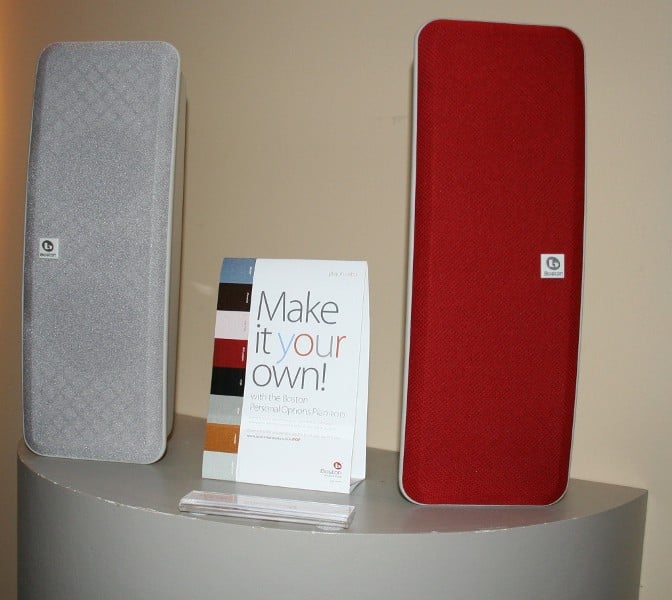 If you've been shopping lately (or have spent any
time online) you'll have noticed that Boston
speakers have been on sale. It doesn't take a brain surgeon to figure out what
that means. Here's the "official" announcement. The VR, CR, and MR
series speakers are going away. If you like the way they sound, get them now.
You won't see them around for much longer and prices are impossible to beat.
The E-series will stay but you won't see any more clock radios or those sorts
of products from Boston.
Instead, there is a renewed focus on their base. And that means speakers.
If you've been shopping lately (or have spent any
time online) you'll have noticed that Boston
speakers have been on sale. It doesn't take a brain surgeon to figure out what
that means. Here's the "official" announcement. The VR, CR, and MR
series speakers are going away. If you like the way they sound, get them now.
You won't see them around for much longer and prices are impossible to beat.
The E-series will stay but you won't see any more clock radios or those sorts
of products from Boston.
Instead, there is a renewed focus on their base. And that means speakers.
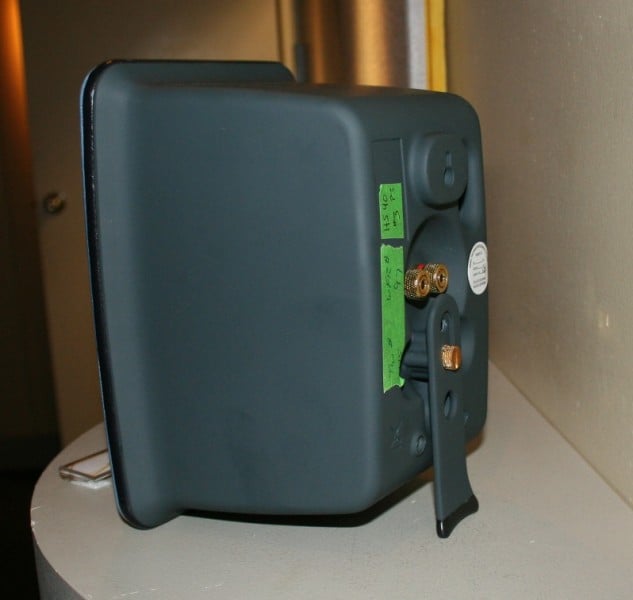 There will
be two new lines of speakers introduced, first the budget minded Horizon line
and later (look for them at CES) the Vista
line. The first thing you'll notice about these new speaker offerings is that
the grills are the most prominent part of the speaker. The speaker box, usually
flush to the grill if not larger, is actually smaller. This gives the grill a flared
look that is very distinctive. Each speaker has integrated stands and five way
binding posts. The grills are interchangeable and can be purchased directly
from the Boston
website.
There will
be two new lines of speakers introduced, first the budget minded Horizon line
and later (look for them at CES) the Vista
line. The first thing you'll notice about these new speaker offerings is that
the grills are the most prominent part of the speaker. The speaker box, usually
flush to the grill if not larger, is actually smaller. This gives the grill a flared
look that is very distinctive. Each speaker has integrated stands and five way
binding posts. The grills are interchangeable and can be purchased directly
from the Boston
website.
This new focus on aesthetics taps into consumer's desires to personalize their products. As SEMA has grown from an industry stepchild to one of the biggest businesses in the auto world and iPods have more "outfits" available than Barbie's, it's hard to argue with Boston's logic. The cabinets of all the Horizon speakers are constructed out of plastic, the larger have MDF braces, and the floorstanding even have handles. The beginning of the product line sports a more (for lack of a better word) normal plastic finish while the mid and top of the line Horizon speaker have a "soft touch" finish. The soft touch feels like the plastic equivalent of suede. The floorstanding Horizon speakers have both passive radiators and ports, an unusual design decision.
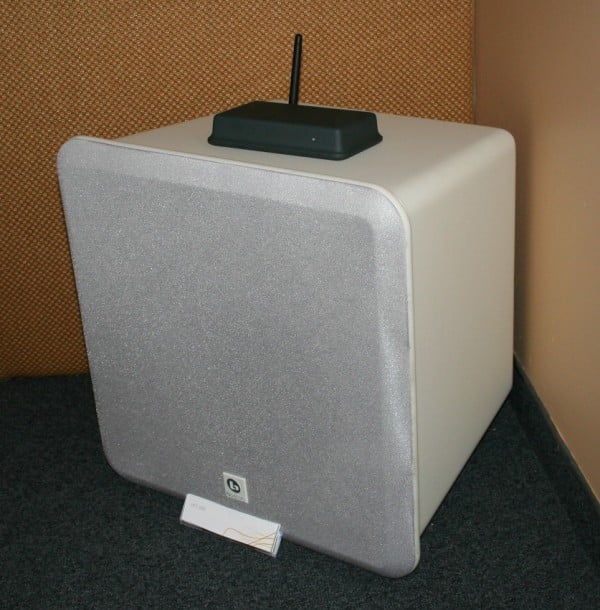 Horizon will also introduce Boston's first wireless subwoofer and a
number of speaker packages. You can always tell the subs that are included in
the packages as they are downfiring rather than the standalone subs which fire
forward. The TVee Model Two is a speaker bar that is paired with a second wireless
sub that does NOT claim 5.1 sound out of a single speaker. Instead it is a
"TV speaker upgrade" for people that recognize the poor sound of flat
panel display speakers but don't want to spend the money on one of the
(generally) substandard 5.1 single speaker solutions.
Horizon will also introduce Boston's first wireless subwoofer and a
number of speaker packages. You can always tell the subs that are included in
the packages as they are downfiring rather than the standalone subs which fire
forward. The TVee Model Two is a speaker bar that is paired with a second wireless
sub that does NOT claim 5.1 sound out of a single speaker. Instead it is a
"TV speaker upgrade" for people that recognize the poor sound of flat
panel display speakers but don't want to spend the money on one of the
(generally) substandard 5.1 single speaker solutions.
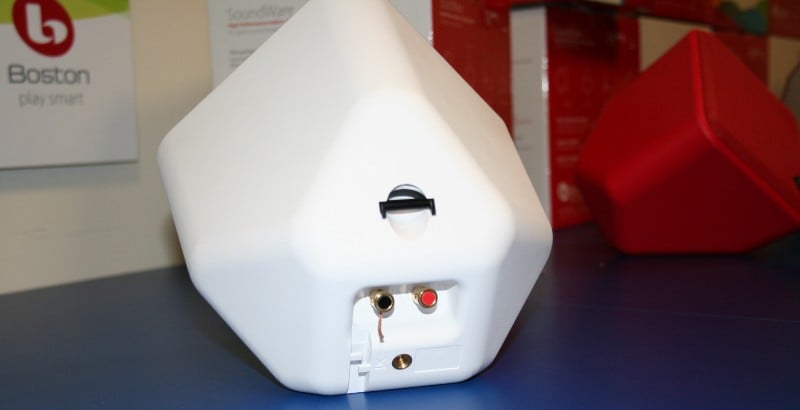
Lastly the SoundWare speaker, an unusually shaped speaker that is designed for easy placement, was introduced. Sealed and able to pass the "submersion" test (dunking it under water), the SoundWare speaker sports an unusual cabinet and mount designed to be installed easily in corners. This interior/exterior speaker comes in a number of colors (seven were announced) and has is one of the few offerings from Boston without an integrated stand. Don't worry, however, the back of the speaker is cut in a number of angels so that you are almost guaranteed to find one that will orient the speaker in the way you want.
The Boston Experience - Manufacturing
If you've ever watched an episode of Dr. Who, you can imagine what it is like to walk into a room and find much more space than you expected. That's what it was like for me on the Boston production and design tour. From a design standpoint, Boston uses absolutely cutting edge computer programs to models their cabinets, drivers, and materials. While many companies might use off the shelf drivers, Boston actually has the ability to design and create many of them in house. They literally had rooms full of baskets, spiders, magnets (that one was bad for the credit cards), surrounds, and cones. The designer can literally model the driver and enclosure on the computer and predict not only the normal frequency response but also how the driver will break up as it is pushed past its limits.
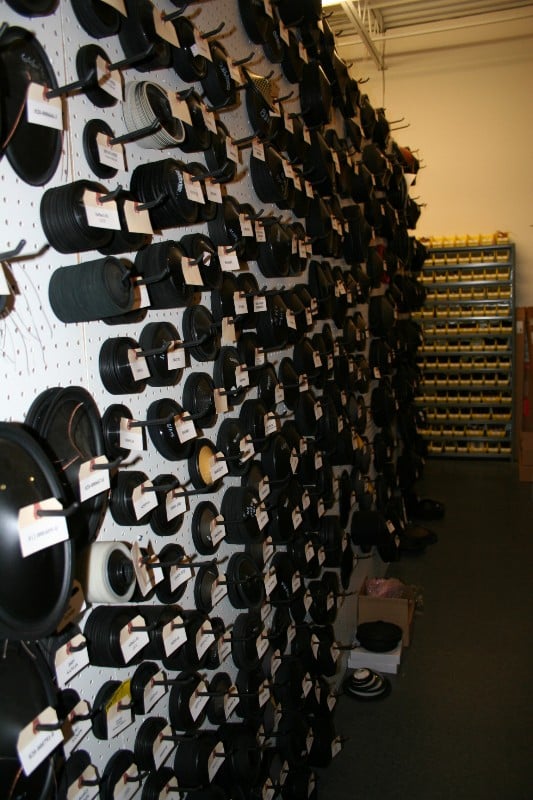
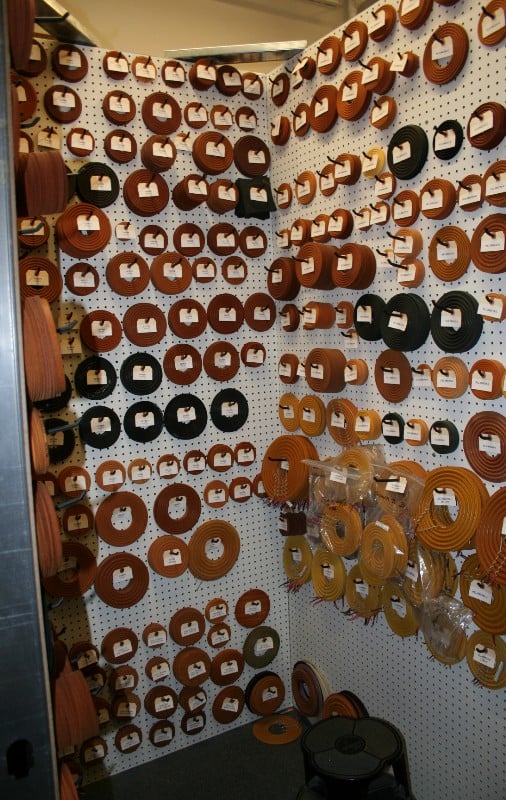
 Once the
designer or design team is satisfied with the design (remember, they are
modeling the enclosure as well), they send it out to be modeled. Now this
probably means that the driver itself is built in house and the enclosure is
either built on the premises out of MDF or off site out of resin through a
process called stereolithography. Stereolithography you've probably seen before but you
may not know the name. It is where a computer controlled
laser is used to cure a photo-sensitive resin, layer by layer, to create the 3D
part or enclosure. The best part is that it is fast (sometimes they can get the
enclosure back the same day) and all you need to provide is a CAD drawing. While
I'm sure it isn't cheap, the fact that everything is modeled on the computer
first means that many of the problems such as clearances and cabinet resonance
frequencies have already been addressed. What does this mean for you the
consumer? A 2 year concept to production cycle on average rather than 4. That's
a lot more innovation in a short period of time.
Once the
designer or design team is satisfied with the design (remember, they are
modeling the enclosure as well), they send it out to be modeled. Now this
probably means that the driver itself is built in house and the enclosure is
either built on the premises out of MDF or off site out of resin through a
process called stereolithography. Stereolithography you've probably seen before but you
may not know the name. It is where a computer controlled
laser is used to cure a photo-sensitive resin, layer by layer, to create the 3D
part or enclosure. The best part is that it is fast (sometimes they can get the
enclosure back the same day) and all you need to provide is a CAD drawing. While
I'm sure it isn't cheap, the fact that everything is modeled on the computer
first means that many of the problems such as clearances and cabinet resonance
frequencies have already been addressed. What does this mean for you the
consumer? A 2 year concept to production cycle on average rather than 4. That's
a lot more innovation in a short period of time.
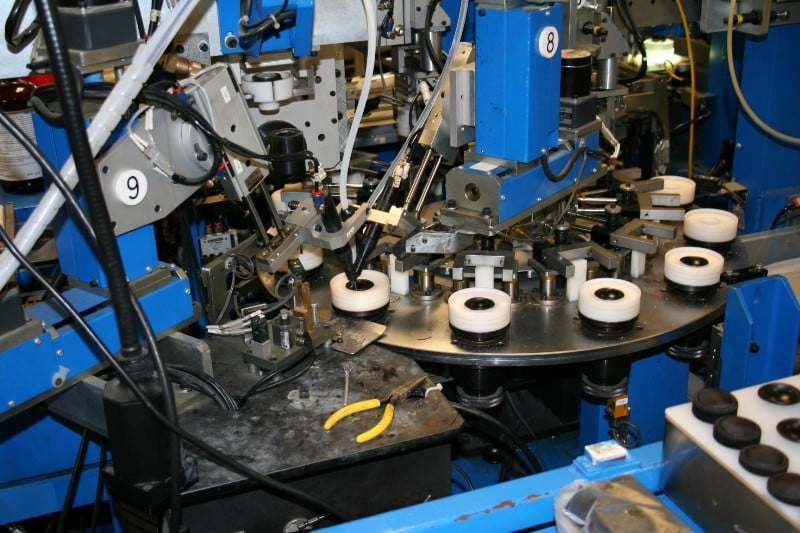 What was most interesting to watch was the device that molds
woofer cones and the machine that assembles tweeters (about 4800 in an 8 hour
shift). After seeing pallets full of driver parts, it was fascinating to see
them come together in a full working driver. While they mostly build car audio
divers in house, they use the same tolerances for their off shore
manufacturing. All drivers must measure +/- 1dB and EVERY driver is measured.
This level of commitment to quality demonstrates clearly that the
"new" Boston,
hasn't forgotten their roots. Much of the manufacturing was handled by robots
but there were plenty of people there to assist and direct the machines. We
even saw a fairly interesting demonstration of how Ferrofluid works to cool
tweeters.
What was most interesting to watch was the device that molds
woofer cones and the machine that assembles tweeters (about 4800 in an 8 hour
shift). After seeing pallets full of driver parts, it was fascinating to see
them come together in a full working driver. While they mostly build car audio
divers in house, they use the same tolerances for their off shore
manufacturing. All drivers must measure +/- 1dB and EVERY driver is measured.
This level of commitment to quality demonstrates clearly that the
"new" Boston,
hasn't forgotten their roots. Much of the manufacturing was handled by robots
but there were plenty of people there to assist and direct the machines. We
even saw a fairly interesting demonstration of how Ferrofluid works to cool
tweeters.

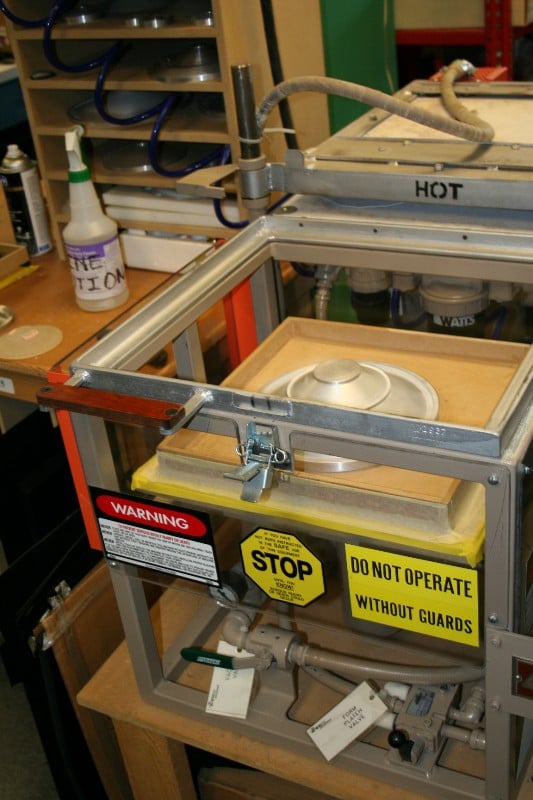
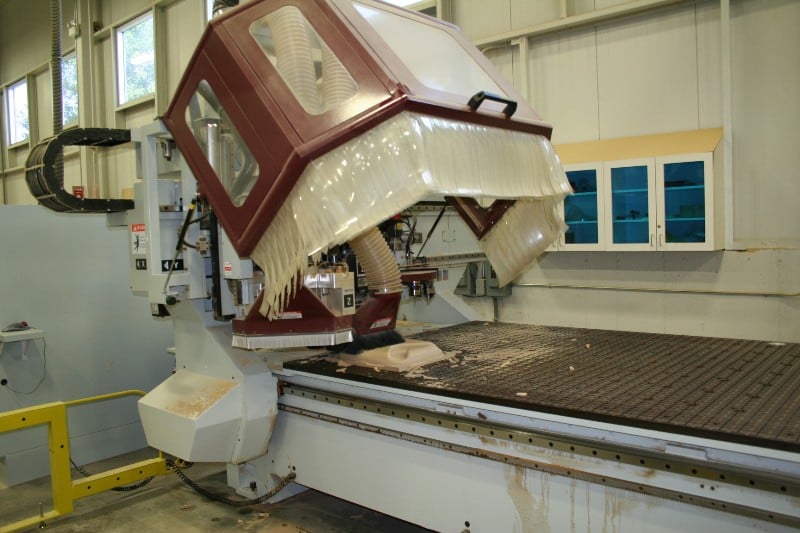
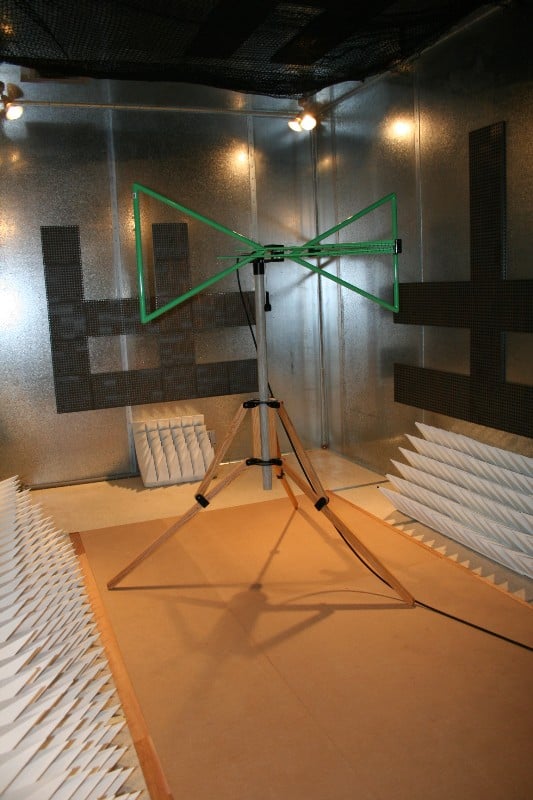 While they took us to a lot of interesting places including
a fully RF shielded room, the Snell woodshop (ever wonder how they make the
non-traditional enclosure of the A7
Reference Towers? Think huge robotic arm with a router on the end), by far
the coolest was the speaker graveyard. External to the rest of the
building because the Fire Marshal thought
having a room where they "blow up speakers" was a bad thing, the room
is smaller than you'd think. Packed with amps and speakers, ear protection is a
must as drivers are pushed to their limits and beyond. When I asked if the
computer modeling predicted how long before driver failure, they responded
"Yes, but we have to know for sure." I got the distinct impression
that they think blowing up drivers is just as cool as I do.
While they took us to a lot of interesting places including
a fully RF shielded room, the Snell woodshop (ever wonder how they make the
non-traditional enclosure of the A7
Reference Towers? Think huge robotic arm with a router on the end), by far
the coolest was the speaker graveyard. External to the rest of the
building because the Fire Marshal thought
having a room where they "blow up speakers" was a bad thing, the room
is smaller than you'd think. Packed with amps and speakers, ear protection is a
must as drivers are pushed to their limits and beyond. When I asked if the
computer modeling predicted how long before driver failure, they responded
"Yes, but we have to know for sure." I got the distinct impression
that they think blowing up drivers is just as cool as I do.

On the Horizon
So, what's next for Boston? Vista. Unconnected to the operating system of the same name, the Vista series speakers will be the higher end of the two new lines out of Boston probably falling between Horizon and the E-series. While we were not able to see any of these speakers, they promise to continue the new tradition of interchangeable grills but will also have wood elements (probably not unlike the E-series though I couldn't get confirmation of this) that will also be interchangeable. The Boston Horizon speakers will be rolling out in October of 2007, the TVee Model Two and accompanied wireless sub in September 2007, and the SonicWare speakers in August 2007. With the Vista rollout to be announced at CES with the product available probably a few months (at the most) later, you're looking at a major overhaul of the Boston brand and lineup. Sure, they've still got all their outdoor and professional products, but all in all, it'll be around 50 new products and speakers launched! That's the most in the brand's history. It's an exciting time for Boston. Changes of this magnitude are always a big risk. Only the time will tell how big the payoff will be.
As Associate Editor at Audioholics, Tom promises to the best of his ability to give each review the same amount of attention, consideration, and thoughtfulness as possible and keep his writings free from undue bias and preconceptions. Any indication, either internally or from another, that bias has entered into his review will be immediately investigated. Substantiation of mistakes or bias will be immediately corrected regardless of personal stake, feelings, or ego.
View full profile Subscribe to our newsletter