Bang & Olufsen On Location
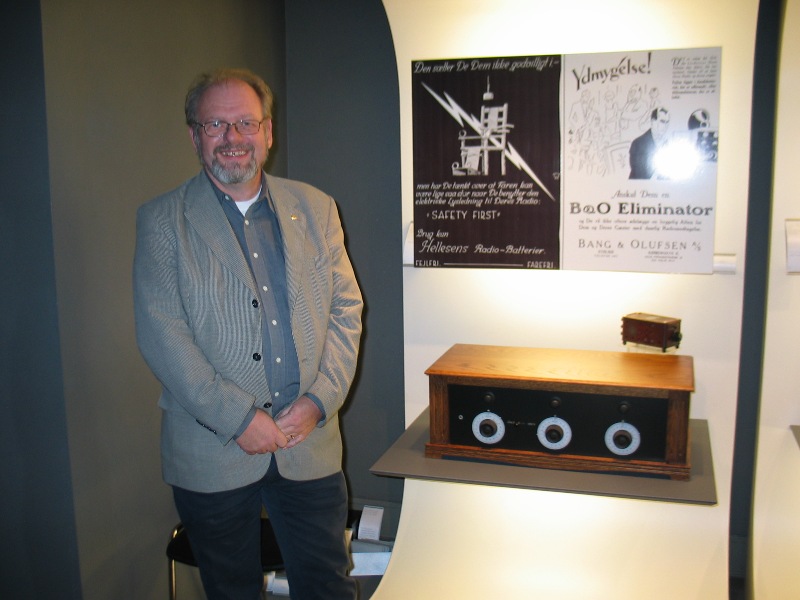
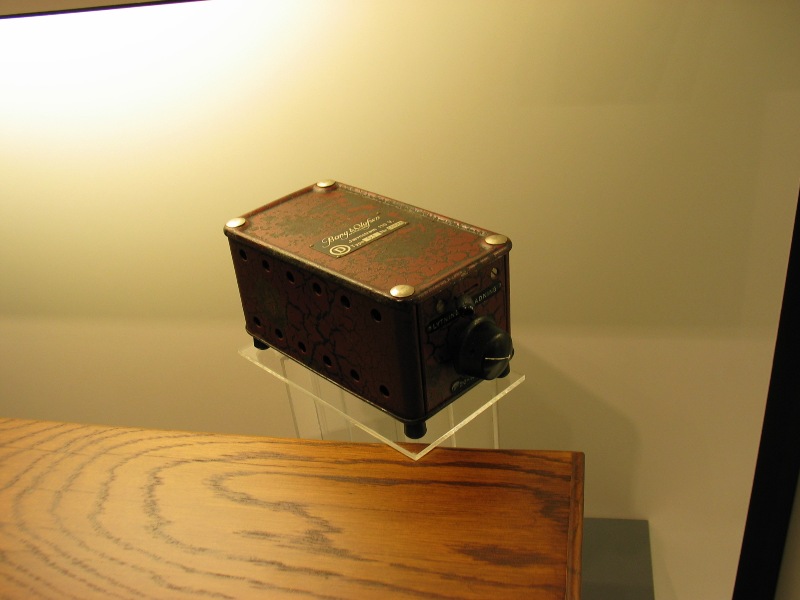
Bang & Olufsen has been around for many, many years - probably a lot more than many American's would realize. Founded in 1925 by Peter Bang and Svend Olufsen, the two had an idea that radios should run on the "mains" (line voltage ran to the home) rather than on batteries. At the time, radios predominantly ran on batteries as power from the mains was generally "dirty" and fluctuated heavily. Bang and Olufsen designed a power conditioner and regulator that allowed their radios to be run on power from the wall. So popular was this unit that in 1927 they turned it into a stand alone box called the Eliminator (their first commercially viable product) that could be used to convert other radios to mains power. It wasn't really until the introduction of the "5-lamper" radio (which had 5 vacuum tubes - hence the name) that B & O really cemented their reputation as a quality radio manufacturer. ![[denmarkmap]](../../../images/denmarkmap.gif)
The Bang and Olufsen partners sold their radios locally in Struer, Denmark at first but quickly became known not only for the quality of their sound, but for their design. Some might ask, "Why Struer?" If you aren't asking, you've never been there. On the northwest coast of Denmark, saying that it is rural is an understatement. Dotted by farms and the occasional town, the area is an eclectic mix of rustic cottages and contemporary "glass box" design. But like so many things in life, the choice of location was based on one thing - love. One of the two fell in love with a girl in Struer, and the rest, as they say, is history.
Day 1 - The Farm
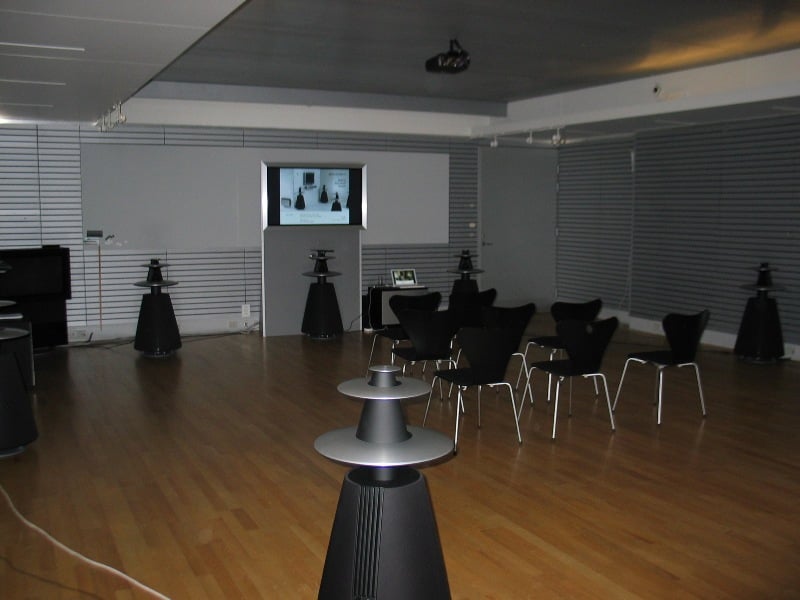
![[TheFarm1]](../../../images/thefarm1.jpg/image) I literally stepped off the plane in Karup and was whisked off to "The Farm" - the new headquarters of Bang & Olufsen - for a quick introduction. Peter Thostrup took us through a quick history of Bang & Olufsen, focusing mostly on the direction of the company and some of the company philosophy. In brief, B & O is focusing mostly on opening more and more dedicated stores (called B1 stores) and pulling away from the store-in-store concept (B & O products sold within another store). To highlight all this, The Farm has a mock store and listening room. Personally, I liked the prices in the store (everything was listed as 0,000 DKK) and it really gave you a feel for how the stores are set up. The listening room was set up in a 5.0 arrangement with four BeoLab 5s on each corner and a BeoLab 7-4 doing center duties. These speakers feature the Acoustic Lens Technology that is becoming more and more prevalent on B & O speakers. Basically, the driver is mounted pointed up into a vertical baffle that spreads the sound in 180 degrees. The room was a bit bright but very representative of the types of rooms one might find in a contemporary Danish home - lots of minimalist furniture, hard surfaces, and clean lines.
I literally stepped off the plane in Karup and was whisked off to "The Farm" - the new headquarters of Bang & Olufsen - for a quick introduction. Peter Thostrup took us through a quick history of Bang & Olufsen, focusing mostly on the direction of the company and some of the company philosophy. In brief, B & O is focusing mostly on opening more and more dedicated stores (called B1 stores) and pulling away from the store-in-store concept (B & O products sold within another store). To highlight all this, The Farm has a mock store and listening room. Personally, I liked the prices in the store (everything was listed as 0,000 DKK) and it really gave you a feel for how the stores are set up. The listening room was set up in a 5.0 arrangement with four BeoLab 5s on each corner and a BeoLab 7-4 doing center duties. These speakers feature the Acoustic Lens Technology that is becoming more and more prevalent on B & O speakers. Basically, the driver is mounted pointed up into a vertical baffle that spreads the sound in 180 degrees. The room was a bit bright but very representative of the types of rooms one might find in a contemporary Danish home - lots of minimalist furniture, hard surfaces, and clean lines.
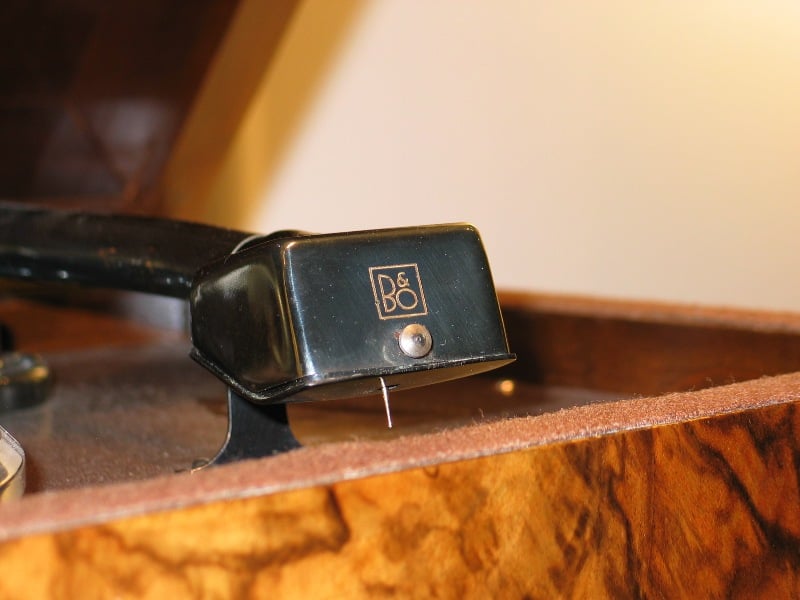
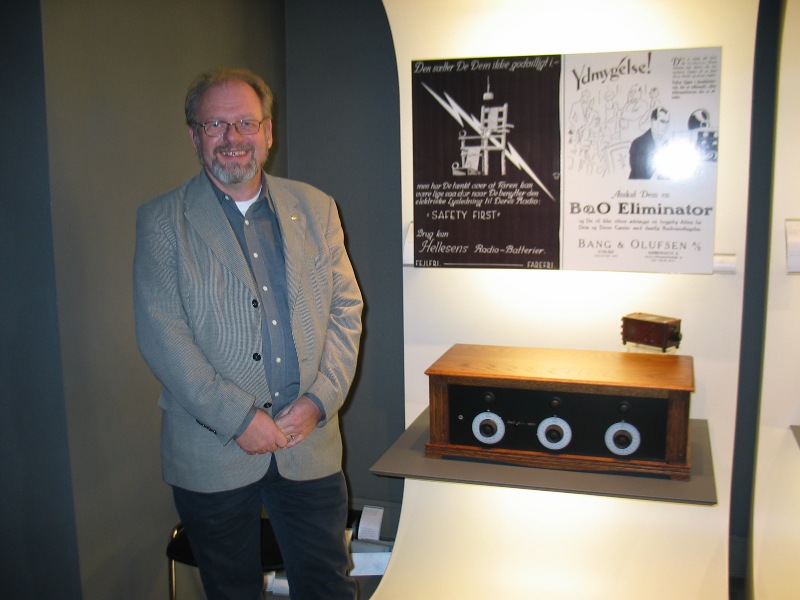
The highlight of the first night was a tour of the Bang & Olufsen museum by B & O consultant Ronny Kaas Mortensen . Both interesting and informative (especially impressive after a 15 hour flight), the museum housed a number of the most influential and landmark products B & O has produced over the years. It started off with the "mains" radio, one of the first designed to utilize line voltage rather than battery power. This led to The Eliminator which was a stand alone box that allowed any radio to be run off of line voltage. Even way back in 1925, you can see how B & O had this flat, sleek design that carries through to tod ay.
![[Hyperbo2]](../../../images/hyperbo2.jpg/image) Bang and Olufsen had many interesting designs. Most of the museum pieces highlighted innovative technology (such as push button operations, tone controls, etc.) but a few were there simply for the design. Two of my favorite early designs revolved around a chair and a car.
Bang and Olufsen had many interesting designs. Most of the museum pieces highlighted innovative technology (such as push button operations, tone controls, etc.) but a few were there simply for the design. Two of my favorite early designs revolved around a chair and a car.
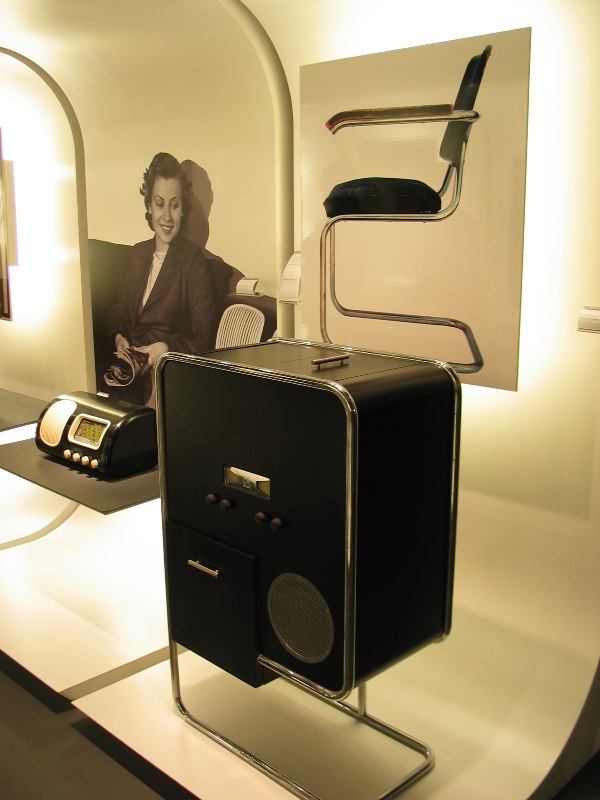
The Hyperbo 5RG Steel was based on a simple chrome frame chair with black leather stretched across it (they even had a picture of the chair above the display unit). The Hyperbo 5RG Steel is truly the precursor to the modern "all in one" unit incorporating a radio, loudspeaker, and record player. It even had a storage shelf for your records. As I was soon to learn, Bang & Olufsen is even now striving along the same lines.
![[BeoLit]](../../../images/beolit.jpg) My personal favorite was the BeoLit - the first radio made with a Bakelite cabinet introduced in 1939. The lines on this unit were exceptionally smooth and clean. The off-white on black made an interesting if a bit dated contrast. Something about the shape of the unit seemed familiar but I couldn't place it until Mr. Mortensen informed us that the design of the unit was inspired by the dashboard of a Buick. Quickly, I could see how the shape could fit nicely into the dash of a car. Personally, I think it is pretty interesting to discover how these designers and engineers came up with their ideas. The shape of the BeoLit (which, incidentally, started the whole "Beo" prefix that carries on to this day) was apparently very difficult to manufacture and a lot of effort went into getting the cabinet shape just right.
My personal favorite was the BeoLit - the first radio made with a Bakelite cabinet introduced in 1939. The lines on this unit were exceptionally smooth and clean. The off-white on black made an interesting if a bit dated contrast. Something about the shape of the unit seemed familiar but I couldn't place it until Mr. Mortensen informed us that the design of the unit was inspired by the dashboard of a Buick. Quickly, I could see how the shape could fit nicely into the dash of a car. Personally, I think it is pretty interesting to discover how these designers and engineers came up with their ideas. The shape of the BeoLit (which, incidentally, started the whole "Beo" prefix that carries on to this day) was apparently very difficult to manufacture and a lot of effort went into getting the cabinet shape just right.
There were lots of other interesting points on the tour including a sort of offhand remark about sedition during the Second World War. Apparently, the Germans suspected that some subversive activities were going on in the B & O plants and constantly inspected them trying to discover what was going on. The Bang & Olufsen employees and owners apparently were a bit too sneaky because they never could find any evidence against them. In lieu of evidence, and probably out of frustration, someone blew up the factories in the night (which is why there were no products launched or dated around 1945).
B&O; On Location: Research and Measurement
![[DevelopmentBuilding]](../../../images/developmentbuilding_th.jpg) Day 2
Day 2
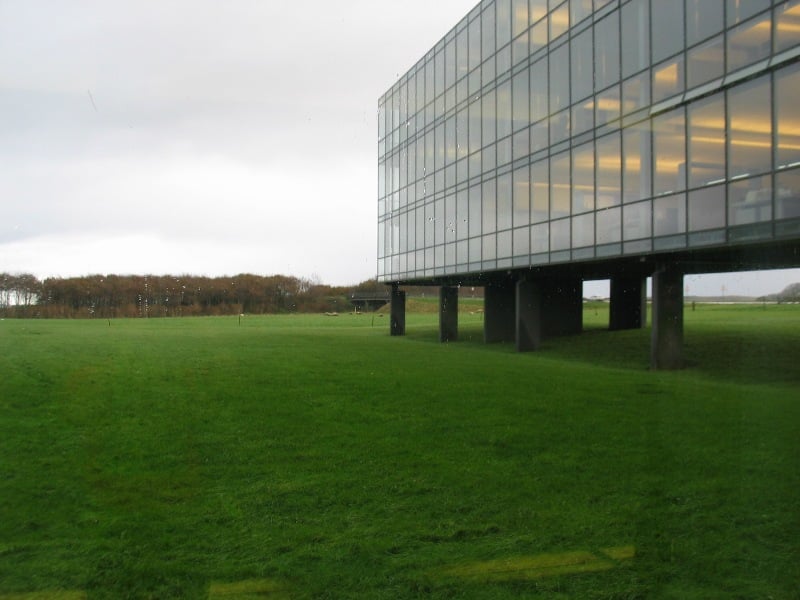
![[DevelopmentBuilding]](../../../images/developmentbuilding.jpg)
This is what I personally was waiting for. I had many preconceived notions of Bang & Olufsen (not all of them very flattering) and I wanted to get at the heart of the matter. At the end of day one, we were taken to dinner with a number of the acoustics employees and I had the good fortune (though I didn't realize it at the time) to sit near Geoff Martin. Geoff, I later found out, has the interesting title - Tonmeister (I'm not sure how Ton Loc feels about this). Apparently, at B&O, he is one of THE acoustic guys. He recently moved over from designing the sound system in the Audi A8 to the Acoustics Department where he is involved with developing DSPs and running listening tests. The latter is where I found myself at the beginning of Day 2
Perceptional Research
![[ListenRoom1]](../../../images/listenroom1.jpg) Listening tests are a strange and wonderful thing. No matter what you do, no matter the precautions you take, SOMEONE will find a flaw (real or imagined) in your methodology. I was impressed first of all that B&O did listening tests. How many manufacturers have the owner and designer sit in a room and listen to their speaker until it sounds "right" to their ear? Probably more than you think. Bang & Olufsen employs some interesting techniques to get the most out of their listening sessions.
Listening tests are a strange and wonderful thing. No matter what you do, no matter the precautions you take, SOMEONE will find a flaw (real or imagined) in your methodology. I was impressed first of all that B&O did listening tests. How many manufacturers have the owner and designer sit in a room and listen to their speaker until it sounds "right" to their ear? Probably more than you think. Bang & Olufsen employs some interesting techniques to get the most out of their listening sessions.
In order to enter either of the two listening rooms, you pass through a control room. B&O employees stated that they had to be very careful what boxes and equipment were visible in this room so as to not taint the perceptions of the listeners. The listening rooms are fairly small (measuring 16.5 x 20 x 8 feet for Room 1 and 13 x 21 x 8 feet for Room 2). They can sort of comfortably fit 8-10 people. There is an acoustically transparent but optically opaque curtain on a track hanging from the ceiling. The speakers (or groups of speakers) would be hidden behind the curtain. The room is furnished similarly to a traditional living space including bookshelves, area rugs, pictures on the walls, and regular couch and chairs. Listening Room 1 was actually a room within a room (a "floating" room) which helps isolate it from outside noises.
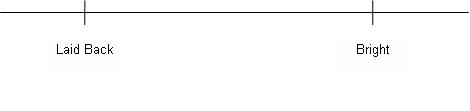
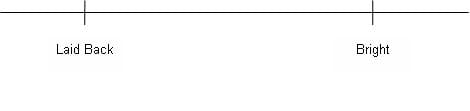
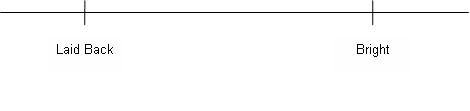
Without getting into all the science behind this type of testing (for more information, read here ), what Bang & Olufsen does is bring in a group of people (called a Listening Panel) and "train" them through common experiences and agreed definitions. The Listening Panel gets together to agree on a number of words and adjectives to use when describing the sound of a speaker. Through an iterative and extensive process, pairs of "attribute" words are agreed upon with opposite meanings (for example: Bright vs. Laid Back, Open vs. Subdued, etc.). These words are used in a graphic rating scale by putting them at either end of a line:

Once a number of these pairs of anchor words are agreed upon, the scale is used to judge the sound of speakers. Using a computer, each member of the Listening Panel is allowed to flip between the two sets of speakers at will and then asked to rate the sound of a speaker by using either a touch screen or a mouse (these listening tests are done individually). The computer measures the distance (in millimeters) and enters the score into the database for statistical analysis. If, after a factor analysis, it is discovered that some of the participants seem to be using the same word to describe different attributes, the Listening Panel is reconvened to further clarify and perhaps add a new attribute pair or two. Note that the words are not located at the end of a line. It is possible, using this scale, to go past the location of the word if the experience warrants.
You may be thinking, "Well, where's the 'Do you like it' question in this methodology?" I know I was thinking it. The idea of this type of research is to have participants objectively quantify their subjective (or perceptional) experience of a speaker. Whether or not a person likes a "bright" speaker, nearly everyone can identify a speaker as being bright (or in this case, brighter than the comparison speaker). Not only can a trained listener identify the differences between a bright and laid back speaker, but they can do it consistently. While I wasn't able to get an exact answer out of the B&O staff, it seems that this data is used to ensure that each successive line of speakers has the signature Bang & Olufsen sound. They can also use this type of research to maintain a consistent sound when they change suppliers or make minor design changes within a speaker line.
Measurement
![[gert]](../../../images/gert.jpg) We were welcomed to the Development Department Measurement Room by Gert Kudahl Munch and Knud-Erik Laurdsen. Gert did most of the talking and was both informative and pleasant. I was particularly impressed with the sign on the door to the measurement lab. It read "A Measurement is Worth a Thousand Words." A true Audioholic mantra if I've ever heard one. The measurement lab - the "Cube" - is a ~40 foot box with two walls completely lined with what looked to be fiberglass. In the center of the room was a speaker sitting on a wooden shelf suspended from a ceiling on a large mechanical boom. The boom can raise and lower the speaker, rotate the speaker left and right, and bring the entire apparatus back to the balcony. With the addition of another device (which was not in place during the tour) the unit can be used to measure a speaker at any rotation or elevation (typically they do 140 different measurements for their total power response calculations though that can vary as they see fit).
We were welcomed to the Development Department Measurement Room by Gert Kudahl Munch and Knud-Erik Laurdsen. Gert did most of the talking and was both informative and pleasant. I was particularly impressed with the sign on the door to the measurement lab. It read "A Measurement is Worth a Thousand Words." A true Audioholic mantra if I've ever heard one. The measurement lab - the "Cube" - is a ~40 foot box with two walls completely lined with what looked to be fiberglass. In the center of the room was a speaker sitting on a wooden shelf suspended from a ceiling on a large mechanical boom. The boom can raise and lower the speaker, rotate the speaker left and right, and bring the entire apparatus back to the balcony. With the addition of another device (which was not in place during the tour) the unit can be used to measure a speaker at any rotation or elevation (typically they do 140 different measurements for their total power response calculations though that can vary as they see fit).
![[measure1]](../../../images/measure1.jpg) A microphone was suspended 10 feet in front of the speaker. B&O uses a MLS measurement to test the speaker's response to an impulse. This measurement is used to find the on-axis frequency response as well as the power response. There was a lot of talk about the importance of the power response (the power response of a loudspeaker signifies the sound pressure averaged over all directions of radiation rather than just one - basically the combination of the on and off axis response in 3 dimensions ) over the frequency response. They believe that having a smooth power response is more important than a smooth frequency response for a speaker. There was also an infinite baffle set up to test the specs of the drivers. This was mostly for the woofers rather than the tweeters. It was explained that since the B&O speakers have such a small internal volume, having each of their drivers perform within a certain specification is very important.
A microphone was suspended 10 feet in front of the speaker. B&O uses a MLS measurement to test the speaker's response to an impulse. This measurement is used to find the on-axis frequency response as well as the power response. There was a lot of talk about the importance of the power response (the power response of a loudspeaker signifies the sound pressure averaged over all directions of radiation rather than just one - basically the combination of the on and off axis response in 3 dimensions ) over the frequency response. They believe that having a smooth power response is more important than a smooth frequency response for a speaker. There was also an infinite baffle set up to test the specs of the drivers. This was mostly for the woofers rather than the tweeters. It was explained that since the B&O speakers have such a small internal volume, having each of their drivers perform within a certain specification is very important.
![[InfiniteBaffle]](../../../images/infinitebaffle.jpg) Since each of Bang & Olufsen's speakers are powered and contain some sort of internal DSP or EQ, each speaker is adjusted while in the testing facility. From the computer terminal, measurements can be taken, the boom can be moved, EQs can be set and changed, and DSPs can be adjusted. Once the speaker is performing the way the engineer and/or designer thinks it ought, it is sent over to the listening rooms for tests. If the data from the listening tests indicate that additional tweaking is needed, the speaker is sent back to the lab for another round of measurements and adjustments. While Gert might be doing this alone, more likely an acoustical engineer would be sitting next to him and collaborating.
Since each of Bang & Olufsen's speakers are powered and contain some sort of internal DSP or EQ, each speaker is adjusted while in the testing facility. From the computer terminal, measurements can be taken, the boom can be moved, EQs can be set and changed, and DSPs can be adjusted. Once the speaker is performing the way the engineer and/or designer thinks it ought, it is sent over to the listening rooms for tests. If the data from the listening tests indicate that additional tweaking is needed, the speaker is sent back to the lab for another round of measurements and adjustments. While Gert might be doing this alone, more likely an acoustical engineer would be sitting next to him and collaborating.
B&O; On Location: Production
Listening Room 2
![[john2]](../../../images/john2.jpg/image) Listening Room 2 was newly renovated and hadn't really been used yet as was explained by Peter John Chapman, another acoustical engineer with Bang & Olufsen. Peter actually took us through a quick listening test. Unbeknownst to us, a pair of BeoLab 5s and BeoLab 3s were behind the curtain. In a room that size (13 x 21 x 8 feet), it was really hard to distinguish a great deal between the two (even though the 3s are so much smaller) other than the differences in bass output.
Listening Room 2 was newly renovated and hadn't really been used yet as was explained by Peter John Chapman, another acoustical engineer with Bang & Olufsen. Peter actually took us through a quick listening test. Unbeknownst to us, a pair of BeoLab 5s and BeoLab 3s were behind the curtain. In a room that size (13 x 21 x 8 feet), it was really hard to distinguish a great deal between the two (even though the 3s are so much smaller) other than the differences in bass output.
It seemed that the left BeoLab 5 was toed out a hair too much as the soundstage seemed a bit unbalanced. In that small of a room (and I was sitting way in the front) the larger speakers were perhaps a tad too much.
![[ListeningRoom2]](../../../images/listeningroom2.jpg) After the curtain was pushed aside, we got a chance to see the BeoLab 5's "room correction" known as Adaptive Bass Control. Essentially, each speaker sports a little mic tucked under the bottom of the speaker. When engaged, the mic extends, the speaker runs through a couple of test tones, the mic extends a little farther, more test tones, and then it is over. In order to demonstrate this, Peter moved the left BeoLab 5 into the corner (we weren't the first group, so this explains the misplacement of this speaker during our listening test). He then demoed some music switching between the left and right speaker. It was easy to hear the amount of bass bloat that was created by boundary reinforcement. After running the Adaptive Bass Control sequence, the left speaker sounded remarkably better. Note that the Adaptive Bass Control only works at 500Hz and lower.
After the curtain was pushed aside, we got a chance to see the BeoLab 5's "room correction" known as Adaptive Bass Control. Essentially, each speaker sports a little mic tucked under the bottom of the speaker. When engaged, the mic extends, the speaker runs through a couple of test tones, the mic extends a little farther, more test tones, and then it is over. In order to demonstrate this, Peter moved the left BeoLab 5 into the corner (we weren't the first group, so this explains the misplacement of this speaker during our listening test). He then demoed some music switching between the left and right speaker. It was easy to hear the amount of bass bloat that was created by boundary reinforcement. After running the Adaptive Bass Control sequence, the left speaker sounded remarkably better. Note that the Adaptive Bass Control only works at 500Hz and lower.
While this is not a true room correction system, it is a fairly interesting dependent boundary and room mode system. In non-optimal placements, the Adaptive Bass Control will help the BeoLab 5 sound the way the designers meant for it to sound. When asked about true room correction (something that corrects for a particular seat or listening area), all I got was, "We are working on it."
Production
![[Production]](../../../images/production.jpg/image) The tour of the Production facility necessitated a short bus trip to a separate building and checking our cameras and cell phones at the door. There are a couple of units in production that we would inevitably see (and we did) that we can't discuss (yet). As Jens Rahbek took us through the production floor, the most immediately noticeable aspect was the relative quiet and lack of people. Sure, there were people at work but there seemed to be more empty stations than working ones. We were assured that this is not only normal, but that the facility was in a "high production" mode in preparation for the holidays.
The tour of the Production facility necessitated a short bus trip to a separate building and checking our cameras and cell phones at the door. There are a couple of units in production that we would inevitably see (and we did) that we can't discuss (yet). As Jens Rahbek took us through the production floor, the most immediately noticeable aspect was the relative quiet and lack of people. Sure, there were people at work but there seemed to be more empty stations than working ones. We were assured that this is not only normal, but that the facility was in a "high production" mode in preparation for the holidays.
When taking a look at the product line offered by B&O, a common theme rings though. Aluminum. Lots of it. It doesn't take a brain surgeon to figure out that it would be cost effective for Bang & Olufsen to manufacture their own aluminum. While we weren't shown this process, we were told that not only did B&O produce their own aluminum, but they provided metal for other companies including BMW. The anodized aluminum on hand was absolutely gorgeous. Because they control the entire process, if a designer wants all the aluminum to be brushed in a certain direction (like they did on the BeoVision 7), they can do that (at I'm sure a fraction of the cost it would take to special order that out of house).
![[BeoLab3]](../../../images/beolab3.jpg) As we viewed the "naked" speakers, we couldn't help but ask some technical questions. Reportedly, they get their drivers from Tymphany (manufacturer of ScanSpeak, Peerless, and Vifa), Philips (for some tweeters), and Foster (for their high volume drivers). The internals of some of the speakers are so tight they literally had to trim back the internal circuit boards to allow for passive radiator movement (as in the BeoLab 3s). It now became painfully obvious as to why their drivers need to perform within very tight specifications. With all the amps and internal electronics, if the driver's performance is off too much, it could really affect the sound.
As we viewed the "naked" speakers, we couldn't help but ask some technical questions. Reportedly, they get their drivers from Tymphany (manufacturer of ScanSpeak, Peerless, and Vifa), Philips (for some tweeters), and Foster (for their high volume drivers). The internals of some of the speakers are so tight they literally had to trim back the internal circuit boards to allow for passive radiator movement (as in the BeoLab 3s). It now became painfully obvious as to why their drivers need to perform within very tight specifications. With all the amps and internal electronics, if the driver's performance is off too much, it could really affect the sound.
As we were watching them assemble a BeoLab 5, we observed the speaker entering a large heavily dampened chamber with a number of mics placed at different locations. Even though we couldn't hear it (except for some of the lowest bass), it was obvious that some serious testing was going on. Gert explained, "We do not make BeoLab 5s, we clone them." The original BeoLab 5's performance (they call it the "Golden Sample") has been measured and recorded and each BeoLab 5 that comes off the line is measured and its performance is compared to the reference. The internal electronics is modified to mirror the Golden Sample's performance within a certain tolerance. There are also other tests that are conducted including a "Rub and Buzz" test to ensure that there are no mechanical noises. If a wire is rubbing or if the cabinet isn't airtight, this would cause the unit to fail. They have techs on hand to fix any problems that may arise. Regardless, the final performance of each and every BeoLab 5 is recorded so that if any of them need repairs, they know exactly how the speaker is supposed to sound. Literally, they can scan the barcode on the speaker and download the sonic signature for each speaker as it left the factory. They go so far as to make sure that each of the components of the speaker is at the proper temperature when assembled to reduce measurement error.
With a background in Organizational Behavior, I couldn't help but ask a few questions about how Bang & Olufsen is organized and run. My curiosity was piqued when Jens pointed out that each production employee was allowed to set up their station however they want. In every American production facility that I've ever been or worked in, you are shown your station, what to do, and that is that. Changes are generally not tolerated much less encouraged. In the B&O factory, each and every station is on a hydraulic lift so that the individual worker can find the right height for them. Teams seem to be a central feature on all levels and managers are seen more as consultants rather than taskmasters. At the beginning of every day, each worker is told the number of units that they are required to produce. If they get that done early, they leave. Evaluation of performance is not based on number of units produced but on quality of work. As long as they produce quickly and accurately, they can not only excel, but leave early every day (theoretically)! When yearly evaluations are done (which was being undertaken during our visit), the manager is required to solicit the opinions of coworkers when performing the evaluation. I didn't get into detail about this but it sounds basically like a 360 degree evaluation that gets much lip service here in the states.
In the break room, there was a display of some of the current products (so that the employees can see what exactly they are producing). There is also a HUGE wall of pictures. The pictures are of people that have worked for 25 years or more. By my unscientific count, there were around 1000 of them! If someone works for B & O for 50 years, they get an updated plaque. That is really a thing of the past, though, as the law now mandates retirement at 65. You'd literally have to start working for B&O at 15 (which is possible with reduced hours). You can work for yourself at 65 or older (as a consultant or something) but you can't work for anyone else. Weird.
B&O; On Location: Poster Presentation
In order to give us an opportunity to talk with some of the other members of the acoustics team, they had a "Poster" presentation ala Grad school. In a large room, tables were set up with little displays of a number of different products. I'll take you through a couple of the more interesting items.
Stereo Subs
Geoff Martin once again took center stage as he demonstrated how using two subs in stereo can increase the spaciousness of the sound reproduced. First using a pink tone and then music, Geoff flipped between mono, dual mono, and stereo presentation of subwoofer content. He started with a high crossover point and then reduced it down in a few steps to 120Hz. With the pink tone, it was easy to see how spaciousness was increased by the stereo subs even as low as 120Hz. With the music, I had a harder time hearing it. There are a few problems with this concept. First, it is hard enough to place two subs in a room much less place two equidistance on both sides (so you can take advantage of the stereo). Second, and more importantly, most music is recorded with mono bass (though classical music tends to have more widely spaced mics). You'd have to find a recording where the left and right channels used different mics placed sufficiently apart to garner a different bass response. While not impossible to find, it isn't very common either. Lastly, we feel that evening out the bass response in a room by reducing room modes is immensely more important to sound quality than stereo subwoofer imaging. In the ideal room, stereo subwoofers might be cool, but to the average listener, dual mono subs offer the greater advantage.
Audi A8 Speaker System
![[Audi1]](../../../images/audi1.jpg) Shown off by Dirk Hogenfeld, Training and Event Manager in the Automotive department, the Audi A8 car audio system was by far the most popular exhibit regardless of the rain. Designed by Bang & Olufsen, this system sounds remarkably good for being inside a car. It consisted of 13 speakers and a subwoofer (totaling 14 speakers), 3 across the front, 2 in each of the four doors, and three across the back. There are presets for Driver, Front seats, Rear seats, and All. The tweeters (utilizing the Acoustic Lens Technology) popped out of the dash in the front corners. Each speaker is incased in its own box (rather than using the internal volume of whatever part of the car it is installed in) to control its frequency response and sound.
Shown off by Dirk Hogenfeld, Training and Event Manager in the Automotive department, the Audi A8 car audio system was by far the most popular exhibit regardless of the rain. Designed by Bang & Olufsen, this system sounds remarkably good for being inside a car. It consisted of 13 speakers and a subwoofer (totaling 14 speakers), 3 across the front, 2 in each of the four doors, and three across the back. There are presets for Driver, Front seats, Rear seats, and All. The tweeters (utilizing the Acoustic Lens Technology) popped out of the dash in the front corners. Each speaker is incased in its own box (rather than using the internal volume of whatever part of the car it is installed in) to control its frequency response and sound.
![[Audi2]](../../../images/audi2.jpg) All told, the system sports over 1000 watts of power but when you step out of the car, even at earsplitting volumes, the sound is remarkably muted (a testimony to the Audi's ride and noise dampening material). Only the bass really escapes with any conviction. Inside, the demo highlighted how well the DSP works to create a soundstage for the intended audience. When focused on the Driver (where I was sitting), All, or the Front seat, I enjoyed a fairly convincing soundstage that was only slightly skewed left due to my proximity to the left tweeter and driver's side window. When Rear seat was chosen, the soundstage disintegrated considerably though the guys in the back seemed to be having a good time. All and all, I was pretty impressed. Currently, B&O only has systems in the high-end Audi's though they are looking to expand into other vehicles.
All told, the system sports over 1000 watts of power but when you step out of the car, even at earsplitting volumes, the sound is remarkably muted (a testimony to the Audi's ride and noise dampening material). Only the bass really escapes with any conviction. Inside, the demo highlighted how well the DSP works to create a soundstage for the intended audience. When focused on the Driver (where I was sitting), All, or the Front seat, I enjoyed a fairly convincing soundstage that was only slightly skewed left due to my proximity to the left tweeter and driver's side window. When Rear seat was chosen, the soundstage disintegrated considerably though the guys in the back seemed to be having a good time. All and all, I was pretty impressed. Currently, B&O only has systems in the high-end Audi's though they are looking to expand into other vehicles.
3M Littmann Electronic Stethoscope
![[Scope]](../../../images/scope.jpg) Imagine my surprise when I saw a stethoscope on display. For the first time, I saw a product that wasn't branded by the iconic B&O logo. The 3M Littmann Electronic Stethoscope has the ability to reduce background noise, uses a DSP to focus solely on lung or heart noise (to the exclusion of the others), and can even take your heart rate. Apparently the stethoscope is sold pretty widely in the United States though I can't say I've ever noticed a doctor using one. Of course, I can't say I've looked all that closely either. The next time I visit the pediatrician, I'll ask about them.
Imagine my surprise when I saw a stethoscope on display. For the first time, I saw a product that wasn't branded by the iconic B&O logo. The 3M Littmann Electronic Stethoscope has the ability to reduce background noise, uses a DSP to focus solely on lung or heart noise (to the exclusion of the others), and can even take your heart rate. Apparently the stethoscope is sold pretty widely in the United States though I can't say I've ever noticed a doctor using one. Of course, I can't say I've looked all that closely either. The next time I visit the pediatrician, I'll ask about them.
Rub and Buzz Test Demo
![[RubnBuzz]](../../../images/rubnbuzz.jpg) During the Production Tour, we got to see the testing of the BeoLab 5. One of those tests was the "Rub and Buzz" test. To show how this test of harmonic distortion works, B & O had a driver in a box hooked up to a laptop. The box was dampened and there was a mic inserted through the top. The test started by running a test tone through the driver and taking a measurement. Then, a piece of a paperclip was taped on top of the driver and the test was run again. Even from outside the box you could hear the buzzing. The test took all of a couple of seconds and you could easily see on the laptop how poorly the driver failed the test (indicating that it could detect more subtle differences). They had a number of drivers on hand just in case one got damaged. The tech that was running the test looked all too eager to blow a couple of the drivers. The boys from Mythbusters would be proud.
During the Production Tour, we got to see the testing of the BeoLab 5. One of those tests was the "Rub and Buzz" test. To show how this test of harmonic distortion works, B & O had a driver in a box hooked up to a laptop. The box was dampened and there was a mic inserted through the top. The test started by running a test tone through the driver and taking a measurement. Then, a piece of a paperclip was taped on top of the driver and the test was run again. Even from outside the box you could hear the buzzing. The test took all of a couple of seconds and you could easily see on the laptop how poorly the driver failed the test (indicating that it could detect more subtle differences). They had a number of drivers on hand just in case one got damaged. The tech that was running the test looked all too eager to blow a couple of the drivers. The boys from Mythbusters would be proud.
3D Headset
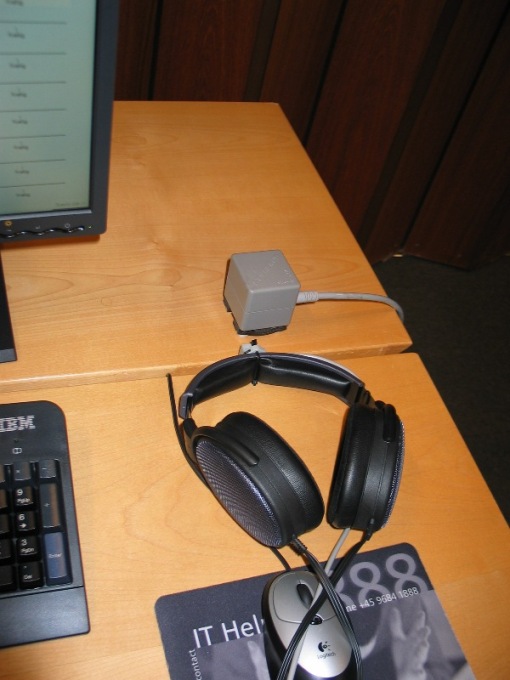
![[Headphones]](../../../images/headphones.jpg/image) Back at CEDIA, Yamaha was demoing the YSV-1 Multi Channel Headphone Preamp
Back at CEDIA, Yamaha was demoing the YSV-1 Multi Channel Headphone Preamp
Dinner at the Olufsen's
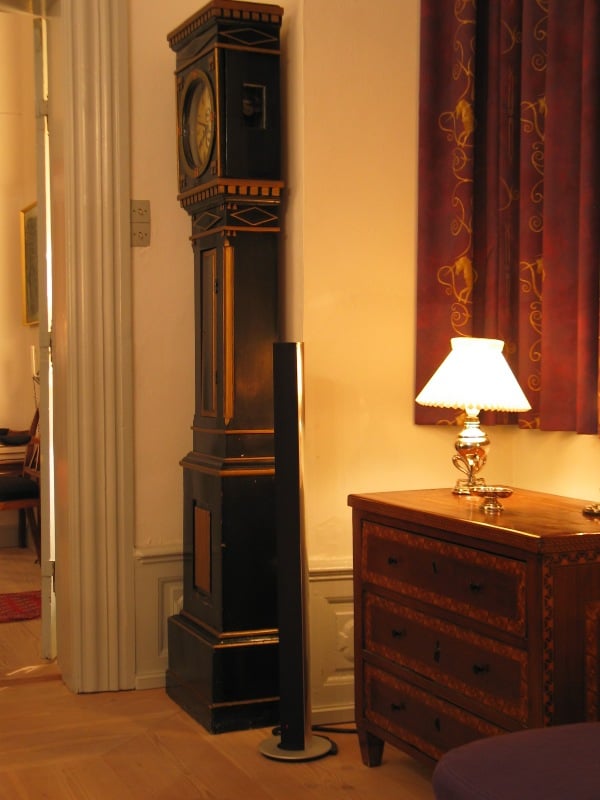
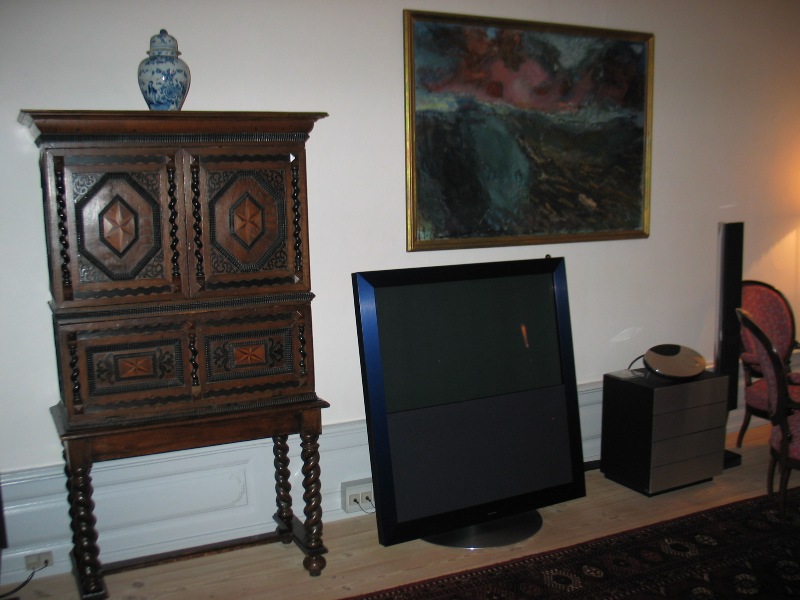
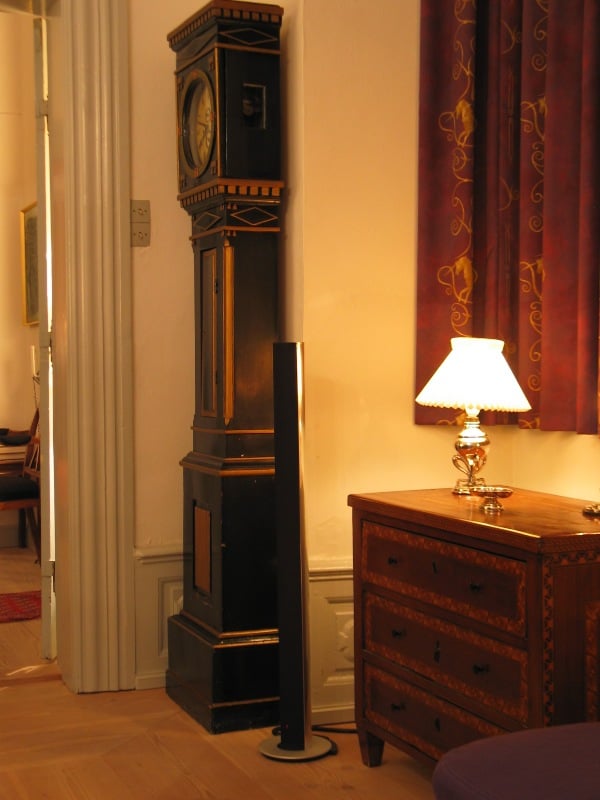
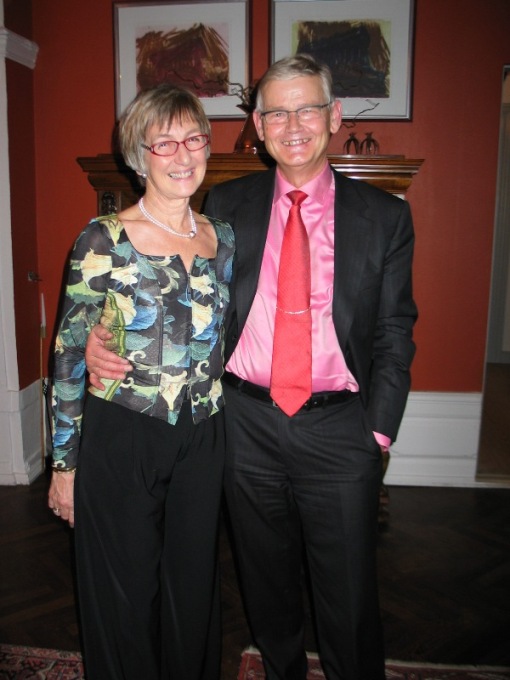
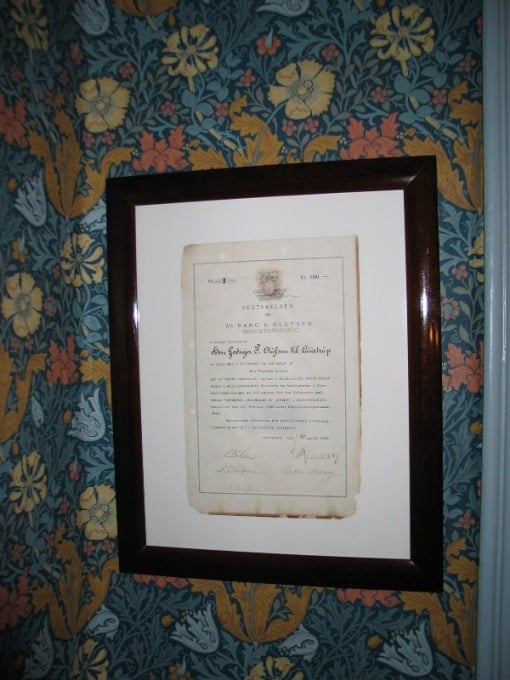
After a short break (where I fed my jet lag by taking a nap), we were brought to dinner at the place where it all began - the Olufsen family farm. It was raining and icky that night but the home was no less impressive. Unfortunately, I couldn't really get exterior pictures but I did get a chance to photograph the inside. The small portion of the home that we had access to was still large by American standards and furnished with an eclectic mix of antiques and Bang & Olufsen equipment. Seeing a flat screen TV and a thin aluminum tube filled with drivers next to a grandfather clock and exquisitely inlaid furniture seemed befuddling at times. Still, the home was beautiful and Peter Skak Olufsen and his wife Susanne were gracious hosts. I must say that the meal was by far the best that I had while in Denmark. We were served shrimp salad, veal tenderloin, and a plate of various desserts including crème brulee. Yum.

B&O; On Location: Demos
Day 3 - Listening Tests and Demos
![[Test21]](../../../images/test21.jpg) We headed back to The Farm for the most anticipated of the trip's activities - the listening tests. Instead of visiting the same room we visited the first night, we were taken to what looked to be a conference room. The room was filled with hard surfaces and a disturbing lack of furnishings. Nary a soft surface to absorb sound in sight. We were treated to a 7.0 (they consider the BeoLab 5's full range) demo of the bean scene from House of Flying Daggers and the big wave from the HD DVD version of The Perfect Storm . Of course, the first thing that was said by the B&O staff was that the room was a bit bright. Yeah, a bit. Some of the highs were a bit unbearable but overall it was a fairly interesting demo.
We headed back to The Farm for the most anticipated of the trip's activities - the listening tests. Instead of visiting the same room we visited the first night, we were taken to what looked to be a conference room. The room was filled with hard surfaces and a disturbing lack of furnishings. Nary a soft surface to absorb sound in sight. We were treated to a 7.0 (they consider the BeoLab 5's full range) demo of the bean scene from House of Flying Daggers and the big wave from the HD DVD version of The Perfect Storm . Of course, the first thing that was said by the B&O staff was that the room was a bit bright. Yeah, a bit. Some of the highs were a bit unbearable but overall it was a fairly interesting demo.
![[BeoVision1]](../../../images/beovision1.jpg) Next, we were introduced to the BeoVision 9 - Bang & Olufsen's new flagship 50" display. At ~$20,000 one would wonder why a 50-inch plasma utilizing Panasonic glass would interest anyone that didn't have huge piles of money cluttering up the house. Well, the BeoVision 9 is much more than a just a 720p display. The display sits on top of a large integrated center channel that utilizes the B&O Acoustic Lens Technology. The base of the unit swivels at a touch of a button on the remote. There are presets for the remote so that you can program different positions for the TV depending on your sitting location. The picture brightness will also adjust automatically to the ambient light in the room.
Next, we were introduced to the BeoVision 9 - Bang & Olufsen's new flagship 50" display. At ~$20,000 one would wonder why a 50-inch plasma utilizing Panasonic glass would interest anyone that didn't have huge piles of money cluttering up the house. Well, the BeoVision 9 is much more than a just a 720p display. The display sits on top of a large integrated center channel that utilizes the B&O Acoustic Lens Technology. The base of the unit swivels at a touch of a button on the remote. There are presets for the remote so that you can program different positions for the TV depending on your sitting location. The picture brightness will also adjust automatically to the ambient light in the room.
But that is not all. Remember that all the B&O speakers are powered. This means that they can all be controlled by the BeoSystem 3 - essentially a processor that can control up to 10 speakers. The BeoSystem 3 can also "flip" your room so that if you have an "everyday" viewing area on one wall and a "movie" viewing area (with a projection screen) on another, the BeoSystem 3 can be programmed to utilize the same speakers in both configurations. Surrounds become mains and mains become surrounds. It is perhaps a hard thing to describe but very intuitive when demoed. Although the unit is designed by, and probably best used with, B&O speakers it can be used with other systems as well. You would need to provide amps but the unit can decode all the current DTS and Dolby formats as well as set channel levels and distances. These settings can of course be modified based on the different area presets.
![[BeoVision2]](../../../images/beovision2.jpg) But that is not all. On top of all this, the BeoVision 9 has the BeoMedia 1 integrated into the unit. The BeoMedia 1 is essentially a media server for music, Internet radio, and pictures. Rather than streaming media off other computers on your network, the BeoMedia has an integrated hard drive that can be used to store all of that media locally. Reportedly, the BeoMedia can be set to automatically download media from your computer as it is added (music only, not pictures). The interface to the BeoMedia is the coolest I've seen to date. It even allows you to web browse with the remote in what looks to be a fairly effective way. This is something I've never seen done without the aid of an external mouse. I'm hoping to get a unit to test in the near future.
But that is not all. On top of all this, the BeoVision 9 has the BeoMedia 1 integrated into the unit. The BeoMedia 1 is essentially a media server for music, Internet radio, and pictures. Rather than streaming media off other computers on your network, the BeoMedia has an integrated hard drive that can be used to store all of that media locally. Reportedly, the BeoMedia can be set to automatically download media from your computer as it is added (music only, not pictures). The interface to the BeoMedia is the coolest I've seen to date. It even allows you to web browse with the remote in what looks to be a fairly effective way. This is something I've never seen done without the aid of an external mouse. I'm hoping to get a unit to test in the near future.
The picture on the BeoVision 9 looked very nice. I didn't notice any real obvious problems during the short demo. Of course, Bang & Olufsen provides all of their own electronics with the set. What this unit really represents is the idea of total system integration. When you buy this display you get a display, processor, media server, center channel, and more all in one box. All you need to buy is a transport and speakers. I guess if you have the money and want the ultimate in clean installs, this is the way to go.
Additional Products
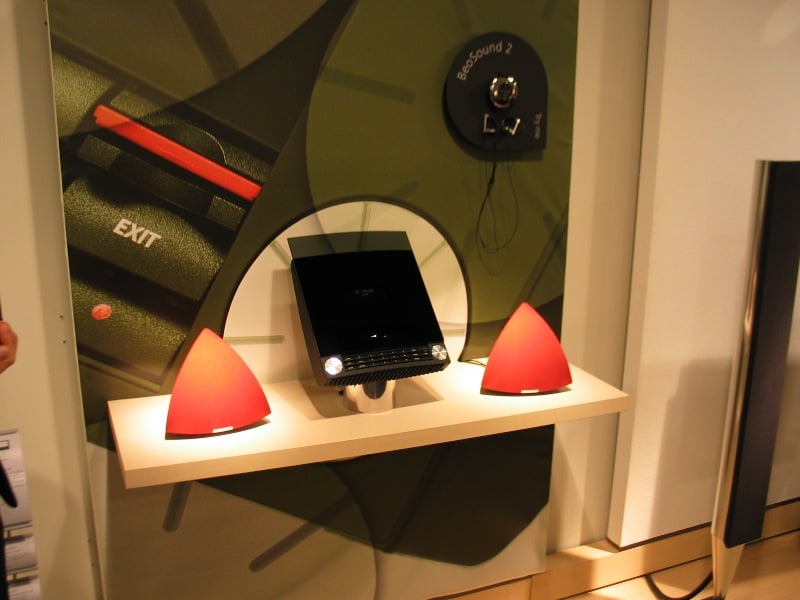
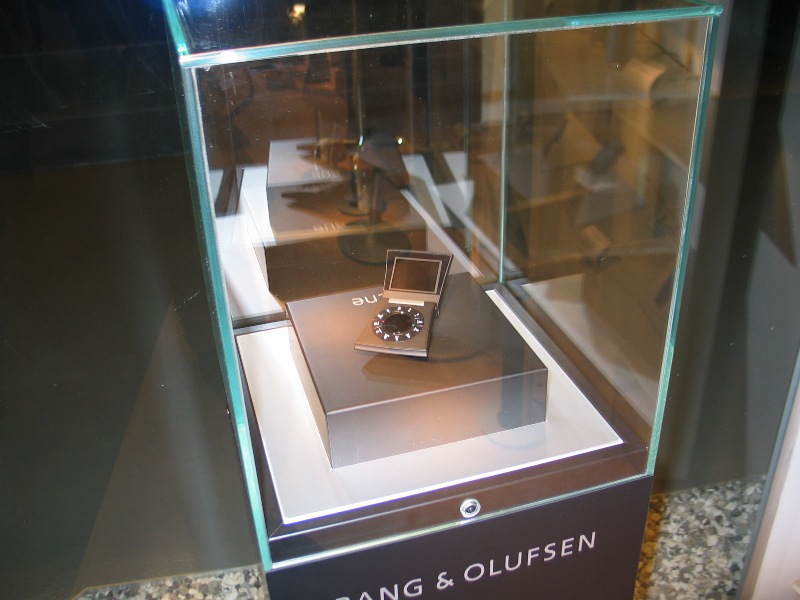
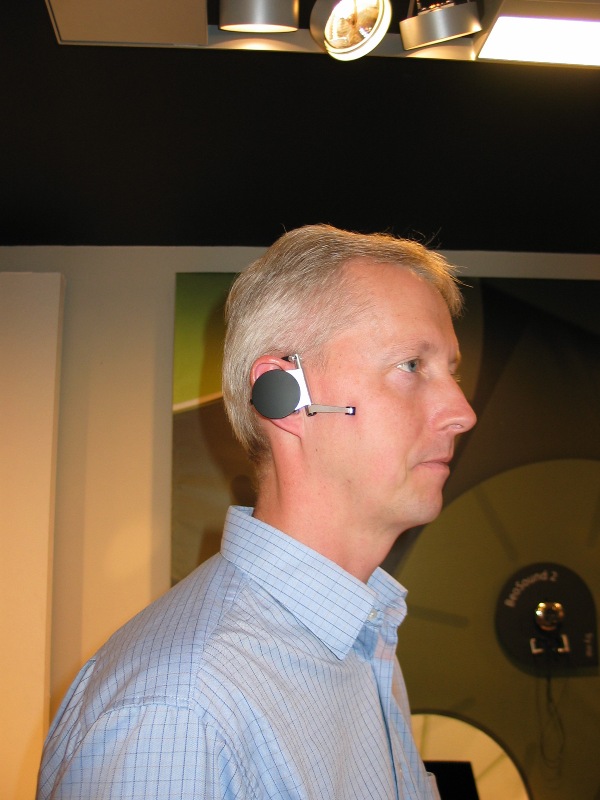
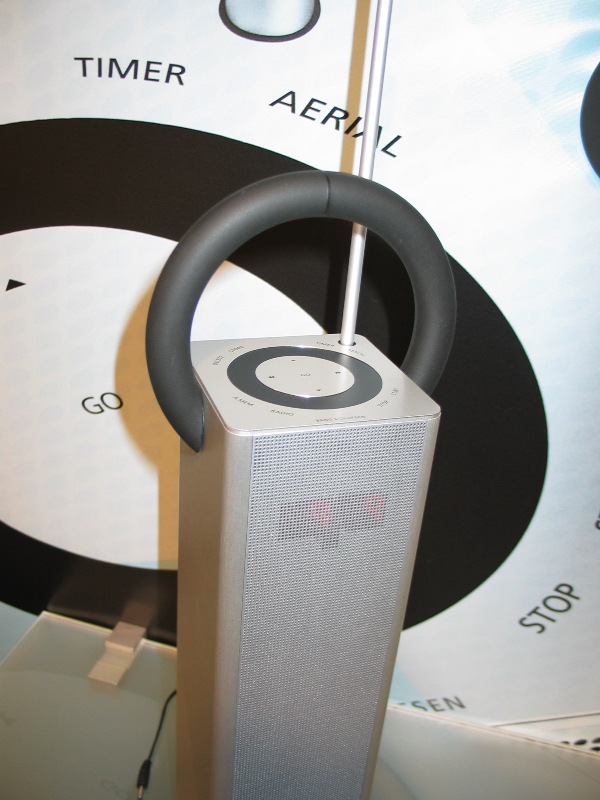
We got a chance to see and, to some extent, play with a number of different products from Bang & Olufsen while visiting the mock store at The Farm. We toyed with production units like the quart milk box shaped BeoSound 3 - a portable radio/SD card reader, the desk-sized BeoLab 4 speakers, and even a pyramid-shaped speaker designed for nearfield listening with interchangeable exterior grills of different colors to fit any mood. The Serene cellphone was interesting - a cool if slightly pointy portable phone with a camera in the hinge. I loved the the circular keypad and the way it automatically opened with just a touch, though the fact that you have to talk into the screen and listen to the keypad seemed a little counterintuitive to me. The phone retails for around $1500 (yikes) while the EarSet 2 retails for a "mere" $300 or so. The EarSet 2 is a Bluetooth headset which claims up to 4 hours talk time and 100 hours of standby time. It looks kind of like something made by the Borg but it is light and seems to be fairly comfortable. You'll be reading more about the EarSet 2 in the future.
B&O; On Location: Additional Pictures and Sights
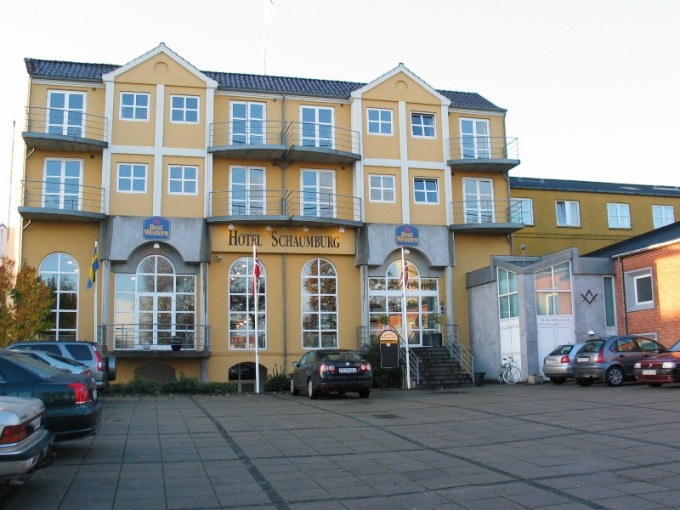
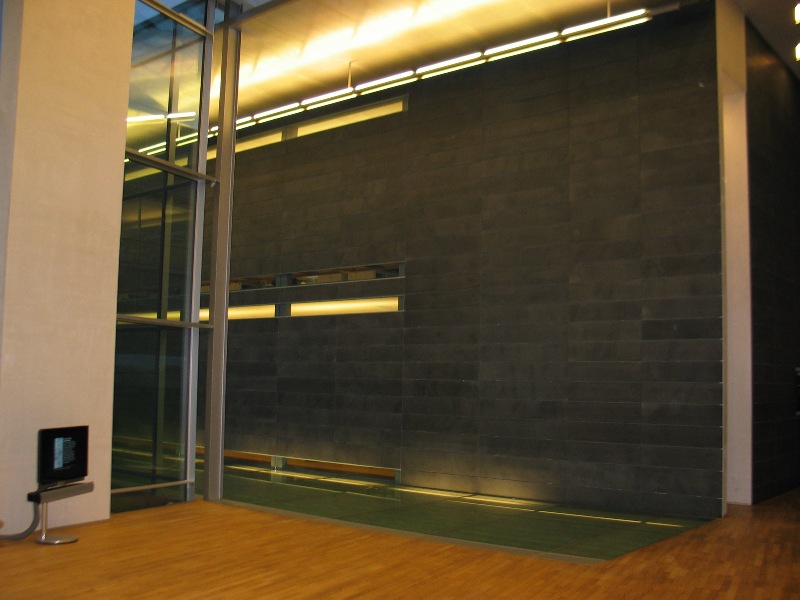
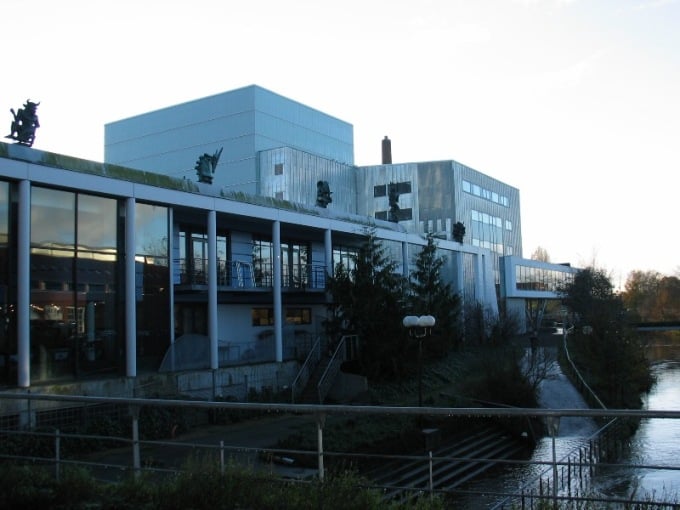
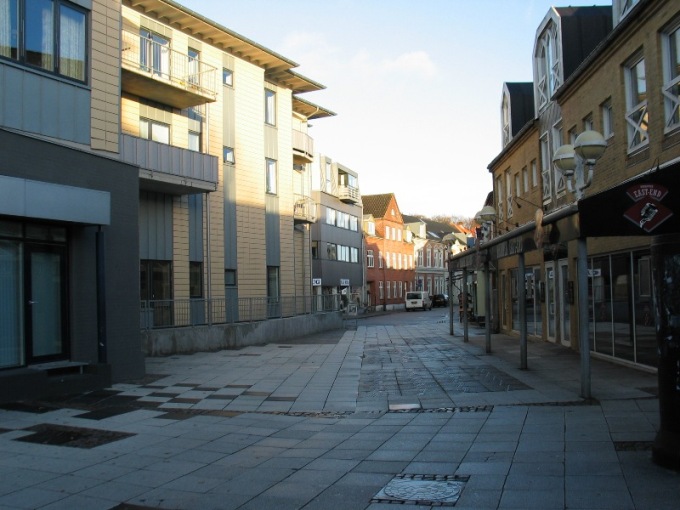
![[TheFarmSheep]](../../../images/thefarmsheep.jpg/image) The area around Struer is very rural but has a kind of charm that can't be denied. Rolling hills, lush green fields, livestock and windmills abound. Of course, Struer is near the coast so they have the benefit of fresh seafood and a more temperate climate than the inland communities. I brought a sweater but I really didn't need it. The Best Western we stayed at (I know - it was even across the street from a Blockbuster) was nice though had traditionally small European style rooms. Some of the journalists from the colder climates were complaining about the hotel being too hot but I (from Florida) thought it was just right.
The area around Struer is very rural but has a kind of charm that can't be denied. Rolling hills, lush green fields, livestock and windmills abound. Of course, Struer is near the coast so they have the benefit of fresh seafood and a more temperate climate than the inland communities. I brought a sweater but I really didn't need it. The Best Western we stayed at (I know - it was even across the street from a Blockbuster) was nice though had traditionally small European style rooms. Some of the journalists from the colder climates were complaining about the hotel being too hot but I (from Florida) thought it was just right.
|
|
|
|
|
|
|
|
|
|
|
|


Traveling Overseas
If you've never traveled overseas, you don't know what you are missing. As soon as you exit an American based plane and enter one from nearly ANY OTHER country, you will immediately notice the change. Better food, better service, metal silverware… Let's put it this way, on the way over, I traveled SAS (Scandinavian Airlines). I had my own small touch screen monitor with my choice of games, movies, music and more. Plus, I could view outside cameras on the front of the plane and pointing down. Talk about cool (though a bit disconcerting during landing). On the way back I flew Delta and could watch whatever movie was being shown on the projector (not that you could see it because it was washed out by ambient light), I got the pleasure of eating my food with the finest plastic forks, and the only game available was seeing how many people I could alienate with my snoring.
Final Thoughts
My mental attributions associated with the Bang & Olufsen name were not always flattering and rarely correct before this trip. I had not idea the history of the company and the research they put in behind their speakers. Talking with the Bang & Olufsen staff, I asked, "So, are your products more affordable here in Denmark than in the US?" "No" was the reply. B&O is under no illusions that their products are inexpensive. They know where they stand in the marketplace. But they also have a vision - a vision for a line of products that have a specific look about them and perform well. Bang & Olufsen products are not for everyone, and they know that. But I found it reassuring to know that it was not all smoke and mirrors. There is real technology inside those aluminum tubes. Real research goes into making them. And as long as that is the case, they've earned my respect.
B&O; On Location: Peter Petersen Interview
Interview with Peter Petersen, Director of Technology, Bang & Olufsen
![[1PPE72]](../../../images/1ppe72.jpg) I was fortunate enough to spend a few moments interviewing Peter Petersen, the Director of Technology at Bang & Olufsen. I've transcribed this almost verbatim only cleaning up a little of the text for clarity. When you see ellipses (…) it is because a train of thought was changed in mid sentence and not because of omitted information.
I was fortunate enough to spend a few moments interviewing Peter Petersen, the Director of Technology at Bang & Olufsen. I've transcribed this almost verbatim only cleaning up a little of the text for clarity. When you see ellipses (…) it is because a train of thought was changed in mid sentence and not because of omitted information.
How long have you been with B&O?
I've been with the company for 28 years.
What is your background?
I'm an electrical engineer with a Master's degree from the Danish Technical University and then after graduation I joined Bang & Olufsen. I started, in fact, in acoustics. I did some programming on automatic crossover network generation and then on to my first big task which was the introduction of CD at the beginning of the '80s.
If you had to describe Bang & Olufsen to someone that had never heard of the company, how would you describe it?
I see the important points of Bang & Olufsen qualities - of course their design, their looks. Aesthetically very well designed but combined with very, very good performance - on picture, on sound, and on user interface.
What is the philosophy of the company?
The philosophy of Bang & Olufsen to make products that are useable by human beings. We focus very much on the human aspect. So, as an engineer, you have to put yourself in the place of the end user. You are not only an engineer designing electronics or software… you are also the user. You are a user representative in the design process. So, you think of the end user's experience when designing - and to do that we have teams where a lot of people are playing this role. We have industrial designers, but also engineers very well skilled in acoustics; and picture process to make these products because we have aesthetically well-designed products but our performance has to meet the standards of the design.
What are the goals of your loudspeaker design?
Of course it very much depends on the type of product we are going for. Is it going to be a small speaker or big speaker… With the BeoLab 5 the goal was the ultimate. To produce a speaker that would give you the ultimate sound playback from a speaker. From the very low frequencies to the high frequencies… anything to meet the expectations of anybody. But when you are designing a small speaker, you have some constraints because of the size. Also, the price can be a constraint so we cannot put in all the amplifiers on the driver units that we want. Given, for instance, the size, which is the basic limiting factor then getting the best sound out of that given size.
So, does that mean you start more often with the size or shape of the speaker rather than the price point?
I would absolutely say that we would not start with the price. We would start with the size. Where are we going to see this one placed? See the placement [in the room] gives you an idea of the size [of the speaker] and then you can start working on the aesthetical design and the acoustics at the same time. Trying to get the maximum from the acoustics based on the size. Is there space for a three-way system or do we only have the space for a two-way system… amplifiers… what levels can we have, what amplifier do we need to get the best performance from these driver units?
All you speakers are active speakers. Is that something you see continuing through the future or will that change?
To be quite honest, we will be introducing an in-wall speaker that is not active in a short while. That is because of regulations - because it is difficult to put a high voltage amplifier into the walls. But the principle is active speaker[s] because we can have much more performance tuning the amplifiers for each of the drivers in the speaker systems.
Because you focus so heavily on design, is that why you need the control that an active speaker solution provides?
Yes. It's an integrated design with the acoustics, amplifier, and signal processing.
What is the process from idea to actuality in creating a new product?
We set down a team and for sure there will be a designer on that team. But also we will need the engineers that are skilled in the specific areas (if it is a speaker we will need amplifier engineer, acoustical engineer, mechanical engineer) and then they start off the project thinking "What's the target here?" What's the size, as I said. The shape? Think about where it is going to be placed [in the room], where it is going to be playing. And then the engineers should come up with new ideas, new solutions, new methods of making this product better than what we did before.
The world of technology produces improvements and we have to take them into our products. If it is a television that is a starting point, then it could be a new generation of displays with new features could be starting point for a new television. But we are always looking for starting points that [are] something new, something new we can do to generate experience on the product.
And then we run a process… maybe six months or so… and at the end of that process we have a design. And that design will be very similar to the product that will come out to the market maybe one and a half years later. Of course, we haven't really developed it yet, we have just reached the specification of the design. We also know how it sounds. If it is a television with integrated sound or if it is a loudspeaker we know the sound... we can simulate the sound. We know the rough specifications for the using space. We know the picture performance. All those experience parameters we know but haven't actually designed electronic circuits and so on. But we know, because of the skills of the engineers, we know the specifications plus the internal specifications and that is the 'build or no' vote for the big investment. Because what we have invested so far is maybe only 10% of the whole investment in the product to bring it to market. Then we make the goal and invest the rest and…
After the team comes up with the design, that goes before who to decide to continue investing?
We have a council that meets every month and they will make a decision. That decision is based on a small report… a one page report on the cost, one page on the turnover, and the rest describing the product. The most important factor is the feeling the council members have listening to or viewing the product. What is their subjective feeling… because if the product excites the whole management then it will be possible to make money on this product. This is the philosophy. You have to excite.
At that point it goes back to the engineers…
Yes. And then we'll form a project team of engineers and make the big investment.
What are your future plans for active room correction other than the speaker level system in the BeoLab 5?
Automatic correction for the placement of the listener we are experimenting on but we haven't found the right solution. We have found solutions that work if you are sitting here and there is one person in the room. The problem is, if you optimize for one person, then if there are others in the room, they will have maybe not as good an experience. Because when you get to the higher frequencies, you can optimize for one position but for other positions you will do worse. That's our experience but we will keep looking. One thing, the lens technology, because it spreads acoustic energy in all directions, it improves… enhances the sweetspot for the listener. But I wouldn't say that we have found the optimal solution yet and we will keep looking.
What about passive room correction?
That is another way but that is not in our control because we are just delivering products. But of course when you make big installations like in the BeoLiving, you are obliged to also have a skilled acoustician - someone that knows room acoustics - to know what to put that in the room. But basically that is not in our control when designing the products.
When doing your Perceptional Research, you assemble in house teams. Is there some sort of systematic way that you go test consumer reactions to a new product before it is launched?
Basically, the specifications of the sound, the sound performance, is in-house. But the tool we have is the Listening Panel. Our philosophy is that we calibrate the Listening Panel to end users in general and they are the end users' representative in this. They are trained, they are skilled, and they can be used quite fast. If you have a Listening Panel of say 8 persons, you can take them in, have tests one day and then calculate the statistics the next day and then you have the results. If you want to have the same quality of feedback you need maybe 100 people from the street - it takes a lot longer. So the philosophy is to have a Listening Panel that is trained. They are not only listening to Bang & Olufsen loudspeakers but they are forced to listen to other manufacturers loudspeakers here at Bang & Olufsen and in their homes and they are forced to go to live events where sound is important - movie theaters, concerts (both reinforced and acoustic) so they have a wide reference in their minds. And then we can use them as our measurement tools.
When speaking with Geoff Martin, he indicated that you don't always ask your Listening Panel "do you like it."
That's right. What we are looking for is that objective feedback on the "depth" on the "width" on these sorts of things. Attributes of sounds. And not going to the point where we ask if you like it or not because that's not the point. That, in the end, becomes very, very subjective.
Your testing methodology can be considered controversial - a lot of people may not buy into it. Within Bang & Olufsen, is it a popular idea?
It is a widely accepted way and therefore I would say popular. We believe in this way of doing things. So widely accepted.
[Note - I asked this question because I sensed some dissent about this procedure from some of the B&O employees I talked to.]
Your target consumer is who?
It is a person who has some preferences for a quality level and is prepared to pay for having that quality. Quality matters to that person. Quality in general. Performance. The aesthetics matter to that person. This person has placed such a high priority on these things that they are willing to spend more money.
Do you see your target consumer base expanding, contracting, or staying the same in the future?
I think our consumers are changing because, for instance, the convergence of technology. As they get more skilled in certain technology and as technology shifts… We also believe that at the moment our target base is widening. We see growth in our sales and that is because our target group is widening.
As new technologies emerge, how much pressure does Bang & Olufsen feel to "keep up?"
We are not just following every movement of the market. We basically are primarily building products for the home, for multiple homes of course because many of our customers have multiple homes [Americans, don't balk at this statement. It is much more common to have multiple homes in Europe than it is here]. When new technologies come out, we will evaluate those and see if we have good concepts to utilize this technology. We are not in the "hit and run" market you could say. It is more long term things we do.
What are your key marketing directions, avenues, etc.?
We have a strong position in what we call the B1 shops which is a Bang & Olufsen owned shop. We want to widen that channel which is an important part of the marketing. That's the Bang & Olufsen showrooms. Where you can also buy the products. And that is an important part of the marketing because you are invited to come and have the experience. Sit down, listen, watch the products work. Have the experience of all the products. This is very, very important for the customers to have the experience when they decide to buy a Bang & Olufsen product.
It seems that you have a lot of collaborative work - you work in teams. There also seems to be empowerment - workers are encouraged to set up their own stations. How does Bang & Olufsen see itself as far as a corporate structure?
I think the Scandinavian culture, the hierarchy in the society and Scandinavian companies is more flat and the floor level is empowered to do a lot of things. You don't have to ask, you don't have to wait until someone comes to tell you what to do. We expect from normal employees that they know what to do and they'll just start doing it. Of course, along some guidelines but more "guidelines" than "do this or…" kind of order.
How does someone know they are doing a good job?
You have evaluations. Each employee will be evaluated by his or her manager. And that manager will have to ask people who are working together with the given employee to do this evaluation. What we evaluate, of course, is within their specific discipline their skills but also your personal and social skills. How do you relate… how do you work in teams. Are you a front runner in teamwork or are you always sitting back. It's an evaluation that comes right around.
Every year the employee will sit down with their manager and have a talk for one and a half or two hours where they go through this evaluation and where the employee has the possibility to discuss his or her uses for the future - future work - for new directions for their job. That is standard procedure and these talks are in this period of the year. And that is independent of the talks that you have when discussing your salary. Because, of course, salary is part of the appraisal but the appraisal is more wide than just the salary.
What are the things you look for in a very good employee?
Each specific job has a role. How efficient you are in this role? You could be at the front end where idea generation and pursuing ideas and these sorts of things is important. Or you could be at the back end of a project where finalizing all the details… so depending on the specific role and the efficiency to produce results. The efficiency to produce results is based on your skills in your specific disciple but also social relations because nobody is doing a complete job on his or her own.
What about productivity versus quality of work?
Quality is number 1. You have to give the product specifications as intended. The quality is the most important.
So, say you had an employee that was brilliant - Einstein - but they didn't work well with others. Would they last long at Bang & Olufsen?
We call them "Gorillas" and the organization has to have room for these Gorillas. That means the people working around the Gorilla has to adapt. So it is not only up to the Gorilla to adapt to the team but the team has to adapt because everyone knows he's a Gorilla. He's efficient in his way. But we need to take special care. That's evaluated on the team and the team's ability to make this Gorilla efficient.
Do you have anything else you'd like to say about Bang & Olufsen?
I think when we are talking about employees, most employees are very, very motivated to work for Bang & Olufsen because of the things we do, the products we produce. Everybody is just proud and maybe that is the most important motivating factor in working with Bang & Olufsen. Salary is, of course, important but the motivation comes not only from the salary but also from products we produce, the quality, the high performance, and the image of the brand. So we are very proud to work here and have motivation from that.
As Associate Editor at Audioholics, Tom promises to the best of his ability to give each review the same amount of attention, consideration, and thoughtfulness as possible and keep his writings free from undue bias and preconceptions. Any indication, either internally or from another, that bias has entered into his review will be immediately investigated. Substantiation of mistakes or bias will be immediately corrected regardless of personal stake, feelings, or ego.
View full profile Subscribe to our newsletter