Audioholics On-Spot Location: RBH Sound
Later on RBH Sound began producing loudspeakers for a retailer in LA called Northridge Audio. They didn't advertise or market these products to avoid a conflict of interest with their other OEM customers (i.e. McIntosh, Parasound, Fosgate, etc). People nonetheless sought them out because of their high performance, which lead to a good success story and response for their products. Over the years RBH Sound was successful at helping other companies in achieving their goals. Based on their strong engineering background and sourcing ability, they took it upon themselves to enter the market under their own banner.
What sets RBH Sound apart from most companies is they are in this business for the love of audio. They aren't in it for the money as much as they wish to further the art of audio. When speaking with Roger Hassing he told me the biggest problem he has at the end of the day is to get his people to go home, especially their engineers. " Everyone here eat sleeps and drinks audio ," says Roger.
Roger attributes their success to a lot of good fortune, comradeship between employees, and their passion for their work. Because of their conservative and strategic business tactics, they are a completely debt free company. Their diverse product line keeps them stable and allows them to enjoy a steady growth of about 15% annually. Unlike most big corporations that shower the top execs with fat bonuses and salaries, RBH Sound puts much of their profits back into the company to expand their facility and also help out the local community.
Staff Biographies
Roger B. Hassing
President
 Roger Hassing, Founder and President of RBH Sound, has been a lover of audio his entire life. His family is very musically oriented; therefore, he is very aware of how specific musical instruments should sound. Not only does his background consist of engineering in the hi-fi world; he also has a wealth of experience in business. One of the hidden secrets which helps keep RBH on sound footing is Mr. Hassing's seven-year experience as an auditor for the Internal Revenue Service. In addition to his business expertise, Mr. Hassing, as well as the RBH Sound company, has a strong desire to produce the finest quality products that can possibly be produced. According to Roger, quality is more important than price; one could say, "He is a perfectionist." Roger has lived in the USA (with over fifteen years spent in the Los Angeles area), the UK and Puerto Rico . He holds degrees in Business Management and Mark eting. His work in foreign countries such as China and Korea , as well as Europe , has provided him with strong knowledge in the worldwide electronics industry, which has been very useful for the growth of RBH Sound.
Shane G. Rich
VP/ Technical Director, RBH Sound
 Shane's background in audio began in his youth. His father being an avid Hi-Fi enthusiast and professional musician, Shane was regularly exposed to auditioning equipment as his father compiled a sound system that would reproduce recordings with the most natural sound possible. Occording to Shane, " While growing up, the sound system was the focus of our house. In fact, much to my mother's chagrin, our house was purchased specifically because it provided the proper acoustic environment for the sound-system. My father was always looking to recreate the experience he had just had in the concert hall as a musician or audience member and that mindset and training has brought me to where I am today". Being an avid musician himself, Shane initially enrolled in college as a music major and since that time has performed with numerous orchestras, bands and musical ensembles in the Salt Lake City area, including 17 years of service as a member of the 23rd Army Band. After several years in the music program at Weber State University , Shane's love of physics and loudspeaker design in particular lead him to enroll in both Mechanical and Electronics engineering programs, as well as accepting part time employment at RBH Sound assembling loudspeakers. Now in his 10th year with RBH, Shane has a B.S. degree in Electronics Engineering with an emphasis in analog filter design. He still attributes much of his success as a loudspeaker designer to the countless hours spent listening to music in live settings as a performer or audience member, and the time he spent in front of his Father's Hi-Fi system.
Daren B. Egan
V.P. Sales and Marketing
 Daren has been in the audio industry for over 19 years. He began installing car audio systems when he was 15 years old. He was one of the first three MECP First Class certified mobile electronics installers in the state of Utah . Some of the vehicles he has installed audio systems in have taken IASCA awards.
The recipient of an Associates Degree in Architectural Drafting in 1993, Daren migrated from car audio sales and installation to home audio sales and installation in 1995. Joining the RBH team in October, 1996, Daren was promoted to a Sales Management position and received a Bachelor's Degree in Business Administration/Management in 1997. In the course of his employment with RBH, Daren has also assumed the responsibility of RBH's Information Technology Administration. Recently, Daren was promoted to the position of Vice President of Sales and Mark eting.
He lives in Northern Utah with his wife of 10 years, a 6-year old daughter and a 3-year old son.
Allen Lewis
Project and Purchasing Manager
 Allen has been managing projects and purchasing on both a small and large scale since 1978. He received a degree in Computer Technology while serving in the United States Air Force. During his Air Force career he managed and operated many types of computer systems from multi-million dollar big ones to networked little ones! He started the first "one stop small computer shop" in the Air Force while at RAF Chicksands in England and was in charge of Mobile Tactical Air Traffic Control Communications Systems until his retirement from Hill Air Force Base, Utah , in 1995. From young man on, he has always had a deep interest in art and music. By the time he was 18, he had already surrounded himself with the best audio equipment he could afford and had amassed a 1200 album (vinyl, what's that?) collection. Before joining the Air Force, Allen was offered an Art Scholarship to the University of Munich , but, due to family reasons at the time, could not continue the art and design training he had received while at High School in Wiesbaden Germany . Allen came on board with RBH Sound in December 1996 as production/warehouse/shipping/receiving/inventory/purchasing manager. Whew! (okay, we've grown a bit since then!) In 2003 his primary duties became purchasing and project management. He works with engineering to continuously improve existing or design new products.
John Fenn
Customer Service / Special Projects
John has been with RBH Sound for over ten years. Prior to working with RBH, he was self-employed in retail. It is because of this experience John understands the need for great Customer Service in such a competitive industry.
John obtained an Associate of Science degree from Weber State University in 1985. John learned to speak Japanese while living in Japan for a few years. John also has spent time living in China and Russia during an internship while earning a Bachelor of Arts in International Relations from Utah State University in 1990.
As the head of RBH's Product Returns Department, and with the excellent quality of RBH products, he sometimes feels like the Maytag Repairman.
John lives in Northern Utah with his wife of 20 years and two sons, 18 and 19, one of which is currently serving an LDS mission in Brazil.
RBH Sound Facilities


 Tucked away within the beautiful valley of mountains in Layton, Utah, lies a very spacious 40,000 square foot facility which houses more speakers than your local chain store warehouse. More importantly, it is the operating center for RBH Sound. All of the R & D, product development, testing of prototypes, and assembly of Signature Series products is done here. The rest of their product lines are manufactured in a remote location. In this megaplex building lies about 9,000 square feet of office space and labs whereas the remaining facility space is reserved for stocked product. Roger tells us he keeps a 3+ month inventory of all product lines, except the Signature Series which is built to order.
When I asked Roger how it was possible for them to have such an enormous facility at their disposal, he informed me that they built enough equity in prior real estate over the last seven years that it became a natural transition for them to expand to this facility. In fact, Roger claims they will likely outgrow this facility in a few years making it time to expand yet again. It was at that moment I suggested some property in Tampa, Florida (my home base), but he didn't seem too receptive.
 What's neat about this facility is its modular design base. You can rearrange office space, testing facilities, etc by a simple moving around wall dividers. Since each zone has independent air conditioning, they even have the ability to rent out and isolate unused facility space. It's a very well thought-out design to say the least.
RBH Sound spared no expense in their facilities and really went that extra mile for their employees as evident in their amenities. These include state of the art custom tiled and control automated wash rooms, a room with a massage chair for the mandatory weekly massages each employee must "endure", and a giant break room with electric stove, refrigerator, and microwave. The only thing missing are beds (which I suggested might help keep Shane Rich, their Chief Designer, on schedule for developing new products. There's no sense in going home when all of your creature comforts are brought to you, right?
The Listening Room


Perhaps one of the most widely frequented areas of the grand RBH Sound facility is their listening room. This serves as their product demo room for employees and dealers alike. It houses modest, but quality, electronics to drive all of the demo products.
The Current Equipment Configuration Consisted of:
Full blown Signature T2 System , M C616C, 61SE, 441SE, 661SE, and the new WM24s
Acurus ACT3, ACD11 CD Player, and A200x3 power amplifiers
JVC RX-DV3 DVD Digital Receiver
Yamaha CD-1000 CD Recorder
Theater Room


This is definitely the most impressive room in the facility. I discovered over the course of the two days visiting RBH Sound, residing in this room was an inseparable experience. This was CinemaSITE to the nth level featuring custom wood work from the company that does the furniture design for CinemaSITE. Though the speaker system was virtually invisible, it certainly was audible. The room sported very comfortable reclining theater seats and even a "mini" theater seat for any of the little ones who happen into their facility.
Lined on all the side walls were in-wall room treatments and a pair of SI-760's for surround duties. What really impressed me most was entering this room and noting how quiet it was, revealing a very good RT60 time without being over-damped as some treated rooms tend to be. There was still plenty of energy in the room allowing us to clearly hear distant conversation, but gone was annoying slap echo and background noise from other rooms once the door was closed.
We thoroughly enjoyed demos of The Fifth Element and Star Wars Episode II: The Clone Wars . Shane warned me the system was likely out of calibration since prior to my visit they entertained many dealers and guest who played around with the products. In addition, this room was so new that they still haven't spent the necessary time tweaking it all out. I noted their B & K processor was set to PLII Music Mode and switched it over to Cinema for our demo. The audio experience was most impressive, more so than the video presentation since I believe their projector wasn't fully calibrated. The bass was a bit overdone in level, so while they weren't looking, I turned the subs down a few dB. Overall it was a most enjoyable experience both audibly and visually. Seeing such beautiful pieces of furniture produce great sound brought a smile on my wife's face. Or course just hearing it was what did it for me.
The Current Equipment Configuration Consisted of:
SI-6100 LCR, SI-12 x2 powered by SA200s, 1010-SEP, SI-760
B & K Reference Gear, Samsung DVD player, Panasonic LCD, DaLite Screen
RBH Sound Part Two
The Testing Area
Part of the reason why RBH Sound speakers excel in performance is because of their exhaustive design and listening process as well as analytical testing and verification. While their other lines are tested in their remote facility we did manage to get a glimpse at what is done with their premier Signature Series line of products.


In their assembly area resides computers hosting diagnostic and measurement software such as L M S, M LS and Leap to do driver diagnostics, and frequency & impedance sweeps. To the above right we see a line of their venerable 6" aluminum drivers and crossovers getting ready to be installed into product.


Here we see a Signature 1010-SEP subwoofer cabinet being assembled and stuffed with insulation. To the right is a finished Signature 661-SE cabinet waiting to be stuffed with insulation, drivers and crossover components. Note the ample amount of baffling and bracing and ¾" HDF front baffle. As you can see RBH Sound cuts no corners in their cabinet design (something they have been known for since back in the M cIntosh days). Great cabinets, drivers and crossovers all add up to excellent loudspeaker design which is one of the reasons Signature Series products grace many of our reference systems.
Introducing New Loudspeaker Products from RBH Sound
 It always amazes me just how diversified RBH Sound's product lines are. From their entry level CT speakers to their flagship Signature Series, they almost always have a product to fit every conceivable application whether a box speaker or custom in-wall equivalent. Perhaps what sets them apart from most manufacturers is their ability to customize, design and tool products in a variety of form factors and finishes to satisfy a broad market. They really listen to their dealers and professional installers which is evident from products such as CinemaSITE and the following new on-wall product - the WM24.
The WM -24 wall-mounted speakers contain dual 4" active and dual 4" passive aluminum drivers and a 1" silk dome tweeter. They are sold separately and include wall-mount brackets and black and silver fabric grilles. The W M -24 measures 24"H x 7.125" W x 3.75" D and each weigh 9.5 pounds. M SRP is $449/ea. The W M -24s are available for immediate order.
For more information on the new WM-24, check out this the press release or our review.
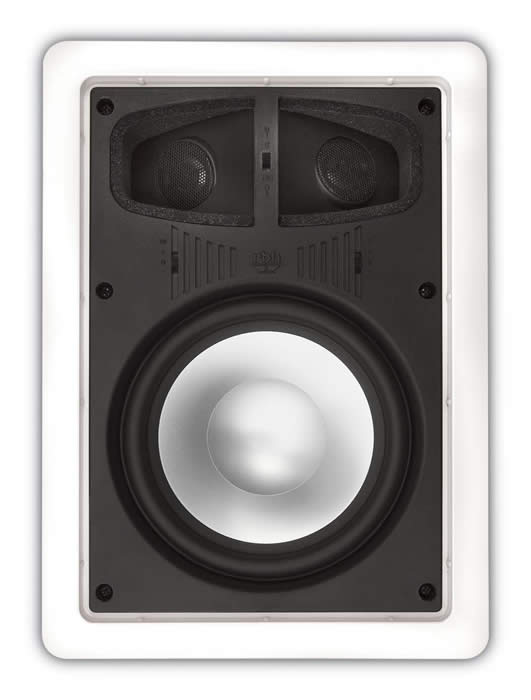
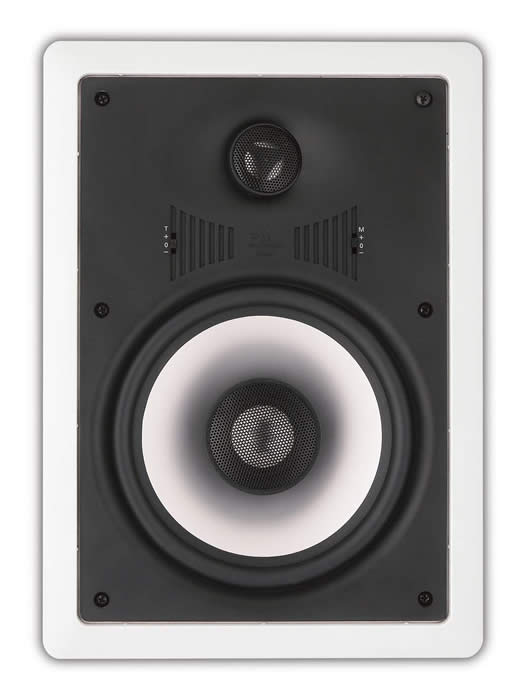
Want inwalls? RBH Sound has added two more products to their very extensive line up. The MC-6DB and MC-83.
Technical Specifications

MC-6DB
• Bi-polar/Di-polar switchable tweeters
• -3dB/0dB/+3dB adjustable tweeter level
• -3dB/0dB/+3dB adjustable woofer level
The MC-6DB (pictured right) is the di/bi-polar in-wall with 6 inch aluminum woofer and tweeters.
|
Frequency Response: |
50Hz - 20kHz±3dB |
|
Sensitivity: |
88dB (2.83V @ 1 meter) |
|
Power Handling: |
120 Watts |
|
Drive Units: |
(1) 6½" Aluminum Woofer |
|
|
(2) ¾" Aluminum Dome Tweeters |
|
Swivel Tweeter(s): |
Yes (2) |
|
Tweeter Protection: |
Yes |
|
Crossover Frequency: |
3000 Hz |
|
Crossover: |
12dB/Octave |
|
System Impedance: |
8 Ohms |
|
Color: |
White Paintable Frame and Grille |
|
Finished Dimensions: |
8¾" W x 12" H |
|
Cutout Dimensions: |
7½" W x 11" H |
|
Weight: |
5½ Lbs. (each) |
|
MSRP: |
$649/pair |
 MC-83
MC-83
• Currently RBH's only 3-way in-wall loudspeaker
• -3dB/0dB/+3dB adjustable tweeter level
• -3dB/0dB/+3dB adjustable midrange level
The MC-83 (pictured right) is a full range 3 way in-wall loudspeaker featuring an 8 inch aluminum cone woofer and one aluminum midrange and tweeter.
|
Frequency Response: |
45Hz - 20kHz±3dB |
|
Sensitivity: |
88dB (2.83V @ 1 meter) |
|
Power Handling: |
170 Watts |
|
Drive Units: |
(1) 8" Aluminum Woofer |
|
|
(1) 2½" Aluminum Cone Midrange |
|
|
(1) 1" Aluminum Dome Tweeter |
|
Swivel Tweeter(s): |
Yes |
|
Tweeter Protection: |
Yes |
|
Crossover Frequency: |
2500 Hz, 10kHz |
|
Crossover: |
12dB/Octave |
|
System Impedance: |
8 Ohms |
|
Color: |
White Paintable Frame and Grille |
|
Finished Dimensions: |
10¼" W x 14¼" H |
|
Cutout Dimensions: |
9" W x 12¾" H |
|
Weight: |
5½ Lbs. (each) |
|
MSRP: |
$649/pair |
There are also some very impressive new box standing speaker designs in the works, based off the W M product, which should be debuting next year at CES. Based on my listening experience, these are hot items to keep on your radar screen if you are looking for a high performance, high value narrow foot print loudspeaker system to cosmetically appease the spouse, your golden ears and/or wallet.
Introducing New Loudspeaker Products from Status Acoustics
 Status Acoustics represents the ultra high end of RBH Sound. Their products have set the benchmark in performance at Audioholics with such models as the Decimo ( 61-LSE/SER RBH Sound equivalent but with normal HDF cabinets), and Atlas (1266-LSE/SER RBH Sound equivalent but with normal HDF cabinets). In fact we are so enamored with the performance and value of RBH Sound products upgraded with Status Acoustics drivers that we featured them in our $25K Recommended Home Theater Systems section of our site and they also constitute several of our primary reference systems .
Because of the enormous complexity and expense of manufacturing Status Acoustics products such as the Titus, and Atlas, RBH Sound was forced to discontinue this product line for some time until other manufacturing means would surface to produce this level or product more easily and cost effectively. Alas, 3 years later it has finally happened. However, this time the Status Acoustics design team, lead by Shane Rich , has taken it up a few notches with their new (still unnamed) Status Acoustics flagship tower.
In the tradition of their former flagship Titus loudspeaker system its successor is big and heavy, but not nearly as imposing. It has a very narrow baffle up at top with a big bottom which sports five (yes, 5) 10" high excursion aluminum subwoofers. The cabinet shape reminds me of an electric guitar which Shane and Alan both admit would look neat with thin silver vertical metal strips from top to bottom to serve as a grill cover guised as guitar strings.


This is an early prototype design of the new Status Acoustics flagship tower. The wires on the back access the outboard crossover which of course production models will either have integrated into the design, or utilize as separate outboard devices. The rear port opening is big enough to house an additional 10" driver. Now that's a port! All 10" subwoofer drivers are active but according to Shane he will provision for passive rear woofers for variable tuning of system bass response to better cope with room placement issues. The midrange/tweeter driver array is considered to be a truncated line array, similar to that of the RBH Sound T-2 System, but with all of the midrange drivers in a straight vertical arrangement and the tweeter array to the outer edge of the mids rather than inner like the T-2 system.
Status Acoustics Tower Preliminary Specifications
Speaker Efficiency: 94-95dB SPL @ 1 meter (subject to change); padded the mid/tweeter by 4dB to match bass level
Impedance: 4 ohm (nom)
Recommended Power: 15watts - 1000 watts rms
Cabinet M aterial & Construction: M DF wrapped around an acrylic polymer (1/2" thick)
Weight: 400lbs+
As I learned during my review of the RBH Sound T-2 system, a truncated line array has some distinct benefits over traditional 3 way designs such as:
- Extended dynamic range
- Improved dispersion characteristics.
- Maintains intimate feeling of traditional 2 way designs but with dynamics of a conventional line array.
Once hearing a speaker system like this one, it is very difficult going back to conventional designs. In comparison, they seem lifeless or unnatural. After spending nearly two years with the T-2 system, I simply cannot have a conventional 3 way design loudspeaker as a permanent fixture in my primary reference system.
Some of the benefits of the new Status Acoustics Tower over the RBH Sound T-2 System include:
- More cone area (5 high excursion 10" subwoofers as opposed to 2 10" subwoofers) for increased dynamic range, lower distortion, and lower frequency extension.
- M ore cone area for truncated line array (6 mids and tweeters as opposed to 4 mids and 3 tweeters in the T-2 system).
- Improved driver quality of mids and tweeters. The phase plug midranges are similar to the ones found in the older Status Acoustics lines while the tweeters are the very newest phase plug drivers from Vifa featuring a neodymium vented magnet for improved power handling and dynamics.
Editorial Note on Phase Plug Drivers
Hi quality aluminum cone midrange driver with phase plug. Using aluminum for the cone provides significant audible benefits because of the superior stiffness to weight ratio over conventional paper or plastic cones. As a result, the driver acts more like an ideal piston thus reducing tendencies of break up distortion and dynamic compression due to cone flexing. The phase plug essentially eliminates the need for a dust cap, which in turn, reduces cone mass, permitting extended frequency response. It allows more airflow through the motor structure, which improves cooling and thus increases power handling. A Phase plug also helps to reduce on-axis beaming by dispersing higher frequencies that the cone is producing.
Note : Beware, many loudspeaker manufacturers use a quasi phase plug which looks like a phase plug for marketing purposes, but does not physically separate from the cone of the driver. These "so called" phase plugs can do more harm than good as they provide an inconsistent surface area and they also increase mass of the cone yielding poorer frequency response and linearity.


As you can see in the pics of the subwoofers above, the new Status sub driver has over twice the motor structure and throw of the original 10" aluminum RBH subwoofer which can be found in many of the Signature Series products such as the 1010-SEP subwoofer, 1044-SE towers. The old driver was certainly no slouch, but in a no-compromise design such as that of the new Status Acoustics series, it was time to create a dedicated driver that could live up to its name. Imagine five of these drivers in each enclosure!
 Granted, the " more is better " approach usually doesn't guarantee better quality, but in this case, after my short listening sessions, it appeared to apply here with flying colors.
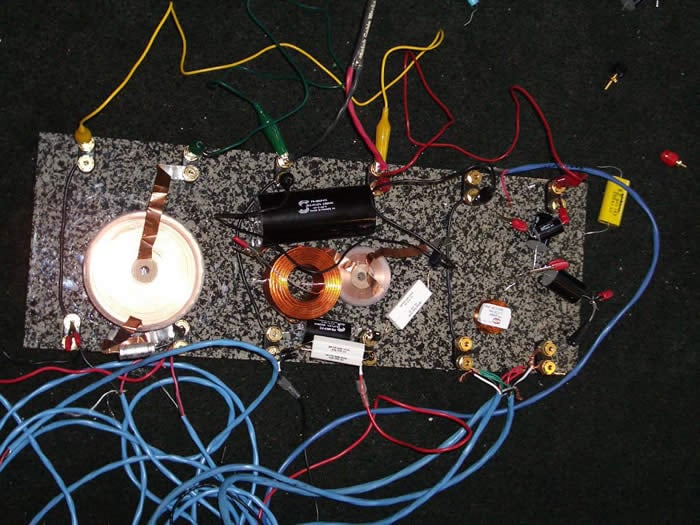
This is the prototype crossover system to be used in the Status Acoustics tower. Note all inductors are air core (meaning no saturation) and only high grade polypropylene capacitors are used throughout the design. Roger told me he big black capacitor seen in this pic costs more than an entire crossover assembly from a 1266-SE! When I asked Roger about how he could spare such expense in parts, he said " this is a no compromise loudspeaker design. We have spared no expense at using the best materials on the market currently available." Roger reminded me about the old days of M cIntosh when they too shared similar philosophies of designing the absolute best in audio, more so for the art or expression of the field rather than for turning a profit with cookie cutter designs that were easier and less costly to manufacturer.
Audioholics On-Spot Location: RBH Sound - p3
Status Acoustics Listening Experience
My moment of audio nirvana happened when I was first introduced to the Status Acoustics Decimos so many years ago. It was then that I discovered how good high end audio could sound. Because I was so enamored with these speakers, I suggested that RBH Sound implement Status Acoustics drivers into their Signature Series lineup to bring this sound quality to a more affordable reality of passionate audiophiles, and thus the LSE/SER series was born. As good as these speakers were, I couldn't help but wonder how much better they would be in a Status level cabinet. Imagine my enthusiasm at finally hearing a full range Status Acoustics speaker system, especially since this was a completely new model built off of the philosophy of the Signature T-2 system I treasure so much!
The Status Acoustics Tower wasn't quite ready for prime time as clearly indicated by the pics. In fact, Shane was assembling and troubleshooting them while I was there. One tower was loaded with stock Signature bass woofers while the other had the new high excursion Status driver. Despite the crossover wasn't tweaked to compensate for the higher impedance Status driver, it didn't detract me from wanting to take a quick listen nonetheless.
We initially ran the Status Acoustics Towers on a Denon AVR-3802 receiver. That's right, we started off on mid level gear to see, or more importantly hear, how well they could be driven on inexpensive electronics. I wasn't expecting much, especially since I held the misconception of - big high end tower speaker with many drivers equates to impossible load for a receiver to drive. M y misconceptions were instantly shattered when I felt the walls shaking in Shane's 30 ft x 17 ft test room. I could not believe the bass response and could only conclude he must have snuck in a few SA M 400s to power the bass sections. To my surprise, the only device the speaker cables were connected to was the Denon receiver. How could this be?
Shane showed me a very flat impedance profile (almost resistive) and benign electrical phase response and I soon realized that combined with a high sensitivity and gobs of piston area equates to a speaker system that doesn't require a Mack truck to drive. Of course, with its multi-driver configuration and usage of high quality driver and crossover components, it will happily accept any He-Man power amplifier on the market. Just for fun we connected a power meter to the receiver outputs where we measured about 6Vp (about 12 watts) when driving the speakers to 90+ dB 15ft away. Talk about efficiency. Tube lovers rejoice*, here is an ultra high-end loudspeaker system that can be powered by almost any esoteric amplifier you wish to throw at it.
*Disclaimer: I don't condone using tube amplifiers for audio applications.
We proceeded to connect one of the Acurus A200s (again another modest amplifier) Shane had on hand to take things up a level in performance.
We began with a CD I like to travel with from Marillion called Holidays in Eden . "Splintering Heart" quickly filled the room with sound but because of the amount of compression in this recording, and the limitless dynamics of this speaker system, you could really hear how dull and lifeless it sounded. M uch like my experience when listening to it at home on my reference system, these speakers really brought out the worst in this recording, though I was a bit surprised to hear revealing background details I don't recall during prior listening sessions on other systems. Our M arillion listening session didn't last long since both Shane and myself were eager to hear well-recorded, dynamic recordings to get a better understanding of the capabilities of this loudspeaker system.
 Artist: Brian Bromberg
Title: Tribute to Jaco
- Come On, Come Over (vocal version)
- Continuum
- Teen Town (acoustic bass version)
- A Remark You Made
- Portrait of Tracy
- Three Views of a Secret
- The Chicken
- Tears
- Slang (ish)
- Come On, Come Over (instrumental version)
- Teen Town (piccolo bass version)
I was so impressed with this disc when I heard it on the T-2 System at CES last year that I was anxious to hear it on this new super system. We skipped over to track #9 "Slang" where the Brian 's bass guitar just erupted. The presence was huge. You really felt like Brian was in the room slamming away at the bass. I really can't comprehend how one man can make all of these sounds with a bass but he was certainly doing it, and the Status towers as well as myself were loving every minute of it.
We continued with a drum demo disc from Chesky which absolutely knocked my socks off at the sound of the first snare hit. The transient response was amazing. I heard no compression whatsoever, only effortless and natural sound just as expected from a drum kit. The cymbal crashes and decay were surreal. I never heard a loudspeaker system produce them so convincingly.
We spent a good deal of time (too much actually) listening to a variety of acoustic guitar from the likes of Angel Romero and vocal tracks from more singers than I'd care to remember, that I almost lost sight of why I was at the RBH Sound facility to begin with. I was here to conduct an On Location Interview of the company, not to formally review a product! With that in mind, I ended my listening session with high expectations for this product and hopes it will soon grace my reference system for a formal review. Though, I couldn't help to think through the logistics of hoisting a 7 foot, 400+ pound speaker up a flight of steps to my listening lab. Any volunteers?
Expect a full blown demo at CES this January. Product release date and retail pricing is still T.B.D. though, rough ballpark pricing is around $50k/pair depending on configuration and finish options such as a completely acrylic cabinet finish and upgraded midrange cone material to Beryllium. Beryllium comes with a high cost addition due to its complex manufacturing process but it has advantages over Aluminum such as decreased mass, significantly less pronounced break up mode, and smoother roll off characteristics.
Closing Comments
Spending a few short days with RBH Sound really reinforced my respect and admiration for the company. It is obvious their passion for audio has captured the essence of what it is to be an Audioholic. Their no compromise design philosophy is what this industry should be all about. In my opinion, too many once respected companies from a couple of decades ago seemed to have lost track of this. While some companies depend on hype, inflated pricing and " the emperors new clothes " to sell and market their products, this is not the case with this company. This is most evident by their unfamiliarity by a great bulk of home theater enthusiasts, or full blown ads in every other page of the home theater publications, despite the fact they have been around for over 25 years. One statement Roger said to me that is left an indelible impression is " We are living in an era where truth has become a marketable commodity " - we couldn't agree more. It's obvious that Roger Hassing still operates the company with the same mantra as when it was started. Just like we learned so many years ago, " the difference is quality " is a high ideal RBH Sound still holds close to them today, perhaps more so with the rebirth of Status Acoustics products. When I asked Roger what their plans were going forward, he replied "to continue on track, enjoy what we are doing, and hope our efforts are noticed by the buying public."
I hold the highest respect for the engineering staff headed by Shane Rich whom I have found to be one of the most talented, yet humble and open-minded loudspeaker designers in this industry. If it weren't for his passion of designing loudspeakers for a living we would have attempted to assimilate him into our collective staff long ago. However, there is always hope for the future as everyone eventually retires. I will patiently wait for that day! Until then, I will continue to enjoy reviewing the masterful products which he and his design team have demonstrated an unswerving ability to manufacturer.
Local Sights and Impressions
This being my first trip to Utah I wasn't sure what to expect other than dry air and hot summer days. In addition to that, I found so many other points of interest that really left a lasting impression on me.


The Conference Center which incidentally sports many ceiling mounted RBH speakers suspended on a long thin pole. The application here is target sound at key display areas.


The Most Amazing Conference Venue which seats over 20,000 people. Imagine the sound system and acoustics planning that went into this!


Gene manages this organization, establishes relations with manufacturers and keeps Audioholics a well oiled machine. His goal is to educate about home theater and develop more standards in the industry to eliminate consumer confusion clouded by industry snake oil.
View full profile Subscribe to our newsletter