


Audioholics On Location: APC AV
Over the last 20 years, APC has been a pioneer in the development of new power protection technologies, resulting in countless industry awards, design patents and an installed base numbering in the tens of millions of units. Multiple R&D centers, along with APC-owned and controlled factories, have helped ensure that APC solutions are the safest, most advanced, and reliable available. When you buy APC, you buy "peace of mind".
With the growing presence of power sensitive products (media servers, DVRs, projectors, etc.) in the AV market, APC recognized the need for power protection for home theater and automation applications. There were no high quality reliability solutions in market. APC determined the unique needs of the market and in response, spent years researching and developing engineered power solutions specific to these application. The APC AV products are not simply computer surge protectors/UPS's with attractive faceplates. Instead, the AV line is engineered solely for high-performance audio/visual systems and benefits from the support of a $2 billion company and its power experts and dedicated research facilities behind it.

Outside Pic of West Kingston Facilities (located in Rhode Island) which is APC's corporate headquarters
Company Financials & Quick Facts
- APC celebrates its 25th year in business
- Vision - APC products ensure availability wherever data is created, transmitted, or stored
- World's largest consumer of sealed lead acid batteries
- Approximately 32,000 miles of power cords sold in 2006, enough to circle the globe
- $2 billion / year in revenues, over $700 million in cash, 7900 employees, no debt - a business model all of corporate America should strive for.
- APC reported sales of $2 billion for the year ended December 31, 2005, and is a Fortune 1000, Nasdaq 100 and S & P 500 Company.
APC AV Staff Biographies
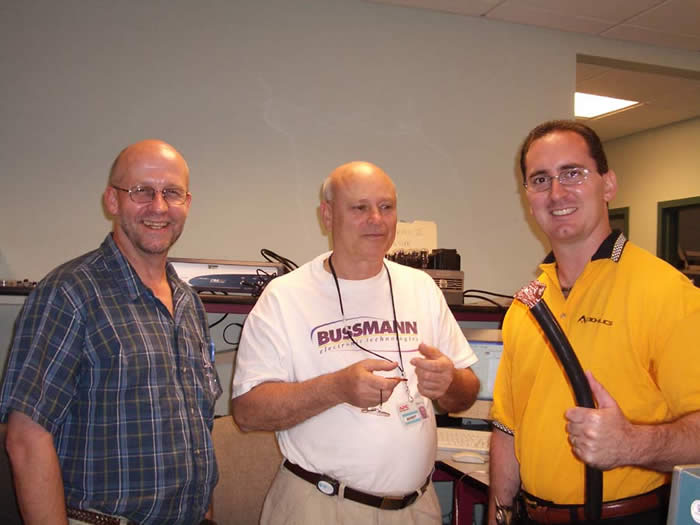 Emanuel E. Landsman - Vice President; Director Since 1981
Emanuel Landsman is Vice President and Director Emeritus of American Power Conversion (APC).
Dr. Landsman is one of three founders of APC, and is currently an active leader within APC's research and development effort. Dr. Landsman is a recognized expert in the field of power electronics. In 2002, he was awarded the IEEE PELS - William E. Newell Award. Awarded annually since 1977, this award is presented by the Power Electronics Society for outstanding achievement in power electronics and has come to represent recognition by one's peers as an outstanding contributor to the field of power electronics. Prior to founding APC, Dr. Landsman was a member of the technical staff at Massachusetts Institute of Technology's (MIT) Lincoln Laboratory, where he was in the Space Communications Group from 1966 to 1977 and the Energy Systems Engineering Group from 1977 to 1981. He received a BS from MIT in 1958, a MS from MIT in 1959, and a Doctor of Science from MIT in 1966.
Fred W. Rodenhiser - Chief Engineer
David Reilly - Senior Staff Design Electrical Engineer
Dave Reilly is currently a Senior Staff Design EE with APC's AV and CNS divisions. He has 26 years experience as a power conversion designer of custom power supply products. He has been awarded four U.S. patents and one E.U. patent for power conversion related innovations. Dave attended Northeastern University and is a current member of the IEEE. He is also a practicing musician and audiophile. In his spare time, he enjoys playing lead guitar in his band, recording in his home studio and woodworking.
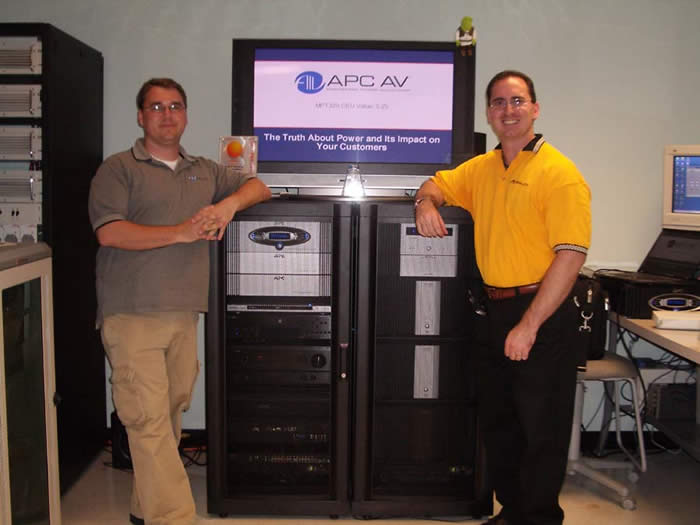
Michael Schenck - Electrical Design Engineer
Michael Schenck is an Electrical Design Engineer for APC AV. With a BSEE and MSEE* in power electronics from Virginia Tech, he brings a unique perspective to APC. In his studies, Mike primarily researched alternative energy systems and high efficiency power conversion systems. He is an avid audiophile with a preference for tubes and little patience for AV mythology. Previously, Mike owned a professional audio/video/lighting business and brought this no-nonsense attitude to APC's products. In his spare time, he currently moonlights as the sound engineer for a local band and an occasional video segment.
 Steve Williams - Regulatory Compliance Engineer
Steve Williams is a staff regulatory compliance engineer at APC and has over 15 years experience of product safety and EMC/EMI testing against US, Canadian and International regulatory standards.
Patrick Donovan - CNS Senior Product Manager
Patrick Donovan is a Senior Product Manager for APC's Consumer Networks Group. Patrick began his career at APC eleven years ago as a Technical Support Engineer. Later he managed the Technical Support and Field Service teams for APC China in Beijing . After returning from Asia , he managed APC's North American Escalation Team and from there he went into Product Management. In his current role, Patrick is responsible for the development and marketing of APC AV power protection solutions.
APC - A Master of All Things Power
Over the past couple of years, we've watched the AV division of APC break into the AV marketplace with products that are seemingly far ahead of their competition. Sadly most AV enthusiasts are unfamiliar with APC as a name for consumer audio and video power products. Those not familiar with APC's past may be dumbfounded by this, but it all makes sense when you recognize that they are the leaders in the IT marketplace and it's no surprise that they would want to extend their expertise to audio & video applications.
The APC mantra has been " to protect data wherever it is transferred or stored ".
I can't think of anything that better exemplifies this than their portable mobile unit which is capable of supplying power, data services and more for extended periods of time to whole cities if needed (think New Orleans after Hurricane Katrina).

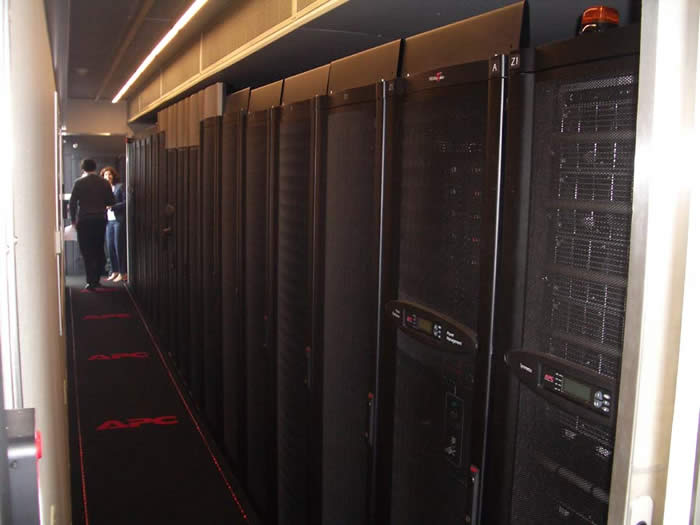
Their vision of the future is to standardize data centers to save the industry money since, according to their research, the cost of electricity will soon exceed server costs in the near future. If anyone can do this, I am confident APC is up for the challenge. Their engineering talent and resource pool seems almost limitless.
APC AV
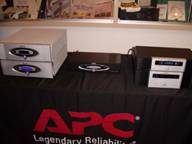 So why would a company that has primarily focused on the IT market get its feet wet in the consumer AV market? Global Domination is the answer. No seriously, with the explosion of HDTV and new display technologies driving the industry, APC recognized the need for well-engineered power solutions for the growing AV marketplace. Of course they also recognized the need for it to be done correctly , which unfortunately most companies in the A/V business haven't quite figured out yet.
APC defines power conditioning much differently than most A/V manufacturers. In order for a product to be considered a power "conditioner" by APC standards, it must provide the following:
- Surge suppression
- EMI/Noise filtration
- Line (voltage) regulation
Taking a quick inventory of the power "conditioner" industry today, you'll find that most companies provide the first two - at best - and neglect the third item which is extremely important, especially for newer display products.
APC UL Certified and Engineered Products
ALL APC products are UL certified and not simply "designed to" or "meets" UL certification like so many of their competitors claim.
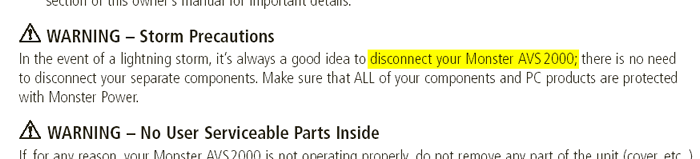
In one of the more comical industry revelations, one of APC's closest competitors actually recommends that you unplug their power conditioners during a lightning storm.
See: CES 2006 Blunders Deceptions and Other Goofs
This is somewhat disheartening to wary consumers thinking they purchased a "guarantee" to keep their equipment safe and immune from surges and power faults when instead they purchased a product that isn't UL certified NOR engineered to do that for which it is designed. Buyer BEWARE!
Simply put if you don't see the UL marking on the back of your power conditioner product, it is not UL certified. If you're a Professional Installer you could be held liable by your client's insurance company for installing a non UL certified product in a residential home. If you are a consumer, your insurance company can nullify your claim if your system was the cause of a fire in your home and the gear you used was NOT UL listed. Check your policy or contact your agent for more specifics. These are important considerations when assembling a home theater system that one should not take too lightly.
During my tour of their facilities, APC engineering gave me a demo of simulated lightening strikes and how the surges from such events wipe out capacitors and electronics until you block them with UL certified power devices such as APC power strips and power conditioners. Seeing caps frying is one thing, watching your new $4000 DVD player go up in flames during a lightening storm is (gasp!) another.
When speaking with the APC Regulatory body on this topic, I asked them why so few companies have UL approval on their products. Truth be told, although it's the law to have it, it isn't strictly enforced, at least until a claim is filed against the company for liability. In addition, most companies don't allocate the budget to submit their products through UL's stringent testing and certification processes. Not only can it be cost prohibitive, but it is very time consuming as well. APC is such a large user of UL services they actually have a UL lab on-site at their facility.
UL testing is more than just ensuring hazard free surge immunity. EMC testing includes immunity to surges, Electrostatic discharge and RF interference. EMI testing verifies how much RF interference is escaping from the unit either through air or conductively through the power cord and into the building's 60Hz wiring system.
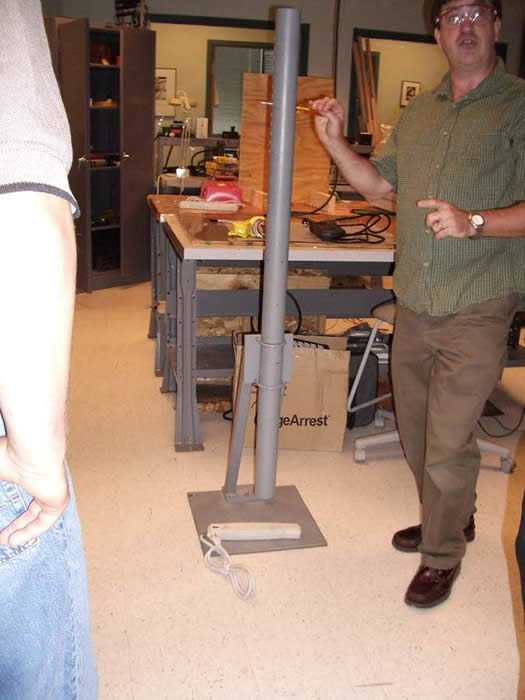
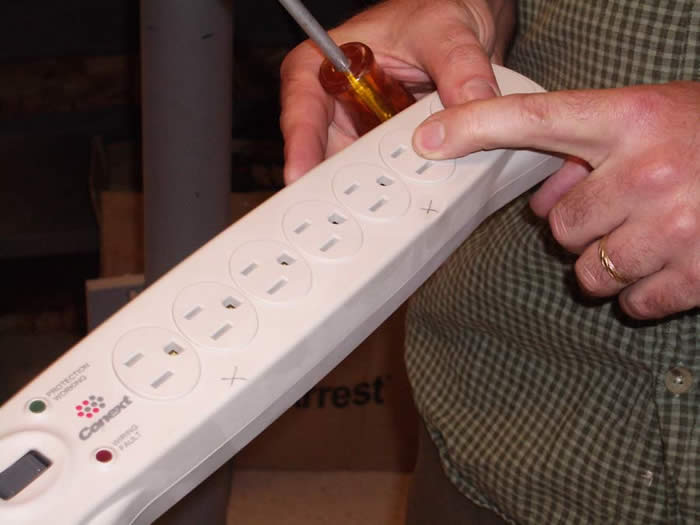
UL Drop Test (left) and Impact Results on Failed Product (right)
Typical tests performed in any Safety Evaluation (this is not a complete list) include heating tests which check that components are used within their ratings and are not a fire risk, Leakage Current which determines if hazardous currents could ever become available to the product user by simple contact with the enclosure, Electric Strength which verifies the effectiveness of the isolation barrier between hazardous voltages and safe voltages, and Ball Impact which simulates normal mechanical abuse of a product.
The Ball Drop is one of my personal favorites and I could see it was one of Steve's favorites too. What better way to take out your daily frustrations then by dropping a 5 lbs steel ball a few feet from the floor to attempt to crush the product under test? Self restraint is an important lesson here; else you may find many disgruntled employees placing the accursed copy machine that happens to break down (think Office Space ) minutes before a meeting in the crosshairs of the test path. I couldn't help but imagine the sounds of Beavis and Butthead laughter in my head each time Steve demonstrated the drop test to me. Yea that was cool.
For more info on APC testing and UL Certification, see: APC AV Interview on Power Conditioners
Editorial Note on UL Certification
In this article we speak about Underwriter's Laboratory Inc (UL) - but any Nationally Recoginzed Testing Laboratory (NRTL) mark is sufficient for meeting code and liability requirements. Other NRTLs include ETL, CSA, VDE, TUV, etc. Any of the appropriate listing will suffice.
Audioholics APC AV On Location: Tech Talk
Hanging with the Engineering staff of APC AV reminded me of my Telecom days at Paradyne when I worked for the Technology Group of their elite R & D staff. I usually felt like the dumb guy at our meetings since I was surrounded by an awesome think tank, but it helped me grow intellectually and, as a result, I am a better engineer and debunker of myths for it. Speaking with one of the founders of APC, Manny Landsman, was most enlightening especially since he frowned upon much of the misconceptions surrounding audio, particularly about exotic cables. I happily pointed him to our articles on such topics and let him know we are slowly winning the battle against misinformation.
We discussed many aspects of power including the misconceptions many consumers have about typical amplifier power tests. Mike Schenck was kind enough to help out in one of our most recent articles on this very topic.
See: The All Channels Driven (ACD) Amplifier Test
As a footnote to the ACD article, Patrick informed me that the National Electric Code does not allow loading a circuit by more than 80% Thus on a 15A line, that means no more than 12 amps should be drawn. This translates to 1440VA or Watts . In reality, that means available power to drive your Amp ACD style is actually less than what we discussed in the article. Food for thought next time that ignorant forum member claims his amp can deliver 400wpc x 7 ACD.
We also discussed the all too familiar problems some manufacturers have who utilize VARIACs to do line regulation in their power conditioners. VARIACs are too slow to respond properly to line fluctuations due to the mechanical time constant of the VARIAC system. In other words, by the time the motor has started to respond, the voltage fluctuation has come and gone. The motor is much too slow to address fast moving electrical transients that cause most of the damage in connected equipment. An electrical transient can be anything from a voltage surge to a momentary cycle drop to a long term 'brownout'. These transients vary both in duration and 'attack' speed. An entire surge event occurs within micro-seconds whereas the onset to an under/over voltage event will occur within mlli-seconds but last several hours. In simpler terms, power conditioning equipment must be designed to handle real world conditions, not just display pretty numbers.
The lag between a power system fluctuation and the motorized VARIAC system response, (such as increasing or decreasing voltage) can result in a dangerous over voltage condition to the connected equipment. (See the graphic below) Couple this scenario with a power amplifier whose capacitor bank has a very slim design margin against an overvoltage condition, and you've created a recipe for disaster. This is why some amplifier manufacturers advise against connecting a power conditioner to their products. A poorly designed power conditioner coupled with a marginally designed power supply in an amplifier can create a failure condition during major line voltage fluctuation conditions. It's best to avoid this scenario by using a properly designed power conditioner. Of course we advise a UL certified one as well.

Commercially Available 'AV' Voltage Regulator utilizing a motorized VARIAC
A commercially available motorized VARIAC based voltage regulator was exposed to an IEEE 1159 styled test. The blue line is the input voltage - the utility voltage underwent a rapid under voltage event not unlike what happens when a tree partially shorts one of the phases to ground. The 'onset' is very rapid - much less than one cycle and it takes a few moments for the short to clear. The utility voltage then rapidly returns - usually within a cycle or two.
The red line is the output of the 'Voltage Regulator' - it took a full second to respond to the voltage event. By the time the 'Voltage Regulator' responded, the damage had already been done - the DVR shut down, the amplifiers shut off, the DLP bulb was thermally shocked, etc. However, the real damage occurs when the utility returns to normal - the motorized VARIAC continues to 'correct' the voltage supplying a peak of over 248V to your sensitive & expensive equipment. The 'Voltage Regulator' was a little faster reducing the voltage, but it still supplied dangerous voltage levels for nearly ¾ of a second. An amplifier's capacitors and power supply would have been toast.
APC has a most impressive testing facility tailored to AV. They torture test their products by power, voltage and frequency cycling them 1000's of times per day over multiple days to ensure their products wont fault because of the large inrush currents caused by heavy loads such as power amplifiers and plasma displays. One life test forces an S-15 to cold boot (power on using only batteries) 1000's of times into a massive simulated amplifier. They had to build an 'amplifier' because no commercially available amplifier unit was capable of being cycled on and off thousands of times in a short period. They had some very interesting stories about amplifier failures! They assured me the amps were not being used in a manner consistent with their design (turning on and off thousands of times within a few weeks).
Another test simulates a large AV system in a horrendous power environment. A massive subwoofer, multiple amplifiers, plasma, and DVR/media PCs are all simulated in an interesting test that squeezes 25 years of electrical performance in a matter of months. The voltage, frequency, sags, swells, small surges, EMI etc are all slammed into the S-Type's brick wall power conditioning and UPS functionality. After a unit 'fails' these abuse tests, it is dissected, and the root cause is determined. If there is a design issue, it is logged and the will make it into the next product revision. An impressive array of electrical test equipment and resources are available to thoroughly design and test all of APC AV's products.
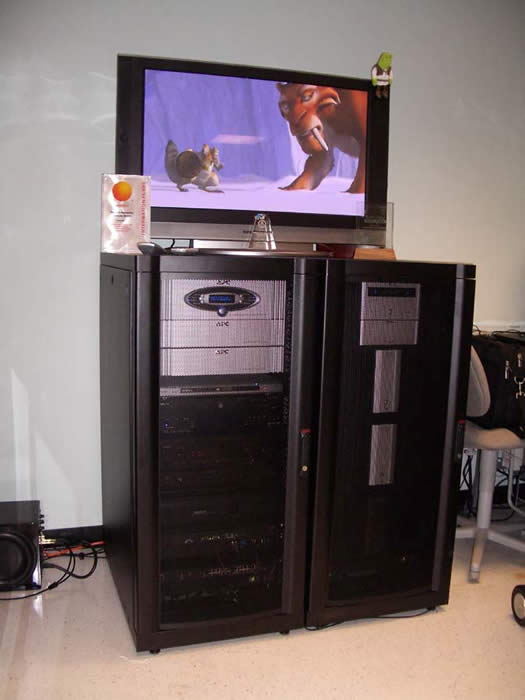

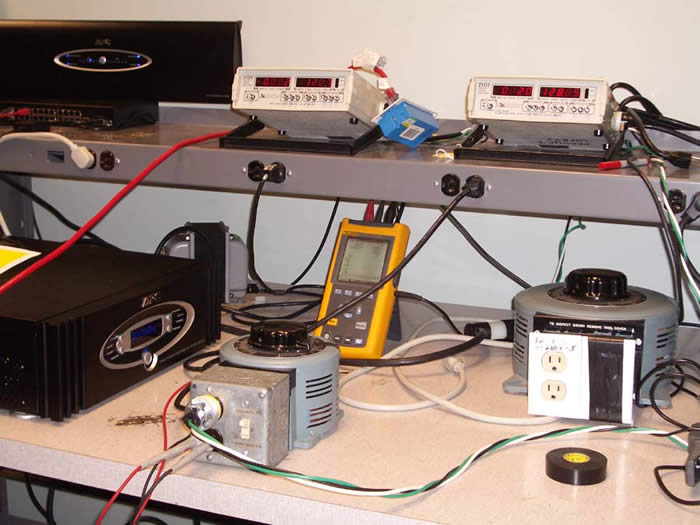
I was particularly interested in some of the testing Mike was doing with VARIACs and how in reality these are NOT the best devices to use when attempting to hold the line voltage constant during power amplifier tests. VARIACS are commonly used to validate the steady state or long term voltage correction capability of a voltage regulator. VARIACS are too slow to simulate voltage transients, but they are great for looking at the 'long term' performance of voltage regulators. In other words, it is not possible to accurately capture the response time of a voltage regulator but it is great for finding out it well it corrects long duration voltage issues.
Using a VARIAC to test an amplifier is not a good idea (though sadly many other review publications use them religiously) .
The output from the VARIAC is NOT indicative of the real world AC voltage waveform. It distorts the AC waveform so much as to effectively add miles of wire between the utility and the amplifier. Take a look at the excerpt from the ACD article I previously authored below.
A great example of a weak transformer - or one that has poor regulation - is a smaller VARIAC similar to those used to evaluate amplifiers. In this example, the VARIAC was setup to boost the output voltage from 108V to 120V. In an unloaded state, the VARIAC was boosting the voltage by 12V RMS. The VARIAC began to lose regulation as the load was increased to 50% of its rated load. This particular test was only run at 50%; imagine how much worse it will be at 100%!
V no load RMS: 120V
V 1/2 load RMS: 112V
½ Load Percent Regulation: 7%
The clipped waveform also changes the behavior of the power supply. The peak voltage available for the bridge rectifier has been reduced from 170V to 158V - a whopping 12V drop in the peak voltage output. (120*SQRT(2)=170V). Reducing the peak voltage reduces the DC bus voltage of the amplifier. The amount of capacitance, the turns ratio of the transformer, and other power supply design factors. These factors affect APC's AVR transformer design. APC strives to maximize the advantages of voltage regulation, not minimize it or cause any other down stream problems.
|
VARIAC is unloaded. Ch1: Input Voltage Ch2: Output Voltage |
VARIAC is 50% loaded Ch1: Input Voltage Ch2: Output Voltage |


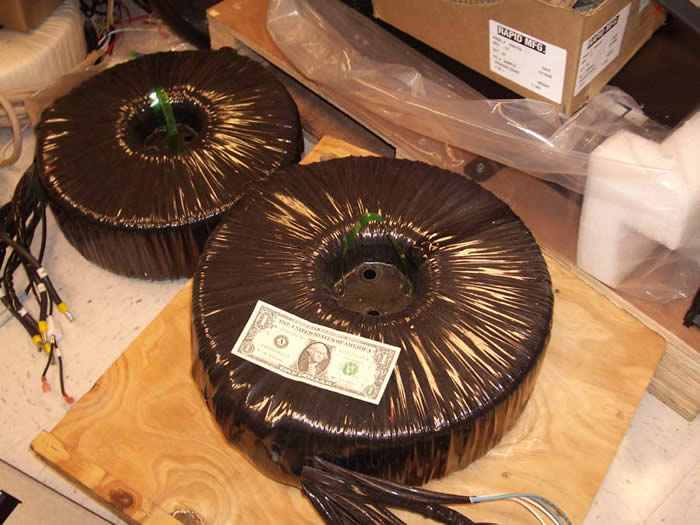

APC knows about all things related to power. To the left we have the largest toroidal transformers I've ever seen. These can satisfy any power freak who dreams of an amplifier powered by a nuclear reactor that can deliver its specified power into all channels driven continuously. On the right are the leftovers from a massive power test - they were interested in testing their high power InfraStrucure equipment. After connecting these transformer and inductors to a 300kVA power feed, they promptly shorted the outputs to ground. In doing so, they overloaded the utility's transformer - instead of giving up, they rented a 1 MW (1 Million Watt) generator to continue testing.
APC AV Future Roadmap
Unfortunately I am not at liberty to discuss most of the new stuff APC is developing until the CEDIA show. I can however tell you they are working on some enhancements for the estimable S15 power conditioner and some very savvy new products that can be installed at the main breaker of your home to provide APC protection and backup to the most critical circuits in your home. Best of all, they will be incorporating intelligent power management and monitoring unlike anything I've seen in this product genre.
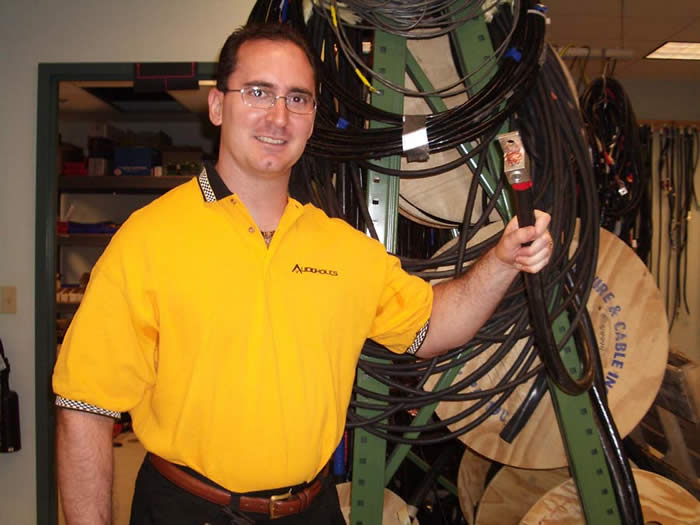 They have a slew of new portable products coming out, including a battery extender and charger for your iPOD and some nifty laptop and travel bags loaded with APC goodies to die for. APC has recently released the Universal Power Adapter, a power supply that can run most leading brands of notebook computers using power from any airplane, auto or AC outlet, as well as the Mobile Power Pack, which is an external battery that provides users extended runtime for mobile device.
I leave you with a hero shot of their version of the Audioholics GLOB speaker cable. While it doesn't have any batteries slapped on it for biasing, its gauge is low enough to not be measured on conventional gauge charts and it is heavy enough to bust any exotic porcelain cable elevator that we know of. Best of all this cable doubles as a curling bar should you not be able to make it to your local gym for a bicep workout.
Local Sights and Impressions


Our view (left pic) from our hotel window at the Marriot in Newport . A local vineyard (right) we visited after a grueling day of geeking out with the APC engineering staff.

Downtown Newport was simply amazing as it reminded me of my childhood days growing up in Port Jefferson Long Island. I love the North East, especially when it's not snowing.
Gene manages this organization, establishes relations with manufacturers and keeps Audioholics a well oiled machine. His goal is to educate about home theater and develop more standards in the industry to eliminate consumer confusion clouded by industry snake oil.
View full profile Subscribe to our newsletter