


WARNING: 3D Video Hazardous to Your Health
Danger in 3D
Nintendo unveils 3DS and quickly follows-up with a statement about dangers to children under 7 playing with the company’s new portable gamer. Samsung releases a line of 3D HDTVs then issues a warning about its potential health risk to certain viewers. What they haven’t told you is that these warnings come after years of industry spin and cover ups. The truth is that prolonged viewing of 3D video may be even more harmful than the consumer electronics industry wants you to know.
Before you bring a 3D HDTV into your house or let a child under seven play with a brand new Nintendo 3DS, you need to understand the fragile development of an aspect of human vision called stereopsis.
Stereopsis: Hunter See, Hunter do
Stereopsis, a result of the frontal placement of our eyes, is the process in visual perception that lets us see depth. Two slightly different projections of the world enter our retinas, which causes us to see in real-3D. Stereopsis made us humans into mighty hunters of prey, builders of civilization and crackers-open of the occasional bottle of beer – but this important process is being tricked every time we watch a 3D movie.
Stereoscopic vision begins developing when we first start using our eyes and is generally considered complete by the time we’re around six years old. That’s when the tiny nerves and muscles behind the eye are fully formed and have learned to work in conjunction with the brain to respond automatically to visual cues that provide seamless depth of vision. 
Unfortunately there’s a malaise in children that can prevent full stereopsis from developing, called strabismus. This condition is also called lazy-eye but has nothing to do with laziness; it’s an abnormal alignment of the eyes in which the eyes don’t focus on the same object and depth perception is compromised.
There is treatment for strabismus that involves helping a child’s nervous system to learn stereopsis, causing it to eventually become a natural response. But the ability to re-learn has its limitations, and treatment has been met with limited success beyond a certain age.
In the 1960s, Nobel Prize winning research by Drs. Hubel and Weisel came up with a critical period during which the optic nerves learn stereopsis – the time up to 7 years old. Doctors thereafter used this critical period as the point-of-no-return for treatment of lazy eye. The old way of thinking was that lazy eye can’t be treated after 7 years old.
However, recent medical science indicates that the nervous system never stops learning and re-learning. Doctors today will tell you it’s never too late to try to treat strabismus – or re-teach the optic nerves the trick of binocular vision. The chances of success may be diminished beyond seven, but there’s still a chance.
So, if it’s never too late for the optic nerves to learn correct vision, one can surmise that it’s also never too late to learn bad habits that could create visual problems.
Escher and 3D Tricks
Anyone who learned the technique that allows them to peer into stereograms has taught themselves a temporary form of lazy-eye. Stereograms are those pictures that look like confetti but transform into three-dimensional images if you stare into them long enough. They’re popular with college kids experimenting with Escher.
The modern digital 3D effect using glasses makes this same effect effortless. Your eyes are invited or forced not to properly focus in order to get the full effect of eye-popping 3D.
Some people report being temporarily disoriented when walking out of a 3D movie. Walking into the light while your vision shifts back to active binocular depth perception can indeed be disorienting for anyone. The effect is described by virtual reality researcher and co-developer of VRML Mark Pesce as an effect similar to having sea legs.
When you take off the 3D glasses, Pesce says, “…it takes time to get your land legs back”. During that lag period where you’re re-learning binocular vision, your depth perception is compromised and you may lack the visual acuity required to perform tasks, such as driving.
What happened to 3D Virtual Reality?
Do you remember in the mid-90s when virtual reality headsets were going to be the next big thing? Do you wonder why the whole technology just sort of… went away?
VR pioneer Mark Pesce has spilled the goods. Audioholics was able to contact Mr. Pesce via Twitter where he answered a few questions for us regarding his work with Sega and the mysterious disappearance of its VR project.
Over 15 years ago, Mark Pesce worked with Sega on its VR Headset, which was intended to plug into the Sega set-top-box. The headset was going to provide gamers with a virtual reality 3D environment. Of course Sega wasn’t the only one developing a VR headset at the time, and we all expected to be running around in 3D environments when graphics evolved beyond chunky wireframes of the early VR visuals. We thought the technology was just around the corner.
With a working VR Headset almost ready for market, Sega had the product tested by a third party lab, the Stanford Research Institute (SRI) at Palo Alto California - the results weren’t pretty. 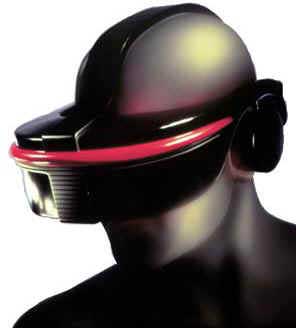
The lab at Stanford came back to Sega with dire warnings about the hazards of prolonged use of this technology. SRI warned Sega:
“You Cannot Give This To Kids!”
Pesce says that Sega took the test results and buried them. Fearing lawsuits and consumer backlash over health risks, the VR Headset never made it to market and neither did the truth about the dangers of prolonged exposure to 3D virtual environments - until now.
The results of SRI’s research have been published and there is an unclassified document from the defense department of Australia that says there are a variety of “…unintended psychophysiological side effects of participation in (3D) virtual environments.”
VR Headsets disappeared amid vague rumors of headaches and poor implementation of a technology just wasn’t ready. The Consumer Electronics industry was content to leave it at that and wait for a new implementation of the same visual effects. Now, virtual reality is back but instead of a headset, the same visual effect is being sold through LCD monitors and glasses.
Conclusion
Children under seven are at risk of strabismus – period.
Going to a 3D movie each month probably won’t hurt anyone’s vision, especially adults; however, if we introduce the 3D effect into the home, we dramatically increase our exposure. We could sit at home with our new 3D HDTV and watch non-stop 3D for days. Even 2D video that hasn’t been coded for the FHD3D format can be upconverted by consumer-grade 3D HDTV through 3D interpolation mode.
Now you’ve gone from tricking your optic nerves into self-imposed strabismus once or twice a month to potentially hours every day – and evidence already suggests this could be harmful to your vision.
Marathon video game sessions in 2D are already difficult on the eyes because you’ve had to focus intensely at a single depth for hours. How will you step away from a marathon video game session in 3D?
So far, the only real research we have on the effect of prolonged exposure to 3D virtual environments has concluded that the health risks are real. The only defense the Consumer Electronics industry has for the new line of 3D HDTV is that since the research is over fifteen years old, maybe there are new factors using the modern implementation of the technology. So, more research needs to be done before we can conclude that 3D HDTV is safe, even for adults.
The good news is that your new 3D HDTV is also very good at displaying 2D images. So, until we get more information, we advise protecting yourself and your family by using that new HDTV for standard 2D viewing a majority of your time.
Wayde is a tech-writer and content marketing consultant in Canada s tech hub Waterloo, Ontario and Editorialist for Audioholics.com. He's a big hockey fan as you'd expect from a Canadian. Wayde is also US Army veteran, but his favorite title is just "Dad".
View full profile Subscribe to our newsletter