


The Decibel (dB) and the Violin/Piano Recital
Concert Hall
One of the most difficult-to-understand terms for newcomers (and even experienced enthusiasts) in audio and sound reproduction is the decibel, partly because it’s a measure of relative intensity or power in both acoustics and electrical circuits. It may help to understand it better if you know how the engineers at Bell Laboratories, back in 1924, came up with the term from which the decibel was derived.
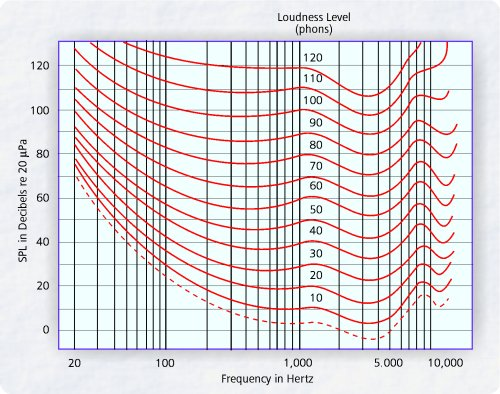
One “Bel,” named in honor of the brilliant inventor and communications pioneer Alexander Graham Bell, represented the relative reduction in audio level that a mile of telephone cable imposed on the telephone audio signal (and you were worried about 30 or 40 feet of speaker cable!). It became shortened to “decibel”, which represents one-tenth of 1 bel (1 bel = 10 decibels). So a decibel expresses relative intensity, and it’s logarithmic in nature, based on multiples of 10. In terms of loudness and acoustical intensity, the decibel can conveniently express a huge range in sound pressures to which the ear responds (far greater than one million), from 0 dB (the threshold of hearing in young, undamaged ears) to 120 dB, the loudness of a jet engine or front-row seating at a rock concert. An increase of 1 dB can also be thought of as a just barely noticeable change in loudness, or the sound intensity generated by a mosquito flying at a distance of about 3 meters, or 10 feet. Can you hear a mosquito in a quiet cabin flying 10 feet away? Young, undamaged ears likely can.
 On a more practical
level, we often wonder how amplifier power output in watts relates to changes in
the acoustical output (loudness), of loudspeakers. Now for the really amazing
part: although it seems that doubling the amplifier power in watts would also
double the loudness, disappointingly it only increases loudness by 3 dB,
a change in volume most of us perceive as “slightly louder.” That’s why going
from an amplifier of 75 watts output to one of 150 watts output only increases
the actual acoustic output a bit—again by 3 dB. To make sounds subjectively
“twice as loud”—an increase of 10 dB—requires ten times as much power from the
amplifier. So if your speakers are using 5 to 10 watts (a fairly typical
value) to produce reasonably loud sound in your average-size room, and you want
to make your music twice as loud, you’ll need ten times as much power, or about
50 to 100 watts. That’s why it’s important to have plenty of reserve power in
your amplifier/receiver to handle the peaks in loudness that may be at least 10
dB louder than average levels. In fact, I have a classical CD recording where
the loudest portions of the music are almost 30 dB louder than the quietest
passages. Think about how much amplifier power that requires cleanly reproducing
the 98-dB peaks in my 2,200 cu. ft. living room. Bring on the Axiom A1400-8!
On a more practical
level, we often wonder how amplifier power output in watts relates to changes in
the acoustical output (loudness), of loudspeakers. Now for the really amazing
part: although it seems that doubling the amplifier power in watts would also
double the loudness, disappointingly it only increases loudness by 3 dB,
a change in volume most of us perceive as “slightly louder.” That’s why going
from an amplifier of 75 watts output to one of 150 watts output only increases
the actual acoustic output a bit—again by 3 dB. To make sounds subjectively
“twice as loud”—an increase of 10 dB—requires ten times as much power from the
amplifier. So if your speakers are using 5 to 10 watts (a fairly typical
value) to produce reasonably loud sound in your average-size room, and you want
to make your music twice as loud, you’ll need ten times as much power, or about
50 to 100 watts. That’s why it’s important to have plenty of reserve power in
your amplifier/receiver to handle the peaks in loudness that may be at least 10
dB louder than average levels. In fact, I have a classical CD recording where
the loudest portions of the music are almost 30 dB louder than the quietest
passages. Think about how much amplifier power that requires cleanly reproducing
the 98-dB peaks in my 2,200 cu. ft. living room. Bring on the Axiom A1400-8!
Most of us have seen the charts that document the relative loudness of various common sounds—rustling leaves, 10 dB; a very quiet library, 30 dB; average conversation, 60 dB; street traffic, 85 dB, a full orchestra, 98 dB, and so on (see decibel charts). But it’s fun to actually measure the relative loudness of various types of music heard live; moreover, it’s amazing how accurate even an inexpensive sound pressure meter is, and how closely the values relate to our subjective perception of “quiet” and “quite loud” music and to universally measured sound pressure levels.
A practical
illustration of real-life volume levels of two acoustic instruments occurred at
a violin and piano recital I attended by a young virtuoso violinist, Yuri Cho,
and her accompanist, Michael Tan, at Merkin Concert Hall, a small 300-seat venue
in New York City. Mr. Tan played a big Steinway concert grand piano. Ms. Cho was
standing about 5 feet in front of the piano. I sat in Row B, only about 15 feet
from the two performers. In the background hush before the recital began, I
could easily hear the whirr of the hall’s air-exchange system, which was
constant and measured 55 dB (all C-weighted), the latter quite high compared to
some of the newest halls with baffled air-exchange systems that are almost
silent at 35 or 40 dB. With my RadioShack meter in my lap, during the
pianissimo sections, where the two recitalists played very quietly, the
sound levels averaged about 70 dB; when things got loud (forte), the
measurements rose to peaks of 87 and 89 dB, which certainly sounded very loud.
The higher strings of Ms. Cho’s violin had a somewhat hard and steely
edge from my seat in Row B, so after intermission I moved to row F, which about
doubled the listening distance from the piano and violin to 30 feet. According
to acoustical laws (the inverse square ratio) the sound levels should have
dropped to one quarter of their previous values (in an anechoic chamber that
would happen) but in the hall, sitting midway back in Row F, my ears were
receiving a much more rounded blend of direct and reflected sounds. Amazingly,
the measured levels were only slightly less loud. On dynamic peaks in Gershwin’s
wonderful Three Preludes, the sound levels still peaked in the range of
85 dB, only about 3 dB less loud than sitting up close. In Row B, the direct
instrumental sounds were very dominant, with very little ambience, which is why
the violin sounded hard (yes, some real instruments can sound harsh and edgy
close up; I ought to know, I studied violin for 15 years). Back in row F, my
ears were receiving lots of reflected sounds from the hall’s side walls, which
combined with the direct sounds to produce a much more pleasing blend, with
hints of the small recital hall size.
 Special thanks to Axiom Audio for allowing us to reprint
this article.
Special thanks to Axiom Audio for allowing us to reprint
this article.
 Subscribe to our newsletter