


MagnaLev ML5 Isolator Electromagnetic AV Rack
MagnaLev AV Rack
- Product Name: ML5 Isolator Electromagnetic AV Rack
- Manufacturer: MagnaLev
- Performance Rating:

- Value Rating:
- Review Date: March 31, 2007 20:00
- MSRP: $ 2899 ($799 for single amplifier version)
Pros
- Freaking cool!
- Handles up to 150lbs per shelf
- Smart-capacitance(TM) allows operation on single 15A 120V outlet
- Safe-T locks prevent accidental overdraft and damage
- Zero vibrations
Cons
- Pricey
- Gear can drift forward or backwards if bumped too hard
- Simplistic look, black only color option
- Rotation of gear (twisting) not possible
MagnaLev ML5 AV Rack Overview and Operation
When I say that it is RARE that we review anything that truly takes us by surprise, I mean it. We've seen just about everything and the trade shows ensure that we aren't typically taken by surprise on new product announcements. This new product by MagnaLev, however, came out of nowhere and was first demonstrated at IIC-China earlier this month. We had a colleague who was in town for the show (in addition to some other manufacturing work) and caught site of this new product. A couple weeks later, we had a MagnaLev rack in for review. This may be the most prolific invention for consumer electronics since Gene Roddenberry's Star Trek invented the flip phone. It's just freakin cool.
Overview & Build Quality
The MagnaLev ML5 "Isolator" looks like a simple AV rack - and it is - until you turn it on. Turn it on? Yes, this AV rack plugs into the wall - any standard 120V unit will do (European versions will handle 220V as well with a flip of the switch and different removable cable). When you put your equipment on to this rack (up to 150 pounds per shelf) a powerful distributed electromagnetic system will lift your gear and float it about 3/16" to 1/4" off the shelf - depending upon the weight of the component. In the event of a power failure the system uses a Smart-capacitance system that not only allows 120V operation, but also provides a natural magnetic field decay in the event that power is lost (i.e. your gear won't come crashing down).
The rack system itself currently only comes in black, but the system is robust - weighing in at 161 pounds (including the power supply and MagnaLev plates). The appearance is of anodized aluminum with each shelf taking up roughly 2 inches in height. The reason, of course is because each shelf houses a certain amount of electronic components to make everything work. The overall height is 46-inches, which is a good size for people who aren't planning on having tons of source components. If you have an amplifier, DVD player, processor and tuner you'll still have room for one more component (like a cable box, for example). With that said, the unit is a bit unrefined in the looks department, but its functionality is what will make people hang out nearby with their mouths hanging agape.
How It Works
This is a lot to comprehend - as is usually the case with new technologies. First off, there is a lot involved in providing equipment isolation through electromagnetic, but the principle is very simple. Like a magnetic train, you simply create a strong enough electromagnetic field and provide a proper opposite polarity on the equipment chassis (or in this case underbelly) to allow the equipment to "float" above the shelf. Geoff Tripp, the Product Manager for MagnaLev, told us that they tried initially to get a system to work with the aluminum chassis of most equipment, however it became quickly apparent that a thin metal shelf inverter had to be included with the system in order to get an even lift that would disperse the electromagnetic force across the entire surface of any equipment. The current system utilizes this method. Here are the components required to get the system to work properly:
 Power supply and field generator:
This device (contained in a black box and stored beside the rack) supplies the DC voltage required to make the electronics in each individual rack work properly. It also houses a large capacitor (opposite side) that ensures the unit has a slow decay should power ever be suddenly cut off. This allows the equipment on each rack to "settle down" gradually rather than crashing down to the shelf. I pulled the plug on the review unit and it worked as advertised - even with about 300 pounds of net weight - though the decay time is only about 1 second at that weight.
Manufacturer's Note:
The decay time decreases with additional weight, however even with the aggregate maxed out limit of 450 pounds, the decay time is still around 1 second - plenty of time to allow equipment to settle without causing any damage to components. In addition, the system will wait until sufficient power and charge is restored before re-engaging the MagnaLev system and isolating the equipment.
MagnaPlates: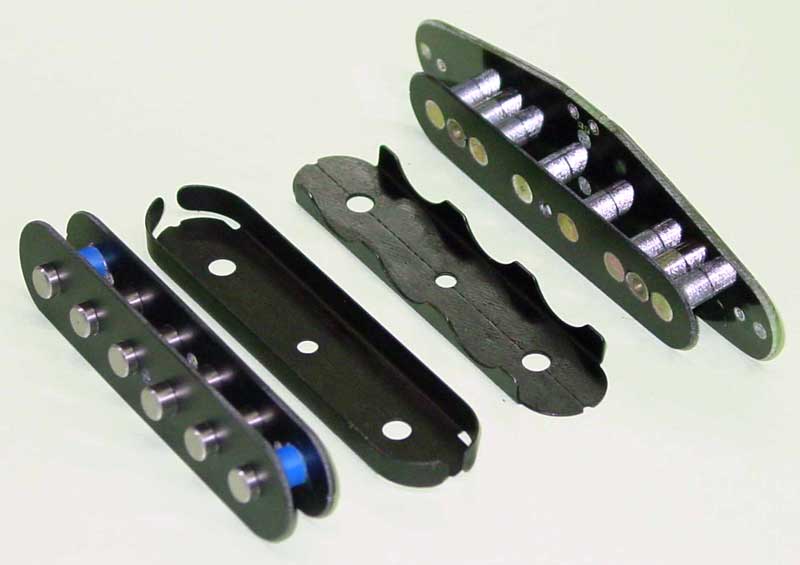 These ingenious devices are what distribute the electromagnetic field throughout the shelf system. Shown here are the standard MagnaPlates (left) and the Advanced MagnaPlates (right) which are dedicated for the single amplifier stand model (rated to 200 pounds as opposed to 150 pounds.) There are 10 of these per shelf (12 on the amplifier stand model) and they are contained completely within the rack shelves (we got MagnaLev to send us a photo of the devices separately since we couldn't remove ours.
ML5-Pads: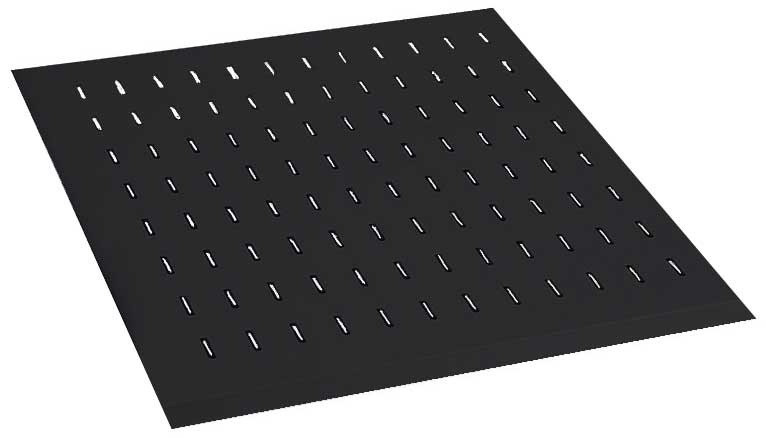 These pads are basically 1/8-inch thick plates which are polarized by the system and placed underneath your individual components. Each AV rack comes with five ML5-Pads. Without these Pads, the polarization would be uneven and different gear would be affected differently (some wouldn't physically isolate at all.) The ML5 pads can be secured via screws to the bottom of your equipment, but they do not need to be, you can merely place your components on top and let gravity do the rest. We merely set our gear on top of the plates and found that they did indeed provide an even magnetic field so that equipment isolated evenly and without any tipping. Additionally, the ML5-Pads include a plastic Safe-T loc system that ensures they cannot extend more than 5 inches past the front or rear of the unit.
MagnaLev ML5 AV Rack Use and Conclusion
 It's never any fun putting together furniture, but the MagnaLev system at least comes well packaged and with clear, easy instructions. Aside from the existence of an external power supply, the ML5 Isolator is basically 4 structural supports and 5 shelves. The shelving takes a bit more time to install than most as each shelf weighs approximately 26 pounds. The system came in an unremarkable box containing 5 additional unmarked boxes and a spacer. Everything seemed to be packed well and nothing was damaged during shipping.
The system assembles with just a Philips head screwdriver and it took me only 25 minutes to get everything ready for power up - including putting my gear back onto the shelves (but not making the connections of course). Each shelf has a small jumper that connects it to the left rear support which houses all of the main cabling. The ML5-Pads require that a small plastic wire called a Safe-T system be applied which keeps your gear from ever flying off the rack (more to follow).
Using the System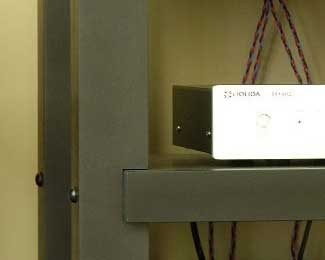 Using the system is as easy as plugging it in and turning it on via a rocker switch on the right side near the top. At once I heard a low hum that gradually dropped in frequency and went away completely after 15 seconds (whew!) At first nothing happened - and then I remembered that the capacitor had to charge. After 60 seconds my equipment slowly lifted into the air!!! It was amazing to actually look under each of my components and see that NOTHING was touching the shelf below. All of my equipment had a 1/4-inch space underneath, including a rather hefty stereo amplifier I am testing at the moment and a loaded Sony SCD-CE775 5-disc SACD changer.
I tested the mobility of the equipment and found, as indicated by the literature, that the individual components can be moved forward or backwards up to 5 inches until the Safe-T lock system kept it from going any further. This makes hooking up your gear infinitely easier as you can pull out, for example, a DVD player and make rear connections - then slide it back in. There is no friction but the gear still feels as if it has a modicum of resistance, so it's not as if you will graze a product and it will fly out on you. I was amazed at how easily everything just held its place until I wanted it to move.
Suggestions and Recommendations
It would be pompous of me to make too many recommendations - that would be like critiquing the Model-T or the Wright Bros first plane. Still, my few comments would include a way to provide more color options -either through paint or anodizing. Secondly, I can't wait until the price drops - everyone with money to blow needs to pick this up so others can benefit as soon as possible! Thirdly, the exposed screws on the sides of the unit take away from the elegant look and clean lines. All of these things don't even make a DENT in the overall impressiveness of this product, however.
Conclusions
This is NEW. And when I say new I am talking about mind-bendingly amazingly new. If you can't afford this product, you owe it to yourself to at least go see it as soon as one comes to a dealer near you (they are gearing up currently and should be soliciting a multitude of dealers at CEDIA in September. If you have $2900 to spend on an AV rack - just get this thing - it is the most amazing thing you will ever buy.
About MagnaLev
MagnaLev was formed in 2003 as a technology investment firm to explore areas of electrical-mechanical engineering principles and electromagnetics in the industrial and manufacturing sectors. As a result of numerous patents and personal passion, MagnaLev has adapted its technology to the home theater market in an effort to provide innovative and helpful products to consumers looking for high-end solutions and trend-setting products.
Oh , PS: April Fools. :-)
The Score Card
The scoring below is based on each piece of equipment doing the duty it is designed for. The numbers are weighed heavily with respect to the individual cost of each unit, thus giving a rating roughly equal to:
Performance × Price Factor/Value = Rating
Audioholics.com note: The ratings indicated below are based on subjective listening and objective testing of the product in question. The rating scale is based on performance/value ratio. If you notice better performing products in future reviews that have lower numbers in certain areas, be aware that the value factor is most likely the culprit. Other Audioholics reviewers may rate products solely based on performance, and each reviewer has his/her own system for ratings.
Audioholics Rating Scale
 — Excellent
- — Very Good
- — Good
- — Fair
- — Poor
| Metric | Rating |
|---|---|
| Performance | |
| Function | |
| Versatility | |
| Stability | |
| Build Quality | |
| Ergonomics & Usability | |
| Ease of Setup/Programming/Integration | |
| Features | |
| Fit and Finish | |
| Performance | |
| Value | |
Clint Deboer was terminated from Audioholics for misconduct on April 4th, 2014. He no longer represents Audioholics in any fashion.
View full profile Subscribe to our newsletter