


Audyssey DSX 10.2 Surround Sound Overview
Audyssey as a company is sort of a brain trust that creates and licenses signal processing solutions. They employ the sciences of psychoacoustics, acoustics, signal processing and use highly complex mathematical algorithms to put those Mega Flop DSP chips to work to do dynamic equalization and derive extra channels for surround sound. It would be difficult to talk about Audyssey's 7, 9 or 10 channel DSX, or surround sound of any stripe without mentioning Tom Holman. For those of you who have never heard of DSX, Audysseys new wide channel Dynamic Surround eXpansion, or THX, or "5.1", you may have been cave residents for the past 35 years, because that is how long Tom Holman, Chief Scientist for Audyssey has been influencing the Audio Engineering business with his fundamental scientific discoveries and innovation. He is joined in that effort by Professor Chris Kyriakakis, Chief Technology Officer, Dr. Sunil Bharitkar, VP of research, Philip Hilmes, VP of Engineering, Michael Solomon, CEO, and Neal Osterhaus VP of finance and operations. Short bio's for all these key people can be read at: http://www.audyssey.com/aboutus/index.html
 On Wednesday, May 27th, members of the Audio Press community gathered at Audyssey's offices in downtown Los Angeles, a short drive from USC. We were there to attend two demonstrations in downtown Los Angeles. After meeting at Audysseys offices, we went to USC, where the days first demonstration began at USC in the Viterbi School of Engineering building. This houses the Immersive Audio Laboratory, part of the National Science Foundations integrated Media Systems Center (IMSC). This is a multi-million dollar multimedia room, the quietest room in all of the USC campus. I I had expected to be exposed to new products and get the soft sell on their products to view and review them in a favorable light. I was wrong. Instead I got an education on surround sound. There was hardly a mention of product, and to my delight, the demonstrations and tours concentrated on basic fundamental principles of psychoacoustics and multichannel sound reproduction. This tour was given by Tom Holman and Chris Kyriakakis, both of whom are USC professors. Professor Kyriakakis is the co-founder of the National Science Foundations integrated Media Systems Center (IMSC) and founder of the Immersive Audio Laboratory at USC. IMSC has 28 faculty members, more than 250 research assistants, and a annual operating budget of nearly 10 Million dollars. In reference to the work done at the Immersive Audio Laboratory, "The group here works at the intersection of acoustics, psychoacoustics, and signal processing." The Immersive Audio Laboratory was put on a floor constructed to be about 3 feet taller than the other floors in the same building. This was done in order to have sufficient ceiling height for a large listening space, and space enough above the high ceiling to route and isolate all the ducts carrying Air Conditioning. When you enter this very large room, you will notice it is generously covered in acoustical treatments, and has 14 large speaker systems placed all about the listening space. (14 is actually 10.2 on steroids...) All 14 are not used simultaneously, but rather some of these speakers are swapped between channels for reasons of comparisons of location and experiments. The room is full of "diffusion, absorption and reflection killing" treatments. They are strategically placed in areas to absorb and/or make diffuse reflections so that the surround speakers can supply the delayed arrivals the brain interprets as reflections that we use to interpret the size and characteristics of the acoustic space. These delayed sound arrivals are interpreted as the rooms signature even more than the actual reflections in this well treated room. A multimedia room of this caliber would be suitable for billionaires and Movie Studio executives viewing movies prior to release. It was an eerily quiet but very comfortable place to be. This room was clearly designed by acoustics experts for exactly this purpose, multimedia and multichannel sound experiments.
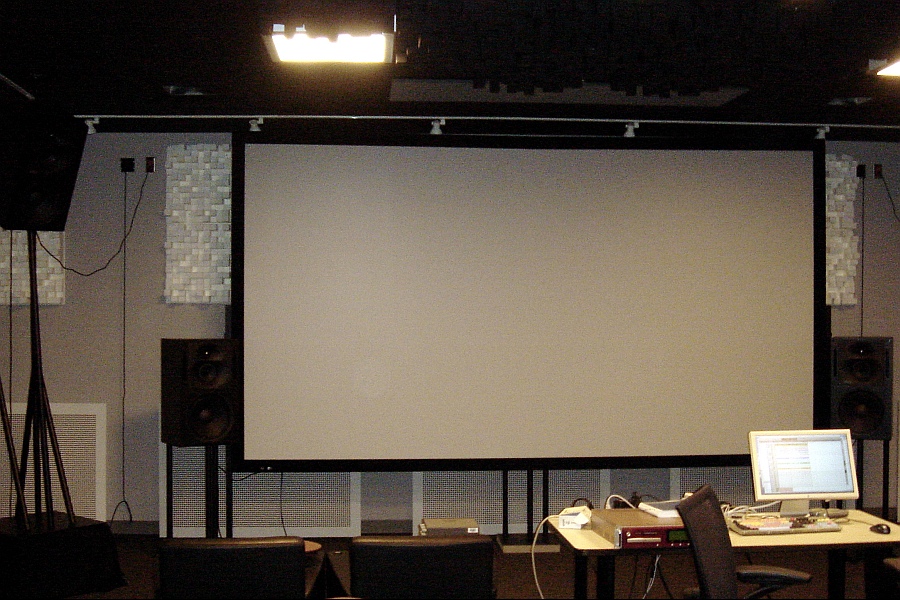
The Front of the Immersive Audio Laboratory Room at USC

7 & 9 Channel Surround Sound with Audyssey Wides
Surrounded by 14 speakers, we got a demonstration of 10.2 channel sound that was quite compelling. By turning off certain channels and repeating simple tracks such as a moving vehicle, we could hear demonstrable differences with the extra channels at work. We had all the dimensions of width, height depth at our disposal, and the location of what we were listening to at the time was never in question. To simply call it superb imaging is an understatement. In order to eliminate what Mr Holman calls cross-modality, (one sense modulating another) the lights are slowly turned down so we heard our sound demonstrations in complete darkness.
The second meeting was held at Audyssey offices a few miles away in the heart of downtown Los Angeles. The essence of both demonstrations was to reveal the same set of underlying facts. Facts gathered throughout hundreds of hours of experiments, all designed to determine how it is we perceive space though cues in sound. It is this formidable amount of data, when analyzed by computer that helps to create the mathematical algorithms used to create the palpable and believable sense of space in multichannel channel surround sound. 10.2, as it is called, is not being touted as an end all and be all in surround sound, but merely as the next viable and economically realizable step. We were given quite a history lesson by Mr Holman. As it turns out, the nomenclature "5.1" was first suggested by Tom in 1987 during an SMPTE (Society of Motion Picture and Television Engineers) digital sound on film subcommittee meeting, where a number of engineers were debating how to partition the resources on optical film and still create a surround sound experience. 5.1 was a new term for describing a pre-existing 6 track split surround format already in use on 70 mm film. This was the MINIMUM number of channels necessary to give a sense of spaciousness. 5.1 was processed to minimize the data needed to encode it on film. It was never intended to be the OPTIMUM number of channels, but rather a compromise. The again, admittedly, 10 discrete channels is not perfect either. So how many is necessary you ask? During our visit to USC, Mr Holman referred to the figure of 30 channels quoted by Jens Blauert in the book "Spatial Hearing". If this sounds a bit extreme, in his book on surround sound Holman also references an English mathematician who suggests 1 million channels would be necessary and a gentleman from AT&T who thought 10,000 would do. I strongly urge all the married guys reading this to make copies for the wife if she starts to complain about speakers taking too much real estate in her living room. As we keep the notion of 10,000 channels in mind (and the wife at bay) we need be mindful of the idea that 10.2 channels appears to be a stop along the way, not the final destination in the surround sound journey. That said, it is far and away a better surround sound experience than what most of us have become accustomed to.
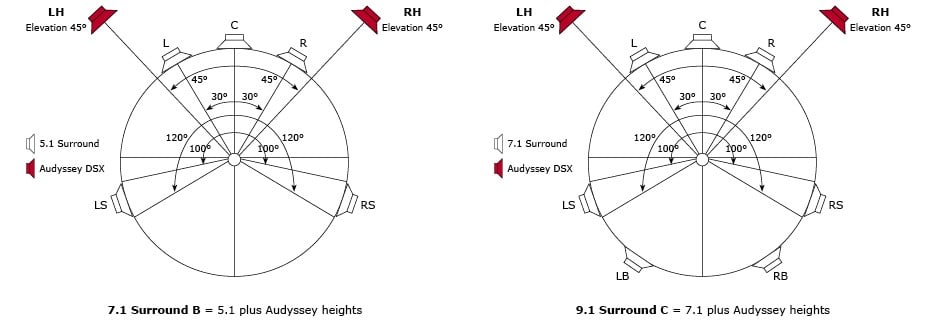
7 & 9 Channel Surround Sound with Audyssey Height Channels
Audyssey has, in addition to a great amount of in house expertise on the subject, some very well founded opinions on the topic of surround sound, and those opinions take life in their standard for 10.2 surround sound. Before I introduce 10.2 as if it were something new, and not simply something new to the market, I would like to point out in Holman's book titled "Surround Sound: Up and Running", he includes a graphical time-line to put Surround sound into historical perspective. This time-line shows the introduction of 10.2 as early as 1996, before the DVD. As Audyssey points out on their website, there are three basic requirements we need to meet in order to attain realistic reproduction of sound.
- Frequency response
- Dynamic Range
- Accurate Spatial Rendering
These three items correlate well with Holman's answer to the question; "What determines the bit rate needed for audio on media?"
- Frequency range
- Dynamic range
- Number of channels
As Mr Holman is quick to point out, any audio engineer confronted with the question, “what do you want to do with a higher bitrate?”; will always ask for more frequency range and more dynamic range because they don't know what to do with more channels. "It's a new paradigm." "Just to go to 192 KHz sampling rate to satisfy passing bats instead of human beings is pretty crazy, but adding channels is of very great value." (For those readers not terribly familiar with flying rodents, bats have an ability to hear ultrasonic frequencies, the kind you can reproduce with a 192 KHz sampling rate). In answer to the question what is 10.2? Mr Holman replies "It is as far as we can push the market without people thinking we are crazy."

10.2 versus 9.1 Surround Sound
Part Two - The 10.2 Room
The basic underlying principles that drive this new 10.2 standard are based on an enormous amount of supporting data, and some elegantly performed experiments, the conclusions of which I will do my best to simplify and summarize here. Many of these are not new concepts, but I will do my best to reiterate them in a logical and reasoned way so that I do not confuse those new to these particular surround sound concepts by misstatement of fact.
1) The front half of the room is more important than the back half!
What is perhaps the most repeated mantra I heard during my visit was how the decision to add 2 rear channels when 7 channel sound offered itself as an improvement over 5 channels is according to Audyssey, a serious error. IF these extra channels are available, they should be added to the front, NOT the rear. Why? Human hearing has far better spatial acuity in the front of us than we do behind us. According to Tom Holman, we can resolve auditory spatial information to about 1 degree in angle in front of us from right to left, (Horizontal plane) and about 3 degrees in height (Vertical plane). Both of these sensitivities are far greater than what we have for sounds coming from behind us. Hence Audyssey's preference of multiple channels in front and sides, and one required for rear channel sound.
2) Width is more important than height!
Width is crucially important in placing instruments and recreating acoustical space. Concert halls with side walls perpendicular to the stage are considered by experts on the subject to be acoustically superior spaces to fan shaped halls. One of the reasons here is the importance of the early reflections from the right and left side walls perpendicular to the stage. In the "fan shaped" concert halls, the splayed side walls did not support the same kind of early reflections and are one of the main reasons these halls are not judged as good by the experts. To quote Mr Holman, "it is known in concert hall acoustics that the first side wall reflection is the single most important reflection direction, it sets the auditory source width... Channels constrained to plus/minus 30 degrees are too narrow for that". For this reason, the DSX standards (7.1, 9.1 and 10.2) support a left wide and right wide channel at plus/minus 60 degrees to reproduce the kind of side wall reflection you would hear if you were seated in a great concert hall. (Note: Those who recall Audioholics' original article on 10.2 may note that the front widths were at 55 degrees, not 60 degrees. According to professor Chris, this small adjustment was made because the difference between the two angles was minimally audible, and "60 degrees is easier to eyeball").
3) If you pan front from the front to the surrounds, it is nearly impossible to get the sound source to appear to go behind you with only the two rear channels at 110 degrees. For this reason and others, 10.2 employs a center back channel, located 180 degrees relative to the listener.
4) Because height is also an important element in recreating acoustic space. (Not as important as width, but important nonetheless) a pair of channels are added at 45 degrees off the center front, and 45 degrees high relative to the listener. A sound source with height can best reproduce reflections from a high ceiling, adding an additional dimension of space to the recording. We were able to listen to some choral music during the hour or so spent in the USC multimedia room, and the high speakers made a dramatic difference in the source height and sense of space.
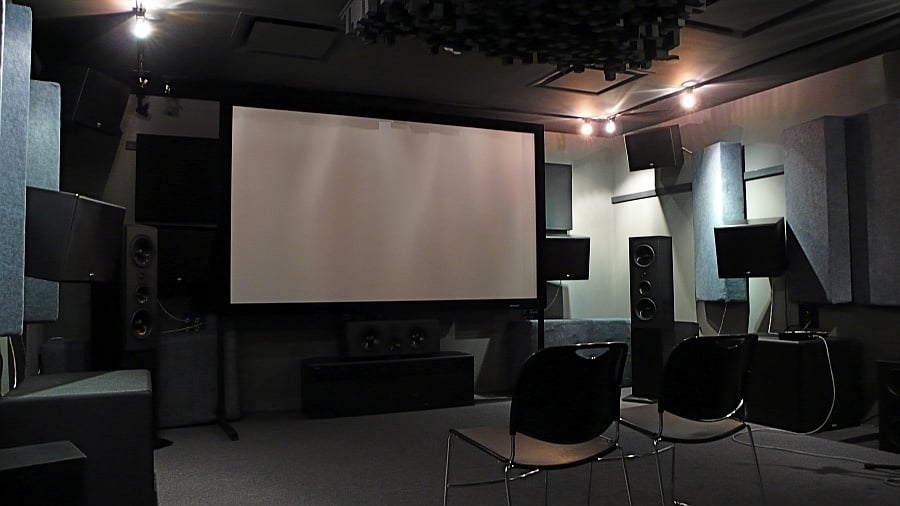
Audyssey's Surround Sound Room
In summary I would like to add one small note. We have all had experiences with surround sound we find both enjoyable and memorable. They all require one common element, musical or dramatic performance. There is little doubt in my mind that these additional channels will not only improve the spaciousness and immersion of the surround sound experience, it will allow greater musical expression by allowing both visual and musical artists to more fully engage the listeners sense of space and direction in the musical or theatrical performance. When all is said and done, this is one very important aim of both Audyssey and 10.2 sound.
What does this all mean for consumers? A quick check of Audyssey's website, which is an excellent resource for information about surround sound standards and practice will reveal that there are already a great many commercially available products which employ Audyssey technologies like MultEQ XT, dynamic EQ and volume. Currently there is only one receiver employing DSX, the Denon AVR-4310CI.. DSX is a scheme for deriving wide channel information from the front channels. The ideal situation would be recordings which encode discrete multichannel sound of course, but it is likely to take years before the recording industry adopts these standards for most recordings of music. Fortunately, ever increasing media density and improvements in bit-rates available will receive pressure from the movie industry for more channels. While audiophiles are interested in higher sampling rates (96 kHz over 44.1 kHz) and greater bit depth (24 bits over 16 bits) extending dynamic range and available frequency response, Audyssey is more interested in adding additional discrete recording channels to the sound for an improvement in the ability of listeners to localize sound in space.
The one big question mark about pushing the confines of audio into truly discrete 5, 7, 9 or even 10 channel sound is the question about the availability of recordings with this discrete information. While Dolby, DTS and THX all have surround sound standards with 5, 6 and even 7 discrete channels, our selection of media is limited to DVD's. While the number of movies with this multichannel information continues to grow, audio only media seems to be stuck in the 2 channel format for the most part.
Editor's Note:
We feel obligated to say that while, in theory, 10.2 seems to be the current epitome of surround sound we have no illusions that this will necessitate or translate into better sound for the average consumer. In fact, it is likely that it will result in quite the opposite. As manufacturers scramble to include more and more speakers for the same price point, quality is almost certain to suffer. This goes double for the front of the room - in which most houses top off at 8 ft ceilings, rendering height channels less useful. The average consumer spends less than $1000 on surround sound and figuring 10 speakers and two subwoofers into that mix is going to lead to some interesting results to say the least. In the final analysis, it is likely that more will not equal better. For the most part we still stick to the axiom that better is better. As for 10.2 - this is likely to get its best reception from high-end cost-no-object theaters,
As it did back in the day when 5.1 changed how we listen to music in the home, movies will be driving the next changes in audio. Our 5.1 channel receivers of today are as sure to be obsolete in another 10 years as was the stereo receiver of 1992. The industry will slowly ramp up, stopping at 7.1 and 9.1 along the way towards the drive to make 10.2 the next defacto standard. Wife acceptance factor of our loudspeaker boxes will become an ever bigger issue as audiophiles move towards the 10 channel realization that if some is good, more is better.
 Subscribe to our newsletter