


Bassaholic Subwoofer Room Size Rating Protocol
Bassaholic Certified logo
Update: 4/2/2024 - new Maximus Room Size Rating!
As part of our new powered subwoofer measurement protocol, we will be offering a room size recommendation for each subwoofer tested. Based on the subwoofer's max CEA output vs frequency and distortion capabilities we measure, it is our goal to provide a reasonable estimate of just how large a room the sub will be suited to play in. Of course a sub capable of playing well in a large room is more than capable of playing well in a small room too, but using a sub with limited output capabilities in a larger room means the sub may not be able to hit reference levels (the loudest intended output playback level) in such a large listening space. This can cause the subwoofer to strain and, in so doing, produce audible levels of distortion which is something that should be avoided if your desired goal is clean and accurate reproduction of music and movies in your home theater. Read on to see if and how your favorite subwoofer will earn our "Bassaholic" recommendation or to figure out how many additional identical subs you'll need to add to your room to achieve it.
In order to determine a subwoofer's room size capabilities, we have to make some reasonable assumptions as outlined below.
How We Measure and Review Subwoofers
Reference Levels & Test Frequency
 The
standard calibration "Reference Level" (RL) is 75dB at the listening
position. The goal is to ensure the
system calibrated at 75dB can hit clean 105 dB peaks for each of the speaker
channels and 115 dB peaks for the LFE channel.
Note that the LFE channel is boosted 10 dB over the speaker
channels. Technically speaking, most
people redirect the bass from other channels to the subwoofer, which in
conjunction with LFE could in theory ask the sub for a 123dB peak signal.
However this is NOT a common scenario and most people don't listen at reference
levels (especially if they value their long term hearing). It is much more
common for A/V enthusiasts to listen between -15 to -10db from reference. Thus
a 115 dB peak at the listening seats in-room is a more realistic benchmark goal
for large rooms. To really stand out, a sub must hit the 123dB mark to earn our "Extreme Bassaholic" rating. Anything higher is icing on the cake of course. Margin is always a good thing.
The
standard calibration "Reference Level" (RL) is 75dB at the listening
position. The goal is to ensure the
system calibrated at 75dB can hit clean 105 dB peaks for each of the speaker
channels and 115 dB peaks for the LFE channel.
Note that the LFE channel is boosted 10 dB over the speaker
channels. Technically speaking, most
people redirect the bass from other channels to the subwoofer, which in
conjunction with LFE could in theory ask the sub for a 123dB peak signal.
However this is NOT a common scenario and most people don't listen at reference
levels (especially if they value their long term hearing). It is much more
common for A/V enthusiasts to listen between -15 to -10db from reference. Thus
a 115 dB peak at the listening seats in-room is a more realistic benchmark goal
for large rooms. To really stand out, a sub must hit the 123dB mark to earn our "Extreme Bassaholic" rating. Anything higher is icing on the cake of course. Margin is always a good thing.
Next we need to determine the test frequency that the sub must hit the 123dB peak at in order to meet our "Extreme Room" goal. CEA burst signals are a reasonably good approximation of how a sub will be stressed with real program material. Since we are using CEA peak SPL data which is measured in 1/3 octave increments, we can either choose anywhere from 20Hz to 63Hz in 1/3rd octave step sizes. The tactile bass we feel and hear happens mostly in the 30-60Hz range. Room gain typically reinforces ultra low end bass frequencies (below 40Hz) - so at first glance, it seems reasonable to average our CEA test data from 25Hz to 63Hz to determine a subwoofer's room size capability.
Annex A of the CEA 2010 standard recommends adding SPL data in dB to average over the critical bands they refer to as "Ultra Low" (20Hz to 31.5Hz) and "Low" (40 to 63Hz). It is mathematically incorrect to average logarithmic based numbers (such as decibels) as it will bias the outcome to the lowest number in the data set. The correct way to average dB's is to first convert them to Pascals (a linear, not logarithmic, measure of pressure) to properly average the data before converting back to dB's. There is a problem averaging like this, however, since our ears don't hear loudness equally for different frequencies. Averaging in Pascals will bias the average to the highest measurement in the data set. Properly averaging in Pascals (Pa) will make a sub with just one good SPL # still have a good average score. Averaging in dB’s (instead of Pascals) will make a sub with just one bad SPL # look bad. This can be seen in the examples tabulated below.
Averaging across a bandwidth using discrete 1/3 octave wide data sets is just not a good idea any way you slice it. The speaker which is flat is going to achieve approximately the same score as one which is mistuned. If you tune too high, you get a bump followed by a quick rolloff. So if you average over too wide a frequency range, this information is obscured. 1/3 octave measurement is already a crude approximation for a sub. If you average that 1/3rd octave data over an even wider range, it just makes it harder to determine the quality of the product or measured data.
| Conversions & Formulas for comparing dB to Pa |
||
| 1 Pa = 94dB | ||
| Pa = [10^(dB/20)]*.00002 | ||
| dB = 20*log[Pa/.00002] | ||
| CEA Average Example (from CEA 2010 Annex A) | |||
| Frequency | Pa | SPL | |
| 20Hz | 0.079621 | 72 dB |
|
| 25Hz | 0.158866 | 78 dB |
|
| 31.5Hz | 0.316979 | 84 dB |
|
| AVG | 0.185155 | ||
| CEA Average | 78 dB | ||
| Actual Average | 79.3 dB |
||
| Example of
Typical Subwoofer |
|||
| Frequency | Pa | SPL | |
| 20Hz | 0.709627 | 91 dB |
|
| 25Hz | 1.588656 | 98 dB |
|
| 31.5Hz | 2.825075 | 103 dB |
|
| AVG | 1.707786 | ||
| CEA Average | 97.3 dB |
||
| Actual Average | 98.6 dB |
||
| Example
of Subwoofer with wide variance |
|||
| Frequency | Pa | SPL | |
| 20Hz | 0.355656 | 85 dB |
|
| 25Hz | 5.023773 | 108 dB |
|
| 31.5Hz | 20 | 120 dB |
|
| AVG | 8.45981 | ||
| CEA Average | 104.3 dB |
||
| Actual Average | 112.5 dB |
||
Comparison of Averaging SPL Data in dB vs Pa
There are two solutions to this problem:
- Use broadband Pink Noise and weight the response using C-weighting to approximate how the human ear perceives loudness
- Take the CEA peak data at 25Hz, and 31.5Hz to 63Hz and verify if the sub is within a set deviation limit at 25Hz with respect to the established Reference level (RL in dB) between 31.5Hz to 63Hz.
Option #1 is not a very good solution since we are testing using CEA burst tones instead of pink noise. The CEA burst tones are far more representative of actual program material and will stress the subwoofer in a more realistic way.
Option #2 is the best option in our opinion provided we set the limits reasonably so that the criteria isn't too difficult or unrealistic to pass, or too easy so that a small sealed sub can meet our Bassaholic room size requirements. We want to set limits so that we can reasonably approximate how a sub will load into a room. More importantly, we don't want to create a way for manufacturers to "game" the system and create subs that will yield good scores, but which only perform well in small frequency ranges.
How Does a Sub Work?
Let’s think about how a subwoofer works. Its critical output region is in the 40-63Hz range. This is where it will play the loudest and where we will perceive and hear the most tactile response, it’s also where most of the low-bass content is in music and movies. Thus it seems reasonable to take the CEA peak data at 31.5 Hz (a more strenuous test frequency than 40-63Hz) and set a tolerance so that the sub must hit reference level from 31.5Hz to 63Hz with no more than - 6dB attenuation at 25Hz. Most subs will always have their max output in the 40-63Hz range and below 31.5Hz the room gain usually compensates for a sub with tapered off response, by boosting the output levels in the very low frequency range.
Hence we will consider the subwoofer critical bandwidth to be 32Hz to 63Hz when determining its room size capabilities.
The sub must not exceed the following deviation limitation criteria to earn a room size recommendation:
- Reference Level (dB) from 31.5Hz to 63 Hz with no greater than -6 dB @ 25 Hz
Room Size Categories
Most home theater spaces are considered to be small when compared to an actual commercial movie theater. However, the goal for a small listening space is no less important for a large listening space. You want to be able to hit reference levels with little to no distortion or compression. The bigger the room, the louder the speaker or subwoofer needs to play to hit reference levels. We have broken up room sizes into four categories which, based on feedback from industry professionals, seems most appropriate.
| Room | Dimensional Volume |
| Small Room | < 1,500 ft^3 |
| Medium Room | 1,500 ft^3 to 3,000 ft^3 |
| Large Room | 3,000 ft^3 to 5,000 ft^3 |
| Extreme Room | > 5,000 ft^3 < 6,500 ft^3 |
| Maximus Room |
> 6,500 ft^3 |
Commonly Specified Acoustical Loads & Associated Output Differences
 |
Full Space = 4 pi steradians This represents radiation into free space, that is in the open with no walls, floor or surfaces nearby. 0 dB reference |
 |
Half Space = 2 pi steradians (commonly specified
speaker load) If you imagine putting a speaker on an infinitely large baffle then the front of the speaker would be radiating into half space. The plane divides all of space into two halves. +6dB SPL increase compared to full space |
 |
Quarter Space = pi steradians Imagine the speaker placed at the intersection of two infinitely large perpendicular planes. Approximated by the intersection of two walls. The two planes divide all of space into four quarters. +12dB SPL increase compared to full space |
 |
Eighth Space = pi/2 steradians (1/8th freespace) Now, imagine the speaker placed at the intersection of three walls, such as in the corner of a room The three planes divide all of space into eight parts. +18dB SPL increase compared to fullspace (not factoring in ceiling contribution of the room) |
Images and definitions courtesy of True Audio
Half space (ie.groundplane) is how Audioholics and most acoustic professionals measure subwoofers. Our measurements are done outdoors to ensure room acoustics don't influence the measurement. We typically don't listen to our subs outdoors so we need a way to translate what we measure outdoors to what can be expected indoors.
In order for the sub to achieve the most output possible indoors, it is assumed the listener will corner-load the sub which puts it into 1/8th the volume as it sees in freespace. Each halving of the sphere the acoustical device sees corresponds to a +6dB increase in SPL assuming distance from the acoustical device to the microphone is held constant and assuming the walls are not lossy while also ignoring any additional room gain factors. Thus corner-loading a sub (1/8th freespace) increases the SPL output +18dB compared to freespace (Full space) and +12dB compared to our groundplane (Half Space) measurement.
Editorial Note about converting 2pi (half space) data to in-room corner loaded (1/8th freespace)
In real rooms the walls are not infinitely long and are also lossy so boundary additions are closer to +3-4dB for each surface added yielding a net gain of +9dB to +12dB for 3 surfaces instead of +18dB theoretical. However, SPL fall off in real rooms is more like 3dB for every doubling of distance instead of 6dB which happens in an anechoic environment. We are being conservative in our SPL derating to add more cushion in our recommendation which reduces the likelihood of overdriving the sub in the intended listening space. Also we do not factor in room gain which is highly dependent on room dimensions and composition and will also help your sub play louder than what can be predicted in our theoretical scenario.
Choosing a Common Subwoofer Distance
So we now know that simply adding +12dB to our outdoor 2 meter peak groundplane SPL data (+9dB for RMS data) will give us an equivalent corresponding corner-loaded room output at 2 meters. Again, this does not factor in any room resonances which varies from room to room depending on room dimensions, position of the listening seats and room furniture, ceiling contribution, and the quality and kind of construction of the room.
It is reasonable to assume the subwoofer will be (on the average) at a fixed distance of 4 meters from the listening area.
So in order for us to translate our 2 meter groundplane data to a corresponding 4 meter corner-loaded approximation, we can simply add 6dB (+12dB for two additional surfaces and -6dB for doubling of distance) to our SPL data. IE. If a sub measures 110dB 2 meter groundplane, the corresponding in-room output if the sub was corner-loaded would be roughly 116 dB at 4 meters.
Determining Subwoofer Room Size Rating
Now that we have made our assumptions and set our desired benchmark goals, let's recap and discuss our procedure going forward.
Recap of Assumptions
- Target reference level is 115dB for large room and 123dB for Extreme room Bassaholic rankings.
- Test
signal is CEA 2010 with RL data centered between 31.5Hz to 63Hz using the following
criteria:
RL (dB) from 31.5Hz to 63 Hz with no greater than -6 dB @ 25 Hz.
- Subwoofer is corner-loaded (1/8th freespace)
- Listening position is 4 meters away
- Boundary Gain from corner loading sub: +12dB compared to groundplane measurement
- Other room gain influences not factored since they are highly variable depending on room dimensions and loading
- Room size de-ratings happen in -6dB intervals for halving of volume which requires a sub with 6dB less output accordingly (Pressure (SPL) is directly proportional to the volume in which it is confined.)
- Adding an additional identical sub corner-loaded will increase system output by +6dB which can upgrade a single sub room size recommendation to a higher level if combined output meets the requirement.
Procedure for Determining Subwoofer Room Size Capability
- Measure the sub 2 meter groundplane outdoors using CEA test bursts
- Translate
CEA 2 meter outdoor groundplane peak SPL data to
4 meter corner-loaded in-room (1/8th free space)
by adding +6dB (+9dB for RMS values)
- If the 4 meter 1/8th freespace SPL equals/exceeds 123dB then the sub is suited for "Extreme" room size
- If the 4 meter 1/8th freespace SPL equals/exceeds 115dB then sub is suited for "Large" room size
- If the 4 meter 1/8th freespace SPL data equals/exceeds 109dB then sub is suited for "Medium" room
- If the 4 meter 1/8th freespace
SPL data is below 103dB then sub is suited for "small" room
Updated Room Size SPL Rating Tables
To make things easy for our readers, we now give you two data tables for SPL and corresponding room size ratings. The first table SPL #s correspond to our 2m RMS measurements of the subwoofer. The 2nd table is 4m peak like we used to present SPL vs room size prior to this revision. We also added a new Maximus rating for HIGH output infrasonic bass levels for both tables. We now also assign a minimum SPL requirement at 20Hz for Large and above room size ratings.
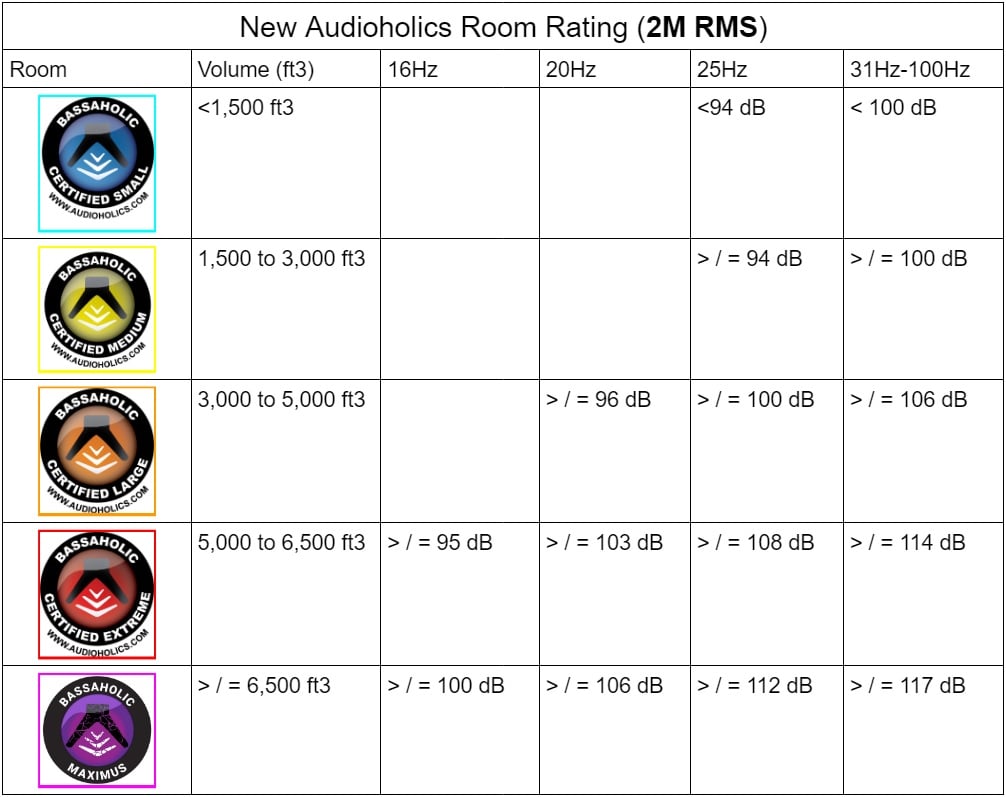
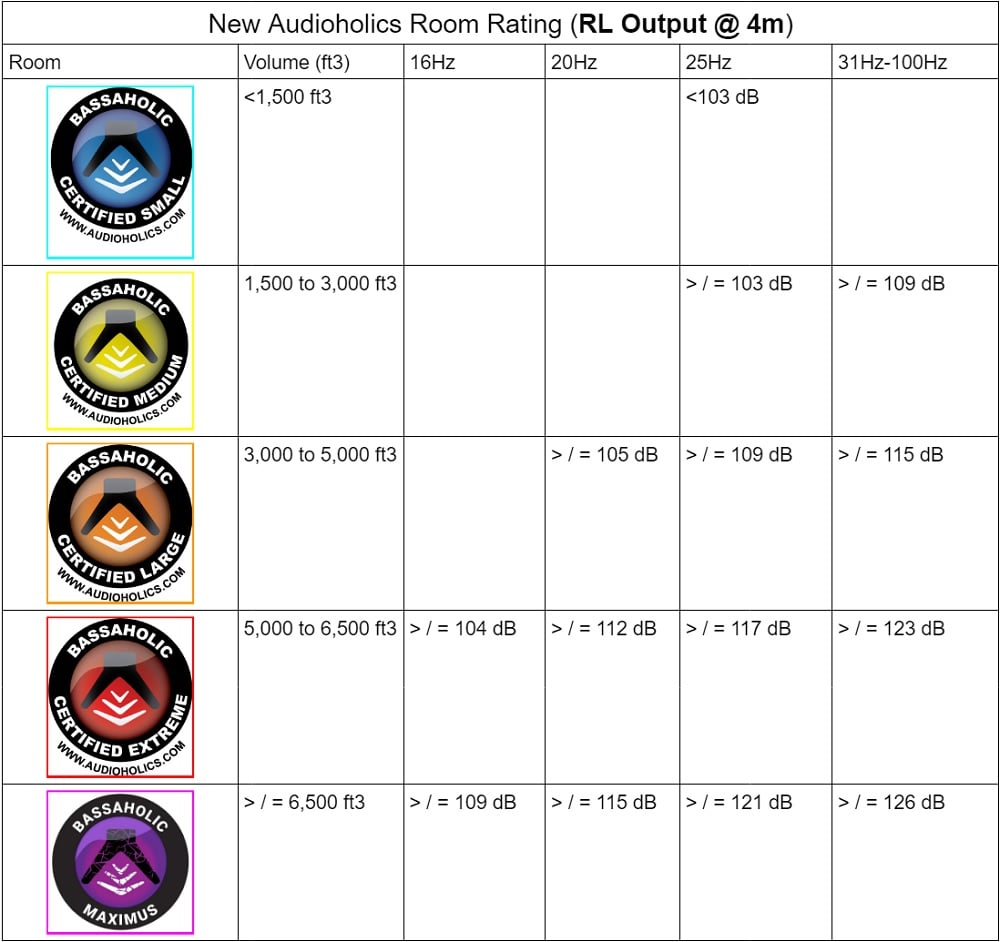
Minimum Targeted Subwoofer Output Criteria vs Room Size
Conclusion
 It is our
hope that the methodology we chose in determining the room size capability for
subwoofers can be a useful general rule of thumb for an end user attempting to
determine which model is right for their listening space. There are obviously too many variables in
making this an exact science, but our test data should certainly help when
attempting to determine just how much output you need in your room to hit
reference levels. These are “rule of
thumb” calculations designed to let you make quick judgments based on a few
numbers.
It is our
hope that the methodology we chose in determining the room size capability for
subwoofers can be a useful general rule of thumb for an end user attempting to
determine which model is right for their listening space. There are obviously too many variables in
making this an exact science, but our test data should certainly help when
attempting to determine just how much output you need in your room to hit
reference levels. These are “rule of
thumb” calculations designed to let you make quick judgments based on a few
numbers.
If a subwoofer gets a "Medium" size room recommendation based on its output capabilities, the end user can always simply add a second identical sub and position it in the opposite corner to achieve up to +6dB (colocated) more output (which at very low frequencies is equivalent to a doubling of loudness). The rule of thumb is for every doubling of identical subs you use and load in the same corner, your overall system response will go up +6dB. However when not placing each sub in the same location, the net output gain will be much less than the theoretical +6dB rule. This is a trade off worth considering if you want the best and most consistent performance. We always recommend multiple subwoofers not just for the potential of more overall output but for the benefits of modal averaging to provide smoother and more consistent bass response from seat to seat. The goal for a great A/V system is lots of clean output and a similarly good listening experience for all listening seats in the room, NOT just the money seat.

Many thanks to Ed Mullen of SVSound, Paul Apollonio and Josh Ricci for their consultation and peer review in developing our new subwoofer room size protocol.
Gene manages this organization, establishes relations with manufacturers and keeps Audioholics a well oiled machine. His goal is to educate about home theater and develop more standards in the industry to eliminate consumer confusion clouded by industry snake oil.
View full profile Subscribe to our newsletter